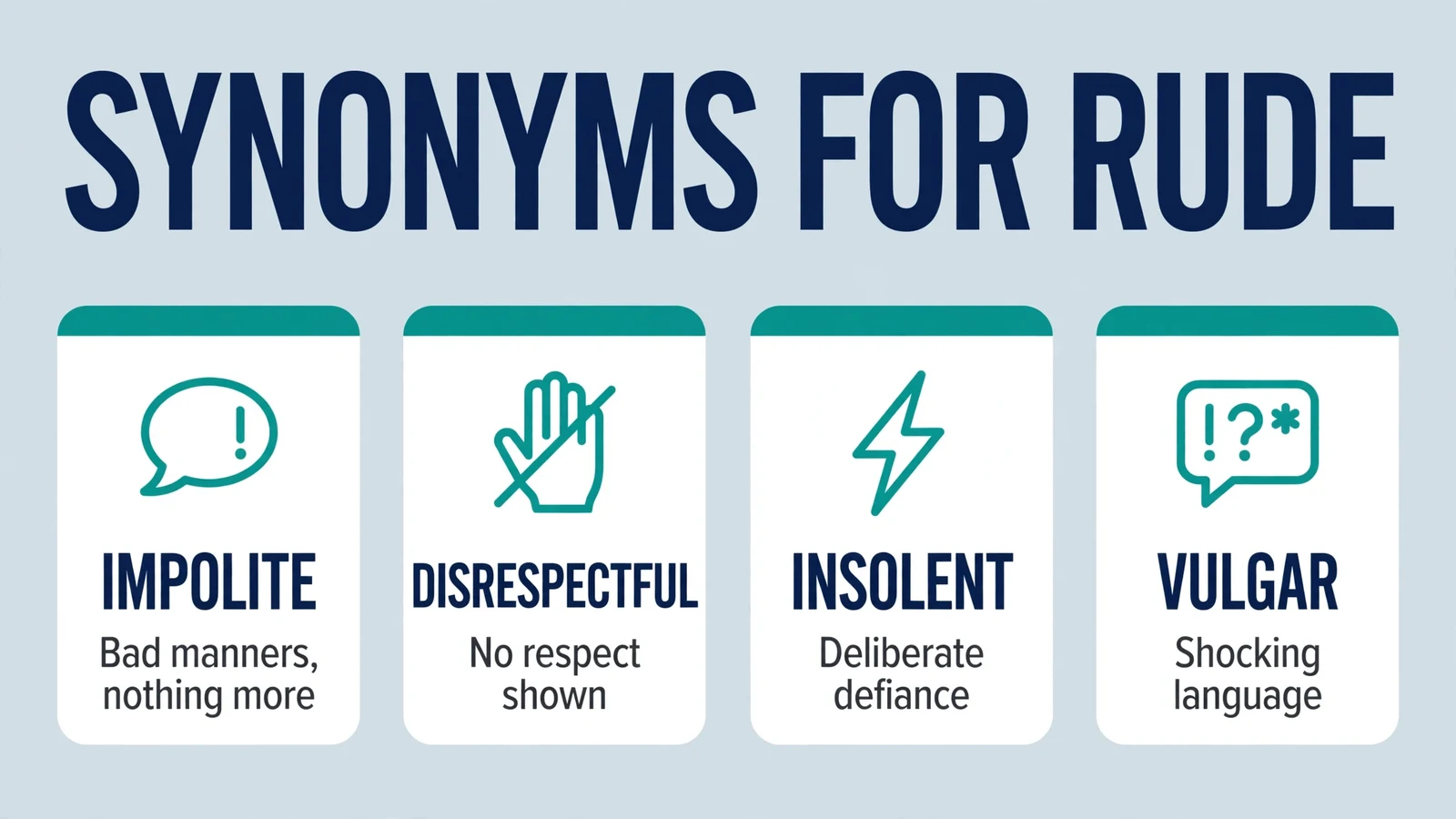
Some behaviour is just a little impolite. Other behaviour stops a room cold. English has a different word for almost every step between those two points, and picking the right one makes your writing sharper and your meaning clearer.
The most useful synonyms for rude are impolite, discourteous, and disrespectful for everyday bad manners; blunt, abrupt, and curt for rude speech; insolent, impertinent, and impudent for deliberate disrespect; and abusive, crude, and vulgar when behaviour turns truly offensive.
This guide sorts 46 verified words into groups by type and strength. You will see what each word really means, where it fits, and where it would overshoot. You will also learn which popular words, such as frank and direct, are not synonyms for rude at all.
Quick Reference: Top Synonyms for Rude at a Glance
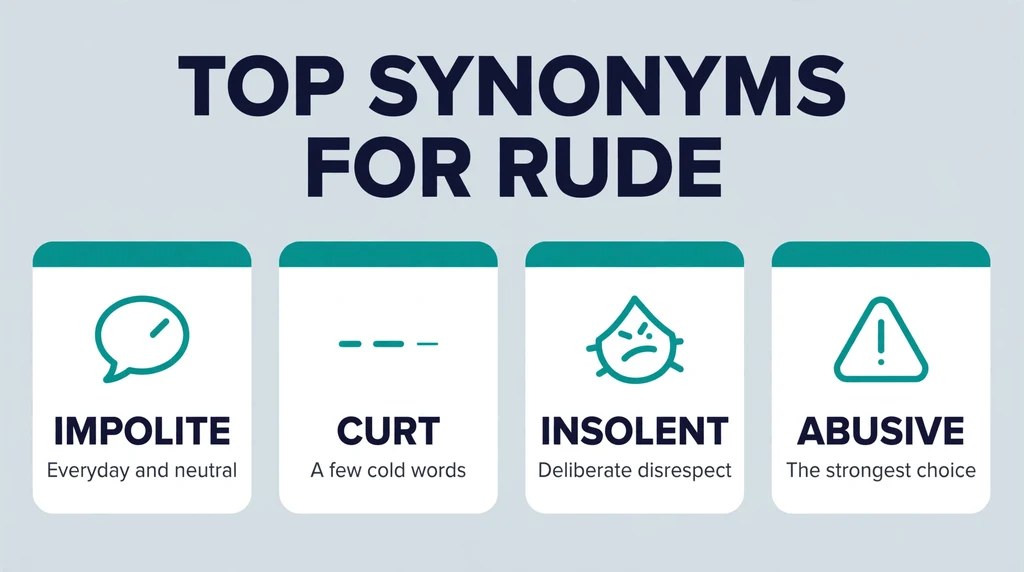
Start here if you need one good word fast. The table below covers the 24 most useful options, from the mildest to the strongest.
| Word | Meaning in one line | Best for / tone |
|---|---|---|
| impolite | Not polite, breaks basic manners | Everyday, neutral |
| discourteous | Lacking courtesy | Formal, written |
| uncivil | Ignores common courtesy | Formal |
| ill-mannered | Shows poor manners | Everyday |
| tactless | Says the wrong thing carelessly | Speech, social slips |
| blunt | Direct to the point of offence | Speech, borderline |
| abrupt | Sudden and short in manner | Speech, replies |
| curt | Very few words, dismissive | Speech, written replies |
| brusque | Quick and unfriendly in speech | Speech, service settings |
| disrespectful | Shows no respect | Everyday, central meaning |
| insolent | Boldly disrespectful on purpose | Behaviour, strong |
| impertinent | Rude in a nosy or presumptuous way | Questions, juniors |
| impudent | Shamelessly bold and disrespectful | Behaviour, children |
| cheeky | Playfully rude, not seriously hostile | UK, light |
| churlish | Surly and ungenerous in manner | Literary, formal |
| insulting | Directly offensive to a person | Remarks, strong |
| abusive | Attacking with words or behaviour | Very strong |
| crude | Gross and primitive in taste | Jokes, language |
| vulgar | Obscene or in very poor taste | Language, formal |
| coarse | Rough, sexual or toilet humour | Language |
| boorish | Badly behaved, no social polish | People, behaviour |
| uncouth | Awkward and unrefined | People, formal |
| loutish | Loud, clumsy and ill-mannered | Behaviour, British |
| offensive | Causes upset or insult | General, strong |
The groups below explain each word properly, with examples. A word that works for a rude email may be far too weak for a rude outburst, so check the group before you choose.
What Does Rude Mean?
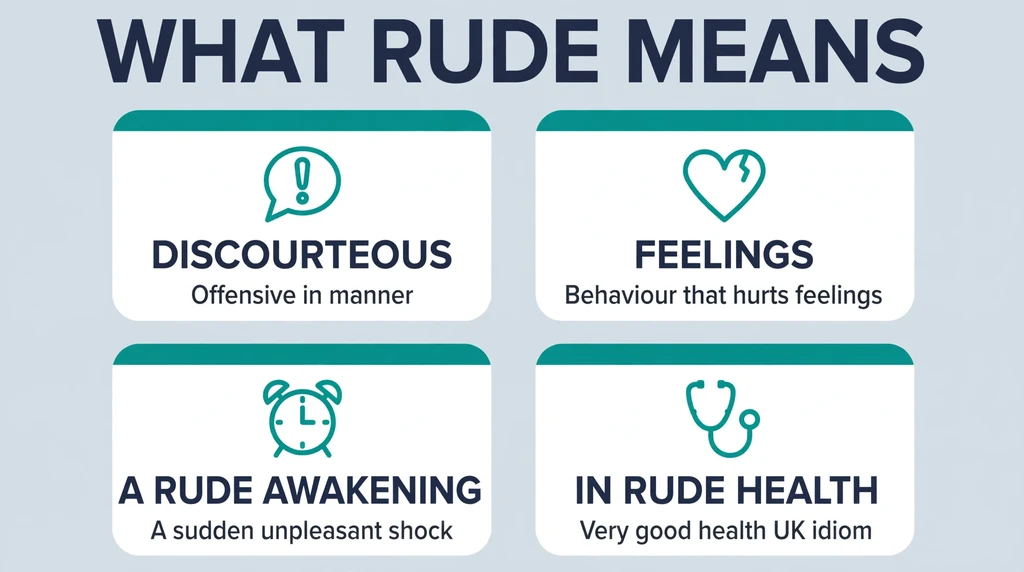
Merriam-Webster defines rude as “offensive in manner or action” and simply glosses it as discourteous. Its example is one almost everyone has lived: “It was rude to keep us waiting.” Cambridge puts the human cost first and calls it behaving in a way that hurts other people’s feelings.
The core idea
At its heart, rude describes a failure of manners. The rude person ignores the small rules that make social life comfortable. They interrupt, they ignore, they mock, or they simply do not consider the other person at all. Merriam-Webster’s thesaurus sums the sense up as showing a lack of manners or consideration for others.
Intent matters, but it is not everything. Some rude behaviour is deliberate, like an insulting remark. Some is careless, like checking a phone through a whole conversation. The synonyms in this guide separate those two kinds, because writers often need one and not the other.
How rude is used: common patterns
Watch the small words around rude and you will see its grammar at work. People are rude to someone: “He was rude to the waiter.” Cambridge also gives the pattern “It is rude to” plus a verb, as in its own example, “It’s rude not to say thank you when you are given something.”
Rude also teams up with a small set of nouns. A rude remark attacks in words. A rude gesture attacks without them. A rude joke or a rude word belongs to the vulgar sense, the one that makes grandparents reach for the soap. When you meet rude in the wild, the noun beside it usually tells you which sense is meant.
Other senses of rude
Rude has a few older meanings that still appear in books and set phrases. A rude shelter or a rude cabin is roughly made, with no finish or polish. Collins lists crude, rough, raw, and simple for this sense, and Cambridge marks it as old use or literary.
You will also meet rude in the phrases a rude awakening and a rude shock. Here it means sudden and unpleasant. The truth arrives without warning, and it is not welcome. Finally, the British idiom in rude health means the opposite of what you might guess. It means very good health.
A short word history
The word has roughness built into its roots. Merriam-Webster traces rude through Anglo-French back to the Latin word rudis, probably related to rudus, meaning rubble. It has been in English since the 14th century. The path from rough rubble to rough manners is easy to follow.
Mild Synonyms for Rude: Impolite but Not Offensive
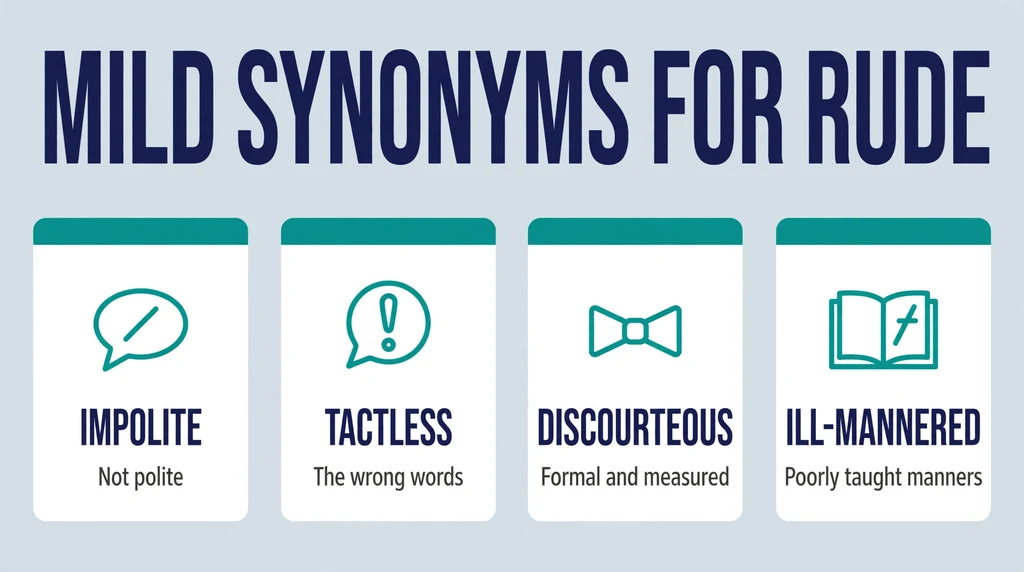
These are the words for everyday bad manners. They criticise behaviour without launching an attack. Most of them are safe in essays, reports, and polite conversation about impolite people.
The everyday words
Impolite is the safest and most neutral choice. It simply means not polite. Thesaurus.com notes that impolite avoids the accusatory, judgmental tone of rude itself, so teachers and parents often prefer it. “It is impolite to point at people” sounds like guidance, not a scolding.
Ill-mannered and bad-mannered point at the same failure from the side of training. They suggest the person was never taught, or never learned, basic manners. Both fit children, guests, and strangers whose behaviour disappoints rather than shocks.
Tactless is slightly different. A tactless person may mean no harm at all. They simply say the wrong thing at the wrong moment, with no thought for feelings. Asking a new colleague about her divorce over lunch is tactless rather than cruel.
The formal words
Discourteous is the formal heavyweight of this group. It means lacking courtesy, and Merriam-Webster uses it as a headword for one whole sense of rude. Hotels, airlines, and official complaints letters reach for it: “We regret that our driver was discourteous to you.”
Uncivil goes a step further toward principle. Thesaurus.com explains that uncivil behaviour ignores common courtesy itself. It sounds serious and slightly legal, which is why it appears in debates about public life and online behaviour.
Unmannerly and mannerless close the group. Both mean without manners. Unmannerly is a little old-fashioned, and mannerless is rare and literary. Writers of historical fiction can use them where impolite would sound too modern.
Mild words in real sentences
Examples make the shades easier to feel. “It was impolite of him to leave without thanking the host” reports a lapse, nothing more. “Her tactless question about his salary silenced the table” shows carelessness, not cruelty.
Formal examples climb one step in tone. “The committee called the letter discourteous and asked for an apology” sounds official. “Drivers who block the crossing are simply uncivil” passes judgment on public behaviour. In each case the criticism lands, but nobody has been called a monster.
Rude in Speech: Blunt, Abrupt, Curt and Brusque
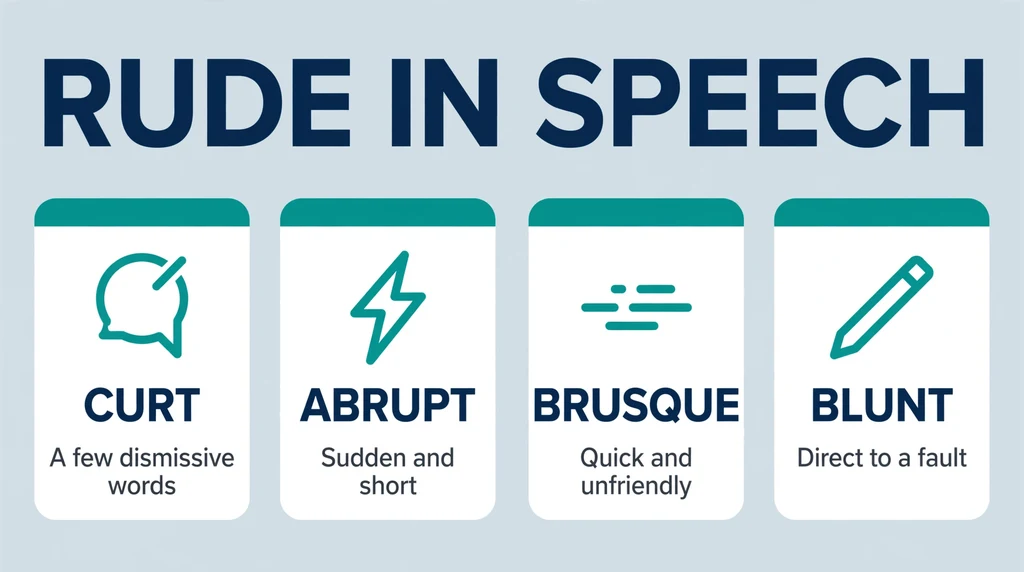
Some rudeness lives entirely in the voice. The words may be few, but the tone does the damage. This group is ideal for describing dialogue, emails, customer service, and anyone whose replies land like a slap.
Short answers and sharp replies
Curt is the classic word for a reply cut down to almost nothing. Collins gives the example, “‘The matter is closed,’ was his curt reply.” A curt answer is not long enough to argue with. It dismisses you, and it means to.
Abrupt describes sudden, short speech that breaks social flow. Collins writes, “He was abrupt to the point of rudeness,” which captures the scale perfectly. Abrupt sits right at the border where efficiency turns into offence.
Short works only in one pattern, but it is a very common one. You are short with someone when your replies are brief and cold. Collins illustrates it with “She was definitely short with me.” Never use short alone to mean rude, or readers will think of height.
Brusque adds unfriendliness to speed. A brusque doctor, official, or shop assistant deals with you quickly and makes sure you feel it. Collins pairs it with busy: “The doctors are brusque and busy.” The word criticises manner, not competence.
Directness pushed too far
Blunt is the borderline word of this whole article, and both Collins and Thesaurus.com list it under rude. A blunt speaker says exactly what they think, with no softening at all. Sometimes that is honesty. Sometimes it is a weapon. Context decides, and the accuracy section below explains the difference in full.
Brash is blunt with extra confidence and noise. Thesaurus.com groups it with people who are overly blunt or aggressive. A brash remark does not just skip the niceties. It performs its own boldness, and everyone in the room notices.
Speech words in real sentences
Put the group to work and the contrasts sharpen. “Asked about the delay, the manager grew abrupt and turned away” shows speech closing down. “His curt email contained four words: the matter is closed” shows a reply designed to end discussion.
Tone decides the rest. “She was short with the salesman, though he had done nothing wrong” reports coldness the speaker may not even have intended. “The brusque nurse was excellent at her job and terrible at comfort” separates skill from manner in one clean line.
Disrespectful Behaviour: Insolent, Impudent and Cheeky
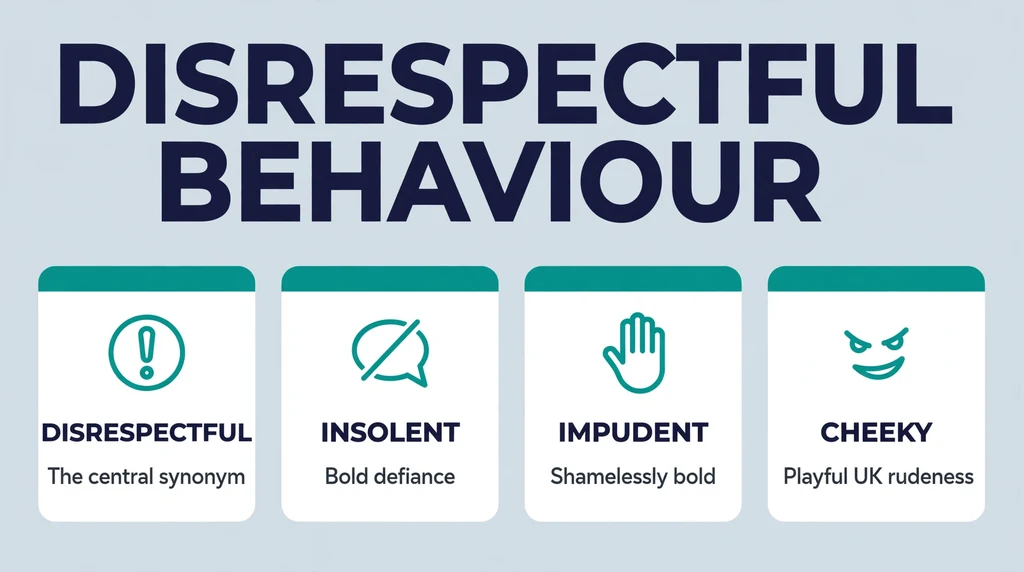
The next step up the ladder is deliberate. These words describe people who know the rules and choose to break them in front of you. Most of them are aimed upward, at parents, teachers, bosses, and officials.
Deliberate disrespect
Disrespectful is the central synonym of the whole entry. Merriam-Webster puts it at the head of the main sense of rude, and Cambridge uses it for a class that turns on a new teacher. If a word must carry the full meaning of rude on its own, this is the safest pick.
Insolent is disrespect with insolence baked in: bold, proud, and meant to wound. Thesaurus.com calls insolent a word for more active, deliberate rudeness. Cambridge’s example is pure family life: “What an ungrateful, insolent child!”
Impertinent targets presumption. The impertinent person asks questions or makes comments above their station, as older writers would say. Cambridge shows students finding a man’s questions impertinent. It is also, usefully, one of the politer words in this group.
Impudent is close to insolent but a touch more shameless than proud. Collins contrasts classroom behaviour with it: some pupils were well behaved, while others were impudent. It often carries a hint of not caring who sees.
Insulting names the result rather than the manner. An insulting remark is built to offend, and Collins uses it for a worker’s remark to a supervisor. Choose it when the words themselves, not the tone, do the harm.
Playful and surly edges
Cheeky needs a warning label. In British English it means rude in a playful, not seriously hostile way. Cambridge’s example is a student asking a teacher her age. A cheeky comment may raise a laugh. An insolent one never does.
Churlish is surly rather than playful. It describes someone who refuses to be pleasant or generous. Collins writes, “It seemed churlish to refuse an offer meant so kindly.” The word has a literary flavour and suits essays and reviews well.
Behaviour words in real sentences
Watch the targets in these examples, because this group aims upward. “The insolent reply earned him a week of detention” belongs to school, where defiance meets authority. “Her impertinent questions about the director’s private life ended the interview” shows presumption crossing a line.
Scale still matters. “It was disrespectful to talk through her speech” fits almost any setting and any age. “His impudent grin made the telling-off worse” adds the shameless flavour that impudent does best. And a cheeky example stays light: “The cheeky banner teased the rival fans, and even they laughed.”
Strong and Offensive Synonyms for Rude
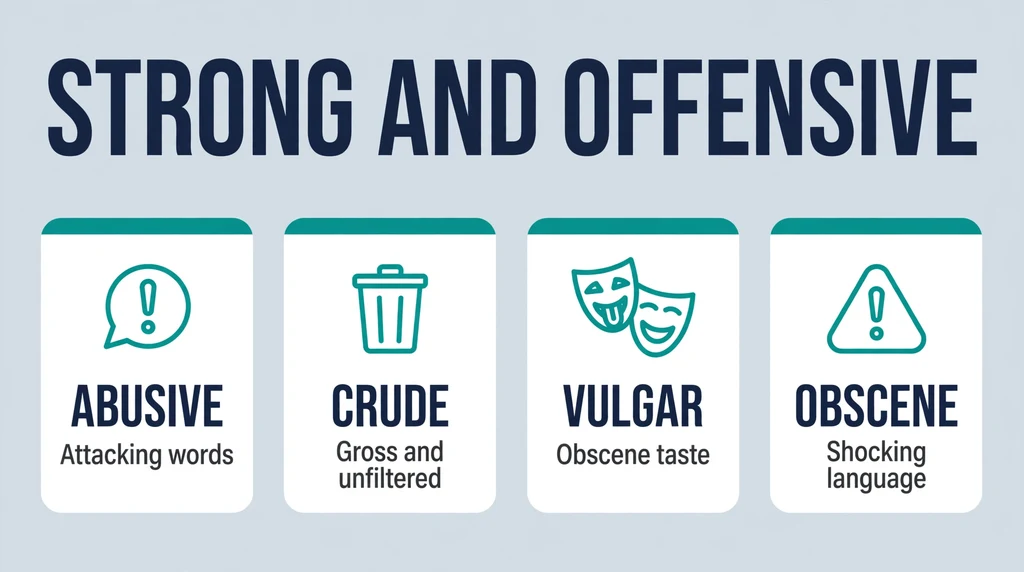
At the top of the ladder, rudeness stops being a manners problem. It becomes an attack, or language that shocks. Use these words carefully. Each one is stronger than plain rude, and some belong to discussions of jokes, gestures, and media rather than people.
Attacks on people
Abusive is the strongest everyday word in this guide. Collins illustrates it with abusive language, and in modern use it often appears in reports of abuse at work or online. An abusive message does not just break etiquette. It attacks the person who receives it.
Offensive is broader. Collins uses it for remarks about minority groups, and Cambridge lists it for upsetting or insulting content. Behaviour, jokes, images, and comments can all be offensive. The word says the material causes offence, without specifying how.
Gross is the informal member of the group. It expresses disgust more than judgment. Collins gives the playground version: “That’s a disgusting thing to say, you’re so gross!” Save it for speech and casual writing.
Rude language and humour
Crude covers thought and behaviour that stay gross, obvious, or primitive. That is Merriam-Webster’s careful wording, and its example is a crude joke. A crude remark is unfiltered rather than targeted, which is why comedians attract the word so often.
Vulgar is the formal heavyweight here. Collins places it under the sense “vulgar or obscene,” and Cambridge marks it disapproving. It fits sexual jokes, gestures, and displays that break public standards of decency.
Coarse sits close to crude but leans toward rough speech and humour about sex or the body. Cambridge groups it with the rude sense of jokes and stories. A coarse laugh or a coarse remark suggests no refinement at all.
Obscene is stronger still, with a legal edge in many countries. It covers language and images so shocking that laws regulate them. Lewd narrows the focus to sexual content presented crudely, as in the lewd remarks Collins apologises for in its example.
Indecent judges behaviour against accepted moral standards. Filthy, which Cambridge marks as offensive, intensifies dirty talk: filthy language is language that disgusts. Dirty itself can mean rude in this sense, and Cambridge labels that use informal.
Two words soften the shock with style. Bawdy belongs to songs, plays, and jokes full of sexual humour, often cheerful rather than nasty. Risqué means slightly indecent and daring. A risqué joke risks offence on purpose, but it usually stays this side of revolting. Smutty, which Cambridge marks as disapproving, tips back toward cheap and dirty.
Words for rude jokes, songs and gestures
Notice the company these words keep. Cambridge illustrates the vulgar sense with a rude joke, a rude story, and a rude gesture made at another driver. In this sense, rude rarely describes a personality. It describes material: the joke, the gesture, the song, the remark. If your sentence is about content rather than character, this group is your home.
Boorish and Uncouth: Rude Without Refinement
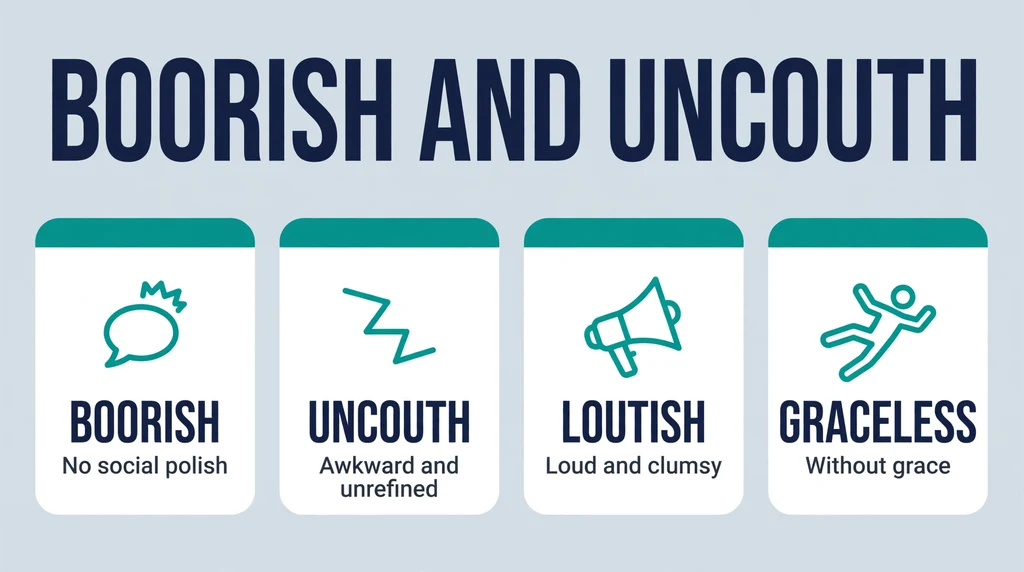
The last group describes people, not moments. These words say that someone lacks polish, training, and social grace as a settled trait. Several are literary or slightly old-fashioned, which makes them powerful in character description.
Boorish is the leader of the group. Thesaurus.com uses it for people who are overly blunt or aggressive, and Collins applies it to the boorish behaviour of sports players. A boor behaves like manners were never invented.
Uncouth suggests awkwardness as much as aggression. The uncouth person does not know how the room works, and it shows. Thesaurus.com even offers uncouth as a more polite way to say rude, which tells you how much softer it can sound.
Loutish and oafish describe heavy, clumsy ill manners. A lout is loud and rough; an oaf is slow and stupid in company. Collins writes of loutish behaviour with dismay and calls an oafish man a lout outright. Both words carry a British flavour.
Graceless is quieter and sadder. It means without grace in movement or manner. Collins gives “his blunt, graceless manner,” a phrase that links clumsiness of style with rudeness of effect.
Rough belongs here too, in the phrase rough manners. Merriam-Webster says rough stresses a lack of polish and gentleness. It is the gentlest word in this group and can even sound forgiving.
The final three are strong and dated, so use them sparingly. Brutish paints behaviour as animal-like. Uncivilized and barbarous come from Collins’s “lacking refinement” sense, and savage joins them there. In modern writing they read as deliberate exaggeration, best kept for fiction and rhetoric.
Boorish words in real sentences
Examples keep these character words honest. “His boorish table manners embarrassed the whole family” judges a pattern, not one bad moment. “The uncouth guest wiped his hands on the tablecloth” shows awkwardness doing the damage.
Stronger colours suit stronger scenes. “A loutish group shouted through the entire train journey” gives noise, size, and manners in a single adjective. “She was graceless in defeat and refused every handshake” turns the word toward sport, where manner after a loss says a great deal about a person.
How to Choose the Right Synonym for Rude
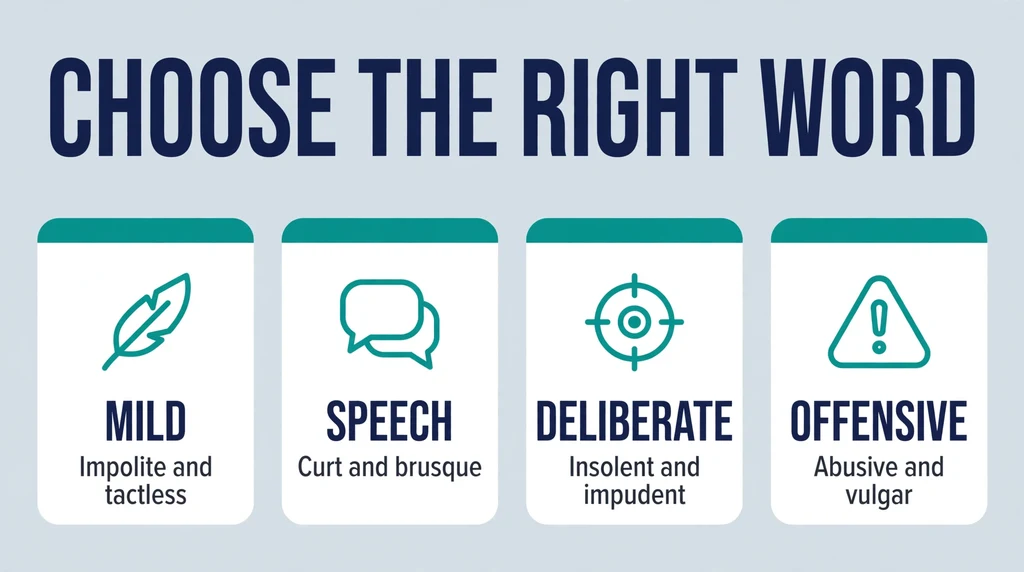
Most weak word choices fail in one direction. The word is either too soft for the behaviour or far too strong for it. Run through three quick questions and the right group usually selects itself.
The intensity ladder
Picture the scale as a ladder with five rungs. At the bottom sit impolite, ill-mannered, and tactless, for slips and lapses. One rung up are the speech words: abrupt, curt, brusque, and blunt. The middle belongs to disrespectful, insolent, and impertinent, where intent is clear. Above them stand insulting and abusive. At the top, crude, vulgar, and obscene describe language that shocks a whole room.
Ask first how much harm was done. A guest who forgets to say thank you is impolite. A guest who mocks the host’s cooking to the table is insulting. The same dictionary family covers both, but the rung is different.
Ask what kind of rudeness it was
Next, ask where the rudeness lived. If it lived in a reply, choose from the speech group. “Her answer was curt” tells a reader far more than “her answer was rude,” because curt shows the shape of the reply.
If it lived in an attitude toward a person, choose from the behaviour group. A student can be insolent to a teacher in a single look. If it lived in a joke, a gesture, or a song, choose from the language group: crude, bawdy, or risqué, depending on the flavour.
Finally, ask whether you are judging a moment or a person. Rude and impolite judge moments well. Boorish, uncouth, and loutish judge the person, and they stick. Use them when the pattern, not the incident, is your subject.
Paired examples
Compare these pairs. “The receptionist was abrupt with every caller” reports short, cold service. “The receptionist was abusive to every caller” reports attacks, and a manager reading it would act very differently.
Or take dialogue in a story. “I have nothing to add,” he said curtly, closes a door. “To be honest, your plan will fail,” she said bluntly, opens an argument. Curt ends conversations; blunt starts them. That is the kind of difference the right synonym buys you.
Quick picker: match the situation
When you are in a hurry, match the scene to the word:
| Situation | Best word |
|---|---|
| A child forgets to say please | impolite |
| A reply cut to a few cold words | curt |
| A worker snaps at customers all day | brusque |
| A pupil defies a teacher on purpose | insolent |
| A nosy question from a stranger | impertinent |
| A joke full of sexual swearing | vulgar |
| A guest attacks others all evening | abusive |
| A manners-free regular at the bar | boorish |
Rude in Writing: Formal, Informal and Professional Use
The best word also depends on the document in front of you. A complaint letter, a school essay, and a group chat each need a different rung of the ladder.
Formal and academic writing
In formal writing, choose discourteous, uncivil, disrespectful, or offensive. These words judge behaviour without sounding emotional themselves. An essay can write that a character treats his servants discourteously, and the tone stays measured.
For language and media, formal writing prefers vulgar, crude, coarse, and obscene. Each has a precise shade, which markers and editors reward. Avoid gross and dirty in this register. They belong to speech.
Examiners also like the literary members of the boorish group. Churlish, uncouth, and graceless add range to an essay, as long as the meaning is controlled. Do not stack three of them in one sentence.
Professional and everyday writing
At work, precision protects you. Report the observable word, not the explosive one. A note that a supplier was curt on the phone is factual. A note that he was abusive is an allegation, and it may need evidence.
In everyday writing, impolite, disrespectful, and blunt do most of the work. Cheeky is perfect for light British contexts, from family stories to sports reports. Save insolent and impudent for behaviour toward authority, where their flavour of defiance makes sense.
Antonyms of Rude
Every synonym above has a polite mirror. Collins lists these opposites for the main sense of rude: polite, courteous, civil, respectful, gracious, cordial, considerate, mannerly, well-bred, decent, urbane, and courtly.
The three you will use most are polite, courteous, and respectful. Polite is the everyday opposite, and our full guide to synonyms for polite collects its whole family in one place. Courteous adds warmth and formality, while respectful stresses regard for the other person’s dignity.
Writers describing warmth rather than manners often need the neighbouring idea of kindness. If that is the direction your sentence is heading, browse the synonyms for kind for gentler options like kind-hearted and considerate.
Notice how the antonyms split just as the synonyms did. Mannerly answers ill-mannered. Gracious answers churlish and graceless. Civil answers uncivil almost letter for letter. Pairing the right opposite with the right offence keeps your contrasts clean.
One more distinction helps in essays. Polite describes behaviour that follows the rules of manners. Courteous adds genuine consideration on top of the rules. A shop assistant can be polite by script and courteous by character. When your sentence praises warmth as well as form, courteous or gracious is the stronger choice.
Not Quite Synonyms: Frank, Honest and Direct Are Not Rude
Here is the mistake this guide most wants to prevent. Frank, honest, candid, and direct are not synonyms for rude, and no major dictionary lists them as such. They describe truth-telling. Rudeness describes discourtesy. The two ideas can meet, but they are not the same thing.
Cambridge defines frank as honest, sincere, and telling the truth, even when this might be awkward or make other people uncomfortable. Its listed synonyms for frank are honest, straight, sincere, and truthful. Read that definition again. A frank person may cause discomfort, but the discomfort comes from the truth, not from bad manners.
Direct works the same way. A direct answer goes straight to the point. It can be delivered kindly, neutrally, or rudely. The word itself judges only the route, never the manners. Honest is even further away: it is a compliment about character.
Where blunt crosses the line
Blunt is where the border truly sits, and the dictionaries prove it. Collins and Thesaurus.com both list blunt among the synonyms of rude. Why? Because blunt speech refuses to soften anything for the listener’s sake. “Your work is not good enough” is blunt. Said with a shrug and no help attached, it becomes rude. Said with care and a plan to improve, it is honest feedback. Same words, different manners.
A related confusion involves the word mean. Rudeness and meanness overlap, but they are not identical. Thesaurus.com makes the point crisply: rude behaviour can be seen as mean, yet a person can be mean while appearing perfectly polite. If cruelty, not manners, is your subject, the guide to synonyms for mean is the better tool.
The practical rule is simple. If the person told an uncomfortable truth with basic respect, write frank, honest, or direct. If they ignored the other person’s feelings or dignity, then reach for the synonyms in this guide.
Frequently Asked Questions
What is the best synonym for rude?
For most sentences, disrespectful and impolite cover the ground best. Disrespectful carries the full force of rude and suits behaviour aimed at a person. Impolite is softer and safer, and it suits lapses in manners. Choose between them by asking how deliberate the behaviour was.
What is a stronger word for rude?
Insolent and impertinent are stronger when the rudeness is deliberate and aimed at authority. For outright attacks, abusive is stronger still. For shocking language, crude, vulgar, and obscene outrank rude by a wide margin. Match the stronger word to the kind of harm, not just its size.
What is a more polite word for rude?
Impolite is the classic polite alternative, because it states the fact without the sting. Thesaurus.com also suggests impertinent, uncouth, and discourteous as ways to soften the charge. In a workplace note, discourteous is often the most professional choice of all.
Is blunt the same as rude?
Not quite. Blunt means direct and unsoftened, and it can be honest rather than hostile. However, Collins and Thesaurus.com both list blunt among the synonyms of rude, because blunt speech ignores the listener’s feelings. Tone, setting, and intent decide which side of the line it falls on.
What is the difference between rude and mean?
Rude is about manners: interrupting, mocking, ignoring, or insulting within social rules. Mean is about cruelty of intent. The two overlap when rude behaviour is meant to hurt, but a person can also be mean in a calm, polite voice. Rudeness breaks etiquette; meanness breaks kindness.
Can rude describe something that is not a person?
Yes. A rude joke or a rude gesture uses the sense of vulgar or obscene. A rude awakening means a sudden, unpleasant surprise. Older writing also uses rude for things roughly made, like a rude shelter of branches. Context tells the reader which sense is active.
What is a professional way to say someone was rude in a report?
Describe the behaviour with the mildest accurate word and one concrete detail. Discourteous, abrupt, and dismissive in tone are the usual professional choices. “The agent was discourteous to two callers” is report-ready. Words like abusive belong in a report only when the behaviour truly attacked someone.
What is the opposite of rude?
The everyday opposite is polite. Courteous, civil, respectful, and gracious are the other common choices, and Collins lists all of them against rude. For a deliberate contrast in an essay, pair the offence precisely: civil against uncivil, mannerly against ill-mannered, gracious against churlish.
Final Thoughts
Rude is a small word doing heavy work. Behind it stands a whole ladder, from the tactless slip to the abusive outburst, and each rung has a name. Impolite and discourteous handle everyday lapses. Curt, abrupt, and brusque capture rudeness in speech. Insolent and impudent mark deliberate disrespect, while crude and vulgar take over when language itself offends.
Keep the accuracy rule close as well. Frank, honest, and direct describe truth, not bad manners, and your writing stays fair when you keep them apart. When you want to check any of these words against the dictionary itself, the Merriam-Webster Thesaurus entry for rude is the natural place to start.
Choose the rung that matches the harm, and your sentence will land exactly as hard as it should.