Have you ever written an email, an essay, or a social media caption and realized you used the same word three times in two sentences? It happens to everyone. You know there is a better word somewhere, but you cannot quite find it. That frustration is exactly why understanding the synonyms of apathy matters. Choosing the right word transforms vague writing into clear, powerful communication. This guide helps you move beyond basic vocabulary and select the precise word for every situation. Whether you are drafting a business report, writing a college essay, or simply trying to sound more natural in conversation, knowing your options makes all the difference.
What Are the Best Synonyms of “Apathy”?
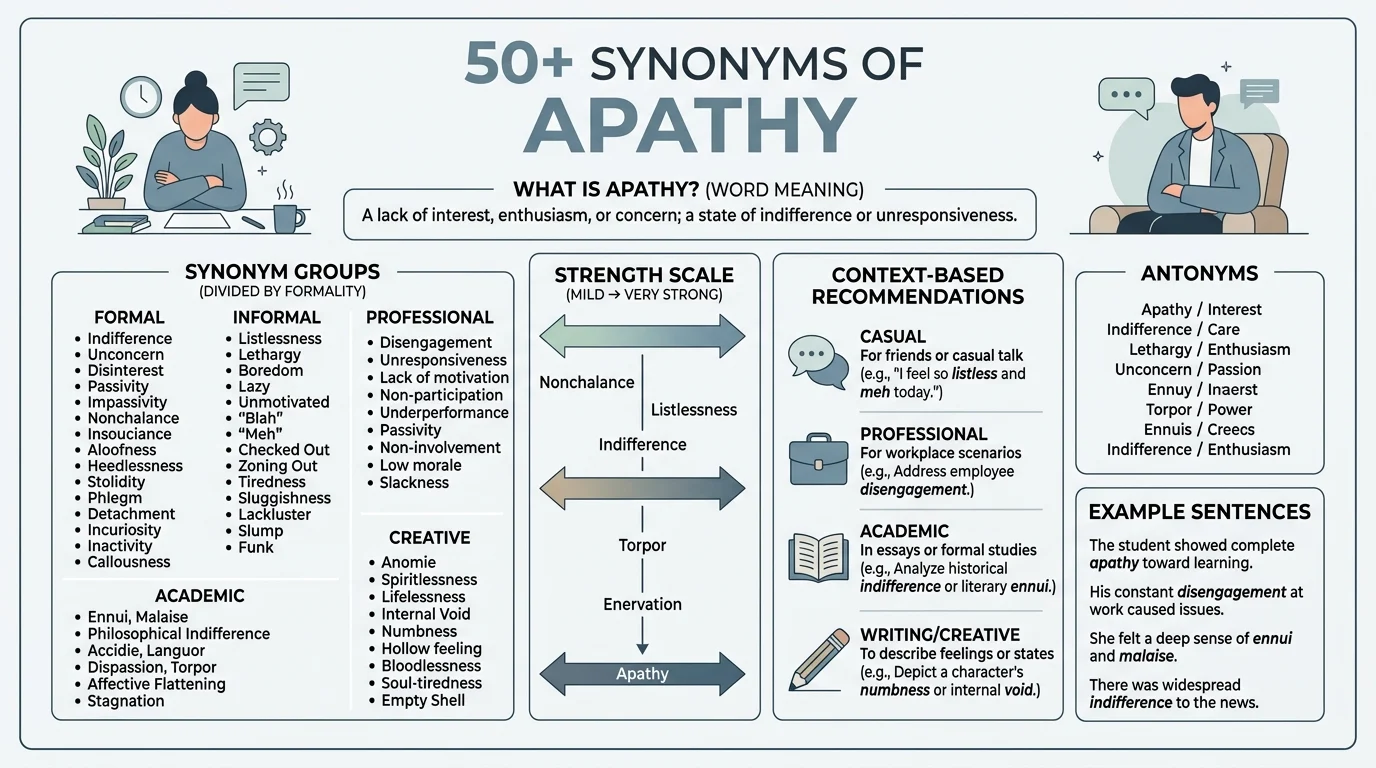
Apathy means a lack of interest, enthusiasm, or concern. The best synonym depends on your context. Formal writing, use indifference or dispassion. For casual conversation, try unconcern or nonchalance. For professional settings, detachment works well. Emotional writing, listlessness or passivity are stronger choices.
Meaning, Tone, and Context
Simple Definition
Apathy is the state of not caring. It describes a lack of interest, emotion, or concern about things that typically matter to others. People experiencing apathy show little energy and很少主动采取行动.
Part of Speech
Apathy is a noun. The adjective form is apathetic. The adverb form is apathetically.
Overall Tone
Apathy is negative in most contexts. It suggests disengagement, indifference, or emotional numbness. In some clinical or philosophical discussions, it can be neutral, describing a state of emotional detachment rather than a moral failing.
Formality Level
Apathy is neutral to semi-formal. It appears in academic writing, journalism, professional reports, and everyday conversation. It is not slang and works in almost any context.
Common Uses
Native English speakers use apathy most often in discussions about:
- Politics (voter apathy)
- Education (student apathy)
- Workplace engagement (employee apathy)
- Mental health (depression and apathy)
- Social issues (public apathy toward important problems)
Word Forms
| Form | Word |
|---|---|
| Noun | apathy |
| Adjective | apathetic |
| Adverb | apathetically |
| Opposite (noun) | passion, enthusiasm, concern, interest |
When and How to Use “Apathy”
Choose apathy when you want to describe a significant lack of interest or emotional response. It works best when the lack of concern is notable enough to be a problem or a notable characteristic. Here are seven realistic examples.
Professional
The team’s apathy toward the new project timeline delayed our launch by two weeks.
Academic
Researchers observed widespread apathy among students who felt disconnected from the curriculum.
Workplace
Employee apathy has become a serious concern after three rounds of layoffs.
Personal
His apathy about planning the vacation frustrated everyone else in the group.
I am concerned about the apathy I am seeing regarding the upcoming deadline.
Resume
I noticed a growing apathy in the department and took the initiative to organize weekly check-ins to reengage the team.
The apathy surrounding this issue is exactly why we need to speak up now.
Best Synonyms of “Apathy”
No synonym is identical in every situation. The right word depends on your audience, your tone, and what you want to emphasize. Here are the best synonyms for specific contexts.
Professional Writing
Choose detachment. It sounds composed and objective without being overly emotional. It suggests a deliberate choice to remain separate from a situation.
Her professional detachment allowed her to make difficult decisions without bias.
Academic Writing
Choose indifference. It is precise, widely understood, and carries the formal tone expected in research papers and scholarly articles.
The study measured voter indifference across demographic groups.
Business Communication
Choose unconcern. It clearly communicates a lack of worry or interest without sounding clinical.
The board’s unconcern about customer feedback cost us market share.
Casual Conversation
Choose nonchalance. It has a lighter, more conversational feel and suggests a relaxed attitude rather than a deep emotional void.
She shrugged with total nonchalance when I told her the news.
Emotional Writing
Choose listlessness. It conveys a lack of energy and enthusiasm, making it ideal for describing emotional or physical exhaustion.
The listlessness in his eyes told me he had given up hope.
Creative Writing
Choose torpor. It adds a literary, almost poetic quality and suggests a state of inactivity or sluggishness.
The summer heat settled over the town like a torpor that dulled every ambition.
Resume Writing
Choose disengagement or describe the lack of apathy you overcame. Frame it as a challenge you addressed.
I identified widespread disengagement in my department and implemented a recognition program that boosted participation by 40 percent.
Workplace Communication
Choose passivity. It highlights a lack of initiative and action, which is often the most visible symptom of apathy in a work setting.
The team’s passivity during the planning phase forced management to step in.
Stronger Meaning
Choose indifference. It is the strongest and most direct synonym for apathy, carrying a clear sense of not caring at all.
Softer Meaning
Choose disinterest. It suggests a mild lack of interest without the emotional weight of apathy. It is less severe and more forgiving.
When Not to Use “Apathy”
Apathy is not always the best choice. Here are situations where you should choose a different word.
The Word Sounds Too General
If you need to describe a specific type of lack of interest, apathy may be too broad.
Incorrect: His apathy about the movie was obvious.
Better: His disinterest in the movie was obvious.
Why: Disinterest is more specific to a single topic, while apathy suggests a broader, more general state.
The Word Sounds Too Vague
If you need to describe a lack of energy rather than a lack of caring, apathy misses the mark.
Incorrect: The apathy in the room was palpable.
Better: The lethargy in the room was palpable.
Why: Lethargy describes physical or mental sluggishness, which is more precise when energy is the issue.
When the Word Sounds Too Formal
In casual conversation, apathy can sound stiff or overly academic.
Incorrect: I have apathy about where we eat dinner.
Better: I do not care where we eat dinner.
Why: In everyday speech, simple language sounds more natural.
When the Word Sounds Too Weak
If the situation involves active disregard rather than passive lack of interest, apathy is not strong enough.
Incorrect: The manager’s apathy toward safety violations was concerning.
Better: The manager’s disregard for safety violations was alarming.
Why: Disregard implies active neglect, which is stronger than mere lack of interest.
The Word Sounds Too Strong
If you only mean a mild lack of enthusiasm, apathy is excessive.
Incorrect: I feel apathy about trying the new restaurant.
Better: I feel lukewarm about trying the new restaurant.
Why: Lukewarm suggests mild interest without the weight of apathy.
The Word Sounds Outdated
Apathy is not outdated, but in very informal contexts, simpler words work better. Use “do not care” or “not interested” in text messages and casual chats.
Words Commonly Confused With “Apathy”
Apathy vs Indifference
Difference: Apathy is stronger and suggests a deeper emotional void. Indifference can be a temporary state or a mild reaction.
When to Use It: Use indifference when the lack of concern is mild or situational. Use apathy when it is profound and persistent.
Example (Apathy): His apathy toward his own future worried his parents.
Example (Indifference): She showed complete indifference to which restaurant they chose.
Apathy vs Detachment
Difference: Detachment suggests a deliberate emotional distance. Apathy suggests a lack of emotion that may not be chosen.
When to Use It: Use detachment when someone has intentionally separated themselves emotionally. Use apathy when someone simply does not care.
Example (Detachment): The therapist maintained professional detachment during the session.
Example (Apathy): His apathy made it impossible to motivate him.
Apathy vs Disinterest
Difference: Disinterest is milder and often specific to a topic. Apathy is broader and more severe.
When to Use It: Use disinterest for a specific lack of curiosity. Use apathy for a general lack of concern.
Example (Disinterest): Her disinterest in sports was well known.
Example (Apathy): Voter apathy threatened the election’s legitimacy.
Apathy vs Lethargy
Difference: Lethargy focuses on physical or mental sluggishness. Apathy focuses on emotional and motivational lack.
When to Use It: Use lethargy when describing tiredness or low energy. Use apathy when describing lack of concern.
Example (Lethargy): The medication caused lethargy and drowsiness.
Example (Apathy): The staff’s apathy toward customer complaints was unacceptable.
Apathy vs Passivity
Difference: Passivity describes a lack of action or resistance. Apathy describes a lack of interest or concern. Passivity can exist without apathy.
When to Use It: Use passivity when someone fails to act. Use apathy when someone does not care enough to act.
Example (Passivity): The board’s passivity allowed the problem to grow.
Example (Apathy): Voter apathy kept turnout below 30 percent.
Apathy vs Stoicism
Difference: Stoicism is a deliberate philosophy of enduring hardship without complaint. Apathy is a lack of feeling, not a chosen response.
When to Use It: Use stoicism when someone chooses not to show emotion. Use apathy when someone does not feel emotion.
Example (Stoicism): He faced the diagnosis with stoicism and quiet strength.
Example (Apathy): She faced the news with apathy, as if it did not matter.
Best Synonyms of “Apathy” by Context
| Context | Best Synonym | Why It Works | Example |
|---|---|---|---|
| Formal writing | Indifference | Precise and widely accepted in academic and professional contexts | The data revealed a pattern of indifference among participants. |
| Academic writing | Dispassion | Suggests objectivity and lack of bias | Scientific inquiry requires dispassion toward personal beliefs. |
| Professional communication | Detachment | Implies composed, objective distance | Her detachment allowed her to mediate the dispute fairly. |
| Business emails | Unconcern | Clear and direct without being harsh | I am troubled by the team’s unconcern about the budget shortfall. |
| Resume writing | Disengagement | Professional term for lack of involvement | I addressed widespread disengagement by launching a mentorship program. |
| Workplace communication | Passivity | Highlights inaction and lack of initiative | The department’s passivity delayed the project by three months. |
| Casual conversation | Nonchalance | Light, conversational, and relaxed | He replied with total nonchalance when I asked about the deadline. |
| Everyday speaking | Do not care | Simple, natural, and direct | I honestly do not care which movie we watch. |
| Creative writing | Torpor | Literary and evocative | A deep torpor settled over the household after the news. |
| Storytelling | Listlessness | Conveys emotional exhaustion and hopelessness | The listlessness in her movements told me she had given up. |
| Emotional writing | Emptiness | Powerful and evocative of emotional void | The emptiness he felt was worse than any sadness. |
| Strong emphasis | Indifference | The strongest and most direct synonym | His indifference to her suffering was shocking. |
| Mild tone | Disinterest | Soft and forgiving | She showed only mild disinterest in the topic. |
| Social media captions | Meh | Informal, trendy, and relatable | My reaction to the news: meh. |
How to Choose the Best Synonym of “Apathy”
Choosing the right synonym comes down to five questions.
1. What is your audience?
For a boss or professor, choose indifference or detachment. For friends, choose nonchalance or simply say “do not care.”
2. What tone do you want?
Formal tone, use dispassion or indifference. For casual tone, use unconcern or nonchalance. For emotional tone, use listlessness or emptiness.
3. How strong should the word be?
Mild lack of interest, use disinterest or lukewarm. For moderate lack of concern, use unconcern or nonchalance. For strong lack of emotion, use indifference or apathy itself.
4. What is the writing purpose?
For academic writing, prioritize precision. Creative writing, prioritize imagery. For business writing, prioritize clarity. Personal writing, prioritize authenticity.
5. What sounds most natural?
Read your sentence aloud. If the synonym sounds forced or overly formal, choose a simpler word. Natural language always wins.
Real Life Examples of “Apathy”
School
The teacher noticed a growing apathy in her classroom. Students who once participated actively now stared blankly at their desks.
College
College freshmen often experience apathy during their second semester when the novelty wears off and the workload piles up.
Workplace
After the merger announcement, apathy spread through the office. No one wanted to start new projects when their jobs might disappear.
Business
The CEO mistook employee apathy for loyalty. In reality, people had simply stopped caring enough to voice concerns.
Subject: Urgent – Lack of Engagement. I am writing to address the apathy I have observed regarding our quarterly goals. We need to act now.
Resume
Identified and reversed team apathy by introducing weekly recognition awards, resulting in a 25 percent increase in productivity.
Conversation
“Why did you not respond to my message?” “Honestly, apathy. I just did not have the energy to reply.”
Storytelling
The village had fallen into a kind of apathy. No one repaired the broken fountain. No one painted the faded shutters. Life simply continued without purpose.
Blogging
The apathy I see in my industry is alarming. Too many professionals have stopped learning, stopped growing, and stopped caring about excellence.
Apathy is the real enemy of progress. If you care about this issue, show up. Speak up. Do something.
18 Best Synonyms of “Apathy”
| Synonym | Simple Meaning | Best Used For | Example Sentence |
|---|---|---|---|
| Indifference | Lack of concern or interest | Strong, direct statements | His indifference to the suffering of others was disturbing. |
| Unconcern | Lack of worry or interest | Professional and everyday use | The manager’s unconcern about safety issues was irresponsible. |
| Detachment | Emotional distance, often deliberate | Professional and clinical contexts | She maintained a healthy detachment from office politics. |
| Disinterest | Mild lack of curiosity or interest | Casual and specific situations | His disinterest in fashion was obvious from his wardrobe. |
| Nonchalance | Casual lack of concern, relaxed attitude | Conversation and informal writing | She accepted the criticism with surprising nonchalance. |
| Passivity | Lack of action or resistance | Workplace and behavioral descriptions | The board’s passivity allowed the crisis to escalate. |
| Listlessness | Lack of energy and enthusiasm | Emotional and descriptive writing | The heatwave left everyone in a state of listlessness. |
| Lethargy | Physical or mental sluggishness | Medical and health-related contexts | The illness caused lethargy and loss of appetite. |
| Torpor | State of inactivity or dormancy | Literary and creative writing | The town sank into a winter torpor that lasted for months. |
| Dispassion | Lack of emotion, objectivity | Academic and scientific writing | The judge’s dispassion ensured a fair trial. |
| Insouciance | Casual lack of concern, carefree attitude | Lighthearted or ironic contexts | He faced the deadline with insouciance that amazed his coworkers. |
| Impassivity | Lack of emotional response | Clinical and psychological descriptions | Her impassivity made it hard to read her true feelings. |
| Disregard | Active neglect or ignoring | Stronger than apathy, implies willful ignoring | His disregard for the rules got him fired. |
| Coolness | Emotional reserve or lack of warmth | Describing interpersonal distance | The coolness between them was uncomfortable. |
| Emptiness | Emotional void or hollowness | Deeply emotional or poetic writing | She felt an emptiness that no amount of success could fill. |
| Numbness | Inability to feel emotion | Trauma or shock contexts | After the accident, he experienced emotional numbness. |
| Stolidity | Lack of emotion, unresponsiveness | Literary and descriptive contexts | His stolidity in the face of tragedy was remarkable. |
| Acedia | Spiritual or existential apathy | Literary, religious, or philosophical contexts | The monk struggled with acedia, a loss of spiritual purpose. |
Synonyms of “Apathy” by Usage
Professional vs Personal Synonyms
Professional (workplaces, business, formal settings):
detachment, dispassion, unconcern, passivity, disengagement
Personal (conversations, social media, casual writing):
nonchalance, do not care, meh, disinterest, insouciance
Formal vs Conversational Synonyms
Formal (reports, essays, business writing, presentations, emails):
indifference, dispassion, detachment, unconcern, impassivity
Conversational (casual conversations, texting, social media):
nonchalance, do not care, meh, disinterest, insouciance
Academic Synonyms
For research papers, essays, reports, and academic discussions, choose precise vocabulary that sounds authoritative.
- Dispassion suggests objectivity and freedom from bias
- Indifference is the standard academic term for lack of concern
- Impassivity describes a lack of emotional responsiveness
- Unconcern is clear and widely accepted in social science writing
These words sound more authoritative because they are common in peer-reviewed journals and scholarly publications.
Professional and Business Synonyms
For resumes, interviews, meetings, presentations, performance reviews, client communication, and business emails:
- Detachment suggests composure and objectivity
- Disengagement is the standard HR term for lack of involvement
- Passivity highlights inaction and lack of initiative
- Unconcern clearly communicates a lack of worry or interest
These words fit professional settings because they sound composed, objective, and businesslike.
Creative and Literary Synonyms
For storytelling, fiction, poetry, descriptive writing, and speeches:
- Torpor adds a literary, poetic quality
- Listlessness conveys emotional exhaustion
- Emptiness evokes deep emotional void
- Acedia adds a philosophical or spiritual dimension
- Stolidity suggests unshakeable calm or numbness
These alternatives add emotion and imagery that plain language cannot achieve.
Slang or Modern Synonyms
Apathy does not have many established slang equivalents, but these informal alternatives are common in modern English.
- Meh expresses mild indifference or lack of enthusiasm. Acceptable in text messages, social media, and very casual conversation. Avoid in professional or academic writing.
- Could not care less is a common phrase expressing complete indifference. Works in casual speech but is too informal for professional contexts.
- Whatever conveys dismissive indifference. Common in casual conversation but can sound rude or disrespectful.
Strongest to Mildest Synonyms
Mild → Moderate → Strong → Very Strong
| Intensity | Synonyms |
|---|---|
| Mild | disinterest, lukewarm, meh |
| Moderate | unconcern, nonchalance, insouciance, detachment |
| Strong | indifference, passivity, listlessness, lethargy |
| Very Strong | apathy, disregard, numbness, emptiness, torpor |
Emotional intensity increases as you move down the scale. Mild synonyms suggest temporary or situational lack of interest. Very strong synonyms suggest deep, persistent, or profound emotional voids.
Emotional vs Neutral Synonyms
Emotional Synonyms (express stronger feelings):
- listlessness (suggests exhaustion and hopelessness)
- emptiness (suggests a profound void)
- numbness (suggests trauma or shock)
- torpor (suggests inactivity and dullness)
- acedia (suggests spiritual or existential crisis)
Use these when you want the reader to feel the weight of the emotion.
Neutral Synonyms (simply communicate information without adding emotion):
- indifference (direct and factual)
- unconcern (clear and straightforward)
- detachment (objective and composed)
- disinterest (mild and specific)
- passivity (behavioral and descriptive)
Use these when you want to describe a situation objectively without emotional coloring.
Antonyms of “Apathy”
| Antonym | Meaning | Example Sentence |
|---|---|---|
| Passion | Strong emotion or enthusiasm | Her passion for teaching inspired every student in the room. |
| Enthusiasm | Intense eager enjoyment or interest | The team’s enthusiasm was contagious. |
| Interest | Curiosity or concern about something | He showed genuine interest in the project from day one. |
| Concern | Worry or care about something | The manager expressed concern about the declining numbers. |
| Zeal | Great energy and enthusiasm | She approached every task with zeal and determination. |
| Ardor | Great passion or enthusiasm | His ardor for the cause never wavered. |
| Fervor | Intense and passionate feeling | The crowd’s fervor reached a fever pitch. |
| Devotion | Deep love, loyalty, or enthusiasm | Her devotion to her work was evident in every detail. |
| Dedication | Complete commitment to a purpose | His dedication to the mission inspired the whole team. |
| Eagerness | Strong desire to do or have something | The students’ eagerness to learn made teaching a joy. |
| Excitement | Great enthusiasm and eagerness | The excitement in the room was electric. |
| Empathy | Ability to understand and share others’ feelings | Her empathy made her an exceptional counselor. |
| Compassion | Sympathetic concern for others’ suffering | The nurse showed compassion to every patient. |
| Engagement | Active involvement and commitment | Employee engagement increased after the new policy. |
| Involvement | Active participation or connection | Her involvement in the community was well known. |
Comparison: “Apathy” vs Similar Words
Apathy vs Antipathy
Main Difference: Apathy is a lack of feeling. Antipathy is a strong feeling of dislike or hostility.
Which Is Stronger? Antipathy is much stronger because it involves active dislike rather than passive lack of concern.
Which Is More Formal? Both are formal, but antipathy is more specialized and less commonly used.
When to Use Each: Use apathy when someone does not care. Use antipathy when someone actively dislikes something.
Examples:
Apathy: His apathy toward the election meant he did not vote.
Antipathy: Her antipathy toward the candidate was clear from her angry tweets.
Apathy vs Empathy
Main Difference: Apathy is not caring. Empathy is understanding and sharing another person’s feelings.
Which Is Stronger? Empathy is an active, positive quality. Apathy is a passive, negative state. They are opposites in function.
Which Is More Formal? Both are standard in formal and informal English.
When to Use Each: Use apathy to describe lack of emotional connection. Use empathy to describe emotional understanding.
Examples:
Apathy: The government’s apathy toward the homeless crisis was shameful.
Empathy: Her empathy allowed her to connect with patients on a deep level.
Apathy vs Sympathy
Main Difference: Apathy is not caring. Sympathy is feeling pity or sorrow for someone else’s misfortune.
Which Is Stronger? Sympathy involves active emotional response. Apathy involves no emotional response.
Which Is More Formal? Both are widely used in formal and informal contexts.
When to Use Each: Use apathy when there is no emotional response. Use sympathy when there is a caring response.
Examples:
Apathy: The public’s apathy toward the crisis was disappointing.
Sympathy: I sent a card to express my sympathy for her loss.
Apathy vs Nihilism
Main Difference: Apathy is a lack of emotion or concern. Nihilism is a philosophical belief that life has no objective meaning.
Which Is Stronger? Nihilism is a complete worldview. Apathy is an emotional state. Nihilism is broader and more profound.
Which Is More Formal? Nihilism is academic and philosophical. Apathy is used in everyday language.
When to Use Each: Use apathy for emotional or motivational states. Use nihilism for philosophical positions.
Examples:
Apathy: His apathy made it impossible to motivate him.
Nihilism: His nihilism led him to reject all moral systems.
Apathy vs Cynicism
Main Difference: Apathy is not caring. Cynicism is believing that people are motivated by self-interest and distrusting their motives.
Which Is Stronger? Both are negative, but cynicism involves active judgment while apathy involves passive lack of concern.
Which Is More Formal? Cynicism is slightly more formal and philosophical.
When to Use Each: Use apathy for lack of interest. Use cynicism for distrust and skepticism.
Examples:
Apathy: Voter apathy kept turnout low.
Cynicism: His cynicism about politics made him refuse to vote at all.
Apathy vs Stoicism
Main Difference: Apathy is an involuntary lack of feeling. Stoicism is a deliberate choice to endure hardship without complaint.
Which Is Stronger? Stoicism involves active emotional control. Apathy involves passive emotional absence.
Which Is More Formal? Stoicism is more philosophical and formal.
When to Use Each: Use apathy when someone simply does not care. Use stoicism when someone chooses not to show emotion.
Examples:
Apathy: She received the news with apathy, as if it did not matter.
Stoicism: He faced the diagnosis with stoicism and quiet dignity.
Common Phrases and Expressions with “Apathy”
Voter apathy
Meaning: Lack of interest or concern among eligible voters about participating in elections.
Example Sentence: Voter apathy reached record levels during the midterm elections.
Political apathy
Meaning: Lack of interest in or concern about political issues and processes.
Example Sentence: Political apathy among young people is a growing concern for democracy.
Student apathy
Meaning: Lack of interest or enthusiasm among students about their education.
Example Sentence: Teachers are struggling to overcome student apathy in the post-pandemic classroom.
Public apathy
Meaning: Widespread lack of concern among the general population about an issue.
Example Sentence: Public apathy about climate change made it difficult to pass environmental legislation.
Apathy toward (something)
Meaning: Lack of interest or concern directed at a specific topic.
Example Sentence: His apathy toward his own health worried his family.
Sink into apathy
Meaning: Gradually become less interested or concerned over time.
Example Sentence: After months of rejection, he sank into apathy and stopped trying.
Widespread apathy
Meaning: Lack of concern affecting a large group of people.
Example Sentence: There is widespread apathy among the electorate.
Common Mistakes to Avoid
1: Choosing a Vague Synonym Instead of a Precise One
Incorrect: There is a lot of apathy in the office.
Better: There is widespread disengagement in the office.
Why: Disengagement is more specific to workplace context and suggests a lack of involvement, not just a lack of caring.
2: Confusing “Apathy” with “Antipathy”
Incorrect: I feel apathy toward that politician because I disagree with everything he says.
Better: I feel antipathy toward that politician because I disagree with everything he says.
Why: Antipathy means strong dislike. Apathy means not caring. If you actively disagree, you are not apathetic.
3: Using an Informal Synonym in Formal Writing
Incorrect: The board’s meh attitude toward the proposal was concerning.
Better: The board’s indifference toward the proposal was concerning.
Why: “Meh” is too casual for professional or academic writing.
4: Selecting an Overly Dramatic Synonym
Incorrect: I feel emptiness about what to eat for dinner.
Better: I feel indifferent about what to eat for dinner.
Why: Emptiness is a profound emotional state. Dinner decisions do not warrant that level of drama.
5: Repeating the Same Word Too Often
Incorrect: His apathy was obvious. Her apathy was also clear. Their apathy affected the whole team.
Better: His apathy was obvious. Her indifference was equally clear. Their disengagement affected the whole team.
Why: Varying synonyms keeps writing fresh and engaging.
6: Choosing a Synonym with the Wrong Emotional Tone
Incorrect: She faced the tragedy with nonchalance.
Better: She faced the tragedy with numbness.
Why: Nonchalance suggests casual unconcern, which is inappropriate for a serious situation. Numbness suggests emotional shutdown from trauma.
7: Using Slang in Academic or Professional Writing
Incorrect: The study found that students were like, whatever, about their grades.
Better: The study found that students demonstrated indifference toward their grades.
Why: Slang has no place in formal writing.
Frequently Asked Questions
What are the best synonyms of “apathy”?
The best synonyms depend on context. Formal writing, use indifference or dispassion. For casual conversation, use nonchalance or unconcern. Professional settings, use detachment or disengagement. For emotional writing, use listlessness or emptiness.
What are the best formal synonyms of “apathy”?
The best formal synonyms are indifference, dispassion, impassivity, and unconcern. These words appear frequently in academic papers, professional reports, and formal business communication. They sound authoritative and precise without being overly emotional.
What are common informal synonyms of “apathy”?
Common informal synonyms include nonchalance, insouciance, disinterest, and casual phrases like do not care or could not care less. In very informal contexts, meh is also used to express mild indifference.
What is another word for “apathy” in professional writing?
In professional writing, detachment and disengagement are excellent alternatives. Detachment suggests composed objectivity, while disengagement is the standard HR term for lack of involvement. Passivity also works when describing inaction.
What is the difference between “apathy” and “indifference”?
Apathy is stronger and suggests a deeper emotional void. Indifference is milder and can be temporary or situational. Apathy means you genuinely do not care. Indifference can mean you simply have no strong preference. Use apathy for profound lack of concern and indifference for milder lack of interest.
What is the opposite of “apathy”?
The opposites of apathy include passion, enthusiasm, interest, concern, zeal, ardor, and fervor. These words describe active emotional engagement, caring, and motivation. Use them when you want to describe the positive counterpart to apathy.
Conclusion
Apathy is a word that describes a lack of interest, emotion, or concern. It is a useful word, but it is not always the best choice. The synonyms of apathy give you options. Indifference works in formal writing. Nonchalance works in casual conversation. Detachment works in professional settings. Listlessness works in emotional writing. No synonym works perfectly in every situation. The best word depends on your audience, your tone, and your purpose. Choose the word that communicates your message most clearly. And remember: the best vocabulary improvement tip is to read widely and pay attention to how skilled writers choose their words. Every great writer started with a basic vocabulary and built it one word at a time.
Definitions, meanings, and usage recommendations should be verified with trusted language references before publication. Recommended sources include Cambridge Dictionary, Oxford English Dictionary, Merriam Webster, Collins Dictionary, and Britannica.