You are writing a story, an email, or a quick social media caption, and you catch yourself typing “he says” or “she says” for the third time in a single paragraph. It feels repetitive, a little flat, and it does not truly capture the tone of the conversation.
The word “says” is a foundational verb in the English language, yet its overuse can make your writing feel basic and unpolished. This guide will give you the precise vocabulary you need to express exactly how someone communicates, from a formal declaration to a casual whisper.
We have analyzed real-world usage to provide you with expert-level word choices that will strengthen your writing immediately.
What Does “Says” Mean?
The word “says” is the third-person singular present tense form of the verb “say,” meaning to utter words or express an idea vocally. Choosing the best synonym depends entirely on your context.
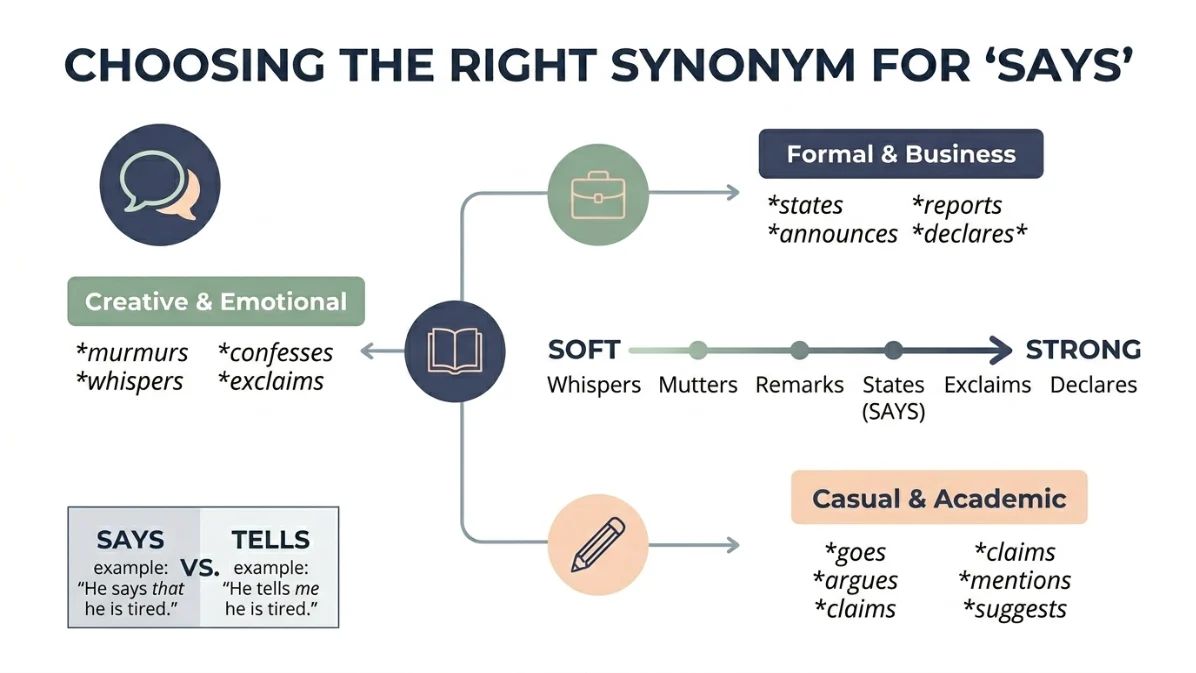
For formal reporting, consider “states” or “declares.” For casual dialogue, “mentions” or “chimes in” may fit better. Emotional depth, words like “confesses” or “insists” add powerful meaning.
Meaning, Tone and Context
The main meaning of “says” is to voice words aloud to convey information, an opinion, or a feeling. It is a verb and the standard conjugation used for a single subject like he, she, or it. The tone of “says” is fundamentally neutral, which makes it versatile but often too plain for specific situations.
Its formality level sits right in the middle of the English register, making it acceptable almost everywhere but precise almost nowhere. You will use it in journalism, everyday dialogue, instruction, and narrative.
A related noun form is “saying,” which refers to a proverb or adage. The infinitive form is “to say,” and the past tense is “said.” A direct opposite in terms of communication would be to “withhold” or to remain silent, often described as to “keep quiet.”
When and How to Use “Says”
You should use “says” when you need a clean, invisible verb for general speech attribution. It is the safe choice when the manner of speaking is not the focus of your sentence.
However, you should select a stronger synonym when you want to reveal a speaker’s emotion, authority, or relationship to the listener.
Consider these realistic examples:
- Professional: The report says we have exceeded our quarterly targets.
- Personal: My grandmother always says that patience is a garden’s best friend.
- Academic: The researcher says the findings are statistically significant, though cautiously.
- Emotional: She says she is fine, but her voice cracks with every syllable.
- Creative: The old house says nothing, yet its creaking floors tell a hundred secrets.
- Social media: The caption says “summer mode,” while the photo screams winter escape.
- Resume: As my reference says, I am consistently punctual and detail-oriented.
Another Word for “Says”
The single best replacement for “says” is often “states,” especially when a neutral but slightly more formal tone is required. This choice adds a layer of authority and seriousness to the attribution without introducing emotional bias. For professional writing, use “asserts” or “confirms.”
In academic writing, “argues” or “posits” works well. Casual conversation flows naturally with “goes” or “mentions.” For emotional writing, lean into “confesses” or “pleads.” Creative writing benefits from vivid words like “murmurs” or “announces.”
On resumes, action-oriented words like “details” or “specifies” show precision. For a stronger meaning, choose “insists” or “declares.” For a softer meaning, use “offers” or “hints.”
When Not to Use “Says”
“Says” sounds too vague when the manner of delivery is critical to understanding the message. If someone is terrified and speaking quietly, “he says” falls flat. A more precise synonym like “he whispers” instantly clarifies the scene.
It is also too weak for legal or formal declarations, where “the witness says” lacks the weight of “the witness testifies.” In academic critique, “the author says” is less rigorous than “the author argues,” which implies a defended position.
Avoid “says” when you need to convey volume, emotion, or the professional function of the speech.
Words Commonly Confused With “Says”
There are several verbs frequently mistaken as direct synonyms for “says,” but each carries a distinct meaning.
- Says vs. Tells: “Says” focuses purely on the spoken words, while “tells” requires a direct listener. He says he is tired, but he tells his friend a story.
- Says vs. Explains: You use “says” for simple delivery, but “explains” means the speaker is clarifying a complex idea to make it understood.
- Says vs. Speaks: “Says” is transitive, usually attached to the words spoken, whereas “speaks” often refers to the ability to use language or the act of addressing an audience.
- Says vs. Talks: “Talks” implies a more interactive, conversational exchange. “Says” can be a single, one-way statement.
- Says vs. Asks: “Says” delivers information, but “asks” formulates the communication as a direct question.
- Says vs. Claims: “Claims” introduces a strong suggestion of doubt or an assertion that the information might not be fully verified or believed.
Best Synonym by Context for “Says”
| Context | Best Synonym | Why It Works | Example |
|---|---|---|---|
| Formal writing | States | Adds neutrality and authority without emotion. | The policy clearly states the terms of the agreement. |
| Academic writing | Argues | Indicates a reasoned, defended position. | The scholar argues that the data is incomplete. |
| Professional or business use | Reports | Frames the speech as factual, verifiable information. | The market analysis reports a surge in demand. |
| Resume | Details | Shows precision and an ability to communicate specifics. | My cover letter details my project management experience. |
| Casual conversation | Mentions | Feels light, effortless, and not overly intense. | She just mentioned she might stop by later. |
| Creative writing | Murmurs | Adds texture, volume, and a sense of intimacy. | He murmurs a quiet apology before turning away. |
| Emotional tone | Confesses | Implies vulnerability, guilt, or a deeply held secret. | She confesses that she never truly loved the city. |
| Strong intensity | Declares | Conveys boldness, certainty, and public announcement. | The leader declares a new era of innovation. |
| Soft or moderate tone | Suggests | Delivers a thought gently without forceful assertion. | My colleague suggests we reconsider the timeline. |
| Social media captions | Reads | A modern, casual way to reference a text or image’s message. | The sign proudly reads “Happiest Place on Earth.” |
Which Synonym Should You Choose?
Your choice must hinge on three factors: the emotional weight you want to convey, the level of formality the situation demands, and the precise function of the speech. Start by identifying the speaker’s intention. If a lawyer is presenting a fact, “states” is your word. If a child is telling a secret, “whispers” captures the scene perfectly. Consider your audience. A professional email requires “reports” or “confirms,” while a text to a friend calls for “says” or “goes.” Always match the intensity of the synonym to the stakes of the conversation.
Real Life Examples of “Says” in Sentences
- School: The teacher says the homework is due Friday, but the syllabus confirms it is due Monday.
- Workplace: My manager says we need to cut costs, yet the email details exactly where we should invest.
- Writing: The author says the theme is hope, but the ending murmurs a quiet tragedy.
- Conversation: He says he will be on time, but his partner quickly adds a note of doubt.
- Social media: Her post says she is grateful, and the photo radiates pure joy.
- Resume: The testimonial says I am a team player because it highlights my collaborative wins.
- Email: Your message says the meeting is at noon, so I will prepare the deck by eleven.
- Storytelling: The traveler says the path is safe, but the old map whispers a hidden warning.
20 Synonyms for “Says”
| Synonym | Simple Meaning | Best Used For | Example Sentence |
|---|---|---|---|
| States | Expresses something definitely | Formal reports | The witness states the event occurred after midnight. |
| Argues | Presents a reason for or against | Academic essays | The critic argues that the novel is a modern masterpiece. |
| Claims | Asserts something, often with doubt implied | Investigative journalism | The suspect claims he was at home during the incident. |
| Mentions | Brings up casually or briefly | Light conversation | She just mentions that she loves the restaurant’s decor. |
| Whispers | Speaks very softly | Intimate or secretive scenes | He whispers the secret in her ear as the room goes quiet. |
| Murmurs | Speaks in a low, indistinct voice | Romantic or tense atmosphere | She murmurs his name in her sleep. |
| Declares | Announces formally or emphatically | Announcements or speeches | The judge declares the court is now in session. |
| Insists | Asserts something firmly despite opposition | Conflict or persuasion | He insists he followed the correct procedure. |
| Explains | Makes something clear | Training or teaching | The guide explains how the ancient mechanism worked. |
| Suggests | Puts forward a subtle idea | Brainstorming or counseling | My advisor suggests taking a different elective. |
| Reports | Provides a factual account | Business or news | The CFO reports a successful fiscal year. |
| Confirms | Verifies something as true | Verification or agreements | The manager confirms our booking for the conference room. |
| Confesses | Admits to something private or guilty | Personal narratives | The letter confesses a long-held family secret. |
| Adds | Contributes extra information | Collaborative editing | She quickly adds a crucial detail to the story. |
| Points out | Draws attention to a specific fact | Meetings or critiques | My mentor points out a minor flaw in the design. |
| Reads | Interprets written words as spoken | Texts, captions, or simple cues | Her t-shirt reads “Future CEO.” |
| Goes | Informal replacement for “says” | Very casual, spoken dialogue | So then he goes, “Wait, what?” |
| Testifies | Gives evidence as a witness | Legal or formal inquiry | The expert testifies about the digital forensics. |
| Offers | Presents something for consideration | Gentle feedback | He offers a unique perspective on the issue. |
| Chimes in | Joins a conversation unexpectedly | Group discussions | Everyone nods until Sarah chimes in with a new question. |
Synonym Groups and Usage Differences
Professional vs. Personal Synonyms
In a professional setting, accuracy and accountability are paramount, making words like “reports,” “states,” and “confirms” ideal. These words remove personal emotion and focus on the factual content. In a personal context, you want to capture character and relationship dynamics. A friend does not “report” their vacation plans. They “share” or “mention” them. Choosing a professional synonym in a personal story can make dialogue sound cold and bureaucratic.
Formal vs. Conversational Synonyms
Formal synonyms like “asserts,” “contends,” and “declares” belong in reports, academic essays, and prepared speeches. They carry a weight that commands respect. Conversational synonyms like “goes,” “mentions,” and “chimes in” are perfect for texts, dialogue in fiction, and casual emails. They mirror the natural rhythm of spoken English. Using “he goes” in a business report would damage your credibility, just as “he contends” would sound stiff in a text message.
Academic Synonyms
Precision is key in academic writing. “Argues” is the cornerstone synonym, as it implies a thesis and supporting evidence. “Posits” is excellent for introducing a theory, and “asserts” works for a strong, defended claim. Avoid vague words like “talks about” or “goes over.” You are not just reporting what a scholar says. You are framing their contribution to the field.
Professional and Business Synonyms
Business communication requires a mix of clarity and diplomacy. “Reports” is vital for data and findings. “Details” works perfectly in emails when attaching documents or explaining processes. “Confirms” is essential for agreements and deadlines. In performance reviews, use “points out” for constructive feedback and “highlights” for achievements. These words move beyond simple speech to show professional action.
Creative or Literary Synonyms
The right dialogue tag can paint a picture without any scene description. “Whispers,” “murmurs,” and “breathes” use sound and texture to set a mood. “Announces” and “declares” mark a shift in power or plot. In a poem or narrative, “the autumn wind says” is dull, but “the autumn wind sighs” creates an immediate, evocative image. Your verb choice becomes a tool for sensory storytelling.
Slang or Modern Synonyms
The primary modern slang replacement is “goes,” as in “So I go, ‘No way,’ and she goes, ‘Totally.’” This is perfectly natural in spoken English and very informal dialogue writing. Another is “like,” as in “She was like, ‘We need to talk.’” These are strictly conversational and create a youthful, casual feel. They are never acceptable in professional or academic writing.
Strongest vs. Weaker Synonyms
Understanding intensity helps you control the emotional dial of your writing.
- Mild: Suggests, offers, hints.
- Moderate: Mentions, adds, remarks.
- Strong: States, explains, reports.
- Intense: Argues, insists, claims.
- Strongest: Declares, confesses, testifies, demands.
Emotional vs. Neutral Synonyms
Neutral synonyms such as “states,” “reports,” and “says” itself are objective carriers of information. They add zero emotional coloring. Emotional synonyms do the heavy lifting of character and mood. “Confesses” injects a sense of weight and vulnerability. “Insists” brings defensiveness. “Whispers” can signal fear, intimacy, or conspiracy. Choosing an emotional synonym is a direct instruction to your reader on how to feel about the spoken words.
Antonyms of “Says”
| Antonym | Meaning | Example Sentence |
|---|---|---|
| Keeps quiet | Chooses not to speak. | Despite the accusation, he just keeps quiet. |
| Listens | Pays attention to sound. | She never argues; she patiently listens. |
| Withholds | Refuses to give information. | The official withholds the critical detail. |
| Hushes | Tells someone to be quiet. | The librarian hushes the noisy students. |
| Suppresses | Forcibly puts an end to speech. | The regime suppresses all public dissent. |
| Mutes | Reduces the volume to silence. | He mutes the television to hear the conversation. |
| Silences | Causes to become silent. | A single look silences the entire room. |
| Conceals | Keeps something secret. | The report conceals the true financial status. |
| Observes | Watches carefully without comment. | The analyst observes the trends but draws no conclusion. |
| Overhears | Hears without the speaker’s intention. | I overhear their plans while passing by. |
| Ignores | Refuses to acknowledge speech. | He simply ignores the question and walks away. |
| Questions | Expresses inquiry rather than statement. | The attorney questions the witness’s memory. |
| Commands | Gives an authoritative order. | The general commands absolute silence. |
| Pleads | Makes an emotional appeal. | She pleads for another chance. |
| Retorts | Replies sharply or angrily. | He retorts with a sarcastic remark. |
Comparison: “Says” vs. Similar Words
“Says” vs. “States”
The main difference is formality and authority. “Says” is general and neutral, used in all registers. “States” is more formal and implies the information is definitive and officially delivered.
- Example for Says: He says he will try to make it.
- Example for States: The press release states the merger is complete.
“Says” vs. “Tells”
The main difference is grammatical and relational. “Says” can stand alone without a listener. “Tells” requires a direct object, a person receiving the information, making the communication more personal.
- Example for Says: She says the weather is beautiful.
- Example for Tells: She tells her son the weather is beautiful.
“Says” vs. “Explains”
The main difference is purpose. “Says” delivers a message, while “explains” clarifies a process, reason, or complex idea to an audience that seeks understanding.
- Example for Says: The plumber says the pipe is broken.
- Example for Explains: The plumber explains how the pipe burst.
“Says” vs. “Claims”
The main difference is the hint of doubt. “Claims” immediately introduces a layer of skepticism or an awareness that the statement is an unverified assertion.
- Example for Says: The politician says the policy will help.
- Example for Claims: The politician claims the policy will help, but data is lacking.
“Says” vs. “Argues”
The main difference is structure. “Says” is simple expression. “Argues” is a structured, persuasive, and evidence-based presentation of a point of view, fundamental in essays and debates.
- Example for Says: The student says she disagrees.
- Example for Argues: The student argues her position with three clear points.
“Says” vs. “Asks”
The main difference is the sentence type. “Says” introduces a declarative or imperative statement. “Asks” introduces an interrogative, a direct question requiring a response.
- Example for Says: The researcher says the outcome was positive.
- Example for Asks: The researcher asks whether the outcome was truly random.
Common Phrases and Expressions with “Says”
1. Says a lot
Meaning: Reveals significant, often unspoken, information about someone or something.
Example sentence: The fact that he volunteers every weekend says a lot about his character.
2. Who says?
Meaning: A casual, defiant question challenging the source or truth of a statement.
Example sentence: Who says you can’t start a new career at forty?
3. That goes without saying
Meaning: Something is so obvious it does not need to be stated.
Example sentence: Your loyalty to the team goes without saying, and we are grateful.
4. If I do say so myself
Meaning: An expression of pride in one’s own work, used to sound modestly boastful.
Example sentence: This pie turned out beautifully, if I do say so myself.
5. Never say die
Meaning: A motivational phrase encouraging someone not to give up hope.
Example sentence: We are down by ten points, but never say die.
6. Say the word
Meaning: An offer indicating you are ready to act as soon as you receive a command.
Example sentence: Just say the word, and I will help you move that furniture.
Common Mistakes to Avoid
- Using “says” for a question. This is a grammatical mismatch. If the speaker is forming a query, the correct attribution is “asks” or “inquires.”
- Confusing “says” with “explains” in instructional content. A recipe “says” to add salt, but a science teacher “explains” why you add salt. Use “explains” when the goal is to clarify cause and effect.
- Inserting a casual synonym like “goes” into a professional email. Writing “My manager goes that the project is delayed” harms your professional image.
- Choosing an overly dramatic synonym for a simple, neutral situation. Writing “She declared her preference for vanilla ice cream” is comically intense.
- Repeating “says” and “said” in a long dialogue sequence. This creates a monotonous rhythm. Replace every third instance with an action beat or a descriptive synonym like “added” or “murmured.”
- Using a synonym with the wrong emotional tone. You “confess” to a mistake, but you “announce” a wedding. Swapping them creates confusion.
- Using “claims” when you intend a neutral report. “The source claims” injects doubt, while “the source reports” delivers facts without bias.
FAQs
What is the best synonym for says?
The best overall neutral synonym is “states” because it is clear, direct, and works in almost any formal or professional context without adding emotional bias.
What is a formal synonym for says?
A highly formal synonym is “asserts,” which implies a confident and forceful statement, or “declares,” which indicates a public and official pronouncement.
What is an informal synonym for says?
A very common informal synonym is “goes,” used widely in casual spoken narratives, as in “He goes, ‘Let’s go.’”
What is another word for says in professional writing?
“Reports” is an excellent word for professional writing, as it frames the spoken information as reliable, factual, and suitable for business decisions.
What is the difference between says and tells?
The key difference is grammatical. “Says” focuses on the words, but “tells” requires a direct listener to complete its meaning.
What is the opposite of says?
A core opposite of “says” is “keeps quiet,” referring to the act of not speaking, or “listens,” which is the receptive counterpart to speaking.
Conclusion
The word “says” is a useful starting point, but precise communication requires a broader vocabulary. The right synonym does more than just attribute speech. It clarifies intention, reveals emotion, and establishes authority.
From the quietness of a “whisper” to the power of a “declaration,” your word choice controls your reader’s entire perception of a scene or message. A practical vocabulary tip is to read back your writing and check if the dialogue tags match the spoken words’ emotional temperature.
A single precise verb can replace an entire sentence of explanation.