Have you ever found yourself repeating the word “states” over and over in an essay or email? This common verb can become monotonous when you rely on it too heavily. Writers, students, and professionals often struggle to find fresh alternatives for this versatile word.
You might catch yourself writing “the report states” three times in a single paragraph. This guide will help you break that habit. You will discover powerful synonyms for states that match your exact meaning and context.
Whether you are writing a resume, a social media caption, or an academic paper, the right word makes all the difference. Let us explore the best ways to express this common verb with precision and style.
What Does “States” Mean?
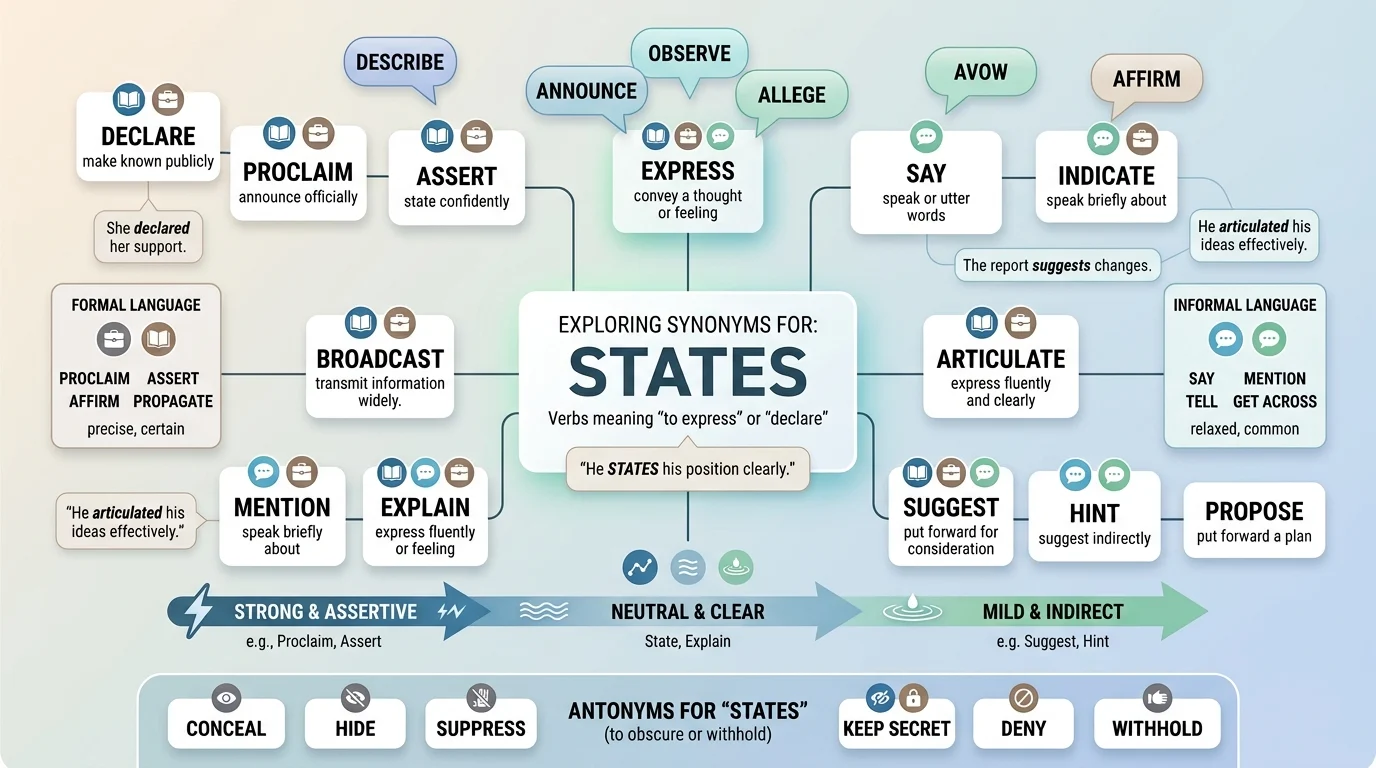
The verb “states” means to express something clearly and formally in speech or writing. The best synonyms for states depend on your context. For formal writing, try “asserts,” “declares,” or “proclaims.” For casual conversation, use “says,” “mentions,” or “points out.” Academic work benefits from “contends,” “maintains,” or “postulates.” Professional settings often prefer “indicates,” “notes,” or “reports.”
Meaning, Tone and Context
1. Simple Definition
States means to express information, opinions, or facts in a clear and direct way. This verb implies a formal or authoritative delivery of information.
2. Part of Speech
States is a verb. It functions as the third person singular present tense of the verb “state.”
3. Positive, Negative, or Neutral Tone
States has a neutral tone. The word itself does not carry strong positive or negative emotional weight. It simply indicates the act of expressing something.
4. Formality Level
States is moderately formal. It works well in professional and academic contexts. It can also be used in everyday conversation without sounding stiff.
5. Common Use Cases
Writers use states in reports, essays, legal documents, and professional correspondence. Journalists use it to attribute statements to sources. Students use it when citing authors or presenting arguments.
6. Important Word Forms
The word state can be a noun meaning a political unit or a condition. As a verb, it has related forms: stated (past tense), stating (present participle), and statement (noun form). The adjective “stated” means expressed or declared.
When and How to Use “States”
Use “states” when you want to present information clearly and directly. This word works best in formal or neutral contexts. It suggests authority and clarity without excessive emotion. You can use it to attribute information to sources, present facts, or express opinions in a measured way. The word “states” signals that the information is reliable and should be taken seriously.
Professional Context
The manager states that all employees must complete the training by Friday.
Academic Context
The researcher states that the findings support the original hypothesis.
Personal Context
My friend states that she will join us for dinner tonight.
Creative Writing Context
The letter states the author’s deepest feelings about the situation.
Social Media Context
The announcement states that the event has been postponed until next month.
Email Context
The email clearly states the deadlines for the project submission.
Resume Context
My previous supervisor states that I exceeded all performance targets.
Casual Conversation
He states his opinion without worrying about what others think.
Another Word for “States”
Professional Writing
“Indicates” works well in professional documents and reports.
Academic Writing
“Contends” adds intellectual weight to academic arguments.
Casual Conversation
“Says” is the simplest and most natural replacement.
Emotional Writing
“Declares” adds passion and conviction to the statement.
Creative Writing
“Proclaims” brings drama and emphasis to creative works.
Resume
“Demonstrates” shows evidence of your skills and achievements.
Social Media Captions
“Shares” feels more personal and engaging for social posts.
Stronger Meaning
“Asserts” conveys confidence and firmness in the statement.
Softer Meaning
“Suggests” offers a gentler, more tentative expression.
When Not to Use “States”
Avoid using “states” when the context calls for a more vivid or emotional word. “States” can sound too clinical in personal writing. It may feel detached in situations that require warmth or passion. Consider your audience and purpose carefully. A love letter should not use “states” to express feelings. A casual text message sounds unnatural with “states” instead of “says.” Use more precise synonyms when you need to convey specific meanings.
Weak sentence: The email states that the party will be fun.
Improved sentence: The email promises that the party will be fun.
Weak sentence: She states that she loves her new job.
Improved sentence: She exclaims that she loves her new job.
Words Commonly Confused With “States”
States vs. Says
“Says” is more conversational and less formal. Use “states” for official or formal communication.
States vs. Claims
“Claims” suggests doubt or controversy. Use “states” when presenting accepted facts.
States vs. Asserts
“Asserts” implies confidence and forcefulness. Use “states” for neutral presentation.
States vs. Suggests
“Suggests” is tentative and indirect. Use “states” for clear, direct expression.
States vs. Declares
“Declares” has a dramatic, public tone. Use “states” for ordinary formal statements.
States vs. Indicates
“Indicates” points to evidence or signs. Use “states” for direct verbal expression.
Best Synonym by Context for “States”
| Context | Best Synonym | Why It Works | Example |
|---|---|---|---|
| Formal writing | Asserts | Projects confidence and authority | The attorney asserts that the evidence is clear. |
| Academic writing | Contends | Shows scholarly argumentation | The historian contends that the event changed history. |
| Professional business | Indicates | Suggests evidence based conclusions | The data indicates a strong upward trend. |
| Resume achievement | Demonstrates | Highlights proven abilities | My track record demonstrates consistent leadership. |
| Casual conversation | Says | Natural and relaxed for everyday use | She says we should leave early. |
| Creative writing | Proclaims | Adds dramatic flair and emphasis | The poet proclaims his love for nature. |
| Emotional tone | Declares | Shows strong personal conviction | He declares his commitment to the cause. |
| Strong intensity | Insists | Shows determined repetition of a point | The witness insists he saw the accident. |
| Soft or moderate | Suggests | Offers a gentle or tentative idea | The report suggests a possible solution. |
| Social media captions | Shares | Creates a personal, engaging connection | She shares her favorite recipe with followers. |
| US English standard | States | Commonly used in formal American writing | The manual states the safety procedures clearly. |
| UK English standard | States | Equally common in formal British writing | The policy states the terms of the agreement. |
Which Synonym Should You Choose?
Consider your audience first. Formal academic readers expect precise language like “contends” or “maintains.” Business professionals appreciate “indicates” or “notes.” Friends and family respond better to “says” or “mentions.” Think about your purpose. Are you presenting facts? Use “states.” Are you making a bold argument? Choose “asserts.” Are you offering a gentle suggestion? Select “suggests.” Consider emotional intensity. Strong feelings call for “declares” or “proclaims.” Neutral information works well with “states” or “notes.” Match your word to the formality of your document. Reports need formal synonyms. Emails can be moderately formal. Texts and social media lean casual. The right choice depends on tone, audience, and your specific message.
Real Life Examples of “States” in Sentences
School Context
The textbook clearly states the causes of the American Revolution.
Workplace Context
Our company policy states that all employees receive annual performance reviews.
Writing Context
The author states her main argument in the opening paragraph.
Conversation Context
He states his preference for coffee over tea every morning.
Social Media
The influencer states that this product transformed her skincare routine.
Resume Context
My performance review states that I consistently exceed sales targets.
Email Context
The confirmation email states that your order has been shipped.
Storytelling Context
The legend states that a hidden treasure lies beneath the old oak tree.
15 Synonyms for “States”
| Synonym | Simple Meaning | Best Used For | Example Sentence |
|---|---|---|---|
| Says | Expresses in ordinary speech | Casual conversation and everyday writing | My grandmother says that hard work builds character. |
| Declares | Announces publicly with emphasis | Formal announcements and emphatic statements | The mayor declares a state of emergency. |
| Asserts | States confidently and forcefully | Legal writing and strong arguments | The expert asserts that climate change is urgent. |
| Contends | Argues a point in a debate | Academic writing and persuasive essays | The philosopher contends that happiness is the highest good. |
| Maintains | Holds firmly to a position | Long standing arguments and beliefs | She maintains that exercise improves mental health. |
| Claims | States without providing proof | Controversial statements and assertions | The report claims that crime rates have dropped. |
| Notes | Mentions briefly and casually | Adding minor observations | The article notes an increase in remote work. |
| Indicates | Points to evidence or signs | Data driven writing and reports | The study indicates a clear pattern of behavior. |
| Proclaims | Declares publicly with pride | Dramatic and celebratory announcements | The victor proclaims his triumph to the crowd. |
| Reports | Gives an account of information | News writing and official communications | The journalist reports from the scene of the event. |
| Affirms | Confirms something as true | Supporting previous statements | The witness affirms the accuracy of the document. |
| Comments | Offers an opinion or observation | Informal remarks and social media | She comments on the beautiful sunset. |
| Mentions | Refers to briefly in passing | Casual references and quick remarks | He mentions his travel plans for the summer. |
| Conveys | Communicates a message or feeling | Expressing emotions or abstract ideas | The speech conveys a sense of hope for the future. |
| Relates | Tells a story or account | Narrative writing and storytelling | The memoir relates her experiences during the war. |
Synonym Groups and Usage Differences
Professional vs. Personal Synonyms
Professional settings benefit from “indicates,” “reports,” and “notes.” These words sound objective and businesslike. Personal contexts prefer “says,” “mentions,” and “shares.” These words feel warmer and more relatable.
Formal vs. Conversational Synonyms
Formal writing uses “asserts,” “contends,” and “maintains.” These words appear in essays, reports, and legal documents. Conversational writing uses “says,” “mentions,” and “points out.” These words fit emails, texts, and casual articles.
Academic Synonyms
Academic writing values precise vocabulary. “Contends,” “postulates,” and “hypothesizes” work well in research papers. “Maintains” shows careful argumentation. “Asserts” demonstrates confidence in findings. These words help you sound scholarly and credible.
Professional and Business Synonyms
Business communication needs clear, professional language. “Indicates” shows evidence based conclusions. “Notes” provides gentle observations. “Reports” presents factual information. “Recommends” offers suggestions for action. These synonyms keep your business writing polished and effective.
Creative or Literary Synonyms
Creative writers can choose more vivid synonyms. “Proclaims” adds drama and emotion. “Declares” brings weight to important moments. “Relates” helps with storytelling. “Conveys” expresses abstract ideas beautifully. These words add color and depth to creative works.
Slang or Modern Synonyms
Modern conversation often uses “says” or “goes” in casual speech. “Spills” means to reveal information dramatically. “Drops” indicates sharing news suddenly. These words are acceptable in informal settings but avoid them in professional writing. Keep slang for social media and casual conversations.
Strongest vs. Weaker Synonyms
Mild intensity: mentions, notes, says
Moderate intensity: states, indicates, reports
Strong intensity: asserts, declares, proclaims
Strongest intensity: insists, contends, maintains
Emotional vs. Neutral Synonyms
Neutral synonyms include “states,” “indicates,” and “notes.” These words simply present information. Emotional synonyms include “declares,” “proclaims,” and “exclaims.” These words show strong feeling or conviction. Choose based on the emotional temperature of your writing.
Antonyms of “States”
| Antonym | Meaning | Example Sentence |
|---|---|---|
| Denies | Refuses to accept something as true | The suspect denies any involvement in the crime. |
| Contradicts | Says the opposite of a statement | Her testimony contradicts the official report. |
| Questions | Expresses doubt about something | The committee questions the validity of the findings. |
| Disputes | Challenges the truth of a statement | The lawyer disputes the evidence presented. |
| Conceals | Hides information intentionally | The company conceals its financial problems. |
| Withholds | Keeps information from being known | The witness withholds crucial details from the court. |
| Ignores | Refuses to acknowledge something | The manager ignores the concerns of the staff. |
| Disagrees | Has a different opinion | I disagree with your assessment of the situation. |
| Refutes | Proves something to be false | The scientist refutes the claim with clear evidence. |
| Challenges | Calls something into question | The journalist challenges the official narrative. |
| Opposes | Acts against something | The senator opposes the new legislation. |
| Rejects | Refuses to accept or consider | The board rejects the proposed budget. |
| Negates | Makes something ineffective | The new evidence negates the previous theory. |
| Doubts | Feels uncertain about something | The researcher doubts the accuracy of the data. |
| Misrepresents | Gives a false account | The article misrepresents the facts of the case. |
Comparison: States vs. Similar Words
States vs. Says
The main difference is formality. “States” works in formal, official contexts. “Says” fits everyday conversation. “States” is stronger in professional writing. “Says” is more natural in casual speech. Example: The report states the company’s position. Example: My friend says we should go to the movies.
States vs. Claims
“Claims” suggests uncertainty or controversy. “States” presents information as factual. “Claims” is weaker in terms of proof. “States” implies authority and reliability. Example: The suspect claims he was not there. Example: The evidence states the suspect was present.
States vs. Asserts
“Asserts” shows more confidence and force. “States” is neutral and measured. “Asserts” is stronger in argumentative writing. “States” is better for factual information. Example: The lawyer asserts the client’s innocence. Example: The law states the requirements clearly.
States vs. Declares
“Declares” has a dramatic, public quality. “States” is ordinary and routine. “Declares” is stronger for official announcements. “States” works for everyday formal statements. Example: The president declares a national holiday. Example: The email states the meeting time.
States vs. Indicates
“Indicates” points to evidence or signs. “States” expresses direct verbal communication. “Indicates” is more objective and scientific. “States” implies someone spoke or wrote directly. Example: The thermometer indicates a high temperature. Example: The sign states the store hours.
States vs. Contends
“Contends” is used in arguments and debates. “States” can be used in any formal context. “Contends” is stronger for academic persuasion. “States” is more general and widely applicable. Example: The historian contends that the war was avoidable. Example: The textbook states the date of the war.
Common Phrases and Expressions with “States”
1. States Clearly
Meaning: Expresses something in an unmistakable way.
Example: The instructions state clearly that you must wear safety goggles.
2. States Firmly
Meaning: Expresses something with determination and resolve.
Example: The manager states firmly that deadlines must be met.
3. States the Obvious
Meaning: Expresses something that everyone already knows.
Example: He states the obvious when he says water is wet.
4. States the Facts
Meaning: Presents information that is true and verifiable.
Example: The report states the facts without any bias.
5. States the Case
Meaning: Presents an argument or position clearly.
Example: The attorney states the case to the jury.
6. States Without Reservation
Meaning: Expresses something completely and without doubt.
Example: The expert states without reservation that the product is safe.
7. States a Position
Meaning: Declares an official stance on an issue.
Example: The politician states her position on healthcare reform.
8. States an Opinion
Meaning: Expresses a personal viewpoint.
Example: The columnist states his opinion in the editorial section.
Common Mistakes to Avoid
1. Overusing “States” in Writing
Repeating “states” makes your writing dull. Replace it with varied synonyms. Try “says,” “notes,” or “indicates” to add variety.
2. Using “States” When “Says” Fits Better
Casual writing needs “says” for natural flow. Save “states” for formal contexts. Your text messages should not use “states.”
3. Confusing “States” with “Claims”
“Claims” suggests doubt. “States” presents facts. Use “claims” for controversial statements. Use “states” for accepted information.
4. Using Casual Synonyms in Formal Writing
Avoid “says” in academic papers. Choose “contends” or “maintains” instead. Formal writing requires formal synonyms.
5. Using Overly Dramatic Synonyms for Simple Situations
Do not use “proclaims” for everyday statements. Save dramatic words for dramatic moments. Match your intensity to the situation.
6. Choosing the Wrong Emotional Tone
“Declares” shows strong feeling. “States” shows neutral expression. Choose words that match your emotional message.
7. Using Slang in Professional Writing
Avoid “spills” or “drops” in formal documents. Keep professional writing polished. Use “states” or “indicates” instead.
FAQs
1. What is the best synonym for states?
The best synonym depends on context. For formal writing, use “asserts.” For casual use, choose “says.”
2. What is a formal synonym for states?
“Asserts” and “contends” are excellent formal synonyms for states.
3. What is an informal synonym for states?
“Says” is the most natural informal synonym for states.
4. What is another word for states in professional writing?
“Indicates” and “notes” work well in professional writing contexts.
5. What is the difference between states and says?
“States” is formal and official. “Says” is casual and conversational.
6. What is the opposite of states?
The opposite of states is “denies,” “contradicts,” or “questions.”
Conclusion
The word “states” serves an important role in formal and neutral communication. It allows you to present information clearly and authoritatively. However, relying on this single word can make your writing feel repetitive and flat. The synonyms we explored today offer you a rich vocabulary to express yourself with precision. Choose “asserts” for confidence and strength. Use “says” for natural conversation. Select “contends” for academic arguments. Pick “indicates” for professional reports. Remember that context, audience, and tone should guide your word choice. A strong vocabulary makes your writing more engaging and effective. Start using these synonyms today and watch your communication skills improve. Your readers will appreciate the variety and precision in your writing.