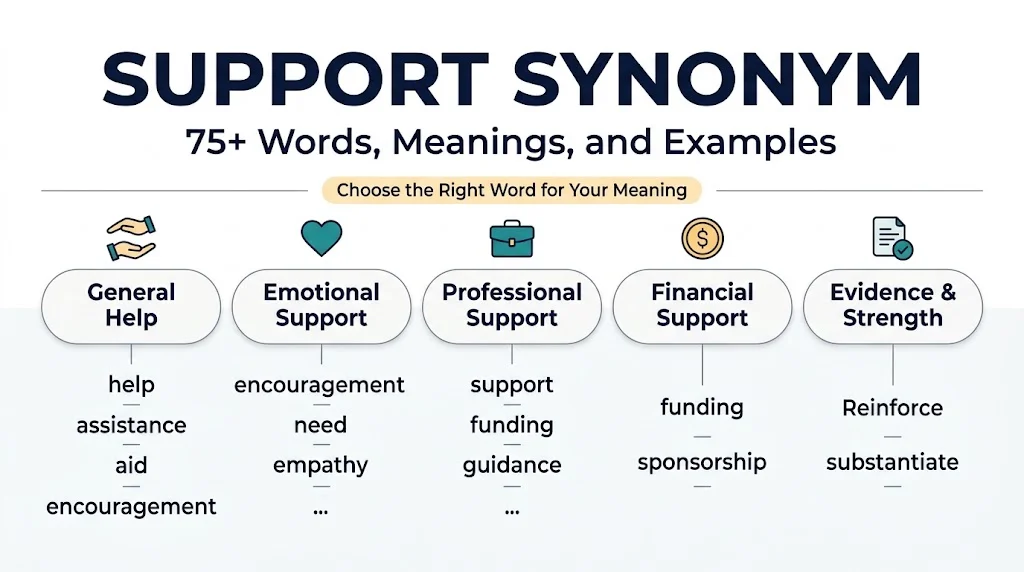
The word support can describe helping a friend, funding a project, approving an idea, or holding up a physical structure. Although it works in many situations, repeating it throughout your writing can make your sentences sound vague or repetitive. Choosing a more precise synonym helps you communicate your meaning clearly.
Common synonyms for support include help, assistance, aid, backing, encouragement, guidance, reinforcement, and uphold. However, the best alternative depends on how you use the word. For example, you can assist a colleague, encourage a friend, fund a project, endorse a proposal, or reinforce a structure.
This guide explores more than 75 support synonyms, explains their meanings, and provides practical examples. You’ll also discover formal alternatives, professional expressions, emotional support words, financial terms, academic vocabulary, and natural phrases you can use instead of support.
What Does Support Mean?
Support is a versatile English word that functions as both a noun and a verb. It generally describes providing help, strength, encouragement, approval, resources, or something that holds another object in place.
Its exact meaning depends on the situation. Consider these examples:
- Practical help: My colleague offered support with the presentation.
- Emotional encouragement: Her family provided support during a difficult period.
- Approval: The committee expressed support for the proposal.
- Financial assistance: The charity provides financial support to students.
- Physical stability: The beam supports the weight of the roof.
- Evidence: The research supports the scientist’s conclusion.
Although all six examples use the same word, each describes a different relationship. A colleague might assist with a presentation, a family member might comfort someone, and research might substantiate a conclusion.
Understanding these distinctions is the first step toward choosing a suitable synonym.
Support as a Noun
As a noun, support refers to the help, resources, approval, or physical structure that someone or something receives.
Common noun synonyms include:
- Help: Assistance with a task or problem.
- Assistance: Help provided to meet a particular need.
- Aid: Help, often involving financial, practical, or emergency needs.
- Backing: Approval, loyalty, or resources provided to a person or cause.
- Encouragement: Words or actions that increase confidence or motivation.
- Guidance: Advice that helps someone make decisions or complete a task.
- Endorsement: An expression of approval or public support.
- Reinforcement: Something that adds strength or stability.
- Foundation: A base that supports a building, system, or idea.
- Funding: Money provided for a project, organization, or activity.
Example: The organization received financial support from several donors.
You could rewrite this sentence as, “The organization received funding from several donors.” The revised sentence is more precise if money is the specific form of help being provided.
Support as a Verb
As a verb, support describes an action. It can mean helping someone, defending an idea, providing money, maintaining something, or holding an object up.
Useful verb synonyms include:
- Help: Make a task or situation easier.
- Assist: Provide help with a particular activity.
- Aid: Help someone overcome a problem or meet a need.
- Encourage: Increase someone’s confidence or motivation.
- Endorse: Publicly or formally approve something.
- Advocate: Actively speak or argue in favor of a cause.
- Strengthen: Make something stronger or more effective.
- Reinforce: Add strength, stability, or effectiveness.
- Sustain: Keep something going over time.
- Uphold: Maintain or defend a principle, right, or decision.
- Finance: Provide or arrange money for an activity.
- Substantiate: Provide evidence that supports a claim.
Example: The new research supports the original theory.
A more specific version would be, “The new research substantiates the original theory.” This wording emphasizes that the research provides evidence for the theory.
Best Synonyms for Support at a Glance
If you need a quick replacement, start with the word that most closely matches your intended meaning. The following table highlights common alternatives and shows how to use them naturally.
| Synonym | Meaning | Example sentence |
|---|---|---|
| Help | Make something easier | Can you help me complete the report? |
| Assistance | Practical or formal help | The team provided assistance during the project. |
| Aid | Help with a need or difficulty | Volunteers delivered aid to affected families. |
| Backing | Approval, loyalty, or resources | The proposal received strong backing. |
| Encouragement | Help that builds confidence | Her encouragement gave me the confidence to apply. |
| Guidance | Advice or direction | The mentor offered valuable guidance. |
| Endorsement | Formal or public approval | The candidate received the organization’s endorsement. |
| Reinforcement | Added strength or stability | The wall needs additional reinforcement. |
| Uphold | Maintain or defend | The court upheld the decision. |
| Sustain | Keep something going | Donations sustain the community program. |
| Fund | Provide money | The grant will fund the project. |
| Substantiate | Support with evidence | The records substantiate the claim. |
| Facilitate | Make a process easier | The manager facilitated communication between departments. |
| Bolster | Strengthen or improve | The additional evidence bolstered the argument. |
| Defend | Protect against criticism or opposition | She defended her colleague’s decision. |
| Maintain | Keep something functioning or in a particular condition | The team maintains the software system. |
| Encourage | Inspire confidence or action | Teachers encourage students to ask questions. |
| Advocate | Actively recommend or promote | The group advocates for better public services. |
| Sponsor | Provide financial or other agreed support | A local company sponsored the event. |
| Comfort | Ease emotional distress | Her friends comforted her after the disappointment. |
These words don’t all mean exactly the same thing. Comfort concerns emotional distress, whereas fund refers to money. Similarly, substantiate works well with claims and arguments but usually cannot replace support when describing help for a friend.
The most effective synonym conveys the original meaning without forcing the reader to interpret your sentence.
General Synonyms for Support in Everyday English
Everyday writing usually benefits from familiar words rather than complicated alternatives. When you write a message, have a conversation, or explain a situation, words such as help, assist, encourage, and stand by often sound natural.
Common One-Word Alternatives
Help is the broadest and most flexible choice. It works for practical tasks, personal problems, and general assistance.
Example: My neighbors helped me move into my new apartment.
Assist sounds slightly more formal than help. It works especially well in workplace instructions, service descriptions, and professional communication.
Example: A technician assisted the customer with the installation.
Aid often describes help provided to someone in need. It appears frequently in humanitarian, medical, financial, and emergency contexts.
Example: The relief organization supplied aid to displaced families.
Back often means supporting a person, decision, plan, or cause. It can suggest loyalty or a willingness to stand behind a choice.
Example: The team backed its manager’s proposal.
Encourage focuses on building confidence or inspiring someone to continue. It doesn’t necessarily mean completing a task for that person.
Example: Her parents encouraged her to pursue a career in science.
Strengthen means making something more powerful, effective, or stable.
Example: Regular feedback can strengthen communication between coworkers.
Uphold means maintaining or defending a principle, right, standard, or decision.
Example: The organization works to uphold professional standards.
Sustain means keeping something alive, active, or functioning over time.
Example: Community donations sustain the local food bank.
Casual Ways to Say Support
Sometimes a natural phrase communicates more than a single word. These expressions work well in conversations, informal messages, and friendly writing.
- Lend a hand: Offer practical help.
- Give someone a hand: Help someone complete a task.
- Help out: Provide assistance, often informally.
- Be there for someone: Offer emotional presence or practical help.
- Stand by someone: Remain loyal during difficult circumstances.
- Stand behind someone: Express confidence or backing.
- Stick by someone: Continue supporting someone despite difficulties.
- Come through for someone: Provide needed help when it matters.
- Have someone’s back: Protect or defend someone.
- Give someone a boost: Increase confidence, energy, or progress.
Examples:
- Could you lend a hand with these boxes?
- I’ll be there for you while you work through this challenge.
- My friends stood by me when the business struggled.
- The team came through for us before the deadline.
- She always has her colleagues’ backs.
Notice the differences between these expressions. Lend a hand usually suggests practical help, while stand by someone emphasizes loyalty. Have someone’s back suggests that you will defend or protect that person when necessary.
Emotional Support Synonyms
Emotional support helps people manage stress, disappointment, uncertainty, grief, or major life changes. It can involve listening, reassurance, compassion, understanding, and encouragement.
However, different forms of emotional support serve different needs. Someone who feels anxious may appreciate reassurance, while someone experiencing grief may need compassion and a patient listener.
Words for Comfort and Reassurance
Comfort means helping someone feel less upset or distressed.
Example: Her sister offered comfort after the disappointing news.
Reassurance means helping someone feel less worried by addressing their concerns or restoring confidence.
Example: The doctor provided reassurance by explaining the test results clearly.
Encouragement means giving someone confidence to continue or attempt something challenging.
Example: His coach offered encouragement before the final match.
Empathy means understanding or recognizing another person’s feelings and perspective.
Example: The manager responded with empathy when an employee described a difficult personal situation.
Compassion involves concern for someone’s suffering and a willingness to respond with kindness.
Example: The volunteers treated every family with compassion.
Sympathy expresses concern for another person’s hardship or sadness.
Example: We expressed our sympathy to the family after their loss.
Validation means acknowledging that someone’s feelings or experience deserve to be recognized. It doesn’t necessarily mean agreeing with every belief or interpretation they hold.
Example: Her counselor validated her concerns and helped her explore possible next steps.
Solidarity describes standing with people who share a struggle, experience, or cause.
Example: The community showed solidarity with workers affected by the closure.
Understanding means recognizing another person’s situation, feelings, or point of view.
Example: A little understanding helped the family discuss the disagreement calmly.
Care expresses concern for someone’s well-being and may involve emotional or practical actions.
Example: The support group offered care and understanding to new members.
Choosing the Right Emotional Support Word
Use this guide to match your wording to the situation.
| If you want to express… | Consider using… | Example |
|---|---|---|
| Relief from sadness | Comfort | Her friends offered comfort after the loss. |
| Reduced worry | Reassurance | His explanation provided reassurance. |
| Confidence or motivation | Encouragement | The teacher’s encouragement helped her persist. |
| Understanding another person’s feelings | Empathy | The counselor listened with empathy. |
| Concern for someone’s suffering | Compassion | The nurse showed compassion toward the patient. |
| Recognition of someone’s feelings | Validation | The conversation gave him a sense of validation. |
| Loyalty during a difficult time | Solidarity | The group expressed solidarity with affected families. |
The distinction matters because emotional support isn’t always about fixing a problem. Sometimes people need practical solutions. At other times, listening without judgment or acknowledging their feelings is more helpful.
Professional Synonyms for Support
Professional communication often benefits from precise verbs. Instead of saying you supported a team, explain whether you trained colleagues, coordinated projects, solved problems, offered guidance, or provided resources.
Specific wording tells readers what you actually contributed.
Formal and Professional Alternatives
Assist: Provide help with a task or responsibility.
Example: Assisted the sales team with customer onboarding.
Facilitate: Make a process, activity, or interaction easier.
Example: Facilitated communication between the design and engineering teams.
Guide: Provide direction or advice that helps someone make progress.
Example: Guided new employees through the onboarding process.
Advise: Offer recommendations based on knowledge, experience, or analysis.
Example: Advised the management team on process improvements.
Mentor: Help someone develop skills, knowledge, or professional confidence over time.
Example: Mentored junior employees during their first year.
Coordinate: Organize people, activities, or resources to achieve a shared objective.
Example: Coordinated cross-functional efforts to deliver the project on schedule.
Enable: Give someone the ability, opportunity, or resources to do something.
Example: Improved internal tools to enable faster customer service.
Collaborate: Work with other people toward a shared goal.
Example: Collaborated with the product team to improve the user experience.
Champion: Actively promote a cause, proposal, or initiative.
Example: Championed a workplace initiative to improve employee training.
Provide resources: Supply the tools, information, time, or materials someone needs.
Example: Provided resources to help the team complete its research.
Offer guidance: Give advice or direction without necessarily performing the task yourself.
Example: Offered guidance to colleagues preparing for their annual reviews.
Professional Alternatives in the Workplace
Consider the following examples when revising workplace documents or describing your contributions.
| Instead of writing… | Write… | Why it works |
|---|---|---|
| Supported the team | Assisted the team | Identifies practical help. |
| Supported new employees | Mentored new employees | Emphasizes skill development. |
| Supported project delivery | Coordinated project activities | Names the specific responsibility. |
| Supported communication | Facilitated communication | Highlights the process being improved. |
| Supported business growth | Enabled business growth | Emphasizes creating the conditions for progress. |
| Supported a new initiative | Championed a new initiative | Shows active advocacy. |
| Supported customer issues | Resolved customer issues | Emphasizes solving problems. |
| Supported the implementation | Helped implement the system | Describes the actual contribution. |
These distinctions are especially useful for resumes and professional profiles. A phrase such as supported business operations may be accurate, but it doesn’t show whether you analyzed data, managed schedules, trained employees, or solved technical problems.
Choose the verb that reflects your actual work. Clear descriptions are more informative than impressive-sounding but vague language.
Formal and Academic Synonyms for Support
Academic writing often uses support when discussing evidence, theories, arguments, conclusions, or interpretations. In these situations, a precise alternative can clarify how information relates to a claim.
However, formal vocabulary should improve accuracy rather than make a sentence unnecessarily complicated.
Formal Alternatives for Providing Help
- Assist: Help with a task or activity.
- Aid: Provide help, often for a defined need.
- Facilitate: Make an action or process easier.
- Guide: Offer direction or advice.
- Sustain: Maintain something over time.
- Uphold: Defend or maintain a principle, standard, or decision.
- Provide assistance: Express the act of helping in formal language.
- Offer guidance: Describe advice or direction given to someone.
Example: The research team assisted the community with data collection.
Another natural version would be, “The research team provided assistance with data collection.”
The best choice depends on sentence structure and the intended tone. Academic writing doesn’t require every common word to be replaced with a longer alternative.
Academic Synonyms for Supporting an Argument
Substantiate means providing evidence that supports a claim or statement.
Example: The survey results substantiate the researchers’ interpretation of the findings.
Corroborate means providing additional evidence that confirms or strengthens an existing account or conclusion.
Example: The second experiment corroborated the results of the initial study.
Bolster means strengthen an argument, position, or explanation.
Example: The additional findings bolstered the case for further investigation.
Reinforce means add strength to an argument, idea, or conclusion.
Example: The latest results reinforce the study’s central conclusion.
Underpin means form the underlying basis for an argument, method, theory, or system.
Example: Established principles underpin the proposed analytical framework.
Justify means provide reasons or evidence that show why a claim, decision, or action is reasonable.
Example: The available evidence justifies further research into the issue.
Validate means establish that a method, result, interpretation, or instrument meets relevant criteria or has a sound basis.
Example: The researchers used an independent sample to validate their findings.
Lend weight to means add credibility or persuasive force to a claim.
Example: The consistent survey responses lend weight to the proposed explanation.
Provide evidence for directly describes information that supports a conclusion.
Example: The archival records provide evidence for the historical account.
How to Choose an Academic Synonym
| Word or phrase | Best use | Example |
|---|---|---|
| Substantiate | Provide evidence for a claim | The records substantiate the allegation. |
| Corroborate | Confirm a finding with additional evidence | A second study corroborated the result. |
| Bolster | Strengthen an argument | The new data bolstered the argument. |
| Reinforce | Add strength to an existing idea | The results reinforce the original interpretation. |
| Underpin | Form the basis of an idea or framework | These assumptions underpin the model. |
| Justify | Show that a decision or claim is reasonable | The findings justify further analysis. |
| Validate | Establish validity against relevant criteria | Testing validated the measurement method. |
These words express related but distinct relationships. For instance, a study may corroborate an earlier finding, while a theory may underpin a research method.
Also, don’t automatically replace support with prove. Evidence may strengthen a conclusion without establishing it beyond reasonable doubt. Accurate academic writing reflects the strength and limits of the available evidence.
Financial Support Synonyms
Financial support describes money or material resources provided to meet expenses, sustain an individual, fund an activity, or help an organization operate.
Although several financial terms overlap, each carries a specific meaning. A grant isn’t the same as a loan, and sponsorship may involve obligations that a donation doesn’t.
Alternatives for Financial Support
Funding refers to money provided for a project, organization, or activity.
Example: The foundation provided funding for a community education program.
Financing refers to providing or arranging money to cover costs. It may involve loans, investor funds, or other financial arrangements.
Example: The company secured financing to expand its operations.
Financial assistance describes money or financial help given to meet a person’s or organization’s needs.
Example: Eligible students can apply for financial assistance with tuition costs.
Monetary aid means money given to help someone facing financial needs.
Example: The relief program offered monetary aid to affected households.
Sponsorship describes financial or material support provided under an arrangement that may include recognition, promotion, or other agreed benefits.
Example: A local business provided sponsorship for the youth sports tournament.
Subsidy refers to financial assistance that reduces the cost of an activity, product, service, or operation.
Example: The program offers a subsidy to qualifying households.
Grant means money awarded for a specified purpose, usually under defined eligibility requirements or conditions.
Example: The university awarded a research grant to the science department.
Donation refers to money or goods given voluntarily, usually without an expectation of direct repayment.
Example: Public donations helped the shelter purchase essential supplies.
Contribution describes money, materials, effort, or another resource provided toward a shared purpose.
Example: Each partner made a contribution to the community project.
Investment refers to resources committed with the expectation of future benefits or returns. Those benefits may be financial, social, or strategic, depending on the arrangement.
Example: The business attracted investment to develop its new product.
Patronage describes support given to an individual, organization, or activity, often by a person or institution that provides financial backing or opportunities.
Example: The artist developed a career with the patronage of several supporters.
Maintenance can mean ongoing financial provision for someone’s needs, particularly in certain personal or legal contexts. It can also mean keeping equipment or systems in good condition.
Example: The agreement included maintenance payments for the dependent family member.
Financial Support Words Compared
| Term | Main emphasis | Typical use |
|---|---|---|
| Funding | Money allocated to an activity | Projects and organizations |
| Financing | Arranging or providing money | Businesses, purchases, and projects |
| Financial assistance | Help meeting financial needs | Students, households, and individuals |
| Grant | Money awarded under specified conditions | Education, research, and community projects |
| Subsidy | Reducing costs | Services, industries, and qualifying households |
| Sponsorship | Financial or material backing under an arrangement | Events, sports, and public initiatives |
| Donation | Voluntary giving | Charities and community causes |
| Investment | Resources committed for expected benefits | Businesses and development |
| Contribution | A share of resources toward a goal | Campaigns, projects, and organizations |
Use the most specific term available. If a person gives money to a charity without expecting repayment, donation may be more accurate than investment. If an organization awards money under specific conditions, grant is generally more precise than the broad term support.
Synonyms for Support as Agreement, Approval, or Advocacy
Sometimes support means agreeing with an idea, defending a position, or encouraging others to accept a proposal. In these cases, words such as endorse, approve, advocate, and champion can make your meaning clearer.
Words for Agreement and Approval
Approve means consider something acceptable or give permission for it.
Example: The board approved the proposed budget.
Endorse means publicly or formally express approval or recommend something.
Example: The professional association endorsed the new safety guidelines.
Back means support a person, decision, or proposal.
Example: Several department heads backed the manager’s plan.
Favor means prefer or consider an option desirable.
Example: Most committee members favored the revised policy.
Agree with means share someone’s opinion or accept the reasoning behind a statement.
Example: I agree with the recommendation to extend the training period.
Stand behind means remain committed to or publicly support a person, idea, or decision.
Example: The leadership team stood behind its decision after reviewing the feedback.
Words for Advocacy and Defense
Advocate for means actively speak or argue in favor of a person, cause, policy, or change.
Example: The organization advocates for better access to public transportation.
Champion means actively promote a cause or idea and work to advance it.
Example: The director championed improvements to employee training.
Defend means protect a person, claim, decision, or position against criticism or opposition.
Example: The lawyer defended the client’s position using documented evidence.
Uphold means maintain or defend a standard, principle, right, or decision.
Example: The institution strives to uphold its ethical standards.
Promote means encourage the acceptance, development, or use of something.
Example: The campaign promotes responsible water use.
Stand up for means defend or advocate for someone or something, often when facing opposition or unfair treatment.
Example: She stood up for her colleague during the discussion.
Speak in favor of means express support for a person, proposal, or position.
Example: Several residents spoke in favor of the park renovation.
Support vs. Endorsement vs. Advocacy
These terms may appear similar, but their emphasis differs.
- Support: A broad term for helping, approving, defending, or providing resources.
- Endorsement: An expression of approval or recommendation.
- Advocacy: Active efforts to promote a cause or influence decisions.
- Approval: Acceptance or permission.
- Defense: Protecting a position against criticism or challenge.
For example, a committee might endorse a proposal, an advocacy group might campaign for it, and a volunteer might support its implementation. Each action contributes differently to the same goal.
Technical Support and Customer Support Alternatives
In business and technology, support often describes assistance with a product, service, system, or customer problem. More specific wording helps readers understand whether someone answers questions, repairs faults, maintains equipment, or resolves complaints.
Alternatives for Technical Support
Technical assistance describes help with technical questions, tools, equipment, or systems.
Example: The IT department provides technical assistance to employees.
Troubleshooting means identifying and resolving the causes of a problem.
Example: The technician handled troubleshooting after the software update failed.
IT assistance describes help with computers, networks, software, accounts, and related technology.
Example: Employees can request IT assistance when they have trouble accessing the company network.
Software assistance refers to help using, configuring, or resolving problems with software.
Example: The service team provided software assistance during installation.
System maintenance involves tasks that keep a system functioning properly, such as updates, inspections, and routine checks.
Example: Regular system maintenance reduces the risk of avoidable interruptions.
Help-desk services describe a service point where users can request help with technical or operational problems.
Example: Help-desk services are available to employees who need account assistance.
Problem resolution focuses on finding a solution to an issue.
Example: The service team prioritized problem resolution for customers who couldn’t access their accounts.
Alternatives for Customer Support
- Customer service: Assistance and service provided to customers before, during, or after a purchase.
- Customer assistance: Direct help with questions, orders, accounts, or product use.
- Client services: Services provided to clients in a professional or business relationship.
- After-sales service: Assistance provided after a customer buys a product.
- Product guidance: Instructions or advice that help customers understand a product.
- Service assistance: Help with using or accessing a service.
- User assistance: Guidance for people using a system, application, or product.
Example sentences:
- The customer service team answered questions about the new subscription.
- A technician resolved the software problem remotely.
- The company provides after-sales service for eligible products.
- The help desk guides employees through common account issues.
Choose the term that describes the actual activity. Maintenance keeps a system in working condition, while troubleshooting identifies problems and customer service covers a broader range of customer interactions.
Synonyms for Physical and Structural Support
The word support can also refer to an object, component, or structure that carries weight or keeps something stable. In this sense, alternatives include brace, prop, pillar, base, foundation, and reinforcement.
Structural Support as a Noun
Foundation is the base on which a building, system, or idea rests.
Example: The building’s foundation distributes its load into the ground.
Base refers to the bottom or underlying part that holds something up.
Example: The lamp has a heavy base that keeps it steady.
Brace is a device or structural member that strengthens, steadies, or holds something in position.
Example: The carpenter installed a brace to stabilize the frame.
Prop is an object placed under or against something to hold it up.
Example: A temporary prop held the damaged section in place during repairs.
Pillar is a vertical structural element that carries a load. Figuratively, it can describe someone or something essential to an organization or community.
Example: The columns serve as pillars that support the roof.
Framework is the underlying structure that holds parts together or organizes a system.
Example: The steel framework supports the building’s upper floors.
Buttress is a structure that strengthens or stabilizes a wall or other construction. It can also describe something that strengthens an argument or position.
Example: The architect added a buttress to improve the wall’s stability.
Reinforcement is an added component or measure that increases strength.
Example: The engineer specified additional reinforcement for the concrete structure.
Stabilizer is a component that reduces movement or helps maintain balance.
Example: The equipment uses a stabilizer to reduce unwanted movement.
Structural Support as a Verb
- Hold up: Carry the weight of something.
- Bear: Carry or withstand a load.
- Brace: Strengthen or steady something.
- Prop up: Hold something in place, often temporarily.
- Reinforce: Add strength or stability.
- Buttress: Strengthen or fortify a structure or argument.
- Underpin: Provide a foundation or underlying basis.
Examples:
- Steel columns hold up the roof.
- The bridge must bear the weight of passing vehicles.
- Workers braced the frame before beginning repairs.
- Additional steel will reinforce the structure.
These words are not always interchangeable. A foundation usually serves as a base, a prop may provide temporary support, and reinforcement describes an addition that increases strength.
When discussing buildings, equipment, or other load-bearing structures, use accurate technical language rather than choosing a synonym solely because it sounds stronger.
Strong Synonyms for Support
If you want a more forceful word, choose one that communicates a specific action or level of commitment. Words such as champion, defend, bolster, reinforce, and uphold can add precision and emphasis.
Strong Words for Active Support
Champion suggests active promotion and commitment to a cause.
Example: She championed the initiative to improve access to education.
Defend emphasizes protecting someone or something from criticism, attack, or opposition.
Example: The spokesperson defended the decision with clear evidence.
Uphold emphasizes maintaining a principle, right, standard, or decision.
Example: The organization works to uphold its code of conduct.
Bolster means strengthen or increase the effectiveness of something.
Example: New evidence bolstered the argument for revising the policy.
Reinforce means add strength, stability, or emphasis.
Example: The training program reinforces safe working practices.
Strengthen is a clear, versatile choice when something needs to become more effective, stable, or powerful.
Example: The partnership strengthened the organization’s outreach efforts.
Advocate for emphasizes actively recommending or arguing in favor of a cause.
Example: The committee advocates for fair access to public services.
Stand firmly behind emphasizes strong commitment or loyalty to a person, position, or decision.
Example: The board stood firmly behind the revised strategy.
Which Strong Synonym Should You Choose?
| Intended meaning | Strong synonym | Example |
|---|---|---|
| Actively promote a cause | Champion | She championed workplace improvements. |
| Protect a position from criticism | Defend | He defended the proposal with evidence. |
| Maintain a standard or principle | Uphold | The company upholds strict safety standards. |
| Add strength to an argument | Bolster | The results bolstered the conclusion. |
| Add physical or figurative strength | Reinforce | The findings reinforce the original point. |
| Increase effectiveness | Strengthen | The changes strengthened the partnership. |
| Argue for a cause | Advocate for | They advocate for accessible education. |
A stronger word isn’t automatically a better word. Defend may sound forceful, but it implies opposition or challenge. Champion indicates active promotion, while reinforce emphasizes added strength.
The best choice captures the action you want to describe.
Positive Words for Support
Positive support helps people develop confidence, build skills, overcome setbacks, and pursue meaningful goals. The right word depends on whether you want to emphasize motivation, personal growth, reassurance, or recognition.
Positive Alternatives to Support
Encourage means inspire confidence or motivate someone to take action.
Example: The teacher encouraged students to explore different solutions.
Empower means help someone gain the ability, confidence, or authority to act independently.
Example: The training program empowers employees to make informed decisions.
Inspire means motivate someone through an idea, example, or experience.
Example: Her story inspired other students to continue their education.
Uplift means improve someone’s mood, confidence, or sense of hope.
Example: The community event uplifted families during a difficult period.
Reassure means ease someone’s worry or uncertainty.
Example: Clear instructions reassured participants before the activity began.
Motivate means encourage someone to act or work toward a goal.
Example: Regular feedback motivated the team to improve its performance.
Nurture means help someone or something grow and develop over time.
Example: The program nurtures creativity through practical activities.
Affirm means express or reinforce recognition, acceptance, or confidence.
Example: The supervisor affirmed the employee’s contribution to the project.
Champion means actively promote or defend something considered worthwhile.
Example: The organization champions opportunities for young people.
Examples of Positive Support
- Her mentor encouraged her to apply for the position.
- The program empowers students to manage their own learning.
- The team’s achievements inspired other departments.
- A kind message uplifted him after a challenging day.
- Constructive feedback motivated employees to develop new skills.
- Parents nurture curiosity by encouraging children to ask questions.
These alternatives highlight different kinds of positive action. Empower emphasizes agency, nurture emphasizes development over time, and affirm emphasizes recognition or acknowledgment.
Use a word that reflects the support being provided instead of treating every positive expression as a direct substitute.
Different Ways to Say “Provide Support”
Sometimes a complete phrase sounds more natural than a single-word synonym. The phrase you choose should reflect whether you’re helping, encouraging, financing, endorsing, or maintaining something.
| Common phrase | Alternative wording | Example |
|---|---|---|
| Provide support | Offer assistance | The team offered assistance during the transition. |
| Give support | Lend a hand | Volunteers lent a hand with the cleanup. |
| Show support | Express solidarity | Residents expressed solidarity with affected families. |
| Support a decision | Back a decision | The committee backed the final decision. |
| Support a cause | Advocate for a cause | The group advocates for safer streets. |
| Support an argument | Substantiate an argument | The documents substantiate the argument. |
| Support someone’s growth | Encourage someone’s development | The mentor encouraged her professional development. |
| Support a project | Contribute to a project | Several partners contributed to the research project. |
| Support a family financially | Provide for a family | He works to provide for his family. |
| Support a system | Maintain a system | The IT team maintains the system. |
| Support a structure | Reinforce a structure | Engineers reinforced the structure. |
| Support a colleague | Assist or mentor a colleague | She mentored a colleague who was new to the role. |
Alternative Ways to Say “Thank You for Your Support”
The best expression of gratitude reflects the specific help you received. A person who gave you advice deserves a different acknowledgment from someone who provided funding or stayed beside you during a difficult time.
Consider these alternatives:
- Thank you for your assistance. Use this for practical help or a professional task.
- I appreciate your encouragement. Use this when someone helped you maintain confidence or motivation.
- Thank you for standing by me. Use this when someone remained loyal during a difficult period.
- I appreciate your guidance. Use this when someone offered advice or direction.
- Thank you for your continued backing. Use this when someone consistently supports a proposal, plan, or organization.
- Thank you for your generous contribution. Use this when someone provides money, materials, or other resources.
- Your help made a real difference. Use this for a sincere, conversational expression of gratitude.
- I appreciate the time and effort you invested. Use this when someone made a meaningful personal or professional commitment.
Example: Instead of writing, “Thank you for your support with the project,” you could say, “Thank you for coordinating the team and helping us meet the deadline.”
The second version is more specific. It acknowledges the contribution rather than relying on a broad phrase.
Support Synonyms With Example Sentences
The following examples show how support synonyms work across everyday conversations, workplaces, academic writing, personal relationships, finances, and technology.
Support Synonyms in Everyday Sentences
- Help: My neighbor helped me carry the groceries upstairs.
- Assist: The receptionist assisted visitors with registration.
- Aid: The volunteers aided families affected by the storm.
- Back: Most team members backed the proposal.
- Encourage: Her friends encouraged her to enter the competition.
- Stand by: His colleagues stood by him during the investigation.
- Strengthen: Daily practice strengthens essential skills.
- Sustain: Regular contributions sustain the community library.
Support Synonyms in Professional Sentences
- Facilitate: The coordinator facilitated communication between departments.
- Guide: The supervisor guided the new employee through the process.
- Coordinate: She coordinated the team’s efforts to complete the assignment.
- Mentor: Senior staff members mentored new recruits.
- Enable: The updated software enables faster data processing.
- Collaborate: The researchers collaborated to improve the study design.
- Advise: The consultant advised the company on operational changes.
- Champion: The director championed a more efficient workflow.
Synonyms in Academic Sentences
- Substantiate: The interview transcripts substantiate the researcher’s interpretation.
- Corroborate: The second analysis corroborated the initial findings.
- Bolster: Additional evidence bolstered the proposed explanation.
- Reinforce: The new results reinforce the study’s central argument.
- Underpin: These principles underpin the research framework.
- Justify: The findings justify further examination of the issue.
- Validate: Independent testing validated the measurement procedure.
- Provide evidence for: The historical documents provide evidence for the account.
Support Synonyms in Emotional and Personal Sentences
- Comfort: Her friends comforted her after the disappointing result.
- Reassure: The manager reassured the team about the upcoming changes.
- Encourage: His family encouraged him to keep learning.
- Understand: A good friend tries to understand your perspective.
- Stand by: She stood by her brother during a difficult year.
- Show compassion: The volunteers showed compassion toward people in need.
- Express solidarity: The community expressed solidarity with the affected workers.
Support Synonyms in Financial and Technical Sentences
- Fund: The grant will fund the next research phase.
- Finance: The company financed the equipment purchase.
- Sponsor: A local organization sponsored the educational event.
- Contribute: Several donors contributed to the relief effort.
- Maintain: The technicians maintain the equipment regularly.
- Troubleshoot: The IT specialist troubleshot the connection issue.
- Resolve: The service team resolved the customer’s complaint.
- Provide technical assistance: The help desk provided technical assistance during installation.
When using a synonym in your own writing, check the entire sentence rather than replacing the word mechanically. The correct alternative must fit both the meaning and the grammar.
Differences Between Support and Similar Words
Words such as support, help, assistance, and backing overlap in meaning, but they emphasize different actions. Understanding these nuances can make your writing clearer.
Support vs. Help
Help generally means making a task or situation easier. Support can also describe ongoing assistance, approval, encouragement, financial provision, or physical stability.
Compare these examples:
- My colleague helped me prepare the presentation. This describes assistance with a task.
- My colleague supported me throughout the project. This may include advice, resources, encouragement, and continued assistance.
Use help when you want straightforward wording. Use support when the relationship involves a broader or more sustained form of assistance.
Support vs. Assistance
Assistance often sounds more formal than help. It usually refers to help with a particular task, activity, or need.
- The team provided assistance with the application.
- The team supported the program throughout the year.
The first sentence focuses on a specific kind of help. The second suggests broader involvement or continued backing.
Support vs. Aid
Aid frequently describes help for people facing difficulty or needing resources. It commonly appears in discussions of emergency relief, humanitarian programs, education, and financial assistance.
- The organization provided emergency aid.
- The organization supported families through counseling and job training.
The first sentence emphasizes assistance with immediate needs. The second may describe a wider set of services.
Support vs. Backing
Backing usually emphasizes approval, loyalty, resources, or commitment to a person, proposal, or cause.
- The proposal received strong backing from the board.
- The board provided support during implementation.
The first sentence stresses approval or commitment. The second may refer to help with carrying out the plan.
Support vs. Encouragement
Encouragement focuses on building confidence or motivation. It doesn’t necessarily involve direct practical help.
- Her encouragement helped me apply for the scholarship.
- Her support included reviewing my application and preparing me for the interview.
The first describes a motivational contribution. The second includes more than one form of help.
Support vs. Reinforcement
Reinforcement emphasizes adding strength, stability, or effectiveness. It works in structural, psychological, educational, and argumentative contexts.
- The wall needs additional reinforcement.
- The new evidence reinforces the conclusion.
In both sentences, the word describes added strength. It doesn’t work as a general replacement for support in every personal or professional situation.
Support vs. Endorsement
Endorsement specifically refers to approval or recommendation. It doesn’t necessarily imply practical help or financial involvement.
- The committee endorsed the proposal.
- The committee supported the proposal by endorsing it and allocating funding.
The second sentence specifies two different forms of support: approval and resources.
What Is the Opposite of Support?
The opposite of support depends on its meaning in a sentence. There isn’t one antonym that works for every use of the word.
| Meaning of support | Possible antonym | Example |
|---|---|---|
| Help or assistance | Hindrance | Poor communication became a hindrance to progress. |
| Approval or backing | Opposition | The proposal faced strong opposition. |
| Encouragement | Discouragement | Constant criticism caused discouragement. |
| Care or attention | Neglect | Neglect can prevent a system from working properly. |
| Strengthening a structure | Weakening | Corrosion was weakening the metal frame. |
| Defending a claim | Undermining | Contradictory evidence undermined the argument. |
| Remaining loyal | Abandonment | The sudden abandonment left the project without leadership. |
| Promoting a cause | Resistance | The initiative encountered resistance from local groups. |
Opposition is appropriate when support means approval or agreement. Hindrance works when support means assistance. Neglect contrasts with care or ongoing attention, while undermining means weakening a claim, plan, or position.
Choose the antonym that expresses the reverse of the intended meaning rather than relying on a generic opposite.
How to Choose the Best Synonym for Support
The right synonym should make your sentence more precise, not simply more complicated. Before replacing support, consider the action, the audience, and the grammatical structure.
Identify What Support Means in Your Sentence
Start by asking what kind of support you’re describing.
- Is someone providing practical help? Consider help, assist, or aid.
- Is someone offering emotional care? Consider comfort, reassure, or encourage.
- Is someone approving a proposal? Consider endorse, approve, or back.
- Is someone supplying money? Consider fund, finance, or sponsor.
- Is evidence strengthening a claim? Consider substantiate, corroborate, or bolster.
- Is an object holding up a structure? Consider brace, bear, or reinforce.
- Is someone maintaining a principle or standard? Consider uphold.
Identifying the intended meaning eliminates alternatives that sound similar but don’t fit the sentence.
Match the Word to Your Audience
Different contexts call for different levels of formality.
In a casual conversation, help out or lend a hand may sound natural. In a formal business report, provide assistance or facilitate implementation may fit better. Academic writing may require substantiate or corroborate when discussing evidence.
Compare these examples:
- Casual: My friend helped me prepare.
- Professional: My colleague assisted with the preparation.
- Academic: The data substantiate the conclusion.
Each sentence uses vocabulary appropriate to its purpose. Formality should serve the reader, not become an obstacle to understanding.
Check Grammar and Sentence Structure
A suitable synonym must fit the way the sentence works.
Consider the sentence, “The report supports the claim.”
You could write:
- The report substantiates the claim.
- The report reinforces the claim.
- The report provides evidence for the claim.
However, these versions use different grammatical structures. Substantiate and reinforce function as verbs, while evidence is a noun in the third example.
The sentence “The report provides support for the claim” cannot be revised by replacing support with any verb without changing the sentence structure. A better revision is “The report substantiates the claim.”
Always check whether your alternative is a noun, verb, or phrase before using it.
Choose Precision Over Complexity
Longer words don’t automatically improve writing. A familiar word often communicates the message more effectively than an obscure alternative.
For instance:
- Instead of “We provided support to customers,” write “We helped customers resolve account problems.”
- Instead of “The evidence supports the theory,” write “The evidence substantiates the theory” when the evidence provides the relevant justification.
- Instead of “The organization supports local students financially,” write “The organization funds scholarships for local students” when scholarships are the specific form of assistance.
The revised versions identify the actual action. They also give readers more information without adding unnecessary words.
Avoid Repeating the Word Support
When a paragraph uses support several times, identify what each use means before changing it.
For example:
Repetitive version:
“The organization supports students by providing support with their studies. It also supports families by providing financial support.”
Improved version:
“The organization helps students with their studies. It also provides financial assistance to families.”
The revised version replaces repetition with words that describe each contribution more accurately.
However, don’t remove support just because it appears twice. Repetition is acceptable when it improves clarity or preserves a useful technical term. The goal is to make each sentence easy to understand, not to avoid every repeated word.
Frequently Asked Questions
What Is the Best Synonym for Support?
The most common synonyms for support include help, assistance, aid, backing, and encouragement. The best choice depends on the meaning. Use assistance for practical help, backing for approval or loyalty, and encouragement for emotional or motivational support.
What Is Another Word for Support in Professional Writing?
Professional alternatives include assist, facilitate, guide, coordinate, mentor, and provide assistance. Choose a specific verb that describes your contribution. For example, coordinate fits organizing activities, while mentor describes helping someone develop skills over time.
What Is a Stronger Word for Support?
Strong alternatives include champion, bolster, reinforce, strengthen, defend, and uphold. Champion implies active promotion, bolster means strengthen, and defend emphasizes protection against criticism or opposition.
What Are Some Positive Synonyms for Support?
Positive alternatives include encouragement, reassurance, compassion, empathy, empowerment, and solidarity. Use encouragement to describe motivation, reassurance to ease worry, and empowerment when someone gains greater confidence or ability to act independently.
What Is Another Word for Emotional Support?
Depending on the situation, emotional support may be described as comfort, encouragement, reassurance, empathy, compassion, understanding, or care. These words differ in emphasis, so select the one that best reflects the emotional help being provided.
What Is Another Word for Financial Support?
Common alternatives include funding, financial assistance, monetary aid, sponsorship, grants, subsidies, and donations. The right term depends on the arrangement. A grant is awarded under specified conditions, a subsidy reduces costs, and a donation is a voluntary contribution.
What Is Another Word for Technical Support?
Useful alternatives include technical assistance, IT assistance, troubleshooting, user assistance, and help-desk services. Use troubleshooting when identifying and resolving technical problems, and maintenance when describing routine work that keeps equipment or software functioning properly.
What Is the Opposite of Support?
Possible antonyms include opposition, hindrance, discouragement, neglect, resistance, and undermining. Opposition contrasts with support as approval, while hindrance contrasts with support as practical help.
How Can I Avoid Repeating the Word Support?
Replace support with the action you’re trying to describe. Use guide for advice, fund for providing money, encourage for building confidence, endorse for expressing approval, or reinforce for adding strength. You can also rewrite the sentence to make the intended action clearer.
Are Support and Assistance Interchangeable?
They’re often interchangeable when both refer to practical help, but not in every context. Assistance generally emphasizes help with a need or task, whereas support can also describe emotional care, approval, financial provision, or physical stability.
Which Support Synonyms Work Best in Essays?
For essays, useful choices include substantiate, corroborate, bolster, reinforce, underpin, and justify. Use substantiate when evidence supports a claim, corroborate when additional evidence confirms a finding, and underpin when something forms the basis of an argument or theory.
Final Thoughts on Choosing a Support Synonym
Finding the right synonym for support starts with understanding what the word means in your sentence. A friend may offer encouragement, a colleague may provide assistance, a donor may fund a project, and research may substantiate an argument.
The most useful alternatives include help, assist, aid, backing, encouragement, guidance, endorse, reinforce, sustain, and uphold. Each word adds a different shade of meaning, so choose one that fits your purpose, tone, and sentence structure.
When you write, focus on the actual action rather than replacing words simply to sound more sophisticated. Clear, precise wording helps your readers understand exactly what you mean and makes your writing more effective.