Have you ever caught yourself using the word “confident” three times in a single email? Or maybe you wrote an essay where every other sentence relied on the same tired adjective. It happens to almost everyone. You know what you want to say, but the right alternative just does not come to mind. That is exactly why understanding the synonyms of confident can transform your writing from repetitive to remarkable.
Choosing the right word is not just about avoiding repetition. It is about precision. Different situations call for different shades of confidence. A job interview requires a different tone than a casual conversation with friends. An academic paper demands more formal language than a social media caption. When you know the best synonyms of confident for each context, your communication becomes clearer, more powerful, and more natural.
What Are the Best Synonyms of “Confident”?
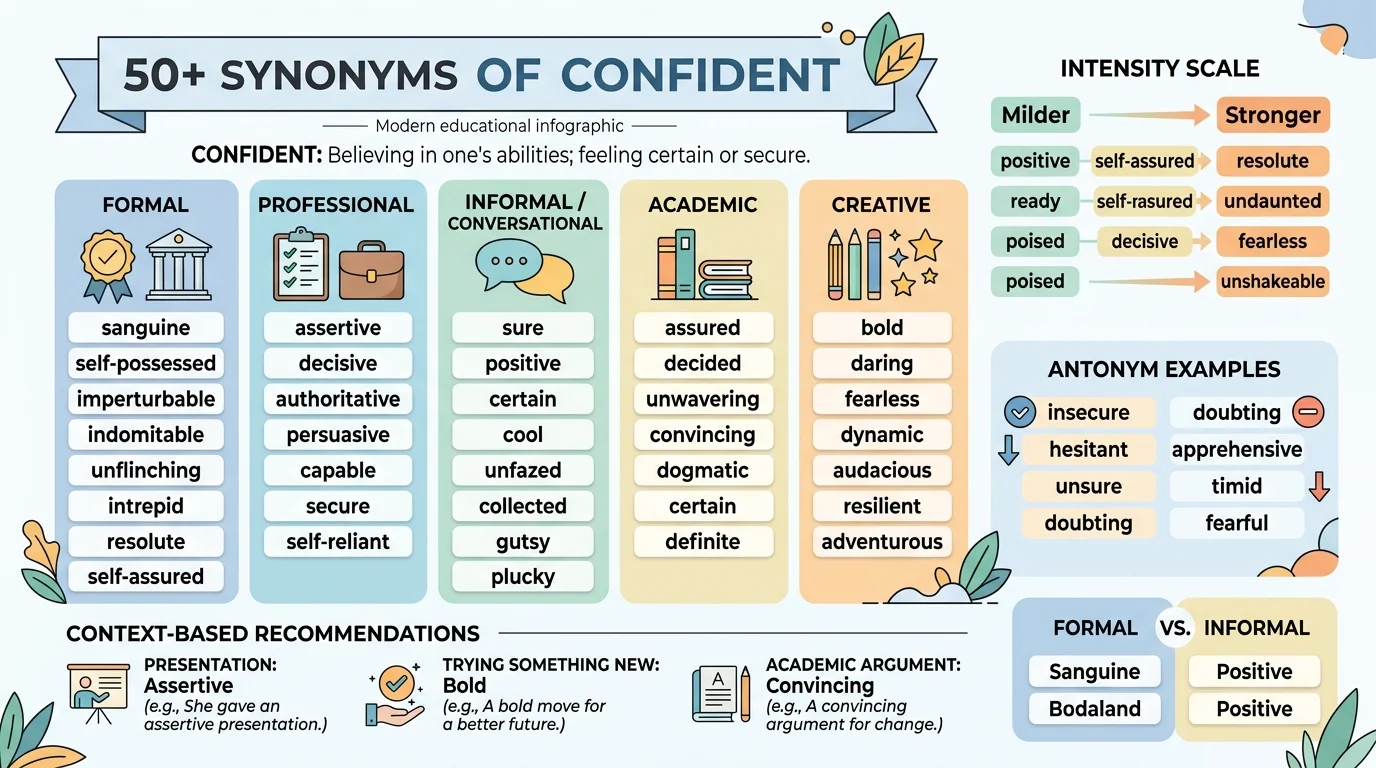
Confident means feeling or showing certainty about your abilities, judgment, or the outcome of a situation. For formal writing, use “assured” or “self-possessed.” For casual conversation, try “sure” or “positive.” In professional settings, “assertive” and “self-assured” work well. For emotional or creative writing, “fearless” and “bold” add impact. Choose based on your audience and purpose.
Meaning, Tone, and Context
Simple Definition
Confident describes a person who feels certain about their abilities, trusts their own judgment, or believes something will happen as expected. It is the feeling of knowing you can handle whatever comes your way.
Part of Speech
Confident is an adjective. The adverb form is “confidently.” The noun form is “confidence.”
Overall Tone
Confident is a positive word. It carries a sense of strength, capability, and self-belief. Unlike arrogance, which suggests an inflated sense of self, confident implies a realistic and earned trust in one’s abilities.
Formality Level
Confident is neutral in formality. It works equally well in professional emails, casual conversations, academic writing, and everyday speech. This versatility makes it useful, but it also means more precise alternatives exist for specific contexts.
Common Uses
Native English speakers use “confident” in many situations:
- Expressing belief in a future outcome: “I am confident we will meet the deadline.”
- Describing someone’s demeanor: “She gave a confident presentation.”
- Talking about self-belief: “He feels more confident about his skills now.”
- Reassuring others: “You should feel confident in your decision.”
Word Forms
- Adjective: confident
- Adverb: confidently
- Noun: confidence
- Verb (rare): confide (different meaning)
- Opposite: diffident, insecure, uncertain
When and How to Use “Confident”
Choose “confident” when you want a straightforward, widely understood word that works in almost any context. It is your default choice for general communication. Here are seven realistic examples showing how to use it naturally.
Professional
The team feels confident about securing the new client account.
Academic
Researchers are confident that their findings will influence future studies in the field.
Workplace
My manager seems confident in my ability to lead this project.
Personal
I finally feel confident enough to pursue my dream of starting a business.
Email
We are confident that the proposed solution addresses all your concerns.
Resume
Confident communicator with proven experience in cross-functional team leadership.
Social Media
Feeling confident and ready to take on the week ahead. #MondayMotivation
Best Synonyms of “Confident”
No synonym is identical in every situation. Each alternative carries its own nuance, tone, and level of formality. Here are the best synonyms for specific contexts.
Professional writing: Assured. This word conveys calm, steady confidence that inspires trust in others. It sounds polished and reliable.
Academic writing: Self-possessed. This formal term suggests composure and control, ideal for research papers and scholarly articles.
Business communication: Assertive. This word emphasizes confidence in expressing ideas and standing up for what you believe. It is perfect for negotiations and leadership.
Casual conversation: Sure. Simple, direct, and friendly. “Sure” feels natural in everyday speech without sounding overly formal.
Emotional writing: Fearless. This word adds dramatic impact and conveys courage in the face of uncertainty.
Creative writing: Bold. Bold suggests confidence that takes risks and stands out. It works well in fiction and descriptive writing.
Resume writing: Self-assured. This term projects quiet confidence without arrogance. It tells employers you know your value.
Workplace communication: Poised. Poised suggests calm confidence under pressure, an excellent quality in any professional setting.
Stronger meaning: Dauntless. This word means fearless and undaunted, suggesting confidence that cannot be shaken.
Softer meaning: Positive. Positive is gentler than confident. It suggests optimism rather than absolute certainty.
When Not to Use “Confident”
Sometimes “confident” is not the best choice. Here are situations where you should reach for a more precise word.
When the word sounds too general. If you are writing a performance review, “confident” might not provide enough detail. Instead of saying “She is confident,” try “She demonstrates assertive leadership in team meetings.”
When the word sounds too vague. In a resume, “confident communicator” is fine, but “self-assured presenter with experience addressing executive audiences” is stronger and more specific.
When the word sounds too formal. In a text message to a friend, “I am confident I can make it” sounds stiff. “I am sure I can make it” feels more natural.
When the word sounds too informal. In a formal report, “We are sure the data is accurate” is acceptable, but “We are certain the data is accurate” sounds more authoritative.
When the word sounds too weak. If you need to convey unshakeable belief, “confident” may not be strong enough. Use “convinced” or “assured” instead.
When the word sounds too strong. In sensitive situations, “confident” might come across as overbearing. “Positive” or “hopeful” can soften the message.
Incorrect: I am confident that the proposal might be accepted.
Better: I am confident that the proposal will be accepted.
Why: Confidence implies certainty, not possibility. Using “might” undermines the strength of the word.
Words Commonly Confused With “Confident”
Confident vs. Confidant
Difference: Confident is an adjective describing a person who feels sure of themselves. Confidant is a noun meaning a trusted person you share secrets with. They are spelled differently and have completely different meanings.
When to Use It: Use “confident” for feelings of certainty. Use “confidant” for a trusted friend.
Example: She felt confident about her decision and shared it with her closest confidant.
Confident vs. Arrogant
Difference: Confident is positive and based on real ability. Arrogant is negative and suggests an inflated sense of self-worth without the skills to back it up.
When to Use It: Use “confident” to describe someone with genuine self-belief. Use “arrogant” only when criticizing excessive pride.
Example: He was confident in his presentation skills, but his arrogant attitude turned off the audience.
Confident vs. Cocky
Difference: Cocky is an informal, disapproving term for someone who is overly confident in a way that annoys others.
When to Use It: Use “cocky” in casual conversation when describing someone who is smug or conceited. Avoid it in professional writing.
Example: The rookie was cocky about his chances, but the experienced players knew better.
Confident vs. Secure
Difference: Secure suggests freedom from worry or doubt, often because of external factors like support or safety. Confident is more about internal belief.
When to Use It: Use “secure” when describing a stable, protected feeling. Use “confident” for self-belief.
Example: She felt secure in her job and confident in her ability to handle any challenge.
Confident vs. Positive
Difference: Positive often means optimistic or hopeful, while confident means certain or sure.
When to Use It: Use “positive” when you want to express optimism. Use “confident” for stronger certainty.
Example: I am positive we can improve the numbers, and I am confident we will exceed our targets.
Confident vs. Certain
Difference: Certain suggests knowledge without doubt, often based on evidence. Confident can be based on belief or feeling.
When to Use It: Use “certain” when you have factual proof. Use “confident” when you have strong belief.
Example: I am certain the report is correct because I verified every number. I am confident the client will approve it.
Best Synonyms of “Confident” by Context
| Context | Best Synonym | Why It Works | Example |
|---|---|---|---|
| Formal writing | Assured | Sounds polished and reliable | The ambassador delivered an assured address to the assembly. |
| Academic writing | Self-possessed | Conveys composure and intellectual control | The self-possessed scholar handled challenging questions with ease. |
| Professional communication | Assertive | Shows strength without aggression | We need an assertive leader who can negotiate effectively. |
| Business emails | Positive | Optimistic and professional | We are positive about the partnership’s potential. |
| Resume writing | Self-assured | Projects quiet confidence and competence | Self-assured project manager with a track record of on-time delivery. |
| Workplace communication | Poised | Suggests calm confidence under pressure | She remained poised during the entire crisis. |
| Casual conversation | Sure | Simple, natural, and friendly | I am sure we can figure this out together. |
| Everyday speaking | Positive | Upbeat and approachable | I feel positive about how things are going. |
| Creative writing | Bold | Adds dramatic flair and risk-taking energy | The bold heroine stepped into the unknown without hesitation. |
| Storytelling | Fearless | Creates emotional impact and courage | His fearless pursuit of justice inspired everyone around him. |
| Emotional writing | Dauntless | Conveys unshakeable courage | Her dauntless spirit carried her through every hardship. |
| Strong emphasis | Convinced | Shows complete persuasion and certainty | I am convinced this is the right path forward. |
| Mild tone | Hopeful | Gentle and optimistic without overpromising | We are hopeful about the upcoming changes. |
| Social media captions | Unstoppable | Energetic and motivating | Feeling unstoppable today. Let’s go! |
| American English | Confident | Standard, widely understood | She is confident about her new role. |
How to Choose the Best Synonym of “Confident”
Choosing the right synonym depends on several factors. Start by considering your meaning. Are you expressing certainty about an outcome, describing someone’s personality, or showing belief in abilities?
Next, think about your audience. A formal report for executives requires different language than a text message to a friend. Match your word choice to who will read it.
Consider the emotional strength you want to convey. “Hopeful” is gentle. “Dauntless” is powerful. Choose the intensity that fits your message.
Think about your writing purpose. Are you persuading, informing, inspiring, or entertaining? Each purpose benefits from different shades of confidence.
Finally, read your sentence aloud. Does the word sound natural? If it feels forced or awkward, try a different synonym. The best word is the one that communicates your message most clearly.
Real Life Examples of “Confident”
School
Maria felt confident about her math exam after weeks of studying.
College
The confident freshman volunteered to answer the professor’s question on the first day.
Workplace
Our manager is confident that the new software will streamline operations.
Business
The CEO gave a confident presentation that reassured investors about the company’s direction.
Email
I am confident we can resolve this issue by the end of the week.
Resume
Confident decision-maker with a history of successful project completions.
Conversation
“You seem really confident about this plan,” Jake said. “I am,” Sarah replied. “I have done the research.”
Storytelling
The confident knight strode into the dragon’s lair without a trace of fear.
Blogging
Building a confident mindset starts with acknowledging your strengths and accepting your weaknesses.
Social Media
Confident vibes only. Here is to chasing your dreams unapologetically.
18 Best Synonyms of “Confident”
| Synonym | Simple Meaning | Best Used For | Example Sentence |
|---|---|---|---|
| Assured | Calm and certain, showing self-belief | Professional and formal writing | Her assured handling of the crisis earned everyone’s respect. |
| Self-assured | Confident in your own abilities and judgment | Resumes and self-descriptions | He is a self-assured leader who trusts his team. |
| Assertive | Confident in expressing opinions and needs | Business and workplace communication | You need to be more assertive in meetings to get your ideas heard. |
| Bold | Willing to take risks and act confidently | Creative writing and storytelling | The bold decision transformed the company’s future. |
| Positive | Optimistic and certain about good outcomes | Everyday conversation and emails | I am positive we will find a solution. |
| Certain | Without any doubt, based on knowledge | Academic and factual writing | Scientists are certain about the data’s accuracy. |
| Convinced | Fully persuaded and sure about something | Strong emphasis and persuasion | I am convinced this strategy will work. |
| Secure | Free from worry, safe in your position | Describing stable confidence | She feels secure in her role at the company. |
| Self-possessed | Calm and in control of your emotions | Formal and academic contexts | The self-possessed speaker captivated the audience. |
| Fearless | Without fear, showing great courage | Emotional and dramatic writing | The fearless activist spoke truth to power. |
| Poised | Graceful and composed under pressure | Professional and social situations | She remained poised throughout the difficult negotiation. |
| Dauntless | Unable to be intimidated or discouraged | Inspirational and heroic contexts | His dauntless determination inspired the whole team. |
| Self-reliant | Confident in depending on yourself | Personal development and independence | Growing up in a big family made her self-reliant. |
| Sanguine | Optimistically confident, especially in difficult situations | Literary and sophisticated writing | He remained sanguine about the economy’s recovery. |
| Unafraid | Not feeling fear, boldly confident | Casual and conversational use | She is unafraid to speak her mind. |
| Intrepid | Fearless and adventurous | Storytelling and travel writing | The intrepid explorer ventured into unknown territory. |
| Upbeat | Cheerfully optimistic and confident | Social media and casual contexts | The upbeat team captain kept morale high. |
| Self-confident | Confident in yourself and your abilities | General use and self-improvement | He became more self-confident after the training program. |
Synonyms of “Confident” by Usage
Professional vs Personal Synonyms
In professional settings, choose words that project competence without arrogance. “Assured,” “self-assured,” and “assertive” are excellent choices. They sound polished and reliable.
In personal conversations, simpler words work better. “Sure,” “positive,” and “certain” feel natural and friendly. They do not sound like you are trying too hard.
Professional: The assured manager navigated the restructuring with confidence.
Personal: I am sure we will have a great time at the concert.
Formal vs Conversational Synonyms
Formal writing benefits from precise, sophisticated vocabulary. “Self-possessed,” “sanguine,” and “dauntless” add authority to reports, essays, and presentations.
Conversational English favors shorter, more common words. “Sure,” “positive,” and “upbeat” fit casual chats, texting, and social media posts.
Formal: The committee remained sanguine about the project’s timeline despite initial setbacks.
Conversational: I feel positive about how things are going.
Academic Synonyms
Academic writing demands clarity and precision. “Certain” and “convinced” work well when presenting research findings. “Self-possessed” describes composed scholars and researchers. These words sound authoritative and evidence-based.
Professional and Business Synonyms
In resumes, interviews, and business emails, choose words that highlight your strengths. “Self-assured” tells employers you know your value. “Assertive” shows you can lead and negotiate. “Poised” suggests you handle pressure gracefully. These synonyms make your professional communication stronger and more memorable.
Creative and Literary Synonyms
Writers and storytellers need expressive language. “Fearless,” “bold,” and “dauntless” add drama and emotion to fiction and poetry. “Intrepid” works well for adventurous characters. “Sanguine” brings a sophisticated touch to literary descriptions. These words help you paint vivid pictures with your writing.
Slang or Modern Synonyms
“Unstoppable” is a modern, energetic way to say confident, often used on social media. “Cocky” is informal and disapproving, describing overconfidence that annoys others. Use slang sparingly and only in casual contexts. Avoid it in professional or academic writing.
Strongest to Mildest Synonyms
Mild
- Hopeful
- Positive
- Upbeat
- Sure
Moderate
- Confident
- Self-assured
- Assured
- Secure
Strong
- Convinced
- Certain
- Assertive
- Poised
Very Strong
- Fearless
- Dauntless
- Intrepid
- Bold
Emotional vs Neutral Synonyms
Emotional Synonyms
- Fearless (courage)
- Dauntless (determination)
- Bold (risk-taking)
- Intrepid (adventure)
These words express strong feelings and add dramatic impact to your writing.
Neutral Synonyms
- Assured (calm certainty)
- Certain (factual knowledge)
- Sure (simple confidence)
- Positive (optimistic belief)
These words communicate information clearly without adding emotional weight.
Antonyms of “Confident”
Comparison: “Confident” vs Similar Words
Confident vs Assured
Main Difference: Confident describes a personal belief in one’s abilities. Assured emphasizes a calm, steady certainty that others can perceive.
Which Is Stronger? Assured is slightly stronger because it suggests confidence that is so solid it shows in your demeanor.
Which Is More Formal? Assured is more formal and polished.
When to Use Each: Use “confident” for internal feelings. Use “assured” to describe external presence and performance.
Examples:
Confident: I am confident I can finish the project on time.
Assured: Her assured presentation convinced everyone of her expertise.
Confident vs Self-Assured
Main Difference: Confident can apply to any situation. Self-assured specifically refers to confidence in oneself as a person.
Which Is Stronger? Self-assured is stronger because it describes a deeper, more personal sense of certainty.
Which Is More Formal? Both are neutral, but self-assured sounds more introspective.
When to Use Each: Use “confident” for general situations. Use “self-assured” when describing someone’s overall personality.
Examples:
Confident: He felt confident about his exam results.
Self-assured: She is a self-assured woman who knows what she wants.
Confident vs Assertive
Main Difference: Confident is about feeling sure. Assertive is about expressing that sureness openly and standing up for yourself.
Which Is Stronger? Assertive implies action and is stronger in social and professional contexts.
Which Is More Formal? Assertive is common in both formal and informal settings.
When to Use Each: Use “confident” for internal states. Use “assertive” when describing how someone communicates.
Examples:
Confident: He is confident in his ideas.
Assertive: She is assertive in presenting her ideas to the team.
Confident vs Bold
Main Difference: Confident suggests belief in success. Bold suggests a willingness to take risks and act decisively.
Which Is Stronger? Bold is stronger because it implies action and courage, not just belief.
Which Is More Formal? Bold works in both formal and informal contexts, but it is more common in creative writing.
When to Use Each: Use “confident” for certainty. Use “bold” for risk-taking and daring actions.
Examples:
Confident: She was confident the plan would succeed.
Bold: She made a bold decision to change careers.
Confident vs Sure
Main Difference: Confident often implies belief in oneself or a positive outcome. Sure is simpler and more factual, meaning without doubt.
Which Is Stronger? Confident is slightly stronger because it carries emotional weight.
Which Is More Formal? Sure is more casual and conversational.
When to Use Each: Use “sure” in everyday conversation. Use “confident” when you want to sound more deliberate.
Examples:
Confident: I am confident we will win.
Sure: I am sure the store is open until 9 PM.
Confident vs Certain
Main Difference: Certain is based on knowledge or evidence. Confident can be based on belief or feeling.
Which Is Stronger? Certain is stronger because it implies factual proof.
Which Is More Formal? Certain is more formal and objective.
When to Use Each: Use “certain” when you have evidence. Use “confident” when you have strong belief.
Examples:
Confident: I am confident the team will perform well.
Certain: I am certain the data supports our conclusion.
Common Phrases and Expressions with “Confident”
Confident in
Meaning: Trusting or believing in someone or something.
Example Sentence: I am confident in your ability to handle this project.
Confident about
Meaning: Feeling sure about a particular situation or outcome.
Example Sentence: She is confident about her chances of getting the promotion.
Confident of
Meaning: Certain that something will happen.
Example Sentence: He was confident of victory before the match even began.
Confident that
Meaning: Believing strongly that something is true or will happen.
Example Sentence: Doctors are confident that she will make a full recovery.
Sound confident
Meaning: To speak or appear in a way that shows certainty.
Example Sentence: You need to sound confident during your presentation.
Feel confident
Meaning: To have a sense of self-assurance or certainty.
Example Sentence: I finally feel confident enough to apply for that position.
Confident decision
Meaning: A choice made with certainty and without hesitation.
Example Sentence: She made a confident decision to accept the job offer.
Common Mistakes to Avoid
1: Choosing a vague synonym instead of a precise one.
Incorrect: He gave a confident performance.
Better: He gave an assured performance.
Why: “Assured” is more precise for describing a polished, professional performance.
2: Confusing “confident” with “confidant.”
Incorrect: She is my closest confident.
Better: She is my closest confidant.
Why: Confident is an adjective. Confidant is a noun meaning a trusted person.
3: Using an informal synonym in formal writing.
Incorrect: The CEO was upbeat about the quarterly results.
Better: The CEO was positive about the quarterly results.
Why: “Upbeat” is too casual for a formal business report.
4: Selecting an overly dramatic synonym for a mild situation.
Incorrect: I am fearless about trying the new restaurant.
Better: I am positive about trying the new restaurant.
Why: “Fearless” is too strong for a casual situation like trying a restaurant.
5: Repeating the same word too often.
Incorrect: She is confident in her skills. She is confident about the interview. She is confident she will get the job.
Better: She is confident in her skills. She feels assured about the interview. She is certain she will get the job.
Why: Varying your word choice makes your writing more engaging and professional.
6: Choosing a synonym with the wrong emotional tone.
Incorrect: The assertive teacher helped the shy student.
Better: The patient teacher helped the shy student.
Why: “Assertive” implies standing up for oneself, which does not fit the context of helping a shy student.
7: Using slang in academic or professional writing.
Incorrect: The research team was unstoppable in their findings.
Better: The research team was confident in their findings.
Why: “Unstoppable” is informal and inappropriate for academic writing.
Frequently Asked Questions
What are the best synonyms of “confident”?
The best synonyms depend on context. Formal writing, use “assured” or “self-possessed.” For casual conversation, try “sure” or “positive.” For professional settings, “assertive” and “self-assured” work well.
What are the best formal synonyms of “confident”?
The best formal synonyms are “assured,” “self-possessed,” and “sanguine.” These words sound polished and authoritative, making them ideal for academic papers, business reports, and professional correspondence.
What are common informal synonyms of “confident”?
Common informal synonyms include “sure,” “positive,” “upbeat,” and “unstoppable.” These words feel natural in everyday conversation, text messages, and social media posts.
What is another word for “confident” in professional writing?
In professional writing, use “assured,” “self-assured,” or “assertive.” These words project competence and reliability without sounding arrogant. They are excellent choices for resumes, emails, and presentations.
What is the difference between “confident” and “assured”?
Confident describes personal belief in one’s abilities. Assured emphasizes a calm, steady certainty that others can see. Assured is slightly more formal and polished.
What is the opposite of “confident”?
The opposite of confident includes “diffident,” “insecure,” “uncertain,” “timid,” and “hesitant”. These words describe a lack of self-belief or doubt about one’s abilities.
Conclusion
Confident is a versatile word that describes certainty in yourself, your abilities, or a future outcome. It is positive, neutral in formality, and widely understood. But no single word works perfectly in every situation. Understanding the synonyms of confident allows you to choose the exact word for your audience, tone, and purpose.
The best synonym depends on context. Use “assured” for formal writing, “sure” for casual conversation, “assertive” for professional communication, and “fearless” for emotional impact. Match your word choice to your message, and your writing will become clearer, stronger, and more natural.
A practical tip: keep a list of your favorite synonyms nearby. When you write, challenge yourself to use at least one alternative to “confident” in every piece of communication. Over time, choosing the right word will become second nature.