Have you ever noticed how often you type or say the word after in your daily communication? It appears in emails, essays, captions, and conversations more than you might realize. You might find yourself repeating after again and again without even noticing.
This overuse can make your writing feel repetitive and dull. Whether you are a student working on an essay, a professional drafting an important email, or a writer looking for variety, finding the right synonym for after can transform your communication.
This guide will help you understand the meaning of after and provide you with a rich collection of alternatives. You will learn which synonyms work best in formal documents, casual chats, creative projects, and professional settings. Let us explore how to use these words with confidence and precision.
What Does “After” Mean?
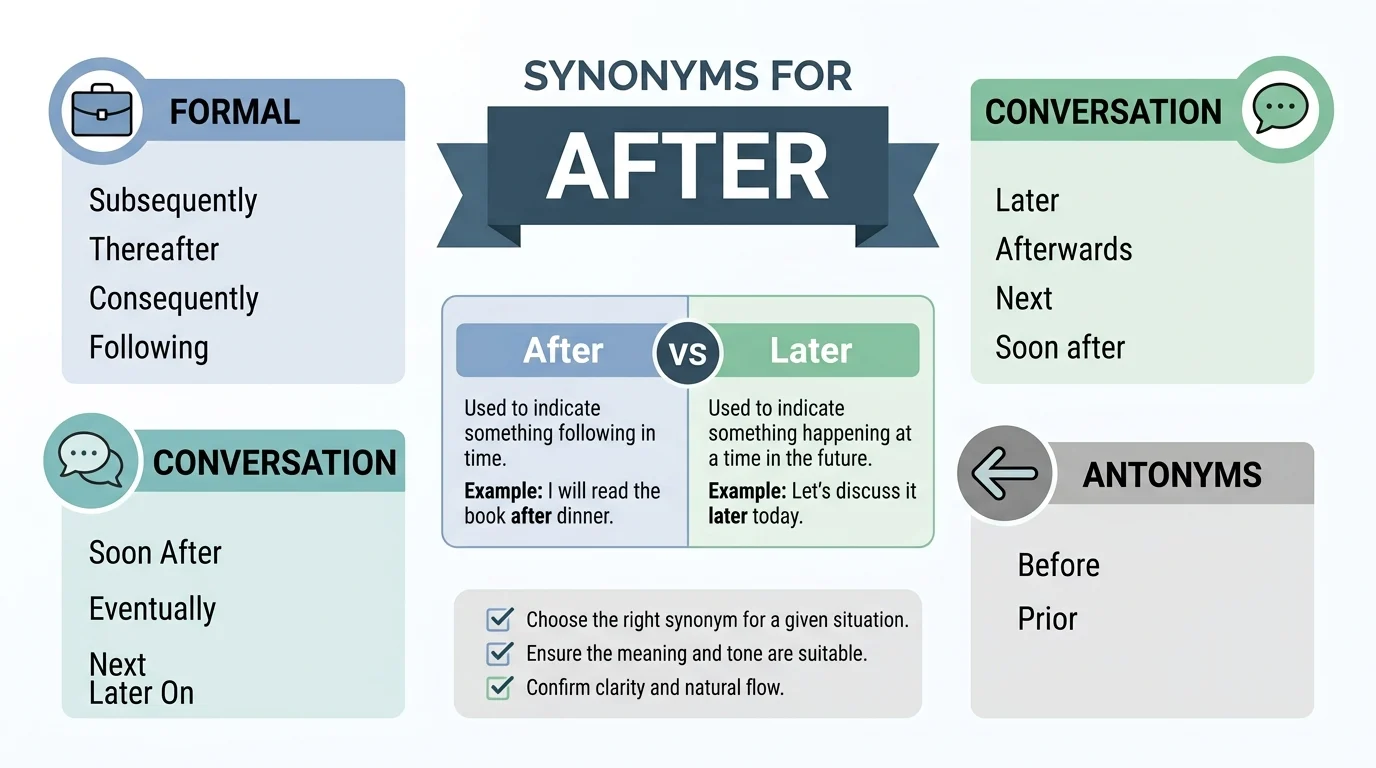
After primarily means later in time or following something in order. The best synonyms depend on your context. For formal writing, use subsequently or thereafter.casual conversation, try later or next. For professional settings, consider following or subsequent to. Academic work benefits from afterwards or consequently.
Meaning, Tone and Context
Simple Definition
After means following in time, order, or position. It indicates that one event, action, or item comes later than another.
Part of Speech
After functions as a preposition, adverb, conjunction, and adjective. Its versatility makes it one of the most common words in English.
Tone
The tone of after is completely neutral. It does not carry positive or negative emotional weight by itself. The surrounding words determine the overall feeling of your sentence.
Formality Level
After works in every formality level from casual texting to academic papers. This universal applicability explains why it appears so frequently in everyday language.
Common Use Cases
People use after to show sequence in time, cause and effect relationships, physical position, and logical order. It helps organize thoughts and create clear timelines in writing and speaking.
Important Word Forms
The adverbial form afterwards appears frequently in British English. The adjective form later is common in American usage. The noun form aftermath describes the consequences following an event.
When and How to Use “After”
The word after works perfectly when you need to show simple time relationships or basic sequence. Use it in everyday writing where clarity matters more than stylistic variety.
Here are realistic examples of after in different contexts.
Professional Context
Our team will review the proposal after we receive the final budget numbers from accounting.
Personal Context
We decided to take a walk after dinner because the weather was so pleasant.
Academic Context
The experiment yielded significant results after the researchers adjusted the temperature settings.
Emotional Context
She felt a wave of relief after she received the good news about her test results.
Creative Context
The sun painted the sky in brilliant colors after the storm finally passed.
Social Media Context
Celebrating the big win after months of hard work and dedication.
Email Context
I will send the updated file after I finish reviewing the client feedback.
Casual Context
Let us meet at the cafe after your class ends this afternoon.
Another Word for “After”
The best single replacement for after depends entirely on your specific situation and context. Here are the top alternatives for various writing scenarios.
Professional Writing
Subsequent to works well in business reports and formal correspondence. It sounds polished and precise.
Academic Writing
Subsequently appears frequently in research papers and scholarly articles. It shows clear logical progression.
Casual Conversation
Later feels natural and friendly in everyday speech. It fits perfectly in texts and informal chats.
Emotional Writing
Following carries a gentle, narrative quality that works well in personal stories and reflective pieces.
Creative Writing
Thereafter adds a literary touch to fiction and descriptive prose. It creates a sense of unfolding events.
Resume and Workplace Use
Post is concise and modern for resumes and professional summaries. It saves space while sounding current.
Social Media Captions
Next works beautifully for Instagram and TikTok captions. It keeps the tone light and engaging.
Stronger Meaning
Consequently emphasizes the logical outcome or result of a previous action.
Softer Meaning
Then provides a gentle transition without drawing too much attention to the sequence.
When Not to Use “After”
After sometimes sounds too vague or general for precise communication. In these situations, a more specific synonym improves your writing significantly.
Too Vague
After the meeting, we discussed the project.
More Precise
Following the meeting, we discussed the project.
The revised version creates a stronger connection between the two events.
Too Casual
We will address this issue after we get the data.
More Professional
We will address this issue once we obtain the data.
The second option sounds more authoritative and intentional.
Too Weak
She felt sad after he left.
More Emotional
She felt sadness wash over her following his departure.
The stronger synonym adds depth and feeling to the sentence.
Too General
After the incident, changes were made.
More Specific
In the aftermath of the incident, significant changes were implemented.
The specific synonym clarifies the relationship between events.
Words Commonly Confused With “After”
Several words are often mistaken for after, but each has a distinct meaning and usage.
After vs. Later
After shows a sequence relationship between two things. Later simply means at a future time without referencing another event.
After vs. Then
After is a preposition showing position or time. Then is an adverb indicating what happens next in a sequence.
After vs. Next
After shows relative position to something else. Next simply means the following item in a sequence.
After vs. Since
Since indicates a starting point in time and implies continuation. After simply marks a point following another event.
vs. Behind
Behind refers to physical position at the back of something. After refers to time or order.
After vs. Following
Following means coming immediately after.can indicate any time later, even with a gap.
Best Synonym by Context for “After”
| Context | Best Synonym | Why It Works | Example |
|---|---|---|---|
| Formal Writing | Subsequently | Creates a professional academic tone | The board approved the budget and subsequently allocated funds. |
| Academic Writing | Thereafter | Indicates clear chronological progression | The sample was heated and thereafter analyzed for purity. |
| Business Use | Subsequent to | Sounds polished and authoritative | Subsequent to the merger, new policies were implemented. |
| Resume Writing | Post | Modern and concise for professional summaries | Post internship, I managed a team of five employees. |
| Casual Conversation | Later | Natural and friendly in everyday speech | I will call you later when I finish my shift. |
| Creative Writing | Afterwards | Adds gentle narrative flow to descriptions | The rain stopped, and afterwards the garden sparkled. |
| Emotional Tone | Following | Creates a soft, reflective quality | Following the loss, she found comfort in writing. |
| Strong Intensity | Consequently | Emphasizes cause and effect strongly | The team failed to prepare and consequently lost the match. |
| Soft Intensity | Then | Provides a simple, gentle transition | We ate dinner and then went for a walk. |
| Social Media | Next | Keeps captions light and engaging | Next stop, the beach for some well earned relaxation. |
| US Usage | After | Standard American English usage | After work, I go to the gym. |
| UK Usage | Afterwards | More common in British English writing | We had tea and afterwards went to the cinema. |
Which Synonym Should You Choose?
Choosing the right synonym for after requires you to consider several factors about your writing situation.
Consider Your Meaning
Think about what you want to emphasize. Are you showing time, order, or result? The meaning you intend guides your choice.
Evaluate the Formality
Match the formality level of your synonym to your document. A resume needs professional language. A text message works fine with casual words.
Assess Emotional Intensity
Decide whether you need emotional weight or neutral language. Some synonyms carry more feeling than others.
Think About Professional Value
In workplace writing, professional synonyms create a stronger impression. They show attention to detail and communication skill.
Examine Your Sentence Context
Look at the words around your synonym. Some alternatives fit better with certain grammatical structures than others.
Real Life Examples of “After” in Sentences
These examples show how after and its alternatives appear in different situations.
School Context
The students submitted their papers and subsequently received feedback from their professor.
Workplace Context
Post approval, the marketing team launched the new campaign across all social media channels.
Writing Context
The author described the setting and thereafter introduced each character gradually.
Conversation Context
We should grab coffee after the presentation finishes this afternoon.
Social Media Context
A year after starting this journey, I finally reached my goal.
Resume Context
After leading three successful product launches, I developed expertise in project management.
Email Context
I will send the complete report following our meeting tomorrow morning.
Storytelling Context
The storm passed, and afterwards the village slowly began to rebuild.
25 Synonyms for “After”
| Synonym | Simple Meaning | Best Used For | Example Sentence |
|---|---|---|---|
| Subsequently | Following in time or order | Academic and formal writing | The committee reviewed the proposal and subsequently approved it. |
| Thereafter | After that time | Literary and formal contexts | He accepted the position and thereafter dedicated his career to research. |
| Afterwards | At a later time | Casual and personal writing | We finished dinner and afterwards watched a movie. |
| Following | Coming next after something | Professional and narrative use | Following the presentation, the team asked insightful questions. |
| Next | Immediately after | Conversational and simple writing | Please complete this form and next sign your name. |
| Later | At a future time | Everyday conversation | I will explain everything later when we have more time. |
| Consequently | As a result of | Cause and effect writing | The funding was approved and consequently the project began. |
| Then | At that time | Simple sequential writing | She arrived and then we started the meeting. |
| Post | After in time | Modern and professional use | Post graduation, she started her own business. |
| Ensuing | Coming right after | Formal and descriptive writing | The ensuing discussion clarified many important issues. |
| Succeeding | Coming after in order | Academic and structured writing | The succeeding chapter explores this topic in depth. |
| Subsequent to | Following in time | Professional business documents | Subsequent to the audit, new procedures were established. |
| In the wake of | Following an event | Emotional and narrative writing | In the wake of the storm, the community came together. |
| As a result of | Because of an event | Logical and cause effect writing | As a result of the training, productivity increased significantly. |
| In the aftermath of | Following a significant event | Serious and historical writing | In the aftermath of the war, reconstruction efforts began. |
| Trailing | Following behind | Descriptive and creative writing | The younger child came trailing behind her older brother. |
| Pursuant to | Following in accordance with | Legal and formal documents | Pursuant to the regulations, all employees must complete training. |
| Thereafter | From that time onward | Literary and chronological writing | The couple married and thereafter lived happily. |
| Afterward | At a later time | American English casual use | We went to the museum and afterward visited the cafe. |
| Eventually | After some time passes | Storytelling and future focus | Eventually, his hard work paid off with a promotion. |
| Ultimately | After everything considered | Conclusion and summary writing | Ultimately, the decision rested with the board members. |
| Finally | After a long wait | Emotional and personal writing | Finally, after years of effort, she achieved her dream. |
| In due course | After the appropriate time | Professional and formal use | In due course, all applications will be reviewed carefully. |
| By and by | After a period of time | Literary and old fashioned use | By and by, the travelers reached their destination. |
| At a later date | At some future time | Professional scheduling | We will address this matter at a later date. |
Synonym Groups and Usage Differences
Professional vs. Personal Synonyms
Professional synonyms like subsequent to and post sound more formal and structured. They work well in reports, emails, and business documents. Personal synonyms like later and afterwards feel warm and natural for conversations with friends and family.
Formal vs. Conversational Synonyms
Formal synonyms appear in essays, reports, and speeches. Words like subsequently and thereafter fit these contexts perfectly. Conversational synonyms like next and then flow easily in texts, casual emails, and everyday talk. Choose based on your audience and setting.
Academic Synonyms
Academic writing benefits from precise, clear synonyms. Subsequently and ensuing show careful logical progression. Following works well for methodology sections. Thereafter fits literature reviews and chronological descriptions. These words maintain the scholarly tone expected in academic work.
Professional and Business Synonyms
Business writing demands professional alternatives. Post and subsequent to work well in emails. Ensuing suits presentation descriptions. In due course sounds appropriate for scheduling communications. These synonyms project competence and attention to detail.
Creative or Literary Synonyms
Creative writing allows for richer vocabulary. Afterwards adds gentle narrative flow. In the wake of creates visual imagery. By and by brings an old fashioned charm. Trailing works beautifully for descriptive passages. These alternatives add depth to storytelling.
Slang or Modern Synonyms
No common slang alternatives exist for after in mainstream English. Some casual phrases like down the road or later on appear in informal conversation. These work for texts and social media but not for professional or academic writing.
Strongest vs. Weaker Synonyms
The intensity of after synonyms varies considerably. Subsequently sounds neutral and factual. Consequently carries stronger logical force. In the aftermath of feels emotionally weighty. Eventually suggests a longer timeline. Choose the intensity that matches your meaning.
Emotional vs. Neutral Synonyms
Neutral synonyms like subsequently and thereafter convey information without emotional content. Emotional synonyms like in the wake of and in the aftermath of carry feeling and atmosphere. Following falls somewhere in between. Match your choice to your desired tone.
Antonyms of “After”
| Antonym | Meaning | Example Sentence |
|---|---|---|
| Before | Earlier in time | Please review the document before the meeting begins. |
| Prior to | Before a specific time | Prior to the interview, she researched the company. |
| Ahead of | In advance of something | We finished the project ahead of the deadline. |
| Preceding | Coming before in order | The preceding chapter covered the basic concepts. |
| Earlier | At a previous time | He had completed the task earlier in the week. |
| Previously | At an earlier time | The data had previously been collected by another team. |
| Fore | Before in position | The fore section of the plane offers more legroom. |
| Anterior | Situated before | The anterior portion of the report contains the summary. |
| In front of | Ahead of in position | The lead car remained in front of the pack. |
| Ahead | Further forward | The team was ahead of schedule on the project. |
| Erstwhile | Former or previous | His erstwhile colleagues remembered him fondly. |
| Former | Earlier in time | The former version of the software had fewer features. |
| First | Before all others | The first step is the most important. |
| Initial | Happening at the beginning | The initial response was overwhelmingly positive. |
| Introductory | Coming before the main content | The introductory remarks set the tone for the conference. |
Comparison: After vs. Similar Words
After vs. Later
The main difference lies in how each word relates to other events. After requires a reference point in time. Later simply points to a future time without comparison. After is the stronger choice when showing sequence. Later works better for general future references.
Example with after:
She called her mother after she finished work.
Example with later:
She called her mother later in the evening.
After vs. Then
After functions as a preposition showing position. Then works as an adverb indicating the next item in sequence. After connects two things directly. Then simply moves the narrative forward.
Example with after:
We went to the store after we ate lunch.
Example with then:
We ate lunch, and then we went to the store.
After vs. Next
After shows relative position to another thing. Next means the following item without comparison. After creates a relationship. Next provides simple progression.
Example with after:
The after dinner activities included games.
Example with next:
The next activity was a game.
After vs. Since
Since indicates a starting point and implies ongoing action. After marks a point in time following something else. Since suggests continuation. After suggests completion and sequence.
Example with after:
After the rain, we went outside.
Example with since:
Since the rain, we have stayed inside.
After vs. Behind
Behind refers to physical position at the back. After refers to time or order. Behind is spatial. After is temporal.
Example with behind:
The mailbox stood behind the fence.
Example with after:
The mail arrived after the storm.
After vs. Following
Following means immediately after with no gap. After can include some time between events. Following is more precise about immediacy. After is more flexible about timing.
Example with following:
Following the announcement, applause erupted.
Example with after:
After the announcement, changes were slowly implemented.
Common Phrases and Expressions with “After”
1. After all
Meaning: Despite expectations or contrary to assumptions.
Example sentence: We decided to go to the concert after all, even though we were tired.
2. After hours
Meaning: Outside of normal operating or working times.
Example sentence: The janitorial staff works after hours to clean the building.
3. Afterthought
Meaning: Something considered or added later than the original plan.
Example sentence: The parking garage was an afterthought in the building design.
4. After the fact
Meaning: After something has already happened.
Example sentence: He apologized after the fact, but the damage was already done.
5. After a fashion
Meaning: In a limited or imperfect way.
Example sentence: She could play the piano after a fashion, though she was not a professional.
6. After one’s own heart
Meaning: Sharing similar values or preferences.
Example sentence: My new colleague is a person after my own heart when it comes to attention to detail.
7. After the dust settles
Meaning: When the excitement or chaos ends.
Example sentence: We will evaluate the results after the dust settles from the election.
8. A day after the fair
Meaning: Too late or after an opportunity has passed.
Example sentence: He wanted to invest, but he arrived a day after the fair.
Common Mistakes to Avoid
1. Using After When a More Precise Synonym Works Better
Simple repetition of after makes writing feel dull and unsophisticated.
Instead of: After the meeting, after the presentation, after lunch.
Try: Following the meeting, subsequent to the presentation, post lunch.
2. Confusing After with Behind in Spatial Descriptions
After refers to time and order. Behind describes physical position.
Incorrect: He walked after me in the hallway.
Correct: He walked behind me in the hallway.
3. Using Casual Synonyms in Formal Writing
Informal alternatives like later on and down the road sound unprofessional in business documents.
Instead of: Later on, we will discuss this issue.
Use: Subsequently, we will discuss this issue.
4. Using Dramatic Synonyms for Simple Situations
Overly intense words sound unnatural in everyday contexts.
Instead of: In the aftermath of dinner, we washed dishes.
Use: After dinner, we washed dishes.
5. Repeating the Same Word Too Often
Monotonous writing loses reader interest and reduces impact.
Instead of: After we arrived, after we checked in, after we unpacked.
Use: After we arrived, we checked in and then unpacked.
6. Choosing a Synonym with the Wrong Emotional Tone
Some alternatives carry unintended emotional weight.
Instead of: In the wake of his promotion, he celebrated.
Use: Following his promotion, he celebrated.
7. Using Slang in Academic or Professional Writing
Casual expressions have no place in formal documents.
Avoid: We will handle that later on down the road.
Use: We will address that at a later date.
FAQs
1. What is the best synonym for after?
The best synonym depends entirely on your context. For formal writing, use subsequently. casual conversation, use later. For professional documents, use subsequent to.
2. What is a formal synonym for after?
Subsequently and thereafter are excellent formal alternatives. These words create a polished academic or professional tone in your writing.
3. What is an informal synonym for after?
Later and afterwards work well in casual conversation. Next is also a natural choice for everyday speech and texting.
4. What is another word for after in professional writing?
Subsequent to sounds highly professional and precise. Post works well for modern business communications and resume writing.
5. What is the difference between after and later?
After shows sequence relative to another event. Later simply means at a future time without making a specific comparison.
6. What is the opposite of after?
Before is the direct opposite of after. Prior to and preceding are also excellent antonyms in formal writing contexts.
Conclusion
After is a versatile and neutral word that helps us show sequence, time, and order in our communication. While it works in almost every context, overusing it makes your writing feel repetitive and dull.
The best synonyms for after depend on your situation. For formal writing, choose subsequently or thereafter. casual conversation, later or afterwards feel natural. For professional documents, subsequent to or post create a polished impression. Academic work benefits from ensuing or succeeding.
Always consider your tone, audience, and purpose before selecting an alternative. Stronger words like consequently and in the wake of add emotional intensity. Softer options like then and next keep things simple and clear.
The key to better writing lies in choosing the right word for the right moment. Match your vocabulary to your context, and your communication will become more precise, engaging, and effective.