Have you ever found yourself writing a report or essay and using the word “quantitative” over and over again? This happens to students, researchers, and professionals all the time.
You might be describing data, analysis, or research methods. Your writing starts to feel repetitive and dull. The word “quantitative” keeps appearing in every sentence, and you know you need better alternatives.
This guide will help you break that cycle. You will learn dozens of synonyms for quantitative that fit different contexts. Whether you are writing an academic paper, a business report, or a simple email, you will find the right word here.
What Does “Quantitative” Mean?
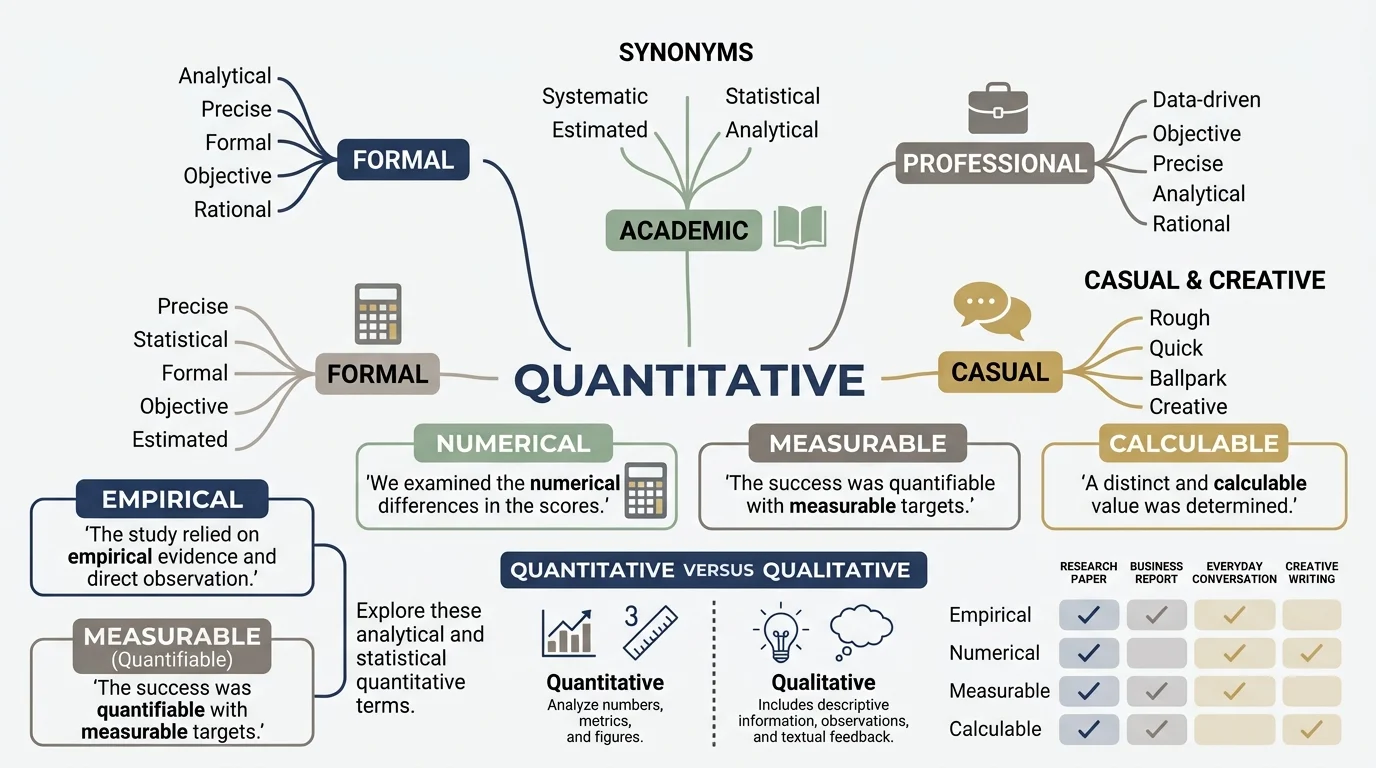
Quantitative refers to something that can be measured, counted, or expressed in numbers. The best synonyms depend on your context. For formal writing, use “numerical” or “statistical.” casual conversation, “measurable” or “countable” works well. For academic work, “empirical” or “data driven” are excellent choices.
Meaning, Tone and Context
Understanding the word “quantitative” fully helps you choose better alternatives. Let us break down everything you need to know about this versatile term.
Simple Definition
Quantitative means relating to or involving numbers, amounts, or measurements. It describes things that can be counted, measured, or expressed numerically.
Part of Speech
Quantitative is an adjective. It modifies nouns like data, analysis, research, or methods. The noun form is “quantity.” The adverb form is “quantitatively.”
Tone
The word carries a neutral tone in most contexts. It is factual and objective. It does not express emotion or opinion.
Formality Level
Quantitative is moderately formal. It is appropriate for academic, professional, and technical writing. It sounds too formal for casual conversation or social media posts.
Common Use Cases
You will encounter this word in research papers, business reports, data analysis, economics, science, and statistics. It often appears alongside words like “qualitative” when comparing research approaches.
Important Word Forms
The adjective form “quantitative” is most common. The noun “quantity” describes the amount itself. The verb “quantify” means to measure or express something in numbers. The adverb “quantitatively” describes actions done using numbers.
When and How to Use “Quantitative”
You should use “quantitative” when you want to emphasize numbers, measurements, or countable data. This word adds precision and clarity to your writing. It signals to readers that you are discussing measurable information rather than subjective opinions.
Here are realistic examples showing how to use “quantitative” in different situations.
Professional Context
The marketing team analyzed the quantitative data from our latest campaign to determine ROI.
Academic Context
Her dissertation focused on quantitative research methods to study consumer purchasing behavior.
Personal Context
I prefer quantitative goals like saving five hundred dollars each month instead of vague objectives.
Scientific Context
The experiment required quantitative measurements of temperature changes over time.
Business Context
Our quarterly report includes both quantitative metrics and qualitative feedback from clients.
Resume Context
Developed quantitative models to forecast sales trends and improve inventory management.
Email Context
Please send the quantitative breakdown of our quarterly expenses before the meeting.
Another Word for “Quantitative”
The best single replacement for “quantitative” depends entirely on your context. Here are the most effective alternatives for different situations.
Professional Writing
“Numerical” works perfectly in professional settings. It sounds precise and businesslike.
Academic Writing
“Empirical” is an excellent choice for research papers. It emphasizes evidence based on observation.
Casual Conversation
“Measurable” feels more natural in everyday speech. It is clear and easy to understand.
Emotional Writing
“Concrete” adds a sense of solidity and reliability. It suggests something you can trust and count on.
Creative Writing
“Tangible” gives a sense of something you can hold or grasp. It adds texture to your description.
Resume or Workplace
“Analytical” highlights your ability to work with numbers and data effectively.
Social Media Captions
“Numbers based” is simple and relatable for social media audiences.
Stronger Meaning
“Statistical” emphasizes the mathematical rigor behind the numbers.
Softer Meaning
“Appreciable” suggests a noticeable amount without being overly technical.
When Not to Use “Quantitative”
There are times when “quantitative” sounds too vague, too formal, or simply wrong. Learning when to avoid it will improve your writing instantly.
When the Topic Is Subjective
Do not use “quantitative” when describing feelings, opinions, or experiences. These cannot be measured numerically. Use “qualitative” or “subjective” instead.
When You Need Specificity
Saying “quantitative analysis” is vague. Saying “regression analysis” or “statistical modeling” is much more precise. Choose specific terms when possible.
In Casual Conversation
Using “quantitative” in everyday talk can make you sound stiff. Say “numbers based” or “measurable” instead.
Weak Example
The report included quantitative information about our sales.
Improved Version
The report included monthly sales figures for each region.
Weak Example
We need a quantitative approach to this problem.
Improved Version
We need to measure customer satisfaction using a numerical scoring system.
Words Commonly Confused With “Quantitative”
Several words are often mixed up with “quantitative.” Understanding the differences will help you choose the right one.
Quantitative vs. Qualitative
“Quantitative” deals with numbers and measurements. “Qualitative” deals with qualities, descriptions, and observations. Use “quantitative” for counted data. Use “qualitative” for observed characteristics.
Quantitative vs. Numeric
“Quantitative” is broader and includes statistical relationships. “Numeric” simply means expressed in numbers. “Quantitative” is more formal and technical.
Quantitative vs. Measurable
“Measurable” means capable of being measured. “Quantitative” specifically involves numerical measurement. “Measurable” can include non numerical scales.
Quantitative vs. Statistical
“Statistical” specifically relates to mathematics and probability. “Quantitative” is broader and includes basic counting and measuring. Use “statistical” for formal data analysis.
Quantitative vs. Empirical
“Empirical” means based on observation or experience. “Quantitative” specifies the use of numbers. Empirical research can be either quantitative or qualitative.
Quantitative vs. Concrete
“Concrete” means specific and definite. “Quantitative” specifies numerical detail. “Concrete” can refer to non numerical specifics as well.
Best Synonym by Context for “Quantitative”
This table shows you exactly which synonym to choose based on your writing situation.
| Context | Best Synonym | Why It Works | Example |
|---|---|---|---|
| Formal writing | Numerical | Adds precision and authority | The numerical data supported our hypothesis |
| Academic writing | Empirical | Emphasizes evidence based research | Empirical studies confirm this pattern |
| Business use | Measurable | Focuses on trackable outcomes | Set measurable targets for the quarter |
| Resume writing | Analytical | Highlights data skills | Conducted analytical reviews of financial data |
| Casual conversation | Countable | Simple and clear | The benefits are clearly countable |
| Creative writing | Tangible | Adds descriptive power | The tangible results impressed everyone |
| Emotional tone | Solid | Suggests reliability | We have solid evidence to support this |
| Strong intensity | Statistical | Emphasizes mathematical rigor | Statistical analysis revealed the trend |
| Soft or moderate | Appreciable | Suggests noticeable amounts | An appreciable difference emerged |
| Social media | Numbers based | Relatable and accessible | Our numbers based approach worked well |
| Technical writing | Quantifiable | Precise and specific | These variables are quantifiable |
| Government reports | Metric | Professional and standardized | Track key metric indicators |
| Journalism | Factual | Emphasizes truth | Factual data supported the story |
| Education | Objective | Highlights unbiased nature | Objective test scores show improvement |
| Healthcare | Clinical | Appropriate for medical contexts | Clinical measurements were recorded |
Which Synonym Should You Choose?
Choosing the right synonym for “quantitative” depends on several factors. Use this decision guide to make the best choice every time.
Consider Your Audience
Think about who will read your writing. Academic audiences expect terms like “empirical” or “statistical.” Business audiences respond well to “measurable” or “metrics based.” General audiences prefer “countable” or “numbers based.”
Consider Your Purpose
Are you trying to sound authoritative? Choose “statistical” or “empirical.” Are you explaining something simply? Choose “measurable” or “numerical.” Are you writing creatively? Choose “tangible” or “concrete.”
Consider Your Tone
Formal writing needs “quantifiable” or “metric.” Casual writing works with “numbers based” or “countable.” Professional writing balances formality with clarity using “numerical” or “analytical.”
Consider Your Sentence Structure
Sometimes the synonym you choose affects your entire sentence. “Empirical” might require restructuring your sentence. “Measurable” fits naturally in most sentences.
Consider Your Field
Different fields prefer different terms. Economics uses “quantifiable” frequently. Psychology prefers “empirical.” Business uses “metrics” and “measurable.” Match your field’s conventions.
Real Life Examples of “Quantitative” in Sentences
Seeing “quantitative” in action across different situations helps you understand its flexibility. Here are examples from various aspects of life.
School Context
The science teacher asked us to collect quantitative data for our experiment on plant growth.
Workplace Context
Our team presents quantitative evidence to justify every major budget decision.
Writing Context
She used quantitative descriptions throughout her report to support her arguments.
Conversation Context
My friend prefers quantitative goals like running three miles instead of vague fitness plans.
Social Media Context
Our quantitative results speak for themselves in this campaign summary.
Resume Context
Managed quantitative analysis of customer feedback data for product improvement.
Email Context
Please review the quantitative section of the proposal before we submit it.
Storytelling Context
The detective relied on quantitative clues like time stamps and distances to solve the case.
15 Synonyms for “Quantitative”
This table provides fifteen accurate alternatives with clear explanations and natural examples. Each synonym has a unique meaning and use case.
| Synonym | Simple Meaning | Best Used For | Example Sentence |
|---|---|---|---|
| Numerical | Relating to numbers | General use | The numerical results confirmed our predictions |
| Measurable | Capable of being measured | Business goals | Set measurable objectives for the team |
| Empirical | Based on observation | Academic research | Empirical evidence supports this theory |
| Statistical | Involving mathematics | Data analysis | Statistical models predicted the outcome |
| Quantifiable | Able to be counted | Technical writing | These factors are quantifiable |
| Metric | Standard of measurement | Business reports | Track this metric over time |
| Countable | Able to be counted | Simple explanations | The benefits are countable |
| Analytical | Using logical analysis | Resume skills | Strong analytical abilities |
| Factual | Based on facts | Journalism | Factual information guided decisions |
| Solid | Reliable and real | Emotional contexts | We have solid proof |
| Tangible | Perceptible by touch | Creative writing | Tangible results emerged |
| Appreciable | Noticeable in amount | Soft emphasis | An appreciable increase occurred |
| Objective | Unbiased and factual | Educational contexts | Objective measurements are essential |
| Precise | Exact and accurate | Technical description | Precise calculations were required |
| Definitive | Clear and conclusive | Strong conclusions | Definitive data resolved the debate |
Synonym Groups and Usage Differences
Professional vs. Personal Synonyms
Professional settings demand clear, precise language. “Numerical,” “metric,” and “quantifiable” work well in business contexts. They sound competent and reliable.
Personal contexts allow simpler language. “Countable” and “numbers based” are more conversational. They fit naturally into everyday conversations.
The difference matters because professional writing requires credibility. Personal writing prioritizes clarity and connection. Choose accordingly.
Formal vs. Conversational Synonyms
Formal writing benefits from “empirical,” “statistical,” and “quantifiable.” These words signal expertise and careful thinking. They belong in academic papers and official reports.
Conversational writing prefers “measurable,” “countable,” and “numbers based.” These terms are accessible and clear. They work well in emails, blog posts, and everyday speech.
The gap between these styles is significant. Using formal terms in casual writing sounds pretentious. Using casual terms in formal writing appears unprofessional.
Academic Synonyms
Academic writing demands precision and authority. “Empirical” is the gold standard for research papers. It signals evidence based on observation and experimentation.
“Statistical” is essential when discussing data analysis. It indicates mathematical rigor and proper methodology.
“Quantifiable” works well when describing variables that can be measured. These terms show your familiarity with academic conventions.
Professional and Business Synonyms
Business communication needs clear, action oriented language. “Measurable” is excellent for goal setting. It implies accountability and progress tracking.
“Metric” is standard in business reporting. It suggests standardized measurement and comparison.
“Analytical” works well on resumes and in job descriptions. It highlights valuable data skills employers seek.
Creative or Literary Synonyms
Creative writing sometimes needs alternatives to “quantitative.” “Tangible” adds texture and sensory detail. It suggests something real and substantial.
“Concrete” is a powerful alternative. It implies firmness and reliability.
“Solid” works well in emotional contexts. It suggests strength and dependability.
Strongest vs. Weaker Synonyms
An intensity scale helps you choose the right level of emphasis. “Definitive” is the strongest alternative. It leaves no room for doubt or argument.
“Statistical” and “empirical” are also strong. They invoke the authority of mathematics and science.
“Appreciable” is much softer. It simply means noticeable without being exact.
“Countable” is neutral and basic. It simply indicates something can be counted.
Emotional vs. Neutral Synonyms
“Quantitative” itself is neutral. It carries no emotional weight. Some synonyms add emotional resonance.
“Solid” adds a feeling of security and confidence. “Tangible” adds a sense of realness and substance.
“Concrete” suggests something you can trust and rely on. These synonyms work well when you want to reassure your audience.
Neutral synonyms like “numerical” and “quantifiable” maintain objectivity. Use them when emotions should not influence your message.
Antonyms of “Quantitative”
Understanding antonyms helps you express the opposite meaning clearly. These fifteen antonyms provide alternatives when you need to describe non numerical qualities.
| Antonym | Meaning | Example Sentence |
|---|---|---|
| Qualitative | Based on qualities not numbers | Qualitative feedback revealed customer opinions |
| Subjective | Based on personal views | Her assessment was completely subjective |
| Immeasurable | Cannot be measured | The benefits were immeasurable |
| Indefinite | Not clearly defined | We have only indefinite estimates |
| Vague | Unclear or uncertain | Vague descriptions were not helpful |
| Abstract | Theoretical not concrete | Abstract concepts are difficult to quantify |
| Intangible | Cannot be touched or measured | Brand value is intangible |
| Imprecise | Not exact or accurate | Imprecise figures misled the team |
| Uncountable | Cannot be counted | The uncountable variables complicated the study |
| Informal | Casual and unstructured | Informal observations were noted |
| Anecdotal | Based on stories not data | Anecdotal evidence is not reliable |
| Speculative | Based on guesses | Speculative projections are risky |
| Inestimable | Cannot be estimated | Inestimable value comes from experience |
| Unquantifiable | Cannot be measured numerically | The unquantifiable human element matters |
| Characteristic | Based on inherent qualities | Characteristic traits are qualitative |
Comparison: Quantitative vs. Similar Words
Quantitative vs. Qualitative
These are the most commonly confused pair. Quantitative deals with numbers. Qualitative deals with descriptions.
Quantitative is more objective and precise. Qualitative is more subjective and interpretive.
Choose quantitative for measurable data. Choose qualitative for observed characteristics.
Quantitative example: We collected numerical data from the survey.
Qualitative example: We recorded participants’ opinions during interviews.
Quantitative vs. Numerical
Quantitative is broader and more formal. Numerical is more specific and simpler.
Quantitative can include complex relationships between numbers. Numerical simply means expressed in numbers.
Quantitative is better for academic and professional writing. Numerical is better for general use.
Quantitative example: Quantitative analysis revealed market trends.
Numerical example: Numerical values were recorded in the spreadsheet.
Quantitative vs. Measurable
Quantitative specifically involves numbers. Measurable can include non numerical scales.
Measurable is more versatile. Quantitative is more precise.
Use quantitative when numbers are essential. Use measurable when tracking any kind of progress.
Quantitative example: Quantitative data supported the hypothesis.
Measurable example: Set measurable goals for the project.
Quantitative vs. Statistical
Statistical is a subset of quantitative. All statistical data is quantitative, but not all quantitative data is statistical.
Statistical implies formal mathematical analysis. Quantitative can be simple counting.
Use statistical for complex analysis. Use quantitative for basic measurement.
Statistical example: Statistical tests confirmed significance.
Quantitative example: Quantitative data showed a trend.
Quantitative vs. Empirical
Empirical is broader than quantitative. Empirical research can use either numbers or observations.
Quantitative always involves numbers. Empirical can be qualitative too.
Use empirical for observation based research. Use quantitative when numbers are central.
Empirical example: Empirical evidence supported the theory.
Quantitative example: Quantitative evidence provided exact figures.
Quantitative vs. Concrete
Concrete means specific and real. Quantitative means numerical.
Concrete can refer to non numerical specifics. Quantitative always refers to numbers.
Use concrete for clear, specific descriptions. Use quantitative for numerical descriptions.
Concrete example: Concrete examples clarified the concept.
Quantitative example: Quantitative examples used actual numbers.
Common Phrases and Expressions with “Quantitative”
1. Quantitative Data
Meaning: Information that can be measured or counted numerically.
Example sentence: The researchers collected quantitative data from five thousand survey respondents.
2. Quantitative Analysis
Meaning: Examination of data using mathematical and statistical methods.
Example sentence: Quantitative analysis of sales figures revealed seasonal buying patterns.
3. Quantitative Research
Meaning: Systematic investigation using numerical data and statistical techniques.
Example sentence: Quantitative research methods are essential for psychology studies.
4. Quantitative Methods
Meaning: Techniques for collecting and analyzing numerical data.
Example sentence: The economics course focused on quantitative methods for forecasting.
5. Quantitative Measure
Meaning: A standard or unit used to count or measure something.
Example sentence: Customer satisfaction requires both quantitative measures and qualitative feedback.
6. Quantitative Evidence
Meaning: Proof or support based on numerical data.
Example sentence: The team presented quantitative evidence to justify their recommendations.
7. Quantitative Approach
Meaning: A strategy that emphasizes numbers and measurements.
Example sentence: Their quantitative approach produced clear, actionable results.
8. Quantitative Skills
Meaning: Abilities related to working with numbers and data.
Example sentence: Her quantitative skills made her an excellent candidate for the analyst position.
Common Mistakes to Avoid
1. Using “Quantitative” When a More Precise Synonym Is Better
“Quantitative” can be too vague. Instead of saying “quantitative data,” specify what kind. Say “sales figures,” “temperature readings,” or “survey scores.”
2. Confusing “Quantitative” With “Qualitative”
This is a common error that changes your entire meaning. Remember that quantitative = numbers. Qualitative = descriptions. Using the wrong one confuses your readers.
3. Using Casual Synonyms in Formal Writing
Words like “numbers based” have no place in academic papers. Use “empirical” or “statistical” instead. Formal writing demands formal vocabulary.
4. Using Overly Dramatic Synonyms for Simple Situations
Saying “empirical” when you simply mean “countable” is pretentious. Match your word choice to the situation. Simple situations deserve simple words.
5. Repeating the Same Word Too Often
Even good words become tiresome when repeated. Vary your vocabulary. Use different synonyms throughout your writing to keep it fresh.
6. Choosing a Synonym With the Wrong Emotional Tone
Using “solid” in a purely objective report adds unintended emotional weight. Choose neutral synonyms for neutral contexts. Save emotional synonyms for emotional contexts.
7. Using Slang in Academic or Professional Writing
Never use “numbers based” in a research paper. Never use “countable” in a formal report. Know your audience and choose your words accordingly.
FAQs
What is the best synonym for quantitative?
The best synonym depends on your context. “Numerical” works well for general use. “Empirical” is best for academic writing. “Measurable” fits business contexts perfectly.
What is a formal synonym for quantitative?
“Empirical” and “statistical” are excellent formal synonyms. They signal scholarly rigor and precision. “Quantifiable” also works well in formal writing.
What is an informal synonym for quantitative?
“Countable” and “numbers based” are good informal alternatives. “Measurable” can work in casual contexts too. These words feel natural in everyday conversation.
What is another word for quantitative in professional writing?
“Numerical” and “measurable” are perfect for professional writing. “Metric” is excellent in business contexts. These words sound professional without being pretentious.
What is the difference between quantitative and qualitative?
Quantitative deals with numbers and measurements. Qualitative deals with descriptions and observations. Quantitative is objective and countable. Qualitative is subjective and descriptive.
What is the opposite of quantitative?
“Qualitative” is the most direct opposite. Other antonyms include “subjective,” “immeasurable,” and “vague.” These words describe things that cannot be counted or measured.
Conclusion
Understanding the synonyms of quantitative gives you more control over your writing. You can now choose the perfect word for every situation. “Numerical” for general use, “empirical” for academic work, “measurable” for business goals, and “countable” for casual conversation.
Remember that tone and context matter more than the word itself. The best writers choose words that fit their audience, purpose, and medium. Practice using these alternatives in your writing. Your vocabulary will grow stronger every time you make a conscious choice.
The practical tip for today is to keep a list of these synonyms handy. When you write the word “quantitative,” pause and ask if a better alternative exists. This simple habit will transform your writing from repetitive to rich and varied.