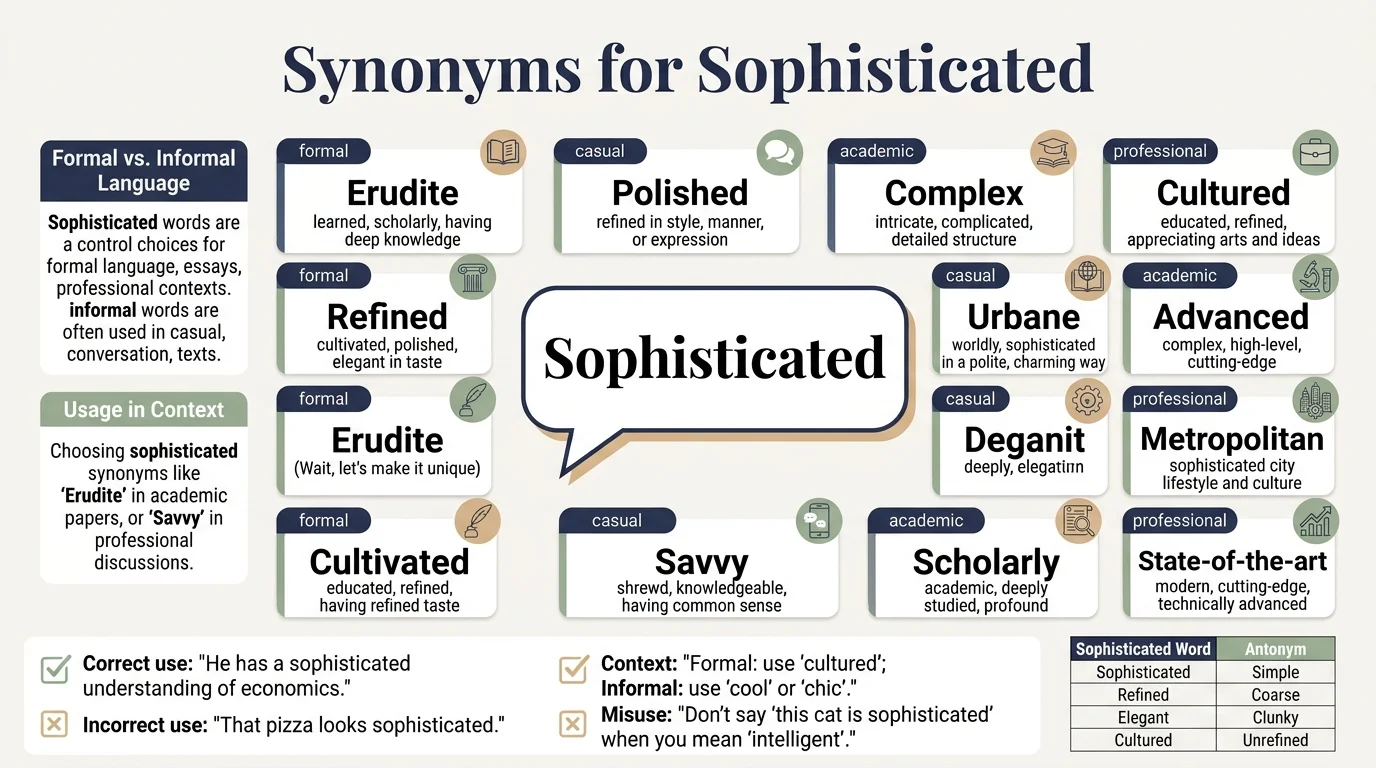
Do you find yourself using the word “sophisticated” too often in your writing, emails, or conversations? Many English learners and professionals rely on this one word to describe everything from technology to people. This habit can make your language feel repetitive and less precise.
The English language offers many nuanced alternatives that can elevate your communication and make your meaning clearer.This guide will help you understand the full meaning of “sophisticated” and provide over 50 synonyms to use in different situations. You will learn the subtle differences between these alternatives and discover exactly which word fits your context.
Whether you are writing a resume, an academic essay, or a social media caption, this vocabulary guide will expand your word choice.
What Does “Sophisticated” Mean?
Sophisticated describes something or someone developed to a high degree of complexity, refinement, or worldliness. The best synonyms depend on context. For formal writing use “complex” or “refined.” In casual settings try “high tech” or “cultured.” For resumes choose “knowledgeable” or “experienced.” Academic work benefits from “intricate” or “nuanced.”
Meaning, Tone and Context
Simple definition
Sophisticated means having a refined understanding, complex design, or advanced level of development. It suggests intelligence, elegance, and a departure from simple forms.
Part of speech
The word functions primarily as an adjective. The noun form is “sophistication.” The verb form “sophisticate” means to make someone or something more refined or complex.
Tone
The tone is generally positive but can be neutral when describing systems or machines. It implies a favorable view of complexity or cultural awareness.
Formality level
This word sits at a moderate to high formality level. It works in professional and academic settings but can feel slightly formal in casual conversation.
Common use cases
People use “sophisticated” to describe technology, design, people, arguments, and tastes. It applies to both tangible objects and abstract concepts.
Important word forms
Adjective: sophisticated. Noun: sophistication. Verb: sophisticate. Opposite: unsophisticated. Related adverb: sophisticatedly.
When and How to Use “Sophisticated”
This word works best when you want to acknowledge complexity, refinement, or cultural awareness. It bridges the gap between technical accuracy and social grace.
Here are examples across different contexts:
Professional context
The company uses sophisticated software to analyze consumer behavior patterns across multiple platforms.
Personal context
My aunt is a sophisticated traveler who always knows the best local restaurants in any city.
Academic context
The researcher proposed a sophisticated theory that explained the unexpected results.
Emotional context
She had a sophisticated understanding of human motivation that surprised her colleagues.
Creative context
The painting used sophisticated color combinations that created depth without obvious contrast.
Email context
We need a more sophisticated approach to our marketing strategy to reach new demographics.
Resume context
Developed sophisticated solutions to reduce production costs while maintaining quality standards.
Another Word for “Sophisticated”
The best single replacement depends entirely on your specific meaning. Here are direct suggestions for different situations:
Professional writing
Use “refined” when describing processes or strategies that have been carefully improved over time.
Academic writing
Use “complex” to describe theories or systems with many interconnected parts.
Casual conversation
Use “cultured” when referring to someone with broad knowledge and good taste.
Emotional writing
Use “perceptive” to describe someone who understands emotions and situations deeply.
Creative writing
Use “elegant” when describing beauty achieved through simplicity and careful design.
Resume use
Use “knowledgeable” to emphasize expertise and practical understanding.
Social media captions
Use “polished” for visuals or content that appears professional and well crafted.
Stronger meaning
Use “sophisticated” itself for the strongest sense of complexity combined with refinement.
Softer meaning
Use “smart” when you want to acknowledge intelligence without emphasizing worldliness.
When Not to Use “Sophisticated”
This word sounds vague when you describe simple improvements or basic understanding. The term carries an assumption of advanced development that may not fit every situation.
Consider this sentence: “We need a sophisticated plan to organize the office supplies.” Here “detailed” or “clear” would be more precise because organizing supplies requires order rather than complexity.
When describing people, “sophisticated” can sound pretentious if the context is too casual. In a job interview, it may be better to say “experienced” or “well rounded” instead of “sophisticated.”
Avoid this word when you mean something is merely complicated for the sake of being complicated. “Complex” or “intricate” work better for systems that have many parts but lack elegance.
Words Commonly Confused With “Sophisticated”
Many similar words share some meaning with “sophisticated” but carry distinct differences.
Complex
This word emphasizes many interconnected parts without necessarily implying elegance. A complex problem can be messy or difficult, while a sophisticated solution is elegant and well designed.
Intricate
This word focuses on detailed and delicate construction. Intricate patterns require careful attention to details, while sophisticated systems require understanding of relationships.
Refined
This word suggests improvement through careful processing. sugar is pure. Refined taste comes from experience. Sophisticated combines refinement with complexity.
Cultured
This word applies specifically to people who have acquired knowledge and appreciation of the arts. Sophisticated people also have practical knowledge and social grace.
Elegant
This word emphasizes grace and beauty through simplicity. Sophisticated design can be elegant, but elegance does not require complexity.
Polished
This word suggests a smooth, finished surface or presentation. Polished writing has no rough edges. Sophisticated writing demonstrates depth of thought.
Experienced
This word refers to practical knowledge gained through direct involvement. Sophisticated understanding comes from experience combined with reflection.
Worldly
This word describes someone familiar with many cultures and places. Sophisticated people have this quality but also possess intellectual depth.
Best Synonym by Context for “Sophisticated”
| Context | Best Synonym | Why It Works | Example |
|---|---|---|---|
| Formal writing | Refined | Emphasizes careful improvement and high quality | The committee proposed a refined approach to policy implementation |
| Academic writing | Complex | Highlights multiple interconnected elements | The study revealed a complex relationship between variables |
| Business use | Strategic | Suggests thoughtful planning and execution | The company adopted a strategic marketing plan |
| Resume use | Knowledgeable | Demonstrates practical expertise | Knowledgeable in emerging market trends |
| Casual conversation | Cultured | Sounds natural and approachable | She is a cultured person who enjoys classical music |
| Creative writing | Elegant | Adds aesthetic appreciation | The poet crafted elegant verses with subtle rhythms |
| Emotional tone | Perceptive | Indicates deep understanding | His perceptive comments revealed genuine empathy |
| Strong intensity | Sophisticated | Full meaning of complexity and refinement | The device features sophisticated AI technology |
| Soft tone | Smart | Accessible and widely understood | A smart system handles the scheduling automatically |
| Social media | Polished | Describes visual or content quality | The polished design of this app is impressive |
| Technical writing | Advanced | Emphasizes cutting edge development | The advanced software processes data in real time |
Which Synonym Should You Choose?
Selecting the right synonym requires careful consideration of your audience, purpose, and subject.
Consider the formality of your situation. Academic papers and business reports demand formal language, so “refined” or “complex” serve well. Social media posts and personal emails benefit from simpler choices like “smart” or “polished.”
Think about the emotional impact you want. “Perceptive” works for describing someone’s understanding of others. “Elegant” adds aesthetic appreciation. “Strategic” suggests careful planning.
Examine what you are describing. People benefit from “cultured” or “knowledgeable.” Objects and designs suit “elegant” or “refined.” Systems and theories call for “complex” or “advanced.”
Consider the intensity level. Save “sophisticated” for situations that truly combine complexity with refinement. Use “smart” or “polished” for simpler applications of the concept.
Match your word choice to your specific sentence structure. Some synonyms flow better in certain positions and with certain verbs.
Real Life Examples of “Sophisticated” in Sentences
School context
The professor appreciated sophisticated questions that challenged basic assumptions in the reading.
Workplace context
Our team needs to develop sophisticated solutions for the client’s growing business demands.
Writing context
Good writers use sophisticated vocabulary without making their text difficult to understand.
Conversation context
He sounded so sophisticated when he discussed international politics at the dinner party.
Social media context
The influencer posted sophisticated content that attracted a professional following.
Email context
Please provide a sophisticated analysis of the quarterly results for the board meeting.
Storytelling context
The protagonist was a sophisticated woman who navigated both business and romance with ease.
Resume context
Created sophisticated strategies that increased online engagement by 45 percent.
15 Synonyms for “Sophisticated”
| Synonym | Simple Meaning | Best Used For | Example Sentence |
|---|---|---|---|
| Refined | Improved to a high standard | Describing processes, taste, or manners | The restaurant serves refined French cuisine |
| Complex | Having many connected parts | Systems, theories, and problems | The project involved complex technical requirements |
| Elegant | Graceful and stylish | Design, fashion, and writing | Her elegant prose captivated the audience |
| Cultured | Knowledgeable about arts and society | People with broad education | The cultured traveler visited every major museum |
| Advanced | Highly developed or modern | Technology and methods | The advanced software predicts market trends |
| Perceptive | Quick to understand situations | Emotional intelligence and insight | She is perceptive about her team’s concerns |
| Polished | Smooth and professional | Presentations and written work | The polished report impressed the executives |
| Strategic | Planned for maximum effectiveness | Business decisions and approaches | They took a strategic approach to expansion |
| Nuanced | Having subtle distinctions | Arguments and interpretations | The nuanced analysis revealed hidden patterns |
| Worldly | Experienced in international matters | Global business and travel | His worldly perspective benefited the negotiations |
| Intricate | Very detailed and complicated | Patterns, designs, and systems | The intricate mechanism required expert handling |
| Knowledgeable | Having deep understanding | Professional expertise | The knowledgeable consultant solved our problems |
| Enlightened | Showing advanced understanding | Philosophical or social views | Her enlightened approach improved company culture |
| Discriminating | Showing good judgment | Tastes and choices | The discriminating buyer selected quality materials |
| Suave | Smooth and confident in manner | Personal charm and social skills | The suave host welcomed every guest personally |
Synonym Groups and Usage Differences
Professional vs. Personal Synonyms
Professional settings benefit from words that suggest competence and strategic thinking. “Strategic” and “knowledgeable” work well in workplace communication. Personal contexts allow more emotional words like “cultured” and “perceptive” to describe people you know.
Formal vs. Conversational Synonyms
Formal reports and academic papers require “refined” and “complex.” These words carry authority and precision. Conversational speech welcomes “smart” and “polished” because they sound natural and accessible. “Cultured” and “worldly” bridge both worlds effectively.
Academic Synonyms
Academic writing demands precision, so “nuanced” and “complex” are excellent choices. “Intricate” works for describing detailed research methods. These words signal careful thinking and thorough analysis without emotional coloring.
Professional and Business Synonyms
Business communication benefits from “strategic” and “advanced.” These words suggest competitive advantage and forward thinking. “Knowledgeable” demonstrates expertise that clients and colleagues value. “Refined” describes processes that have been optimized for efficiency.
Creative or Literary Synonyms
Creative writing gains depth from “elegant” and “nuanced.” These words add artistic appreciation to descriptions. “Perceptive” works well for character development. “Worldly” adds dimension to characters who have broad experience.
Slang or Modern Synonyms
Modern usage includes “high tech” for sophisticated technology and “well versed” for knowledgeable people. These expressions are acceptable in casual writing but do not fit formal contexts. “Smooth” can replace “suave” in informal conversation.
Strongest vs. Weaker Synonyms
Strongest: sophisticated, advanced, enlightened. These words carry the full weight of complexity and development.
Moderate: refined, complex, cultured. These words are direct and clear without being overwhelming.
Weaker: smart, polished, knowledgeable. These words are accessible and widely understood but less intense.
Emotional vs. Neutral Synonyms
Emotional: perceptive, enlightened, suave. These words carry feelings of appreciation and admiration.
Neutral: complex, intricate, advanced. These words describe facts and features without emotional judgment.
Antonyms of “Sophisticated”
| Antonym | Meaning | Example Sentence |
|---|---|---|
| Simple | Lacking complexity | The simple design appealed to all users |
| Naive | Lacking experience or judgment | His naive approach overlooked obvious risks |
| Unsophisticated | Lacking refinement | The unsophisticated system could not handle demand |
| Crude | Roughly made or lacking skill | The crude machine broke down frequently |
| Primitive | Basic and undeveloped | The primitive tools were difficult to use |
| Basic | Fundamental and simple | The basic model had few features |
| Plain | Simple and unadorned | The plain website lacked visual appeal |
| Uncultured | Lacking artistic knowledge | The uncultured tourist ignored local traditions |
| Inexperienced | Lacking practical knowledge | The inexperienced manager made poor decisions |
| Artless | Without skill or guile | Her artless comment revealed her lack of awareness |
| Rough | Not finished or refined | The rough draft needed substantial editing |
| Unpolished | Not smooth or professional | His unpolished presentation failed to impress |
| Coarse | Rough in texture or manner | The coarse fabric irritated sensitive skin |
| Provincial | Limited in outlook | His provincial views surprised his colleagues |
| Unrefined | Not improved or purified | The unrefined material could not be used |
Comparison: Sophisticated vs. Similar Words
Sophisticated vs. Complex
Main difference: Sophisticated implies refinement and elegance, while complex simply means having many parts. Complex systems can be messy or inefficient. Sophisticated systems work smoothly despite their complexity.
Which one is stronger: Sophisticated carries more positive meaning. Complex is neutral.
Which one is more formal: Complex is more academic. Sophisticated is more social.
Example with sophisticated: The sophisticated algorithm processed data efficiently.
Example with complex: The complex algorithm required significant computing power.
Sophisticated vs. Refined
Main difference: Refined focuses on improvement through processing, while sophisticated combines refinement with complexity. Refined sugar is pure. Sophisticated desserts combine flavors and textures expertly.
Which one is stronger: Sophisticated implies more breadth and depth.
Which one is more formal: Refined is more formal and technical.
Example with sophisticated: The sophisticated palate appreciated unusual flavor combinations.
Example with refined: The refined palate preferred subtle seasonings.
Sophisticated vs. Cultured
Main difference: Cultured applies specifically to cultural knowledge and appreciation. Sophisticated includes this but also covers practical intelligence and social awareness.
Which one is stronger: Sophisticated covers more ground.
Which one is more formal: Cultured is more literary.
Example with sophisticated: The sophisticated executive navigated international business easily.
Example with cultured: The cultured traveler appreciated Renaissance art.
Sophisticated vs. Elegant
Main difference: Elegant emphasizes grace and beauty achieved through simplicity. Sophisticated can include complexity. A sophisticated device has advanced features. An elegant device has a beautiful design.
Which one is stronger: Sophisticated suggests more substance.
Which one is more formal: Elegant is more aesthetic.
Example with sophisticated: The sophisticated watch included weather tracking.
Example with elegant: The elegant watch featured a minimalist face.
Sophisticated vs. Worldly
Main difference: Worldly specifically describes experience with different cultures and places. Sophisticated includes this but also includes intellectual and social dimensions.
Which one is stronger: Sophisticated covers more aspects of development.
Which one is more formal: Worldly is more conversational.
Example with sophisticated: The sophisticated businessman understood multiple markets.
Example with worldly: The worldly traveler spoke three languages fluently.
Sophisticated vs. Advanced
Main difference: Advanced focuses on modern development and cutting edge features. Sophisticated includes refinement and cultural aspects. Advanced technology is new. Sophisticated technology is both new and well designed.
Which one is stronger: Sophisticated carries more positive judgment.
Which one is more formal: Advanced is more technical.
Example with sophisticated: The sophisticated design made the product easy to use.
Example with advanced: The advanced technology required specialized training.
Common Phrases and Expressions with “Sophisticated”
1. Sophisticated taste
Meaning: A refined ability to appreciate quality.
Example: Her sophisticated taste in wine impressed the sommelier.
2. Sophisticated technology
Meaning: Advanced and well designed equipment or systems.
Example: The sophisticated technology in the new phone captures professional quality photos.
3. Sophisticated audience
Meaning: People with high expectations and good judgment.
Example: The comedian performed for a sophisticated audience that appreciated subtle humor.
4. Sophisticated argument
Meaning: A complex and well reasoned point of view.
Example: The philosopher presented a sophisticated argument that challenged traditional views.
5. Sophisticated traveler
Meaning: Someone experienced in international travel and cultural awareness.
Example: The sophisticated traveler booked local experiences instead of typical tours.
6. Sophisticated taste buds
Meaning: The ability to detect subtle flavors and quality.
Example: His sophisticated taste buds could distinguish between the different spice blends.
7. Sophisticated understanding
Meaning: Deep comprehension beyond surface knowledge.
Example: Her sophisticated understanding of finance helped the company grow.
8. Sophisticated design
Meaning: A well planned, elegant, and functional layout.
Example: The sophisticated design of the building won architectural awards.
Common Mistakes to Avoid
Using “sophisticated” when a more precise synonym is better
The new employee showed sophisticated enthusiasm. Instead say “strong enthusiasm” or “genuine interest.” Enthusiasm does not need refinement.
Confusing “sophisticated” with “complicated”
A complicated procedure has many steps. A sophisticated procedure is carefully designed. Use “complicated” for messiness and “sophisticated” for elegance.
Using a casual synonym in formal writing
Do not use “high tech” or “smooth” in academic papers. Choose “advanced” or “refined” to maintain professionalism.
Using an overly dramatic synonym for a simple situation
Calling a simple schedule “sophisticated” sounds pretentious. Use “detailed” or “thorough” for ordinary planning.
Repeating “sophisticated” too often
Vary your vocabulary. Use “refined,” “complex,” and “elegant” to keep your writing fresh and engaging.
Choosing a synonym with the wrong emotional tone
“Perceptive” sounds warm. “Complex” sounds neutral. Match your word to the emotion you want to convey.
Using slang in academic or professional writing
Avoid “smooth” and “high tech” in formal work. These words sound unprofessional in serious contexts.
FAQs
What is the best synonym for sophisticated?
The best synonym depends on your context. Use “refined” for formal writing, “complex” for academic work, and “cultured” for describing people.
What is a formal synonym for sophisticated?
“Refined” and “nuanced” are excellent formal choices. These words work well in academic papers and professional reports.
What is an informal synonym for sophisticated?
“Smart” and “polished” are good informal options. They sound natural in conversation and social media posts.
What is another word for sophisticated in professional writing?
“Strategic” and “knowledgeable” are strong professional choices. They emphasize competence and thoughtful planning.
What is the difference between sophisticated and complex?
Sophisticated implies elegance and refinement, while complex simply means having many parts. Complex systems can be messy.
What is the opposite of sophisticated?
“Simple,” “naive,” and “unsophisticated” are common opposites. “Crude” also work for describing basic development.
Conclusion
Sophisticated means having a high degree of complexity, refinement, or cultural awareness. This word serves many contexts but becomes more powerful when you choose precise alternatives. Match your vocabulary to your audience and purpose.
Formal writing benefits from “refined” and “nuanced.” Professional communication improves with “strategic” and “knowledgeable.” Creative work shines with “elegant” and “perceptive.” Casual conversation welcomes “smart” and “polished.”
Consider tone, intensity, and emotional impact when selecting synonyms. The most sophisticated vocabulary choice is the one that communicates your exact meaning clearly. Build your word bank gradually and practice using new alternatives in daily writing.