Do you find yourself writing “furthermore” over and over again in your essays, emails, or reports? You are not alone. Many writers, students, and professionals rely on this single transition word without realizing how many powerful alternatives exist.
Imagine you are writing a cover letter. You use “furthermore” three times in one paragraph. Your reader notices the repetition, and your writing loses its impact. The solution is simple. Learning synonyms for furthermore will transform your writing from repetitive to remarkable.
This guide will show you exactly how to choose the right synonym for every situation. You will learn the subtle differences between similar words. You will discover which words sound professional, which words fit academic writing, and which words work best in casual conversation. By the end, you will never overuse “furthermore” again.
What Does “Furthermore” Mean?
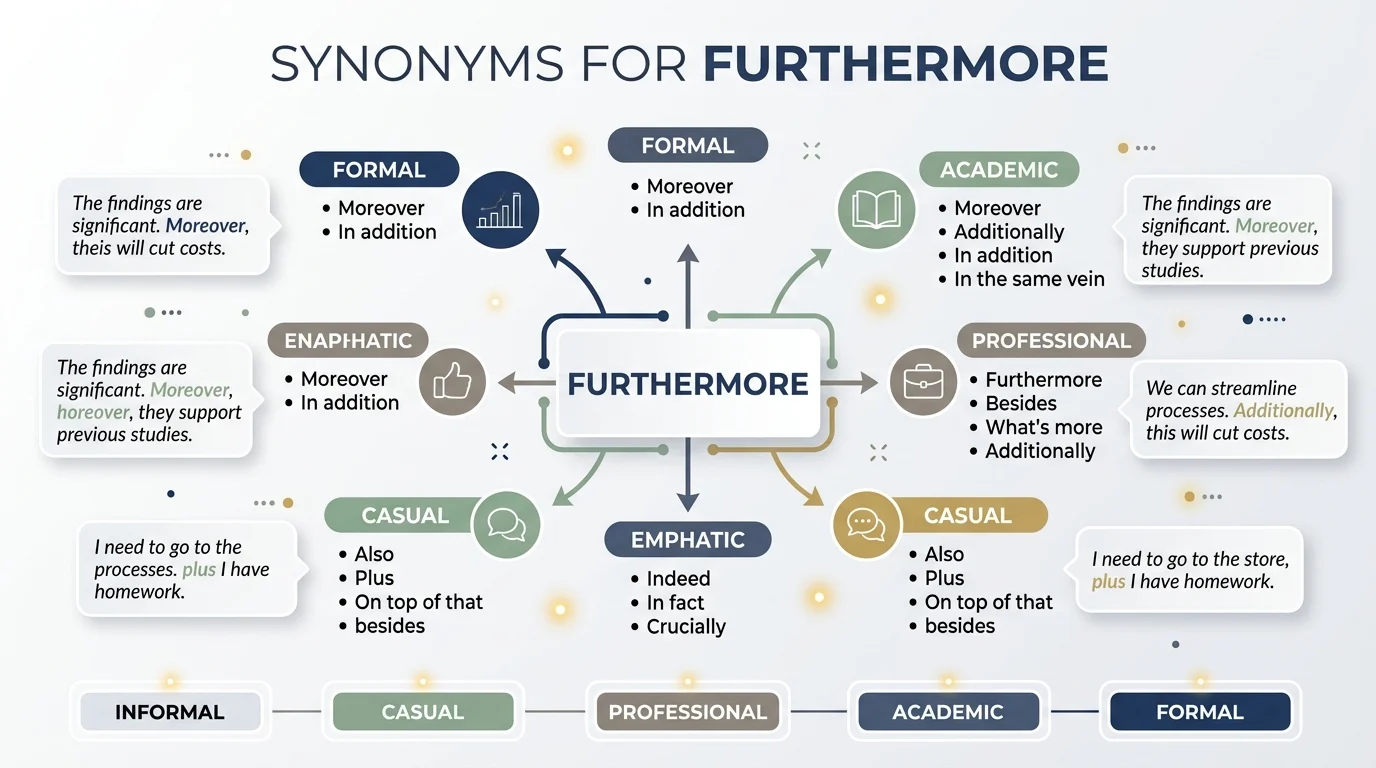
Furthermore means in addition to what has already been stated. It introduces extra information that supports or extends a previous point. For formal writing, use “moreover” or “additionally.” For casual contexts, try “plus” or “besides.” Academic work favors “furthermore” itself or “in addition.” Professional communication works well with “also” or “additionally.”
Meaning, Tone and Context
- Simple definition: Furthermore is an adverb that adds information to support or strengthen a previous statement.
- Part of speech: Adverb. It connects ideas and shows logical progression in writing.
- Tone: Neutral to formal. It does not carry strong emotional weight.
- Formality level: Formal. It appears most often in academic essays, business reports, and professional documents.
- Common use cases: Essays, research papers, business proposals, reports, presentations, and formal letters.
- Related forms: The word “further” can function as an adjective, verb, or adverb with different meanings. “Furthermore” is strictly an adverb used for adding points.
When and How to Use “Furthermore”
You should use furthermore when you need to add a point that builds on your previous argument. It signals to your reader that you are continuing the same line of thought. It works best in formal writing where you want to maintain a professional tone.
Here are realistic examples labeled by context:
Professional context
The new software will increase productivity by twenty percent. Furthermore, it will reduce operational costs significantly.
Academic context
The study found a clear correlation between sleep and memory retention. Furthermore, participants who slept eight hours performed better on recall tests.
Email context
I have attached the revised budget proposal. Furthermore, I included a summary of projected expenses for the next quarter.
Presentation context
Our sales figures have improved this quarter. Furthermore, customer satisfaction scores reached an all time high.
Report context
The data confirms our initial hypothesis. Furthermore, the results show a consistent pattern across all demographic groups.
Proposal context
This investment will generate immediate returns. Furthermore, it positions our company for long term growth.
Essay context
The novel explores themes of identity and belonging. Furthermore, it challenges traditional notions of family structure.
Another Word for “Furthermore”
The best single replacement depends entirely on your context and purpose. Here are direct suggestions for different situations:
- Professional writing: Additionally is the most natural replacement. It sounds polished without being overly formal.
- Academic writing: Moreover works perfectly. It adds weight to your argument and shows logical progression.
- Casual conversation: Plus is simple and natural. It fits everyday speech without sounding forced.
- Emotional writing: Besides adds a personal touch. It feels more conversational and relatable.
- Creative writing: Then again adds narrative flow. It works well in storytelling and descriptive passages.
- Resume use: Also is the safest choice. It adds information without drawing attention to the transition itself.
- Social media captions: Besides sounds authentic. It creates a natural conversational tone.
- Stronger meaning: Moreover carries more emphasis. Use it when you want to stress the importance of the additional point.
- Softer meaning: Also is gentle and unobtrusive. It adds information without making the connection feel forced.
When Not to Use “Furthermore”
Furthermore sounds too formal for casual conversations. If you are texting a friend or writing a social media post, choose simpler words.
Furthermore can feel repetitive when used multiple times in one document. Vary your transitions to keep your reader engaged.
Furthermore may seem weak when you need to emphasize a strong point. Use “moreover” or “what is more” for greater impact.
Here is an example of a weak sentence using furthermore incorrectly:
Weak sentence: I like my job. Furthermore, I enjoy my coworkers.
Improved sentence: I like my job. My coworkers make every day enjoyable.
The improved version eliminates the unnecessary transition and makes the connection more natural.
Words Commonly Confused With “Furthermore”
Furthermore vs. Moreover
Furthermore adds information that supports the previous point. Moreover adds information that strengthens or emphasizes the previous point. Moreover carries slightly more weight and conviction.
Furthermore vs. Additionally
Additionally is more versatile and slightly less formal. It fits both professional and casual contexts. Furthermore belongs strictly to formal writing.
Furthermore vs. Also
Also is the most casual and common option. It works in any context but lacks the sophistication of furthermore. Use also when you want to sound natural and unpretentious.
Furthermore vs. Besides
Besides feels conversational and personal. It often introduces a point that is slightly separate from the main argument. Furthermore keeps the focus tightly on the main line of reasoning.
Furthermore vs. In addition
In addition is interchangeable with furthermore in most formal contexts. It may sound slightly more natural in spoken English. Furthermore feels more distinctly written.
Furthermore vs. What is more
What is more adds a conversational emphasis. It draws attention to the additional point. Furthermore is more neutral and matter of fact.
Best Synonym by Context for “Furthermore”
| Context | Best Synonym | Why It Works | Example |
|---|---|---|---|
| Formal writing | Moreover | Adds gravitas and emphasis | The proposal is cost effective. Moreover, it requires minimal training. |
| Academic writing | In addition | Clear and precise | The experiment succeeded. In addition, the results were repeatable. |
| Professional business | Additionally | Polished and professional | Our revenue grew. Additionally, we expanded our market share. |
| Resume writing | Also | Simple and effective | Managed a team of ten. Also implemented new training procedures. |
| Casual conversation | Plus | Natural and conversational | I love this restaurant. Plus, the prices are reasonable. |
| Creative writing | Then again | Adds narrative rhythm | She agreed to help. Then again, she always supported her friends. |
| Emotional tone | Besides | Personal and warm | I miss my family. Besides, they live too far away. |
| Strong intensity | What is more | Emphasizes importance | The plan succeeded. What is more, it exceeded expectations. |
| Soft moderate tone | Also | Gentle and unobtrusive | We need more time. Also, we require additional resources. |
| Social media captions | On top of that | Casual and engaging | Had an amazing trip. On top of that, I made new friends. |
| US English preference | Additionally | Widely accepted and natural | Most Americans prefer additionally in professional writing. |
| UK English preference | Moreover | More common in British formal writing | UK academics frequently use moreover in research papers. |
Which Synonym Should You Choose?
Choose based on your audience first. If you are writing for a formal academic journal, use “moreover” or “in addition.” If you are emailing a colleague, “additionally” works well. For a text message, “plus” is perfect.
Choose based on your purpose second. Are you adding neutral information? Use “also.” Are you emphasizing an important point? Use “what is more.” Are you connecting two strong arguments? Use “moreover.”
Choose based on your tone third. Want to sound professional? Avoid “plus” and “besides.” Want to sound approachable? Avoid “moreover” and “furthermore” itself.
The best choice always considers your reader, your message, and your relationship with your audience.
Real Life Examples of “Furthermore” in Sentences
School context
The historical evidence supports this interpretation. Furthermore, primary source documents confirm the timeline.
Workplace context
Our team met all project deadlines. Furthermore, we stayed under budget for the entire quarter.
Writing context
The author builds suspense effectively. Furthermore, the character development feels authentic and compelling.
Conversation context
I think we should postpone the meeting. Furthermore, I believe we need more preparation time.
Social media context
This recipe is incredibly easy. Furthermore, it uses ingredients you already have at home.
Email context
I have reviewed your application. Furthermore, I have spoken with your references.
Storytelling context
The hero accepted the quest. Furthermore, she gathered allies for the journey ahead.
Report context
The data shows a clear upward trend. Furthermore, projections indicate continued growth.
15 Synonyms for “Furthermore”
| Synonym | Simple Meaning | Best Used For | Example Sentence |
|---|---|---|---|
| Moreover | In addition to what was said | Formal writing with emphasis | The theory is sound. Moreover, it has been tested extensively. |
| Additionally | As an extra point | Professional and academic use | We need more staff. Additionally, we require better equipment. |
| In addition | Added to what exists | Formal writing and speech | The course is affordable. In addition, it offers flexible hours. |
| Also | In the same way | Any context, especially casual | She speaks French. Also, she knows Spanish. |
| Plus | With the addition of | Casual conversation and informal writing | The job pays well. Plus, the benefits are excellent. |
| Besides | In addition to | Casual and personal contexts | I cannot attend. Besides, I have other commitments. |
| What is more | More importantly | Emphasizing a strong point | The product is innovative. What is more, it solves a real problem. |
| On top of that | In addition to everything | Casual and conversational | The hotel was beautiful. On top of that, the staff was friendly. |
| As well as | In addition to | Connecting two items | She is talented as well as hardworking. |
| Too | Also | Casual contexts | I want to go too. |
| Along with | Together with | Combining ideas | The package includes software along with hardware. |
| To boot | As an extra | Informal and slightly old fashioned | The meal was delicious and cheap to boot. |
| Over and above | Beyond what is expected | Formal and professional | We received praise over and above our expectations. |
| Not to mention | And also | Emphasizing an obvious point | The car is reliable, not to mention affordable. |
| Into the bargain | As an extra advantage | British English, slightly informal | The house is spacious, and modern into the bargain. |
Synonym Groups and Usage Differences
Professional vs. Personal Synonyms
Professional contexts demand polished words like “additionally” and “in addition.” These words sound competent and serious. Personal contexts allow “plus,” “besides,” and “on top of that.” These words feel warmer and more natural in conversation.
Formal vs. Conversational Synonyms
Formal writing benefits from “moreover,” “furthermore,” and “in addition.” These words appear in academic journals, legal documents, and official reports. Conversational writing uses “also,” “plus,” and “too.” These words appear in texts, social media, and everyday speech.
Academic Synonyms
Academic writing requires precision and formality. “Moreover” works well when you need to emphasize a supporting point. “In addition” sounds clear and objective. “Additionally” is acceptable but slightly less formal. Avoid casual words like “plus” or “besides” in academic contexts.
Professional and Business Synonyms
Business communication values clarity and professionalism. “Additionally” is the safest choice for emails, reports, and presentations. “In addition” works for formal proposals. “Also” is acceptable in internal communication. Avoid “moreover” if it sounds too academic for your workplace culture.
Creative or Literary Synonyms
Creative writing allows more expressive choices. “Then again” adds narrative flow. “What is more” creates dramatic emphasis. “On top of that” feels conversational and engaging. Choose words that match your character’s voice and your story’s tone.
Slang or Modern Synonyms
Modern synonyms include “plus,” “on top of that,” and “not to mention.” These words appear in casual conversation and social media. They are acceptable in informal writing. Avoid them in professional documents, academic papers, and formal speeches.
Strongest vs. Weaker Synonyms
Strongest: “moreover,” “what is more,” “over and above.”
These words add emphasis and conviction.
Moderate: “additionally,” “in addition,” “furthermore.”
These words add information neutrally.
Weakest: “also,” “too,” “plus.”
These words add information gently without drawing attention.
Emotional vs. Neutral Synonyms
Neutral synonyms include “additionally,” “in addition,” and “also.” These words add facts without emotional weight. Emotional synonyms include “besides” and “on top of that.” These words feel personal and connected to the speaker’s perspective.
Antonyms of “Furthermore”
| Antonym | Meaning | Example Sentence |
|---|---|---|
| However | Introduces a contrast | The plan is ambitious. However, it faces significant obstacles. |
| Nevertheless | In spite of that | The weather was terrible. Nevertheless, we completed the hike. |
| Conversely | Opposite way around | He prefers city life. Conversely, she loves the countryside. |
| On the other hand | From a different perspective | The job pays well. On the other hand, the hours are long. |
| Despite this | Regardless of this fact | The project was difficult. Despite this, the team succeeded. |
| Yet | Nevertheless | She studied hard. Yet, she failed the exam. |
| But | However | I wanted to help. But, I was too busy. |
| Still | Despite that | The evidence was weak. Still, the jury convicted him. |
| Instead | As an alternative | We cannot go forward. Instead, we should pause and reconsider. |
| Alternatively | Offering a different choice | You can pay now. Alternatively, you can set up a payment plan. |
| In contrast | Showing difference | The first candidate was nervous. In contrast, the second was confident. |
| Whereas | Comparing differences | He enjoys action movies, whereas she prefers romantic comedies. |
| On the contrary | Opposite of what was said | The plan was not simple. On the contrary, it was quite complex. |
| Rather | Instead of | We should not rush. Rather, we should take our time. |
| Instead of | In place of | We chose coffee instead of tea. |
Comparison: Furthermore vs. Similar Words
Furthermore vs. Moreover
Furthermore adds an additional point in the same line of reasoning. Moreover adds a point that strengthens or emphasizes the previous argument. Moreover carries a stronger sense of conviction. Use furthermore for neutral additions. Use moreover when you want to stress importance.
Example with furthermore: The restaurant has excellent food. Furthermore, the service is fast.
Example with moreover: The restaurant has excellent food. Moreover, it has won multiple awards.
Furthermore vs. Additionally
Additionally is more flexible and slightly less formal. It fits both written and spoken English naturally. Furthermore sounds distinctly formal and written. Use additionally in professional emails. Use furthermore in academic essays.
Example with additionally: We will expand our team. Additionally, we will invest in new equipment.
Example with furthermore: We will expand our team. Furthermore, we will invest in new equipment.
Furthermore vs. Also
Also is the most casual and common word. It works in every context. Furthermore is formal and specific. Also is neutral and unpretentious. Use also for everyday communication. Use furthermore for formal documents.
Example with also: I love traveling. Also, I enjoy trying new foods.
Example with furthermore: I love traveling. Furthermore, I enjoy trying new foods.
Furthermore vs. Besides
Besides feels personal and slightly separate from the main point. It often introduces an additional reason that is not central to the argument. Furthermore stays tightly connected to the main line of reasoning. Use besides for personal opinions. Use furthermore for logical arguments.
Example with besides: I cannot attend the party. Besides, I have to work that night.
Example with furthermore: I cannot attend the party. Furthermore, I have to work that night.
Furthermore vs. In addition
In addition is interchangeable with furthermore in most contexts. It may feel slightly more natural in spoken English. Furthermore feels more distinctly written and formal. Both work in professional and academic writing.
Example with in addition: The proposal is complete. In addition, we have prepared a presentation.
Example with furthermore: The proposal is complete. Furthermore, we have prepared a presentation.
Furthermore vs. What is more
What is more adds an element of emphasis and surprise. It draws attention to the additional point. Furthermore presents the additional point neutrally. Use what is more when you want to highlight something remarkable.
Example with what is more: The device is affordable. What is more, it lasts for years without repairs.
Example with furthermore: The device is affordable. Furthermore, it lasts for years without repairs.
Common Phrases and Expressions with “Furthermore”
1. And furthermore
Meaning: Used to add an extra point, often in speeches or formal statements.
Example sentence: The defendant is guilty. And furthermore, the evidence proves his intent.
2. Furthermore, it should be noted
Meaning: A formal expression used to draw attention to an important additional point.
Example sentence: The company has grown significantly. Furthermore, it should be noted that profits have doubled.
3. Furthermore, we must consider
Meaning: Used to introduce an additional factor that requires attention.
Example sentence: The plan is innovative. Furthermore, we must consider the implementation costs.
4. And what is more
Meaning: An emphatic way to add a surprising or important point.
Example sentence: She finished the race first. And what is more, she broke the record.
5. In addition to that
Meaning: A slightly more conversational way to add information.
Example sentence: The hotel has a pool. In addition to that, it offers spa services.
6. Not only that, but
Meaning: Used to add an unexpected or impressive additional fact.
Example sentence: He speaks five languages. Not only that, but he also plays three instruments.
7. On top of everything else
Meaning: Used to add a final point, often when listing multiple items.
Example sentence: The car broke down. On top of everything else, we missed our flight.
Common Mistakes to Avoid
1. Using “furthermore” when a more precise synonym is better
The word “furthermore” fits formal contexts. For casual writing, “plus” or “also” sound more natural. Choose the word that matches your audience and purpose.
2. Confusing “furthermore” with “further”
“Further” refers to distance or degree. “Furthermore” refers to adding information. Do not use them interchangeably.
3. Using a casual synonym in formal writing
Words like “plus” and “on top of that” do not belong in academic essays or business reports. Choose “moreover,” “additionally,” or “in addition.”
4. Using an overly dramatic synonym for a simple situation
You do not need “what is more” for a minor point. Save emphatic synonyms for truly important additions.
5. Repeating the same word too often
Vary your transitions. Use “additionally,” “in addition,” “moreover,” and “also” throughout your document to maintain reader interest.
6. Choosing a synonym with the wrong emotional tone
“Besides” feels personal and warm. “Moreover” feels formal and serious. Match the emotional tone of your synonym to your content.
7. Using slang in academic or professional writing
Avoid “to boot” and “into the bargain” in formal contexts. These words sound old fashioned or too casual.
FAQs
What is the best synonym for “furthermore”?
The best synonym depends on context. “Moreover” works best for formal emphasis. “Additionally” works best for professional writing. “Plus” works best for casual conversation.
What is a formal synonym for “furthermore”?
“Moreover” and “in addition” are the most formal synonyms. These words appear in academic writing, legal documents, and official correspondence.
What is an informal synonym for “furthermore”?
“Plus,” “besides,” and “on top of that” are informal synonyms. These words work well in conversations, texts, and social media posts.
What is another word for “furthermore” in professional writing?
“Additionally” is the most professional synonym. It sounds polished and competent without being overly formal or academic.
What is the difference between “furthermore” and “moreover”?
“Furthermore” adds neutral supporting information. “Moreover” adds information that strengthens or emphasizes the previous point. “Moreover” carries stronger conviction.
What is the opposite of “furthermore”?
The opposites are contrast words like “however,” “nevertheless,” and “on the other hand.” These words introduce opposing ideas rather than additional points.
Conclusion
Furthermore is a valuable transition word that adds information and builds arguments. It belongs in formal writing, academic papers, and professional documents. However, overusing it makes your writing repetitive and dull.
The best synonym depends on your audience, purpose, and tone. Choose “moreover” for emphasis, “additionally” for professional polish, “plus” for casual conversation, and “in addition” for clear formal writing. Always consider your reader and your message when selecting transition words.
Remember this practical tip: Read your writing aloud. If you hear the same transition word repeated, replace it with a synonym from this guide. Your writing will sound more natural, varied, and professional.
Before publishing any content that uses synonyms for “furthermore” or similar transition words, verify definitions using trusted dictionaries such as Cambridge, Oxford, Merriam Webster, Collins, or Britannica. This ensures accuracy and maintains your credibility as a writer.