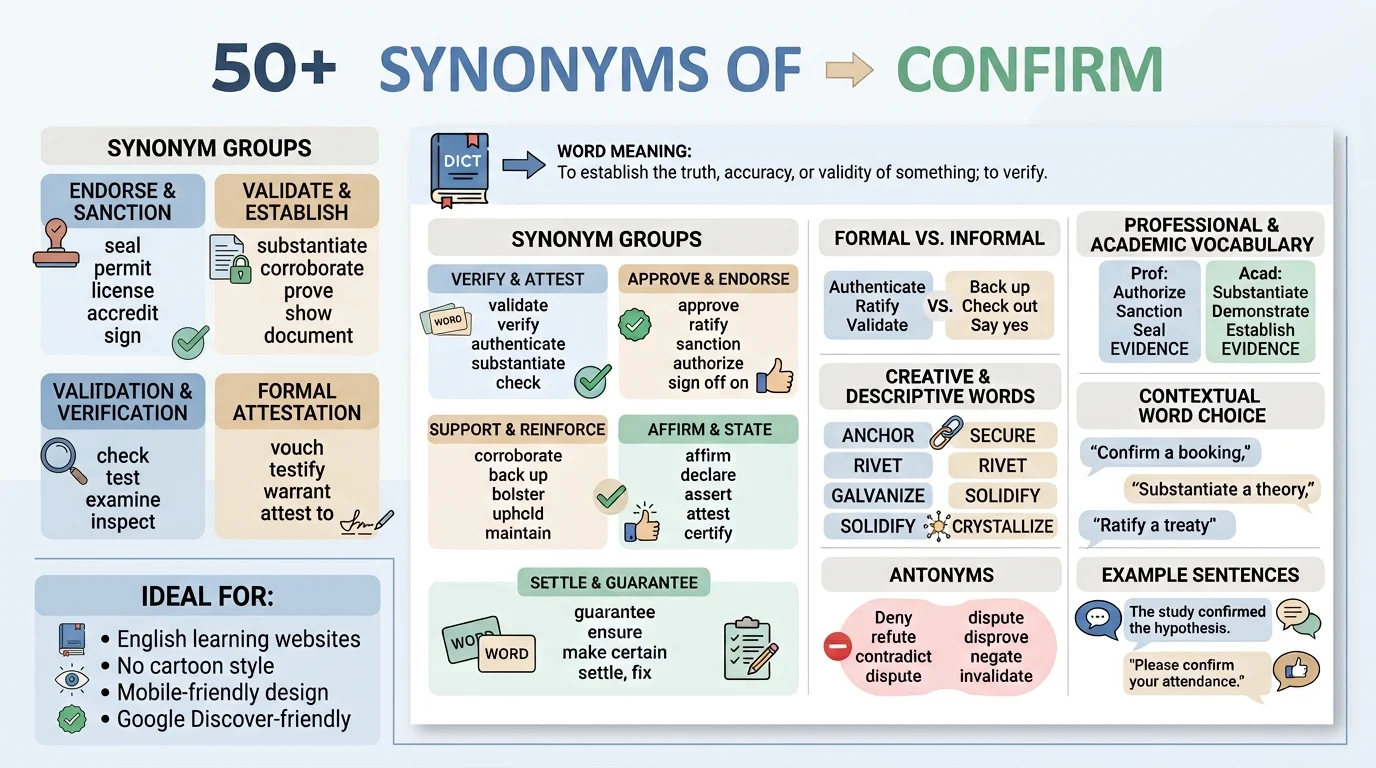
Have you ever written an email, essay, or social media post and realized you used the word “confirm” three times in two sentences? You are not alone. Many writers fall back on this reliable verb whenever they need to express certainty, verification, or approval.
But overusing any single word makes your writing feel repetitive and dull. When you search for synonyms of confirm, you open up a world of more precise, powerful, and appropriate alternatives. The right synonym can transform a bland sentence into something that sounds confident, professional, or warmly reassuring.
Whether you are writing a business proposal, an academic paper, or a casual text message, choosing the exact word for your situation improves clarity and shows off your vocabulary skills.
This guide will help you understand the meaning of “confirm,” explore its best synonyms, and learn exactly which word fits every context you encounter.
What Are the Best Synonyms of “Confirm”?
“Confirm” means to establish the truth, accuracy, or validity of something, or to express agreement with a plan or arrangement. The best synonym depends entirely on context. For formal writing, choose “verify” or “substantiate.” For professional communication, use “validate” or “authenticate.”Casual conversation, “double-check” or “make sure” work well. In emotional contexts, “reassure” or “affirm” are excellent choices. Academic writing benefits from “corroborate,” while business settings call for “ratify” or “formalize.”
Meaning, Tone, and Context
Simple Definition
To confirm means to establish the truth, accuracy, or validity of something. It can also mean to express or show support for a decision, appointment, or arrangement. When you confirm something, you remove doubt and provide assurance.
Part of Speech
Verb (transitive)
Overall Tone
Neutral
Formality Level
Semi-formal
“Confirm” sits comfortably in the middle range of formality. It works well in professional emails, academic writing, and everyday conversation. It is not overly stiff like “substantiate,” nor too casual like “make sure.” This flexibility makes it a default choice for many writers, which is precisely why you need alternatives.
Common Uses
Native English speakers use “confirm” in several common situations:
- Verifying information, like checking a reservation or appointment time
- Expressing agreement with a plan, decision, or arrangement
- Providing reassurance that something is true or correct
- Officially approving a decision or appointment
- Acknowledging receipt of information
Word Forms
- Confirmation (noun): The act of confirming or the evidence that confirms something
- Confirmable (adjective): Capable of being confirmed or verified
- Confirmed (adjective): Established as true or certain; also refers to someone firmly established in a habit or belief
- Confirming (present participle): The ongoing act of confirming
- Unconfirmed (adjective): Not yet confirmed or verified
When and How to Use “Confirm”
Choose “confirm” when you need a neutral, clear verb that indicates you are establishing something as true, verified, or agreed upon. It works in most situations and rarely sounds out of place. However, its very versatility means it often lacks the precision or emotional weight that other synonyms provide.
Here are seven realistic examples showing how to use “confirm” across different contexts:
Professional
Please confirm your attendance at the quarterly review meeting by Friday afternoon.
Academic
The researcher conducted follow-up experiments to confirm the initial findings.
Workplace
I need to confirm the delivery schedule with our logistics team before we finalize the client proposal.
Personal
Let me confirm our dinner reservation before we leave for the restaurant.
Email
Thank you for your application. We will confirm your interview time within two business days.
Resume
Confirmed safety compliance standards across all manufacturing facilities.
Social Media
Can anyone confirm if the event starts at 7 PM or 8 PM?
Best Synonyms of “Confirm”
No two synonyms are exactly identical. Each alternative brings its own shade of meaning, level of formality, and emotional weight. Understanding these differences helps you choose the perfect word for every situation.
Best Synonym for Professional Writing: Verify
“Verify” emphasizes the act of checking facts or data against evidence. It sounds precise and methodical, making it ideal for professional documents, reports, and official communications. Choose “verify” when you want to emphasize that you have thoroughly checked information.
Best Synonym for Academic Writing: Corroborate
“Corroborate” is a formal word that means to support or strengthen a statement or theory with additional evidence. It appears frequently in research papers, scholarly articles, and academic discussions. It suggests careful, rigorous investigation and lends authority to your writing.
Best Synonym for Business Communication: Validate
“Validate” implies confirming the worth, accuracy, or legitimacy of something. It works particularly well in business contexts involving data, processes, or strategic decisions. It adds a sense of thorough assessment and approval.
Best Synonym for Casual Conversation: Double-Check
“Double-check” is friendly, informal, and practical. It suggests a quick review to make sure everything is correct. Use it when talking with friends, family, or colleagues in relaxed settings.
Best Synonym for Emotional Writing: Reassure
“Reassure” conveys comfort and emotional support along with confirmation. It is perfect for personal letters, supportive messages, and situations where someone needs to feel certain and at ease.
Best Synonym for Creative Writing: Affirm
“Affirm” carries a positive, uplifting tone. It suggests not just confirming but also supporting and encouraging. Creative writers use it to add emotional depth and conviction to their prose.
Best Synonym for Resume Writing: Attest
“Attest” works well on resumes because it implies you can provide evidence or testimony about your accomplishments. It sounds confident and authoritative without being boastful.
Best Synonym for Workplace Communication: Certify
“Certify” suggests official approval and validation. Use it when discussing compliance, qualifications, or formal statements. It carries a weight of authority and official recognition.
Best Synonym for Stronger Meaning: Substantiate
“Substantiate” means to provide solid evidence or proof that supports a claim. It is much stronger than “confirm” and suggests the need for significant evidence.
Best Synonym for Softer Meaning: Acknowledge
“Acknowledge” is gentler and less emphatic than “confirm.” It suggests accepting or recognizing something without necessarily verifying its complete accuracy.
When Not to Use “Confirm”
When the Word Sounds Too General
Why: “Confirm” is a general-purpose word that often fails to capture the specific nature of what you are trying to say.
Better Synonym: “Verify” when checking data, “corroborate” when supporting a theory, or “certify” when providing official approval.
Example Rewrite:
- Weak: “I confirmed the facts before writing the report.”
- Stronger: “I verified every data point before writing the report.”
When the Word Sounds Too Vague
Why: Readers may not know what exactly you confirmed. Did you check details? Are you agree? Did you reassure someone?
Better Synonym: “Validate” for processes, “attest” for personal testimony, or “reassure” for emotional situations.
Example Rewrite:
- Weak: “She confirmed my concerns.”
- Stronger: “She validated my concerns by presenting evidence.”
When the Word Sounds Too Formal
Why: “Confirm” can sound stiff in casual conversations, text messages, or friendly notes.
Better Synonym: “Double-check,” “make sure,” or “check.”
Example Rewrite:
- Too Formal: “I confirm that I will arrive at seven.”
- Natural: “I’ll double-check and let you know when I arrive.”
When the Word Sounds Too Informal
Why: In academic papers, legal documents, or official reports, “confirm” may not carry enough weight or precision.
Better Synonym: “Corroborate,” “substantiate,” or “authenticate.”
Example Rewrite:
- Too Informal: “The study confirms the theory.”
- More Authoritative: “The study corroborates the theory through extensive testing.”
When the Word Sounds Too Weak
Why: “Confirm” does not always convey the level of certainty or authority you need.
Better Synonym: “Certify,” “attest,” or “substantiate.”
Example Rewrite:
- Weak: “I confirm that the product is safe.”
- Stronger: “I certify that the product meets all safety standards.”
When the Word Sounds Outdated
Why: “Confirm” itself is not outdated, but some uses of it can feel old-fashioned or bureaucratic.
Better Synonym: “Lock in” for plans, “make official” for decisions, or “solidify” for arrangements.
Example Rewrite:
- Outdated: “We confirm the agreement.”
- Modern: “We will solidify the agreement with a signed contract.”
Words Commonly Confused With “Confirm”
Confirm vs Verify
Difference: “Confirm” often involves validating something already believed or expected, while “verify” emphasizes the act of checking and establishing truth through evidence. Confirming may be less rigorous than verifying.
When to Use Each:
- Use “confirm” when you are validating expectations or arrangements
- Use “verify” when you are actively checking facts, data, or authenticity
Example:
- Confirm: “The hotel confirmed our reservation.”
- Verify: “Please verify your identity before accessing your account.”
Confirm vs Validate
Difference: “Validate” suggests recognizing or proving the worth, legitimacy, or correctness of something, often through a formal or systematic process. “Confirm” is more general and less process-oriented.
When to Use Each:
- Use “confirm” for straightforward validation of facts or plans
- Use “validate” for official approval, data verification, or when assessing worth
Example:
- Confirm: “I confirm that I received your application.”
- Validate: “The software validates each entry before processing it.”
Confirm vs Corroborate
Difference: “Corroborate” is much more formal and academic. It means to support a statement, theory, or finding with additional evidence. “Confirm” can mean the same thing but is less precise and authoritative.
When to Use Each:
- Use “confirm” for general verification in everyday situations
- Use “corroborate” for academic writing, research, and formal arguments
Example:
- Confirm: “The witness confirmed the suspect’s location.”
- Corroborate: “Multiple sources corroborate the researcher’s findings.”
Confirm vs Affirm
Difference: “Affirm” carries an emotional and supportive tone. It means to state something positively and confidently, often to support or encourage someone. “Confirm” is neutral and lacks this emotional weight.
When to Use Each:
- Use “confirm” for factual validation and neutral communication
- Use “affirm” when you want to provide emotional support or positive reinforcement
Example:
- Confirm: “The manager confirmed the meeting time.”
- Affirm: “The teacher affirmed the student’s hard work and progress.”
Confirm vs Reassure
Difference: “Reassure” specifically means to remove someone’s doubts or fears. It is emotional and personal. “Confirm” simply establishes truth without addressing emotional needs.
When to Use Each:
- Use “confirm” when you need to establish facts without emotional content
- Use “reassure” when someone needs comfort or emotional certainty
Example:
- Confirm: “The test results confirmed the diagnosis.”
- Reassure: “The doctor reassured the patient about the treatment plan.”
Confirm vs Substantiate
Difference: “Substantiate” is stronger than “confirm.” It requires providing solid proof or evidence. It implies that the claim needed significant backing to be accepted.
When to Use Each:
- Use “confirm” for routine validation and straightforward verification
- Use “substantiate” when claims need strong evidence or when the stakes are high
Example:
- Confirm: “The study confirmed previous findings.”
- Substantiate: “The researcher substantiated the hypothesis with extensive experimental data.”
Best Synonyms of “Confirm” by Context
| Context | Best Synonym | Why It Works | Example |
|---|---|---|---|
| Formal writing | Verify | Sounds precise, methodical, and thorough | The auditor verified the financial statements. |
| Academic writing | Corroborate | Adds scholarly authority and suggests rigorous research | The evidence corroborates the proposed theory. |
| Professional communication | Validate | Implies thorough assessment and approval | The committee validated the new protocol. |
| Business emails | Acknowledge | Sounds polite and professional without being overly formal | I acknowledge receipt of your proposal. |
| Resume writing | Attest | Shows confidence and the ability to provide evidence | Attested to successful implementation of safety protocols. |
| Workplace communication | Certify | Suggests official approval and authority | The inspector certified the equipment as compliant. |
| Casual conversation | Double-check | Friendly, practical, and natural for everyday use | Let me double-check the time of the movie. |
| Everyday speaking | Make sure | Simple, clear, and universally understood | Make sure you lock the door when you leave. |
| Creative writing | Affirm | Adds emotional depth and positive conviction | The character affirmed her commitment to the cause. |
| Storytelling | Reassure | Builds emotional connection and provides comfort | The hero reassured the frightened villagers. |
| Emotional writing | Validate | Acknowledges and supports someone’s feelings or experiences | She validated his feelings of frustration. |
| Strong emphasis | Substantiate | Conveys the need for solid evidence and thorough proof | The lawyer substantiated every claim with documentation. |
| Mild tone | Acknowledge | Gentle and non-emphatic, ideal for soft confirmation | I acknowledge your concern and will address it. |
| Social media captions | Confirm | Short, clear, and perfectly natural for quick updates | Confirm your RSVP before Wednesday. |
| American English | Verify | Widely used and preferred in professional US contexts | Please verify the address before shipping. |
How to Choose the Best Synonym of “Confirm”
Choosing the right synonym for “confirm” requires considering several factors. Here is a practical decision guide to help you select the perfect word every time.
Consider Your Meaning
What exactly do you want to communicate? If you are checking facts, “verify” works best. You are supporting a claim, “corroborate” is more appropriate. You are offering emotional support, choose “reassure” or “affirm.” Be specific about what kind of confirmation you need.
Consider Your Audience
Who will read or hear your message? Professional colleagues expect words like “validate” and “certify.” Academic readers appreciate “corroborate” and “substantiate.” Friends and family respond better to “double-check” and “make sure.” Match your vocabulary to your audience.
Consider Your Tone
How do you want your message to feel? A neutral, professional tone calls for “verify” or “validate.” A warm, supportive tone benefits from “reassure” or “affirm.” A firm, authoritative tone works well with “certify” or “attest.” Your emotional intent should guide your choice.
Consider Your Writing Purpose
What kind of document are you writing? Resumes need confident words like “attest” and “certify.” Academic papers require precise words like “corroborate” and “substantiate.” Business communications benefit from “validate” and “acknowledge.” Creative writing calls for expressive words like “affirm” and “reassure.”
Consider Formality Level
How formal is your communication? Formal documents demand “substantiate,” “corroborate,” and “authenticate.” Semi-formal settings work with “confirm” and “verify.” Informal situations welcome “double-check,” “make sure,” and “check.” Always match your formality level to your context.
Consider Natural Sound
Does your chosen word sound natural in your sentence? Read it aloud. If it feels forced or awkward, try another option. The best synonym is the one that flows naturally while conveying your exact meaning.
Real Life Examples of “Confirm”
School Setting
The teacher confirmed the assignment deadline after several students asked for clarification.
Improved: The teacher verified the assignment deadline after several students asked for clarification.
College Assignment
She confirmed the sources she used for her research paper.
Improved: She corroborated the sources she used for her research paper.
Workplace
The manager confirmed that the team completed the project on time.
Improved: The manager certified that the team completed the project on time.
Business
We confirmed the contract terms with our client.
Improved: We validated the contract terms with our client.
I want to confirm that I received your payment.
Improved: I want to acknowledge receipt of your payment.
Resume
Confirmed successful project delivery for major clients.
Improved: Attested to successful project delivery for major clients.
Conversation
Can you confirm the time we are supposed to meet?
Improved: Can you double-check the time we are supposed to meet?
Storytelling
She confirmed that everything would be okay.
Improved: She reassured everyone that everything would be okay.
Blogging
I confirmed the information before publishing the article.
Improved: I verified the information before publishing the article.
Social Media
Please confirm your spot for the workshop.
Improved: Please lock in your spot for the workshop.
18 Best Synonyms of “Confirm”
| Synonym | Simple Meaning | Best Used For | Example Sentence |
|---|---|---|---|
| Verify | Check facts or data against evidence | Professional reports, fact-checking, technical writing | The software verifies each transaction before processing. |
| Validate | Confirm worth, accuracy, or legitimacy | Business processes, data, strategic decisions | The committee validated the new marketing strategy. |
| Corroborate | Support with additional evidence | Academic writing, research, scholarly discussion | Multiple studies corroborate the effectiveness of the treatment. |
| Substantiate | Provide solid proof or evidence | Legal arguments, strong claims, formal writing | The witness substantiated the defendant’s alibi with photographs. |
| Affirm | State positively with conviction | Creative writing, emotional support, encouragement | The leader affirmed the team’s dedication to the project. |
| Reassure | Remove doubts or fears | Personal communication, emotional situations | The mother reassured her child before the first day of school. |
| Certify | Officially confirm or approve | Compliance, qualifications, official documents | The agency certified the building as earthquake-safe. |
| Attest | Bear witness or provide evidence | Resumes, professional testimony, formal statements | The former supervisor attested to her leadership abilities. |
| Authenticate | Prove something is genuine | Security, identity verification, official documents | The bank authenticated the customer’s identity. |
| Acknowledge | Accept or recognize existence | Professional emails, polite communication | Please acknowledge receipt of this message. |
| Double-check | Verify again carefully | Casual conversation, personal tasks | I need to double-check the directions before we leave. |
| Ratify | Formally approve with authority | Legal processes, agreements, organizational decisions | The board ratified the new bylaws. |
| Formalize | Make official or definite | Business agreements, plans, arrangements | The partners formalized their agreement with a signed contract. |
| Validate | Confirm as genuine or acceptable | Professional communication, data, processes | The system validates each user login. |
| Establish | Set up or prove conclusively | Research, formal arguments, legal proceedings | The investigation established his involvement in the project. |
| Prove | Demonstrate truth through evidence | Everyday conversation, formal arguments | The test results proved the theory correct. |
| Reaffirm | Confirm again, often with added strength | Speeches, formal statements, personal commitments | The manager reaffirmed the team’s goals for the quarter. |
| Vouch | Provide personal guarantee or assurance | Informal recommendations, personal statements | I can vouch for his reliability and professionalism. |
Synonyms of “Confirm” by Usage
Professional vs Personal Synonyms
Professional Synonyms:
- Verify (precise and methodical)
- Validate (thorough and assessable)
- Certify (official and authoritative)
- Attest (confident and evidence-based)
- Substantiate (strong and proof-oriented)
These words build credibility and demonstrate careful attention to accuracy and procedure.
Personal Synonyms:
- Double-check (friendly and practical)
- Make sure (simple and clear)
- Reassure (supportive and emotional)
- Affirm (positive and encouraging)
- Check (casual and straightforward)
These words work best in everyday conversations, text messages, and personal notes. They feel warm and natural without sounding overly formal.
Formal vs Conversational Synonyms
Formal Synonyms (Reports, Essays, Business Writing, Presentations, Official Emails):
- Substantiate
- Corroborate
- Authenticate
- Ratify
- Certify
- Attest
- Validate
These words command respect and precision. They are appropriate for formal documents, academic papers, official reports, and professional presentations.
Conversational Synonyms (Casual Emails, Texting, Everyday Discussions):
- Double-check
- Make sure
- Check
- Look into
- See if
- Lock in
These words feel approachable and natural in casual settings. They do not sound stiff or overly formal.
Academic Synonyms
Academic writing demands precision, authority, and scholarly vocabulary. These synonyms sound more authoritative in research papers, essays, and academic discussions.
Corroborate: Supports a claim with additional evidence. Perfect for research papers and scholarly arguments.
Substantiate: Provides solid proof for a claim. Ideal for strong academic assertions.
Verify: Confirms facts through systematic checking. Suitable for method sections and data validation.
Authenticate: Proves the genuineness of something. Used in historical research, document analysis, and data verification.
Validate: Confirms the accuracy or legitimacy of research methods or findings.
Establish: Sets up or proves conclusively. Used when presenting foundational arguments.
Professional and Business Synonyms
Business communication requires confidence, clarity, and professionalism. These words help you sound competent and credible.
Certify: Ideal for compliance, qualifications, and official approvals. Shows authority.
Validate: Perfect for strategic decisions, data verification, and process approval.
Attest: Excellent for resumes, interviews, and professional recommendations. Shows confidence.
Ratify: Used for formal agreements, organizational decisions, and legal approvals.
Formalize: Makes arrangements official and definite. Works well for contracts and agreements.
Authenticate: Essential for identity verification and security-related communication.
Acknowledge: Professional and polite. Shows you have received and accept information.
Creative and Literary Synonyms
Creative writing benefits from expressive language that adds emotion and imagery. These synonyms help you tell better stories.
Affirm: Adds positive conviction and emotional support. Works well in dialogue and character development.
Reassure: Creates emotional connection and provides comfort. Perfect for moments of tension or uncertainty.
Validate: Shows understanding and acceptance of someone’s feelings or experiences.
Reaffirm: Adds strength and repetition to a commitment or belief.
Establish: Sets the scene or builds a foundation for the narrative.
Prove: Works well in climactic moments when characters discover truth.
Slang or Modern Synonyms
Modern English does not have many slang synonyms for “confirm” that are widely accepted. However, some informal phrases are commonly used in casual speech.
Make sure: The most common informal alternative. Works in every casual situation.
Double-check: Friendly and practical. Suggests a quick review.
Lock in: Modern and casual. Used for plans, reservations, and decisions.
Nail down: Used for finalizing plans or decisions. Suggests taking action.
Get the go-ahead: Informal phrase meaning to receive confirmation of approval.
Give the green light: Informal phrase meaning to confirm approval.
These should never be used in formal or professional writing unless you are quoting someone or writing very casual communication.
Strongest to Mildest Synonyms
Mild:
- Acknowledge (simple recognition)
- Check (basic review)
- Make sure (general assurance)
Moderate:
- Confirm (neutral validation)
- Verify (checked against evidence)
- Validate (assessed for legitimacy)
Strong:
- Certify (official approval)
- Attest (personal testimony)
- Establish (proven conclusively)
Very Strong:
- Substantiate (requires solid proof)
- Corroborate (supported by additional evidence)
- Authenticate (proven genuine)
- Ratify (formally approved)
Emotional vs Neutral Synonyms
Emotional Synonyms:
- Reassure (comforts and removes fear)
- Affirm (supports and encourages)
- Validate (acknowledges and accepts feelings)
- Reaffirm (strengthens commitment)
Use these when you want to acknowledge emotions, provide comfort, or show support. They add warmth and human connection to your communication.
Neutral Synonyms:
- Verify (factual checking)
- Certify (official approval)
- Acknowledge (simple acceptance)
- Authenticate (identity verification)
- Substantiate (evidence-based)
- Ratify (formal approval)
Use these when you need to communicate information without emotional content. They are perfect for professional, academic, and official contexts.
Antonyms of “Confirm”
| Antonym | Meaning | Example Sentence |
|---|---|---|
| Deny | Refuse to accept or believe | The witness denied seeing the suspect at the scene. |
| Refute | Prove to be false or incorrect | The scientist refuted the theory with new evidence. |
| Contradict | Assert the opposite of a statement | The latest report contradicts previous findings. |
| Disprove | Show that something is false | The experiment disproved the initial hypothesis. |
| Reject | Refuse to accept or approve | The committee rejected the proposal for funding. |
| Invalidate | Make something invalid or no longer acceptable | The court invalidated the contract due to fraud. |
| Discredit | Harm the reputation or credibility of something | The scandal discredited the entire organization. |
| Dispute | Argue against or question the truth of | The lawyer disputed the evidence presented. |
| Question | Express doubt or uncertainty | The journalist questioned the official explanation. |
| Oppose | Disagree with or resist | The senator opposed the new legislation. |
| Challenge | Call into question or dispute | The attorney challenged the witness’s testimony. |
| Negate | Make ineffective or null | The new evidence negates the previous conclusion. |
| Gainsay | Deny or contradict (formal) | No one could gainsay the accuracy of the report. |
| Retract | Withdraw a statement or confirmation | The newspaper retracted its earlier statement. |
| Overrule | Reject or set aside a decision | The judge overruled the previous decision. |
Comparison: “Confirm” vs Similar Words
Confirm vs Verify
Main Difference: “Confirm” usually validates something already believed or expected, while “verify” involves actively checking and establishing truth through evidence.
Which Is Stronger? “Verify” is often stronger because it implies a systematic checking process.
Which Is More Formal? Both are semi-formal, but “verify” is slightly more technical and precise.
When to Use Each:
- Use “confirm” for arrangements, appointments, and expected outcomes
- Use “verify” for facts, data, identities, and technical information
Examples:
- Confirm: “I confirm that I received your email.”
- Verify: “Please verify your password before continuing.”
Confirm vs Validate
Main Difference: “Validate” suggests confirming the worth, legitimacy, or effectiveness of something, while “confirm” is more general.
Which Is Stronger? “Validate” is stronger in professional and technical contexts.
Which Is More Formal? “Validate” is slightly more formal, especially in business and technology.
When to Use Each:
- Use “confirm” for straightforward verification of facts or arrangements
- Use “validate” for professional approval, data verification, and strategic decisions
Examples:
- Confirm: “The hotel confirmed our reservation.”
- Validate: “The system validates each user before granting access.”
Confirm vs Corroborate
Main Difference: “Corroborate” is much more formal and academic. It means to support a statement with additional evidence.
Which Is Stronger? “Corroborate” is stronger and more rigorous.
Which Is More Formal? “Corroborate” is significantly more formal and academic.
When to Use Each:
- Use “confirm” for everyday situations and general verification
- Use “corroborate” for academic writing, research, and formal arguments
Examples:
- Confirm: “The receptionist confirmed the appointment.”
- Corroborate: “The data corroborates the researcher’s hypothesis.”
Confirm vs Affirm
Main Difference: “Affirm” carries an emotional and supportive tone, while “confirm” is neutral.
Which Is Stronger? “Affirm” is stronger emotionally.
Which Is More Formal? Both are semi-formal, but “affirm” is more commonly used in personal and creative contexts.
When to Use Each:
- Use “confirm” for factual, neutral validation
- Use “affirm” when you want to express support, encouragement, or positive conviction
Examples:
- Confirm: “The doctor confirmed the diagnosis.”
- Affirm: “The teacher affirmed the student’s growth.”
Confirm vs Substantiate
Main Difference: “Substantiate” requires providing solid proof or evidence, while “confirm” can be less rigorous.
Which Is Stronger? “Substantiate” is much stronger and more demanding of evidence.
Which Is More Formal? “Substantiate” is much more formal.
When to Use Each:
- Use “confirm” for routine verification and ordinary situations
- Use “substantiate” for strong claims, legal arguments, and formal writing
Examples:
- Confirm: “We confirmed the delivery address.”
- Substantiate: “The investigator substantiated the claim with documents.”
Confirm vs Reassure
Main Difference: “Reassure” specifically addresses emotional needs and removes doubts or fears. “Confirm” is purely informational.
Which Is Stronger? “Reassure” is stronger emotionally but weaker as a factual statement.
Which Is More Formal? “Confirm” is more formal.
When to Use Each:
- Use “confirm” for factual communication without emotional content
- Use “reassure” when someone needs comfort or emotional certainty
Examples:
- Confirm: “The report confirms the sales figures.”
- Reassure: “The manager reassured the team about their job security.”
Common Phrases and Expressions with “Confirm”
Confirm a Reservation
Meaning: To finalize or check the details of a booking for travel, dining, or events.
Example Sentence: “I need to call the restaurant and confirm our reservation for seven o’clock.”
Confirm Receipt
Meaning: To acknowledge that you have received something, such as a message, package, or document.
Example Sentence: “Please reply to this email to confirm receipt of the attached files.”
Confirm Attendance
Meaning: To state that you will be present at an event or meeting.
Example Sentence: “The RSVP card asks you to confirm attendance by the end of the week.”
Confirm an Appointment
Meaning: To verify the date, time, and details of a scheduled meeting.
Example Sentence: “The office will call you to confirm your appointment before the procedure.”
Confirm a Theory
Meaning: To provide evidence that supports or proves a scientific or intellectual hypothesis.
Example Sentence: “The experimental results confirm the theory proposed by the research team.”
Confirm Someone’s Suspicions
Meaning: To prove that someone’s doubts or concerns were correct.
Example Sentence: “The new evidence confirmed the detective’s suspicions about the suspect.”
Confirm the Details
Meaning: To verify all the specific information about a plan, arrangement, or situation.
Example Sentence: “We should confirm the details of the contract before signing anything.”
Common Mistakes to Avoid
Choosing a Vague Synonym Instead of a Precise One
Incorrect: “I confirmed the safety of the equipment.”
Better: “I certified the safety of the equipment.”
Why It Is Better: “Certified” carries official weight and implies a formal process. “Confirmed” sounds less authoritative and less thorough.
Confusing “Confirm” with “Verify”
Incorrect: “I confirmed the customer’s identity before processing the order.”
Better: “I verified the customer’s identity before processing the order.”
Why It Is Better: “Verified” suggests active checking of identity documents or credentials. “Confirmed” is too weak and vague for security-related actions.
Using an Informal Synonym in Formal Writing
Incorrect: “The study double-checked the findings.”
Better: “The study corroborated the findings.”
Why It Is Better: “Double-checked” is too casual for academic writing. “Corroborated” sounds scholarly and authoritative.
Selecting an Overly Dramatic Synonym
Incorrect: “I substantiated that the store opens at nine.”
Better: “I confirmed that the store opens at nine.”
Why It Is Better: “Substantiated” is much too strong for simple everyday confirmation. It suggests significant evidence is needed, which is not the case here.
Repeating the Same Word Too Often
Incorrect: “Please confirm your attendance. Also confirm your dietary preferences. We will confirm the schedule later.”
Better: “Please confirm your attendance. Also indicate your dietary preferences. We will finalize the schedule later.”
Why It Is Better: Using variations keeps writing fresh and engaging. It shows vocabulary range and prevents monotony.
Choosing a Synonym with the Wrong Emotional Tone
Incorrect: “I confirm that you have my full support.”
Better: “I affirm that you have my full support.”
Why It Is Better: “Affirm” carries warmth and personal conviction. “Confirm” sounds cold and transactional for a supportive message.
Using Slang in Academic or Professional Writing
Incorrect: “Let’s nail down the meeting time.”
Better: “Let’s confirm the meeting time.”
Why It Is Better: “Nail down” is too casual and informal for professional communication. “Confirm” is appropriately neutral and clear.
Frequently Asked Questions
What are the best synonyms of “confirm”?
The best synonyms depend on your context. Use “verify” for fact-checking, “corroborate” for academic writing, “validate” for business settings, “reassure” for emotional situations, and “double-check” for casual conversation. Each word brings a different shade of meaning and level of formality.
What are the best formal synonyms of “confirm”?
Formal synonyms include “substantiate,” “corroborate,” “authenticate,” “ratify,” and “certify.” These words command authority and precision. They are perfect for academic papers, legal documents, official reports, and professional presentations where formal language is expected.
What are common informal synonyms of “confirm”?
Common informal synonyms include “double-check,” “make sure,” “check,” “look into,” and “lock in.” These words work well in casual conversation, text messages, and friendly emails. They sound natural and approachable without feeling stiff or overly formal.
What is another word for “confirm” in professional writing?
Professional writing benefits from “verify,” “validate,” “certify,” and “attest.” These words convey competence, authority, and attention to detail. They are ideal for resumes, business emails, reports, and official communications where credibility matters.
What is the difference between “confirm” and “verify”?
“Confirm” usually validates something already believed or expected. “Verify” emphasizes active checking through evidence or systematic review. Confirm is often simpler and less rigorous. Verify suggests careful examination and is preferred in technical, security, and fact-checking contexts.
What is the opposite of “confirm”?
Common antonyms include “deny,” “refute,” “contradict,” “disprove,” “reject,” “invalidate,” “dispute,” and “question.” These words express doubt, opposition, or the act of proving something false. Choose your antonym based on the context and the nature of the disagreement.
Conclusion
“Confirm” is a useful and versatile word, but it does not have to be your only choice. The best synonyms of confirm vary widely depending on your context, audience, and purpose. Formal situations call for “substantiate” and “corroborate.” Professional settings benefit from “validate” and “certify.” Casual conversations welcome “double-check” and “make sure.” Emotional moments come alive with “reassure” and “affirm.” No single synonym works perfectly in every situation. The key to strong writing is matching your word to your exact meaning, audience, and tone. A rich vocabulary gives you options, and choosing the right option shows thoughtfulness and skill. Start small. Pick one new synonym each week and practice using it in your writing. Over time, these alternatives will become natural parts of your vocabulary. You will communicate more clearly, confidently, and effectively.