Finding the right word can change the entire mood of your sentence. The word dark is useful, but it can become repetitive, vague, or too basic when you want to describe something with more precision. You may need a stronger word for a dark color, a gloomy mood, a shadowy place, a serious situation, or a person with a mysterious personality.
That is where the right alternative can make your writing sharper.
In this guide, we cover 50+ synonyms for dark with clear meanings and practical examples. You will discover options for formal writing, creative descriptions, everyday conversations, and emotional contexts. Each word has a slightly different tone, so you can choose one that fits your exact meaning instead of forcing the same word into every sentence.
Whether you are a student, blogger, writer, or simply looking for better vocabulary, this list will help you replace dark with words that sound more natural, vivid, and precise. From dim and shadowy to gloomy, somber, and murky, you will find the best alternatives for your context.
What Does Dark Mean?
The word “dark” primarily describes an absence of light, but it also extends to color, mood, and subject matter. The best synonyms depend entirely on context.
For a physical lack of light, use “dim” or “unlit.” For a gloomy mood, “melancholy” works well. Professional color descriptions, try “deep” or “rich.” Serious themes, “somber” is a powerful formal alternative.
Meaning, Tone and Context
Dark is a flexible word that moves easily between physical description and emotional meaning. Understanding its core definition helps you select the most accurate synonym.
The simple definition of dark is having very little or no light. It also describes colors that are closer to black than white, and moods or themes that are serious, gloomy, or sinister. Dark functions primarily as an adjective, though it also works as a noun in phrases like “afraid of the dark.”
The tone of dark is usually negative or neutral. It often suggests mystery, sadness, or fear, though in design contexts it can feel sophisticated and elegant. The formality level is general and safe for both casual and formal use. Common use cases include describing environments, weather, colors, artistic themes, and emotional states.
When and How to Use “Dark”
The word dark fits naturally into everyday speech, professional descriptions, and creative work. Seeing it in real sentences clarifies when to use it and when to reach for a stronger synonym.
- Professional: The conference room was too dark for a productive video call, so we adjusted the lighting.
- Casual: It gets dark so early now that fall is here.
- Emotional: His thoughts turned dark after hearing the bad news.
- Creative: She painted the sky a dark, bruised purple just before the storm.
- Social Media: That dark roast coffee hits differently on a rainy morning.
- Academic: The study examines dark tourism and its psychological effects on visitors.
- Resume: Designed a color palette that balanced bright accent tones with dark, professional neutrals.
Another Word for “Dark”
There is no single replacement that works in every situation. The best word depends on whether you are describing light, color, emotion, or subject matter. Below are direct recommendations based on common writing goals.
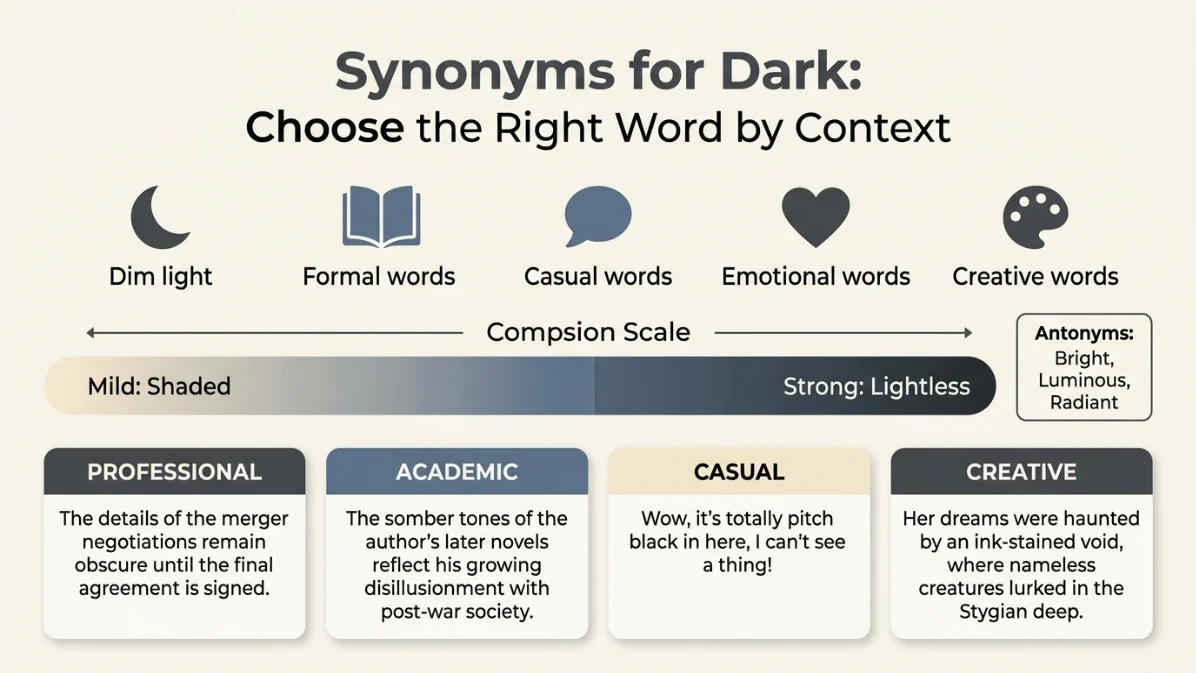
For professional writing, “dim” or “unlit” work well for physical spaces. In academic writing, “obscure” or “tenebrous” offer precision. Casual conversation flows naturally with “pitch black” or “shady.” Emotional writing benefits from “melancholy,” “gloomy,” or “bleak.” Creative writing opens up options like “shadowy,” “murky,” and “dusky.” For resumes or workplace use, “subdued” lighting or “deep” color tones sound polished. Social media captions can use punchy words like “moody” or “inky.” A stronger meaning often calls for “black,” “lightless,” or “Stygian,” while softer meanings work well with “shaded” or “twilit.”
When Not to Use “Dark”
The word dark can become vague when a more precise description is available. In a home design report, “The living room felt dark” tells readers less than “The living room lacked natural light and felt visually closed in.” For emotional writing, “She felt dark” sounds awkward compared to “She felt desolate” or “She felt weighed down by melancholy.” In professional color descriptions, “dark blue” is less evocative than “deep navy” or “rich indigo.” When you mean something sinister or threatening, words like “sinister,” “ominous,” or “menacing” communicate the intended meaning far more clearly.
Words Commonly Confused With “Dark”
Several words overlap with dark but carry distinct meanings. Knowing the difference prevents embarrassing misuse in professional and creative work.
Dark versus Black. Dark indicates a low level of light or a deep shade, while black means the total absence of light or the darkest possible color. A room at dusk is dark, but a sealed cave without any light source is truly black.
Dark versus Dim. Dim means faintly lit or not bright, usually suggesting poor visibility. Dark can mean completely without light. A dim hallway still has some light, but a dark hallway has none.
Dark versus Shadowy. Shadowy means full of shadows and often implies mystery or partial concealment. Dark is broader and does not automatically suggest shadow. A shadowy figure is partially hidden by shadow, not necessarily standing in complete darkness.
Dark versus Gloomy. Gloomy emphasizes a depressing or dreary emotional quality along with low light. Dark can be neutral. A gloomy day feels sad, but a dark night might feel peaceful.
Dark versus Murky. Murky means dark and cloudy, often because of dirt, smoke, or water. Dark has no built in suggestion of cloudiness. Murky water is thick with particles, but dark water may be perfectly clean.
Dark versus Obscure. Obscure means not clearly seen, understood, or known. Dark focuses on light levels or emotional weight. An obscure reference is hard to understand, not physically unlit.
Best Synonym by Context for “Dark”
| Context | Best Synonym | Why It Works | Example |
|---|---|---|---|
| Formal Writing | Somber | Conveys seriousness and dignity | The ceremony carried a somber tone as attendees reflected on the past year. |
| Academic Writing | Obscure | Suggests lack of clarity or hidden meaning | The poet’s obscure imagery challenges readers to find multiple interpretations. |
| Professional Setting | Dim | Accurately describes insufficient lighting | The dim hallway needed brighter bulbs to meet the new safety code. |
| Resume Content | Subdued | Sounds intentional and design focused | Selected subdued accent walls to balance the open office layout. |
| Casual Conversation | Pitch Black | Feels natural and emphatic in speech | It was pitch black outside when we finally left the theater. |
| Creative Writing | Inky | Adds texture and visual depth | The inky sky swallowed the last traces of sunset. |
| Emotional Tone | Bleak | Strongly communicates hopelessness | The character’s future looked bleak after the final confrontation. |
| Strong Intensity | Lightless | Emphasizes complete absence of light | The cave passage was lightless and unnervingly silent. |
| Soft Intensity | Shaded | Gentle and pleasant in tone | We found a shaded spot under the oak trees for the picnic. |
| Social Media Caption | Moody | Modern, atmospheric, and engaging | Moody skies and strong coffee. Perfect writing weather. |
Which Synonym Should You Choose?
Start by asking what you are describing. If you mean a physical lack of light, pick words like dim, unlit, or pitch black. If you are describing a color, deep, rich, or charcoal often sound more polished. For emotional or thematic weight, consider somber, bleak, or melancholic.
Next, check the formality level. Subdued and obscure suit academic or professional contexts, while moody and pitch black fit casual and social media use. Finally, match the intensity. Lightless and black are absolute, while dusky and shaded are gentle.
Your goal is to pick the word that carries the exact meaning, emotional register, and professional tone your sentence needs.
Real Life Examples of “Dark” in Sentences
Seeing synonyms in real life situations helps you internalize natural word choice. These examples show how replacing dark improves clarity across different settings.
- School: The history professor described the obscure diplomatic tensions that led to the conflict.
- Workplace: The dim emergency lighting activated as soon as the power went out.
- Writing: Her short story explored the somber reality of life in a fading coastal town.
- Conversation: The basement is pitch black at night. I’m not going down there alone.
- Social Media: This inky midnight sky is unreal. No filter needed tonight.
- Email: The new conference room feels a bit underlit for client presentations. Could we request brighter bulbs?
- Storytelling: The forest grew lightless and impossibly quiet as the fog rolled in.
15 Synonyms for “Dark”
| Synonym | Simple Meaning | Best Used For | Example Sentence |
|---|---|---|---|
| Dim | Not bright, poorly lit | Professional descriptions of lighting | The restaurant’s dim atmosphere made reading the menu difficult. |
| Gloomy | Dark and depressing | Emotional weather and mood description | The gloomy afternoon matched his unsettled mood perfectly. |
| Somber | Seriously dark in tone | Formal and respectful contexts | The memorial had a somber dignity that honored the occasion. |
| Obscure | Not clear or well known | Academic and intellectual writing | The manuscript contains obscure references to medieval alchemy. |
| Shadowy | Full of shifting shadows | Mystery and descriptive storytelling | A shadowy figure emerged from the alley and disappeared quickly. |
| Pitch Black | Completely and totally dark | Casual speech and emphasis | The countryside at night is pitch black without streetlights. |
| Murky | Dark and cloudy with particles | Water, ethical, or unclear situations | The murky pond water hid everything beneath the surface. |
| Bleak | Cold, hopeless, and harsh | Emotional and literary writing | The landscape looked bleak under the winter sky. |
| Inky | Deep dark like ink | Vivid creative descriptions | The inky ocean stretched endlessly under the moonless sky. |
| Dusky | Darkening at twilight | Soft nature and time of day descriptions | The dusky light softened the edges of the mountain range. |
| Subdued | Softened and muted | Design, professional, and artistic use | The designer chose subdued tones for the meditation space. |
| Lightless | Having no light at all | Extreme, absolute darkness | The lightless depths of the trench remain largely unexplored. |
| Shaded | Protected from direct light | Pleasant, comfortable descriptions | We sat in the shaded courtyard escaping the midday heat. |
| Tenebrous | Literary word for dark and shadowy | Formal literary analysis | The novel’s tenebrous atmosphere foreshadows the tragic ending. |
| Moody | Atmospheric and emotionally charged | Social media, photography, and casual style | This moody editing style makes street photography look cinematic. |
Synonym Groups and Usage Differences
Professional vs. Personal Synonyms
In professional settings, stick with dim, subdued, and poorly lit. These words sound objective and solution oriented. For personal writing and conversation, pitch black, gloomy, and moody feel natural and emotionally expressive. Avoid stark words like lightless in a work email, and skip technical words like tenebrous at a coffee chat.
Formal vs. Conversational Synonyms
Formal writing, reports, and speeches benefit from somber, obscure, and tenebrous. Conversational English and casual emails thrive on everyday choices like dark, dim, and pitch black. You can say “The room was pitch black” to a friend, but write “The lighting conditions were inadequate” for a formal inspection report.
Academic Synonyms
Academic writing demands precision. Obscure works for unclear meanings or hidden knowledge. Somber fits historical or sociological analysis. For physical darkness in scientific contexts, “unilluminated” or “low luminance” may be more appropriate. Avoid emotional or dramatic words like gloomy unless analyzing literary texts.
Professional and Business Synonyms
Business writing values clarity and neutrality. Use dim for lighting, subdued for color choices, and negative or declining for dark financial outlooks. In resume writing, subdued, deep, and balanced color palettes show design awareness. Avoid overly emotional words like bleak in a quarterly report unless describing genuinely severe conditions.
Creative or Literary Synonyms
Fiction, poetry, and narrative nonfiction come alive with inky, shadowy, tenebrous, dusky, and murky. These words add texture and mood. A “shadowy forest” feels mysterious. An “inky sky” feels vast and dramatic. A “dusky horizon” feels gentle and transitional. Match the word to the emotional register of the scene.
Slang or Modern Synonyms
Moody is a popular modern choice for social media captions, photography hashtags, and casual style descriptions. It describes atmospheric lighting and emotional tone rather than literal darkness. Moody is acceptable in casual writing and visual content but too informal for academic or business contexts.
Strongest vs. Weaker Synonyms
The intensity of darkness varies widely. Lightless, pitch black, and Stygian describe absolute, total darkness. Dim, shaded, and dusky describe soft, partial, or gentle darkness. Gloomy, bleak, and somber add emotional weight without literally describing light. Choose the intensity that matches the reality of what you are describing.
Emotional vs. Neutral Synonyms
Bleak, somber, gloomy, and melancholic carry strong emotional connotations. They say as much about mood as about light. Dim, unlit, shaded, and dusky stay neutral and descriptive. When you want to describe a fact, stay neutral. When you want to create an atmosphere, choose emotionally charged synonyms.
Antonyms of “Dark”
| Antonym | Meaning | Example Sentence |
|---|---|---|
| Bright | Giving off much light | The bright kitchen felt welcoming and spacious. |
| Light | Pale, illuminated, not heavy | She painted the walls a light cream to open up the room. |
| Luminous | Glowing with light | The luminous watch face glowed softly through the night. |
| Radiant | Shining brightly | Her radiant smile lit up the entire room. |
| Sunny | Full of sunlight | The sunny patio was perfect for morning coffee. |
| Pale | Light in color | He chose a pale blue tie for the spring wedding. |
| Glowing | Emitting steady light | The glowing embers kept the campfire alive. |
| Brilliant | Exceptionally bright or intelligent | The brilliant chandelier transformed the ballroom. |
| Illuminated | Lit up | The illuminated manuscript gleamed with gold leaf. |
| Cheerful | Happy and optimistic in tone | The cheerful decor lifted everyone’s spirits. |
| Hopeful | Feeling optimistic about the future | The final chapter left readers with a hopeful outlook. |
| Vivid | Producing powerful clear images | The artist used vivid colors to energize the composition. |
| Clear | Easy to see through or understand | The clear night sky revealed thousands of stars. |
| Airy | Spacious and light filled | The airy loft had floor to ceiling windows. |
| Transparent | Allowing light to pass through | The transparent curtains softened the morning sunlight. |
Comparison: Dark vs. Similar Words
Dark vs. Black
The main difference is that dark describes a low level of light or a deep shade, while black means the total absence of light or the darkest color. Black is stronger and more absolute. Dark is broader. “The dark sweater” is deep navy or charcoal. “The black sweater” is the deepest possible shade.
Dark vs. Dim
Dim means faintly lit or not bright enough. Dark means having little or no light. Dim is softer and often temporary. Dark can be total. A dim reading lamp is still on. A dark room has no light source at all. Dim works better for adjustable lighting complaints.
Dark vs. Gloomy
Gloomy adds a layer of sadness or depression to the physical quality of darkness. A dark hallway might just need a lightbulb. A gloomy hallway feels unwelcoming and emotionally heavy. Use gloomy when mood matters, and dark when only light level matters.
Dark vs. Murky
Murky means dark and clouded by particles like mud, dust, or smoke. Dark water might be perfectly clear but unlit. Murky water is opaque because of what is suspended in it. Murky also describes unclear ethical or legal situations.
Dark vs. Obscure
Obscure means hidden from view, not well known, or difficult to understand. Dark describes a low level of light. An obscure poet is not widely read. A dark poet writes about grim themes. The words describe different qualities entirely.
Dark vs. Somber
Somber is dark in mood, tone, or color but carries dignity and seriousness. It is a formal, emotionally aware word. Dark is the broad default term. A somber occasion is respectfully serious. A dark occasion may be frightening or tragic. Somber is almost always preferred in formal and respectful writing.
Common Phrases and Expressions with “Dark”
1. A shot in the dark
Meaning: A guess or attempt with little chance of success.
Example sentence: My answer was a complete shot in the dark, but somehow it was correct.
2. Keep someone in the dark
Meaning: To hide information from someone.
Example sentence: The team felt frustrated because leadership kept them in the dark about the merger.
3. Dark horse
Meaning: A little known competitor who surprises others by winning.
Example sentence: The independent film was a dark horse at the awards and won best picture.
4. The dark ages
Meaning: A historical period of intellectual darkness, or a time lacking progress.
Example sentence: Without reliable data, our marketing strategy feels like it is stuck in the dark ages.
5. Every dark cloud has a silver lining
Meaning: There is something hopeful or positive in every difficult situation.
Example sentence: Losing that client hurt, but it opened up time for a better project. Every dark cloud has a silver lining.
6. Whistling in the dark
Meaning: Trying to stay brave in a scary situation.
Example sentence: His confident speech was really just whistling in the dark before the board made their final decision.
7. In the dark of night
Meaning: During the deepest, quietest part of the night.
Example sentence: The package arrived in the dark of night with no explanation.
Common Mistakes to Avoid
Using “dark” when “obscure” is more accurate for unclear ideas can confuse readers. Confusing dark with gloomy is another common error, as gloomy adds emotional weight that dark does not automatically carry. In formal writing, casual synonyms like “pitch black” or “moody” sound out of place and lower credibility.
Overly dramatic synonyms like “lightless” may exaggerate a simple situation, such as describing a dim hallway as lightless. Repeating the same word too often weakens writing and shows limited vocabulary range. Choosing a synonym with the wrong emotional tone, like calling a peaceful evening “bleak,” creates unintended negative feelings. Using slang like “moody” in academic or business writing undermines professionalism.
FAQs
What is the best synonym for dark?
The best synonym depends on context. Use “dim” for lighting, “somber” for serious tone, and “pitch black” for total darkness in casual speech.
What is a formal synonym for dark?
Somber is a strong formal synonym for dark when describing tone or atmosphere. For physical darkness in formal writing, use “dim” or “unilluminated.”
What is an informal synonym for dark?
Pitch black is the most common informal synonym for dark. It emphasizes complete darkness in everyday speech and casual writing.
What is another word for dark in professional writing?
In professional writing, “dim” for lighting, “subdued” for colors, and “somber” for serious tones are the most appropriate and respected alternatives.
What is the difference between dark and gloomy?
Dark describes a low level of light. Gloomy adds a feeling of sadness or depression. Gloomy is emotional, while dark can be neutral.
What is the opposite of dark?
The direct opposite of dark is “light” or “bright,” depending on whether you mean illumination or color shade. “Illuminated” is another precise antonym.
Conclusion
Dark is a useful, flexible word, but precise synonyms elevate your writing. The right choice depends on what you are describing: physical light, emotional tone, color depth, or intellectual clarity. For professional settings, lean on dim, subdued, and somber. For creative work, explore inky, shadowy, and dusky.
Emotional weight, consider bleak or melancholic. Start noticing the exact shade of meaning you need, and your vocabulary will grow stronger with every sentence.