You are writing an important email to your boss. Agree to take on a new project, but you are not excited about it. You type “I reluctantly agree” and hit send. The next day, you are writing a cover letter and you use the same word again. Later, you are texting a friend and you type the word a third time.
This happens to everyone. You find a word that works and you reuse it without thinking. But using the same word repeatedly makes your writing feel flat and repetitive. Learning synonyms of reluctantly can help you express hesitation, unwillingness, and doubt with more precision and variety.
Choosing the right synonym improves your clarity, tone, and overall communication. Whether you are writing a professional email, an academic essay, or a casual text message, the right word makes all the difference.
What Are the Best Synonyms of “Reluctantly”?
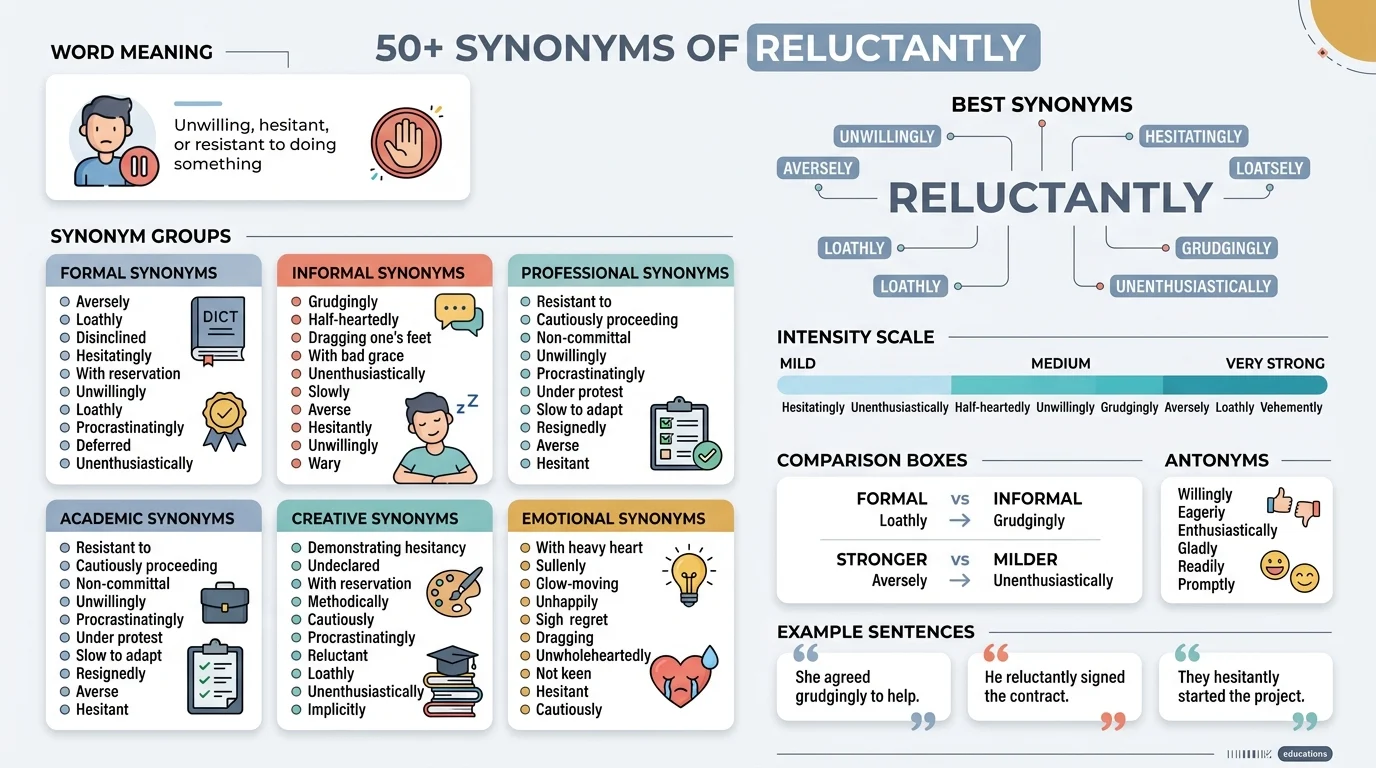
Reluctantly means doing something with hesitation, unwillingness, or a lack of enthusiasm. The best synonyms depend on your context. Formal writing, use “unwillingly” or “with reservation.” For casual conversation, try “hesitantly” or “half-heartedly.” Emotional writing, “grudgingly” or “begrudgingly” work well. For professional communication, “against one’s better judgment” sounds authoritative.
Meaning, Tone, and Context
Simple Definition
Reluctantly means doing something without wanting to do it. You might hesitate, feel doubtful, or experience a sense of dread before acting. When you do something reluctantly, you do not really want to do it.
Part of Speech
Reluctantly is an adverb. It modifies verbs to describe how an action is performed.
Overall Tone
The tone of reluctantly is neutral to slightly negative. It conveys a lack of eagerness or willingness. The word implies some sort of mental struggle, as between disinclination and a sense of duty.
Formality Level
Reluctantly is neutral in formality. It works in both formal and informal contexts. However, some synonyms are more formal or more casual.
Common Uses
Native English speakers commonly use reluctantly in situations involving obligations, requests, compromises, or decisions they do not fully support. You might reluctantly agree to a plan, reluctantly admit a mistake, or reluctantly accept an offer.
Word Forms
- Noun: reluctance
- Adjective: reluctant
- Adverb: reluctantly
When and How to Use “Reluctantly”
Choose reluctantly when you want to describe an action performed without enthusiasm or desire. The word suggests that the person felt a sense of duty, pressure, or obligation that overcame their hesitation.
Here are seven realistic examples showing how to use reluctantly in different contexts.
Professional: The manager reluctantly approved the budget increase after reviewing the data.
Academic: The researcher reluctantly concluded that the hypothesis was incorrect.
Workplace: She reluctantly agreed to work overtime on the holiday weekend.
Personal: He reluctantly attended the family reunion after his mother insisted.
Email: I reluctantly accept your proposal, though I have some concerns.
Resume: Reluctantly took on additional responsibilities during a staffing shortage.
Social Media: She reluctantly posted the photo after her friends begged her to share it.
Best Synonyms of “Reluctantly”
No synonym is identical in every situation. The best choice depends on your audience, tone, and purpose. Here are the top recommendations for specific contexts.
Professional writing: “Unwillingly” is direct and clear. It communicates resistance without emotional excess.
Academic writing: “With reservation” sounds precise and measured. It fits scholarly tone perfectly.
Business communication: “Against one’s better judgment” conveys thoughtful hesitation. It sounds professional and considered.
Casual conversation: “Hesitantly” feels natural and relatable. It works well in everyday speech.
Emotional writing: “Grudgingly” adds a layer of resentment or bitterness. It expresses stronger feelings.
Creative writing: “Loathly” offers a literary, formal alternative. It adds sophistication to narrative prose.
Resume writing: Avoid using reluctantly on a resume. Instead, describe challenges positively. Focus on what you accomplished despite difficulties.
Workplace communication: “With reluctance” sounds professional and diplomatic. It softens the negative tone.
Stronger meaning: “Begrudgingly” implies active resentment or ill will. Use it when the person feels genuinely put out.
Softer meaning: “Cautiously” emphasizes careful consideration rather than emotional resistance.
When Not to Use “Reluctantly”
Using reluctantly in the wrong context can weaken your message or create confusion. Here are situations where you should choose a different word.
When the word sounds too general: Reluctantly can feel vague if you want to specify the exact nature of the hesitation. Instead of “She reluctantly agreed,” try “She hesitantly agreed” to emphasize uncertainty.
When the word sounds too vague: If you need to convey a specific emotion like resentment, “reluctantly” is too mild. Use “grudgingly” instead.
When the word sounds too formal: In casual text messages, reluctantly can feel stiff. Try “kind of” or “not really” for a more natural tone.
When the word sounds too informal: In academic papers, reluctantly may not sound authoritative enough. Use “with reservation” or “against one’s better judgment.”
When the word sounds too weak: If the person felt strong resistance, reluctantly downplays their feelings. Use “unwillingly” or “begrudgingly” for more force.
When the word sounds outdated: Reluctantly is not outdated, but some synonyms like “loathly” sound old-fashioned. Use them only in literary contexts.
Words Commonly Confused With “Reluctantly”
Here are six words that readers often confuse with reluctantly. Understanding the differences will help you choose the right word every time.
Reluctantly vs. Hesitantly
Difference: Reluctantly focuses on unwillingness. Hesitantly focuses on uncertainty or pause.
When to use it: Use hesitantly when someone is unsure or pausing. Use reluctantly when someone does not want to act.
Example (reluctantly): He reluctantly signed the contract.
Example (hesitantly): He hesitantly raised his hand to ask a question.
Reluctantly vs. Unwillingly
Difference: Unwillingly is more neutral. It simply means the person did not want to do something. Reluctantly implies a mental struggle.
When to use it: Use unwillingly for straightforward resistance. Use reluctantly when the person feels conflicted.
Example (reluctantly): She reluctantly agreed to help, despite her busy schedule.
Example (unwillingly): She unwillingly attended the mandatory training session.
Reluctantly vs. Grudgingly
Difference: Grudgingly implies resentment or bitterness. Reluctantly is milder.
When to use it: Use grudgingly when someone feels put out or annoyed.
Example (reluctantly): He reluctantly admitted he was wrong.
Example (grudgingly): He grudgingly admitted she was right, rolling his eyes.
Reluctantly vs. Begrudgingly
Difference: Begrudgingly is very similar to grudgingly but often implies giving something reluctantly, such as praise or money.
When to use it: Use begrudgingly when someone gives something they would rather keep.
Example (reluctantly): She reluctantly gave him a second chance.
Example (begrudgingly): She begrudgingly paid the fine.
Reluctantly vs. Cautiously
Difference: Cautiously emphasizes carefulness and prudence. Reluctantly emphasizes unwillingness.
When to use it: Use cautiously when someone is being careful. Use reluctantly when someone does not want to act.
Example (reluctantly): He reluctantly invested in the startup.
Example (cautiously): He cautiously invested in the startup after researching it thoroughly.
Reluctantly vs. Loathly
Difference: Loathly is formal and literary. It expresses extreme reluctance. Reluctantly is more common and neutral.
When to use it: Use loathly in formal or creative writing. Use reluctantly in everyday contexts.
Example (reluctantly): She reluctantly attended the ceremony.
Example (loathly): He loathly accepted the invitation to the formal dinner.
Best Synonyms of “Reluctantly” by Context
| Context | Best Synonym | Why It Works | Example |
|---|---|---|---|
| Formal writing | With reservation | Sounds measured and precise | The committee accepted the proposal with reservation. |
| Academic writing | Against one’s better judgment | Conveys thoughtful hesitation | The researcher, against her better judgment, published the preliminary findings. |
| Professional communication | Unwillingly | Direct and clear | The team unwillingly accepted the new policy. |
| Business emails | With reluctance | Diplomatic and professional | I accept your offer with reluctance. |
| Resume writing | (Avoid using) | Reluctance is not a selling point | N/A |
| Workplace communication | Hesitantly | Emphasizes careful consideration | She hesitantly agreed to lead the project. |
| Casual conversation | Kind of | Natural and conversational | I kind of agreed to go to the party. |
| Everyday speaking | Not really | Relatable and informal | I didn’t really want to go, but I went. |
| Creative writing | Loathly | Literary and sophisticated | He loathly stepped onto the stage. |
| Storytelling | Grudgingly | Adds emotional depth | She grudgingly followed him into the dark forest. |
| Emotional writing | Begrudgingly | Expresses resentment | He begrudgingly handed over his lunch money. |
| Strong emphasis | Unwillingly | Conveys clear resistance | She unwillingly signed the divorce papers. |
| Mild tone | Cautiously | Softens the hesitation | He cautiously approached the topic. |
| Social media captions | Hesitantly | Relatable and engaging | Hesitantly trying this new trend. |
| American English | Reluctantly | Standard usage | He reluctantly agreed to help. |
How to Choose the Best Synonym of “Reluctantly”
Choosing the right synonym depends on several factors. Use this practical decision guide to make the best choice.
Consider your meaning: Are you describing unwillingness, hesitation, resentment, or carefulness? Choose a word that matches your exact meaning.
Consider your tone: Do you want to sound formal, casual, emotional, or neutral? Select a synonym that fits your desired tone.
Consider your audience: Are you writing for a professor, a boss, a friend, or the general public? Adapt your word choice to your reader.
Consider emotional strength: How strong is the resistance? Use milder words like “cautiously” for weak hesitation. Use stronger words like “begrudgingly” for intense reluctance.
Consider your writing purpose: Are you informing, persuading, entertaining, or expressing emotion? Choose a word that supports your goal.
Consider formality level: Match the formality of your synonym to the formality of your document. Formal writing requires formal synonyms. Casual writing allows informal alternatives.
Consider naturalness: Does the synonym sound natural in your sentence? Read it aloud. If it feels awkward, try a different word.
The goal is to communicate your intended message as clearly as possible. Choose the synonym that best captures your meaning without confusing your reader.
Real Life Examples of “Reluctantly”
Here are realistic examples showing how reluctantly and its synonyms appear in everyday situations.
School: The student reluctantly raised his hand to answer the teacher’s question.
College: She reluctantly chose a major that would lead to a stable career rather than her passion.
Workplace: He reluctantly agreed to work on the weekend to meet the deadline.
Business: The CEO reluctantly announced layoffs despite the company’s strong quarterly earnings.
Email: I reluctantly accept your resignation, though I wish you would reconsider.
Resume: Avoid using reluctantly on a resume. Instead, write: “Stepped up to lead the team during a critical project phase.”
Conversation: “I reluctantly went to the dentist,” she said with a shudder.
Storytelling: The knight reluctantly drew his sword, knowing he could not defeat the dragon alone.
Blogging: I reluctantly tried the new diet, and honestly, it was not as bad as I expected.
Social media: Reluctantly saying goodbye to summer and hello to fall. 🍂
Now compare these improved versions using stronger synonyms.
Improved: The student hesitantly raised his hand, unsure of the answer.
Improved: The CEO, against his better judgment, announced layoffs.
18 Best Synonyms of “Reluctantly”
Synonyms of “Reluctantly” by Usage
Professional vs Personal Synonyms
In professional settings, choose synonyms that sound measured and diplomatic. “With reservation” and “against one’s better judgment” work well in business communication. They convey hesitation without sounding emotional or resistant.
In personal conversations, “hesitantly” and “kind of” sound more natural and relatable. They fit the casual tone of everyday speech.
Formal vs Conversational Synonyms
Formal synonyms include “with reservation,” “against one’s better judgment,” “loathly,” and “disinclined.” Use these in reports, essays, business writing, presentations, and formal emails.
Conversational synonyms include “hesitantly,” “half-heartedly,” “kind of,” and “not really.” Use these in casual conversations, texting, and social media posts.
Academic Synonyms
For academic writing, choose precise, authoritative synonyms. “With reservation” sounds scholarly and measured. “Against one’s better judgment” conveys thoughtful hesitation. “Disinclined” is formal and precise. These words enhance the credibility of your research, essays, and reports.
Professional and Business Synonyms
For resumes, interviews, meetings, presentations, performance reviews, and client communication, choose words that project professionalism. “With reluctance” sounds diplomatic. “Against one’s better judgment” conveys thoughtful decision-making. Avoid words like “grudgingly” or “begrudgingly” in professional contexts because they sound resentful.
Creative and Literary Synonyms
For storytelling, fiction, poetry, descriptive writing, and speeches, choose expressive alternatives. “Loathly” adds literary sophistication. “Faintheartedly” evokes fear and hesitation. “Timidly” creates a vivid image of shyness. These words add emotion and imagery to creative writing.
Slang or Modern Synonyms
There are no widely used slang synonyms for reluctantly. However, phrases like “kind of,” “not really,” and “meh” convey similar meanings in informal contexts. Use these only in casual conversation. Avoid them in academic, professional, or formal writing.
Strongest to Mildest Synonyms
Here is an intensity scale from mild to very strong.
Mild: Cautiously, hesitantly, timidly
Moderate: Reluctantly, unwillingly, with reservation
Strong: Grudgingly, begrudgingly, against one’s better judgment
Very Strong: Loathly, resistantly, faintheartedly
Emotional vs Neutral Synonyms
Emotional Synonyms: Grudgingly, begrudgingly, loathly, faintheartedly, timidly. These words express stronger feelings like resentment, fear, or deep reluctance. Use them when you want to convey emotion.
Neutral Synonyms: Unwillingly, hesitantly, with reservation, cautiously. These words simply communicate information without adding strong emotion. Use them when you want to sound objective and measured.
Antonyms of “Reluctantly”
Comparison: “Reluctantly” vs Similar Words
Reluctantly vs Unwillingly
Main Difference: Reluctantly implies a mental struggle or conflict. Unwillingly is more neutral and simply means the person did not want to do something.
Which Is Stronger? Unwillingly is stronger in terms of clear resistance. Reluctantly suggests internal conflict.
Which Is More Formal? Both are neutral, but unwillingly is slightly more direct.
When to Use Each: Use reluctantly when someone feels conflicted but acts anyway. Use unwillingly when someone acts without desire.
Examples:
Reluctantly: She reluctantly signed the contract, though she had doubts.
Unwillingly: She unwillingly signed the contract because she had no choice.
Reluctantly vs Grudgingly
Main Difference: Grudgingly implies resentment or bitterness. Reluctantly is milder and more neutral.
Which Is Stronger? Grudgingly is stronger emotionally.
Which Is More Formal? Reluctantly is more neutral and works in more contexts.
When to Use Each: Use reluctantly for general hesitation. Use grudgingly when someone feels annoyed or put out.
Examples:
Reluctantly: He reluctantly agreed to help with the move.
Grudgingly: He grudgingly agreed to help, complaining the whole time.
Reluctantly vs Hesitantly
Main Difference: Reluctantly focuses on unwillingness. Hesitantly focuses on uncertainty or pause.
Which Is Stronger? Reluctantly is stronger in terms of resistance. Hesitantly suggests a momentary pause.
Which Is More Formal? Both are neutral.
When to Use Each: Use reluctantly when someone does not want to act. Use hesitantly when someone is unsure or pausing.
Examples:
Reluctantly: She reluctantly accepted the job offer.
Hesitantly: She hesitantly accepted the job offer, unsure if it was the right choice.
Reluctantly vs Begrudgingly
Main Difference: Begrudgingly often implies giving something reluctantly, such as praise, money, or approval.
Which Is Stronger? Begrudgingly is stronger and implies active resentment.
Which Is More Formal? Both are neutral.
When to Use Each: Use reluctantly for general unwillingness. Use begrudgingly when someone gives something they would rather keep.
Examples:
Reluctantly: He reluctantly paid the bill.
Begrudgingly: He begrudgingly paid the bill, muttering about the cost.
Reluctantly vs Cautiously
Main Difference: Cautiously emphasizes carefulness and prudence. Reluctantly emphasizes unwillingness.
Which Is Stronger? Reluctantly is stronger in terms of resistance. Cautiously is about being careful.
Which Is More Formal? Both are neutral.
When to Use Each: Use cautiously when someone is being careful. Use reluctantly when someone does not want to act.
Examples:
Reluctantly: He reluctantly invested in the startup.
Cautiously: He cautiously invested in the startup after researching it thoroughly.
Reluctantly vs Loathly
Main Difference: Loathly is formal and literary. It expresses extreme reluctance. Reluctantly is more common and neutral.
Which Is Stronger? Loathly is stronger and more extreme.
Which Is More Formal? Loathly is more formal and literary.
When to Use Each: Use loathly in formal or creative writing. Use reluctantly in everyday contexts.
Examples:
Reluctantly: She reluctantly attended the ceremony.
Loathly: He loathly accepted the invitation to the formal dinner.
Common Phrases and Expressions with “Reluctantly”
| Phrase | Meaning | Example Sentence |
|---|---|---|
| Reluctantly agree | Agree without wanting to | I reluctantly agree to your terms. |
| Reluctantly accept | Accept without enthusiasm | She reluctantly accepted the award. |
| Reluctantly admit | Admit something unwillingly | He reluctantly admitted his mistake. |
| Reluctantly concede | Concede unwillingly | He reluctantly conceded the point. |
| Reluctantly yield | Give in unwillingly | He reluctantly yielded to their demands. |
| Reluctantly decide | Decide without enthusiasm | She reluctantly decided to stay home. |
| Reluctantly agree to help | Agree to help without wanting to | He reluctantly agreed to help with the project. |
Common Mistakes to Avoid
Mistake 1: Choosing a vague synonym instead of a precise one
Incorrect: She reluctantly went to the party. (Too vague if you want to emphasize her fear.)
Better: She timidly went to the party. (More precise and vivid.)
Why: Timidly conveys fear and shyness, which reluctantly does not.
Mistake 2: Confusing reluctantly with a similar word
Incorrect: He was reticent to share his opinion. (Reticent means reserved, not reluctant.)
Better: He was reluctant to share his opinion.
Why: Reticent means unwilling to speak, not unwilling to act.
Mistake 3: Using an informal synonym in formal writing
Incorrect: The board kind of accepted the proposal. (Too informal.)
Better: The board accepted the proposal with reservation.
Why: Formal writing requires formal language.
Mistake 4: Selecting an overly dramatic synonym
Incorrect: He loathly accepted the job offer. (Too dramatic for a simple acceptance.)
Better: He reluctantly accepted the job offer.
Why: Loathly sounds old-fashioned and overly formal.
Mistake 5: Repeating the same word too often
Incorrect: She reluctantly agreed. He reluctantly signed. They reluctantly left.
Better: She grudgingly agreed. He hesitantly signed. They unwillingly left.
Why: Variety makes your writing more engaging.
Mistake 6: Choosing a synonym with the wrong emotional tone
Incorrect: He begrudgingly helped his friend move. (Implies resentment, which may not be intended.)
Better: He reluctantly helped his friend move.
Why: Begrudgingly adds resentment that reluctantly does not.
Mistake 7: Using slang in academic or professional writing
Incorrect: The researcher kinda agreed with the findings. (Too informal.)
Better: The researcher agreed with the findings with reservation.
Why: Academic writing demands formal language.
Frequently Asked Questions
1. What are the best synonyms of “reluctantly”?
The best synonyms depend on your context. Formal writing, use “unwillingly” or “with reservation.” For casual conversation, try “hesitantly” or “half-heartedly.” For emotional writing, “grudgingly” or “begrudgingly” work well.
2. What are the best formal synonyms of “reluctantly”?
The best formal synonyms include “with reservation,” “against one’s better judgment,” “unwillingly,” and “disinclined”. These words sound measured and authoritative in academic, professional, and business contexts.
3. What are common informal synonyms of “reluctantly”?
Common informal synonyms include “hesitantly,” “half-heartedly,” “kind of,” and “not really”. These alternatives sound natural in casual conversations, text messages, and social media posts.
4. What is another word for “reluctantly” in professional writing?
In professional writing, use “with reservation,” “against one’s better judgment,” or “unwillingly”. These synonyms sound diplomatic and thoughtful, which fits the tone of business communication.
5. What is the difference between “reluctantly” and “hesitantly”?
Reluctantly focuses on unwillingness, while hesitantly focuses on uncertainty or pause. Use reluctantly when someone does not want to act. Use hesitantly when someone is unsure or pausing before acting.
6. What is the opposite of “reluctantly”?
The opposite of reluctantly is willingly, eagerly, or enthusiastically. These words describe actions performed with desire, excitement, and positive energy.
Conclusion
Reluctantly is a useful word for describing actions performed without enthusiasm or desire. It conveys hesitation, unwillingness, and a sense of duty or obligation. But no single word works perfectly in every situation.
The best synonym depends on your context, audience, tone, and purpose. Formal writing, choose “with reservation” or “against one’s better judgment.” For casual conversation, try “hesitantly” or “half-heartedly.” For emotional writing, use “grudgingly” or “begrudgingly.”
Understanding the nuances of synonyms of reluctantly will make your writing clearer, more precise, and more engaging. The next time you write an email, an essay, or a social media post, think carefully about which word best captures your meaning. Your readers will notice the difference.
Here is one practical tip: Before you write, ask yourself what emotion you want to convey. If you want to show resentment, choose “grudgingly.” You want to show carefulness, choose “cautiously.” If you want to show pure unwillingness, choose “unwillingly.” Matching your word to your emotion will instantly improve your writing.