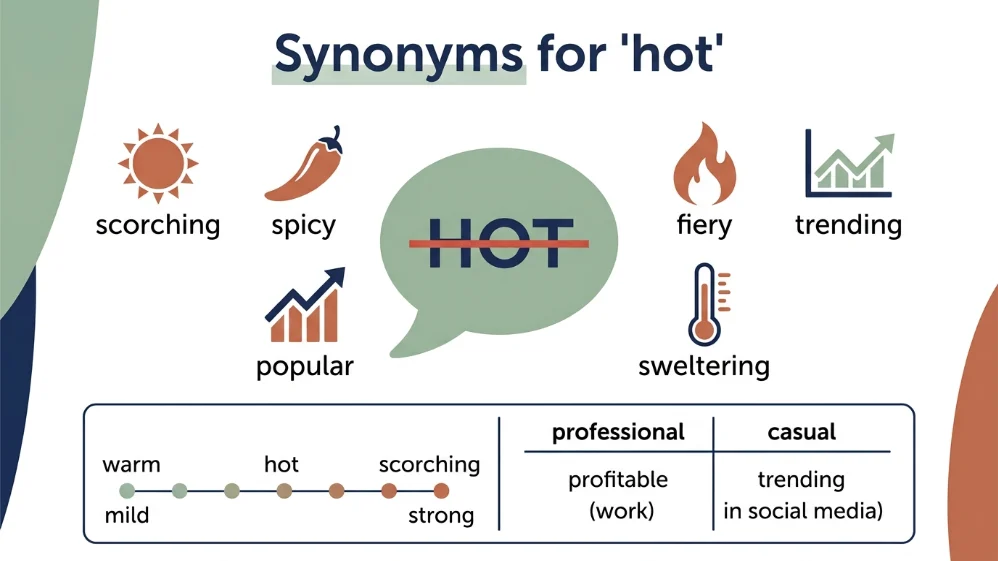
When you need a synonym for hot, the best word depends on what you mean. Are you talking about high temperature, spicy food, attractive looks, strong emotions, or trendy style? English has many options, and each one gives your sentence a slightly different feel.
This guide explores hot synonyms, synonyms for hot, and synonyms of hot in clear, everyday English. You will also find the best another word for hot for different situations, from formal writing to casual conversation. If you are searching for hot synonyms in English, this list makes the choice simple.
We also cover hot synonym slang and modern expressions used online and in everyday speech. By the end, you will know which synonym hot fits your sentence naturally and when to use it.
What Does “Hot” Mean?
“Hot” generally describes a high temperature, strong spiciness, great popularity, or intense emotion. The best synonym depends on your context.
Use “scorching” for weather, “piquant” for food, “trending” for popularity, and “furious” for anger. Always match the word to your specific situation.
Meaning, Tone and Context
- Simple definition: Hot means having a high temperature, a strong spicy flavor, or a significant degree of popularity, intensity, or freshness.
- Part of speech: It is primarily an adjective.
- Positive, negative, or neutral tone: The tone is neutral. Its perception changes entirely based on the context.
- Formality level: This word is very informal. It is best for casual conversations, not professional reports or academic essays.
- Common use cases: You will hear it describing weather, food, attractive people, popular new items, stolen goods, or intense anger.
- Important word forms: The word is an adjective. The noun form is “heat.” The verb is “to heat” or “to hot up” in British English. Opposites include “cold,” “cool,” and “mild.”
When and How to Use “Hot”
Using “hot” is acceptable in everyday chatter. It works well when the meaning is obvious from the physical context. However, it becomes weak in writing. It forces the reader to guess your intended meaning. Your job as a writer is to be precise. You should only use “hot” when its meaning is perfectly clear. Otherwise, choose a more specific synonym.
Here are some realistic examples showing how “hot” functions in different contexts.
- Physical weather: “I need to go inside. This sun is too hot.”
- Spicy food: “This curry is very hot. It might be too spicy for me.”
- Popular trend: “That new smartphone is the hot item this holiday season.”
- Emotional anger: “My brother was so hot about missing the bus.”
- Attractiveness: “She looks hot in that new dress.”
- Professional achievement: “Our sales team is having a hot quarter.”
- Recent or fresh news: “I have the hot gossip about the office party.”
Another Word for “Hot”
Choosing the single best replacement requires careful thought. You cannot use a thesaurus blindly. You must consider what “hot” is doing in your sentence. Are you discussing the weather, a feeling, or a trend? The answer to that question will dictate your word choice.
Here are the best single replacements based on common contexts.
- Professional writing: “Lucrative” or “in-demand” works for business trends. “Terminal” can replace it for serious physical conditions.
- Academic writing: “Thermal” describes temperature. “Piquant” describes taste. “Controversial” describes a current issue.
- Casual conversation: “Warm,” “spicy,” “popular,” or even “attractive” are clear and natural.
- Emotional writing: “Furious” or “livid” captures anger. “Passionate” or “ardent” captures romantic feelings.
- Creative writing: “Scorching,” “sweltering,” “blazing,” and “sultry” add vivid imagery and depth.
- Resume or workplace use: Use “profitable,” “high performing,” or “marketable” to describe products or skills.
- Social media captions: Words like “trending,” “viral,” or “fire” (slang) are perfect.
- Stronger meaning: Use “blistering,” “scorching,” or “fiery” for intense heat or anger.
- Softer meaning: Use “warm,” “tepid,” or “mild” for a less intense sensation.
When Not to Use “Hot”
Avoid “hot” when you need a formal or precise word. The word is too vague for academic reports. It is also too casual for executive summaries. If you use “hot” to describe a profit margin, you sound unprofessional. The word lacks the necessary nuance. It fails to convey exact degrees of temperature, emotion, or popularity.
Let us look at a vague sentence and its improved version.
Vague: “Our new service is hot.”
Improved: “Our new service is highly profitable and in demand.”
The improved version creates confidence. It uses specific professional vocabulary. The original version sounds like a slogan from a used car salesman.
Words Commonly Confused With “Hot”
Many related words share similar meanings with “hot.” They are not interchangeable. Each word has a unique purpose. Using the wrong one can change your intended message.
Here is a breakdown of commonly confused words with “hot.”
- Hot vs. Warm: Warm is a moderate temperature. Hot is a much higher temperature. “This coffee is warm” is a compliment. “This coffee is hot” might be a warning.
- Hot vs. Spicy: Spicy refers to the flavor of food. Hot is often used as a synonym. However, spicy is more precise. A “hot” day is not “spicy.” A “spicy” curry is flavorful.
- Hot vs. Popular: Popular means widely liked. Hot means currently trendy or fashionable. A book can be popular for years. A book is usually “hot” only for a short period.
- Hot vs. Angry: Angry describes the emotion. “Hot” can mean angry, but it is far less direct. If you are “hot,” you are very angry. It is better to just say “angry” or “furious.”
- Hot vs. Attractive: Attractive is the polite standard. “Hot” is a slang term for very physically attractive. It is too informal for professional or polite writing.
- Hot vs. Fresh: Fresh means new or recently made. “Hot” often implies freshness. “Hot bread” is fresh from the oven. However, “fresh news” is better than “hot news” in a formal report.
Best Synonym by Context for “Hot”
Choosing the correct synonym is about understanding your context. The word you use for a professional report is different from a text message. This table provides the best word for many common situations.
| Context | Best Synonym | Why It Works | Example |
|---|---|---|---|
| Formal Writing | Terminal (for condition), Thermal | These are specific and professional. They remove ambiguity. | “The patient was admitted with a terminal fever.” |
| Academic Writing | Controversial (for issues), Piquant | These are precise for academic discussions of topics or flavors. | “The theory remains a controversial topic.” |
| Professional Use | In Demand | It shows market value and profitability without slang. | “Cybersecurity skills are highly in demand.” |
| Casual Conversation | Warm | It is a safe, neutral word for describing weather or objects. | “It is quite warm outside today.” |
| Creative Writing | Scorching, Sultry | These words add vivid imagery and a specific feeling to the text. | “The scorching desert wind blasted the town.” |
| Emotional Tone | Furious, Passionate | These words clearly define the emotion, whether anger or romance. | “He was furious about the unfair decision.” |
| Strong Intensity | Blistering | This implies an extreme, almost violent level of heat or speed. | “The team set a blistering pace.” |
| Soft or Moderate | Mild | This indicates a low level of heat or spiciness. | “I prefer a mild salsa.” |
| Social Media | Trending, Viral | These are the modern terms for popularity and attention online. | “The video is currently trending on Twitter.” |
| Describing Spice | Fiery | This paints a picture of intense, burning spice. | “The chili had a fiery kick.” |
Which Synonym Should You Choose?
You should choose based on a simple formula. First, identify the subject. Are you talking about a physical object, a person, or an abstract idea? Second, identify the tone. Is this a formal email or a text to a friend? Finally, identify the intensity. Is the heat just warm or is it blazing?
When in doubt, use a word that leaves no room for confusion. For example, instead of saying “hot boss,” say “demanding boss” or “strict boss.” Instead of saying “hot pizza,” say “fresh pizza” or “spicy pizza.” This process of selection will improve the clarity of your writing.
Real Life Examples of “Hot” in Sentences
The word “hot” appears everywhere. Let us look at how it functions in diverse real world scenarios. We will also replace it with stronger alternatives.
- School: “The science teacher explained that the lava from the volcano is extremely scorching.”
- Workplace: “The quarterly report showed that our new software is highly marketable in the current economy.”
- Writing: “Her prose was fiery and challenged the complacency of her readers.”
- Conversation: “Be careful with that plate, it is very warm from the microwave.”
- Social Media: “The latest celebrity breakup is the trending topic on every platform.”
- Resume: “Managed a product line that became the company’s most profitable asset.”
- Email: “I am writing to address a critical issue with the server.”
- Storytelling: “A blistering wind came off the mountains, chilling him to the bone.”
25 Synonyms for “Hot”
There is a vast world of vocabulary waiting beyond the word “hot.” These 15 alternatives are the most useful and accurate for various situations. Learn them and use them to improve your language.
| Synonym | Simple Meaning | Best Used For | Example Sentence |
|---|---|---|---|
| Scorching | Extremely hot, burning | Weather, desert heat | “The scorching sun made the pavement soft.” |
| Blazing | Burning very brightly and intensely | Fires, hot sun | “A blazing fire in the fireplace kept us warm.” |
| Sweltering | Uncomfortably hot and humid | Summer weather | “The sweltering heat made it impossible to sleep.” |
| Fiery | Consisting of or containing fire; intense | Personality, temper, chili | “She had a fiery personality that intimidated others.” |
| Roasting | Very hot; heating something fiercely | Cooking, weather | “The inside of the car was roasting.” |
| Piquant | Having a pleasantly sharp or spicy taste | Food, flavors | “The sauce had a piquant flavor that was delightful.” |
| Spicy | Flavored with or containing strong spices | Food, cuisine | “We ordered a spicy tuna roll for lunch.” |
| Sultry | Attractively hot and humid; passionate | Weather, romantic feelings | “The sultry summer night felt full of romance.” |
| Torrid | Full of intense passion; very hot and dry | Love affairs, deserts | “They had a torrid love affair.” |
| Furious | Extremely angry | Emotional states | “My father was furious when he saw the scratch on the car.” |
| Trending | Subject to widespread attention | Social media, news | “The hashtag was trending for several hours.” |
| Lucrative | Producing a great deal of profit | Business, investments | “He found a lucrative business opportunity.” |
| Stolen | Not in legal possession | Legal, legal issues | “The police recovered the stolen artwork.” |
| Popular | Liked or admired by many people | General topics | “The band was very popular in the 1990s.” |
| Fresh | Recently made or obtained | News, food | “We have a fresh batch of muffins.” |
Synonym Groups and Usage Differences
Grouping words helps you understand their family. Knowing the family of a word helps you choose the best one.
Professional vs. Personal Synonyms
Professional synonyms focus on value and logic. Words like “lucrative,” “marketable,” and “profitable” describe business success. Personal synonyms relate to feelings or physical sensations. Words like “attractive,” “sweltering,” and “furious” are for personal life or descriptive writing.
Formal vs. Conversational Synonyms
“Terminal” or “thermal” are formal. You use them in scientific reports or medical contexts. “Fiery,” “spicy,” and “sweltering” are conversational. They are great for storytelling, casual writing, and everyday speech. Avoid formal words with friends and casual words with your boss.
Academic Synonyms
Academics value precision. “Controversial” is a formal and precise way to describe a disputed topic. “Piquant” is a precise word for flavor analysis in food science. “Thermal” is the scientific standard. These words suit essays, research papers, and scholarly journals.
Professional and Business Synonyms
In a resume or email, use “in demand.” It signals that your skills have market value. “Lucrative” indicates a successful financial venture. “Profitable” is the standard business term. These words convey seriousness and professional competence.
Creative or Literary Synonyms
Writers crave vivid language. “Scorching” and “blazing” paint a picture. “Sultry” and “torrid” create a mood. These words are the tools of poets and novelists. They turn simple sentences into powerful imagery.
Slang or Modern Synonyms
“Fire” is a modern slang term. It means something is very good or exciting. It is acceptable in texts or social media captions. It is never acceptable in professional or academic writing.
Strongest vs. Weaker Synonyms
Here is an intensity scale from mild to strongest: Warm, Mild, Hot, Fiery, Blistering, Scorching. Choose “warm” for a comfortable sensation. Choose “scorching” for a burning, dangerous heat.
Emotional vs. Neutral Synonyms
“Furious” is an emotional word. It expresses anger. “Passionate” is an emotional word for love. “Thermal” is a neutral word. It just relates to heat. “Popular” is also neutral. It does not carry a strong feeling.
Antonyms of “Hot”
Antonyms are words with opposite meanings. They are essential for contrast in writing. These 15 antonyms will help you create balance and contrast in your descriptions.
| Antonym | Meaning | Example Sentence |
|---|---|---|
| Cold | Having a low temperature | “I need a coat; it is cold outside.” |
| Cool | Moderately cold | “The weather is pleasantly cool today.” |
| Freezing | Extremely cold | “The water in the lake is freezing.” |
| Chilly | Uncomfortably cold | “The room felt a bit chilly.” |
| Frigid | Very cold in temperature | “The frigid air made his face numb.” |
| Mild | Not severe or intense | “The weather was mild for January.” |
| Tepid | Lukewarm; not enthusiastic | “The soup was tepid and unappetizing.” |
| Indifferent | Having no particular interest | “He was indifferent to the new marketing plan.” |
| Unpopular | Not liked or admired | “The politician was deeply unpopular.” |
| Old | Not new or recent | “That model of phone is already old.” |
| Forgotten | Not remembered | “The issue was quickly forgotten.” |
| Insipid | Lacking flavor | “The chicken was insipid and dry.” |
| Bland | Lacking strong flavor | “The food was bland and needed salt.” |
| Calm | Not showing strong emotion | “She remained calm despite the chaos.” |
| Legal | Allowed by law | “All the merchandise was legal.” |
Comparison: “Hot” vs. Similar Words
Understanding the precise difference between similar words is the key to advanced vocabulary. Here are six comparisons to clarify the subtle distinctions.
Hot vs. Warm
The main difference is the degree of temperature. Warm is a moderate, pleasant heat. Hot is a high, potentially unpleasant heat. Warm is more neutral. Hot is stronger. “I like my bath water warm.” “The stove is hot; do not touch it.”
Hot vs. Spicy
Hot describes a burning sensation. Spicy describes a complex flavor with strong spices. Hot is often a synonym, but it is not the same. Spicy is more descriptive of taste. “This chili is very spicy.” “The curry was too hot for me.”
Hot vs. Popular
Popular means well liked by a large number of people. Hot means current and trendy. A product can be popular and not currently hot. “Classic literature is popular.” “The new dance move is hot right now.”
Hot vs. Angry
Angry is the direct emotion. Hot is a slang term implying extreme anger. Angry is more professional and direct. Hot is informal. “I am angry about the decision.” “He was hot under the collar.”
Hot vs. Attractive
Attractive is the standard, polite term for good looks. Hot is a slang term implying extreme physical appeal. Attractive is broad. Hot is very specific and often informal. “She is an attractive candidate.” “He is a hot celebrity.”
Hot vs. Fresh
Fresh means new or recently made. Hot implies the newness of something desirable. “Fresh” is a broader term. “Hot” is more niche. “We have fresh bread.” “We have the hot news.”
Common Phrases and Expressions with “Hot”
The word “hot” appears in many English idioms. These phrases are useful for casual conversation.
1. Hot off the press
Meaning: Something that has just been published or printed.
Example sentence: “The details are hot off the press.”
2. In hot water
Meaning: In trouble or difficulty.
Example sentence: “He found himself in hot water with his boss.”
3. Strike while the iron is hot
Meaning: To take advantage of an opportunity before it is gone.
Example sentence: “We should strike while the iron is hot and launch the campaign.”
4. Hot and bothered
Meaning: Upset or agitated about something.
Example sentence: “She was all hot and bothered about the meeting.”
5. Hot potato
Meaning: An issue that is difficult to handle.
Example sentence: “The topic of layoffs is a hot potato.”
6. Make it hot for someone
Meaning: To make things difficult or unpleasant for someone.
Example sentence: “The boss will make it hot for you if you are late again.”
7. Full of hot air
Meaning: Talking nonsense or boasting.
Example sentence: “He is full of hot air.”
Common Mistakes to Avoid
Avoid these common errors to ensure your writing is clear and professional.
- Using “hot” in a professional resume. A hiring manager wants to see “profitable” or “in demand,” not “hot.”
- Confusing “hot” with “spicy.” Use “spicy” to describe flavor. Use “hot” to describe temperature or a slang word.
- Using “scorching” to describe a warm day. “Scorching” is for extreme, burning heat.
- Using “attractive” in a casual text. It is too polite. Use “hot” or “cute” for casual conversation.
- Overusing “hot” in creative writing. Use “sweltering,” “blistering,” or “fiery” to add variety.
- Using slang like “fire” in an academic paper. It is unprofessional and will not be taken seriously.
- Describing a product as “hot” without explaining why. It is vague. You need to provide context for your adjective.
FAQs
Here are answers to the most common questions about synonyms for hot.
What is the best synonym for hot?
The best synonym depends on context. Use “sweltering” for weather, “piquant” for food, and “furious” for anger.
What is a formal synonym for hot?
“Thermal” is a formal synonym for physical heat. “Controversial” is formal for a topic of debate.
What is an informal synonym for hot?
“Fiery,” “scorching,” or “blazing” are informal and add dramatic effect to casual writing.
What is another word for hot in professional writing?
Use “lucrative,” “profitable,” or “in demand” to describe a hot product or service professionally.
What is the difference between hot and warm?
Warm is a moderate temperature. Hot is a significantly higher, and often intense, temperature.
What is the opposite of hot?
The direct opposite is “cold.” Other antonyms include “cool,” “frigid,” and “mild.”
Conclusion
“Hot” is a convenient but overly simple word. It can mean temperature, spice, attractiveness, popularity, and anger. For strong writing, you must choose a specific synonym. You must match the word to the situation, the formality, and the intensity. Avoid the lazy choice. Replace “hot” with a vivid and precise word. Your readers will appreciate the clarity and energy in your language. Always ask yourself: what am I really trying to say? Then choose the best word for that job.
2 thoughts on “Synonyms for Hot | 75+ Powerful, Stylish & Creative Words to Describe Heat, Attraction, Food & More in 2026”