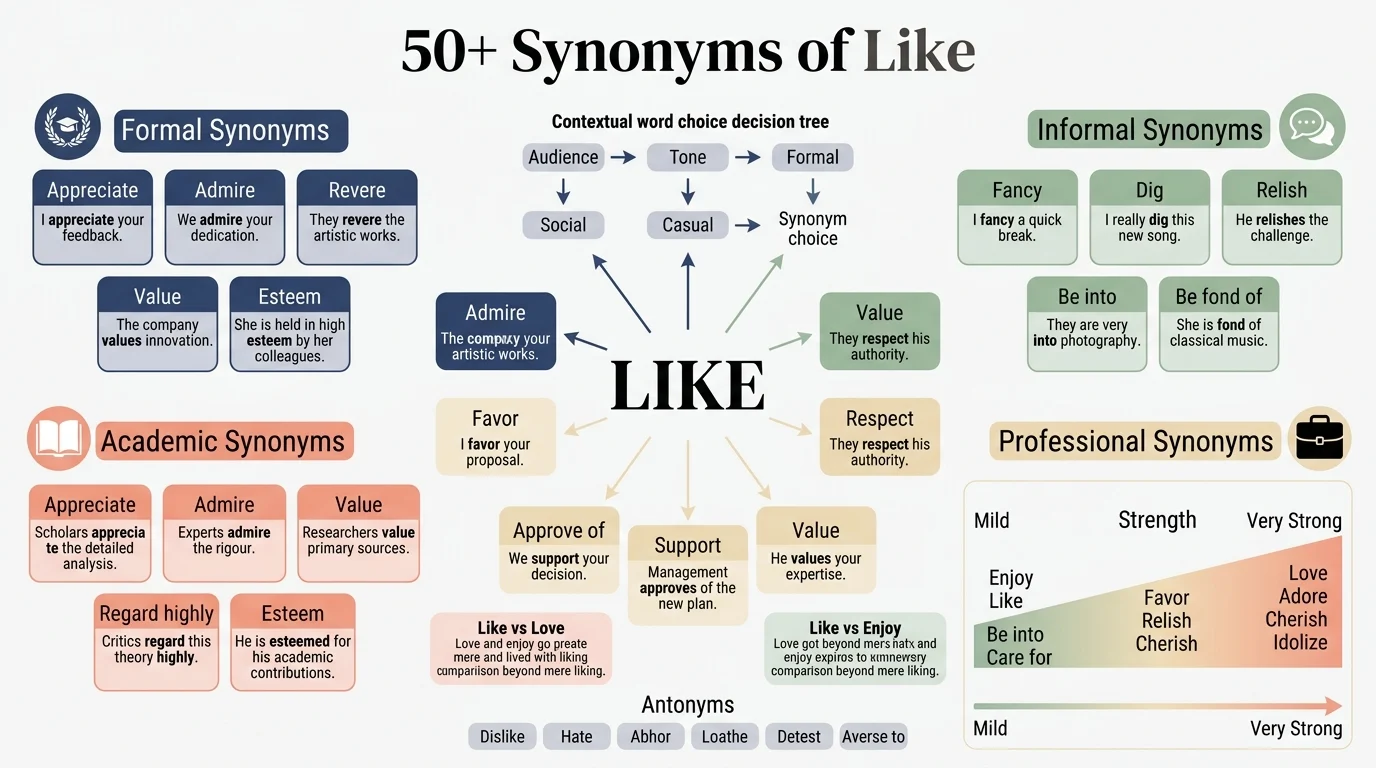
Have you ever read back an email, essay, or social media caption and realized you used the word “like” five times in three sentences? It happens to everyone. The word “like” is one of the most common words in English, but relying on it too often makes your writing sound repetitive and vague. Whether you are drafting a cover letter, writing a blog post, or sending a professional email, choosing the right synonym can transform your communication. The good news is that there are dozens of synonyms of like, each with its own tone, intensity, and ideal use case. This guide will help you understand the meaning of “like,” explore the best alternatives, and confidently choose the right word for every situation.
What Are the Best Synonyms of “Like”?
The word “like” means to enjoy something or someone, or to find something similar or agreeable. The best synonym depends on your context. Formal writing, use “appreciate” or “value.” For casual conversation, try “enjoy” or “love.” For academic work, choose “prefer” or “regard.” Professional settings, “admire” or “respect” work well. Emotional writing, “adore” or “cherish” add warmth. Creative writing, “relish” or “savor” create vivid imagery.
Meaning, Tone, and Context
Simple Definition
As a verb, “like” means to enjoy something, to approve of someone or something, or to feel positively toward a person, activity, or idea. It can also mean to prefer or wish for something, as in “I would like a cup of coffee.”
Part of Speech
“Like” functions primarily as a verb, but it can also serve as a preposition, noun, adjective, adverb, conjunction, and even a filler word in casual speech.
Overall Tone
“Like” is generally neutral to positive. It expresses approval, enjoyment, or preference without extreme emotion.
Formality Level
“Like” is neutral and works in almost any context. However, overusing it can make your writing feel informal or unsophisticated. In very formal writing, stronger or more precise synonyms are often preferred.
Common Uses
Native English speakers use “like” constantly. You will hear it in everyday conversation, see it in emails, and find it in everything from blog posts to business reports. People use it to express enjoyment (“I like pizza”), to show preference (“I like this idea better”), to indicate similarity (“She looks like her mother”), and as a filler word in casual speech (“It was, like, really good”).
Word Forms
- Verb: like, likes, liked, liking
- Noun: like, likes (as in social media likes)
- Adjective: like (as in “of like mind”)
- Preposition: like (as in “running like the wind”)
When and How to Use “Like”
Choose “like” when you want to express general enjoyment, approval, or preference in a neutral, straightforward way. It is safe for almost any situation, but it is rarely the most powerful or precise choice. Here are seven realistic examples showing how “like” appears in different contexts.
Professional
I like the direction this project is taking, and I think we should continue with the current strategy.
Academic
Many students like the flexibility of online learning, though some prefer in-person instruction.
Workplace
My team likes the new software update because it saves time on data entry.
Personal
I really like the new café on Main Street. Their coffee is excellent.
Email
I would like to schedule a meeting for next Tuesday to discuss the quarterly report.
Resume
I like working in fast-paced environments where I can solve problems quickly.
Social Media
I like this dress so much that I bought it in three different colors.
Best Synonyms of “Like”
No synonym is identical to “like” in every situation. The right choice depends on your audience, purpose, and the emotion you want to convey. Here are the best synonyms for specific contexts.
Professional Writing
Appreciate is the strongest choice for professional writing. It shows that you value something thoughtfully. Use it in emails, reports, and client communication. “Appreciate” sounds more deliberate than “like” and adds a layer of respect.
Academic Writing
Prefer works well in academic contexts because it implies a considered choice based on evidence or reasoning. It sounds more analytical than “like.”
Business Communication
Value is excellent for business settings because it suggests that something has worth or importance. It is stronger than “like” and more professional.
Casual Conversation
Enjoy is the most natural replacement for “like” in everyday speech. It is simple, clear, and widely used.
Emotional Writing
Adore conveys deep affection and warmth. Use it when you want to express strong positive feelings toward a person, place, or experience.
Creative Writing
Relish adds a sense of pleasure and appreciation. It works well in descriptive writing and storytelling because it creates a vivid emotional impression.
Resume Writing
Enjoy is perfectly acceptable on a resume, but appreciate or value sound more professional and thoughtful.
Workplace Communication
Respect is a strong choice for workplace settings when you want to express admiration for a colleague’s skills, ideas, or contributions.
Stronger Meaning
Love is significantly stronger than “like.” Use it when you want to express deep enjoyment or strong affection.
Softer Meaning
Quite like softens the expression of enjoyment. It suggests moderate approval without strong enthusiasm.
When Not to Use “Like”
When It Sounds Too General
Using “like” for everything makes your writing feel vague and uninspired. Instead of saying “I like the new policy,” try “I support the new policy” or “I appreciate the new policy.” The second version sounds more thoughtful and professional.
When It Sounds Too Informal
In formal academic papers, legal documents, or official reports, “like” can feel out of place. Replace it with “prefer,” “value,” or “regard.” For example, instead of “Researchers like this method,” write “Researchers prefer this method.”
When It Sounds Too Weak
If you feel strongly about something, “like” does not convey enough emotion. Use “love,” “adore,” or “cherish” instead. Instead of “I like my grandmother’s cooking,” write “I love my grandmother’s cooking.”
When It Sounds Too Strong
Sometimes “like” is too intense. If you only have mild approval, use “quite like” or “am fond of” to soften the statement.
Words Commonly Confused With “Like”
Like vs Love
Difference: “Like” expresses general enjoyment or approval. “Love” expresses deep affection, strong enjoyment, or intense passion.
When to Use Each: Use “like” for casual preferences. Use “love” when you feel strongly about something or someone.
Example (Like): I like swimming, but I only go once a month.
Example (Love): I love swimming. I go to the pool every single day.
Like vs Enjoy
Difference: “Enjoy” focuses specifically on the pleasure you get from an activity or experience. “Like” is broader and can refer to people, things, ideas, and activities.
When to Use Each: Use “enjoy” when you want to emphasize the pleasurable experience. Use “like” for general approval.
Example (Like): I like this restaurant.
Example (Enjoy): I enjoy dining at this restaurant because the service is excellent.
Like vs Prefer
Difference: “Like” means you find something agreeable. “Prefer” means you like one thing more than another. It implies comparison and choice.
When to Use Each: Use “like” for simple enjoyment. Use “prefer” when you are making a choice between options.
Example (Like): I like tea.
Example (Prefer): I prefer tea over coffee in the morning.
Like vs Appreciate
Difference: “Like” is casual and general. “Appreciate” is more thoughtful and implies that you recognize the value or quality of something.
When to Use Each: Use “like” in casual conversation. Use “appreciate” in professional or formal writing.
Example (Like): I like your help.
Example (Appreciate): I appreciate your help with this project.
Like vs Admire
Difference: “Like” expresses general approval. “Admire” expresses respect and high regard, often for someone’s qualities, skills, or achievements.
When to Use Each: Use “like” for everyday preferences. Use “admire” when you want to show respect.
Example (Like): I like my manager.
Example (Admire): I admire my manager’s leadership skills.
Like vs Favor
Difference: “Like” expresses enjoyment or approval. “Favor” implies a preference or a tendency to choose one thing over another. It often suggests bias or partiality.
When to Use Each: Use “like” for general feelings. Use “favor” when discussing choices, decisions, or preferences.
Example (Like): I like the blue option.
Example (Favor): I favor the blue option because it matches our brand colors.
Best Synonyms of “Like” by Context
| Context | Best Synonym | Why It Works | Example |
|---|---|---|---|
| Formal writing | Appreciate | Sounds thoughtful and respectful | We appreciate your continued support of our programs. |
| Academic writing | Prefer | Implies a reasoned choice | Researchers prefer this methodology for its reliability. |
| Professional communication | Value | Suggests importance and worth | We value your feedback on this matter. |
| Business emails | Appreciate | Adds a professional, courteous tone | I appreciate your quick response to my inquiry. |
| Resume writing | Enjoy | Simple and acceptable, but “appreciate” is stronger | I enjoy working in collaborative team environments. |
| Workplace communication | Respect | Conveys admiration for skills and ideas | I respect your approach to solving complex problems. |
| Casual conversation | Enjoy | Natural and widely used | I enjoy spending time with my friends on weekends. |
| Everyday speaking | Like | Perfectly acceptable and natural | I like this song a lot. |
| Creative writing | Relish | Adds vivid emotional imagery | She relished every moment of her vacation. |
| Storytelling | Savor | Creates a sense of slow, deep enjoyment | He savored the taste of the homemade pie. |
| Emotional writing | Adore | Conveys deep affection and warmth | I adore my grandmother’s stories about her childhood. |
| Strong emphasis | Love | Expresses intense enjoyment or affection | I love this movie. I have watched it ten times. |
| Mild tone | Quite like | Softens the expression of enjoyment | I quite like the new design, but I am not sure about the colors. |
| Social media captions | Love | Short, punchy, and engaging | Love this view! 😍 |
| American English | Like, enjoy, love | These are the most common choices | I like your outfit today. |
| British English | Fancy, be keen on, be partial to | These are more common in British usage | I fancy a cup of tea right now. |
How to Choose the Best Synonym of “Like”
Choosing the right synonym comes down to four key factors: your audience, your purpose, the emotion you want to convey, and the level of formality required.
Consider your audience. Are you writing to a client, a professor, a friend, or a social media following? Professional audiences expect more precise and thoughtful language. Friends and casual readers appreciate natural, conversational words.
Consider your purpose. Are you expressing a casual preference, making a formal recommendation, or describing a deep emotional connection? Your purpose determines how strong or formal your word choice should be.
Consider the emotion. Do you feel mildly positive, strongly enthusiastic, or deeply affectionate? Choose a synonym that matches the intensity of your feeling.
Consider formality. Academic papers, business reports, and official documents call for formal synonyms like “appreciate,” “value,” or “prefer.” Text messages, social media posts, and casual conversations allow for informal choices like “enjoy,” “love,” or even “dig.”
The best synonym is the one that communicates your intended message most clearly and naturally to your specific reader.
Real Life Examples of “Like”
School
Original: I like science class because we do experiments.
Improved: I enjoy science class because the hands-on experiments make learning exciting.
College
Original: I like the campus library. It is quiet.
Improved: I appreciate the campus library for its peaceful study environment and extensive resources.
Workplace
Original: I like my new desk. It has a good view.
Improved: I appreciate my new desk because the natural light makes the workspace more pleasant.
Business
Original: We like this supplier because they are reliable.
Improved: We value this supplier for their consistent reliability and high-quality products.
Email
Original: I like the proposal you sent.
Improved: I appreciate the proposal you sent. It addresses our key concerns thoughtfully.
Resume
Original: I like working with data.
Improved: I enjoy analyzing complex data sets to uncover actionable insights.
Conversation
Original: I like this pizza.
Improved: I love this pizza. The crust is perfect.
Storytelling
Original: She liked the sunset.
Improved: She savored the sunset, watching the colors shift from orange to deep purple.
Blogging
Original: I like this recipe because it is easy.
Improved: I adore this recipe because it is simple, delicious, and always impresses guests.
Social Media
Original: I like this place.
Improved: Absolutely love this place! Highly recommend.
18 Best Synonyms of “Like”
| Synonym | Simple Meaning | Best Used For | Example Sentence |
|---|---|---|---|
| Enjoy | To take pleasure in something | Everyday conversation, casual writing | I enjoy reading mystery novels on rainy afternoons. |
| Love | To have strong affection or deep enjoyment | Emotional writing, strong emphasis | I love spending time with my family during the holidays. |
| Adore | To love deeply and warmly | Emotional writing, personal connections | She adores her newborn niece and visits her every week. |
| Appreciate | To recognize the value or quality of something | Professional, formal, and business writing | We appreciate the time you took to review our proposal. |
| Value | To consider something important or worthwhile | Business, professional, and academic writing | Our company values integrity above all else. |
| Prefer | To like one thing more than another | Academic writing, choices and comparisons | I prefer studying in the morning when my mind is fresh. |
| Admire | To regard with respect and approval | Professional, workplace, and formal writing | I admire my colleague’s ability to stay calm under pressure. |
| Respect | To hold in high regard | Workplace, professional, and formal contexts | I respect your decision, even though I disagree. |
| Relish | To enjoy greatly with keen pleasure | Creative writing, storytelling, descriptive writing | He relished the challenge of climbing the difficult mountain. |
| Savor | To enjoy slowly and deliberately | Creative writing, food writing, descriptive passages | She savored every bite of the chocolate cake. |
| Favor | To prefer or show partiality toward | Business, academic, and formal writing | The committee favors the second proposal over the first. |
| Cherish | To hold dear and protect lovingly | Emotional writing, personal relationships | I cherish the memories of my childhood summers at the lake. |
| Esteem | To regard with high respect | Formal and professional writing | He is esteemed by his colleagues for his groundbreaking research. |
| Prize | To value highly | Formal and literary writing | She prizes her independence above all else. |
| Delight in | To take great pleasure in something | Creative and emotional writing | The children delighted in the surprise trip to the zoo. |
| Be fond of | To have a mild liking for | Casual conversation, mild preferences | I am fond of old black-and-white movies. |
| Be keen on | To be enthusiastic about | British English, casual and semi-formal | She is keen on learning new languages. |
| Dig | To like or appreciate informally | Slang, casual conversation, music and pop culture | I really dig this band’s new album. |
Synonyms of “Like” by Usage
Professional vs Personal Synonyms
In professional settings, choose words that sound thoughtful, respectful, and deliberate. “Appreciate,” “value,” “respect,” and “admire” all work well in emails, reports, and meetings. In personal conversations and casual writing, “enjoy,” “love,” and “adore” feel more natural and warm.
Formal vs Conversational Synonyms
Formal synonyms for reports, essays, business writing, and presentations include “appreciate,” “value,” “prefer,” “esteem,” and “prize.” These words add authority and professionalism to your writing.
Conversational synonyms for texting, casual emails, and everyday speech include “enjoy,” “love,” “adore,” and “be fond of.” These words sound natural and friendly.
Academic Synonyms
In research papers, essays, and academic discussions, choose precise, analytical words. “Prefer” suggests a reasoned choice based on evidence. “Favor” implies a deliberate selection. “Value” indicates that something has worth or importance. “Esteem” is excellent for discussing scholarly contributions. These synonyms sound more authoritative than “like.”
Professional and Business Synonyms
For resumes, interviews, meetings, presentations, performance reviews, client communication, and business emails, choose words that demonstrate thoughtfulness and professionalism. “Appreciate” works for expressing gratitude. “Value” shows that you recognize importance. “Respect” conveys admiration for skills and contributions. “Admire” is appropriate when discussing leaders or mentors.
Creative and Literary Synonyms
For storytelling, fiction, poetry, descriptive writing, and speeches, choose expressive alternatives that add emotion and imagery. “Relish” conveys keen enjoyment. “Savor” creates a sense of slow, deliberate pleasure. “Cherish” adds warmth and tenderness. “Delight in” suggests joy and surprise. These words bring your writing to life.
Slang or Modern Synonyms
Dig is an informal synonym meaning to like or appreciate something. It originated in jazz and beatnik culture and remains common in casual conversation, especially when discussing music, art, or pop culture. Use it with friends and in informal settings. Avoid it in professional, academic, or formal writing.
Strongest to Mildest Synonyms
This scale shows how emotional intensity changes from mild to very strong.
| Intensity | Synonym |
|---|---|
| Mild | Quite like |
| Mild | Be fond of |
| Mild to Moderate | Like |
| Moderate | Enjoy |
| Moderate | Appreciate |
| Moderate to Strong | Value |
| Strong | Love |
| Strong | Adore |
| Very Strong | Cherish |
| Very Strong | Relish |
Emotional vs Neutral Synonyms
Emotional Synonyms: “Love,” “adore,” “cherish,” “relish,” and “savor” all express strong feelings. Use them when you want to convey deep affection, enthusiasm, or pleasure. These words are perfect for personal writing, creative work, and situations where emotion matters.
Neutral Synonyms: “Appreciate,” “value,” “prefer,” and “favor” simply communicate information without adding strong emotion. Use them in professional, academic, and business writing where objectivity and clarity are more important than emotional expression.
Antonyms of “Like”
| Antonym | Meaning | Example Sentence |
|---|---|---|
| Dislike | To not enjoy or approve of something | I dislike waking up early on weekends. |
| Hate | To have strong negative feelings toward something | I hate it when people are late without explanation. |
| Loathe | To feel intense disgust or aversion | She loathes the smell of cigarette smoke. |
| Despise | To feel contempt or strong dislike | He despises dishonesty in any form. |
| Abhor | To regard with horror or detestation | They abhor violence in all its forms. |
| Detest | To dislike intensely | I detest waiting in long lines. |
| Recoil from | To shrink back in dislike or fear | She recoils from the thought of public speaking. |
| Not care for | To have no liking for something | I do not care for spicy food. |
| Be repelled by | To be driven away by dislike | He is repelled by the idea of eating insects. |
| Have an aversion to | To have a strong dislike for | She has an aversion to crowded places. |
| Disapprove of | To have an unfavorable opinion of | My parents disapprove of my career choice. |
| Scorn | To feel or express contempt | She scorns anyone who does not share her values. |
| Shun | To avoid deliberately | He shuns social media completely. |
| Oppose | To be against something | I oppose this new policy. |
| Reject | To refuse to accept or consider | The committee rejected the proposal outright. |
Comparison: “Like” vs Similar Words
Like vs Love
Main Difference: “Like” expresses general enjoyment or approval. “Love” expresses deep affection, strong enjoyment, or intense passion.
Which Is Stronger?: “Love” is significantly stronger.
Which Is More Formal?: Both are neutral, but “love” can feel too emotional for formal writing.
When to Use Each: Use “like” for casual preferences. Use “love” when you feel strongly about something or someone.
Examples:
- Like: I like swimming, but I only go once a month.
- Love: I love swimming. I go to the pool every single day.
Like vs Enjoy
Main Difference: “Enjoy” focuses specifically on the pleasure you get from an activity or experience. “Like” is broader and can refer to people, things, ideas, and activities.
Which Is Stronger?: “Enjoy” often implies active participation and pleasure, making it slightly stronger in some contexts.
Which Is More Formal?: Both are neutral, but “enjoy” is slightly more formal.
When to Use Each: Use “enjoy” when you want to emphasize the pleasurable experience. Use “like” for general approval.
Examples:
- Like: I like this restaurant.
- Enjoy: I enjoy dining at this restaurant because the service is excellent.
Like vs Prefer
Main Difference: “Like” means you find something agreeable. “Prefer” means you like one thing more than another. It implies comparison and choice.
Which Is Stronger?: “Prefer” is more deliberate and specific.
Which Is More Formal?: “Prefer” is more formal and analytical.
When to Use Each: Use “like” for simple enjoyment. Use “prefer” when you are making a choice between options.
Examples:
- Like: I like tea.
- Prefer: I prefer tea over coffee in the morning.
Like vs Appreciate
Main Difference: “Like” is casual and general. “Appreciate” is more thoughtful and implies that you recognize the value or quality of something.
Which Is Stronger?: “Appreciate” is more meaningful and respectful.
Which Is More Formal?: “Appreciate” is significantly more formal.
When to Use Each: Use “like” in casual conversation. Use “appreciate” in professional or formal writing.
Examples:
- Like: I like your help.
- Appreciate: I appreciate your help with this project.
Like vs Admire
Main Difference: “Like” expresses general approval. “Admire” expresses respect and high regard, often for someone’s qualities, skills, or achievements.
Which Is Stronger?: “Admire” is much stronger and more specific.
Which Is More Formal?: “Admire” is more formal and respectful.
When to Use Each: Use “like” for everyday preferences. Use “admire” when you want to show respect.
Examples:
- Like: I like my manager.
- Admire: I admire my manager’s leadership skills.
Like vs Favor
Main Difference: “Like” expresses enjoyment or approval. “Favor” implies a preference or a tendency to choose one thing over another. It often suggests bias or partiality.
Which Is Stronger?: “Favor” is more specific and implies a deliberate choice.
Which Is More Formal?: “Favor” is more formal.
When to Use Each: Use “like” for general feelings. Use “favor” when discussing choices, decisions, or preferences.
Examples:
- Like: I like the blue option.
- Favor: I favor the blue option because it matches our brand colors.
Common Phrases and Expressions with “Like”
Would like
Meaning: A polite way to express a desire or wish.
Example Sentence: I would like to thank everyone for their hard work this year.
Feel like
Meaning: To have a desire or inclination to do something.
Example Sentence: I feel like going for a walk after dinner.
Look like
Meaning: To resemble or have the appearance of something.
Example Sentence: She looks like her mother.
And the like
Meaning: And similar things; and so on.
Example Sentence: The store sells clothing, shoes, accessories, and the like.
Like father, like son
Meaning: A son’s behavior or characteristics resemble his father’s.
Example Sentence: He loves fishing just like his dad. Like father, like son.
If you like
Meaning: If you want or if you prefer.
Example Sentence: We can go to the park, or we can stay home if you like.
What is it like?
Meaning: A question asking for a description of something.
Example Sentence: What is it like to live in a big city?
Common Mistakes to Avoid
1: Choosing a Vague Synonym Instead of a Precise One
Incorrect: I like the new software.
Better: I appreciate the new software because it saves our team two hours of work each day.
Why: “Appreciate” is more precise and shows that you recognize the value of the software.
2: Confusing “Like” with “As”
Incorrect: She runs like a professional athlete does.
Better: She runs as a professional athlete does. OR She runs like a professional athlete.
Why: “Like” is a preposition and should be followed by a noun or pronoun. “As” is a conjunction and should be followed by a clause (subject + verb).
3: Using an Informal Synonym in Formal Writing
Incorrect: The research team digs this new approach.
Better: The research team favors this new approach.
Why: “Digs” is slang and inappropriate for academic or professional writing.
4: Selecting an Overly Dramatic Synonym
Incorrect: I adore my morning coffee.
Better: I really enjoy my morning coffee.
Why: “Adore” is too strong for a daily routine. Reserve it for people, experiences, or things you truly cherish.
5: Repeating the Same Word Too Often
Incorrect: I like this book. I like the characters. I like the plot.
Better: I enjoy this book. I admire the well-developed characters. I appreciate the clever plot twists.
Why: Varying your vocabulary keeps your writing fresh and engaging.
6: Choosing a Synonym with the Wrong Emotional Tone
Incorrect: I cherish this new pen.
Better: I like this new pen. It writes smoothly.
Why: “Cherish” implies deep emotional attachment. Save it for things that truly matter to you.
7: Using Slang in Professional Writing
Incorrect: I really dig this project.
Better: I am enthusiastic about this project.
Why: Slang has no place in professional or academic writing. Choose professional synonyms instead.
Frequently Asked Questions
1. What are the best synonyms of “like”?
The best synonyms of “like” depend on your context. Formal writing, use “appreciate” or “value.” For casual conversation, use “enjoy” or “love.” Academic work, use “prefer” or “favor.” For emotional writing, use “adore” or “cherish.”
2. What are the best formal synonyms of “like”?
The best formal synonyms include “appreciate,” “value,” “prefer,” “esteem,” “prize,” and “favor.” These words are suitable for academic papers, business reports, professional emails, and official documents.
3. What are common informal synonyms of “like”?
Common informal synonyms include “dig,” “be into,” “be keen on,” “be fond of,” and “go for.” These words work well in casual conversations, text messages, and social media posts.
4. What is another word for “like” in professional writing?
In professional writing, “appreciate,” “value,” and “respect” are excellent alternatives. “Appreciate” shows that you recognize value. “Value” suggests importance. “Respect” conveys admiration for skills or contributions.
5. What is the difference between “like” and “love”?
“Like” expresses general enjoyment or approval. “Love” expresses deep affection or intense enjoyment. “Love” is significantly stronger and more emotional than “like.” Use “like” for casual preferences and “love” for strong feelings.
6. What is the opposite of “like”?
The most common opposite of “like” is “dislike.” Other antonyms include “hate,” “loathe,” “despise,” “abhor,” and “detest.” The strength of the antonym should match the intensity of the original statement.
Conclusion
The word “like” is simple, versatile, and widely used. But relying on it too often makes your writing feel repetitive and vague. By understanding the meaning, tone, and context of “like,” you can choose from dozens of synonyms that communicate your message with greater clarity, precision, and impact. Whether you are writing a formal report, a casual email, a creative story, or a social media caption, there is a perfect synonym waiting to replace “like.” Remember that no synonym works perfectly in every situation. The best choice depends on your audience, your purpose, and the emotion you want to convey. The next time you write, challenge yourself to replace at least one “like” with a stronger, more precise synonym. Your readers will notice the difference. Expand your vocabulary by exploring synonyms of like for every context, and watch your communication skills improve.