Have you ever found yourself writing an email, essay, or social media caption and realized you have used the word “naive” three times in two paragraphs? It happens to everyone. You know the word fits, but repeating it makes your writing feel flat and uninspired. That is exactly when you need a strong list of synonyms of naive to refresh your vocabulary and communicate with greater precision.
Choosing the right synonym is not just about avoiding repetition. It is about matching your word to your audience, your tone, and your exact meaning. A word that works perfectly in a casual conversation with friends might sound completely wrong in a business email or academic paper. This guide will help you understand what naive really means, which synonyms work best in every situation, and how to avoid common mistakes that even experienced writers make.
What Are the Best Synonyms of “Naive”?
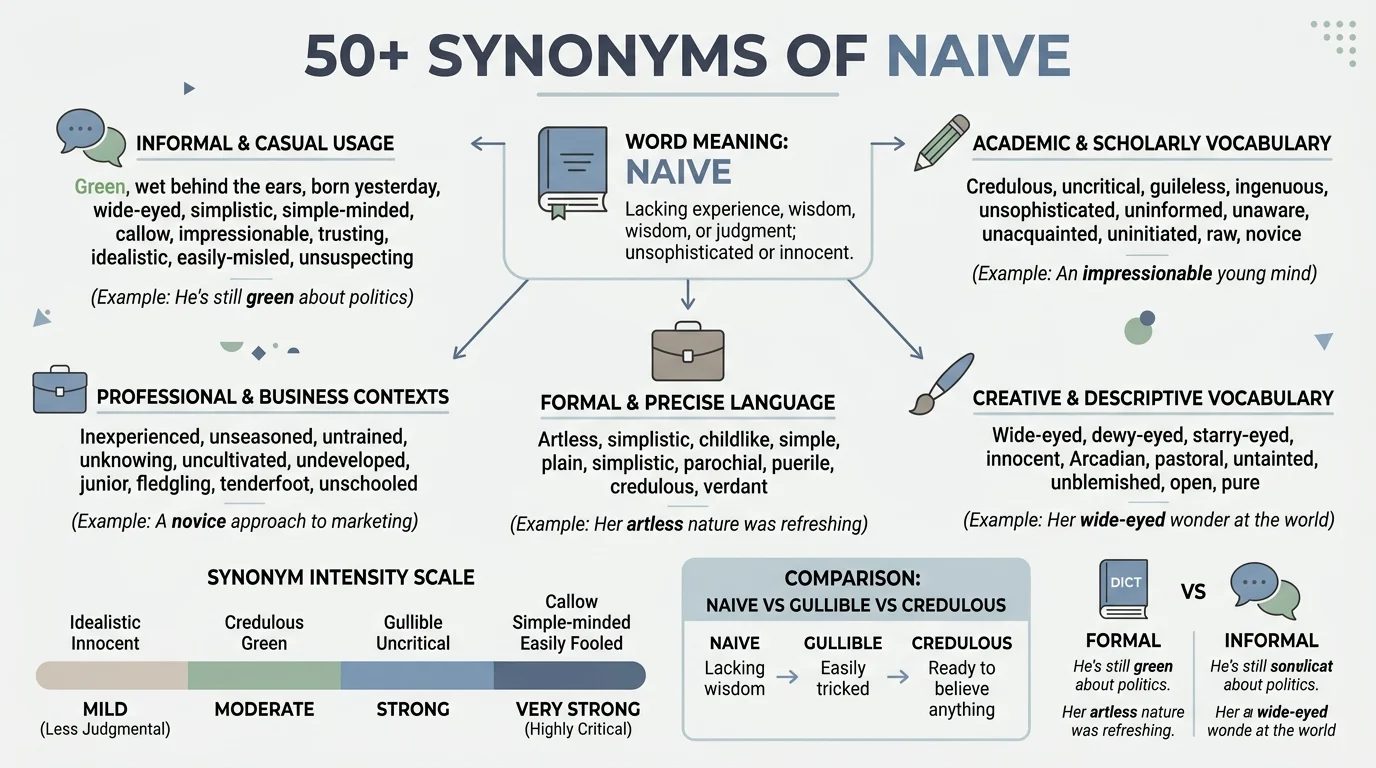
Naive means lacking worldly experience, wisdom, or judgment, often showing innocent simplicity and excessive trust. For formal writing, use “ingenuous” or “unsophisticated.” Casual conversation, “gullible” or “green” work well. For professional contexts, try “inexperienced” or “unseasoned.” Creative writing, “artless” and “guileless” add emotional depth.
Meaning, Tone, and Context
Simple Definition
Naive describes someone who lacks experience, wisdom, or judgment about how the world works. A naive person tends to be overly trusting and innocent, often because they have not yet encountered the harsh realities of life.
Part of Speech
Adjective
Overall Tone
The tone of naive is generally neutral to mildly negative. It can be sympathetic when describing genuine innocence, but it often carries a subtle criticism when used to describe someone who should know better.
Formality Level
Neutral to semi-formal. Naive appears in everyday conversation, news articles, academic writing, and professional contexts. It is not overly technical or casual.
Common Uses
Native English speakers use naive to describe people, beliefs, assumptions, and approaches. Common collocations include “naive belief,” “naive assumption,” “naive optimism,” and “naive approach”. You will hear it in workplace feedback, political commentary, personal relationships, and discussions about decision-making.
Word Forms
| Form | Word |
|---|---|
| Adjective | naive (or naïve) |
| Adverb | naively |
| Noun | naivety (or naïveté) |
When and How to Use “Naive”
Choose naive when you want to describe someone who lacks real-world experience or judgment. The word works best when the person’s innocence or trust leads to poor decisions or misunderstandings.
7 Realistic Examples
Professional
The junior analyst made a naive assumption about the client’s budget and had to revise the entire proposal.
Academic
The researcher’s naive interpretation of the data overlooked several critical variables.
Workplace
It was naive of me to think the project would finish ahead of schedule without overtime.
Personal
She was naive enough to believe that everyone at the networking event had her best interests at heart.
Email
I realize now that my initial request was naive, so I am sending a more detailed proposal.
Resume
Avoid using naive in a resume. Instead, focus on how you gained experience and learned from challenges.
Social Media
Looking back, I was so naive about how long this renovation would actually take.
Best Synonyms of “Naive”
No synonym is identical in every situation. Each alternative carries its own shade of meaning, emotional weight, and level of formality. Here are the best recommendations for specific contexts.
Professional writing: Inexperienced — This word focuses on lack of experience without implying foolishness or weakness. It is neutral and constructive.
Academic writing: Ingenuous — This formal word suggests innocence and honesty without the negative judgment that naive sometimes carries.
Business communication: Unseasoned — This professional term describes someone who is new to a role or industry without being insulting.
Casual conversation: Gullible — This common word describes someone who is easily fooled or tricked.
Emotional writing: Guileless — This warm word suggests innocence and sincerity without deception.
Creative writing: Artless — This literary word describes natural simplicity without cunning or pretense.
Resume writing: Eager or motivated — Never use naive on a resume. Focus on positive qualities instead.
Workplace communication: Green — This informal but acceptable term describes someone new to a job or industry.
Stronger meaning: Credulous — This word emphasizes being too willing to believe things without evidence.
Softer meaning: Innocent — This word focuses on purity and lack of harmful intent rather than lack of judgment.
When Not to Use “Naive”
When the Word Sounds Too General
Using naive to describe every situation where someone lacks knowledge makes your writing vague and imprecise.
Better choice: Choose a more specific word like “uninformed,” “unfamiliar,” or “new to.”
When the Word Sounds Too Vague
Naive does not specify what kind of experience the person lacks.
Better choice: Use “inexperienced in negotiations” or “new to the industry.”
When the Word Sounds Too Formal
In casual texting or informal conversation, naive can feel stiff.
Better choice: Use “green,” “new,” or “clueless.”
When the Word Sounds Too Informal
In academic papers or formal reports, naive can feel slightly casual.
Better choice: Use “ingenuous,” “unsophisticated,” or “unworldly.”
When the Word Sounds Too Weak
Naive sometimes does not convey enough seriousness.
Better choice: Use “credulous” or “gullible” when the person is easily deceived.
When the Word Sounds Too Strong
Naive can sound insulting when you only mean someone is new to something.
Better choice: Use “new,” “fresh,” or “learning.”
When the Word Sounds Outdated
Naive remains current, but some synonyms like “callow” or “jejune” sound old-fashioned in everyday conversation.
Better choice: Use “immature” or “inexperienced” instead.
Words Commonly Confused With “Naive”
Naive vs Gullible
Difference: Naive describes a lack of experience that leads to poor judgment. Gullible describes a willingness to believe anything, even when evidence suggests otherwise.
When to Use It: Use naive for lack of worldly knowledge. Use gullible when someone falls for obvious lies.
Example: She was naive about how business negotiations work. He was gullible enough to believe the scammer’s story.
Naive vs Credulous
Difference: Credulous means being too ready to believe things without sufficient evidence. Naive focuses more on inexperience.
When to Use It: Use credulous in formal writing when emphasizing unreasonable belief. Use naive when emphasizing lack of experience.
Example: The credulous investor trusted every promise the startup made. The naive traveler did not know to check for hidden fees.
Naive vs Innocent
Difference: Innocent emphasizes moral purity and lack of guilt or harmful intent. Naive emphasizes lack of worldly knowledge.
When to Use It: Use innocent when describing someone without bad intentions. Use naive when describing someone who does not understand how things work.
Example: The innocent child had no idea what was happening. The naive adult should have known better.
Naive vs Unsophisticated
Difference: Unsophisticated describes a lack of refinement, culture, or social experience. Naive describes a lack of worldly wisdom.
When to Use It: Use unsophisticated when describing someone who is not polished or cultured. Use naive when describing poor judgment due to inexperience.
Example: His unsophisticated taste preferred simple foods. Her naive belief in quick wealth cost her savings.
Naive vs Ingenuous
Difference: Ingenuous suggests honesty, openness, and an inability to deceive. Naive suggests being easily fooled due to inexperience.
When to Use It: Use ingenuous when describing sincere honesty. Use naive when describing poor judgment.
Example: Her ingenuous confession won everyone’s trust. His naive plan ignored all the obvious risks.
Naive vs Green
Difference: Green is an informal synonym for being new and inexperienced. Naive can apply to anyone lacking worldly wisdom, regardless of age.
When to Use It: Use green in casual contexts for newcomers. Use naive in more formal contexts.
Example: The green intern needed guidance on every task. The naive manager trusted the wrong vendor.
Best Synonyms of “Naive” by Context
| Context | Best Synonym | Why It Works | Example |
|---|---|---|---|
| Formal writing | Ingenuous | Sounds scholarly and precise without being insulting | Her ingenuous approach to the research question revealed fresh insights. |
| Academic writing | Unsophisticated | Describes lack of development without harsh judgment | The unsophisticated methodology failed to account for key variables. |
| Professional communication | Inexperienced | Neutral and constructive feedback | The inexperienced team member asked excellent questions. |
| Business emails | Unseasoned | Professional and respectful of new employees | Our unseasoned staff will receive additional training. |
| Resume writing | Never use naive | Focus on positive qualities instead | Quickly adapted to new responsibilities and learned from experienced mentors. |
| Workplace communication | Green | Informal but acceptable for new hires | She is still green, but she is learning fast. |
| Casual conversation | Gullible | Common and easily understood | I cannot believe you fell for that. You are so gullible. |
| Everyday speaking | New to | Clear and neutral | I am new to this whole process. |
| Creative writing | Artless | Adds literary elegance | Her artless charm won over even the skeptics. |
| Storytelling | Guileless | Creates sympathetic characters | The guileless hero trusted everyone he met. |
| Emotional writing | Innocent | Emphasizes purity and vulnerability | His innocent faith in humanity was touching. |
| Strong emphasis | Credulous | Highlights unreasonable belief | Only the most credulous investors fell for the scheme. |
| Mild tone | Simple | Gentle and non-judgmental | He had a simple view of how business worked. |
| Social media captions | Clueless | Playful and relatable | I was completely clueless about how hard this would be. |
| American English | Naive | Standard spelling without the diaeresis | She made a naive mistake. |
| British English | Naïve | Traditional spelling with the diaeresis | He held a naïve belief about the outcome. |
How to Choose the Best Synonym of “Naive”
Choosing the right synonym comes down to four key factors.
Consider your audience. Are you writing for colleagues, professors, friends, or the general public? Formal audiences expect precise, measured language. Casual audiences appreciate familiar, conversational words.
Consider your tone. Do you want to sound critical, sympathetic, neutral, or playful? Words like “credulous” sound critical. Words like “innocent” sound sympathetic. Like “inexperienced” sound neutral.
Consider the emotional strength. How strongly do you want to convey the person’s lack of judgment? “Mild” options like “new” or “fresh” are gentle. “Strong” options like “gullible” or “credulous” carry more weight.
Consider what you are describing. Are you describing a person, a belief, an action, or a situation? Different synonyms work better for different subjects.
The best synonym communicates your intended message clearly and naturally. If you are unsure, read your sentence aloud with each option. The right word will sound natural and fitting.
Real Life Examples of “Naive”
School
The student made a naive assumption that the teacher would accept late work without penalty.
College
Freshmen often have naive expectations about how much free time college actually offers.
Workplace
It was naive to think the new policy would solve every problem immediately.
Business
The startup’s naive growth projections ignored market realities and competition.
Email
I was naive to assume the deadline was flexible, so I am submitting the revised version today.
Resume
Instead of calling yourself naive, describe how you “quickly adapted to new challenges and learned from experienced mentors.”
Conversation
“You are being naive if you think that deal does not have hidden costs.”
Storytelling
The naive prince trusted every advisor at court, never suspecting their hidden agendas.
Blogging
Five years ago, I was naive about what it actually takes to run a successful blog.
Social Media
Throwback to when I was naive enough to think I could learn Spanish in three months.
18 Best Synonyms of “Naive”
| Synonym | Simple Meaning | Best Used For | Example Sentence |
|---|---|---|---|
| Gullible | Easily fooled or tricked | Casual conversation, describing someone who falls for scams | He is so gullible that he believed the email from the Nigerian prince. |
| Credulous | Too willing to believe without evidence | Formal writing, academic contexts | The credulous audience accepted every claim made by the speaker. |
| Ingenuous | Innocent, honest, and unable to deceive | Academic writing, formal descriptions | Her ingenuous nature made her a terrible liar but a wonderful friend. |
| Unsophisticated | Lacking refinement or worldly experience | Neutral descriptions, formal contexts | His unsophisticated approach to investing cost him dearly. |
| Unworldly | Not concerned with or aware of worldly matters | Literary writing, character descriptions | The unworldly monk had no interest in money or status. |
| Artless | Natural and without cunning or deception | Creative writing, storytelling | Her artless honesty was refreshing in a world of polished lies. |
| Guileless | Free from deceit; completely honest | Emotional writing, character development | The guileless child trusted everyone she met. |
| Innocent | Pure, without guilt or harmful intent | Emotional writing, describing children | His innocent belief in justice was eventually shattered. |
| Green | New and inexperienced | Casual workplace talk, informal settings | She is still green, but she will learn quickly. |
| Callow | Young and inexperienced | Literary writing, slightly old-fashioned | The callow youth had no idea what he was getting into. |
| Inexperienced | Lacking practical knowledge or skill | Professional writing, neutral feedback | The inexperienced manager sought advice from senior colleagues. |
| Unseasoned | New to a role or activity | Professional settings, business writing | Our unseasoned staff will receive intensive training. |
| Trusting | Willing to believe others | Neutral to positive descriptions | Her trusting nature made her popular but vulnerable. |
| Simple | Lacking complexity or sophistication | Mild descriptions, gentle criticism | He had a simple view of how the world worked. |
| Wide-eyed | Innocent and full of wonder | Creative writing, descriptive passages | The wide-eyed tourist was amazed by everything she saw. |
| Childlike | Having the innocence of a child | Positive or sympathetic descriptions | His childlike enthusiasm was contagious. |
| Unsuspecting | Not aware of potential danger | Narrative writing, warnings | The unsuspecting victim handed over her credit card information. |
| Uninformed | Lacking knowledge or information | Neutral descriptions, factual contexts | The uninformed voter made decisions based on rumors. |
Synonyms of “Naive” by Usage
Professional vs Personal Synonyms
Workplace synonyms: Inexperienced, unseasoned, new, green
Personal synonyms: Gullible, trusting, innocent, simple
Professional synonyms focus on lack of knowledge or experience without emotional judgment. Personal synonyms often carry more emotional weight and can sound critical or sympathetic depending on context.
Formal vs Conversational Synonyms
Formal (reports, essays, business writing): Ingenuous, unsophisticated, credulous, unworldly
Conversational (casual talk, texting): Gullible, green, clueless, new
Academic Synonyms
For research papers, essays, and academic discussions, choose words that sound precise and authoritative: ingenuous, unsophisticated, credulous, and unworldly. These words carry less emotional judgment and more analytical precision.
Professional and Business Synonyms
For resumes, interviews, meetings, presentations, performance reviews, and client communication: inexperienced, unseasoned, and new. These words acknowledge a lack of experience without implying weakness or poor judgment.
Creative and Literary Synonyms
For storytelling, fiction, poetry, and descriptive writing: artless, guileless, wide-eyed, childlike, and innocent. These words add emotional depth and create vivid character descriptions.
Slang or Modern Synonyms
Clueless is a modern informal synonym that means completely unaware or lacking understanding. It is acceptable in casual conversation and social media but should be avoided in professional or academic writing.
Green is informal but widely used in workplace settings to describe new employees.
Strongest to Mildest Synonyms
| Intensity | Synonyms |
|---|---|
| Mild | New, fresh, unfamiliar, simple |
| Moderate | Inexperienced, unsophisticated, unseasoned, trusting |
| Strong | Gullible, credulous, green, callow |
| Very Strong | Clueless, simple-minded, foolish |
Emotional vs Neutral Synonyms
Emotional synonyms (express stronger feelings): Gullible, credulous, innocent, trusting, childlike
These words carry emotional weight. They can express sympathy, criticism, or affection depending on context.
Neutral synonyms (communicate information without emotion): Inexperienced, unsophisticated, unseasoned, uninformed
These words simply describe a lack of knowledge or experience without adding emotional judgment.
Antonyms of “Naive”
| Antonym | Meaning | Example Sentence |
|---|---|---|
| Sophisticated | Having worldly knowledge and refinement | The sophisticated investor spotted the scam immediately. |
| Worldly | Experienced in the ways of the world | She was worldly enough to know when someone was lying. |
| Cynical | Believing that people are motivated by self-interest | His cynical view of politics made him distrust every candidate. |
| Experienced | Having practical knowledge from direct involvement | The experienced manager handled the crisis with confidence. |
| Shrewd | Having sharp judgment and practical intelligence | The shrewd negotiator got exactly what she wanted. |
| Savvy | Practical knowledge and good judgment | He was savvy enough to read the fine print. |
| Informed | Having knowledge and information | The informed consumer researched every purchase. |
| Wise | Having experience, knowledge, and good judgment | The wise old mentor gave practical advice. |
| Knowing | Showing awareness and understanding | She gave a knowing smile when she heard the excuse. |
| Skeptical | Not easily convinced; having doubts | The skeptical journalist questioned every claim. |
| Wary | Cautious about potential dangers | He was wary of anyone offering quick solutions. |
| Discerning | Having good judgment and taste | The discerning buyer recognized the counterfeit immediately. |
| Astute | Quick to understand and assess situations | The astute politician read the room perfectly. |
| Judicious | Having good judgment and wisdom | Her judicious decision saved the company money. |
| Pragmatic | Dealing with things realistically | The pragmatic approach focused on what actually worked. |
Comparison: “Naive” vs Similar Words
Naive vs Gullible
Main Difference: Naive describes inexperience. Gullible describes being easily deceived.
Which Is Stronger? Gullible is stronger and more critical.
Which Is More Formal? Naive is more formal and widely acceptable.
When to Use Each: Use naive for lack of worldly knowledge. Use gullible when someone falls for obvious tricks.
Examples:
Naive: She was naive about how much the repairs would cost.
Gullible: He was gullible enough to believe the email was from his bank.
Naive vs Credulous
Main Difference: Naive focuses on inexperience. Credulous focuses on being too ready to believe.
Which Is Stronger? Credulous is stronger and more technical.
Which Is More Formal? Credulous is more formal and academic.
When to Use Each: Use naive for general inexperience. Use credulous when emphasizing unreasonable belief.
Examples:
Naive: The naive traveler did not check the exchange rate.
Credulous: Only credulous investors believed the get-rich-quick scheme.
Naive vs Innocent
Main Difference: Innocent implies moral purity. Naive implies lack of worldly knowledge.
Which Is Stronger? Innocent is emotionally stronger and more sympathetic.
Which Is More Formal? Both are widely used, but naive is more common in professional contexts.
When to Use Each: Use innocent for moral purity. Use naive for practical inexperience.
Examples:
Naive: He was naive to trust that stranger with his wallet.
Innocent: The innocent child had no idea what was happening.
Naive vs Ingenuous
Main Difference: Ingenuous suggests honest openness. Naive suggests being easily fooled.
Which Is Stronger? Naive is more critical. Ingenuous is more neutral.
Which Is More Formal? Ingenuous is more formal and academic.
When to Use Each: Use ingenuous for sincere honesty. Use naive for poor judgment due to inexperience.
Examples:
Naive: His naive plan ignored all the risks.
Ingenuous: Her ingenuous confession won everyone’s trust.
Naive vs Unsophisticated
Main Difference: Unsophisticated describes lack of refinement. Naive describes lack of worldly wisdom.
Which Is Stronger? Both are moderate in strength.
Which Is More Formal? Unsophisticated is slightly more formal.
When to Use Each: Use unsophisticated for cultural or social inexperience. Use naive for judgment-related inexperience.
Examples:
Naive: She was naive to believe the contract had no hidden clauses.
Unsophisticated: His unsophisticated taste preferred simple home-cooked meals.
Naive vs Green
Main Difference: Green is informal and specifically describes being new. Naive is more general.
Which Is Stronger? Green is milder and less critical.
Which Is More Formal? Naive is more formal. Green is casual.
When to Use Each: Use green in casual workplace talk. Use naive in any context.
Examples:
Naive: It was naive to expect the project to finish early.
Green: The green intern needed help with basic tasks.
Common Phrases and Expressions with “Naive”
Naive belief
Meaning: A belief held without sufficient experience or evidence.
Example Sentence: His naive belief that everyone was honest led to disappointment.
Naive assumption
Meaning: An assumption made without considering all the facts.
Example Sentence: Her naive assumption that the deal would close quickly cost her time.
Naive optimism
Meaning: Optimism that ignores realistic challenges.
Example Sentence: Their naive optimism about the product launch ignored serious market competition.
Naive approach
Meaning: An approach that lacks practical understanding.
Example Sentence: The naive approach to negotiations left the team at a disadvantage.
Politically naive
Meaning: Lacking understanding of political realities.
Example Sentence: His politically naive statements revealed his inexperience in government.
Naive question
Meaning: A question that reveals a lack of understanding.
Example Sentence: She asked a naive question that made everyone realize she was new to the industry.
Common Mistakes to Avoid
1: Using “Naive” When You Mean
Incorrect: He was so naive that he could not solve basic math problems.
Better: He was inexperienced and needed more training.
Why: Naive describes a lack of experience, not a lack of intelligence.
2: Using “Gullible” in Formal Writing
Incorrect: The gullible research subjects believed the misleading instructions.
Better: The credulous research subjects accepted the misleading instructions without question.
Why: Gullible is too casual for academic writing.
3: Using “Naive” on a Resume
Incorrect: Naive about corporate processes but willing to learn.
Better: Eager to learn corporate processes and contribute to team success.
Why: Naive highlights weakness instead of positive qualities.
4: Confusing “Naive” with “Innocent”
Incorrect: The naive child had never stolen anything.
Better: The innocent child had never stolen anything.
Why: Innocent describes moral purity. Naive describes lack of knowledge.
5: Overusing “Naive” in a Single Piece of Writing
Incorrect: The naive intern made a naive mistake because of her naive assumptions.
Better: The inexperienced intern made a basic mistake because of her unfounded assumptions.
Why: Repetition weakens your writing. Vary your word choices.
6: Using “Naive” to Describe Someone Who Is Simply New
Incorrect: The naive employee did not know where the supply closet was.
Better: The new employee did not know where the supply closet was.
Why: Naive implies poor judgment, not just lack of information.
7: Misspelling as “Nieve”
Incorrect: She made a nieve mistake.
Better: She made a naive mistake.
Why: “Nieve” is a common misspelling. The correct spelling is naive (or naïve).
Frequently Asked Questions
1. What are the best synonyms of “naive”?
The best synonyms depend on your context. Formal writing, use “ingenuous” or “unsophisticated.” For casual conversation, use “gullible” or “green.” For professional settings, use “inexperienced” or “unseasoned.”
2. What are the best formal synonyms of “naive”?
The best formal synonyms include “ingenuous,” “unsophisticated,” “credulous,” and “unworldly.” These words sound scholarly and precise without being overly casual or insulting.
3. What are common informal synonyms of “naive”?
Common informal synonyms include “gullible,” “green,” “clueless,” and “simple.” These words work well in casual conversation, texting, and social media but should be avoided in professional or academic writing.
4. What is another word for “naive” in professional writing?
In professional writing, use “inexperienced,” “unseasoned,” or “new.” These words describe a lack of experience without implying poor judgment or weakness.
5. What is the difference between “naive” and “gullible”?
Naive describes a lack of worldly experience that leads to poor judgment. Gullible describes being easily fooled or tricked. A naive person may not know enough to recognize a lie. A gullible person may believe a lie even with evidence against it.
6. What is the opposite of “naive”?
The opposite of naive includes “sophisticated,” “worldly,” “experienced,” “shrewd,” “savvy,” and “cynical.” These words describe people who have knowledge, judgment, and awareness of how the world works.
Conclusion
Naive means lacking worldly experience, wisdom, or judgment, often showing innocent simplicity and excessive trust. The best synonym depends entirely on your context, audience, and tone. Formal writing, choose “ingenuous” or “unsophisticated.” For professional settings, choose “inexperienced” or “unseasoned.” For casual conversation, choose “gullible” or “green.” Creative writing, choose “artless” or “guileless.” No synonym works perfectly in every situation, so always consider your audience, your purpose, and the emotional weight of your words. The next time you reach for the word naive, pause and ask yourself whether a more precise synonym would communicate your meaning more clearly.