Have you ever caught yourself writing the same word over and over in an essay, email, or social media post? That feeling of repetition can make your writing feel dull and uninspired. Many writers struggle with finding the right alternative for common words, and “which” is one of those words that often gets overused. Whether you are drafting a professional email, working on a school assignment, or crafting a blog post, knowing the synonyms of which can dramatically improve your writing clarity and variety.
Choosing the right synonym is not just about avoiding repetition. It is about communicating your exact meaning with precision. A well-chosen alternative can make your tone more professional, your message clearer, and your writing more engaging. This guide will help you understand the word “which,” explore its best synonyms, and teach you how to choose the perfect word for every situation.
What Are the Best Synonyms of “Which”?
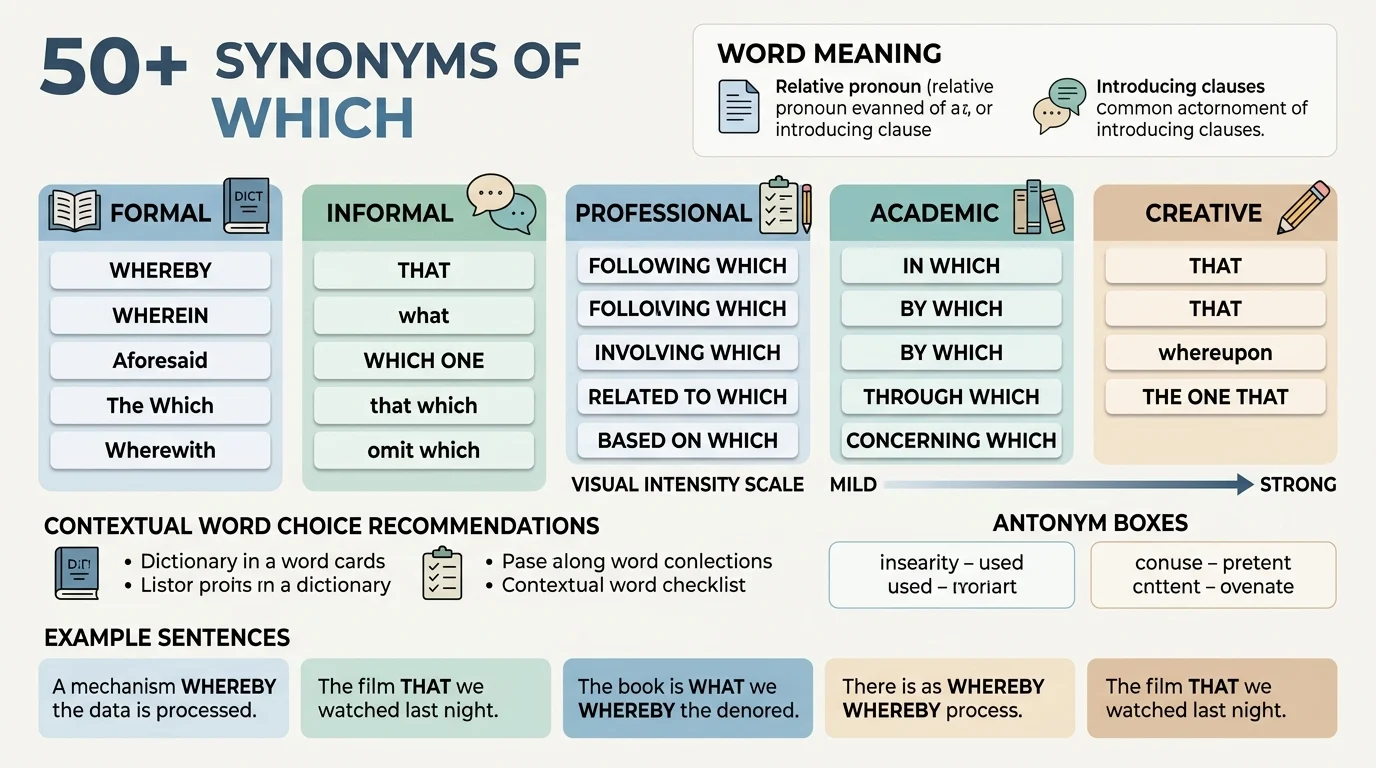
“Which” is a pronoun and determiner used to ask about or refer to a choice among options, or to introduce additional information about a noun. The best synonyms depend on context: use “that” for essential clauses, “what” for open-ended questions, “whichever” for free choice, and “who” or “whom” when referring to people. For formal writing, “that” and “whichsoever” work well; for casual conversation, “what” and “which one” are natural choices.
Meaning, Tone, and Context
Simple Definition
“Which” is a word used in two main ways. First, it asks a question about a specific choice from a limited set of options. Second, it introduces a clause that gives more information about a noun mentioned earlier in the sentence.
Part of Speech
“Which” functions as a pronoun, a determiner, and a relative pronoun.
Overall Tone
“Which” is neutral. It does not carry strong positive or negative emotional weight. Its tone depends entirely on the context in which you use it.
Formality Level
“Which” is considered neutral in formality. It works in almost any setting, from casual conversation to formal academic writing.
Common Uses
Native English speakers use “which” constantly. Use it in questions when choosing between options. They use it to add extra information about a thing or idea in a sentence. They also use it to refer back to a previous statement.
Word Forms
Pronoun: Which of these is yours?
Determiner: Which book did you choose?
Relative Pronoun: The car, which was red, sped past.
When and How to Use “Which”
You should choose “which” when you need to specify one or more items from a known group or when you want to add non-essential information about a noun. Here are seven realistic examples showing how “which” works in different contexts.
Professional
The proposal, which I submitted yesterday, has already been reviewed by the team.
Academic
The theory, which has been debated for decades, continues to influence modern research.
Workplace
Which department will be handling the new client account?
Personal
I am not sure which restaurant we should try tonight.
Email
Please let me know which documents you need for the meeting.
Resume
Developed a new inventory system, which reduced waste by 15 percent.
Social Media
Which filter makes this photo look better?
Best Synonyms of “Which”
No synonym is identical in every situation. The best choice depends on your audience, your purpose, and the specific meaning you want to convey. Here are the best synonyms for different contexts.
Professional writing: “that” is often the best choice when you need a restrictive clause. It sounds crisp and direct in business communication.
Academic writing: “that” works well for essential information. “Whichsoever” can add a formal, scholarly tone when discussing choices among multiple options.
Business communication: “that” keeps sentences tight and professional. Use “what” when asking open-ended questions in a business context.
Casual conversation: “what” feels natural and relaxed. “Which one” is common in everyday speech when pointing to physical objects.
Emotional writing: “which” itself is neutral. To add emotion, you might restructure your sentence rather than relying on a synonym.
Creative writing: “that” and “what” can add variety. “Whichever” suggests freedom and possibility in storytelling.
Resume writing: “that” is preferred for essential clauses. It keeps your resume concise and professional.
Workplace communication: “that” for clarity. “What” for questions. Both are widely understood and accepted.
Stronger meaning: “whichsoever” emphasizes a choice among many options with a formal tone.
Softer meaning: “what” feels less specific and more open-ended, making it a softer choice in casual settings.
When Not to Use “Which”
There are several situations where using “which” is not the best choice.
Too general: When you need to specify a person, “which” sounds impersonal. Use “who” instead.
Incorrect: The manager which hired me is very supportive.
Better: The manager who hired me is very supportive.
Too vague: When you are asking an open-ended question with unlimited options, “which” feels restrictive. Use “what” instead.
Incorrect: Which is your favorite food? (implies a limited menu)
Better: What is your favorite food? (open to any answer)
Too formal: In very casual texting or speech, “which” can sound stiff. Use “what” or simply rephrase.
Incorrect: Which movie do you want to watch tonight?
Better: What movie do you want to watch tonight?
Too weak: When you need to emphasize a specific choice among many, “which” alone may not feel strong enough. Use “whichever” to convey freedom of choice.
Weak: Choose which option you prefer.
Stronger: Choose whichever option you prefer.
Outdated usage: Using “which” to refer to people is considered nonstandard in modern English. Always use “who” for people.
Words Commonly Confused With “Which”
Many writers confuse “which” with similar words. Here are the most common confusions explained clearly.
That
Difference: “That” introduces essential information that defines the noun. “Which” introduces extra, non-essential information.
When to Use It: Use “that” when the clause is necessary to understand which thing you are talking about.
Example: The book that I borrowed is overdue. (Essential: which book?)
What
Difference: “What” asks open-ended questions with unlimited possible answers. “Which” asks about a specific, limited set of options.
When to Use It: Use “what” when you do not have a predefined list of choices.
Example: What is your favorite color? (Any color in the world)
Who
Difference: “Who” refers to people. “Which” refers to things or animals.
When to Use It: Use “who” whenever you are talking about a person.
Example: The woman who called earlier left a message.
Whom
Difference: “Whom” is the object form of “who.” “Which” is for things. “Whom” is more formal and often avoided in casual speech.
When to Use It: Use “whom” in formal writing when referring to the object of a verb or preposition.
Example: The person to whom I spoke was very helpful.
Whichever
Difference: “Whichever” means any one from a group, with no specific choice required. “Which” asks for a specific selection.
When to Use It: Use “whichever” when you want to emphasize that any option is acceptable.
Example: Choose whichever dress you like best.
Whatever
Difference: “Whatever” is the broadest option, meaning anything at all. “Which” is limited to a known set.
When to Use It: Use “whatever” when there are no restrictions or predefined options.
Example: Eat whatever you want from the buffet.
Best Synonyms of “Which” by Context
| Context | Best Synonym | Why It Works | Example |
|---|---|---|---|
| Formal writing | That | Provides clarity and precision in restrictive clauses | The evidence that was presented convinced the jury. |
| Academic writing | That | Essential for defining terms and concepts clearly | The hypothesis that was tested proved to be correct. |
| Professional communication | That | Keeps business language direct and unambiguous | The report that you requested is attached. |
| Business emails | That | Sounds professional without being overly formal | Please review the contract that I sent earlier. |
| Resume writing | That | Creates concise, impactful bullet points | Managed a team that increased sales by 20 percent. |
| Workplace communication | What | Natural for everyday questions and discussions | What time is the meeting scheduled for? |
| Casual conversation | What | Relaxed and easy to use in everyday speech | What movie do you want to see? |
| Everyday speaking | Which one | Emphasizes a specific choice from visible options | Which one of these shirts do you like? |
| Creative writing | Whichever | Adds a sense of freedom and possibility | She could choose whichever path she desired. |
| Storytelling | That | Creates clear, flowing narrative sentences | The house, that stood on the hill, was abandoned. |
| Emotional writing | What | Opens up emotional questions without restriction | What could I have done differently? |
| Strong emphasis | Whichsoever | Formal and emphatic, suitable for legal or scholarly texts | The court will accept whichsoever documents are submitted. |
| Mild tone | What | Soft and non-committal in casual settings | What do you think about this idea? |
| Social media captions | What | Short, punchy, and engaging for posts | What vibes does this photo give you? |
| American English | That | Preferred in restrictive clauses in US English | The car that I bought is blue. |
| British English | Which | More commonly used in restrictive clauses in UK English | The car which I bought is blue. |
How to Choose the Best Synonym of “Which”
Choosing the right synonym is easier when you follow a simple decision process.
First, identify your audience. Are you writing for a professor, a boss, a friend, or a social media follower? Formal audiences usually prefer “that” in restrictive clauses. Casual audiences respond better to “what” and “which one.”
Second, determine your purpose. Are you asking a question, adding information, or making a choice? For questions, decide whether your options are limited or unlimited. Use “which” for limited options and “what” for unlimited ones.
Third, consider your tone. Do you want to sound professional, academic, creative, or relaxed? “That” is safe and professional. “Whichever” feels more creative and open-ended.
Fourth, check your clause type. If the information is essential to the meaning of the sentence, use “that.” If it is extra information that can be removed without changing the core meaning, use “which”.
Finally, read your sentence aloud. The best synonym is the one that sounds most natural to your ear and communicates your intended meaning most clearly.
Real Life Examples of “Which”
These examples show how “which” and its synonyms work in everyday situations.
School
The assignment, which was due on Friday, required extensive research. (Adding extra information)
College
Which courses are you planning to take next semester? (Asking about a limited set)
Workplace
The project that you are managing is a top priority. (Essential information)
Business
Please identify which client accounts need immediate attention. (Specific selection)
Email
I have attached the files that you requested in your last message. (Essential reference)
Resume
Developed a marketing strategy that increased brand awareness by 30 percent. (Essential achievement)
Conversation
Which one of these desserts looks the best to you? (Casual choice)
Storytelling
The old mansion, which had been abandoned for years, stood at the end of the road. (Descriptive detail)
Blogging
Here are five tips that will transform your writing instantly. (Essential advice)
Social Media
Which outfit should I wear for the event tonight? (Engaging question)
18 Best Synonyms of “Which”
| Synonym | Simple Meaning | Best Used For | Example Sentence |
|---|---|---|---|
| That | Introduces essential information about a noun | Restrictive clauses in professional and academic writing | The proposal that you submitted was approved. |
| What | Asks open-ended questions with unlimited answers | Casual conversation and general questions | What do you think about this plan? |
| Whichever | Any one from a group, with no specific preference | Emphasizing freedom of choice | Choose whichever option works best for you. |
| Whatever | Anything at all, with no restrictions | Broad, unrestricted choices | Take whatever you need from the supply closet. |
| Whichsoever | Any one from a group, formal and emphatic | Legal, scholarly, or very formal writing | The court will accept whichsoever evidence is presented. |
| Who | Refers to people as the subject of a clause | Any reference to a person | The manager who hired me is retiring. |
| Whom | Refers to people as the object of a verb or preposition | Formal writing when referring to the object | The candidate to whom we spoke was impressive. |
| Whose | Shows possession for people or things | Indicating ownership or relationship | The author whose book I read is famous. |
| That one | A specific item from a visible group | Pointing out or identifying a particular choice | I will take that one, please. |
| Which one | Emphasizes a single choice from a set | Questions about specific options | Which one of these colors do you prefer? |
| What one | Asks about a single item from a group | Questions where the group is understood | What one would you recommend? |
| Such | Of the kind or degree mentioned | Formal or literary contexts | The decision, such as it was, satisfied everyone. |
| The aforementioned | Previously mentioned | Very formal or legal writing | The aforementioned clauses are hereby void. |
| The latter | The second of two things mentioned | Formal writing when comparing two items | Between coffee and tea, I prefer the latter. |
| The former | The first of two things mentioned | Formal writing when comparing two items | Between coffee and tea, I prefer the former. |
| Aforementioned | Mentioned earlier | Formal or legal documents | The aforementioned agreement is binding. |
| Said | Previously mentioned | Legal or very formal writing | The said property is located on Main Street. |
| The same | The identical thing or person | Formal or business writing | We have received your application and acknowledge the same. |
Synonyms of “Which” by Usage
Professional vs Personal Synonyms
In professional settings, “that” is your safest choice for restrictive clauses. It sounds clear and authoritative. “Whichever” works well when giving options to colleagues or clients. In personal conversations, “what” feels natural and relaxed. “Which one” is common when pointing to physical objects or making casual choices.
Professional: The policy that was implemented last year has been effective.
Personal: What movie do you want to watch tonight?
Formal vs Conversational Synonyms
Formal writing favors “that,” “whichsoever,” and “the aforementioned.” These words add precision and authority to reports, essays, and legal documents. Conversational English prefers “what,” “which one,” and “whatever.” These words feel natural in everyday speech and text messages.
Formal: The committee, whichsoever members are present, shall convene.
Conversational: Whatever you decide is fine with me.
Academic Synonyms
Academic writing requires precision. “That” is essential for defining terms and concepts. “Whichever” can be used in research when discussing variable choices. “The former” and “the latter” are useful for comparing two theories or findings.
Academic: The hypothesis that was tested yielded significant results.
Academic: Between the two methodologies, the former proved more reliable.
Professional and Business Synonyms
In business writing, clarity is paramount. “That” keeps sentences direct and unambiguous. “What” works well in internal communications and questions. “Whichever” is useful when offering clients or colleagues a range of options.
Business: The report that you requested is now available.
Business: Whichever vendor you choose, ensure they meet our quality standards.
Creative and Literary Synonyms
Creative writers can use “whichever” to suggest freedom and possibility. “What” can open up emotional or philosophical questions. “That” provides clear, flowing narrative structure.
Creative: She wandered down whichever path called to her that day.
Literary: What dreams may come, he could not foresee.
Slang or Modern Synonyms
“Which” does not have widely recognized slang equivalents. In very casual texting, some people use “wut” for “what,” but this is not standard English and should be avoided in any formal or professional context.
Strongest to Mildest Synonyms
Mild → Moderate → Strong → Very Strong
| Intensity | Synonym | Explanation |
|---|---|---|
| Mild | What | Open-ended, soft, non-committal |
| Mild | Which one | Casual and specific but gentle |
| Moderate | That | Direct and clear, neutral intensity |
| Moderate | Whichever | Offers choice without pressure |
| Strong | Whichsoever | Formal and emphatic, leaves no doubt |
| Very Strong | The aforementioned | Formal, authoritative, legalistic |
Emotional vs Neutral Synonyms
Emotional Synonyms
“Whatever” can express indifference or frustration depending on tone. “What” can convey surprise or deep questioning. These words gain emotional weight from context and delivery.
Neutral Synonyms
“That” and “whichever” are purely functional. They communicate information without adding emotional coloring. Use them when you want to stay objective and professional.
Antonyms of “Which”
“Which” is a pronoun and determiner, so it does not have direct antonyms in the same way that adjectives do. However, words that indicate no choice, a single option, or the absence of selection can serve as functional opposites.
| Antonym | Meaning | Example Sentence |
|---|---|---|
| None | Not any of the options | None of the options were acceptable. |
| Neither | Not one nor the other of two | Neither choice appealed to me. |
| No | Not any | No answer was given. |
| Not any | Zero options from the set | Not any of the candidates qualified. |
| Either | One or the other of two (opposite of a specific which) | Either option is fine with me. |
| Any | One or some without specification (opposite of a specific which) | Any choice would be acceptable. |
| All | Every one of the options | All of the options are available. |
| Every | Each one without exception | Every option has its advantages. |
| Each | Every individual one | Each choice comes with trade-offs. |
| This | A specific item close to the speaker (opposite of which asking for selection) | This one is my favorite. |
| That | A specific item farther from the speaker (opposite of which asking for selection) | That one over there is the best. |
| These | Specific items close to the speaker | These are the ones I recommend. |
| Those | Specific items farther from the speaker | Those are the ones you should consider. |
| One | A single unspecified item | One of them will work. |
| The | A specific item already known | The one I chose is perfect. |
Comparison: “Which” vs Similar Words
Which vs That
Main Difference: “Which” introduces non-essential (non-restrictive) clauses, while “that” introduces essential (restrictive) clauses.
Which Is Stronger? “That” is stronger in defining exactly which thing you mean.
Which Is More Formal? Both are neutral, but “that” is preferred in American formal writing for restrictive clauses.
When to Use Each: Use “that” when the clause is necessary to identify the noun. Use “which” when the clause adds extra information that could be removed.
Examples:
Which: The car, which is red, belongs to my neighbor. (Extra information)
That: The car that is red belongs to my neighbor. (Essential: which car?)
Which vs What
Main Difference: “Which” asks about a specific, limited set of options. “What” asks open-ended questions with unlimited possible answers.
Which Is Stronger? “Which” is more specific and therefore stronger in narrowing down choices.
Which Is More Formal? “Which” is slightly more formal than “what.”
When to Use Each: Use “which” when you have a known set of options. Use “what” when the options are unlimited or unknown.
Examples:
Which: Which color do you prefer, red or blue?
What: What is your favorite color?
Which vs Who
Main Difference: “Which” refers to things and animals. “Who” refers to people.
Which Is Stronger? Neither is stronger; they serve different purposes.
Which Is More Formal? Both are neutral.
When to Use Each: Use “who” for people. Use “which” for everything else.
Examples:
Which: The dog which barked all night kept me awake.
Who: The woman who called is my sister.
Which vs Whom
Main Difference: “Which” is for things. “Whom” is the object form of “who” and refers to people.
Which Is Stronger? “Whom” is more formal and less common in everyday speech.
Which Is More Formal? “Whom” is significantly more formal.
When to Use Each: Use “which” for things. Use “whom” in formal writing when referring to the object of a verb or preposition.
Examples:
Which: The book which I read was fascinating.
Whom: The person to whom I spoke was helpful.
Which vs Whichever
Main Difference: “Which” asks for a specific selection. “Whichever” means any one from a group, with no specific choice required.
Which Is Stronger? “Whichever” is stronger in conveying freedom of choice.
Which Is More Formal? Both are neutral.
When to Use Each: Use “which” when you need a specific answer. Use “whichever” when any option is acceptable.
Examples:
Which: Which dessert would you like?
Whichever: Choose whichever dessert you like.
Which vs Whatever
Main Difference: “Which” is limited to a known set. “Whatever” means anything at all, with no restrictions.
Which Is Stronger? “Whatever” is broader and more emphatic.
Which Is More Formal? “Which” is more formal. “Whatever” is casual.
When to Use Each: Use “which” for choices within a set. Use “whatever” when there are no limits.
Examples:
Which: Which snack from the menu do you want?
Whatever: Eat whatever you want.
Common Phrases and Expressions with “Which”
| Phrase | Meaning | Example Sentence |
|---|---|---|
| Which one | Asks for a specific choice from a group | Which one of these shirts do you like? |
| Which way | Asks for direction or method | Which way should we go to get to the station? |
| Which means | Introduces an explanation or consequence | The flight was delayed, which means we will arrive late. |
| Which of | Asks about a choice from a specific set | Which of these options is the best? |
| Which time | Asks about a specific occasion or moment | Which time works best for our meeting? |
| Which case | Refers to a particular situation or instance | In which case, we should reconsider our approach. |
| Which year | Asks about a specific year | Which year did you graduate from college? |
| Which is | Introduces a defining or identifying statement | The house, which is old, needs repairs. |
Common Mistakes to Avoid
1: Using “which” when “who” is correct
Incorrect: The manager which hired me is very experienced.
Better: The manager who hired me is very experienced.
Why: “Which” refers to things, not people.
2: Using “which” for essential clauses in American English
Incorrect (in US English): The book which I read was excellent.
Better: The book that I read was excellent.
Why: American English prefers “that” for restrictive (essential) clauses.
3: Using “which” when “what” is more appropriate
Incorrect: Which is your favorite food? (when there is no limited menu)
Better: What is your favorite food?
Why: “What” is for open-ended questions with unlimited answers.
4: Overusing “which” in a single paragraph
Incorrect: The report, which I wrote, which was reviewed, which was approved…
Better: The report that I wrote was reviewed and approved.
Why: Repetition makes writing sound clunky and unprofessional.
5: Using “which” without a clear antecedent
Incorrect: She arrived late, which was annoying. (Unclear what “which” refers to)
Better: She arrived late, and her lateness was annoying.
Why: “Which” should clearly refer to a specific noun or idea.
6: Confusing “which” and “that” in non-restrictive clauses
Incorrect: The car that is red, belongs to my neighbor.
Better: The car, which is red, belongs to my neighbor.
Why: Non-essential clauses require “which” and commas.
7: Using “which” when “whichever” is more precise
Incorrect: Choose which option you prefer from the list.
Better: Choose whichever option you prefer from the list.
Why: “Whichever” emphasizes that any choice is acceptable.
Frequently Asked Questions
1. What are the best synonyms of “which”?
The best synonyms depend on context. Use “that” for essential clauses, “what” for open-ended questions, “whichever” for free choice, and “who” for referring to people. Each synonym serves a specific purpose.
2. What are the best formal synonyms of “which”?
The best formal synonyms include “that” for restrictive clauses, “whichsoever” for emphatic choices, “the aforementioned” for legal or scholarly writing, and “the former” and “the latter” for comparing two items.
3. What are common informal synonyms of “which”?
Common informal synonyms include “what” for open-ended questions, “which one” for casual choices, and “whatever” for unrestricted options. These words feel natural in everyday conversation and text messages.
4. What is another word for “which” in professional writing?
In professional writing, “that” is the most common and effective alternative for restrictive clauses. It keeps sentences clear, direct, and unambiguous. Use “which” only for non-essential, extra information.
5. What is the difference between “which” and “that”?
“Which” introduces non-essential clauses that add extra information. “That” introduces essential clauses that define the noun. If you can remove the clause without changing the core meaning, use “which.” If not, use “that”.
6. What is the opposite of “which”?
“Which” does not have a direct antonym, but functional opposites include “none,” “neither,” “no,” and “not any.” These words indicate the absence of choice or selection among options.
Conclusion
“Which” is a versatile pronoun and determiner that helps us ask questions, make choices, and add information to our sentences. Its neutral tone and wide range of uses make it an essential part of the English language. However, using the same word repeatedly can make your writing feel dull and repetitive.
The best synonym of “which” depends entirely on your context. Use “that” for essential clauses in professional and academic writing. Use “what” for casual questions and open-ended inquiries. Choose “whichever” when you want to emphasize freedom of choice. Remember that “who” is the correct choice for referring to people.
No synonym works perfectly in every situation. The key to strong writing is understanding your audience, your purpose, and the specific meaning you want to convey. Choose the word that communicates your message most clearly and sounds most natural in context.
A practical tip for improving your vocabulary: before you write, think about whether “which” is truly the best word for your sentence. If you are adding extra information, consider whether a comma and “which” are appropriate, or whether “that” would create a tighter, more direct sentence. With practice, choosing the right synonym will become second nature.
Definitions, meanings, and usage recommendations should be verified with trusted language references before publication. Recommended sources include Cambridge Dictionary, Oxford English Dictionary, Merriam Webster, Collins Dictionary, and Britannica.