You are writing an important email to a client, and you want to describe the scale of a new project. You type “This is a big opportunity.” It feels flat. You try again. “We have a big team working on it.” Still not right.
That is the problem with the word “big.” It is simple, clear, and useful. But it is also overused and often too vague.
Most writers reach for “big” when they need a word for size, importance, or intensity. And it works fine in everyday conversation. But in professional writing, academic essays, or creative work, “big” can make your language feel imprecise and weak.
Learning the synonyms of big will transform how you communicate. The right synonym can add precision, emotion, and authority to your writing. It can help you sound more professional in a job interview, more vivid in a story, and more convincing in a business proposal.
This guide will show you exactly how to choose the best synonym for every situation.
What Are the Best Synonyms of “Big”?
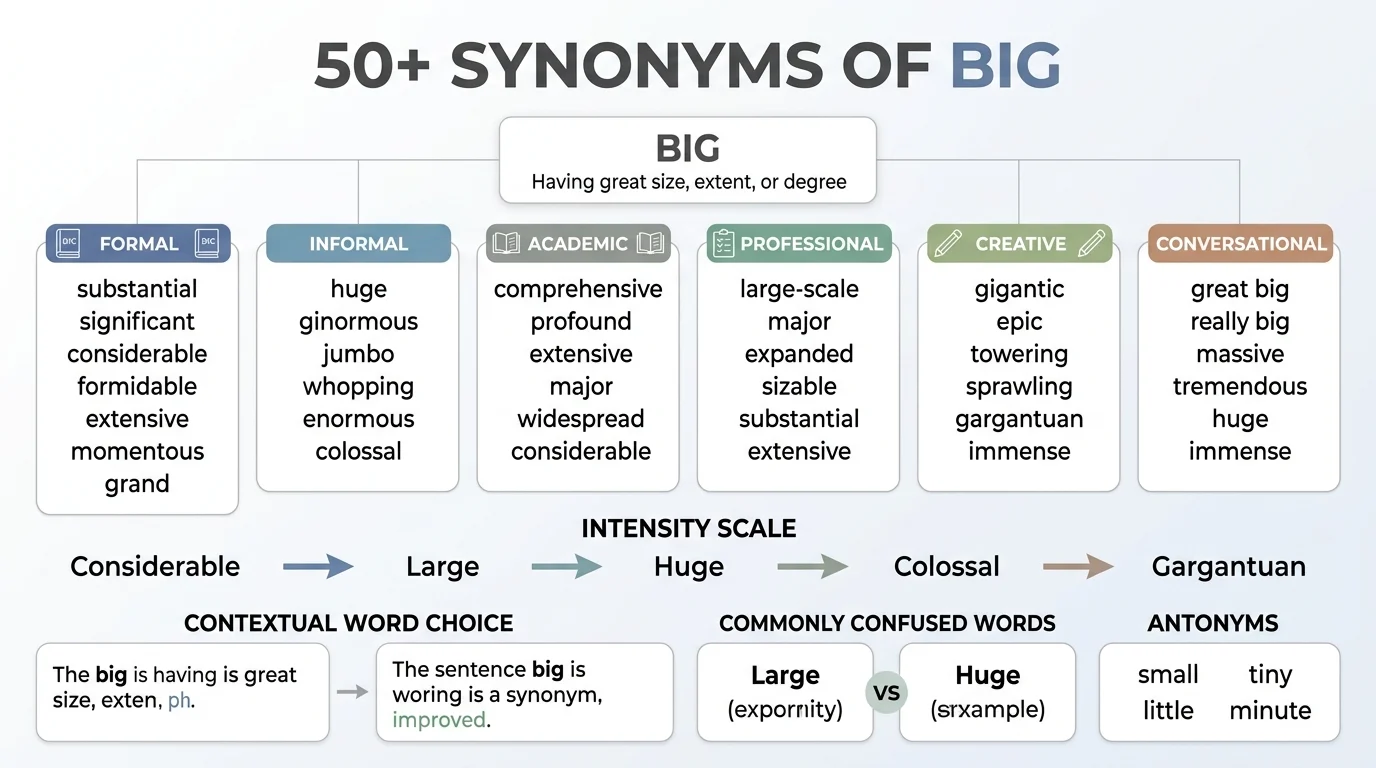
The word “big” means large in size, amount, degree, or importance. It is a neutral, general-purpose word that leans slightly informal. Formal writing, choose large or substantial. For casual conversation, use huge or massive. For emphasis, enormous and gigantic work well. Importance, try major or significant. The best choice depends entirely on your context and audience.
Meaning, Tone, and Context
Simple Definition
Big means greater than average in size, extent, amount, power, or importance.
Part of Speech
Adjective. The comparative form is bigger. The superlative form is biggest.
Overall Tone
Big is neutral but slightly informal. It does not carry strong emotion on its own. It simply states that something exceeds the normal or expected measure.
Formality Level
- Formal: Not suitable
- Semi-formal: Sometimes acceptable
- Neutral: Yes
- Informal: Best suited
Big is generally not used in formal academic or professional writing.
Common Uses
Native English speakers use “big” constantly in everyday speech. It appears in common phrases like big deal, big mistake, big surprise, and big picture. It also combines naturally with words like eater and spender to describe people who do a lot of something.
Word Forms
| Form | Word |
|---|---|
| Adjective | big |
| Comparative | bigger |
| Superlative | biggest |
| Adverb | (no common adverb form) |
| Noun | (no common noun form) |
When and How to Use “Big”
Choose “big” when you need a simple, straightforward word that everyone understands. It works best in casual conversations, informal writing, and situations where precision is not critical.
These examples show how “big” functions naturally in different contexts.
Professional
“We are looking at a big opportunity in the Southeast Asian market.”
Academic
“The study revealed a big difference between the two test groups.” (Better: substantial or significant)
Workplace
“We need to make a big decision about the new software system.”
Personal
“My daughter just got a big promotion at her law firm.”
Email
“Thanks for your email. This is a big project, so I will need a few days to review everything.”
Resume
“Managed a big budget of over $2 million.” (Better: substantial or significant)
Social Media
“Big news coming soon! Stay tuned.”
Best Synonyms of “Big”
No synonym is identical in every situation. Each word carries its own shade of meaning, tone, and emotional weight.
Here are the best synonyms for specific contexts.
Professional writing: Substantial — sounds serious and credible.
Academic writing: Significant — emphasizes importance and measurable impact.
Business communication: Major — conveys priority and strategic importance.
Casual conversation: Huge — natural and expressive without being overdramatic.
Emotional writing: Enormous — adds weight and feeling.
Creative writing: Vast — suggests expansiveness and scope.
Resume writing: Considerable — demonstrates meaningful achievement.
Workplace communication: Large-scale — describes projects and initiatives precisely.
Stronger meaning: Gigantic or colossal — for extreme size or impact.
Softer meaning: Sizable — moderate and neutral.
When Not to Use “Big”
Too General
Saying “a big problem” does not tell your reader anything specific. The problem could be complex, urgent, expensive, or widespread.
Better: “a complex problem” or “an urgent problem.”
Rewrite: “We have a big problem with the supply chain.” → “We have a significant disruption in the supply chain.”
Too Vague
“Big improvement” lacks detail. What kind of improvement? How much?
Better: “a dramatic improvement” or “a measurable improvement.”
Rewrite: “The new system is a big improvement.” → “The new system represents a 40% increase in efficiency.”
Too Informal in Formal Writing
“Big” sounds out of place in academic papers, official reports, and formal business documents.
Better: large, substantial, considerable, or significant.
Rewrite: “The study had a big sample size.” → “The study had a substantial sample size.”
Too Weak for Strong Emphasis
When you need to convey something truly extraordinary, “big” is not strong enough.
Better: enormous, gigantic, colossal, or immense.
Rewrite: “The storm caused big damage.” → “The storm caused enormous damage.”
Overused in Resumes
Resumes filled with “big” sound amateurish. Employers look for precise, action-oriented language.
Better: significant, major, substantial, or considerable.
Rewrite: “Managed a big team.” → “Led a team of 25 professionals.”
Words Commonly Confused With “Big”
Big vs Large
Difference: Big is more informal and emotionally neutral. Large is slightly more formal and is preferred in professional and technical contexts.
When to Use It: Use large in formal writing, business reports, and when describing quantities or clothing sizes. Use big in everyday conversation.
Example (Large): “The company reported a large increase in quarterly revenue.”
Big vs Great
Difference: Great is more formal and often poetic. It suggests that something is not just large but also notable or imposing. Big is casual and straightforward.
When to Use It: Use great with abstract concepts like success, beauty, or importance. Use big for physical size in informal contexts.
Example (Great): “The project was a great success.”
Big vs Huge
Difference: Huge is significantly stronger than big. It emphasizes that something is much larger than normal.
When to Use It: Use huge when you want to emphasize size or impact. Avoid overusing it in formal writing.
Example (Huge): “The response to our campaign was huge.”
Big vs Enormous
Difference: Enormous suggests an extreme excess beyond the norm. It carries a sense of being almost overwhelming.
When to Use It: Use enormous for things that are remarkably or surprisingly large.
Example (Enormous): “The corporation amassed enormous wealth over two decades.”
Big vs Massive
Difference: Massive emphasizes bulk, weight, and physical mass. It can also describe large-scale impact or disruption.
When to Use It: Use massive for heavy physical objects or for significant events and changes.
Example (Massive): “The building work has caused massive disruption.”
Big vs Vast
Difference: Vast describes great extent, range, or area rather than weight or bulk. It often refers to spaces, distances, or collections.
When to Use It: Use vast for landscapes, distances, quantities, or collections.
Example (Vast): “There are vast distances between the stars.”
Best Synonyms of “Big” by Context
| Context | Best Synonym | Why It Works | Example |
|---|---|---|---|
| Formal writing | Large | More formal and precise than big | “A large number of participants completed the survey.” |
| Academic writing | Substantial | Suggests meaningful, measurable significance | “The study found a substantial correlation between the variables.” |
| Professional communication | Significant | Emphasizes importance and measurable impact | “This represents a significant milestone for our department.” |
| Business emails | Major | Conveys strategic priority | “We have a major update regarding the merger.” |
| Resume writing | Considerable | Demonstrates meaningful scope and achievement | “Managed a considerable budget of $5 million.” |
| Workplace communication | Large-scale | Describes projects and initiatives precisely | “We are launching a large-scale training program.” |
| Casual conversation | Huge | Natural and expressive without being overdramatic | “That was a huge party last night.” |
| Everyday speaking | Big | Simple, clear, and universally understood | “I need a bigger suitcase for this trip.” |
| Creative writing | Vast | Suggests expansiveness and scope | “The vast prairie stretched to the horizon.” |
| Storytelling | Gigantic | Creates vivid, larger-than-life imagery | “A gigantic shadow loomed over the village.” |
| Emotional writing | Enormous | Adds weight and feeling to emotional moments | “She felt an enormous sense of relief.” |
| Strong emphasis | Colossal | Conveys extreme, awe-inspiring size | “The project was a colossal undertaking.” |
| Mild tone | Sizable | Moderate and neutral | “We made a sizable donation to the charity.” |
| Social media captions | Massive | Grabs attention and sounds energetic | “Massive giveaway happening now!” |
| American English | Big | Standard, widely used in US conversation | “He’s a big spender.” |
How to Choose the Best Synonym of “Big”
Ask yourself these five questions before choosing a synonym.
What am I describing?
If you are describing physical size, choose large, huge, or gigantic. You are describing importance, choose major or significant. If you are describing scope, choose vast or extensive.
Who is my audience?
For formal audiences, choose large, substantial, or considerable. For casual audiences, choose huge or massive.
What tone do I want?
For neutral, factual tone, choose large or sizable. For emotional or dramatic tone, choose enormous, colossal, or gigantic.
How much emphasis do I need?
For mild emphasis, choose sizable or ample. For strong emphasis, choose enormous, immense, or colossal.
Does it sound natural?
Test your choice in the sentence. Read it aloud. If it sounds forced or awkward, try a different word.
Real Life Examples of “Big”
School
“The science fair project required a big display board.” → “The science fair project required a substantial display board.”
College
“She faced a big challenge balancing work and studies.” → “She faced a significant challenge balancing work and studies.”
Workplace
“We need a big change in our approach to customer service.” → “We need a fundamental change in our approach to customer service.”
Business
“The acquisition was a big move for the company.” → “The acquisition was a strategic move for the company.”
Email
“I have a big favor to ask.” → “I have a significant request to make.”
Resume
“Developed big marketing campaigns.” → “Developed large-scale marketing campaigns reaching 2 million customers.”
Conversation
“That’s a big dog you have there.” (Works well as-is for casual speech.)
Storytelling
“The big wave crashed against the shore.” → “The colossal wave crashed against the shore.”
Blogging
“Here are five big reasons to start investing.” → “Here are five compelling reasons to start investing.”
Social Media
“Big things are coming.” → “Exciting developments are on the horizon.”
18 Best Synonyms of “Big”
Synonyms of “Big” by Usage
Professional vs Personal Synonyms
In professional settings, choose words that sound credible and precise. Substantial, significant, and considerable work well because they suggest measurable importance. In personal conversations, huge and massive feel natural and expressive.
Professional: “We achieved a substantial increase in market share.”
Personal: “We had a huge turnout at the party.”
Formal vs Conversational Synonyms
Formal writing favors large, great, substantial, and considerable. These words appear in reports, essays, and official documents. Conversational English prefers big, huge, and massive.
Formal: “The committee reached a considerable consensus.”
Conversational: “That’s a huge relief.”
Academic Synonyms
Academic writing demands precision and authority. Substantial, significant, considerable, and extensive are strong choices. They suggest rigorous measurement and meaningful results.
Example: “The data revealed a substantial correlation between the two variables.”
Professional and Business Synonyms
In business contexts, choose words that convey strategic importance and measurable impact. Major, significant, large-scale, and substantial are professional and credible.
Example: “The company announced a major expansion into European markets.”
Creative and Literary Synonyms
Creative writing benefits from vivid, evocative language. Vast, colossal, gigantic, and immense create strong visual images and emotional impact.
Example: “The colossal waves crashed against the ancient cliffs.”
Slang or Modern Synonyms
Ginormous combines giant and enormous. Humongous combines huge, enormous, and stupendous. Both are informal and best used in casual conversation. Avoid them in professional or academic writing.
Strongest to Mildest Synonyms
| Intensity | Synonyms |
|---|---|
| Mild | Sizable, ample, goodly |
| Moderate | Large, considerable, substantial |
| Strong | Huge, massive, immense, enormous |
| Very Strong | Gigantic, colossal, gargantuan, mammoth, vast |
The emotional intensity changes significantly across this scale. Sizable sounds neutral and factual. Colossal sounds overwhelming and awe-inspiring.
Emotional vs Neutral Synonyms
Emotional Synonyms: Enormous, gigantic, colossal, immense, massive. These words carry emotional weight. They suggest wonder, fear, excitement, or admiration. Use them when you want to create a strong emotional response.
Neutral Synonyms: Large, substantial, considerable, sizable, extensive. These words simply communicate information. They do not add emotion. Use them in factual, professional, or academic writing.
Antonyms of “Big”
Comparison: “Big” vs Similar Words
Big vs Large
Main Difference: Big is informal. Large is more formal.
Which Is Stronger? Neither. They are similar in intensity.
Which Is More Formal? Large is more formal.
When to Use Each: Use big in casual conversation. Use large in formal writing, reports, and when describing quantities or clothing sizes.
Examples:
- Big: “They live in a big house in the country.”
- Large: “A large number of people were crowded into the room.”
Big vs Great
Main Difference: Great is more formal and poetic. It suggests something notable or imposing.
Which Is Stronger? Great can carry more emotional weight.
Which Is More Formal? Great is more formal.
When to Use Each: Use great with abstract concepts like success, beauty, or importance. Use big for physical size in informal contexts.
Examples:
Big vs Huge
Main Difference: Huge is significantly stronger than big.
Which Is Stronger? Huge is much stronger.
Which Is More Formal? Both are informal, but huge is less formal.
When to Use Each: Use huge when you want to emphasize extraordinary size or impact.
Examples:
Big vs Enormous
Main Difference: Enormous suggests extreme excess beyond the norm.
Which Is Stronger? Enormous is much stronger.
Which Is More Formal? Enormous is acceptable in formal contexts.
When to Use Each: Use enormous for things that are remarkably or surprisingly large.
Examples:
Big vs Massive
Main Difference: Massive emphasizes bulk, weight, and physical mass.
Which Is Stronger? Massive is much stronger.
Which Is More Formal? Massive is acceptable in formal contexts.
When to Use Each: Use massive for heavy physical objects or significant events.
Examples:
- Big: “The project caused big disruption.”
- Massive: “The building work has caused massive disruption.”
Big vs Vast
Main Difference: Vast describes great extent, range, or area.
Which Is Stronger? Vast suggests almost limitless scale.
Which Is More Formal? Vast is formal.
When to Use Each: Use vast for landscapes, distances, or collections.
Examples:
Common Phrases and Expressions with “Big”
Big deal
Meaning: Something important or impressive, often used sarcastically.
Example: “Getting the promotion was a big deal for her.”
Big picture
Meaning: The overall perspective or main idea.
Example: “We need to focus on the big picture, not the small details.”
Big mistake
Meaning: A serious error.
Example: “Not backing up the files was a big mistake.”
Big surprise
Meaning: Something unexpected and significant.
Example: “His resignation came as a big surprise to everyone.”
Big break
Meaning: A sudden opportunity that leads to success.
Example: “Her big break came when she was cast in the lead role.”
Big spender
Meaning: Someone who spends a lot of money.
Example: “He is a big spender, so he never has any savings.”
Think big
Meaning: To have ambitious goals.
Example: “If you want to succeed, you need to think big.”
Common Mistakes to Avoid
1: Using “big” for emotions
Big modifies size and extent, not emotions.
- ❌ Incorrect: “I have a very big love for music.”
- ✅ Better: “I love music very much.”
- Why: “Love” is an emotion, not a physical size.
2: Using informal synonyms in formal writing
Words like huge and massive can sound unprofessional in formal contexts.
- ❌ Incorrect: “The study had a huge sample size.”
- ✅ Better: “The study had a substantial sample size.”
- Why: Substantial sounds more rigorous and credible.
3: Choosing the wrong intensity
Using a weak synonym when you need strong emphasis, or vice versa.
- ❌ Incorrect: “The colossal rainstorm lasted five minutes.” (Too strong)
- ✅ Better: “The heavy rainstorm lasted five minutes.”
- Why: Colossal suggests something massive and overwhelming.
4: Repeating the same synonym
Overusing any synonym makes writing feel repetitive.
- ❌ Incorrect: “The huge building cast a huge shadow. The huge crowd gathered outside.”
- ✅ Better: “The massive building cast a long shadow. The enormous crowd gathered outside.”
- Why: Variation keeps writing engaging and precise.
5: Ignoring collocation patterns
Some words simply do not pair naturally.
- ❌ Incorrect: “a large mistake”
- ✅ Better: “a big mistake” or “a serious mistake”
- Why: “Large mistake” sounds unnatural to native speakers.
6: Using slang in professional writing
Words like ginormous and humongous do not belong in business or academic contexts.
- ❌ Incorrect: “We made a ginormous profit this quarter.”
- ✅ Better: “We made a substantial profit this quarter.”
- Why: Slang undermines professionalism and credibility.
7: Choosing the wrong synonym for the wrong context
Every synonym has a specific nuance.
- ❌ Incorrect: “The vast cat sat on the mat.” (Vast is for areas, not small objects)
- ✅ Better: “The large cat sat on the mat.”
- Why: Vast describes extent and range, not physical size of small objects.
Frequently Asked Questions
1. What are the best synonyms of “big”?
The best synonyms depend on your context. Formal writing, use large or substantial. For casual conversation, use huge or massive. For strong emphasis, use enormous, gigantic, or colossal.
2. What are the best formal synonyms of “big”?
The best formal synonyms are large, substantial, considerable, and significant. These words appear in academic papers, business reports, and professional documents.
3. What are common informal synonyms of “big”?
Common informal synonyms include huge, massive, ginormous, and humongous. Use these in casual conversations, social media, and friendly emails.
4. What is another word for “big” in professional writing?
In professional writing, use substantial, significant, or major. These words convey credibility and measurable importance.
5. What is the difference between “big” and “large”?
Big is more informal and emotionally neutral. Large is more formal and is preferred in professional and technical contexts.
6. What is the opposite of “big”?
The most common opposites are small and little. Other antonyms include tiny, minute, miniature, and diminutive.
Conclusion
“Big” is a simple, useful word that describes size, amount, degree, or importance. But it is often too vague for effective communication.
The best synonyms of big depend on your context, audience, and purpose. Formal writing, choose large or substantial. For casual conversation, choose huge or massive. For strong emphasis, choose enormous, gigantic, or colossal.
No synonym works perfectly in every situation. The key is to match your word choice to your message and your reader.
One practical tip: Before you write “big,” pause and ask yourself what you really mean. Are you describing size, importance, scope, or impact? Choose the word that communicates that meaning most precisely. Your readers will notice the difference.