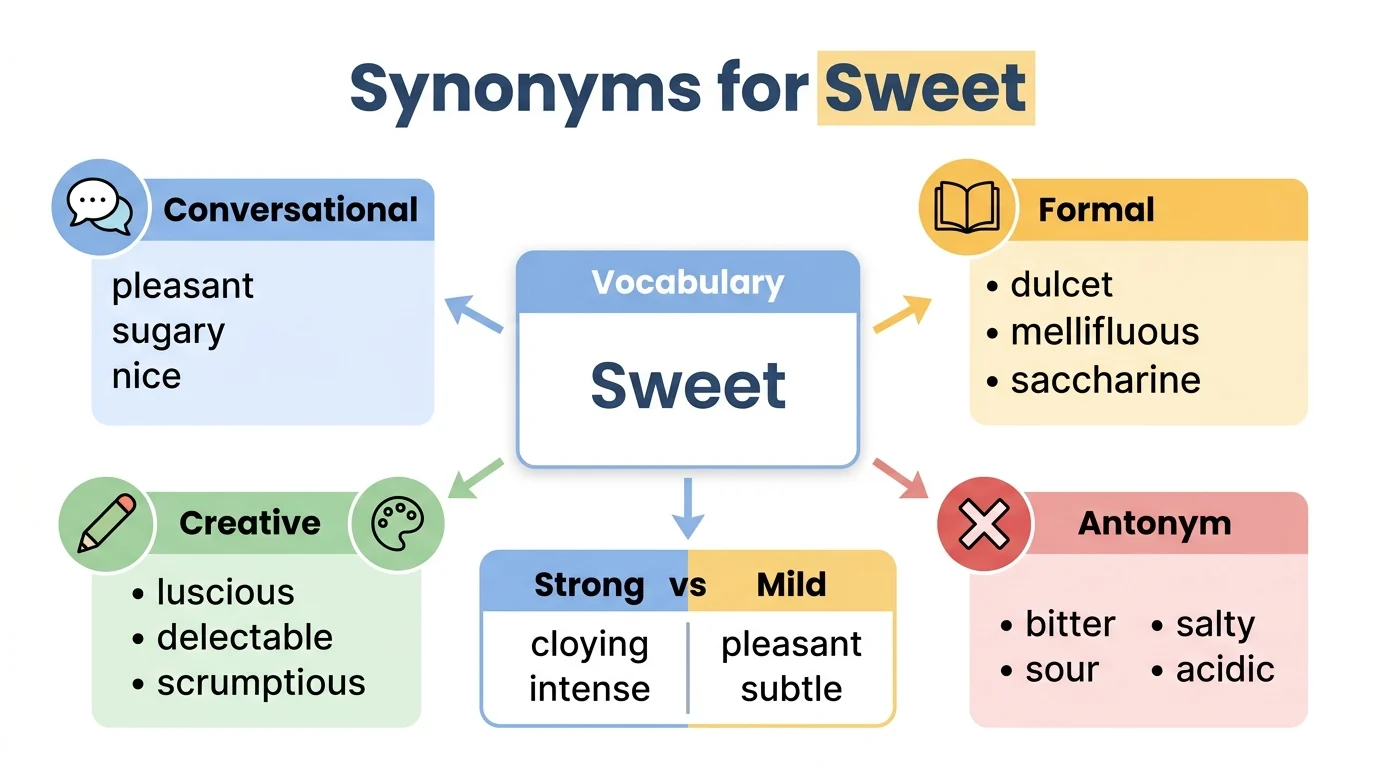
Do you find yourself using the word “sweet” over and over again? You might describe a dessert, a kind person, or a thoughtful gesture all with the same word. While “sweet” is useful, repeating it makes your writing feel flat and uninspired.
Stronger vocabulary choices can transform your emails, essays, captions, and conversations. This guide will help you choose the perfect synonym for every situation.
What Does “Sweet” Mean?
Sweet primarily describes a sugary taste or something pleasant and kind. The best synonyms depend on context. For taste, use sugary or honeyed. For personality, use kind or thoughtful. Formal writing, use gratifying or pleasing. For creative writing, use dulcet or luscious. Choose based on your audience and tone.
Meaning, Tone and Context
Simple Definition
Sweet refers to a taste that is sugary, not salty, bitter, or sour. It also describes people, actions, sounds, or experiences that are pleasing, gentle, or delightful.
Part of Speech
Sweet is primarily an adjective. The noun form is “sweetness.” The adverb form is “sweetly.” You can also use “sweet” as a noun to describe a dessert or a term of endearment.
Positive, Negative, or Neutral Tone
Sweet has a positive tone in almost every context. It conveys warmth, approval, and pleasantness. However, in some situations, it can sound overly sentimental or childish.
Formality Level
Sweet is neutral to informal. It works well in casual conversation and personal writing. In professional or academic contexts, more formal synonyms are often better.
Common Use Cases
You use sweet to describe food, drinks, kind people, loving gestures, gentle sounds, pleasant smells, and satisfying experiences. It appears in everyday conversation, social media captions, personal emails, and creative writing.
Important Word Forms
Adjective: sweet
Noun: sweetness
Adverb: sweetly
Comparative: sweeter
Superlative: sweetest
When and How to Use “Sweet”
Use sweet when you want a simple, positive word that nearly everyone understands. It works best in casual or personal contexts. In professional writing, use it sparingly. In creative writing, it adds warmth and approachability.
Realistic Examples
Professional Context
The client’s feedback was sweet, but we need more specific details for the next iteration.
Personal Context
My grandmother left a sweet note on my pillow before I left for college.
Academic Context
The study revealed a sweet spot in the data where all variables aligned perfectly.
Emotional Context
His apology was so sweet that I could not stay angry with him.
Creative Writing
The sweet melody drifted through the open window on a lazy summer afternoon.
Social Media Caption
Sweet moments with my favorite people. That is all that matters.
Casual Conversation
That coffee is way too sweet for my taste. I prefer mine black.
Another Word for “Sweet”
Professional Writing
Consider using gratifying, pleasing, or favorable. These words sound more polished in business communication.
Academic Writing
Use agreeable, harmonious, or propitious. These words add precision and formality to research papers.
Casual Conversation
Stick with nice, kind, or lovely. These are natural and easy to say in everyday talk.
Emotional Writing
Use tender, gentle, or heartfelt. These words carry more emotional weight.
Creative Writing
Consider dulcet, luscious, or mellifluous. These words add imagery and lyrical quality.
Resume or Workplace Use
Use personable, amiable, or pleasant. These words describe soft skills effectively.
Social Media Captions
Use adorable, precious, or lovely. These words are popular and engaging online.
Stronger Meaning
Use saccharine or cloying for overly sweet. Use delightful or exquisite for intensely pleasant.
Softer Meaning
Use mild, subtle, or gentle for a less intense version of sweet.
When Not to Use “Sweet”
Avoid sweet in formal reports or legal documents. It sounds too casual and vague. A business proposal should use “favorable” or “beneficial” instead of “sweet.”
Avoid sweet when you need precise descriptions. A research paper should use “saccharine” or “sugary” for taste analysis, not the general word “sweet.”
Avoid sweet in negative contexts. It has a positive connotation and does not work for criticism or complaints.
Avoid sweet when you want to sound authoritative. It can make your writing seem childish or overly sentimental in professional settings.
Weak Example
The financial results were sweet this quarter.
Stronger Revision
The financial results were favorable and exceeded our projections this quarter.
Weak Example
Her sweet behavior made everyone comfortable.
Stronger Revision
Her amiable behavior made everyone comfortable in the meeting.
Words Commonly Confused With “Sweet”
Sweet vs. Sugary
Sweet is general. Sugary specifically describes a taste or flavor. Use sugary when discussing food or drink. Use sweet for people or experiences.
Sweet vs. Kind
Kind focuses on actions and helpfulness. Sweet focuses on gentleness and warmth. A kind person helps others. A sweet person is pleasant and endearing.
Sweet vs. Gentle
Gentle describes a soft, mild, or careful approach. Sweet describes a pleasing or likable quality. A gentle touch is delicate. A sweet gesture is thoughtful.
Sweet vs. Lovely
Lovely emphasizes beauty or excellence. Sweet emphasizes charm or niceness. A lovely view is beautiful. A sweet person is charming.
Sweet vs. Pleasant
Pleasant is more formal and neutral. Sweet is warmer and more emotional. A pleasant conversation is enjoyable. A sweet conversation feels heartfelt.
Sweet vs. Saccharine
Saccharine is a stronger, often negative word. It means excessively sweet, sometimes in a fake way. Sweet is neutral and positive. Saccharine is for criticism of overly sentimental things.
Best Synonym by Context for “Sweet”
| Context | Best Synonym | Why It Works | Example |
|---|---|---|---|
| Formal Writing | Gratifying | Sounds professional and polished | The gratifying outcome justified our efforts. |
| Academic Writing | Propitious | Adds scholarly precision | The propitious conditions led to reliable results. |
| Professional Business | Favorable | Sounds objective and measured | We received a favorable response from the board. |
| Resume Writing | Personable | Describes soft skills effectively | Personable team player who builds strong client relationships. |
| Casual Conversation | Nice | Simple and universally understood | That was a nice thing you did for her. |
| Creative Writing | Dulcet | Adds lyrical, poetic imagery | Her dulcet voice calmed the anxious crowd. |
| Emotional Tone | Tender | Conveys deep care and affection | He gave her a tender embrace before she left. |
| Strong Intensity | Exquisite | Emphasizes exceptional quality | The chocolate cake had an exquisite flavor. |
| Soft Moderate Tone | Mild | Downplays intensity for balance | The curry had a mild sweetness from the coconut milk. |
| Social Media Captions | Precious | Creates engagement and relatability | Precious moments with my little family. |
| US Usage | Sweet | The standard American English term | This lemonade is too sweet for me. |
| UK Usage | Nice | Often used where Americans say sweet | She is such a nice person, isnt she? |
Which Synonym Should You Choose?
Start by identifying your audience. For professional emails, choose “favorable” or “gratifying.” For academic writing, choose “propitious” or “harmonious.” Casual conversation, choose “nice” or “lovely.”
Consider your emotional intensity. If you want to express deep affection, use “tender” or “heartfelt.” If you want a neutral observation, use “pleasant” or “agreeable.”
Think about your sentence structure. Some synonyms fit certain phrases better. “Sweet spot” works well. “Favorable spot” does not. “Sweet tooth” is common. “Sugary tooth” is not.
Match your synonym to your meaning. If you discuss taste, choose “sugary” or “honeyed.” If you discuss personality, choose “kind” or “gentle.” You discuss sound, choose “melodious” or “dulcet.”
Test your synonym in context. Read the sentence aloud. If it sounds natural and clear, you made the right choice. If it sounds forced or confusing, try a different word.
Real Life Examples of “Sweet” in Sentences
- In School
The teacher gave a sweet smile when the student finally solved the math problem. - In the Workplace
Her sweet demeanor made her the most approachable manager in the entire department. - In Writing
The author used a sweet, nostalgic tone to describe her childhood home. - In Conversation
That is so sweet of you to remember my birthday without any reminders. - On Social Media
Sweet summer nights and fireflies. This is pure happiness. - In an Email
Thank you for your sweet message. It truly made my day better. - In Storytelling
The sweet aroma of freshly baked bread filled the old kitchen with warmth and comfort. - Using Stronger Synonyms
The saccharine dialogue in the film made the romantic scenes feel forced and unrealistic.
25 Synonyms for “Sweet”
| Synonym | Simple Meaning | Best Used For | Example Sentence |
|---|---|---|---|
| Sugary | Containing or tasting like sugar | Describing food and drinks | The sugary cereal was too sweet for breakfast. |
| Honeyed | Sweet like honey; also soothing or flattering | Creative writing and compliments | She spoke in honeyed tones that calmed everyone. |
| Saccharine | Excessively sweet; sometimes insincere | Critical or analytical writing | The saccharine ending of the movie felt fake. |
| Dulcet | Sweet and soothing to the ear | Describing sounds or voices | The dulcet music helped me fall asleep. |
| Mellifluous | Sweet sounding; flowing with honey | Literary and descriptive writing | His mellifluous voice captivated the audience. |
| Kind | Having a gentle, caring nature | Describing people and actions | She is a kind person who helps everyone. |
| Gentle | Mild, soft, or moderate in action | Describing behavior or touch | He gave her a gentle hug at the airport. |
| Tender | Showing care and affection | Emotional writing and relationships | The tender moment brought tears to my eyes. |
| Lovely | Very beautiful or pleasant | General positive descriptions | We had a lovely afternoon at the park. |
| Pleasant | Enjoyable or agreeable | Formal and neutral contexts | The pleasant weather made our trip enjoyable. |
| Agreeable | Pleasing; easy to accept | Academic and professional writing | The agreeable terms of the contract satisfied both parties. |
| Gratifying | Giving satisfaction or pleasure | Professional and formal contexts | The gratifying results justified our research. |
| Favorable | Showing approval or advantage | Business and professional use | The company received favorable reviews from clients. |
| Propitious | Indicating a good chance of success | Academic and formal writing | The propitious conditions led to a successful experiment. |
| Amiable | Friendly and pleasant | Describing people in professional settings | The amiable host made everyone feel welcome. |
Synonym Groups and Usage Differences
Professional vs. Personal Synonyms
Professional synonyms include gratifying, favorable, and amiable. These words work in business emails, performance reviews, and client communications. Personal synonyms include lovely, tender, and precious. These words work better in letters to friends, family messages, and personal journals.
Formal vs. Conversational Synonyms
Formal synonyms include propitious, agreeable, and gratifying. Use them in reports, academic papers, and professional speeches. Conversational synonyms include nice, lovely, and kind. Use them in texts, casual emails, and everyday conversations.
Academic Synonyms
Academic synonyms like propitious, harmonious, and agreeable show precision. They fit research papers, scholarly articles, and academic essays. Avoid using “sweet” in formal academic writing. Instead, choose words that match your specific meaning.
Professional and Business Synonyms
Business synonyms include favorable, amiable, and personable. Use them in resumes, cover letters, and professional bios. They describe people and outcomes in a polished way. “Favorable results” sounds better than “sweet results” in a quarterly report.
Creative or Literary Synonyms
Literary synonyms include dulcet, mellifluous, luscious, and ambrosial. These words add sensory detail and emotional depth to your writing. They work well in poetry, fiction, and descriptive essays. Creative writing benefits from these rich, evocative words.
Slang or Modern Synonyms
Slang synonyms are rare for sweet. In modern usage, “lit” or “fire” can describe something excellent, but these are informal and context dependent. Use them only in casual social media or text conversations. They do not belong in professional or academic writing.
Strongest vs. Weaker Synonyms
| Mild Synonyms | Moderate Synonyms | Strongest Synonyms |
|---|---|---|
| Nice | Pleasant | Exquisite |
| Mild | Gentle | Luscious |
| Subtle | Agreeable | Saccharine |
| Okay | Kind | Mellifluous |
| Fine | Lovely | Ambrosial |
The mildest synonyms downplay intensity. The strongest synonyms emphasize powerful sensations or emotions. Choose based on how much impact you want your word to have.
Emotional vs. Neutral Synonyms
Emotional synonyms include tender, heartfelt, and precious. These words carry warmth and personal feeling. Neutral synonyms include agreeable, favorable, and pleasant. These words stay factual and objective.
Antonyms of “Sweet”
| Antonym | Meaning | Example Sentence |
|---|---|---|
| Sour | Having a sharp, acidic taste | The sour lemon made my face pucker. |
| Bitter | Having a sharp, unpleasant taste | The bitter coffee needed more sugar. |
| Salty | Tasting of salt | The salty popcorn was a perfect snack. |
| Savory | Tasty but not sweet | The savory stew was hearty and delicious. |
| Unpleasant | Not enjoyable or pleasing | The unpleasant smell made us leave the room. |
| Harsh | Unpleasantly rough or severe | His harsh words hurt her feelings. |
| Mean | Not kind; unkind or cruel | The mean comment ruined her day. |
| Acrid | Having a strong, bitter smell | The acrid smoke burned our eyes. |
| Pungent | Having a strong, sharp smell | The pungent cheese was too strong for me. |
| Tart | Sharp or acidic in taste | The tart apple made me pucker. |
| Acidic | Having a sour or sharp taste | The acidic tomatoes needed more seasoning. |
| Unkind | Lacking kindness or compassion | His unkind remark caused a lot of pain. |
| Disagreeable | Unpleasant or difficult to deal with | The disagreeable weather ruined our picnic. |
| Rancid | Having a bad smell or taste | The rancid butter had gone bad. |
| Sour | Resentful or bitter in mood | Her sour attitude made the meeting uncomfortable. |
Comparison: Sweet vs. Similar Words
Sweet vs. Sugary
Main Difference: Sweet is broad and positive. Sugary specifically describes taste and can imply excess.
Which One Is Stronger: Sugary is more specific and descriptive.
Which One Is More Formal: Sweet is more formal than sugary in general contexts.
Example Sentence for Sweet: She has a sweet personality that everyone loves.
Example Sentence for Sugary: The sugary cereal left a sticky residue in the bowl.
Sweet vs. Kind
Main Difference: Sweet focuses on warmth and pleasantness. Kind focuses on helpfulness and compassion.
Which One Is Stronger: Kind has a stronger moral dimension.
Which One Is More Formal: Kind is slightly more formal.
Example Sentence for Sweet: His sweet smile brightened my morning.
Example Sentence for Kind: Her kind actions helped many people in need.
Sweet vs. Gentle
Main Difference: Sweet describes character or flavor. Gentle describes action or touch.
Which One Is Stronger: Gentle is more specific about physical or behavioral softness.
Which One Is More Formal: Both are neutral in formality.
Example Sentence for Sweet: The sweet melody calmed the baby.
Example Sentence for Gentle: He gave her a gentle pat on the back.
Sweet vs. Lovely
Main Difference: Sweet emphasizes charm and niceness. Lovely emphasizes beauty and excellence.
Which One Is Stronger: Lovely is often stronger and more admiring.
Which One Is More Formal: Lovely is slightly more formal.
Example Sentence for Sweet: It was sweet of you to bring flowers.
Example Sentence for Lovely: We had a lovely time at the beach.
Sweet vs. Pleasant
Main Difference: Sweet is warmer and more emotional. Pleasant is more neutral and objective.
Which One Is Stronger: Sweet carries more emotional weight.
Which One Is More Formal: Pleasant is more formal.
Example Sentence for Sweet: Her sweet voice made everyone feel at ease.
Example Sentence for Pleasant: The weather was pleasant all week.
Sweet vs. Saccharine
Main Difference: Sweet is genuine and positive. Saccharine is excessively sweet, often in a fake or insincere way.
Which One Is Stronger: Saccharine is a stronger, more critical word.
Which One Is More Formal: Saccharine is more formal and analytical.
Example Sentence for Sweet: The sweet ending brought tears to my eyes.
Example Sentence for Saccharine: The saccharine dialogue felt forced and unnatural.
Common Phrases and Expressions with “Sweet”
1. Sweet Tooth
Meaning: A strong liking for sugary foods and desserts.
Example Sentence: I have a sweet tooth, so I always order dessert.
2. Sweet Spot
Meaning: The ideal point or position for the best results.
Example Sentence: The new pricing strategy hit the sweet spot for our customers.
3. Sweet Dreams
Meaning: A phrase used to wish someone a good night’s sleep.
Example Sentence: Goodnight, sweet dreams, and see you in the morning.
4. Sweet Nothing
Meaning: Romantic or affectionate words whispered to a loved one.
Example Sentence: He whispered sweet nothings in her ear as they danced.
5. Sweet and Sour
Meaning: A flavor combination of sweet and acidic; also describes mixed emotions.
Example Sentence: The sweet and sour chicken was the best dish on the menu.
6. Home Sweet Home
Meaning: An expression of comfort and happiness upon returning home.
Example Sentence: After a long trip, it felt good to say home sweet home.
7. Sweet Talk
Meaning: Persuasive or flattering speech meant to influence someone.
Example Sentence: His sweet talk convinced her to agree to the plan.
8. Short and Sweet
Meaning: Brief but pleasant or effective.
Example Sentence: Keep your presentation short and sweet to hold the audience’s attention.
Common Mistakes to Avoid
Mistake 1: Using “Sweet” When a More Precise Synonym Is Better
Sweet is too vague for many professional contexts. Instead of saying “sweet results,” say “favorable results.” Instead of “sweet employee,” say “amiable employee.”
Mistake 2: Confusing “Sweet” With “Sugary”
Sweet describes people, experiences, and sounds. Sugary only describes taste. Do not say “sugary person” when you mean “sweet person.”
Mistake 3: Using a Casual Synonym in Formal Writing
Words like “nice” and “lovely” are too informal for reports and academic papers. Use “agreeable” or “gratifying” instead.
Mistake 4: Using an Overly Dramatic Synonym for a Simple Situation
“Saccharine” and “cloying” are negative and intense. Do not use them to describe a nice gesture. Use “kind” or “pleasant” for everyday situations.
Mistake 5: Repeating the Same Word Too Often
Do not use sweet multiple times in one paragraph. Vary your vocabulary with synonyms like nice, kind, gentle, and pleasant.
Mistake 6: Choosing a Synonym With the Wrong Emotional Tone
Saccharine implies fake sweetness. Dulcet implies musical sweetness. Choose based on your intended emotional impact.
Mistake 7: Using Slang in Academic or Professional Writing
Avoid “lit” or “fire” in formal contexts. These words are too casual and may confuse your audience.
FAQs
What is the best synonym for sweet?
The best synonym depends on context. For taste, choose sugary. For personality, choose kind. Formal writing, choose gratifying.
What is a formal synonym for sweet?
Formal synonyms include gratifying, propitious, and agreeable. Use these in academic papers and professional reports.
What is an informal synonym for sweet?
Informal synonyms include nice, lovely, and kind. Use these in casual conversation and personal writing.
What is another word for sweet in professional writing?
Use favorable, personable, or amiable. These words sound polished and professional in business contexts.
What is the difference between sweet and saccharine?
Sweet is positive and genuine. Saccharine means excessively sweet, often in a fake or insincere way.
What is the opposite of sweet?
The opposite depends on context. For taste, sour or bitter. For personality, mean or harsh.
Conclusion
Sweet is a warm, positive word with many uses. It describes taste, personality, sound, and experience. However, overusing it makes your writing dull. Choosing the right synonym improves clarity and impact. Match your word to your audience, context, and meaning. For professional writing, use gratifying or favorable. For creative writing, use dulcet or luscious. Casual conversation, use nice or lovely. Expand your vocabulary by practicing one new synonym each day.