Have you ever found yourself writing an email, an essay, or a social media caption and realized you have used the word “ghost” three times in two sentences? You know there is a better word, but your mind goes blank.
Maybe you are describing a haunting memory, a looming threat, or an actual apparition. This is exactly when exploring the synonyms of specter can transform your writing. Choosing the right synonym does more than avoid repetition. It sharpens your meaning, sets the correct tone, and helps your reader understand exactly what you intend to communicate.
This guide will help you master every synonym of specter so you can write with confidence and precision.
What Are the Best Synonyms of “Specter”?
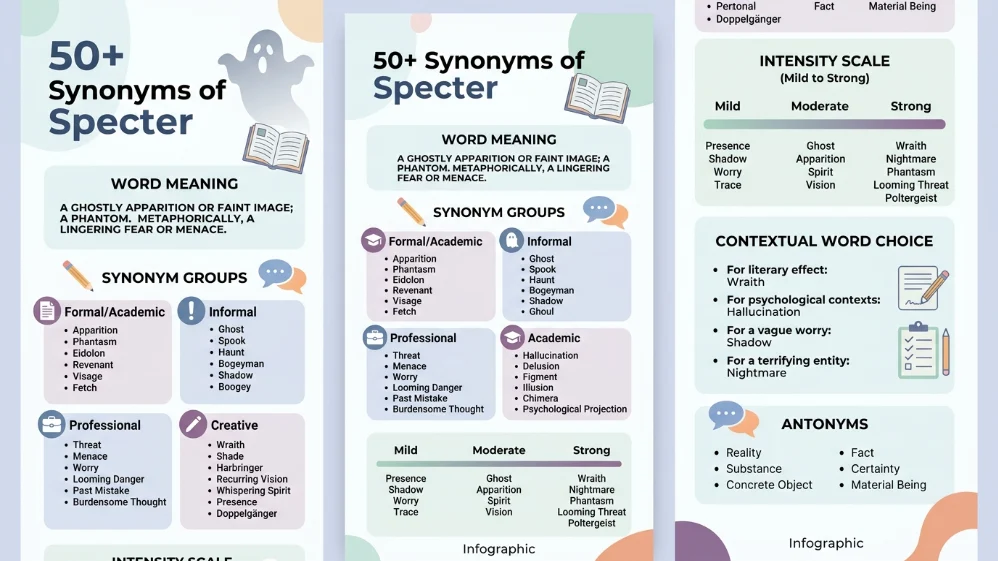
A specter is a ghostly apparition or a haunting, frightening prospect. For formal writing, choose “apparition” or “phantasm.” For casual conversation, use “ghost” or “spook.” In professional contexts, “phantom” or “shadow” work well. For emotional impact, select “wraith” or “shade.” Each synonym carries a unique tone and intensity.
Meaning, Tone, and Context
Simple Definition
A specter is a visible spirit of a dead person, often one that causes fear or dread. The word also describes a frightening idea or potential future event that haunts people’s minds.
Part of Speech
Specter is a noun. The British spelling is “spectre”.
Overall Tone
Specter carries a negative, ominous tone. It suggests fear, dread, or unease.
Formality Level
Specter is semi-formal to formal. It appears in literary works, news articles, and academic discussions. It is less common in casual speech.
Common Uses
Native English speakers use “specter” in two main ways:
- Literal: To describe a ghost or spirit, especially in literature or storytelling.
- Figurative: To describe a looming threat or unpleasant possibility, such as “the specter of war” or “the specter of bankruptcy”.
Word Forms
- Noun: specter (singular), specters (plural)
- Adjective: spectral (meaning ghostly or resembling a specter)
- Related forms: specter-like
When and How to Use “Specter”
Use “specter” when you want to evoke fear, unease, or a haunting quality. It works best in formal writing, literature, and discussions of serious threats. Here are seven realistic examples.
Professional (Business Report)
The specter of rising interest rates has forced our finance team to revise the quarterly projections.
Academic (Research Paper)
Throughout the twentieth century, the specter of nuclear conflict shaped international relations and defense policies.
Workplace (Meeting Discussion)
The specter of budget cuts looms over our department, so we need to demonstrate our value clearly.
Personal (Journal Entry)
Even after all these years, the specter of that difficult conversation still lingers in my memory.
Email (Professional Correspondence)
Given the specter of supply chain disruptions, we recommend securing alternative vendors immediately.
Resume (Cover Letter)
I helped my previous employer navigate the specter of market downturns by diversifying our client portfolio.
Social Media (Thoughtful Post)
The specter of climate change reminds us that small daily choices do make a difference.
Best Synonyms of “Specter”
No synonym is identical in every situation. The best choice depends on your audience, purpose, and desired tone. Here are the top recommendations for specific contexts.
Professional writing: Choose “phantom.” It sounds serious without being overly dramatic.
Academic writing: Choose “apparition” or “phantasm.” These words carry a scholarly, precise tone.
Business communication: Choose “shadow” or “prospect.” They convey concern without alarm.
Casual conversation: Choose “ghost” or “spook.” These are familiar and easy to understand.
Emotional writing: Choose “wraith” or “shade.” These words add sorrow and depth.
Creative writing: Choose “eidolon” or “revenant.” They sound evocative and literary.
Resume writing: Choose “challenge” or “concern” instead of “specter.” Avoid frightening language.
Workplace communication: Choose “risk” or “threat” for clarity.
Stronger meaning: Choose “nightmare” or “menace.”
Softer meaning: Choose “presence” or “hint.”
When Not to Use “Specter”
There are situations where “specter” is not the best choice.
When the word sounds too dramatic
If you are describing a minor inconvenience, “specter” is overkill. Instead of saying “the specter of a late delivery,” say “the possibility of a late delivery.”
When the word sounds too vague
If you need to be specific about a threat, “specter” can be unclear. Instead of “the specter of financial loss,” say “the risk of financial loss.”
When the word sounds too formal
In casual conversation or text messages, “specter” feels out of place. Instead of “the specter of homework,” say “the mountain of homework.”
When the word sounds too weak
If you need to convey immediate danger, “specter” may not be strong enough. Instead of “the specter of the hurricane,” say “the imminent threat of the hurricane.”
When the word sounds outdated
In modern business writing, “specter” can feel old-fashioned. Instead of “the specter of competition,” say “competitive pressure.”
Words Commonly Confused With “Specter”
Specter vs. Ghost
- Difference: A ghost is a general term for the spirit of a dead person. A specter is often more frightening and sometimes implies a warning or omen.
- When to use “ghost”: Use it for everyday references to spirits.
- Example: “The old house is said to be haunted by a ghost.”
Specter vs. Phantom
- Difference: A phantom is an illusion or something that appears real but is not. A specter is more likely to be a genuine spirit.
- When to use “phantom”: Use it for something that seems real but is imaginary.
- Example: “The phantom pain in his amputated leg continued to trouble him.”
Vs. Apparition
- Difference: An apparition is any sudden, unexpected appearance. A specter is specifically a frightening ghost.
- When to use “apparition”: Use it for any unexpected vision or appearance.
- Example: “She saw a strange apparition in the mist.”
Specter vs. Wraith
- Difference: A wraith is a ghost or spirit seen just before death, often as an omen. A specter is a more general frightening ghost.
- When to use “wraith”: Use it for a ghostly omen or a spirit that appears to warn of death.
- Example: “The villagers believed the wraith appeared only before a tragedy.”
Vs. Shade
- Difference: A shade is a faint, shadowy ghost. A specter is more vivid and frightening.
- When to use “shade”: Use it for a faint, elusive spirit.
- Example: “The shades of the departed seemed to wander the ancient battlefield.”
Specter vs. Spirit
- Difference: “Spirit” is a broad term for any non-physical being. “Specter” is more specific and negative.
- When to use “spirit”: Use it for any supernatural being, good or bad.
- Example: “She felt a peaceful spirit in the room.”
Best Synonyms of “Specter” by Context
| Context | Best Synonym | Why It Works | Example |
|---|---|---|---|
| Formal writing | Apparition | Sounds precise and scholarly. | “The apparition appeared at midnight.” |
| Academic writing | Phantasm | Carries a philosophical, theoretical weight. | “The phantasm of utopia drives political movements.” |
| Professional communication | Phantom | Serious but not overly emotional. | “The phantom of a data breach keeps our IT team vigilant.” |
| Business emails | Shadow | Subtle and professional. | “The shadow of a recession influences our strategy.” |
| Resume writing | Challenge | Positive and forward-looking. | “I thrive on tackling complex challenges.” |
| Workplace communication | Risk | Clear and direct. | “We need to assess the risk of project delays.” |
| Casual conversation | Ghost | Familiar and easy to understand. | “I think I saw a ghost in that old barn.” |
| Everyday speaking | Spook | Informal and playful. | “Don’t be such a spook about the exam.” |
| Creative writing | Eidolon | Evocative and literary. | “An eidolon of lost love haunted his dreams.” |
| Storytelling | Revenant | Suggests a returned spirit with purpose. | “The revenant sought revenge on those who wronged him.” |
| Emotional writing | Wraith | Adds sorrow and depth. | “The wraith of her past mistakes followed her everywhere.” |
| Strong emphasis | Nightmare | Conveys intense fear and dread. | “The nightmare of unemployment haunted the town.” |
| Mild tone | Presence | Neutral and gentle. | “I felt a strange presence in the room.” |
| Social media captions | Vibe | Modern and casual. | “This place has a spooky vibe.” |
How to Choose the Best Synonym of “Specter”
Choosing the right synonym comes down to four questions.
1. What is your audience?
For a professor or boss, choose formal words like “apparition” or “phantasm.” For friends, choose “ghost” or “spook.”
2. What is your purpose?
Are you trying to scare, inform, or persuade? Scary stories need “wraith” or “revenant.” Business reports need “risk” or “threat.”
3. How strong should your emotion be?
For mild unease, use “presence” or “hint.” For intense dread, use “nightmare” or “menace.”
4. Does it sound natural?
Read your sentence aloud. If the synonym feels forced or out of place, choose a simpler word.
The goal is always clear communication. Choose the synonym that best conveys your intended meaning to your specific reader.
Real Life Examples of “Specter”
School (Student Essay)
The specter of final exams motivated me to study every evening. (Better: “The pressure of final exams motivated me to study every evening.”)
College (Research Paper)
The specter of authoritarianism has reappeared in modern political discourse.
Workplace (Team Meeting)
The specter of layoffs has created anxiety among staff. (Better: “The threat of layoffs has created anxiety among staff.”)
Business (Annual Report)
Despite the specter of economic uncertainty, our company achieved record growth.
Email (Professional)
The specter of missed deadlines requires us to streamline our workflow. (Better: “The risk of missed deadlines requires us to streamline our workflow.”)
Resume (Cover Letter)
I successfully guided my team through the specter of industry disruption. (Better: “I successfully guided my team through a period of industry disruption.”)
Conversation
“I can’t shake the specter of that horror movie,” she said. (Better: “I can’t shake the memory of that horror movie,” she said.)
Storytelling
A specter in white robes glided through the foggy cemetery.
Blogging
The specter of burnout is real for many remote workers.
Social Media
The specter of Monday morning is already haunting my Sunday night. (Better: “The dread of Monday morning is already creeping into my Sunday night.”)
25 Best Synonyms of “Specter”
| Synonym | Simple Meaning | Best Used For | Example Sentence |
|---|---|---|---|
| Ghost | Spirit of a dead person | General, everyday use | “The ghost of the old sailor supposedly haunts the lighthouse.” |
| Phantom | Something apparent but not real | Describing illusions or fears | “The phantom of failure kept him from taking risks.” |
| Apparition | A sudden, unexpected appearance | Formal or dramatic descriptions | “An apparition appeared in the mirror, then vanished.” |
| Wraith | A ghostly omen or spirit seen before death | Emotional, sorrowful writing | “The wraith of her deceased mother appeared to guide her.” |
| Shade | A faint, shadowy ghost | Poetic or literary contexts | “The shades of ancient warriors roamed the battlefield.” |
| Spirit | A non-physical being | Broad, neutral contexts | “The spirit of the forest protected the animals.” |
| Phantasm | An illusion or deceptive appearance | Academic or philosophical writing | “The phantasm of perfect happiness is unattainable.” |
| Revenant | One who returns from the dead | Storytelling, horror | “The revenant rose from its grave to seek revenge.” |
| Eidolon | An idealized image or phantom | Creative, literary writing | “An eidolon of beauty and grace haunted his dreams.” |
Synonyms of “Specter” by Usage
Professional vs Personal Synonyms
In professional settings, choose words that sound serious and objective. “Phantom,” “shadow,” and “risk” work well. They convey concern without alarm. In personal conversations, you can choose more emotional words like “wraith” or “spook.” These add color and feeling to your stories.
Formal vs Conversational Synonyms
For reports, essays, and business writing, use formal synonyms: “apparition,” “phantasm,” and “portent.” For casual conversations, texts, and social media, use conversational synonyms: “ghost,” “spook,” and “vibe.”
Academic Synonyms
In research papers and academic discussions, precision matters. Choose “phantasm” for theoretical concepts, “apparition” for literal sightings, and “chimera” for impossible fantasies. These words sound authoritative and demonstrate advanced vocabulary.
Professional and Business Synonyms
For resumes, interviews, and client communication, avoid frightening language. Use “challenge” instead of “specter.” Use “risk” or “concern” instead of “threat.” These words sound proactive and solution-oriented.
Creative and Literary Synonyms
For storytelling, fiction, and poetry, choose evocative words like “wraith,” “revenant,” “eidolon,” and “fetch.” These words add imagery, emotion, and depth to your writing.
Slang or Modern Synonyms
“Spook” is the closest to slang. It is informal and can be playful. Use it in casual conversation or lighthearted writing. Avoid it in formal or professional contexts.
Strongest to Mildest Synonyms
| Intensity | Synonyms |
|---|---|
| Mild | Presence, hint, shadow |
| Moderate | Ghost, spirit, vision, phantom |
| Strong | Apparition, wraith, specter, menace |
| Very Strong | Nightmare, revenant, portent |
Emotional vs Neutral Synonyms
Emotional Synonyms: Wraith, revenant, nightmare, shade. These words express fear, sorrow, or dread.
Neutral Synonyms: Spirit, presence, vision, manifestation. These words simply describe a supernatural phenomenon without adding strong emotion.
Antonyms of “Specter”
| Antonym | Meaning | Example Sentence |
|---|---|---|
| Reality | The state of things as they actually exist | “The ghost turned out to be a trick of the light, not reality.” |
| Certainty | Something that is definitely true | “There is no certainty in the world of ghost hunting.” |
| Fact | A thing that is known to be true | “The story was based on fact, not on a specter.” |
| Truth | The quality of being true | “The truth about the haunting was far less dramatic.” |
| Presence | The state of being present | “His presence in the room was comforting, not frightening.” |
| Substance | Physical matter | “The ghost had no substance, only a fleeting form.” |
| Physicality | The quality of being physical | “The specter lacked physicality, passing through walls.” |
| Assurance | A positive declaration | “The assurance of safety calmed their fears.” |
| Comfort | A state of physical ease and freedom from pain | The comfort of her home dispelled the specter of fear. |
| Safety | The condition of being protected from danger | “Safety was their primary concern, not the specter of attack.” |
| Security | The state of being free from danger | “The security of the nation was threatened by the specter of war.” |
| Hope | A feeling of expectation and desire | “Hope replaced the specter of despair in their hearts.” |
| Optimism | Hopefulness and confidence about the future | “Optimism dispelled the specter of failure.” |
| Solution | A means of solving a problem | “They found a solution to the specter of debt.” |
| Blessing | A beneficial thing | “The new policy was a blessing, not a specter.” |
Comparison: “Specter” vs Similar Words
Specter vs Ghost
Main Difference: “Ghost” is a general term for any spirit of the dead. “Specter” implies a more frightening, often ominous spirit.
Which Is Stronger?: Specter is stronger and more frightening.
Which Is More Formal?: Specter is more formal.
When to Use Each: Use “ghost” for everyday references. Use “specter” for dramatic or formal writing.
Examples:
- Specter: “The specter of the murdered king appeared to Hamlet.”
- Ghost: “Do you believe in ghosts?”
Specter vs Phantom
Main Difference: A phantom is often an illusion or something that seems real but is not. A specter is more likely to be a genuine spirit.
Which Is Stronger?: Specter is stronger and more real.
Which Is More Formal?: Specter is more formal.
When to Use Each: Use “phantom” for imaginary threats or illusions. Use “specter” for real or believed threats.
Examples:
- Specter: “The specter of recession loomed over the economy.”
- Phantom: “The phantom pain in his leg was debilitating.”
Specter vs Apparition
Main Difference: An apparition is any sudden appearance, often unexpected. A specter is specifically a frightening ghost.
Which Is Stronger?: Specter is stronger and more frightening.
Which Is More Formal?: Both are formal, but “apparition” is slightly more neutral.
When to Use Each: Use “apparition” for any unexpected vision. Use “specter” for a frightening ghost.
Examples:
- Specter: “The specter appeared in the dark hallway.”
- Apparition: “She saw a strange apparition in the fog.”
Specter vs Wraith
Main Difference: A wraith is a ghost or spirit seen just before death, often as an omen. A specter is a more general frightening ghost.
Which Is Stronger?: Both are strong, but “wraith” has a more specific, ominous meaning.
Which Is More Formal?: Both are formal and literary.
When to Use Each: Use “wraith” when describing an omen of death. Use “specter” for general frightening ghosts.
Examples:
- Specter: “The specter haunted the castle.”
- Wraith: “The villagers saw the wraith and knew death was near.”
Specter vs Shade
Main Difference: A shade is a faint, shadowy ghost. A specter is more vivid and frightening.
Which Is Stronger?: Specter is stronger.
Which Is More Formal?: Both are formal and literary.
When to Use Each: Use “shade” for faint, elusive spirits. Use “specter” for vivid, frightening ones.
Examples:
- Specter: “The specter stood before him, clear and terrifying.”
- Shade: “The shades of the dead whispered in the wind.”
Specter vs Spirit
Main Difference: “Spirit” is a broad term for any non-physical being. “Specter” is more specific and negative.
Which Is Stronger?: Specter is stronger and more negative.
Which Is More Formal?: Specter is more formal.
When to Use Each: Use “spirit” for any supernatural being. Use “specter” for frightening ones.
Examples:
- Specter: “The specter of disease spread fear.”
- Spirit: “The spirit of the forest was kind and gentle.”
Common Phrases and Expressions with “Specter”
The specter of (something)
- Meaning: The frightening possibility of something bad happening.
- Example: “The specter of unemployment haunted the factory workers.”
Raise the specter of (something)
- Meaning: To cause people to worry about a possible bad event.
- Example: “The new policy raised the specter of massive job losses.”
Haunted by the specter of (something)
- Meaning: To be constantly troubled by a frightening possibility.
- Example: “He was haunted by the specter of his past mistakes.”
The specter of (something) looms
- Meaning: A frightening possibility seems imminent.
- Example: “The specter of war looms over the region.”
A specter from the past
- Meaning: Something from the past that causes fear or worry.
- Example: “The old scandal was a specter from the past that threatened his career.”
Common Mistakes to Avoid
1: Choosing a vague synonym instead of a precise one
- Incorrect: “The specter of the exam worried me.” (Too vague)
- Better: “The pressure of the exam worried me.”
- Why: “Pressure” is more specific and natural.
2: Confusing “specter” with “spectrum”
- Incorrect: “The spectrum of war haunted the nation.”
- Better: “The specter of war haunted the nation.”
- Why: “Spectrum” means a range of colors or ideas. “Specter” means a ghost or threat.
3: Using an informal synonym in formal writing
- Incorrect: “The spook of inflation concerns economists.” (Too informal)
- Better: “The specter of inflation concerns economists.”
- Why: “Spook” is too casual for academic or professional writing.
4: Selecting an overly dramatic synonym
- Incorrect: “The nightmare of a late delivery upset the client.” (Too dramatic)
- Better: “The possibility of a late delivery upset the client.”
- Why: “Nightmare” is too strong for a minor inconvenience.
5: Repeating the same word too often
- Incorrect: “The specter of war, the specter of famine, and the specter of disease haunted the country.”
- Better: “The specter of war, the threat of famine, and the shadow of disease haunted the country.”
- Why: Using different synonyms adds variety and keeps the writing engaging.
6: Choosing a synonym with the wrong emotional tone
- Incorrect: “The wraith of the project deadline motivated the team.” (Too emotional)
- Better: “The pressure of the project deadline motivated the team.”
- Why: “Wraith” is too poetic for a workplace context.
7: Using slang in academic or professional writing
- Incorrect: “The spook of a data breach keeps our IT team up at night.”
- Better: “The threat of a data breach keeps our IT team vigilant.”
- Why: “Spook” is too informal for professional communication.
Frequently Asked Questions
1. What are the best synonyms of “specter”?
The best synonyms depend on context. For formal writing, choose “apparition” or “phantasm.” Casual conversation, use “ghost” or “spook.” For emotional impact, select “wraith” or “shade.”
2. What are the best formal synonyms of “specter”?
The best formal synonyms are “apparition,” “phantasm,” “chimera,” and “portent.” These words sound scholarly and precise, making them suitable for academic papers and official documents.
3. What are common informal synonyms of “specter”?
Common informal synonyms include “ghost,” “spook,” and “vibe.” These words are familiar and easy to understand, making them perfect for everyday conversation and social media.
4. What is another word for “specter” in professional writing?
In professional writing, use “phantom,” “shadow,” or “risk.” These words convey concern without alarm and sound serious and objective.
5. What is the difference between “specter” and “ghost”?
A ghost is a general term for any spirit of the dead. A specter is a more frightening, often ominous spirit. Specter also carries a figurative meaning of a haunting threat.
6. What is the opposite of “specter”?
Antonyms of “specter” include “reality,” “certainty,” “fact,” and “truth.” These words represent things that are real and definite, as opposed to the frightening or uncertain nature of a specter.
Conclusion
A specter is a ghostly apparition or a haunting, frightening prospect. The best synonyms depend on your context, audience, and purpose. For formal writing, choose “apparition” or “phantasm.” Casual conversation, use “ghost” or “spook.” For emotional impact, select “wraith” or “shade.” Remember that no synonym works perfectly in every situation. Choose the word that best communicates your intended meaning to your specific reader. The next time you reach for “specter,” pause and consider whether a more precise synonym would serve you better. Your writing will become clearer, stronger, and more engaging.