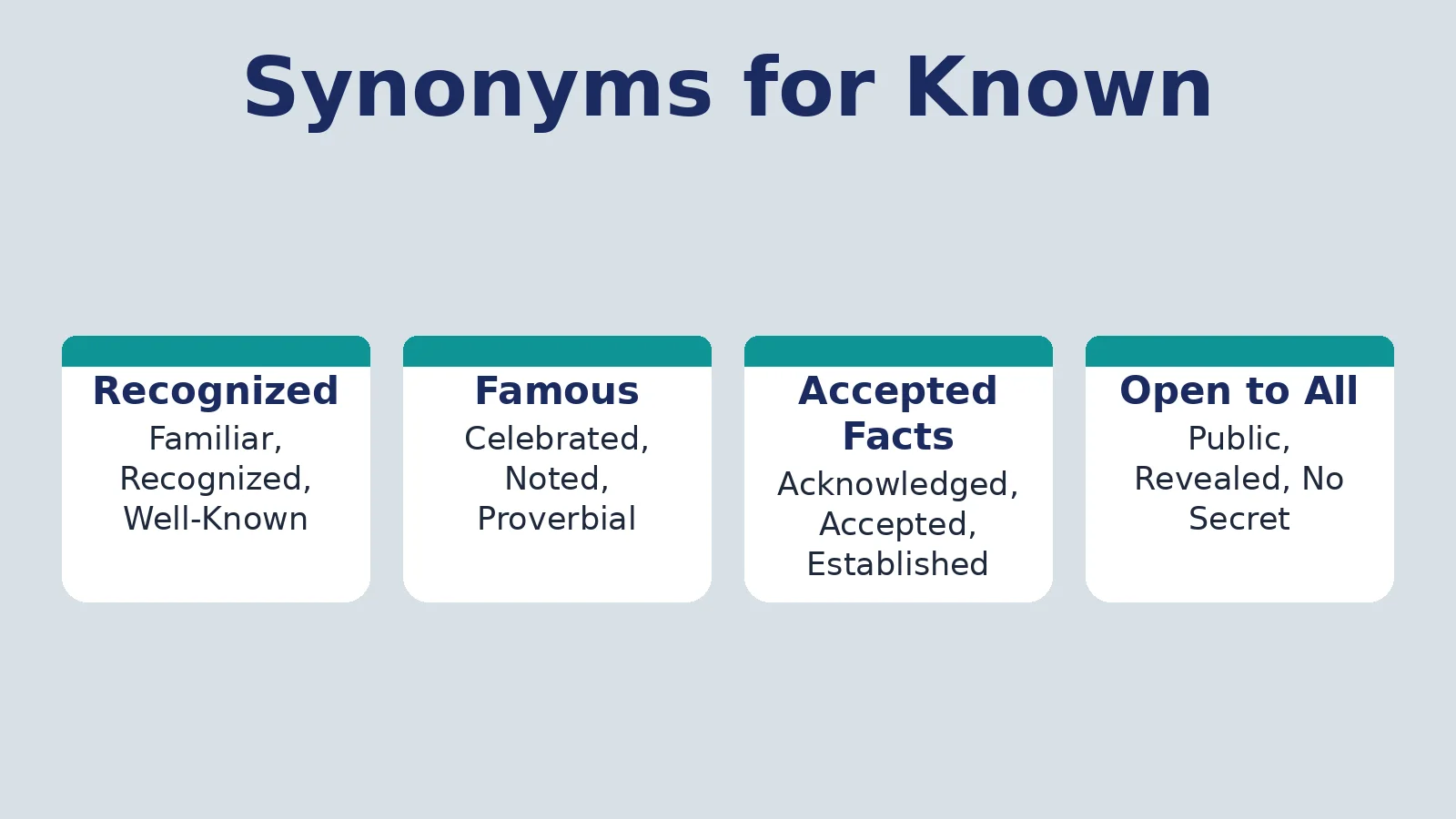
Known looks like a simple word, but it quietly does three different jobs in English. It can mean recognized at a glance, as in a known face. It can mean famous or established, as in a known singer. And it can mean accepted as true, as in a known fact. The strongest synonyms for known include familiar, recognized, well-known, famous, celebrated, acknowledged, accepted, and established. Each one fits a different job, though, so swapping them carelessly can bend a sentence out of shape.
This guide sorts more than 40 synonyms for known by sense. You can see which words belong to faces, which belong to reputations, and which belong to facts. Every word comes with a plain one-line meaning, and the key entries add example sentences. By the end, you will know exactly which word your sentence needs.
Top Synonyms for Known: Quick Reference
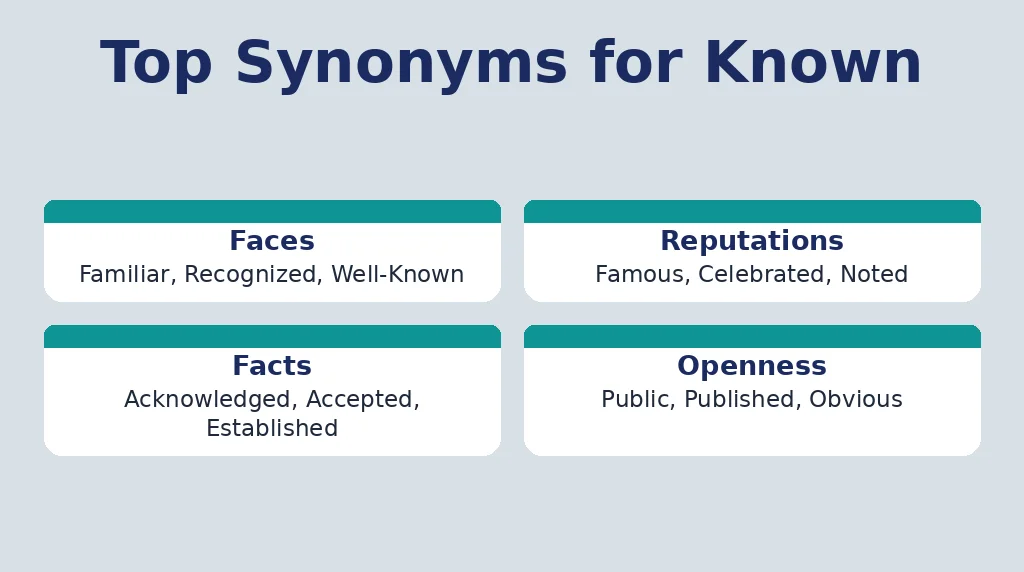
The table below covers the 26 synonyms readers reach for most often. Use it for a fast replacement. The sections after it sort the full list of more than 40 words into finer groups.
| Word | Meaning in one line | Best for |
|---|---|---|
| Familiar | Seen or heard often, easy to recognize | Faces, voices, places |
| Recognized | Identified from earlier experience | People, facts, achievements |
| Well-known | Known by many people | People, places, brands |
| Famous | Known by very many people | Celebrities, landmarks |
| Widely known | Known across a large area or group | Facts, reputations |
| Celebrated | Widely praised as well as known | Artists, writers, chefs |
| Noted | Known and respected for something | Experts, scholars |
| Notable | Worthy of notice, well known | Figures, examples |
| Acknowledged | Accepted publicly as true or real | Facts, experts, leaders |
| Accepted | Generally agreed to be true | Facts, theories, rules |
| Established | Firmly set up and recognized over time | Facts, firms, reputations |
| Admitted | Openly confessed or allowed as true | Faults, facts, members |
| Avowed | Openly declared and owned | Beliefs, supporters |
| Public | Known to everyone, not secret | Information, knowledge |
| Published | Made known in print or online | Reports, results |
| Revealed | Made known after being hidden | Secrets, findings |
| Obvious | Easy to see or understand | Facts, reasons |
| Plain | Clear and easy to see | Evidence, truth |
| Manifest | Clearly shown, plain to see | Formal writing, evidence |
| Common | Shared by many, everyday | Knowledge, practice |
| Usual | Normal and expected | Methods, results |
| Customary | Following long custom | Practice, greetings |
| Notorious | Known for something bad | Criminals, problems |
| Proverbial | So well known it became a saying | Qualities, patience |
| Popular | Liked and followed by many | People, places, trends |
| Well-publicized | Widely announced in the media | Events, cases, launches |
What Does Known Mean?
At its core, known describes something that people recognize or accept. Cambridge puts it simply: known refers to something or someone that is familiar or generally accepted. Collins gives the sharper example of a person, calling a known actor someone who is identified by the public. Both definitions point to the same idea: the knowledge is shared, not private.
Three Scales of Knowing
That sharing happens at three different scales, and each scale has its own synonyms. First, one person can recognize a face, a voice, or a street. Second, a whole public can know a name, a brand, or a reputation. Third, a fact can be known in the sense that everyone accepts it as true. A word that fits one scale often sounds wrong at another.
Hyphens and the Verb Trap
Grammar adds two more details worth knowing. Before a noun, the word usually takes a hyphen in its stronger forms: a well-known author, a best-known song. After a verb, the hyphen drops away: the author is well known. Known is also the past participle of the verb know, which causes real confusion in synonym lists. Words like understood and experienced belong to that verb, not to this adjective, and the mistakes section near the end explains the trap.
One phrase deserves a mention here. A known quantity means a person or thing whose behavior people can predict. The phrase borrows the recognition sense and stretches it toward trust. Its opposite, an unknown quantity, appears in the antonyms section later.
Scale is the last piece of the definition. Almost nothing is known to everyone, and almost nothing is known to only one person. Between those poles sit families, professions, towns, and whole nations, each holding a different circle of knowledge. The synonyms in this guide map onto those circles. Familiar fits the smallest circle, well-known fits a wide one, and acknowledged fits the official circle of experts and records. Keeping the circle in mind prevents most wrong choices before they happen.
Synonyms for Known: Recognized and Familiar
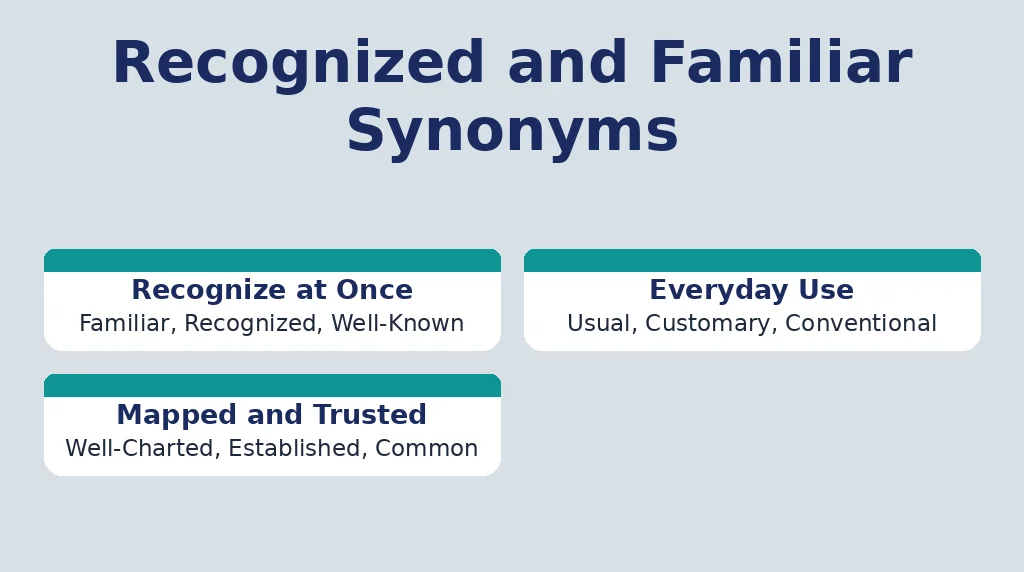
This first family covers the smallest scale of known: things a person, a family, or a neighborhood recognizes from direct experience. The knowledge is personal here. It comes from seeing, hearing, or using something many times before.
Faces and Voices You Recognize
These words describe instant recognition. The face or sound needs no introduction, because memory does the work at once.
- Familiar: seen, heard, or met often, so it feels easy and close. Example: A familiar face at the station made the long trip feel shorter.
- Recognized: picked out and identified from earlier meetings or reports. Example: She recognized the voice on the phone before he gave his name.
- Well-known: recognized by a wide circle of people, not just one person. Example: The café is well-known to everyone in the district.
- Common: shared by many people or found in many places. Example: That tune is common at weddings across the region.
A familiar face at the door can lift a whole afternoon. Words for that warm side of recognition sit close to the ones in our guide to synonyms for happy, because recognition and pleasure often arrive together. Notice the limit, though. Familiar stays personal in scale. A familiar waiter is known to regulars, not to the world, and calling him famous would overshoot the truth by a mile.
Known From Everyday Use
Some things are known simply because daily life repeats them. Nobody announces them, and nobody needs to. The whole community absorbs them through habit, practice, and routine.
- Usual: normal, expected, and done in the ordinary way. Example: He took his usual seat by the window.
- Everyday: ordinary and familiar from daily life. Example: It is an everyday tool in every workshop.
- Customary: following a custom that everyone accepts. Example: The customary greeting took only a moment.
- Conventional: following the accepted, traditional way of doing things. Example: The conventional treatment still works well.
- Established: set up firmly and recognized over a long period. Example: It is an established practice in the trade.
- Well-charted: mapped, recorded, and therefore known in detail. Example: Sailors trust these well-charted waters.
Established does double duty in this guide, because it also describes firms and reputations in the fame sections. That range is normal for known itself. The word stretches from a customary handshake to a scientific fact, and its synonyms stretch with it. Context, not the dictionary alone, tells readers which stretch you mean.
A Known Quantity: Predictable and Trusted
One corner of this family deserves its own note. When people call someone a known quantity, they mean his behavior holds no surprises. The phrase shows up in hiring, politics, and sport, where predictability itself is a kind of value. A manager who picks the familiar candidate over the brilliant stranger is choosing the known quantity on purpose.
The words from this section serve that meaning well. A familiar system is one the team already trusts. A recognized method is one whose results people can forecast. Even well-charted, from the everyday set above, began as a promise that a route held no hidden dangers. Whenever your sentence praises reliability more than fame, this corner of the family is where the right word lives.
Synonyms for Known: Famous and Well-Known
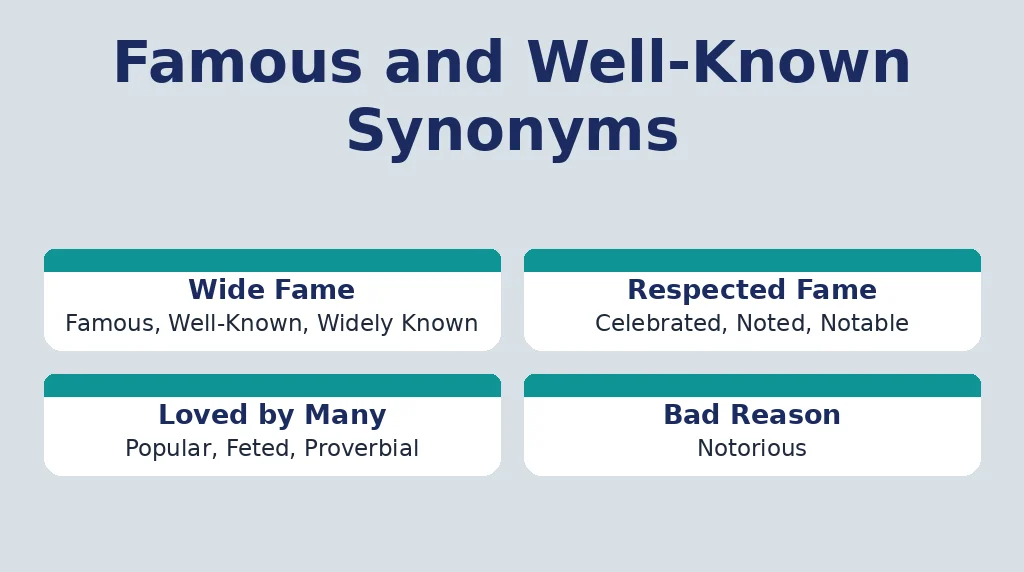
The second family scales recognition up to the whole public. Here, known stops being personal and becomes a reputation. People know the name without ever meeting the person, and that gap between name and meeting is exactly what these words describe.
Known For: Reputation and Fame
These words name people, places, and things with a public reputation. Most of them pair naturally with the phrase known for, and each one adds a slightly different flavor of fame.
- Famous: known by very many people, often across a whole country. Example: The famous old bridge draws visitors from every continent.
- Well-known: known by many people, a step calmer than famous. Example: He is a well-known surgeon in the city.
- Widely known: known across a large area or a large group. Example: The festival is widely known across the province.
- Celebrated: known and praised at the same time. Example: A celebrated chef opened a small restaurant downtown.
- Noted: known and respected for a particular thing. Example: The noted historian spoke first.
- Notable: important enough to be noticed and remembered. Example: She is a notable figure in local politics.
- Popular: liked, enjoyed, and followed by many people. Example: The park is popular with families on weekends.
- Feted: honored and celebrated at public events. Example: The feted author toured three cities in a week.
- Proverbial: so well known that it turned into a saying or a byword. Example: His proverbial patience finally ran out.
When known grows large enough, it turns into fame itself. The full guide to synonyms for famous sorts that bigger family, from everyday well-known to formal renowned. The two families overlap heavily, but the center of gravity differs. Known stresses that people have the information. Famous stresses how far that information has spread.
Local Fame and Household Names
Fame inside this family comes in sizes, and the smaller sizes matter most in daily writing. A baker can be known on one street and unknown two blocks away. A teacher can be a legend inside one school and a stranger everywhere else. English handles that local scale with the calmer words in this section: well-known, noted, and familiar all stretch downward without breaking.
At the top of the scale sits the household name, a person or product that nearly every home recognizes. Writers reach for that phrase when famous feels too showy and well-known feels too weak. Between the two poles, choose by the size of the circle that actually holds the knowledge. A village hero described as famous reads as exaggeration. The same hero described as well-known in the valley reads as fact. Precision about scale is what makes reputation writing believable.
Known For the Wrong Reason
One member of this family carries a warning label, and it deserves its own short section.
- Notorious: known widely, but for something bad or questionable. Example: The road is notorious for flooding every spring.
Dictionaries are blunt about this word. Cambridge explains that notorious and infamous describe people who are famous for something bad. Merriam-Webster adds that notorious frequently brings an implication of questionableness or evil. So a notorious shortcut is never a compliment, no matter how famous it is. Writers who want neutral fame should stay with well-known or noted instead. The choose section below returns to this trap, because it catches even careful writers.
Synonyms for Known: Acknowledged and Accepted
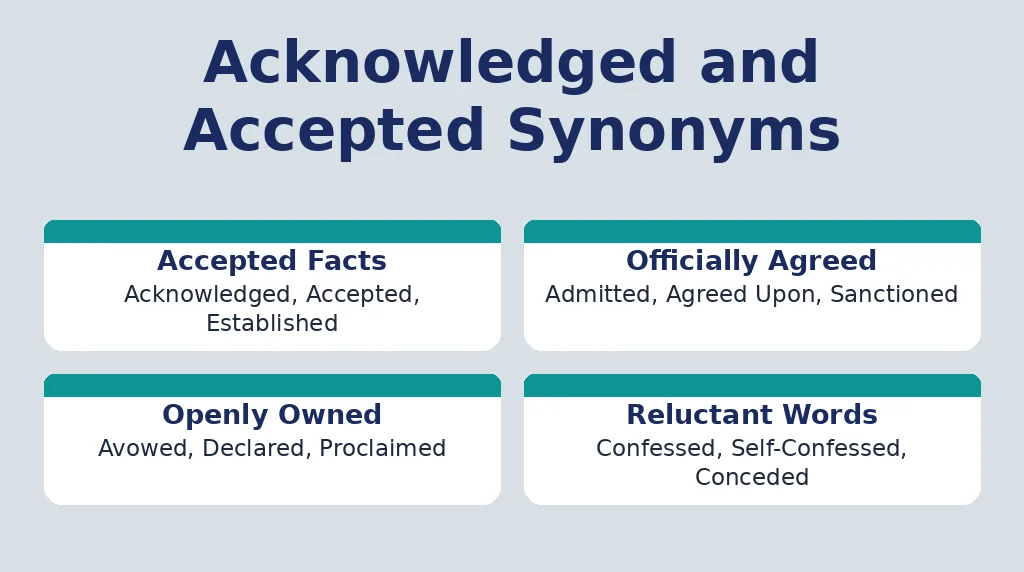
The third family leaves people behind and deals with facts. A known fact is not famous, and it is not merely familiar. It is a fact that the relevant people have accepted as true. Reports, courts, and science all run on this sense of known.
Facts Everyone Accepts
These words say that a claim has passed inspection. The community, the experts, or the public now treat it as settled.
- Acknowledged: accepted openly as true, real, or valid. Example: She is the acknowledged leader of the movement.
- Recognized: accepted officially or publicly as having a status. Example: It is a recognized problem in every large city.
- Accepted: agreed by most people to be true or right. Example: The accepted explanation finally settled the debate.
- Established: proved or accepted over a long period. Example: The established facts left little room for doubt.
- Admitted: accepted as true, often after some resistance. Example: It is an admitted weakness in the design.
- Agreed upon: settled by joint agreement between parties. Example: The agreed upon date suited both sides.
Science depends on this family more than any other. One acknowledged result can reshape a whole field, which is why this sense pairs so naturally with the words in our guide to synonyms for important. The pattern is strict, though. A fact becomes known only after checking, testing, and public acceptance. Calling a rumor known skips every one of those steps.
Openly Admitted
A smaller set covers facts that people declare about themselves or their side. The knowledge here is public because someone owned it out loud.
- Avowed: openly declared and stood behind. Example: He is an avowed supporter of the reform.
- Declared: announced openly and formally. Example: Her declared aim is to cut waiting times.
- Proclaimed: announced publicly with ceremony or emphasis. Example: The proclaimed policy starts next month.
- Confessed: admitted openly, usually something unflattering. Example: He is a confessed lover of bad puns.
- Self-confessed: described by the person himself as such. Example: The self-confessed night owl wrote until dawn.
- Conceded: admitted reluctantly, after argument. Example: It is a conceded point in the negotiations.
- Sanctioned: officially approved or permitted. Example: Only sanctioned copies may be sold.
Notice the honesty gradient in this set. Avowed and proclaimed sound proud. Confessed and conceded sound reluctant. Choosing between them tells readers how the person feels about the fact, not just that the fact is public. Good writers exploit that gradient instead of reaching for acknowledged every time.
Known Risks and Known Offenders: The Official Register
Official writing gives known one more specialized job. Safety reports speak of known risks and known hazards, meaning dangers that inspectors have already recorded. Police and courts speak of known offenders, meaning people whose records the system already holds. In both cases, known works like a stamp: the information sits in a file, checked and dated.
The synonyms from this section fit that register naturally. An acknowledged risk has been accepted by the people in charge. An established pattern of faults has been proved across many cases. An admitted defect has been owned by its maker. If your sentence involves records, files, or duties, stay inside this formal corner. Words from the familiar family, like common or everyday, would make an official warning sound careless.
Synonyms for Known: Public and Open
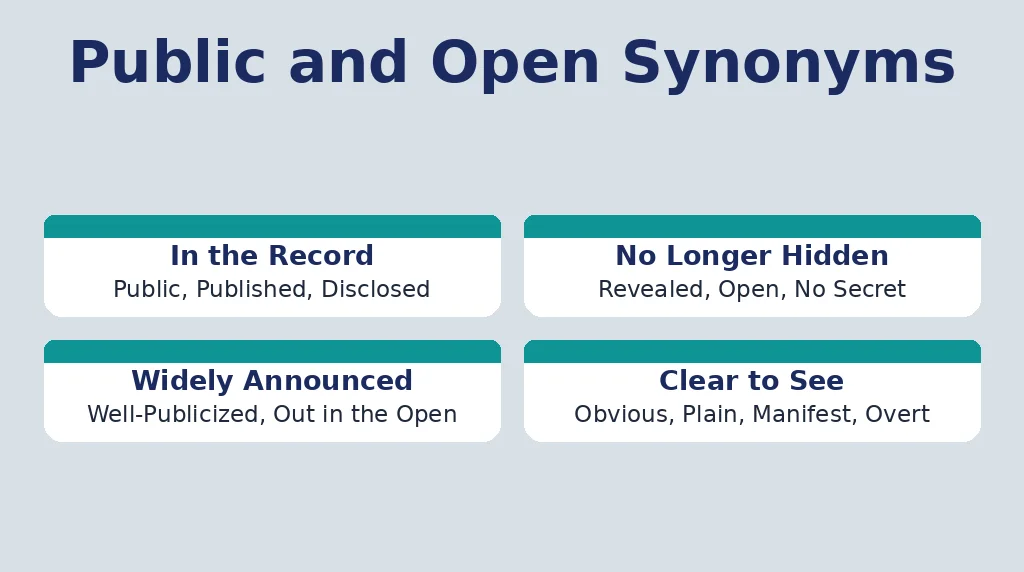
The last family is about access. A known fact in this sense is simply not hidden. Anyone may look at it, check it, and use it. Secrecy, not doubt, is the opposite here.
Out in the Open
These words describe information that has entered the public record. Some were released on purpose. Others escaped.
- Public: open to everyone, not private or secret. Example: The figures are now public knowledge.
- Published: released in print or online for anyone to read. Example: The published results surprised nobody.
- Revealed: shown or told after being kept hidden. Example: The revealed documents changed the story.
- Disclosed: made known, often officially or formally. Example: The disclosed fee appeared in the report.
- Open: free for anyone to see or join. Example: It is an open secret in the office.
- No secret: known to everyone despite any pretense. Example: His ambition is no secret.
- Out in the open: fully exposed, with nothing hidden. Example: The dispute is finally out in the open.
- Well-publicized: announced widely through the media. Example: The well-publicized trial drew crowds daily.
Clear for All to See
A few words go one step further. They say the fact is not just available but impossible to miss.
- Obvious: easy to see or understand at once. Example: The obvious cause was a blocked drain.
- Plain: clear and simple to see. Example: The plain truth is that we ran out of time.
- Manifest: clearly shown and easy to recognize, slightly formal. Example: Cases of manifest injustice angered the town.
- Overt: done openly, with no attempt to hide. Example: There was no overt sign of trouble.
The step matters in careful writing. A published report can still sit unread in a drawer, so published means available, not noticed. Obvious and manifest claim that anyone looking will see it. Use the weaker word when you only know about availability, and the stronger word when the evidence truly stares people in the face.
Using Known As, Known For and Known To
Known rarely travels alone. Three short partners decide most of its meaning in real sentences, and each partner pulls a different synonym family behind it. Learning the three patterns will improve your choices more than memorizing any list.
Known As: The Name or Identity
Known as introduces the name a person, place, or thing goes by. The phrase answers the question: what do people call it?
- Example: The old fort is known as the Gate of the Hills.
- Example: She writes under her own name but performs known as Nova Ray.
Words from the familiar and public families fit this pattern best. A town known as something has a published, recognized identity, so recognized and public sit comfortably nearby. Writers introducing a nickname, a title, or a former name almost always want this construction.
Known For: The Reason Behind a Reputation
Known for introduces the quality, deed, or product that built a reputation. The phrase answers the question: why do people know it?
- Example: The valley is known for its apricots and its stubborn winters.
- Example: He is known for arriving early and leaving quietly.
This is the natural home of the fame family. Celebrated, noted, and notorious all expect a known for clause after them, because each word claims a reason for the fame. When you choose a fame word, check that the reason in your sentence deserves it. Noted for her research sounds earned. Noted for his loud shirts sounds like a joke, unless the joke is the point.
Known To: The Circle That Holds the Knowledge
Known to names the people or bodies who hold the information. The phrase answers the question: who knows it?
- Example: The fault was known to the engineers for years.
- Example: He is known to the police in three districts.
This pattern belongs to the acknowledged and official families. It appears in reports, records, and warnings, where the circle of knowledge matters legally. A risk known to the owners is a different fact from a risk nobody spotted. Whenever responsibility is part of your meaning, known to is the construction that carries it, and acknowledged or admitted is usually the synonym that fits.
How to Choose the Right Synonym for Known
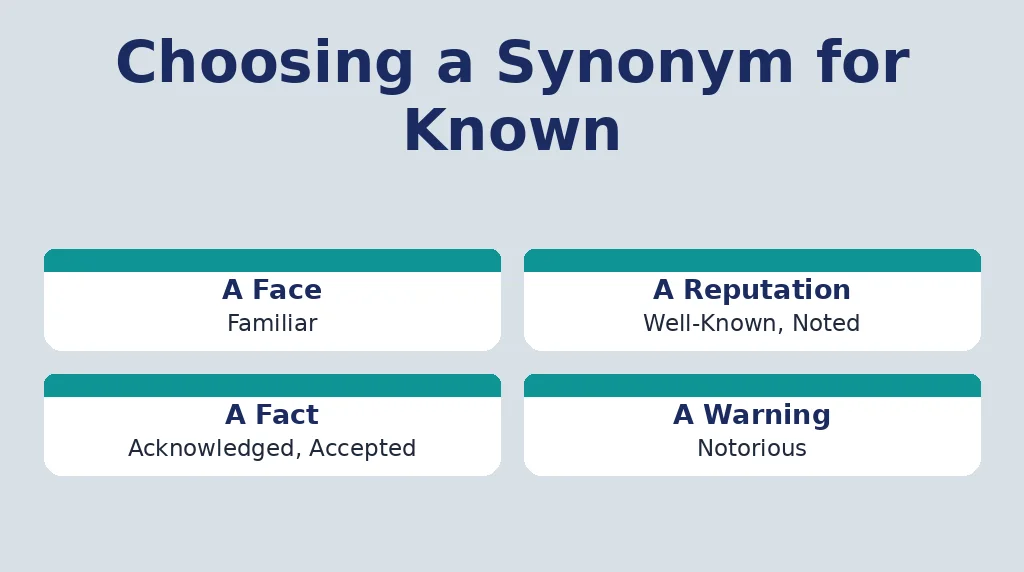
With more than 40 options, the real skill is matching the word to the job. Three quick questions narrow the field fast. Who holds the knowledge: one person, a public, or a panel of experts? Is the thing a face, a reputation, or a fact? And is the tone neutral, proud, or reluctant?
Paired Examples: People and Reputations
Paired examples show how much one word can change a sentence:
- She is a familiar face at the market. Regulars recognize her there.
- She is a well-known face in the city. A wider public knows her name.
- She is a famous face across the country. The scale has grown again.
- She is a notorious face in the papers. Now the fame sounds like trouble.
- She is an acknowledged expert in her field. Now the sentence is about accepted status, not fame at all.
The distance and setting never changed, yet each version tells a different story. That is the power of choosing inside this family with care.
Paired Examples: Facts
The same test works for facts, where the stakes are accuracy rather than color:
- It is a common belief in the village. Many people hold it, rightly or wrongly.
- It is an accepted belief among historians. The experts have checked it.
- It is an acknowledged fact in the report. An official body has owned it.
- It is an open secret in the office. Everyone knows, and nobody says so.
- It is a well-publicized claim in the papers. The media spread it, which says nothing about its truth.
Notice how the last example warns the reader. Publicity and truth travel separately, and this family lets you say exactly which one you mean.
The Quick Picker
The construction steers the choice too. As the section above shows, known as pulls toward identity words, known for toward fame words, and known to toward official words. Picking the right construction often picks the right synonym for free.
| Situation | Strong first choice |
|---|---|
| A face you recognize | Familiar |
| A respected local name | Noted |
| A fact everyone accepts | Acknowledged |
| A secret now revealed | Disclosed |
| Fame for a bad reason | Notorious |
| A custom everyone follows | Customary |
Known in Formal and Everyday Writing
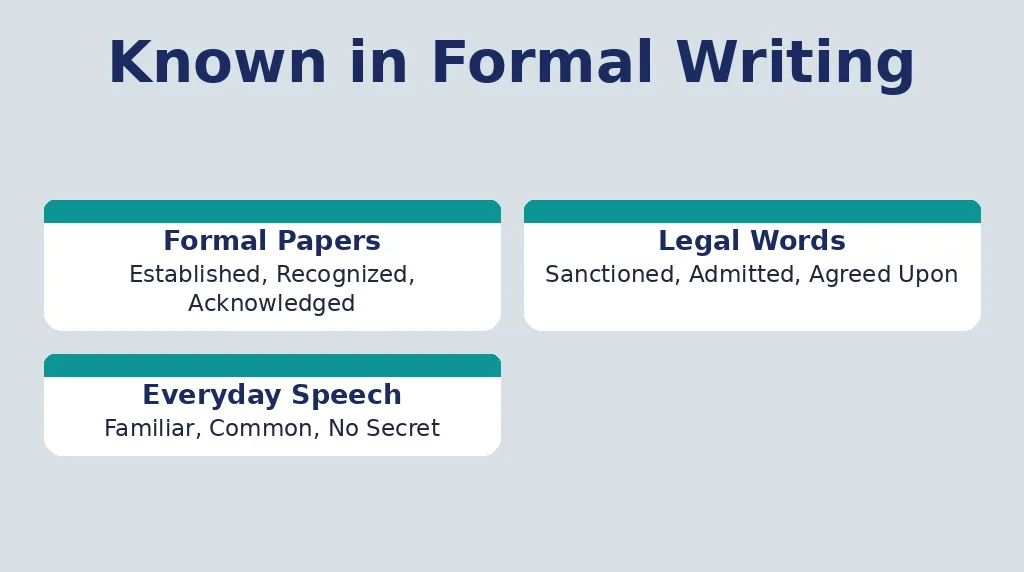
Formal writing leans hard on the acknowledged family. Scientific papers speak of established facts, recognized methods, and acknowledged limitations. Legal writing adds sanctioned, admitted, and agreed upon, because courts care about exactly who accepted what. Reports prefer disclosed and published, which name the channel as well as the fact.
Everyday writing lives at the other end of the scale. People say familiar, common, and no secret far more often than manifest or avowed. A friendly sentence like “it is no secret that the bakery sells out early” sounds warm. The formal twin, “it is manifest that the bakery sells out early”, sounds like a courtroom. Neither is wrong. The setting decides.
Stories mix the two registers on purpose. A narrator can call a character a familiar face in one chapter and a notorious name in the next, and the shift in scale tells the story by itself. Students, meanwhile, should be careful with proverbial and manifest. Both words carry a slightly bookish flavor, which helps an essay sound mature only when the rest of the sentence stays plain.
One style point applies everywhere. Put the hyphen in before a noun (a well-known fact, a best-known example) and drop it after a verb (the fact is well known). Editors enforce this pattern strictly, and Cambridge states it outright for well known. Following it makes any of these synonyms look professional at once.
Antonyms for Known
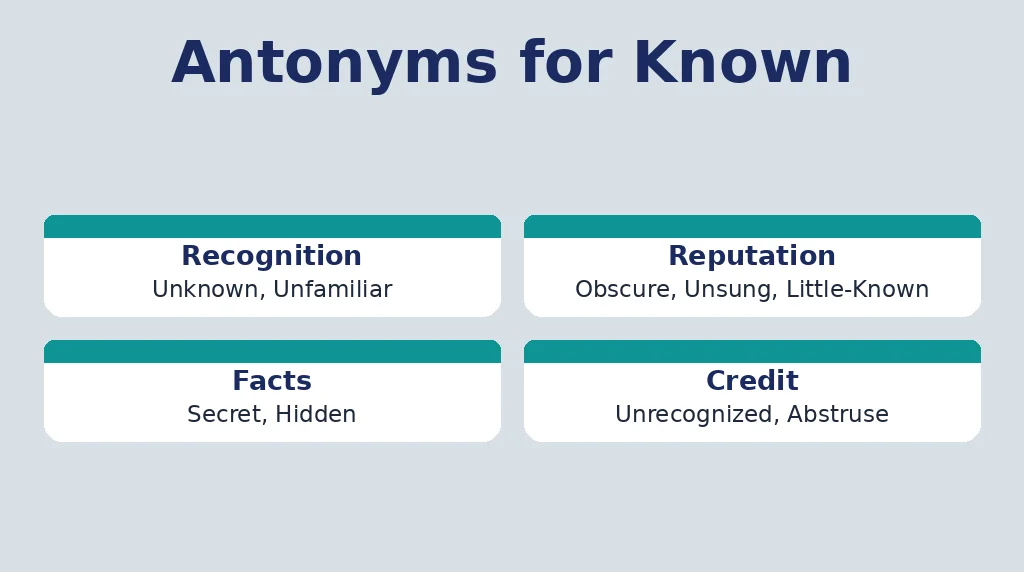
The clearest opposites of known reverse each of its three jobs. For recognition, the opposites are unknown and unfamiliar: an unknown face, an unfamiliar street. For reputation, they are obscure, unsung, and little-known: an obscure poet has skill without an audience, and an unsung hero has deeds without credit. For facts, the opposites are secret and hidden: a secret recipe, a hidden clause.
Two more opposites serve narrower corners. Unrecognized fits achievements and talent that nobody has acknowledged yet. Abstruse fits knowledge that exists but stays too difficult for most people to reach, the opposite of a well-known principle. Oxford’s synonym lists give exactly this set: secret for the acknowledged sense, unknown for the familiar sense, and obscure with unsung for famous people.
A quick test helps in practice. If a word can finish the sentence “it was once known, but now it is” in a natural way, it is probably a true antonym. Secret, hidden, and forgotten all pass. Famous fails the test completely, because it belongs to the same family as known.
One compound deserves a final note. Little-known is the working opposite of well-known in daily prose, and editors use it constantly: a little-known harbor, a little-known clause in the contract. It admits that somebody knows the thing, just not many people. That honesty makes it more useful than unknown in most sentences, since truly unknown things rarely get written about at all.
Common Mistakes: Words That Are Not True Synonyms for Known
Accuracy matters in a synonym guide, so this section clears up the words that often sneak into known lists wrongly.
Understood, experienced, and seen are not synonyms of the adjective known. They belong to the verb know, as in “she has understood the problem” or “he has seen the film”. Merriam-Webster’s thesaurus page for known actually leads with those verb forms, which is how the confusion starts. If your sentence needs the adjective (a known risk), verb forms will not fit.
Traps of Direction and Scale
Aware fails for a different reason. Aware describes the person who holds the knowledge, not the thing that is known. A known fact can exist in a report that nobody has read yet. An aware reader, meanwhile, is the one doing the knowing. Keep the direction straight.
Renowned is a true relative but a misleading swap. It promises glory and acclamation, as Merriam-Webster notes, while plain known promises only recognition. A known local plumber is not a renowned plumber. Save renowned for reputations that genuinely shine.
Common needs a warning of its own. In the familiar family it means shared and everyday, which is harmless. Yet common also carries an older flavor of cheap or low quality, and some readers still hear it. Calling a wine common knowledge is fine. Calling a host a common man may land as an insult he never earned. When the person matters, pick familiar or well-known instead.
Two smaller traps appear often as well. First, writers use notorious as a stylish word for famous, although it always carries blame. Second, they write well known with no hyphen before a noun, then wonder why the sentence looks off. A known fact is simply a fact people accept. Precision about which sense you mean will fix most errors before they happen.
Frequently Asked Questions
What is the best synonym for known?
There is no single best word, because known covers faces, reputations, and facts. Familiar suits recognition, well-known suits reputations, and acknowledged suits accepted facts. Match the word to the job, and the sentence will sound right.
What is a formal word for known?
Acknowledged and established are the standard formal choices. Scientific and legal writing also uses recognized, admitted, and sanctioned. Each one names a slightly different kind of acceptance, so pick by meaning, not by length.
What is the difference between known and famous?
Known only says that people have the information. Famous says the information has spread very widely. A known face may belong to one neighborhood, while a famous face belongs to a whole country.
What is a word for known by everyone?
Well-known and widely known cover most cases. For facts, public knowledge is the natural phrase. Proverbial is the strongest choice, since it means something is so well known that it became a saying.
What is the opposite of known?
Unknown is the general opposite. Secret and hidden oppose the fact sense, unfamiliar opposes the recognition sense, and obscure or unsung opposes the reputation sense. The right opposite depends on which job known is doing.
Is notorious a synonym for known?
Yes, but only with a warning attached. Notorious means known for something bad or questionable. Use it for criminals, problems, and scandals, never as a neutral compliment.
What is the difference between known as and known for?
Known as gives a name or identity, as in a town known as the gateway to the hills. Known for gives the reason behind a reputation, as in a town known for its beaches. The two phrases answer different questions.
Final Thoughts
Known is a small word holding three big jobs: recognition, reputation, and accepted truth. Once you sort its synonyms by those jobs, the right choice usually becomes obvious. Call the face familiar, the surgeon well-known, the fact acknowledged, and the scandal notorious, and each word will do its own quiet work.
For an even deeper list with related words and near-synonyms, the Merriam-Webster Thesaurus entry for known is a reliable next step, especially for the verb forms of know. Keep this guide bookmarked too, and your known sentences will never sound flat again.