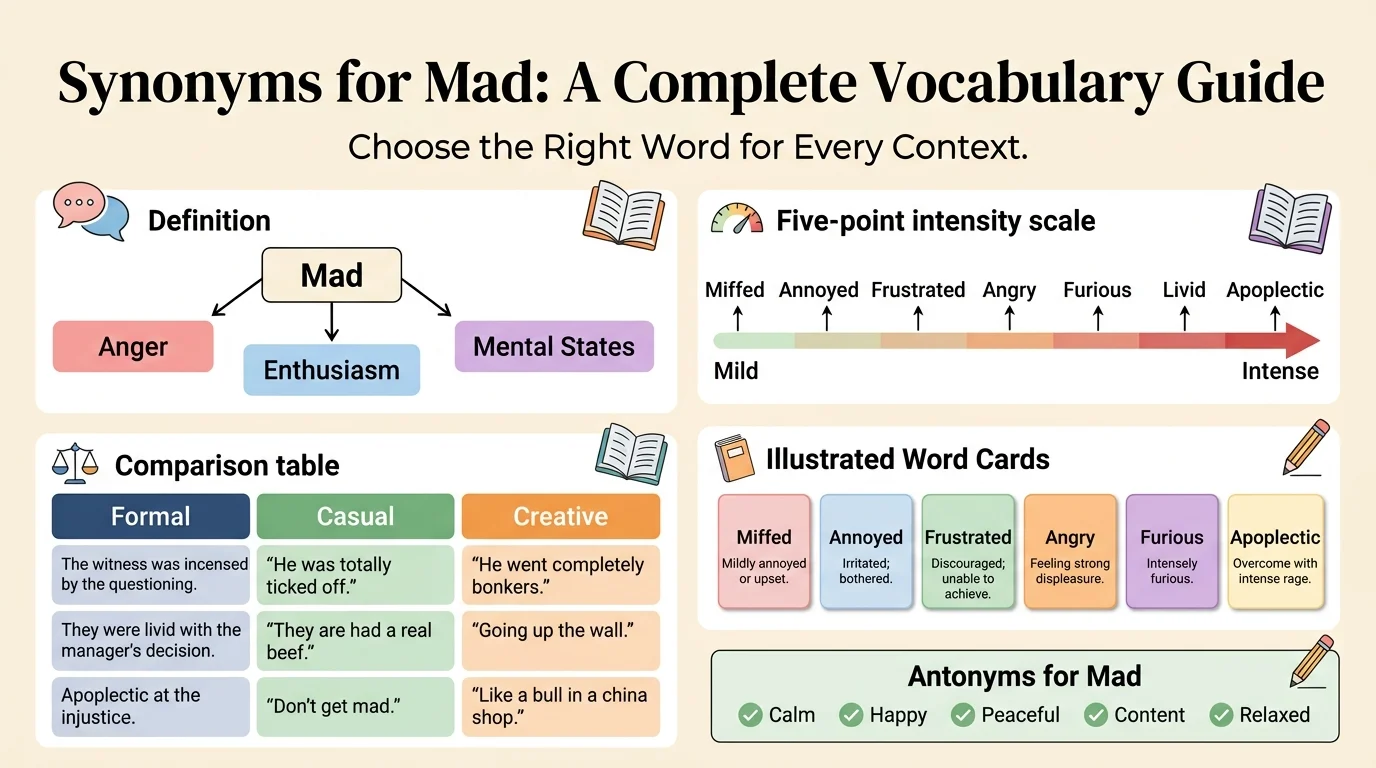
Have you ever written an email, essay, or social media caption and realized you used the word “mad” three times in two sentences? Maybe you were describing a frustrating work situation or a tense moment in a story. Using the same word repeatedly makes your writing feel flat and repetitive.
But finding the right alternative can feel tricky because “mad” carries so many different meanings. It can express anger, excitement, enthusiasm, or even mental distress. This guide will help you choose the perfect synonym for every situation.
What Does “Mad” Mean?
“Mad” primarily means angry, mentally unstable, or extremely enthusiastic depending on the context. The best synonyms for mad vary greatly by situation. anger, use furious or livid. For enthusiasm, use excited or passionate. For mental health contexts, use unstable or distressed. Always choose based on your specific meaning and audience.
Meaning, Tone and Context
- Simple definition: “Mad” describes strong emotional states including anger, insanity, or intense excitement. The meaning shifts dramatically based on how you use it.
- Part of speech: Adjective. The word functions primarily as a descriptive term.
- Positive, negative, or neutral tone: The tone depends entirely on context. In American English, “mad” often means angry and carries a negative tone. When describing enthusiasm, it becomes positive. When describing mental health, it is sensitive and potentially negative.
- Formality level: Informal. “Mad” appears more often in casual conversation than in formal writing. Professional documents typically require more precise alternatives.
- Common use cases: Expressing frustration in everyday situations. Describing strong emotions in personal stories. Showing enthusiasm or passion. Writing creative dialogue. Social media captions.
- Important word forms: Mad (adjective), madden (verb), maddening (adjective), madly (adverb), madness (noun).
When and How to Use “Mad”
Use “mad” when you want simple, direct language in informal settings. It works well for everyday conversations and personal writing. Avoid using it repeatedly in professional documents or academic papers.
Professional context example:
The client was mad about the delayed shipment and demanded an immediate resolution.
Personal context example:
My sister got mad when I borrowed her sweater without asking.
Academic context example:
Researchers examined whether environmental factors contribute to mad behavior patterns in certain populations.
Emotional context example:
He felt mad at himself for forgetting their anniversary.
Creative context example:
The protagonist slowly went as the isolation consumed his sanity.
Social media context example:
I am so mad I missed the concert tickets by two minutes.
Casual context example:
Mom was mad, but she got over it by dinner time.
Another Word for “Mad”
The best single replacement depends entirely on your intended meaning. For anger, choose “furious” when you need intensity. For enthusiasm, choose “excited” to show positive energy.
Professional writing: Use “irate” or “upset” instead of mad. The manager became irate when the report arrived three hours late.
Academic writing: Choose “enraged” or “distressed” based on context. The study measured how participants responded to enraging stimuli.
Casual conversation: Use “annoyed” or “heated” in everyday speech. I was so annoyed when my train got cancelled.
Emotional writing: Pick “livid” or “incensed” for intense feeling. She was livid about the unfair treatment.
Creative writing: Use “frenzied” or “unhinged” for literary effect. His frenzied pacing betrayed his inner turmoil.
Resume or workplace use: Avoid “mad” entirely. Use “frustrated” or “dissatisfied” to stay professional.
Social media captions: Use “fuming” for dramatic effect. Fuming about the terrible customer service I just received.
Stronger meaning: Choose “apoplectic” to express extreme anger. He was apoplectic when he discovered the mistake.
Softer meaning: Pick “miffed” for mild annoyance. She seemed slightly miffed about the seating arrangement.
When Not to Use “Mad”
Avoid “mad” in formal writing, professional documents, and academic papers. The word sounds too casual and imprecise for these settings.
Do not use “mad” when you need to discuss mental health conditions. The term carries stigma and outdated connotations. Use “mentally ill” or “experiencing a mental health condition” instead.
Avoid “mad” when describing anger in a professional context. “Upset,” “frustrated,” or “dissatisfied” sound more appropriate.
Weak sentence:
The customer was mad about the product defect.
Improved sentence with precise synonym:
The customer was frustrated about the product defect.
Vague sentence:
His behavior seemed mad.
Clearer alternative:
His behavior seemed erratic and concerning.
Words Commonly Confused With “Mad”
Mad vs. Angry
“Angry” is the more formal and direct term for displeasure. “Mad” is informal and can mean other things. Use “angry” in professional writing. Use “mad” in casual conversation.
Mad vs.
informal and often offensive when discussing mental health. “Mad” sounds slightly more formal but still inappropriate in medical contexts. Avoid both when discussing actual mental illness.
Mad vs. Furious
“Furious” means extremely angry while “mad” can mean mildly annoyed. Choose “furious” when you need to emphasize intensity. Choose “mad” for everyday frustration.
Mad vs.
is a legal and medical term that should be used carefully. “Mad” is more literary but still imprecise. Neither word belongs in professional mental health discussions.
Mad vs. Enthusiastic
“Enthusiastic” describes positive excitement. “Mad” can describe either positive or negative extremes. Choose “enthusiastic” when you want to clarify positive emotions.
Mad vs. Upset
“Upset” describes a broader range of negative emotions. “Mad” specifically suggests anger or frustration. Use “upset” when you need a milder, more general term.
Best Synonym by Context for “Mad”
| Context | Best Synonym | Why It Works | Example |
|---|---|---|---|
| Formal writing | Angry | Direct and professional without emotional exaggeration | The board members were angry about the budget cuts |
| Academic writing | Enraged | Precise term for intense anger in research contexts | Participants reported feeling enraged by unfair treatment |
| Professional business | Frustrated | Professional tone that acknowledges emotion without drama | The team felt frustrated by the repeated delays |
| Resume writing | Determined | Shifts focus from emotion to action and resilience | Determined to overcome obstacles and deliver results |
| Casual conversation | Annoyed | Moderate and relatable for everyday situations | I was so annoyed when my phone died mid call |
| Creative writing | Frenzied | Adds imagery and literary depth to descriptions | The frenzied crowd surged toward the stage |
| Emotional tone | Livid | Conveys strong anger with an intense, vivid quality | She was livid when she discovered the betrayal |
| Strong intensity | Apoplectic | Expresses extreme, almost uncontrollable anger | He became apoplectic during the heated debate |
| Soft or moderate | Miffed | Light and playful for minor frustrations | She seemed miffed about the last minute change |
| Social media captions | Fuming | Dramatic and attention grabbing for posts | Fuming over the airline losing my luggage again |
| US usage | Mad | Widely accepted and understood in American English | He got mad when the game was cancelled |
| UK usage | Cross | A common British alternative for mild anger | She was rather cross about the misunderstanding |
Which Synonym Should You Choose?
Consider your audience first. A formal report requires precise, professional language. A text message to a friend allows for casual expression. Think about the intensity level you need. Mild annoyance calls for “miffed.” Extreme anger demands “furious” or “livid.”
Examine your sentence structure and overall tone. Academic writing benefits from neutral terms like “angry.” Creative writing thrives on vivid words like “frenzied.” Professional emails should use “frustrated” or “dissatisfied.”
Always check whether “mad” means anger, enthusiasm, or mental distress in your context. Choose a synonym that clarifies your intended meaning. Never use “mad” as a default when a more precise word exists.
Real Life Examples of “Mad” in Sentences
School context:
The teacher grew angry when students kept talking during the exam.
Workplace context:
Our manager seemed frustrated with the quarterly numbers during the meeting.
Writing context:
The novelist described the protagonist’s frenzied mind with vivid detail.
Conversation context:
I was so annoyed about the traffic this morning that I nearly turned back home.
Social media context:
Fuming about the delayed package. Never ordering from that site again.
Resume context:
Determined to resolve client issues effectively and maintain satisfaction.
Email context:
I am disappointed with the service and would like to discuss this further.
Storytelling context:
His livid expression made everyone in the room fall silent.
15 Synonyms for “Mad”
| Synonym | Simple Meaning | Best Used For | Example Sentence |
|---|---|---|---|
| Angry | Feeling strong displeasure or hostility | General anger in most contexts | He was angry about the unfair decision |
| Furious | Extremely angry | High intensity anger | She was furious when she saw the damage |
| Livid | Very angry, often visibly upset | Intense, vivid anger | His face turned red as he grew livid |
| Enraged | Anger that is intense and uncontrollable | Extreme emotional states | The employees were enraged by the pay cuts |
| Irate | Very angry, often in a public or formal setting | Professional anger | Customers became irate about the service failure |
| Frustrated | Annoyed because of unmet expectations | Workplace and daily situations | I felt frustrated by the endless paperwork |
| Annoyed | Mildly angry or irritated | Low level frustration | She seemed annoyed by the constant questions |
| Miffed | Slightly offended or upset | Gentle, playful annoyance | He looked miffed about being left out |
| Cross | Angry or irritable (British English) | UK casual usage | My grandmother gets cross about loud music |
| Incensed | Extremely angry due to injustice | Strong anger from a moral position | The community was incensed by the pollution |
| Outraged | Strong anger caused by unfairness | Social or moral outrage | Citizens were outraged by the new law |
| Unhinged | Mentally unstable or very upset | Psychological or extreme states | His unhinged behavior worried his family |
| Frenzied | Wild, excited, or uncontrolled | Creative or literary descriptions | Frenzied shoppers rushed through the doors |
| Enthusiastic | Excited and passionate about something | Positive excitement | The kids were enthusiastic about the field trip |
| Passionate | Having strong emotions or beliefs | Positive intensity | She gave a passionate speech about change |
Synonym Groups and Usage Differences
Professional vs. Personal Synonyms
Professional contexts demand neutral, measured language. “Frustrated” and “dissatisfied” work well in business settings. Personal writing allows for emotional words like “furious” or “livid.” Choose “angry” for most professional situations. Save “fuming” for private conversations or personal journals.
Formal vs. Conversational Synonyms
Formal writing prefers “angry,” “enraged,” or “irate.” These terms appear in reports, academic papers, and official documents. Conversational speech accepts “mad,” “annoyed,” and “miffed.” Text messages and casual emails allow for more emotional language.
Academic Synonyms
Academic writing values precision and objectivity. “Enraged” describes anger in research contexts. “Distressed” covers emotional upset. “Agitated” suggests nervous energy. Always avoid “mad” in scholarly work unless quoting someone directly.
Professional and Business Synonyms
Business communication requires respectful, measured language. “Frustrated” acknowledges emotion without aggression. “Disappointed” shows care about outcomes. “Concerned” expresses worry constructively. Email to a client: “We are concerned about the delay and are working to resolve it.”
Creative or Literary Synonyms
Creative writing benefits from vivid, evocative language. “Frenzied” adds chaos and energy. “Deranged” suggests instability. “Apoplectic” describes explosive anger. Writers can use “mad” for character dialogue but should vary terms in narration.
Slang or Modern Synonyms
Modern slang includes “heated,” “salty,” and “pressed.” These work in social media posts and casual friend groups. Avoid them in professional contexts. Use “mad” carefully in slang since it has multiple meanings.
Strongest vs. Weaker Synonyms
Mild to intense scale: Miffed, annoyed, frustrated, angry, furious, livid, apoplectic. Choose the right intensity level. A minor inconvenience deserves a mild term. A serious injustice calls for the strongest word.
Emotional vs. Neutral Synonyms
“Angry” and “frustrated” remain relatively neutral. “Livid” and “incensed” carry strong emotional weight. “Upset” mixes sadness with anger. “Mad” leans emotional in American usage.
Antonyms of “Mad”
| Antonym | Meaning | Example Sentence |
|---|---|---|
| Calm | Free from agitation or strong emotion | She remained calm during the crisis |
| Happy | Feeling pleasure and contentment | The news made everyone feel happy |
| Composed | Having control over emotions | He stayed composed despite the pressure |
| Peaceful | Free from disturbance or anger | The peaceful atmosphere relaxed everyone |
| Cheerful | Noticeably happy and optimistic | The cheerful staff improved the mood |
| Relaxed | Free from tension or anxiety | I felt relaxed after the weekend break |
| Pleasant | Giving a sense of happy satisfaction | The pleasant conversation lifted our spirits |
| Content | Satisfied with what one has | She seemed content with her simple life |
| Collected | Calm and self controlled | He remained collected throughout the ordeal |
| Quiet | Making little or no noise or movement | The quiet room helped me focus |
| Gentle | Mild and kind in nature | Her gentle voice calmed the children |
| Patient | Able to tolerate problems without getting angry | Stay patient while we fix the issue |
| Serene | Completely calm and peaceful | The serene landscape inspired everyone |
| Easygoing | Relaxed and not easily upset | My easygoing friend never complains |
| Tranquil | Quiet and peaceful | The tranquil setting helped us relax |
Comparison: Mad vs. Similar Words
Mad vs. Angry
“Mad” is informal and has multiple meanings. “Angry” is formal and precise about displeasure.
“Angry” is stronger and more direct.
is more formal and appropriate for professional writing.
Mad example: My friend got mad about the cancelled plans.
Angry example: The committee was angry about the decision.
Mad vs. Furious
“Furious” means extremely angry. “Mad” can mean mildly annoyed.
“Furious” is much stronger in intensity.
“Furious” is slightly more formal than “mad.”
Mad example: I was mad about the traffic jam.
Furious example: She was furious about the stolen car.
Mad vs. Upset
“Upset” covers sadness, disappointment, and anger. “Mad” specifically suggests anger.
“Mad” is stronger in anger intensity. “Upset” is broader and milder.
“Mad” is less formal. “Upset” works in most contexts.
Mad example: The coach was mad about the loss.
Upset example: The team was upset about the loss.
Mad vs.
describes mental instability or recklessness.
stronger when describing mental states.
more clinical and serious. “Mad” is casual.
example: The mad crowd cheered loudly.
example: His behavior worried everyone.
Mad vs. Excited
“Excited” shows positive enthusiasm. “Mad” can mean positive or negative excitement.
Both can be strong in intensity.
“Excited” is always positive. “Mad” is more flexible.
Mad example: The fans were mad about the win.
Excited example: The fans were excited about the win.
Mad vs. Annoyed
“Annoyed” means slightly irritated. “Mad” ranges from mild to strong anger.
“Mad” is generally stronger than “annoyed.”
“Annoyed” is more formal and precise.
Mad example: I am mad about the delay.
Annoyed example: I am annoyed about the delay.
Common Phrases and Expressions with “Mad”
1. Mad as a hatter
Meaning: Completely eccentric.
Example sentence: My uncle is as mad as a hatter with all his strange habits.
2. Mad about something
Meaning: Extremely enthusiastic or passionate.
Example sentence: The children are mad about the new video game.
3. Mad at someone
Meaning: Angry with a specific person.
Example sentence: She has been mad at her brother since yesterday.
4. someone mad
Meaning: Make someone extremely annoyed .
Example sentence: The constant noise is mad.
5. Mad dash
Meaning: A rushed, frantic movement.
Example sentence: We made a mad dash for the train station.
6. Mad rush
Meaning: A sudden, chaotic movement of people.
Example sentence: The mad rush for tickets caused chaos outside the venue.
7. Mad skills
Meaning: Impressive abilities or talents (slang).
Example sentence: The chef has mad skills in the kitchen.
8. Go
Meaning: Become very angry or lose control.
Example sentence: My parents would if they found out.
Common Mistakes to Avoid
- Using “mad” when a more precise synonym is better. Choose “furious” for intense anger. Use “annoyed” for mild frustration. Select “excited” for enthusiasm. Precise words improve your writing.
- Confusing “mad” with in mental health contexts. Both terms can offend. Use “mentally unwell” or “experiencing distress” instead. Show respect for mental health issues.
- Using a casual synonym in formal writing. “Mad” does not belong in academic papers or professional reports. Choose “angry” or “dissatisfied” for formal documents.
- Using an overly dramatic synonym for a simple situation. Do not describe a minor annoyance as “apoplectic.” Save intense words for serious situations.
- Repeating the same word too often. If you write “mad” multiple times, vary your language. Use synonyms to keep your writing fresh and interesting.
- Choosing a synonym with the wrong emotional tone. “Furious” indicates anger. “Excited” shows positive feeling. “Unhinged” suggests instability. Match the tone to your meaning.
- Using slang in academic or professional writing. Words like “heated” and “salty” are too casual. Stick to standard vocabulary for serious contexts.
- Assuming “mad” means the same thing everywhere. British speakers use “mad” more for mental states. American speakers use “mad” more for anger. Know your audience.
FAQs
- What is the best synonym for mad?
The best synonym depends on your context. “Angry” works for most formal situations. “Furious” works for intense anger. “Excited” works for positive enthusiasm. - What is a formal synonym for mad?
“Angry” and “enraged” are more formal. Use “irate” in business contexts. Choose “dissatisfied” for polite professional language. - What is an informal synonym for mad?
“Miffed” and “annoyed” are common informal options. “Fuming” works for dramatic casual speech. “Mad” itself is informal. - What is another word for mad in professional writing?
“Frustrated” works well in workplace situations. “Dissatisfied” maintains professionalism. “Irate” describes strong anger in a formal way. - What is the difference between mad and furious?
“Furious” means extremely angry. “Mad” can mean mildly annoyed or very angry. “Furious” is always stronger and more intense. - What is the opposite of mad?
“Calm” is a direct opposite for anger. “Happy” opposes the negative emotional state. “Content” suggests peace and satisfaction.
Conclusion
“Mad” is a versatile word with multiple meanings across anger, enthusiasm, and mental states. The best synonyms for mad depend entirely on your context, tone, and audience. Formal writing benefits from “angry” or “frustrated.” Creative work thrives on “frenzied” or “livid.” Casual conversation accepts “annoyed” or “miffed.”
Remember to match your word choice to your situation. A professional email demands precision. A social media post allows for drama. A creative story calls for vivid imagery. Never use “mad” as a lazy default when a more specific word exists.
To improve your vocabulary, practice replacing “mad” with more precise alternatives. Write three sentences for each situation: formal, casual, and creative. Notice how the tone shifts with each choice. Your writing will become clearer, more engaging, and more professional.