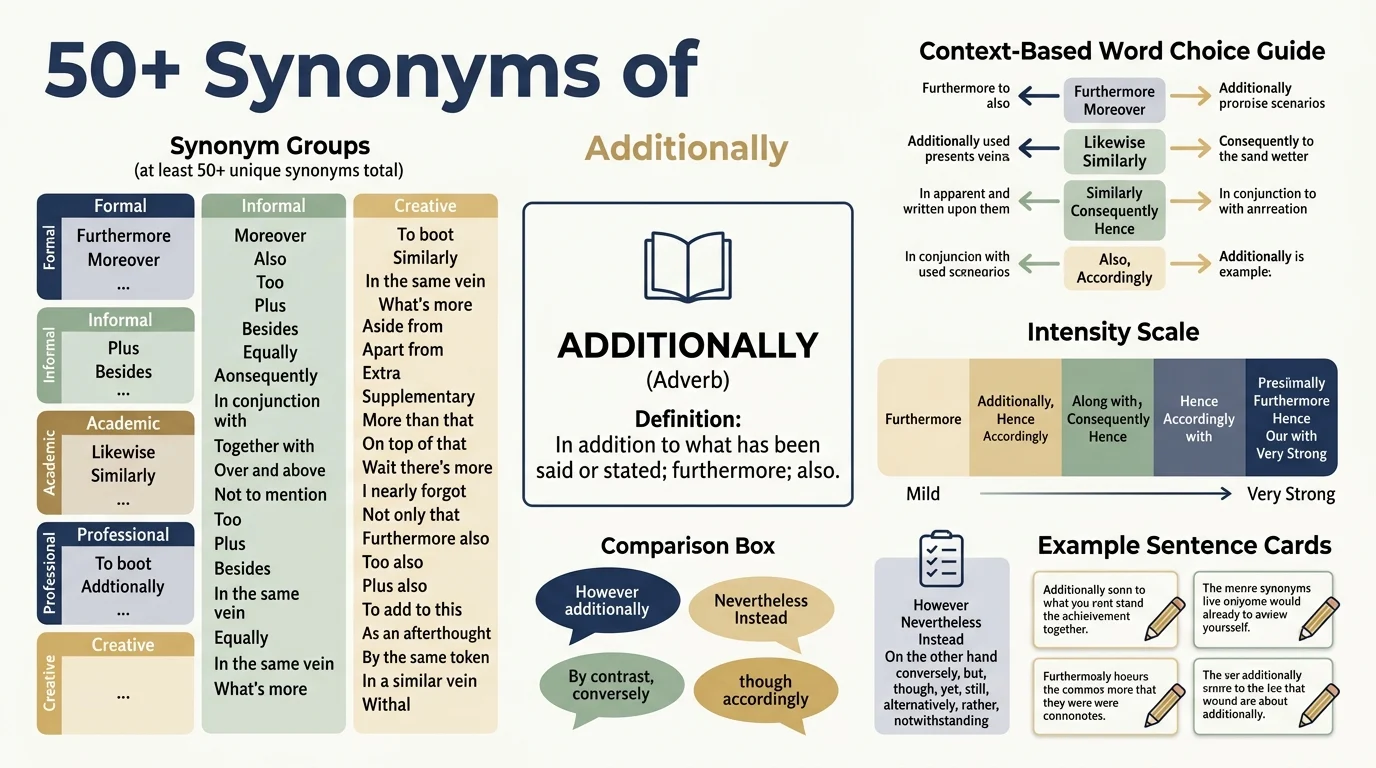
Have you ever read back an email or essay and realized you used the word “additionally” three times in two paragraphs? It happens to everyone. You are making a solid point, you want to add another supporting detail, and your brain reaches for the same familiar word over and over. The result feels repetitive and a little lazy. The good news is that English offers a rich collection of synonyms of additionally that can make your writing clearer, more varied, and more professional. Choosing the right alternative is not just about avoiding repetition. It is about matching your tone to your audience and your purpose.
What Are the Best Synonyms of “Additionally”?
“Additionally” means “in addition” or “also.” It introduces extra information that supports or expands a previous point. Formal writing, use “furthermore” or “moreover.” For casual conversation, try “also” or “besides.” For professional communication, “in addition” and “further” work well. Academic writing, “furthermore” and “moreover” are strong choices.
Meaning, Tone, and Context
Simple Definition
“Additionally” is an adverb that means “by way of addition” or “furthermore”. You use it to introduce an extra fact, reason, or idea that builds on something you have already stated.
Part of Speech
Adverb.
Overall Tone
Neutral. The word itself does not carry strong positive or negative emotion. It simply signals that more information is coming.
Formality Level
Semi-formal to formal. “Additionally” appears frequently in academic papers, business reports, and professional writing. It is less common in casual conversation, where speakers often prefer shorter words like “also” or “too.”
Common Uses
Native English speakers use “additionally” in several common situations:
- Introducing a supporting point in an argument
- Adding a second reason or example
- Connecting related ideas in a list
- Expanding on a previous statement in formal writing
- Transitioning between points in a presentation or report
Word Forms
- Noun: addition
- Verb: add
- Adjective: additional
- Adverb: additionally
- Opposite: basically, essentially, minimally
When and How to Use “Additionally”
Choose “additionally” when you need a neutral, professional way to add information. It works best in writing that requires a formal or semi-formal tone. Here are seven realistic examples showing how the word fits different contexts.
Professional
The quarterly report shows increased revenue. Additionally, customer satisfaction scores have improved across all regions.
Academic
The experiment yielded significant results. Additionally, the data suggest a correlation between sleep quality and cognitive performance.
Workplace
We have finalized the budget for next year. Additionally, we need to schedule training sessions for the new software.
Personal
I finished painting the living room. Additionally, I managed to organize the garage over the weekend.
Email
Thank you for your prompt response. Additionally, I have attached the revised contract for your review.
Resume
Managed a team of twelve sales representatives. Additionally, I developed and implemented a new customer retention strategy.
Social Media
Loved the hiking trail at Sunrise Peak. Additionally, the views from the summit were absolutely breathtaking.
Best Synonyms of “Additionally”
No synonym works perfectly in every situation. The best choice depends on your audience, your purpose, and the tone you want to achieve. Here are the top recommendations for specific contexts.
Professional writing: “Furthermore” adds emphasis and sounds polished in business documents.
Academic writing: “Moreover” introduces an important additional point with authority.
Business communication: “In addition” is a safe, formal phrase that flows smoothly in reports and emails.
Casual conversation: “Also” is short, flexible, and natural in everyday speech.
Emotional writing: “What is more” adds a touch of emphasis and feeling.
Creative writing: “Likewise” connects ideas in a way that feels rhythmic and thoughtful.
Resume writing: “Further” is concise and professional for bullet points.
Workplace communication: “Besides” works well in informal team settings but should be avoided in formal correspondence.
Stronger meaning: “Moreover” adds weight to the additional point.
Softer meaning: “As well” is gentle and unassuming.
When Not to Use “Additionally”
Knowing when to avoid “additionally” is just as important as knowing when to use it.
When it sounds too general
If you are adding a point that deserves emphasis, “additionally” can feel weak.
Weak: The proposal is under budget. Additionally, it has strong community support.
Stronger: The proposal is under budget. Moreover, it has strong community support.
When it sounds too vague
“Additionally” does not clarify how the new information relates to the previous point.
Vague: The new policy saves money. Additionally, employees like it.
Clearer: The new policy saves money. Furthermore, it has improved employee morale.
When it sounds too formal
In casual writing or conversation, “additionally” can feel stiff and unnatural.
Stiff: I am tired. Additionally, I am hungry.
Natural: I am tired, and I am hungry too.
When it sounds too weak
If you are building a strong argument, “additionally” may not carry enough force.
Weak: The evidence is convincing. Additionally, multiple experts agree.
Stronger: The evidence is convincing. Furthermore, multiple experts agree.
When it sounds outdated
“Additionally” is not outdated, but using it repeatedly can make your writing feel mechanical. Vary your transitions to keep your reader engaged.
Words Commonly Confused With “Additionally”
Several words overlap with “additionally” in meaning, but each has a distinct use.
Additionally vs Also
Difference: “Also” is more casual and flexible. “Additionally” is more formal.
When to use it: Use “also” in everyday conversation and informal writing. Use “additionally” in formal documents.
Example: I also need to pick up milk. / Additionally, the study requires more funding.
Additionally vs Furthermore
Difference: Both are formal, but “furthermore” often adds a point that builds on or extends the previous argument.
When to use it: Use “furthermore” when the new point takes the discussion further. Use “additionally” for simple extra information.
Example: The software is user-friendly. Furthermore, it integrates with existing systems.
Additionally vs Moreover
Difference: “Moreover” adds a point that is important or strengthens the argument.
When to use it: Use “moreover” when the additional information deserves emphasis.
Example: The candidate has excellent qualifications. Moreover, she has ten years of relevant experience.
Additionally vs Besides
Difference: “Besides” often introduces a point that is not directly related or serves as an afterthought.
When to use it: Use “besides” in casual contexts or when adding a point that is secondary.
Example: I do not want to go. Besides, it is raining.
Additionally vs In Addition
Difference: These are essentially interchangeable, but “in addition” is a phrase while “additionally” is a single adverb.
When to use it: Use either in formal writing. “In addition” can sometimes sound slightly more formal.
Example: In addition, we will provide training materials.
Additionally vs Further
Difference: “Further” is more concise and often implies going beyond what has already been stated.
When to use it: Use “further” in professional and business writing where brevity matters.
Example: Further, the data supports our initial hypothesis.
Best Synonyms of “Additionally” by Context
| Context | Best Synonym | Why It Works | Example |
|---|---|---|---|
| Formal writing | Furthermore | Adds emphasis and sounds polished | The proposal is sound; furthermore, it is cost-effective. |
| Academic writing | Moreover | Introduces an important supporting point | The study was thorough; moreover, it included diverse samples. |
| Professional communication | In addition | Safe, formal, and flows smoothly | In addition, the team will conduct further tests. |
| Business emails | Further | Concise and professional | Further, I have attached the updated timeline. |
| Resume writing | Also | Simple and effective for bullet points | Also managed vendor relationships and contracts. |
| Workplace communication | Additionally | Neutral and appropriate for most situations | Additionally, we need to review the safety protocols. |
| Casual conversation | Also | Short, flexible, and natural | I also think we should leave early. |
| Everyday speaking | Too | Common and easy to use | I want to come too. |
| Creative writing | Likewise | Rhythmic and connects ideas elegantly | She loved the ocean; likewise, she adored the mountains. |
| Storytelling | What is more | Adds a storytelling rhythm | What is more, he had no idea what awaited him. |
| Emotional writing | Beyond that | Suggests something deeper or more significant | Beyond that, I cannot imagine a better outcome. |
| Strong emphasis | Moreover | Carries weight and importance | The evidence is clear; moreover, the consequences are serious. |
| Mild tone | As well | Gentle and unassuming | I will bring dessert as well. |
| Social media captions | Also | Short and fits casual platforms | Loved the food. Also, the service was amazing. |
How to Choose the Best Synonym of “Additionally”
Choosing the right synonym comes down to a few simple questions.
Who is your audience?
For professors, clients, or senior leaders, choose formal options like “furthermore” or “moreover.” For friends, family, or social media followers, choose casual options like “also” or “too.”
What is your purpose?
If you are building an argument, use “moreover” to add weight. If you are simply listing items, use “also” or “in addition.”
What tone do you want?
Neutral? Use “additionally” or “in addition.” Emphatic? Use “moreover” or “furthermore.” Casual? Use “also” or “besides.”
How much emphasis do you need?
For strong emphasis, choose “moreover.” For mild emphasis, choose “as well” or “too.”
Does it sound natural?
Read your sentence aloud. If the synonym feels awkward or forced, try a different one. The best choice is the one that sounds most natural in context.
Real Life Examples of “Additionally”
Seeing words in action helps you understand how to use them. Here are realistic examples across different situations.
School
I finished my science project early. Additionally, I helped two classmates with theirs.
College
The history course covers European events from 1900 to 1950. Additionally, it examines the social and economic factors that shaped those events.
Workplace
Our team met all quarterly targets. Additionally, we reduced operational costs by eight percent.
Business
The new software increases productivity. Additionally, it reduces the risk of data errors.
Email
I have reviewed your application. Additionally, I would like to schedule a brief phone interview.
Resume
Designed and launched a company website. Additionally, I managed social media accounts and grew followers by 40%.
Conversation
I really enjoyed the movie. Additionally, I thought the soundtrack was fantastic.
Storytelling
The old house creaked in the wind. Additionally, strange shadows moved across the walls at night.
Blogging
This smoothie recipe is packed with vitamins. Additionally, it takes less than five minutes to make.
Social Media
Visited the new art exhibit downtown. Additionally, they had a live jazz band playing in the gallery.
18 Best Synonyms of “Additionally”
Synonyms of “Additionally” by Usage
Professional vs Personal Synonyms
Professional (workplaces, business, formal settings): furthermore, moreover, in addition, further, additionally
These words sound polished and authoritative. They work well in reports, presentations, emails to clients, and performance reviews.
Personal (conversations, social media, casual writing): also, too, as well, besides, plus
These words feel natural and relaxed. They fit everyday speech, text messages, and informal posts.
Formal vs Conversational Synonyms
Formal (reports, essays, business writing, presentations, official emails): furthermore, moreover, in addition, further, additionally
These synonyms maintain a professional tone and show attention to language.
Conversational (casual conversations, texting, social media): also, too, as well, besides, plus
These words are short, familiar, and easy to use in fast-paced communication.
Academic Synonyms
For research papers, essays, and academic discussions, choose words that sound precise and authoritative.
- Moreover: Adds a point that strengthens your argument
- Furthermore: Adds a point that extends your reasoning
- In addition: A clear, formal way to add information
- Also: Acceptable in academic writing, though less formal
These words help you build logical arguments and demonstrate command of academic language.
Professional and Business Synonyms
For resumes, interviews, meetings, presentations, and client communication, choose synonyms that convey competence.
- Furthermore: Adds emphasis to additional points
- Moreover: Emphasizes an important additional point
- In addition: Adds information smoothly
- Further: Concise and professional
These words signal professionalism and help you communicate with clarity and confidence.
Creative and Literary Synonyms
For storytelling, fiction, poetry, and descriptive writing, choose expressive alternatives.
- Likewise: Creates rhythm and connection between ideas
- What is more: Adds a storytelling quality
- Beyond that: Suggests depth or significance
- Not to mention: Adds a conversational, narrative flow
These synonyms add texture and emotion to creative writing.
Slang or Modern Synonyms
“Additionally” does not have widely used slang equivalents. However, some informal phrases work in casual contexts.
- Plus: Common in conversation and informal writing
- On top of that: Conversational and expressive
- Not to mention: Adds emphasis in a casual way
Avoid these in formal, academic, or professional writing.
Strongest to Mildest Synonyms
Mild → Moderate → Strong → Very Strong
- Mild: as well, too, also
- Moderate: in addition, additionally, further
- Strong: furthermore, besides
- Very Strong: moreover, what is more
The emotional intensity increases as you move from mild to very strong. Choose based on how much emphasis you want to give your additional point.
Emotional vs Neutral Synonyms
Emotional Synonyms (express stronger feelings):
- Moreover (adds importance and weight)
- What is more (adds emphasis and feeling)
- Not to mention (adds a sense of significance)
Use these when you want the additional point to carry emotional weight or importance.
Neutral Synonyms (simply communicate information):
- Additionally
- In addition
- Also
- Further
- As well
Use these when you simply want to add information without extra emotion or emphasis.
Antonyms of “Additionally”
| Antonym | Meaning | Example Sentence |
|---|---|---|
| Basically | In the most essential way | Basically, the plan is sound. |
| Essentially | In essence; fundamentally | Essentially, the problem is a lack of funding. |
| Intrinsically | In a way that is inherent | The system is intrinsically flawed. |
| Minimally | To the least possible extent | The changes affected the budget minimally. |
| Generally | In most cases | Generally, employees prefer flexible hours. |
| Genuinely | Truly; authentically | She is genuinely interested in the project. |
| Importantly | In a way that is significant | More importantly, the policy protects consumers. |
| Necessarily | As a necessary consequence | The solution does not necessarily require more staff. |
| Primarily | Mainly; for the most part | The issue is primarily a communication problem. |
| Ultimately | In the end; finally | Ultimately, the decision rests with the board. |
| Fundamentally | At the most basic level | The approach is fundamentally different. |
| Inherently | In a permanent, essential way | The design is inherently risky. |
| Principally | Chiefly; mainly | The funding comes principally from grants. |
| Simply | In a straightforward manner | Simply put, we need more time. |
| Merely | Only; just | It is merely a suggestion, not a requirement. |
Comparison: “Additionally” vs Similar Words
Additionally vs Also
Main Difference
“Also” is more casual and flexible. “Additionally” is more formal.
Which Is Stronger?
“Additionally” carries a slightly more formal weight, but neither is particularly strong in emotional terms.
Which Is More Formal?
“Additionally” is more formal.
When to Use Each
Use “also” in everyday conversation, emails to colleagues, and informal writing. Use “additionally” in academic papers, business reports, and formal correspondence.
Examples
Additionally: Additionally, the committee will review all applications.
Also: I also think we should consider other options.
Additionally vs Furthermore
Main Difference
“Furthermore” often adds a point that builds on or extends the previous argument. “Additionally” adds simple extra information.
Which Is Stronger?
“Furthermore” is stronger in terms of building an argument.
Which Is More Formal?
Both are formal, but “furthermore” is slightly more formal.
When to Use Each
Use “furthermore” when the new point takes the discussion further. Use “additionally” for straightforward extra information.
Examples
Additionally: Additionally, the report includes a cost analysis.
Furthermore: The proposal is under budget; furthermore, it has community support.
Additionally vs Moreover
Main Difference
“Moreover” adds a point that is important or strengthens the argument. “Additionally” is more neutral.
Which Is Stronger?
“Moreover” is stronger and carries more weight.
Which Is More Formal?
Both are formal, but “moreover” is often considered more emphatic.
When to Use Each
Use “moreover” when the additional information deserves emphasis. Use “additionally” for neutral additions.
Examples
Additionally: Additionally, the study included a control group.
Moreover: The results are significant; moreover, they are reproducible.
Additionally vs Besides
Main Difference
“Besides” often introduces a point that is not directly related or serves as an afterthought. “Additionally” introduces a related point.
Which Is Stronger?
“Additionally” is stronger for building a coherent argument.
Which Is More Formal?
“Additionally” is formal. “Besides” is informal.
When to Use Each
Use “besides” in casual contexts or when adding a secondary point. Use “additionally” in formal writing.
Examples
Additionally: Additionally, we need to confirm the delivery date.
Besides: Besides, I do not think it matters anyway.
Additionally vs In Addition
Main Difference
These are essentially interchangeable. “In addition” is a phrase; “additionally” is a single adverb.
Which Is Stronger?
Neither is stronger; they carry similar weight.
Which Is More Formal?
Both are formal. “In addition” may sound slightly more formal in some contexts.
When to Use Each
Use either in formal writing. Choose based on sentence flow and personal preference.
Examples
Additionally: Additionally, the team will provide training.
In Addition: In addition, the team will provide training.
Additionally vs Further
Main Difference
“Further” is more concise and often implies going beyond what has already been stated.
Which Is Stronger?
“Further” can imply deeper progression, while “additionally” is more neutral.
Which Is More Formal?
Both are formal. “Further” is often preferred in business writing for its brevity.
When to Use Each
Use “further” in professional and business writing where conciseness matters. Use “additionally” when you want a more traditional formal tone.
Examples
Additionally: Additionally, the data suggests a new approach.
Further: Further, the data suggests a new approach.
Common Phrases and Expressions with “Additionally”
While “additionally” is not part of many fixed idioms, it appears in several common structures.
Phrase: “And additionally”
Meaning: Used to add another point in a list or sequence.
Example Sentence: The project requires funding, and additionally, it needs skilled staff.
Phrase: “Additionally, …” (at the start of a sentence)
Meaning: Introduces a new point that adds to the previous one.
Example Sentence: Additionally, we should consider the environmental impact.
Phrase: “… , and additionally, …”
Meaning: Adds an extra item or reason within a sentence.
Example Sentence: The course covers theory, and additionally, it includes practical workshops.
Phrase: “Not only … but additionally …”
Meaning: Emphasizes that something is true and something else is also true.
Example Sentence: Not only did she finish the report, but additionally, she prepared the presentation.
Phrase: “Additionally, it is worth noting that …”
Meaning: Draws attention to an important additional point.
Example Sentence: Additionally, it is worth noting that the policy has been successful in other regions.
Common Mistakes to Avoid
Mistake 1: Using a vague synonym instead of a precise one
Incorrect: The data is clear. Also, the methodology is sound.
Better: The data is clear. Moreover, the methodology is sound.
Why: “Also” is too casual for academic writing. “Moreover” adds appropriate weight.
Mistake 2: Confusing “additionally” with “incidentally”
Incorrect: I finished my work. Additionally, I saw your sister at the store.
Better: I finished my work. Incidentally, I saw your sister at the store.
Why: “Additionally” adds related information. “Incidentally” adds unrelated, side information.
Mistake 3: Using an informal synonym in formal writing
Incorrect: The study has limitations. Plus, the sample size was small.
Better: The study has limitations. Furthermore, the sample size was small.
Why: “Plus” is too informal for academic or professional writing.
Mistake 4: Selecting an overly dramatic synonym
Incorrect: The café has good coffee. What is more, it has free Wi-Fi.
Better: The café has good coffee. Additionally, it has free Wi-Fi.
Why: “What is more” is too emphatic for a routine point.
Mistake 5: Repeating the same synonym too often
Incorrect: Additionally, the project is on time. Additionally, the budget is intact. Additionally, the team is motivated.
Better: The project is on time. Furthermore, the budget is intact. Moreover, the team is motivated.
Why: Varying your transitions keeps writing engaging and professional.
Mistake 6: Choosing a synonym with the wrong emotional tone
Incorrect: I am tired. Moreover, I am hungry.
Better: I am tired. Also, I am hungry.
Why: “Moreover” is too formal and weighty for everyday complaints.
Mistake 7: Using slang in academic or professional writing
Incorrect: The experiment succeeded. On top of that, the results were consistent.
Better: The experiment succeeded. Furthermore, the results were consistent.
Why: “On top of that” is too casual for academic or professional contexts.
Frequently Asked Questions
1. What are the best synonyms of “additionally”?
The best synonyms depend on context. Formal writing, use “furthermore” or “moreover.” For casual conversation, use “also” or “too.” For professional communication, use “in addition” or “further.”
2. What are the best formal synonyms of “additionally”?
The best formal synonyms are “furthermore,” “moreover,” and “in addition.” These words appear frequently in academic papers, business reports, and professional correspondence.
3. What are common informal synonyms of “additionally”?
Common informal synonyms include “also,” “too,” “as well,” “besides,” and “plus.” These words work well in everyday conversation, text messages, and social media posts.
4. What is another word for “additionally” in professional writing?
In professional writing, use “furthermore,” “moreover,” “in addition,” or “further.” These alternatives sound polished and authoritative in business contexts.
5. What is the difference between “additionally” and “furthermore”?
“Additionally” adds simple extra information. “Furthermore” adds a point that builds on or extends the previous argument. Both are formal, but “furthermore” often carries more emphasis.
6. What is the opposite of “additionally”?
The opposite of “additionally” includes words like “basically,” “essentially,” “minimally,” and “generally”. These words suggest reducing, simplifying, or limiting rather than adding.
Conclusion
“Additionally” is a useful, neutral word that helps you add information and connect ideas. But relying on it too often makes your writing feel repetitive and uninspired. The synonyms covered in this guide give you options for every situation. Foormal writing, choose “furthermore” or “moreover.” For professional communication, choose “in addition” or “further.” For casual conversation, choose “also” or “too.” No single synonym works perfectly in every context. The best choice depends on your audience, your tone, and your purpose. The next time you reach for “additionally,” pause and ask yourself whether a stronger, clearer, or more natural alternative exists. Your readers will notice the difference.