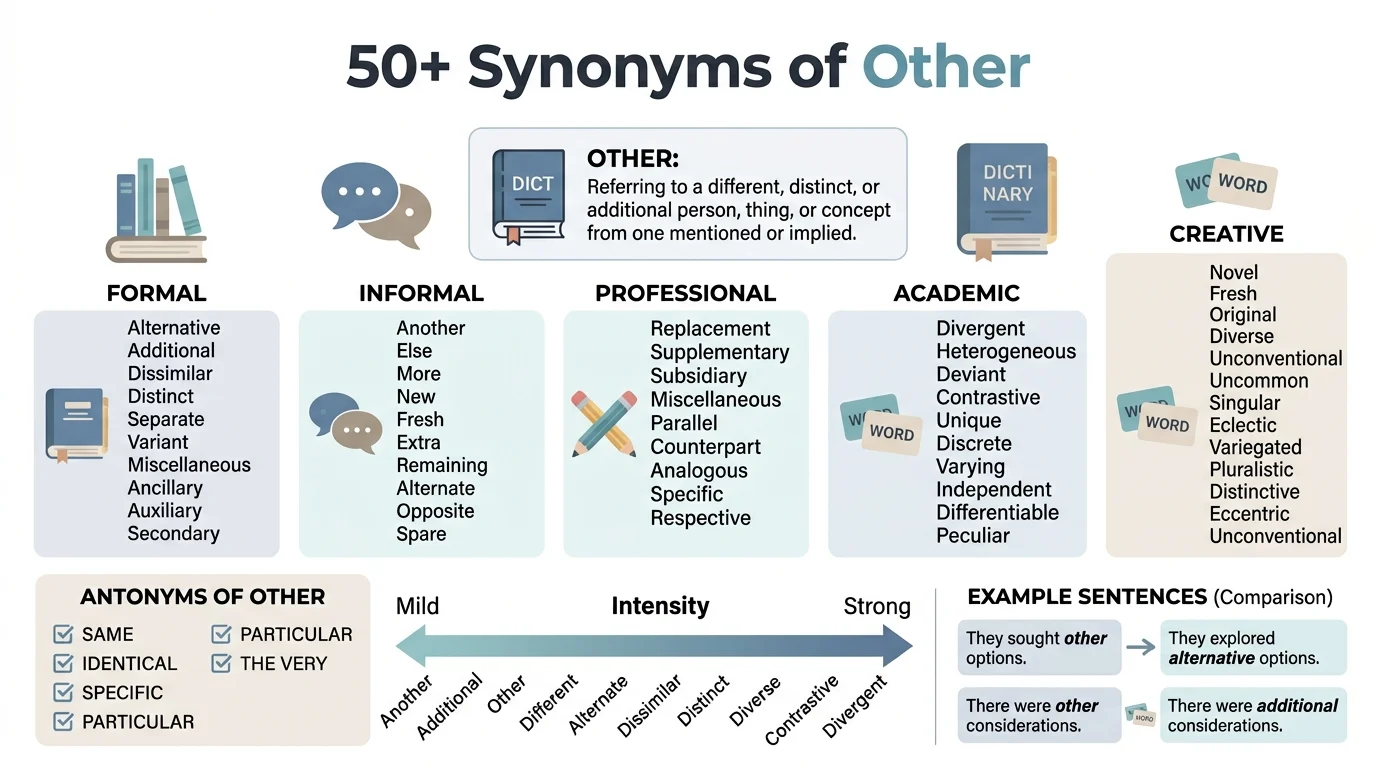
Have you ever read back an email or an essay and realized you used the word “other” five times in two paragraphs? It happens to almost everyone. You are describing alternatives, additional items, or different choices, and the word “other” keeps appearing. That repetition makes your writing feel flat and repetitive. The good news is that English offers a rich collection of synonyms of other that can add precision and variety to your sentences. Choosing the right synonym improves clarity, sharpens your tone, and makes your communication more engaging for readers, whether you are writing a blog post, a business report, or a college application.
What Are the Best Synonyms of “Other”?
The word “other” means something different, additional, or remaining. It is a neutral word used to distinguish between choices or indicate what is left. The best synonyms depend on your context. For formal writing, choose “alternative” or “additional.” For casual conversation, use “another” or “extra.” In professional settings, “supplementary” and “further” work well. For creative writing, try “distinct” or “diverse.”
Meaning, Tone, and Context
Simple Definition
“Other” refers to a person or thing that is not the one already mentioned or known. It can mean different, additional, or remaining.
Part of Speech
“Other” functions as an adjective, noun, pronoun, and adverb.
Overall Tone
Neutral.
Formality Level
Neutral. “Other” works in almost any setting, from casual texts to formal reports.
Common Uses
Native English speakers use “other” constantly. You will hear it in everyday conversation to offer choices, in professional writing to present alternatives, and in academic contexts to distinguish between categories. Common collocations include “the other day,” “each other,” “on the other hand,” and “other than”.
Word Forms
- Adjective: We took the other road.
- Noun: One was blue; the other was red.
- Pronoun: Some people like coffee; others prefer tea.
- Adverb: I cannot act other than as I have.
- Verb (less common): To other someone means to treat them as different or alien.
When and How to Use “Other”
You should choose “other” when you need a simple, clear word that does not add extra emotion or formality. It works well as a default choice in everyday writing and speech.
Here are seven realistic examples showing how “other” fits different situations.
Professional: We need to consider other options before making a final decision.
Academic: The study examined other variables that could affect the results.
Workplace: Please share this announcement with other team members.
Personal: I think we should try other restaurants in the neighborhood.
Email: I have attached the report and other relevant documents for your review.
Resume: Collaborated with other departments to streamline the onboarding process.
Social Media: Exploring other ways to stay active during the winter months.
Best Synonyms of “Other”
No synonym is identical in every situation. The best choice depends on your audience, your purpose, and the specific shade of meaning you want to convey. Here are the top recommendations for common writing contexts.
Professional writing: “Additional.” This word is straightforward and businesslike. It clearly signals that you are adding something without extra interpretation.
Academic writing: “Alternative.” This word suggests a choice between distinct possibilities, which fits the analytical nature of academic work.
Business communication: “Further.” This synonym implies progression and is useful when discussing next steps or additional details.
Casual conversation: “Another.” This is the most natural choice for everyday speech. It is simple and direct.
Emotional writing: “Different.” This word can carry a sense of contrast or even alienation, making it useful when you want to highlight a meaningful distinction.
Creative writing: “Distinct.” This word adds a sense of clarity and individuality to whatever you are describing.
Resume writing: “Supplementary.” This word sounds polished and suggests you bring valuable extra skills or experience.
Workplace communication: “Remaining.” This is the clearest choice when you are talking about what is left after something has been removed or completed.
Stronger meaning: “Contrasting.” This word emphasizes opposition and works well when you want to highlight differences.
Softer meaning: “Else.” This is a gentle, informal way to refer to something different without making a strong distinction.
When Not to Use “Other”
Sometimes “other” is not the best choice. Here are situations where you should replace it with a more precise word.
When the word sounds too general. If you are describing a specific difference, “other” can feel vague. Instead of saying “other methods,” try “alternative methods” to suggest a deliberate choice between options.
When the word sounds too vague. In technical writing, “other” may not provide enough detail. Instead of “other factors,” specify “additional factors” or “remaining factors” to clarify what you mean.
When the word sounds too formal. In casual texts or social media posts, “other” can feel stiff. Use “another” or “extra” for a more relaxed tone.
When the word sounds too informal. In legal or academic documents, “other” may lack authority. Choose “further” or “supplementary” to sound more precise.
When the word sounds too weak. If you need to emphasize a strong contrast, “other” may not carry enough weight. Use “opposite” or “contrasting” instead. For example, instead of “the other side,” say “the opposing side” to make the distinction clearer.
When the word is outdated. In most cases, “other” remains current. However, using it as a verb (“to other”) is relatively new and may not be understood by all readers. Use “alienate” or “marginalize” instead.
Words Commonly Confused With “Other”
Several words are frequently mixed up with “other.” Here is how to keep them straight.
Other vs Another
Difference: “Another” means “one more” or “an additional” and is always singular. “Other” can be singular or plural and often refers to something specific or remaining.
When to use it: Use “another” when you want one more of the same kind. Use “other” when you are referring to something different or the remaining items.
Example: “I would like another cup of coffee.” “I would like the other cup of coffee.”
Other vs Else
Difference: “Else” is used after words like “someone,” “anyone,” “nothing,” or “everything” to mean “in addition” or “different.” “Other” is used before nouns.
When to use it: Use “else” with indefinite pronouns. Use “other” with nouns.
Example: “Is anyone else coming?” “Is any other person coming?”
Other vs Additional
Difference: “Additional” specifically means “added” or “extra.” “Other” can mean different or remaining as well.
When to use it: Use “additional” when you are clearly adding more of the same type. Use “other” when the new item is different in kind.
Example: “We need additional staff.” “We need other staff with different skills.”
Other vs Alternative
Difference: “Alternative” implies a choice between two or more options. “Other” simply means not this one.
When to use it: Use “alternative” when you are presenting a deliberate choice. Use “other” for a general distinction.
Example: “We have an alternative plan.” “We have other plans.
Other vs Distinct
Difference: “Distinct” emphasizes that something is clearly different and separate. “Other” is more neutral.
When to use it: Use “distinct” when you want to highlight a clear difference. Use “other” when the difference is obvious or unimportant.
Example: “The two species are distinct.” “The two species are other than each other” (which sounds awkward).
Other vs Remaining
Difference: “Remaining” specifically refers to what is left after some has been used or removed. “Other” can be more general.
When to use it: Use “remaining” when you are talking about leftovers. Use “other” for any kind of difference.
Example: “The remaining seats are in the back.” “The other seats are in the back.”
Best Synonyms of “Other” by Context
| Context | Best Synonym | Why It Works | Example |
|---|---|---|---|
| Formal writing | Alternative | Suggests a deliberate choice between distinct options. | The committee proposed an alternative solution. |
| Academic writing | Distinct | Highlights clear, analyzable differences. | The researchers identified three distinct categories. |
| Professional communication | Additional | Clear, businesslike, and neutral. | Please send additional information by Friday. |
| Business emails | Further | Implies progression and next steps. | We will provide further details at the meeting. |
| Resume writing | Supplementary | Sounds polished and suggests added value. | Managed supplementary training programs for new hires. |
| Workplace communication | Remaining | Clearly refers to what is left. | The remaining tasks will be completed by noon. |
| Casual conversation | Another | Natural and simple for everyday speech. | Let’s try another restaurant tonight. |
| Everyday speaking | Extra | Informal and friendly. | Do you have an extra pen I could borrow? |
| Creative writing | Diverse | Adds richness and variety to descriptions. | The garden was filled with diverse plant species. |
| Storytelling | Contrasting | Emphasizes opposition and creates drama. | The contrasting characters drove the plot forward. |
| Emotional writing | Different | Can carry a sense of alienation or specialness. | She felt different from everyone else in the room. |
| Strong emphasis | Opposing | Clearly indicates direct opposition. | They held opposing views on the matter. |
| Mild tone | Else | Gentle and indirect. | Is there anything else we should consider? |
| Social media captions | Another | Short and engaging. | Another day, another adventure. |
How to Choose the Best Synonym of “Other”
Choosing the right synonym does not have to be complicated. Ask yourself these questions to make the best decision.
What is your main meaning? Are you adding something, contrasting something, or referring to what remains? If you are adding, choose “additional” or “further.” You are contrasting, choose “alternative” or “distinct.” If you are referring to what remains, choose “remaining” or “leftover.”
What is your tone? Are you writing a formal report or a casual text? For formal writing, choose “alternative,” “supplementary,” or “further.” For casual writing, choose “another,” “extra,” or “else.”
Who is your audience? Are you writing for colleagues, professors, or friends? Choose vocabulary that matches their expectations.
How much emotion do you want? Do you want to sound neutral or emphasize a difference? For neutral tone, choose “additional” or “other.” For stronger emotion, choose “contrasting” or “opposing.”
What is your writing purpose? Are you trying to inform, persuade, or entertain? Informative writing benefits from clear, neutral words like “additional.” Persuasive writing may benefit from stronger words like “alternative.”
Does it sound natural? Read your sentence aloud. If the synonym feels forced or unnatural, try a different one. The best word is the one that communicates your message most clearly.
Real Life Examples of “Other”
Seeing words in action helps you understand how to use them. Here are realistic examples across different situations, with some replacements to show improved writing.
School: The teacher asked if anyone had other questions before the test. (Better: The teacher asked if anyone had additional questions before the test.)
College: She considered other majors before settling on biology. (Better: She considered alternative majors before settling on biology.)
Workplace: The manager assigned the other tasks to the afternoon shift. (Better: The manager assigned the remaining tasks to the afternoon shift.)
Business: We need to explore other markets for our product. (Better: We need to explore additional markets for our product.)
Email: I have enclosed the contract and other documents. (Better: I have enclosed the contract and supplementary documents.)
Resume: Worked with other departments to improve efficiency. (Better: Collaborated with cross-functional departments to improve efficiency.)
Conversation: I think we should try other options. (Better: I think we should try another option.)
Storytelling: The hero faced other challenges along the way. (Better: The hero faced diverse challenges along the way.)
Blogging: There are other ways to save money. (Better: There are alternative ways to save money.)
Social media: Exploring other hobbies this summer. (Better: Exploring new hobbies this summer.)
18 Best Synonyms of “Other”
| Synonym | Simple Meaning | Best Used For | Example Sentence |
|---|---|---|---|
| Additional | Added or extra | Formal writing, business | We need additional resources for this project. |
| Alternative | Another choice | Academic, professional | The committee offered an alternative proposal. |
| Another | One more or a different one | Casual, everyday | Can I have another piece of cake? |
| Contrasting | Showing a clear difference | Creative, analytical | The contrasting colors made the design pop. |
| Different | Not the same | General, emotional | She had a different perspective on the issue. |
| Distinct | Clearly separate and different | Academic, precise | The two concepts are distinct from each other. |
| Diverse | Showing variety | Creative, descriptive | The city is home to diverse communities. |
| Else | In addition or different | Informal, conversational | Is there anything else you need? |
| Extra | More than usual | Casual, informal | I have an extra ticket if you want it. |
| Further | Additional or more advanced | Professional, business | We will conduct further research on this topic. |
| Leftover | Remaining after use | Everyday, casual | We ate the leftover pizza for breakfast. |
| Opposing | Directly against | Strong emphasis, debate | They held opposing views on the new policy. |
| Remaining | What is left | Workplace, clear instructions | The remaining items are on the top shelf. |
| Separate | Not together or different | Clear distinction | Please keep the receipts separate from the forms. |
| Spare | Extra or not in use | Casual, practical | Do you have a spare pen I can borrow? |
| Supplementary | Added to complete | Academic, professional | The supplementary materials are available online. |
| Unalike | Not similar | Comparative | The two siblings are unalike in many ways. |
| Various | Several different types | Descriptive, general | We encountered various problems along the way. |
Synonyms of “Other” by Usage
Professional vs Personal Synonyms
In professional settings, choose words that sound polished and precise. “Additional,” “supplementary,” and “further” are excellent choices. They convey a sense of thoroughness and attention to detail. In personal conversations, “another,” “extra,” and “else” sound more natural and friendly.
Formal vs Conversational Synonyms
For reports, essays, and business writing, use “alternative,” “distinct,” and “supplementary.” These words add authority to your writing. For casual conversations, texts, and social media posts, use “another,” “extra,” and “else.” These words keep your tone relaxed and approachable.
Academic Synonyms
In academic writing, precision is essential. “Distinct” helps you draw clear analytical lines. “Alternative” signals that you are considering different possibilities. “Supplementary” indicates additional but supporting material. These words sound authoritative and help you communicate complex ideas clearly.
Professional and Business Synonyms
In resumes, interviews, and client communication, choose words that project competence. “Additional” shows you are thorough. “Further” suggests you are proactive and forward-thinking. “Supplementary” indicates you bring extra value. These choices help you sound polished and professional.
Creative and Literary Synonyms
For storytelling, fiction, and descriptive writing, choose words that add imagery and emotion. “Contrasting” creates drama. “Diverse” adds richness. “Distinct” brings clarity. These words help you paint vivid pictures with your writing.
Slang or Modern Synonyms
“Other” does not have widely used slang equivalents. In very informal contexts, “different” might be used to mean “unusual” or “special,” as in “That’s a different vibe.” However, this usage is context-dependent and should be avoided in formal writing.
Strongest to Mildest Synonyms
Here is an intensity scale for synonyms of “other,” ranging from mild to very strong.
Mild: Else, extra, spare
Moderate: Additional, another, further, remaining
Strong: Alternative, distinct, separate, supplementary
Very Strong: Contrasting, diverse, opposing, unalike
The emotional intensity increases as you move from mild to very strong. Mild words simply add information. Stronger words emphasize difference, opposition, or variety.
Emotional vs Neutral Synonyms
Emotional Synonyms: “Contrasting,” “opposing,” and “different” can carry emotional weight. They suggest conflict, alienation, or a meaningful departure from the norm.
Neutral Synonyms: “Additional,” “further,” “remaining,” and “supplementary” simply communicate information without adding emotion. Use these when you want to stay objective and professional.
Antonyms of “Other”
| Antonym | Meaning | Example Sentence |
|---|---|---|
| Same | Identical in every way | We ordered the same dish for dinner. |
| Identical | Exactly alike | The two copies were identical. |
| Selfsame | The very same | He used the selfsame excuse again. |
| Very | The exact same (used for emphasis) | That is the very book I was looking for. |
| Same | Not different | We are in the same situation. |
| Equal | The same in value or amount | They received equal treatment. |
| Like | Similar in nature | She has a like personality to her mother. |
| Similar | Almost the same but not identical | The two cars are similar in design. |
| Alike | Similar to each other | The twins look alike. |
| Corresponding | Matching or similar | Please sign the corresponding documents. |
| Equivalent | Equal in value or meaning | The two terms are equivalent. |
| Parallel | Similar and occurring together | The two stories have parallel plots. |
| Comparable | Similar enough to be compared | The two products are comparable in quality. |
| Uniform | Consistent and the same throughout | The uniforms are uniform in color. |
| Unvaried | Not changing or different | The menu was unvaried and boring. |
Comparison: “Other” vs Similar Words
Other vs Additional
Main Difference: “Additional” specifically means “added” or “extra.” “Other” can mean different or remaining as well.
Which Is Stronger? “Additional” is more precise when you are talking about adding something.
Which Is More Formal? Both are neutral, but “additional” is preferred in professional writing.
When to Use Each: Use “additional” when you are clearly adding more of the same type. Use “other” when the new item is different in kind.
Examples: “We need additional staff.” “We need other staff with different skills.”
Other vs Alternative
Main Difference: “Alternative” implies a choice between two or more options. “Other” simply means not this one.
Which Is Stronger? “Alternative” suggests a deliberate decision point.
Which Is More Formal? “Alternative” is more formal.
When to Use Each: Use “alternative” when you are presenting a deliberate choice. Use “other” for a general distinction.
Examples: “We have an alternative plan.” “We have other plans.
Other vs Another
Main Difference: “Another” means “one more” or “an additional” and is always singular. “Other” can be singular or plural and often refers to something specific or remaining.
Which Is Stronger? Neither is stronger; they have different grammatical functions.
Which Is More Formal? Both are neutral.
When to Use Each: Use “another” when you want one more of the same kind. Use “other” when you are referring to something different or the remaining items.
Examples: “I would like another cup of coffee.” “I would like the other cup of coffee.”
Other vs Distinct
Main Difference: “Distinct” emphasizes that something is clearly different and separate. “Other” is more neutral.
Which Is Stronger? “Distinct” is stronger because it emphasizes clear separation.
Which Is More Formal? “Distinct” is more formal.
When to Use Each: Use “distinct” when you want to highlight a clear difference. Use “other” when the difference is obvious or unimportant.
Examples: “The two species are distinct.” “The two species are different from each other.”
Other vs Remaining
Main Difference: “Remaining” specifically refers to what is left after some has been used or removed. “Other” can be more general.
Which Is Stronger? “Remaining” is more specific.
Which Is More Formal? Both are neutral.
When to Use Each: Use “remaining” when you are talking about leftovers. Use “other” for any kind of difference.
Examples: “The remaining seats are in the back.” “The other seats are in the back.”
Other vs Supplementary
Main Difference: “Supplementary” means added to complete something. “Other” is more general.
Which Is Stronger? “Supplementary” is more precise.
Which Is More Formal? “Supplementary” is more formal.
When to Use Each: Use “supplementary” when you are adding supporting or completing material. Use “other” for any kind of difference.
Examples: “Please read the supplementary materials.” “Please read the other materials.”
Common Phrases and Expressions with “Other”
| Phrase | Meaning | Example Sentence |
|---|---|---|
| The other day | Recently, a few days ago | I ran into Sarah the other day at the grocery store. |
| Each other | One another; reciprocally | They have been helping each other with the project. |
| On the other hand | Used to introduce a contrasting point | I love the city; on the other hand, the traffic is terrible. |
| Other than | Except for; besides | Other than a few minor issues, the event went smoothly. |
| Some other time | At a different time | I am busy now; can we meet some other time? |
| The other way around | The opposite situation or order | I thought you were driving, but it was the other way around. |
Common Mistakes to Avoid
Mistake 1: Choosing a vague synonym instead of a precise one. Saying “other methods” is vague. Saying “alternative methods” is precise. Be specific about what you mean.
Incorrect: We need to consider other options.
Better: We need to consider alternative options.
Mistake 2: Confusing “other” with “another.” Remember, “another” is singular and means “one more.” “Other” can be plural and often means “different” or “remaining.”
Incorrect: I need other cup of coffee.
Better: I need another cup of coffee.
Mistake 3: Using an informal synonym in formal writing. “Extra” is casual. Use “additional” or “supplementary” in formal contexts.
Incorrect: The report includes extra data.
Better: The report includes additional data.
Mistake 4: Selecting an overly dramatic synonym. “Opposing” is strong. Use it only when there is real opposition.
Incorrect: We have opposing ideas for lunch.
Better: We have different ideas for lunch.
Mistake 5: Repeating the same word too often. Vary your vocabulary to keep your writing engaging.
Incorrect: We need other staff. The other staff are busy. The other staff will help later.
Better: We need additional staff. The current staff are busy. The remaining staff will help later.
Mistake 6: Choosing a synonym with the wrong emotional tone. “Different” can sound alienating. Use it carefully.
Incorrect: You are so different from us. (Could sound like an insult.)
Better: You have a unique perspective.
Mistake 7: Using slang in academic or professional writing. Slang synonyms for “other” are rare, but avoid overly casual language in formal settings.
Incorrect: We need some other vibe for the project. (Too informal.)
Better: We need a different approach for the project.
Frequently Asked Questions
1. What are the best synonyms of “other”?
The best synonyms depend on your context. Formal writing, choose “additional” or “alternative.” For casual conversation, use “another” or “extra.” For professional settings, “supplementary” and “further” work well.
2. What are the best formal synonyms of “other”?
The best formal synonyms include “alternative,” “supplementary,” “additional,” and “further.” These words add precision and authority to academic, legal, and business documents.
3. What are common informal synonyms of “other”?
Common informal synonyms include “another,” “extra,” “else,” and “spare.” These words are perfect for everyday conversations, texts, and social media posts.
4. What is another word for “other” in professional writing?
In professional writing, use “additional,” “supplementary,” or “further.” These words sound polished and help you communicate clearly with colleagues and clients.
5. What is the difference between “other” and “another”?
“Another” means “one more” or “an additional” and is always singular. “Other” can be singular or plural and often refers to something specific, different, or remaining.
6. What is the opposite of “other”?
The most direct opposite of “other” is “same.” Other antonyms include “identical,” “selfsame,” “equal,” and “similar.”
Conclusion
The word “other” is a versatile and useful part of the English language. It helps us distinguish between choices, add new information, and refer to what remains. However, using the same word repeatedly can make your writing feel flat. By learning the synonyms of other, you can add variety, precision, and emotional depth to your communication. Remember that no synonym works perfectly in every situation. The best choice depends on your audience, your tone, and your purpose. The next time you reach for “other,” pause and consider whether “additional,” “alternative,” or “another” might serve you better. Your readers will notice the difference.
Definitions, meanings, and usage recommendations should be verified with trusted language references before publication. Recommended sources include Cambridge Dictionary, Oxford English Dictionary, Merriam Webster, Collins Dictionary, and Britannica.