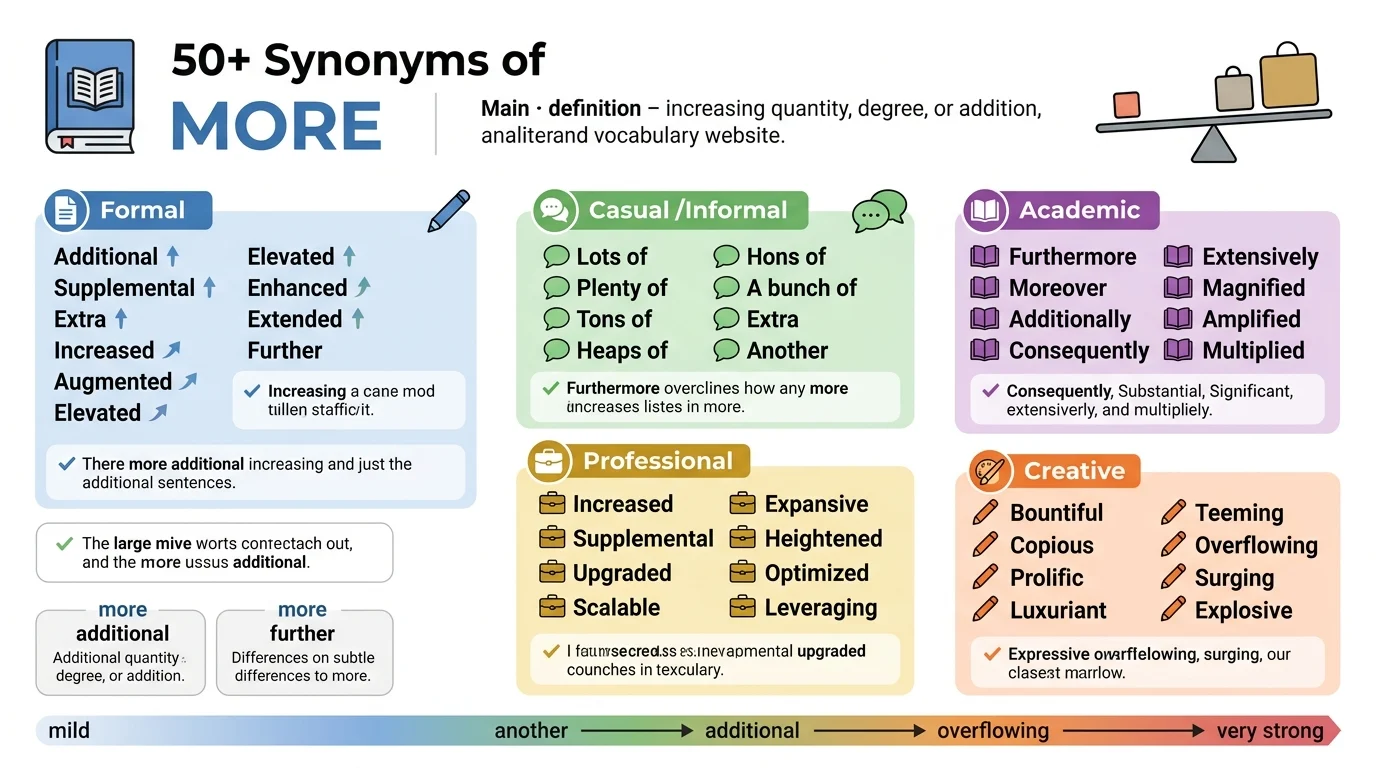
Have you ever read back an email, essay, or social media post and realized you used the word “more” five times in three sentences? You are not alone. Almost every writer does this. The word “more” is incredibly useful, but it is also one of the most overused words in the English language.
Whether you are writing a college essay, crafting a business proposal, updating your resume, or posting on social media, repeating “more” can make your writing feel dull and repetitive. Finding the right synonyms of more can instantly upgrade your communication. Stronger vocabulary choices help you sound more professional, more precise, and more confident. They also keep your reader engaged.
The good news is that English offers dozens of excellent alternatives. The challenge is choosing the right one for your specific situation. This guide will help you do exactly that.
What Are the Best Synonyms of “More”?
“More” means a greater amount, quantity, or degree of something. The best synonym depends on your context. For formal writing, use additional or further. Casual conversation, try extra or plus. For academic work, choose greater or increased. Professional communication, supplementary or further work well.
Meaning, Tone, and Context
Simple Definition
“More” indicates a larger amount, greater number, higher degree, or additional quantity of something compared to what exists or what came before.
Part of Speech
“More” functions as an adjective, adverb, noun, and pronoun.
- Adjective: Modifies a noun to indicate greater quantity. I need more time.
- Adverb: Modifies verbs, adjectives, or other adverbs to indicate greater extent. She runs more quickly.
- Noun/Pronoun: Stands alone to represent a greater amount. I would give you more if I had it.
Overall Tone
“More” is neutral. It does not carry a positive or negative emotional charge on its own. The tone depends entirely on what you are describing and the surrounding words.
Formality Level
“More” is neutral in formality. It works in almost every setting, from casual texting to formal reports. However, in very formal or academic writing, more precise alternatives often sound more professional and authoritative.
Common Uses
Native English speakers use “more” constantly in everyday situations:
- Asking for additional food or drink (Can I have more coffee?)
- Comparing two things (This one is more expensive.)
- Expressing desire for a greater quantity (I want more.)
- Indicating continuing action (Let’s talk more tomorrow.)
- Forming comparative adjectives (more beautiful, more interesting)
Word Forms
| Form | Example |
|---|---|
| Adjective | We need more volunteers. |
| Adverb | Please speak more slowly. |
| Noun | More is expected of him. |
| Pronoun | More will attend this year. |
When and How to Use “More”
Choose “more” when you need a simple, clear, and universally understood way to express a greater amount or degree. It works in almost every situation. However, for professional or formal writing, consider using a more precise alternative.
7 Realistic Examples
Professional
We need more resources to complete this project on time.
Academic
The study requires more data before we can draw meaningful conclusions.
Workplace
Could you provide more details about the new policy?
Personal
I would like more information before making a decision.
Please let me know if you need more time to review the document.
Resume
Generated more than $500,000 in annual revenue through strategic partnerships.
We have more exciting announcements coming next week!
Best Synonyms of “More”
No synonym is identical to “more” in every situation. Each alternative carries slightly different connotations, levels of formality, and specific use cases. Here are the best synonyms for different contexts.
Professional Writing
Additional – This is the most direct professional substitute. It sounds polished without being pretentious. Use it in reports, emails, and business documents.
Academic Writing
Further – Indicates not just more quantity but also progression or continuation. Works well in research papers and scholarly articles.
Business Communication
Supplementary – Suggests something that completes or enhances existing material. Excellent for proposals and project documentation.
Casual Conversation
Extra – Simple, friendly, and natural in everyday speech. Perfect for texting and informal chats.
Emotional Writing
More than ever – Adds emotional weight and emphasis. Works well in personal essays and persuasive writing.
Creative Writing
Greater – Evokes a sense of magnitude and importance. Suitable for storytelling and descriptive passages.
Resume Writing
Increased – Shows action and results. Strong choice for achievement-oriented statements.
Workplace Communication
Further – Signals both additional quantity and forward movement. Professional and clear.
Stronger Meaning
Excessive – When “more” is too much or beyond what is needed. Carries a negative or critical tone.
Softer Meaning
A little more – Softens the request or comparison. Less demanding and more polite.
When Not to Use “More”
When It Sounds Too General
“More” is sometimes too vague. It does not specify what kind of increase or how much.
Why it is less effective: The reader is left guessing about the quantity or degree.
Better synonym: Significant additional funding
Rewrite:
Weak: We need more funding.
Strong: We need significant additional funding to complete the research.
When It Sounds Too Informal
In highly formal documents, “more” can feel casual or unsophisticated.
Why it is less effective: It may undermine your authority or the seriousness of your message.
Better synonym: Further
Rewrite:
Weak: More research is required.
Strong: Further research is required to validate these findings.
When It Sounds Too Weak
Sometimes “more” does not convey enough intensity.
Why it is less effective: It fails to communicate the scale or importance of the increase.
Better synonym: Substantially greater
Rewrite:
Weak: We need more employees.
Strong: We need substantially greater staffing to meet demand.
When It Sounds Too Strong
In sensitive situations, “more” can seem demanding or entitled.
Why it is less effective: It may alienate the listener or reader.
Better synonym: A bit more
Rewrite:
Weak: I need more time.
Strong: Could I have a bit more time to finish?
When It Is Outdated
“More” is never outdated, but certain phrases using it can feel old-fashioned. More than enough is perfectly fine, but more’s the pity sounds archaic.
Words Commonly Confused With “More”
More vs Additional
Difference: “Additional” specifically means added to what already exists. “More” is broader and can mean greater in degree, not just quantity.
When to Use It: Use “additional” when you are explicitly adding something to an existing set or amount.
Example: We ordered additional chairs for the seminar.
More vs Further
Difference: “Further” implies progression or continuation beyond a point. “More” simply indicates a greater amount.
When to Use It: Use “further” when you mean additional progress, distance, or development.
Example: We need further discussion before making a decision.
More vs Extra
Difference: “Extra” suggests something beyond what is usual, necessary, or expected. “More” is neutral.
When to Use It: Use “extra” when emphasizing that something is surplus or beyond the norm.
Example: She brought extra snacks just in case.
More vs Greater
Difference: “Greater” often implies importance or magnitude, not just quantity. “More” is more neutral.
When to Use It: Use “greater” when you want to emphasize significance or scale.
Example: This decision has greater implications than we realized.
More vs Increased
Difference: “Increased” implies a change or growth from a previous state. “More” can be static.
When to Use It: Use “increased” when describing growth or upward movement.
Example: The company reported increased profits this quarter.
More vs Supplementary
Difference: “Supplementary” suggests something that completes or enhances. “More” is simply additional.
When to Use It: Use “supplementary” when something is added to make something else more complete.
Example: The textbook comes with supplementary online materials.
Best Synonyms of “More” by Context
| Context | Best Synonym | Why It Works | Example |
|---|---|---|---|
| Formal writing | Additional | Precise and professional without being pretentious | We require additional documentation. |
| Academic writing | Further | Signals progression and depth | Further analysis is needed. |
| Professional communication | Supplementary | Suggests enhancement and completeness | Please find supplementary materials attached. |
| Business emails | Additional | Clear and widely understood | Let me know if you need additional details. |
| Resume writing | Increased | Shows measurable achievement | Increased sales by 25 percent. |
| Workplace communication | Further | Indicates both quantity and forward action | We will provide further guidance. |
| Casual conversation | Extra | Friendly and natural | Do you want extra cheese on that? |
| Everyday speaking | More | Simple and universally understood | I need more milk. |
| Creative writing | Greater | Adds dramatic weight | A greater mystery had never been told. |
| Storytelling | Further | Suggests unfolding events | Further adventures awaited them. |
| Emotional writing | More than ever | Adds intensity and feeling | I missed her more than ever. |
| Strong emphasis | Substantially more | Conveys significant increase | We need substantially more funding. |
| Mild tone | A bit more | Softens the request | Could I have a bit more time? |
| Social media captions | Extra | Casual and engaging | Extra love for this one. |
| American English | More | Standard and neutral | I want more of that. |
How to Choose the Best Synonym of “More”
Choosing the right synonym comes down to four key factors.
1. Consider your audience. Are you writing for a professor, a boss, a friend, or the general public? Formal audiences expect precise, professional language. Casual audiences appreciate simplicity and warmth.
2. Think about your purpose. Are you informing, persuading, requesting, or describing? Different purposes call for different tones. A request might benefit from a softer synonym like a bit more. A persuasive argument might need a stronger word like substantially greater.
3. Evaluate the emotional strength you need. Do you want to sound neutral, emphatic, or dramatic? Neutral situations call for additional or extra. Emotional writing benefits from more than ever or far more.
4. Match the level of formality. Academic and professional writing generally benefits from further, additional, or supplementary. Casual conversations and social media work well with extra, plus, or more.
The best synonym is the one that communicates your intended message most clearly to your specific reader.
Real Life Examples of “More”
School
I need more time to finish my science project.
Improved: I need additional time to complete my science project.
College
The professor assigned more reading than I expected.
Improved: The professor assigned considerably more reading than I anticipated.
Workplace
We should hire more people for the new department.
Improved: We should hire additional staff for the new department.
Business
Our company needs more investment to grow.
Improved: Our company requires further investment to achieve growth.
Please send more information about the proposal.
Improved: Please send additional information regarding the proposal.
Resume
Managed more projects than any other team member.
Improved: Managed more projects than any other team member. (Sometimes “more” is the best choice.)
Conversation
I want more pizza.
Improved: I want another slice of pizza. (More specific.)
Storytelling
The forest held more secrets than anyone knew.
Improved: The forest held far more secrets than anyone could have imagined.
Blogging
Here are more tips for better writing.
Improved: Here are additional tips for stronger writing.
Social Media
More content coming soon!
Improved: Fresh content dropping soon!
18 Best Synonyms of “More”
Synonyms of “More” by Usage
Professional vs Personal Synonyms
Professional synonyms (work best in workplaces): additional, further, supplementary, increased, augmented. These sound polished and authoritative.
Personal synonyms (sound better in everyday conversations): extra, more, plus, a little more. These feel warm and natural.
Recommendation: In professional settings, choose additional or further. With friends and family, extra or plus are perfectly fine.
Formal vs Conversational Synonyms
Formal synonyms (fit reports, essays, business writing, presentations, emails): additional, further, supplementary, augmented, enhanced. These elevate your writing and demonstrate vocabulary strength.
Conversational synonyms (fit casual conversations and texting): extra, plus, more, a bit more. These keep communication natural and approachable.
Academic Synonyms
For research papers, essays, reports, and academic discussions, choose precise vocabulary that sounds authoritative:
- Further – Indicates additional investigation or analysis
- Additional – Clear and widely accepted in academic contexts
- Supplementary – Suggests supporting or completing material
- Greater – Emphasizes magnitude or significance
- Increased – Shows measurable growth
These words sound more scholarly and help establish credibility.
Professional and Business Synonyms
For resumes, interviews, meetings, presentations, performance reviews, client communication, and business emails:
- Increased – Shows measurable results (Increased revenue by 30 percent)
- Additional – Professional and clear (Additional resources are available)
- Further – Signals forward momentum (Further discussion is needed)
- Supplementary – Adds polish (Supplementary information is enclosed)
- Enhanced – Suggests improvement (Enhanced features benefit users)
These choices project competence and professionalism.
Creative and Literary Synonyms
For storytelling, fiction, poetry, descriptive writing, and speeches:
- Greater – Adds dramatic weight
- Amplified – Suggests growing intensity
- Heightened – Evokes rising emotion or tension
- Magnified – Creates visual or emotional enlargement
- Multiplied – Suggests exponential growth or complexity
These alternatives add imagery and emotional depth to creative work.
Slang or Modern Synonyms
English does not have widely recognized slang equivalents for “more” that are appropriate in most contexts. However, informal phrases like loads more, tons more, and heaps more are common in casual speech.
Where they are acceptable: Casual conversations, social media, friendly emails, and texting.
Where they should be avoided: Professional writing, academic papers, formal presentations, and business communication.
Strongest to Mildest Synonyms
Intensity Scale
Mild
- A bit more – Very soft and polite
- Some more – Gentle and neutral
Moderate
- Extra – Casual and slightly emphatic
- Additional – Professional and neutral
- Further – Formal and measured
Strong
- Greater – Emphasizes significance
- Increased – Highlights growth
- Supplementary – Suggests completeness
Very Strong
- Substantially more – Indicates major increase
- Amplified – Suggests powerful growth
- Magnified – Evokes dramatic enlargement
- Excessive – Implies too much
Emotional vs Neutral Synonyms
Emotional Synonyms (express stronger feelings):
- More than ever – Deep emotional resonance
- Amplified – Growing intensity
- Heightened – Rising tension or excitement
- Magnified – Enlarged importance or feeling
Neutral Synonyms (simply communicate information):
- Additional – Factual and clear
- Further – Objective and professional
- Supplementary – Informational
- Increased – Measurable and neutral
Recommendation: Use emotional synonyms in personal writing, creative work, and persuasive pieces. Use neutral synonyms in professional, academic, and informational writing.
Antonyms of “More”
| Antonym | Meaning | Example Sentence |
|---|---|---|
| Less | Smaller in amount or degree | We need less sugar in this recipe. |
| Fewer | Smaller in number | Fewer people attended this year. |
| Lesser | Smaller or less important | This is the lesser of two evils. |
| Smaller | Reduced in size or amount | The smaller portion is sufficient. |
| Lower | Reduced in amount or degree | The temperature is lower today. |
| Reduced | Made smaller or less | The company reduced its workforce. |
| Decreased | Become smaller or less | Sales decreased last quarter. |
| Diminished | Made smaller or weaker | Her enthusiasm diminished over time. |
| Minimal | Very small in amount | The risk is minimal. |
| Minimum | The smallest possible amount | We need a minimum of five participants. |
| Scarce | Insufficient in supply | Clean water is scarce in some regions. |
| Insufficient | Not enough | The funding was insufficient. |
| Lacking | Missing or deficient | The proposal is lacking in detail. |
| Sparse | Thinly scattered | Vegetation is sparse in the desert. |
| Inadequate | Not enough or not good enough | The response was inadequate. |
Comparison: “More” vs Similar Words
More vs Additional
Main Difference: “More” is broader and can refer to greater degree or extent. “Additional” specifically means added to an existing quantity.
Which Is Stronger? Neither is inherently stronger, but “additional” sounds more precise and professional.
Which Is More Formal? “Additional” is more formal. “More” is neutral.
When to Use Each: Use “more” for general comparisons. Use “additional” when you are explicitly adding to something.
Examples:
- More: I need more sleep.
- Additional: We require additional funding.
More vs Further
Main Difference: “Further” implies progression or continuation. “More” is static.
Which Is Stronger? “Further” often sounds more determined and forward-looking.
Which Is More Formal? “Further” is more formal and academic.
When to Use Each: Use “more” for simple quantity. Use “further” for additional progress or development.
Examples:
- More: I want more information.
- Further: We need further investigation.
More vs Extra
Main Difference: “Extra” suggests something beyond what is usual, necessary, or expected. “More” is neutral.
Which Is Stronger? “Extra” carries a slight emphasis on surplus.
Which Is More Formal? “More” is neutral. “Extra” is more casual.
When to Use Each: Use “extra” when emphasizing surplus or bonus. Use “more” for general increases.
Examples:
- More: I need more time.
- Extra: She brought extra snacks.
More vs Greater
Main Difference: “Greater” often implies importance or magnitude. “More” is neutral.
Which Is Stronger? “Greater” sounds more significant and weighty.
Which Is More Formal? Both are acceptable, but “greater” often appears in more formal contexts.
When to Use Each: Use “greater” when emphasizing significance. Use “more” for simple quantity.
Examples:
- More: There is more work to do.
- Greater: This has greater implications.
More vs Increased
Main Difference: “Increased” implies change or growth from a previous state. “More” does not.
Which Is Stronger? “Increased” suggests measurable change.
Which Is More Formal? “Increased” is more formal and businesslike.
When to Use Each: Use “increased” when describing growth. Use “more” for static comparisons.
Examples:
- More: We have more customers.
- Increased: We have increased our customer base.
More vs Supplementary
Main Difference: “Supplementary” suggests something added to complete or enhance. “More” is simply additional.
Which Is Stronger? “Supplementary” sounds more deliberate and purposeful.
Which Is More Formal? “Supplementary” is significantly more formal.
When to Use Each: Use “supplementary” when something completes or enhances. Use “more” for general additions.
Examples:
- More: We need more materials.
- Supplementary: The supplementary materials are included.
Common Phrases and Expressions with “More”
More or Less
Meaning: Approximately or mostly.
Example Sentence: The project is more or less complete.
More Than
Meaning: To a great degree; very.
Example Sentence: I am more than happy to help.
More and More
Meaning: Increasingly; to an increasing degree.
Example Sentence: More and more people are working from home.
Once More
Meaning: Again; one additional time.
Example Sentence: Let’s review the plan once more.
What’s More
Meaning: In addition; furthermore.
Example Sentence: The hotel is affordable, and what’s more, it’s centrally located.
All the More
Meaning: Even more; to an even greater degree.
Example Sentence: The victory was all the more satisfying because we worked so hard.
No More
Meaning: Not any longer; not any additional.
Example Sentence: I can eat no more.
Common Mistakes to Avoid
Mistake 1: Choosing a Vague Synonym Instead of a Precise One
Incorrect: We need more stuff for the office.
Better: We need additional supplies for the office.
Why: “Stuff” is vague. “Supplies” is specific. “Additional” is more professional than “more.”
Mistake 2: Confusing “More” with “Most”
Incorrect: She is the more qualified candidate.
Better: She is the most qualified candidate.
Why: “More” compares two things. “Most” compares three or more.
Mistake 3: Using an Informal Synonym in Formal Writing
Incorrect: We need loads more time to finish.
Better: We need additional time to finish.
Why: “Loads more” is casual and inappropriate for formal documents.
Mistake 4: Selecting an Overly Dramatic Synonym
Incorrect: We need an excessive amount of coffee for the meeting.
Better: We need plenty of coffee for the meeting.
Why: “Excessive” implies too much, which is probably not what you mean.
Mistake 5: Repeating the Same Word Too Often
Incorrect: We need more time, more resources, and more people.
Better: We need additional time, further resources, and extra people.
Why: Varying your vocabulary keeps writing engaging and professional.
Mistake 6: Choosing a Synonym with the Wrong Emotional Tone
Incorrect: I need magnified support from my team.
Better: I need greater support from my team.
Why: “Magnified” sounds dramatic and unnatural in this context.
Mistake 7: Using Slang in Academic or Professional Writing
Incorrect: The study needs tons more data.
Better: The study needs additional data.
Why: “Tons more” is too casual for academic or professional contexts.
Frequently Asked Questions
1. What are the best synonyms of “more”?
The best synonyms of “more” depend on your context. Formal writing, use additional or further. For casual conversation, use extra or plus. Academic work, use greater or increased. For professional communication, use supplementary or further.
2. What are the best formal synonyms of “more”?
The best formal synonyms of “more” include additional, further, supplementary, augmented, and enhanced. These words sound professional and precise in academic papers, business reports, and formal correspondence.
3. What are common informal synonyms of “more”?
Common informal synonyms of “more” include extra, plus, loads more, tons more, and heaps more. These are appropriate for casual conversations, social media, and friendly emails but should be avoided in formal writing.
4. What is another word for “more” in professional writing?
In professional writing, the best alternatives to “more” are additional, further, and supplementary. Additional is the most direct substitute. Further suggests progression. Supplementary implies completeness.
5. What is the difference between “more” and “additional”?
“More” is broader and can mean greater in degree or extent. “Additional” specifically means added to an existing quantity. In professional contexts, “additional” often sounds more polished and precise than “more.”
6. What is the opposite of “more”?
The most direct opposite of “more” is “less.” While “more” indicates a greater amount, quantity, or degree, “less” signifies a smaller amount, quantity, or degree. Other opposites include fewer, smaller, reduced, and decreased.
Conclusion
“More” is one of the most common and useful words in the English language. It means a greater amount, quantity, or degree of something. But relying on it too heavily can make your writing feel repetitive and uninspired.
The best synonyms of more depend entirely on your context. Formal writing, choose additional or further. For casual conversation, use extra or plus. Academic work, select greater or increased. For professional communication, opt for supplementary or further. Creative writing, try amplified, heightened, or magnified.
No synonym works perfectly in every situation. The key is to consider your audience, your purpose, the emotional tone you want to convey, and the level of formality required. Choose the word that communicates your message most clearly.
One practical tip: Before you publish or send any piece of writing, scan for every use of “more.” Ask yourself whether a more precise synonym would improve clarity, tone, or professionalism. Often, the answer is yes.