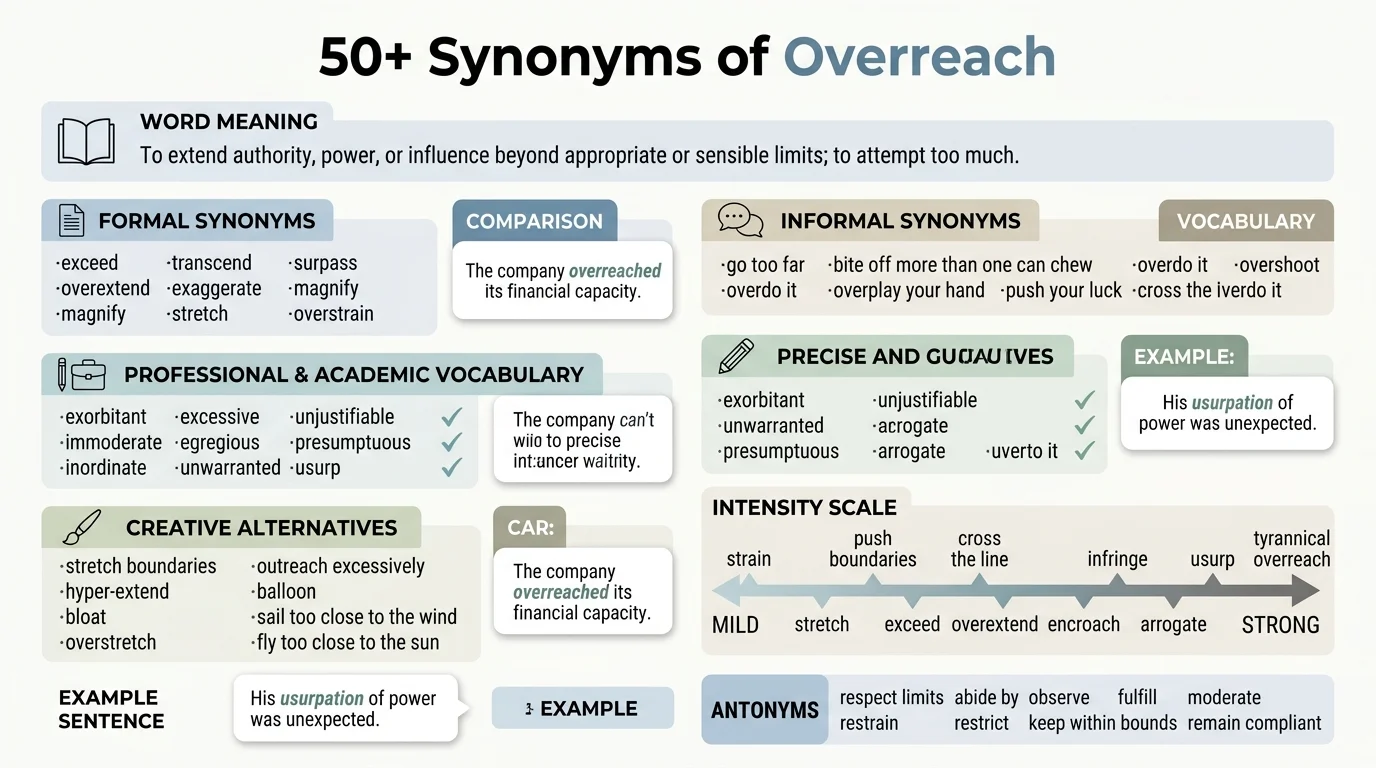
Have you ever written an email or essay and realized you used the same word three times in two sentences? It happens to everyone. Maybe you were describing how a team member went too far with a project, and you kept saying “overreached” over and over. The word “overreach” is useful, but relying on it exclusively makes your writing feel repetitive and lazy. When you understand the synonyms of overreach, you gain the ability to express nuance, adjust your tone, and communicate exactly what you mean. Choosing the right synonym can turn a vague statement into a precise observation.
What Are the Best Synonyms of “Overreach”?
Overreach means to go beyond acceptable limits, overestimate your abilities, or extend too far. The best synonym depends on your context. Professional writing, choose “exceed” or “transgress.” For academic work, use “overextend” or “presume.” For casual conversation, “go too far” works naturally.
Meaning, Tone, and Context
Simple Definition
Overreach means to stretch beyond your limits, authority, or capabilities. It often describes situations where someone attempts something they cannot achieve or goes further than they should.
Part of Speech
Verb (most common): The manager overreached when he promised delivery in two days.
Noun (less common): The company’s overreach led to financial losses.
Overall Tone
Overreach generally carries a negative tone. It suggests poor judgment, excessive ambition, or a lack of self-awareness.
Formality Level
Overreach is semi-formal. It works well in professional writing, journalism, and academic discussions. It also appears in everyday conversation but sounds more sophisticated than casual alternatives.
Common Uses
Native speakers use overreach in several situations:
- Describing someone who overestimates their abilities
- Discussing political or corporate overextension
- Explaining legal or ethical boundary crossing
- Analyzing strategic mistakes
- Critiquing overly ambitious plans
Word Forms
| Form | Example |
|---|---|
| Verb | The committee overreached with its demands. |
| Noun | The proposal was an overreach. |
| Adjective (rare) | His overreaching ambition caused problems. |
| Adverb (rare) | She acted overreachingly. |
Opposite form: underreach, understate, moderate
When and How to Use “Overreach”
Choose “overreach” when you want to describe someone going beyond reasonable or acceptable boundaries. The word works best when you are pointing out a misstep in judgment, planning, or authority. Use it to highlight when someone’s ambition exceeded their capability or when an action crossed an invisible line.
Professional Context
The marketing team overreached by promising results they could not deliver.
Academic Context
The researcher’s conclusions overreached the available evidence.
Workplace Context
Our department overreached when we took on three major projects simultaneously.
Personal Context
I overreached by trying to organize the entire reunion by myself.
Email Context
I think we overreached with the budget request. We should revise it downward.
Resume Context
Avoid using “overreached” on your resume. Instead, describe how you learned from ambitious projects.
Social Media Context
Some influencers overreach when they offer medical advice without credentials.
Best Synonyms of “Overreach”
No synonym matches overreach perfectly in every situation. The right choice depends on your audience, your purpose, and the specific shade of meaning you want to convey. Here are the best synonyms organized by context.
Professional Writing
Exceed works best in professional writing because it clearly states that someone went beyond limits without sounding overly critical.
Academic Writing
Overextend fits academic contexts well. It suggests stretching evidence or conclusions too far without making an aggressive accusation.
Business Communication
Transgress works well when discussing ethical or policy violations. It carries appropriate seriousness.
Casual Conversation
Go too far sounds natural and direct. It avoids the formal weight of other synonyms.
Emotional Writing
Overstep conveys a sense of personal boundary violation. It works well when discussing interpersonal conflicts.
Creative Writing
Overreach itself often works best in literary contexts because of its dramatic quality. Alternatively, “presume” suggests overstepping in a way that reveals character arrogance.
Resume Writing
Overestimate can describe learning experiences without sounding negative.
Workplace Communication
Exceed is neutral and professional. It lets you state facts without assigning blame.
Stronger Meaning
Presume suggests overstepping with arrogance or entitlement.
Softer Meaning
Overextend feels more neutral. It suggests stretching resources rather than violating boundaries.
When Not to Use “Overreach”
When the Word Sounds Too General
Overreach can feel vague when you need to specify what boundary was crossed. Instead of saying “the company overreached,” describe exactly what happened.
Less Effective: The company overreached.
Better: The company exceeded its budget and missed every deadline.
Why It Works: The revised sentence provides concrete details that help readers understand the situation.
When the Word Sounds Too Formal
In casual conversation or text messages, overreach feels stiff. Use simpler alternatives.
Less Effective: I think I overreached with my dinner plans.
Better: I think I went overboard with my dinner plans.
Why It Works: “Went overboard” matches the informal tone of personal conversation.
When the Word Sounds Too Weak
Sometimes overreach does not capture the severity of a situation. When someone crosses a serious ethical line, choose a stronger word.
Less Effective: The politician overreached.
Better: The politician acted unethically.
Why It Works: “Acted unethically” names the violation directly and carries appropriate weight.
When the Word Sounds Too Strong
In neutral descriptions, overreach can sound accusatory. Choose a milder synonym.
Less Effective: My assistant overreached by scheduling that meeting.
Better: My assistant exceeded the scope of her authority.
Why It Works: The revised version explains the issue without sounding critical.
When the Word Is Outdated
Overreach remains current and widely used. This concern does not apply.
Words Commonly Confused With “Overreach”
Overreach vs Overextend
Difference: Overextend focuses on stretching resources or abilities too thin. Overreach emphasizes crossing boundaries or going too far.
When to Use Overextend: Use it when describing financial, physical, or logistical strain.
Example: The small business overextended itself by opening three new locations in one year.
When to Use Overreach: Use it when describing boundary crossing or overstepping.
Example: The manager overreached by making decisions outside her department.
Overreach vs Exceed
Difference: Exceed is neutral. It simply states that someone went beyond a limit. Overreach carries negative judgment.
When to Use Exceed: Use it in professional reports where you want to state facts without blame.
Example: Our expenses exceeded the budget by fifteen percent.
When to Use Overreach: Use it when the action was misguided or inappropriate.
Example: The committee overreached with its demands.
Overreach vs Transgress
Difference: Transgress specifically refers to violating rules, laws, or moral principles. Overreach is broader and includes non-rule-based overstepping.
When to Use Transgress: Use it when discussing clear violations of policy or ethics.
Example: The employee transgressed company policy by sharing confidential information.
When to Use Overreach: Use it for more general overstepping.
Example: The teacher overreached by assigning five hours of homework.
Overreach vs Presume
Difference: Presume suggests acting with excessive confidence or entitlement. Overreach suggests trying to do something beyond your capacity.
When to Use Presume: Use it when someone acts as if they have more authority than they actually possess.
Example: He presumed to speak on behalf of the entire team.
When to Use Overreach: Use it when someone takes on too much.
Example: She overreached by accepting five major clients at once.
Overreach vs Overdo
Difference: Overdo refers to doing too much of something, often in personal contexts. Overreach carries a more formal or strategic meaning.
When to Use Overdo: Use it in casual or personal situations.
Example: I overdid the seasoning in the soup.
When to Use Overreach: Use it in professional or formal contexts.
Example: The proposal overreached by asking for too many resources.
Overreach vs Overstep
Difference: These two overlap significantly. Overstep emphasizes stepping across a boundary. Overreach emphasizes reaching too far.
When to Use Overstep: Use it when the violation involves a personal or social boundary.
Example: She overstepped by asking personal questions during the interview.
When to Use Overreach: Use it for strategic, professional, or broader situations.
Example: The campaign overreached with its unrealistic promises.
Best Synonyms of “Overreach” by Context
| Context | Best Synonym | Why It Works | Example |
|---|---|---|---|
| Formal writing | Exceed | Neutral and precise | The department exceeded its authority. |
| Academic writing | Overextend | Sounds analytical and measured | The study overextended its conclusions. |
| Professional communication | Transgress | Clear about rule violations | The contractor transgressed the agreement. |
| Business emails | Exceed | Professional and non-accusatory | We exceeded our projected timeline. |
| Resume writing | Overestimate | Frames mistakes as learning | I overestimated my capacity and learned to delegate. |
| Workplace communication | Exceed | Keeps feedback constructive | Our team exceeded the scope of the project. |
| Casual conversation | Go too far | Natural and easy to understand | She went too far with her criticism. |
| Everyday speaking | Overdo | Familiar and conversational | I overdid it at the gym. |
| Creative writing | Presume | Reveals character arrogance | He presumed to know more than the experts. |
| Storytelling | Overstep | Creates tension | The villain overstepped, and it cost him everything. |
| Emotional writing | Overstep | Captures personal boundary violations | You overstepped when you shared my secret. |
| Strong emphasis | Presume | Carries moral weight | How dare you presume to make that decision? |
| Mild tone | Overextend | Neutral and non-judgmental | We overextended our resources. |
| Social media captions | Go overboard | Relatable and casual | I went overboard with the decorations. |
| American English | Overreach | Standard usage | The agency overreached its mandate. |
How to Choose the Best Synonym of “Overreach”
Choosing the right synonym starts with understanding your audience. Ask yourself who will read your message and what they expect. A formal report demands neutral language. A personal email allows casual alternatives.
Consider the intensity you need. If you want to make a strong accusation, choose “presume” or “transgress.” If you want to describe a miscalculation, choose “overextend” or “exceed.” Match your word to the severity of the situation.
Think about your purpose. Are you explaining a mistake neutrally, criticizing someone, or describing a learning experience? Each purpose calls for a different synonym.
Finally, read your sentence aloud. Does the synonym sound natural? If it feels forced or awkward, choose a different word. The most effective vocabulary sounds natural and fits smoothly into your sentence.
Real Life Examples of “Overreach”
School Context
The student overreached by claiming her research paper proved a global trend based on only three interviews.
Stronger: The student overextended her conclusion with insufficient evidence.
College Context
The professor overreached when she assigned two research papers during exam week.
Stronger: The professor exceeded reasonable expectations.
Workplace Context
Our team overreached by promising the client a completed product in two weeks.
Stronger: Our team overestimated our capacity and missed the deadline.
Business Context
The startup overreached with its aggressive expansion plan and burned through its funding.
Stronger: The startup overextended itself financially.
Email Context
I think we overreached with the proposal. Can we revise it?
Stronger: I think we exceeded our scope. Can we revise the proposal?
Resume Context
I learned to set realistic goals after I overreached on a previous project.
Stronger: I learned to set realistic goals after I overestimated my capacity.
Conversation Context
My friend said I overreached by trying to fix everything myself.
Stronger: My friend said I took on too much.
Storytelling Context
The general overreached by attacking without sufficient supplies.
Stronger: The general overextended his army and faced defeat.
Blogging Context
Many new bloggers overreach by trying to publish daily content.
Stronger: Many new bloggers overextend themselves with unrealistic schedules.
Social Media Context
That company overreached with its outrageous pricing.
Stronger: That company went overboard with its pricing.
18 Best Synonyms of “Overreach”
| Synonym | Simple Meaning | Best Used For | Example Sentence |
|---|---|---|---|
| Exceed | Go beyond a limit | Professional reports | The expenses exceeded the approved budget. |
| Overextend | Stretch resources too thin | Academic and business writing | The team overextended itself across too many projects. |
| Transgress | Violate a rule or boundary | Ethical and policy discussions | He transgressed company policy by sharing files. |
| Presume | Act with unjustified confidence | Creative and critical writing | She presumed to correct her supervisor. |
| Overstep | Cross a personal or social boundary | Interpersonal situations | You overstepped when you gave unsolicited advice. |
| Go too far | Cross an acceptable limit | Casual conversation | He went too far with his joke. |
| Overdo | Do something excessively | Everyday speech | I overdid the pasta sauce. |
| Overestimate | Judge capacity incorrectly | Resume and learning contexts | We overestimated our team’s capacity. |
| Stretch | Extend beyond comfortable limits | Informal descriptions | That interpretation stretches the facts. |
| Outrun | Go beyond a sustainable pace | Metaphorical writing | The company outran its infrastructure. |
| Overplay | Overemphasize or exaggerate | Media and commentary | The media overplayed the controversy. |
| Strain | Put too much pressure on | Resource discussions | The project strained our team. |
| Overshoot | Go beyond a target | Planning and forecasting | We overshot the deadline by two weeks. |
| Overrate | Value too highly | Critical analysis | Critics overrated the film. |
| Overvalue | Assign too much worth | Economic and business writing | Investors overvalued the startup. |
| Overstate | Express too strongly | Academic and professional writing | The report overstated the benefits. |
| Go overboard | Do too much | Casual and social media | I went overboard with the decorations. |
| Overreach (itself) | The original word | General use | The agency overreached its mandate. |
Synonyms of “Overreach” by Usage
Professional vs Personal Synonyms
In professional settings, choose neutral synonyms that convey facts without assigning blame. “Exceed” and “transgress” work well because they describe actions without emotional weight. “Overextend” fits business writing when describing resource allocation.
In personal conversations, choose simpler words that sound natural. “Go too far,” “overdo,” and “go overboard” match the informal tone of everyday speaking. These words feel comfortable in text messages and casual discussions.
Formal vs Conversational Synonyms
Formal (reports, essays, business writing):
- Exceed
- Transgress
- Overextend
- Overstate
- Presume
Conversational (texting, casual emails, social media):
- Go too far
- Overdo
- Go overboard
- Stretch it
Academic Synonyms
Academic writing values precision and neutrality. “Overextend” works well when discussing conclusions that go beyond evidence. “Exceed” fits discussions of data or limits. “Transgress” appears in legal, ethical, or policy research. “Overstate” describes exaggerated claims. These synonyms sound authoritative and measured.
Professional and Business Synonyms
Business communication requires clarity without unnecessary negativity. “Exceed” is the safest and most professional synonym. “Overextend” describes financial or operational strain. “Transgress” applies to policy violations. “Overshoot” works for planning and forecasting discussions. These choices maintain professionalism while addressing issues directly.
Creative and Literary Synonyms
Creative writers choose synonyms that add emotional depth. “Presume” reveals character flaws like arrogance. “Overstep” creates interpersonal tension. “Outrun” works in metaphorical descriptions. “Overplay” suits commentary on exaggeration. These synonyms add texture to storytelling and descriptive writing.
Slang or Modern Synonyms
“Go overboard” functions as a modern conversational alternative. It suggests doing something excessively without the formal weight of “overreach.” Use it in casual settings, social media, and friendly emails. Avoid it in professional reports or academic writing.
Strongest to Mildest Synonyms
| Intensity | Synonym | Example |
|---|---|---|
| Very Strong | Presume | He presumed to make decisions for everyone. |
| Very Strong | Transgress | She transgressed the core ethical standard. |
| Strong | Overstep | You overstepped your authority. |
| Strong | Overreach | The committee overreached its mandate. |
| Moderate | Overextend | We overextended our team. |
| Moderate | Exceed | The costs exceeded the estimate. |
| Moderate | Overshoot | We overshot the target. |
| Mild | Overdo | I overdid the preparation. |
| Mild | Go overboard | She went overboard with the details. |
| Mild | Overestimate | We overestimated the time required. |
Emotional vs Neutral Synonyms
Emotional Synonyms
These words carry judgment and reveal how the speaker feels about the action.
- Presume (suggests arrogance)
- Transgress (suggests wrongdoing)
- Overstep (suggests boundary violation)
- Overplay (suggests manipulation)
Neutral Synonyms
These words describe actions without strong judgment.
- Exceed (objective measurement)
- Overextend (describes strain)
- Overshoot (describes planning errors)
- Overestimate (describes calculation errors)
Antonyms of “Overreach”
| Antonym | Meaning | Example Sentence |
|---|---|---|
| Underestimate | Judge as less capable | We underestimated the time required. |
| Underachieve | Perform below potential | The team underachieved this quarter. |
| Underdo | Do too little | He underdid the seasoning. |
| Fall short | Fail to reach a goal | Our sales fell short of projections. |
| Moderate | Keep within limits | She moderated her expectations. |
| Restrain | Hold back | He restrained his ambition. |
| Temper | Soften or moderate | Temper your enthusiasm with realism. |
| Limit | Set boundaries | Limit your commitments to what you can handle. |
| Constrain | Restrict or confine | Budget constraints kept us realistic. |
| Play it safe | Avoid risks | We played it safe this quarter. |
| Hold back | Avoid going too far | Hold back until you have more resources. |
| Scale back | Reduce scope | We scaled back the project. |
| Understate | Express with restraint | He understated his qualifications. |
| Curtail | Reduce or restrict | We curtailed our expansion plans. |
| Reel in | Bring back within limits | We reeled in our spending. |
Comparison: “Overreach” vs Similar Words
Overreach vs Exceed
Main Difference: Exceed is neutral and objective. Overreach carries negative judgment.
Which Is Stronger? Overreach is stronger because it implies poor judgment.
Which Is More Formal? Both work in formal contexts, but exceed is more common in business writing.
When to Use Each:
- Use exceed when stating facts.
- Use overreach when critiquing decisions.
Examples:
- Exceed: Our expenses exceeded the budget.
- Overreach: Our team overreached with unrealistic promises.
Overreach vs Overextend
Main Difference: Overextend describes stretching resources. Overreach describes crossing boundaries.
Which Is Stronger? Overreach is stronger because it suggests boundary violation.
Which Is More Formal? Both are formal, but overextend appears more often in academic writing.
When to Use Each:
- Use overextend for financial or logistical strain.
- Use overreach for authority or judgment issues.
Examples:
- Overextend: The company overextended itself with new locations.
- Overreach: The CEO overreached with her demands.
Overreach vs Transgress
Main Difference: Transgress specifically involves rule or law violation. Overreach covers any excessive action.
Which Is Stronger? Transgress is stronger and more accusatory.
Which Is More Formal? Transgress is highly formal and academic.
When to Use Each:
- Use transgress for clear violations.
- Use overreach for broader overstepping.
Examples:
- Transgress: He transgressed safety regulations.
- Overreach: She overreached with her criticism.
Overreach vs Presume
Main Difference: Presume suggests arrogance or entitlement. Overreach suggests miscalculation.
Which Is Stronger? Presume is stronger because it attacks character.
Which Is More Formal? Presume works in formal and literary contexts.
When to Use Each:
- Use presume when criticizing arrogance.
- Use overreach when discussing mistakes.
Examples:
- Presume: He presumed to know better than his boss.
- Overreach: We overreached with our timeline.
Overreach vs Overstep
Main Difference: These words overlap significantly. Overstep often applies to social or personal boundaries. Overreach applies to strategic or professional situations.
Which Is Stronger? Both have similar strength.
Which Is More Formal? Overreach is slightly more formal.
When to Use Each:
- Use overstep for personal interactions.
- Use overreach for professional or strategic situations.
Examples:
- Overstep: She overstepped by asking about his salary.
- Overreach: The agency overreached its authority.
Overreach vs Overdo
Main Difference: Overdo applies to doing too much of a specific activity. Overreach applies to going beyond limits in judgment or authority.
Which Is Stronger? Overreach is stronger and more serious.
Which Is More Formal? Overreach is formal. Overdo is casual.
When to Use Each:
- Use overdo for personal or casual situations.
- Use overreach for professional contexts.
Examples:
- Overdo: I overdid the decorations.
- Overreach: The proposal overreached its goals.
Common Phrases and Expressions with “Overreach”
Overreach one’s authority
Meaning: To act beyond the power or permission you actually have.
Example: The manager overreached her authority by firing an employee without approval.
Overreach oneself
Meaning: To attempt something beyond your capacity.
Example: He overreached himself by agreeing to five presentations in one week.
Overreach the mark
Meaning: To go further than intended or acceptable.
Example: The comedian overreached the mark with his controversial jokes.
Strategic overreach
Meaning: A military, political, or business expansion beyond sustainable limits.
Example: The company’s strategic overreach led to massive losses.
Overreach in diplomacy
Meaning: To demand too much in negotiations.
Example: The ambassador overreached in diplomatic talks and lost leverage.
Overreach in law
Meaning: To interpret or apply law beyond reasonable boundaries.
Example: The court overreached with its broad interpretation.
Overreach in business
Meaning: To expand too aggressively or promise too much.
Example: The startup overreached with its rapid expansion plan.
Common Mistakes to Avoid
1: Using a Vague Synonym Instead of a Precise One
Incorrect: The team went overboard with the project.
Better: The team overextended itself with the project.
Why It Works: “Overextended” precisely describes resource strain. “Went overboard” is too vague for professional writing.
2: Confusing Overreach with Overextend
Incorrect: The manager overextended by making decisions outside her authority.
Better: The manager overreached by making decisions outside her authority.
Why It Works: “Overextended” describes resource issues. “Overreached” describes authority issues. Use the right word for the situation.
3: Using an Informal Synonym in Formal Writing
Incorrect: The defendant went too far with his claims.
Better: The defendant overreached with his claims.
Why It Works: “Went too far” sounds casual. “Overreached” sounds professional and appropriate for legal contexts.
4: Selecting an Overly Dramatic Synonym
Incorrect: She presumed to ask for a day off.
Better: She overstepped by asking for a day off without approval.
Why It Works: “Presumed” suggests arrogance. The situation does not justify such strong language.
5: Repeating the Same Word Too Often
Incorrect: The company overreached. The team overreached. The plan overreached.
Better: The company overreached. The team overextended itself. The plan exceeded reasonable scope.
Why It Works: Varying synonyms improves readability and shows vocabulary range.
6: Choosing a Synonym with the Wrong Emotional Tone
Incorrect: The budget overreached by fifty dollars.
Better: The budget exceeded the estimate by fifty dollars.
Why It Works: “Overreached” sounds like a serious misjudgment. “Exceeded” is neutral and appropriate for small variances.
7: Using Slang in Academic or Professional Writing
Incorrect: The study went overboard with its conclusions.
Better: The study overextended its conclusions.
Why It Works: “Went overboard” is informal. “Overextended” sounds academic and measured.
Frequently Asked Questions
What are the best synonyms of overreach?
The best synonyms include exceed, overextend, transgress, overstep, and presume. Your choice depends on context. Use exceed for neutral descriptions, overextend for resource strain, and presume for arrogant overstepping.
What are the best formal synonyms of overreach?
Formal synonyms include exceed, transgress, overextend, overshoot, and overstate. These words appear in professional reports, academic papers, and business correspondence where precision and neutrality matter.
What are common informal synonyms of overreach?
Common informal synonyms include go too far, go overboard, overdo, and overestimate. Use these in casual conversations, text messages, social media posts, and personal emails with friends.
What is another word for overreach in professional writing?
Exceed is the most common professional alternative. It describes going beyond limits without assigning blame. Overextend also works well for resource-related situations.
What is the difference between overreach and overextend?
Overreach emphasizes crossing boundaries or overstepping authority. Overextend emphasizes stretching resources or capabilities too thin. Use overreach for judgment errors and overextend for capacity issues.
What is the opposite of overreach?
Common opposites include moderate, restrain, limit, underdo, and fall short. These words describe actions that stay within boundaries or fail to reach a target.
Conclusion
Overreach means going beyond acceptable limits, whether in judgment, authority, or capability. The best synonym depends on your audience, purpose, and the specific shade of meaning you need. Professional contexts, choose “exceed” or “transgress.” For academic writing, “overextend” works well. For casual conversation, “go too far” feels natural and direct. No single synonym fits every situation. The most effective writers choose words based on their audience and the emotional tone they want to convey. Next time you write, pause before using “overreach” and ask yourself whether a more specific synonym would communicate your meaning more clearly. This small habit will dramatically improve your vocabulary and your writing.