Have you ever found yourself describing a place to live and using the word “house” over and over again? Perhaps you were writing a real estate listing, crafting a story, or even just describing your dream home. Repeating the same word can make your writing feel dull and uninspired.
The English language offers a rich variety of alternatives that can add precision, emotion, and style to your communication. Understanding these synonyms for house will transform how you describe living spaces in any context.
What Does “House” Mean?
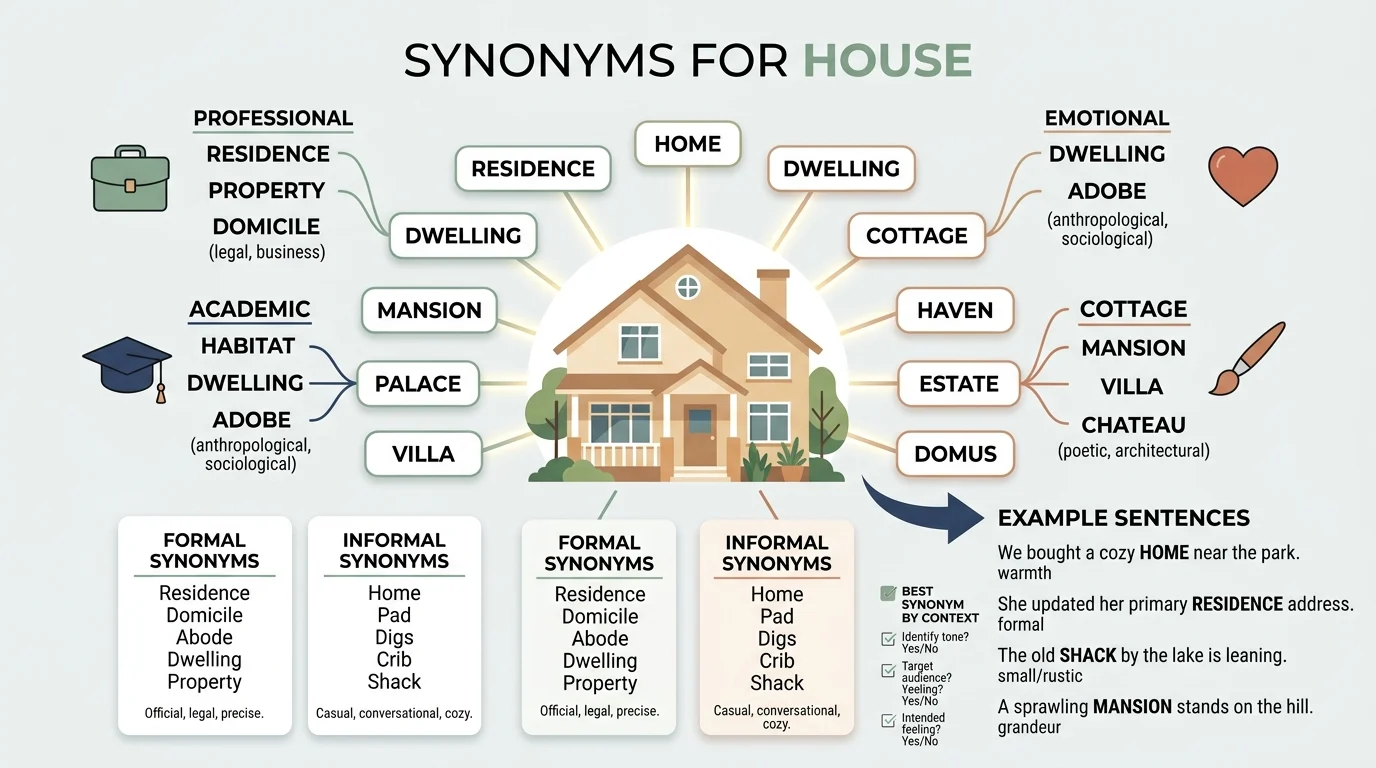
A house is a physical building designed for people to live in. It is typically a standalone structure. The best synonym depends on context. For formal writing choose “residence.” For casual conversation use “home.” Academic work often prefers “dwelling.” Creative writing might use “abode.” Professional contexts favor “property.
Meaning, Tone and Context
Simple Definition: A house is a building that serves as a living space for individuals or families. It provides shelter, privacy, and a place to carry out daily activities.
Part of Speech: Noun (also used as a verb meaning to provide shelter or accommodation).
Tone: Neutral to positive. The word itself carries no strong emotional charge unless modified by adjectives.
Formality Level: Neutral. “House” works in nearly any context from casual conversation to formal documents.
Common Use Cases:
- Real estate descriptions
- Everyday conversation
- Professional writing about property
- Legal documents
- Storytelling and creative writing
Important Word Forms: The verb form means to provide accommodation. The adjective “household” relates to the people living in a house. “Housewarming” refers to a celebration for a new home.
When and How to Use “House”
Use “house” when you are referring to the physical structure itself. It is the most versatile and widely understood term for a residential building.
Professional Example:
The company purchased the house for employee housing.
Personal Example:
We finally found a house with a big backyard for the kids.
Academic Example:
The study examined energy efficiency in single family houses.
Emotional Example:
Walking through that old house brought back so many childhood memories.
Creative Example:
The house stood alone on the hill, its windows dark and empty.
Social Media Example:
Found the cutest little house for sale in our favorite neighborhood.
Another Word for “House”
The best single replacement depends entirely on what you want to communicate. Here are specific recommendations for different contexts.
Professional Writing: Residence or property. These terms sound more formal and business appropriate.
Academic Writing: Dwelling or domestic unit. These words are precise and research friendly.
Casual Conversation: Home or place. These are natural and comfortable in everyday speech.
Emotional Writing: Home or haven. These words carry warmth and personal meaning.
Creative Writing: Abode or dwelling. These add literary flair and descriptive depth.
Resume or Workplace: Property or asset. These terms emphasize value and professional significance.
Social Media Captions: Home sweet home or spot. These feel personal and engaging for posts.
Stronger Meaning: Mansion, estate, or palace. Use these for grand and impressive dwellings.
Softer Meaning: Cottage or bungalow. These suggest coziness and modest size.
When Not to Use “House”
“House” can sound too vague when you need to describe specific architectural styles or property types. It may also feel too casual in formal legal documents.
Vague Use:
They have a beautiful house.
Better:
They have a beautiful Victorian home with original details.
Too Casual:
The company owns several houses in the city center.
Better:
The company owns several commercial properties in the city center.
Too General:
We need to find a house for the conference.
Better:
We need to find a venue with conference facilities.
A precise synonym can strengthen your writing and clarify your meaning.
Words Commonly Confused With “House”
House vs. Home
A house is a physical structure. Home is an emotional concept. Home refers to where someone lives and feels a sense of belonging. Use house for the building itself. Use home for the feeling of comfort and ownership.
House vs. Building
All houses are buildings, but not all buildings are houses. A building is any constructed structure. A house specifically refers to residential buildings. Use building for offices, stores, or schools. Use house only for places where people live.
House vs. Mansion
A mansion is a very large, impressive house. The difference is primarily size and luxury. Use mansion for grand, often historic properties. Use house for standard residential buildings.
House vs. Cottage
A cottage is a small, cozy house often in a rural or country setting. The difference is size and location. Use cottage for charming, compact dwellings. Use house for any size residential building.
House vs. Apartment
An apartment is a unit within a larger building. A house is a standalone structure. Use apartment for units in multi story buildings. Use house for separate dwellings.
House vs. Property
Property is a broader legal term that can include land and buildings. House refers only to the building. Use property in real estate and legal contexts. Use house when focusing on the building itself.
Best Synonym by Context for “House”
| Context | Best Synonym | Why It Works | Example |
|---|---|---|---|
| Formal Writing | Residence | This term sounds official and proper. | The ambassador’s residence is located in the diplomatic quarter. |
| Academic Writing | Dwelling | This word is precise and research oriented. | The study examined housing conditions in urban dwellings. |
| Professional Business | Property | This emphasizes value and investment. | The commercial property has excellent market potential. |
| Real Estate Listing | Single Family Home | This provides specific market information. | This charming single family home features three bedrooms. |
| Casual Conversation | Place | This is relaxed and natural in speech. | We are looking for a new place near the city center. |
| Creative Writing | Abode | This adds literary and descriptive quality. | The old wizard’s abode stood hidden among the ancient trees. |
| Emotional Tone | Home | This carries warmth and personal connection. | There is no place like home after a long trip. |
| Strong Intensity | Estate | This implies luxury and impressive scale. | The sprawling estate includes a vineyard and private lake. |
| Soft Moderate Tone | Cottage | This suggests coziness and modest charm. | They spent summer in a beautiful cottage by the sea. |
| Social Media Captions | Crib | This feels modern and casual. | Check out my new crib in the city. |
| US Usage | House | This is the standard American term. | The house is located in a quiet suburban neighborhood. |
| UK Usage | Flat | This refers to an apartment in British English. | Their flat overlooks the Thames River. |
Which Synonym Should You Choose?
Your choice depends on what you want to communicate and who your audience is.
Consider the formality level you need. Formal reports and legal documents require precise terms like “residence” or “property.” Casual conversations work perfectly with “house” or “place.”
Think about emotional impact. If you want to create warmth and personal connection, choose “home.” If you need a factual, neutral tone, stick with “house” or “dwelling.”
Consider your audience’s expectations. Real estate professionals expect market specific language like “single family home.” Creative readers appreciate descriptive alternatives like “abode.”
Match the intensity to the situation. An ordinary house becomes “estate” for luxury properties and “cottage” for cozy retreats.
Real Life Examples of “House” in Sentences
School Context:
The students studied the architectural features of different houses around the world.
Workplace Context:
Our company is relocating to a new house that has been converted into offices.
Writing Context:
The author described the house in such vivid detail that it felt like a character in the story.
Conversation Context:
We are having dinner at our house on Friday night if you want to come.
Social Media Context:
Swipe to see the before and after transformation of our house renovation.
Email Context:
Thank you for coming to our house for the holiday gathering last weekend.
Storytelling Context:
The old house at the end of the street had been abandoned for decades.
15 Synonyms for “House”
| Synonym | Simple Meaning | Best Used For | Example Sentence |
|---|---|---|---|
| Home | Where someone lives permanently | Emotional or personal writing | The soldiers longed to return to their homes. |
| Residence | A place where someone lives | Formal and official documents | The governor’s official residence is open for tours. |
| Dwelling | A building for living in | Academic and technical writing | Native Americans created dwellings suited to their environment. |
| Property | A building with its land | Real estate and business contexts | The property includes a main house and two guest cottages. |
| Abode | A place where someone lives | Creative and literary writing | The hermit’s mountain abode was simple but peaceful. |
| Cottage | A small cozy house | Casual and descriptive writing | Their seaside cottage had a thatched roof. |
| Villa | A large luxurious house | Travel and lifestyle writing | The Italian villa overlooked the Mediterranean coast. |
| Mansion | A very large impressive house | Real estate and aspirational contexts | The historic mansion had thirty two rooms. |
| Estate | A large property with land | Luxury and formal contexts | The sprawling estate has been in the family for generations. |
| Condo | An individual unit in a larger complex | Urban and modern contexts | Their condo offers stunning views of the city skyline. |
| Bungalow | A small single story house | Architectural and descriptive writing | The beach bungalow had a wrap around porch. |
| Townhouse | A multilevel house sharing walls | Real estate and urban contexts | They purchased a townhouse in the historic district. |
| Crib | A place of residence | Casual conversation and social media | Let’s gather at my crib for the game tonight. |
| Pad | An informal place to live | Extremely casual contexts | He has a cool pad in the trendy part of town. |
| Haven | A safe or peaceful place | Emotional and descriptive writing | Their home was a haven from the busy city. |
Synonym Groups and Usage Differences
Professional vs. Personal Synonyms
Professional contexts favor words like “residence,” “property,” and “estate.” These sound business like and official. Personal situations allow more emotional words like “home” and “haven.” Choose based on your audience and purpose.
Formal vs. Conversational Synonyms
Formal writing demands precise words like “dwelling” and “residence.” These work well in reports, legal documents, and academic papers. Conversational writing allows simpler words like “house,” “place,” and even “crib.” Match your word choice to your writing situation.
Academic Synonyms
Academic writing benefits from precise vocabulary. “Dwelling” is excellent for research papers. “Domestic unit” works in sociological studies. “Habitation” is useful in anthropological contexts. These words show academic precision.
Professional and Business Synonyms
Business professionals should use “property,” “asset,” or “real estate.” These terms convey value and investment. “Residence” works well in formal communications. Avoid casual alternatives like “crib” in professional settings.
Creative or Literary Synonyms
Creative writers have many options for descriptive variety. “Abode” adds a literary touch. “Dwelling” sounds poetic. “Haven” creates emotional imagery. “Homestead” evokes rural settings. These alternatives add depth to your writing.
Slang or Modern Synonyms
Slang terms like “crib” and “pad” are acceptable in very casual situations. Social media posts and conversations with friends are appropriate contexts. Avoid these terms in formal writing, professional communications, or academic papers.
Strongest vs. Weaker Synonyms
Intensity Scale from Mild to Strong:
- Mild: Place, pad
- Moderate: House, dwelling
- Strong: Mansion, estate
- Very Strong: Palace, castle
Emotional vs. Neutral Synonyms
Emotional synonyms include “home,” “haven,” and “sanctuary.” These words create feelings of comfort, belonging, and safety. Neutral synonyms like “dwelling,” “structure,” and “building” are factual and objective. Choose based on your desired tone.
Antonyms of “House”
| Antonym | Meaning | Example Sentence |
|---|---|---|
| Open space | An area without buildings | The open space between houses became a community garden. |
| Field | An open area of land | The field beyond the houses was full of wildflowers. |
| Vacant lot | An empty piece of land | The vacant lot next door was finally purchased. |
| Wilderness | Undeveloped natural land | The wilderness began where the last houses ended. |
| Shelter | A temporary protection | A tent provided shelter where a house had once stood. |
| Outdoors | The area outside | They spent their vacation outdoors rather than in a house. |
| Street | A public road | The street was lined with houses on both sides. |
| Business | A commercial establishment | The old house was converted into a business. |
| Factory | An industrial building | The factory replaced the houses that once stood there. |
| Office | A workplace | The house was converted into an office building. |
| Warehouse | A storage building | The warehouse was larger than the surrounding houses. |
| Store | A retail building | The house was torn down to build a store. |
| Park | A public green space | The park provided recreation where houses once stood. |
| Campus | A group of buildings | The campus houses students in dormitories instead of houses. |
| Facility | A building for a specific purpose | The facility replaced the residential houses in that area. |
Comparison: House vs. Similar Words
House vs. Home
Main Difference: House is a physical structure. Home is an emotional concept.
Which Is Stronger: Home carries stronger emotional weight.
Which Is More Formal: Neither, but house is more neutral.
Example for House:
The house has four bedrooms and two bathrooms.
Example for Home:
This house became a home when our family moved in.
House vs. Residence
Main Difference: Residence is more formal and official.
Which Is Stronger: Residence sounds more impressive.
Which Is More Formal: Residence is clearly more formal.
Example for House:
The house needs some exterior painting.
Example for Residence:
The official residence is open to the public for tours.
House vs. Dwelling
Main Difference: Dwelling is technical and academic.
Which Is Stronger: Dwelling is more precise.
Which Is More Formal: Dwelling is more formal.
Example for House:
We are looking for a house with a garage.
Example for Dwelling:
Ancient dwellings were discovered at the archaeological site.
House vs. Property
Main Difference: Property includes land and buildings, not just the structure.
Which Is Stronger: Property implies greater value.
Which Is More Formal: Property is very formal.
Example for House:
The house is located on a quiet street.
Example for Property:
The commercial property increased significantly in value.
House vs. Mansion
Main Difference: Mansion is a very large, impressive house.
Which Is Stronger: Mansion is much stronger.
Which Is More Formal: Mansion is more formal.
Example for House:
Their house is comfortable and modern.
Example for Mansion:
The mansion has twenty rooms and extensive gardens.
House vs. Cottage
Main Difference: Cottage is small and charming.
Which Is Stronger: Cottage implies coziness, not size.
Which Is More Formal: Cottage is informal and descriptive.
Example for House:
The house is perfect for a growing family.
Example for Cottage:
The cottage is ideal for a peaceful weekend getaway.
Common Phrases and Expressions with “House”
1. House of cards
Meaning: A fragile or unstable situation that could collapse easily.
Example Sentence: Their business plan was a house of cards that fell apart quickly.
2. Bring the house down
Meaning: To receive very enthusiastic applause or laughter.
Example Sentence: The comedian brought the house down with his hilarious jokes.
3. On the house
Meaning: Something provided free of charge by a business.
Example Sentence: The restaurant offered dessert on the house to apologize for the delay.
4. Keep house
Meaning: To manage a household and perform domestic duties.
Example Sentence: Her grandmother taught her how to keep house efficiently.
5. Full house
Meaning: A completely filled venue or a poker hand with three of a kind and a pair.
Example Sentence: The theater had a full house for the opening night performance.
6. Housewarming party
Meaning: A celebration held when someone moves into a new home.
Example Sentence: They invited all their friends to a housewarming party at their new place.
7. Safe as houses
Meaning: Very secure and unlikely to cause problems.
Example Sentence: This investment is safe as houses, with guaranteed returns.
8. Set your house in order
Meaning: To organize your affairs or solve your problems.
Example Sentence: Before expanding the business, we need to set our house in order.
Common Mistakes to Avoid
1. Using “house” when a more precise synonym is better
Saying “the house” repeatedly in a real estate listing sounds amateurish. Vary your language with “property,” “residence,” or “home.”
2. Confusing “house” with “home” in formal writing
Legal documents should use “residence” or “dwelling” rather than “home.” Home is emotional and personal, which may not suit official contexts.
3. Using a casual synonym in formal writing
Do not use “crib” in a professional report. This undermines your credibility. Choose “residence” or “property” for formal documents.
4. Using an overly dramatic synonym for a simple situation
Describing a modest suburban house as a “mansion” will confuse readers. Use accurate terms that match the actual property.
5. Repeating the same word too often
Variety keeps your writing fresh. Mix “house,” “home,” “property,” and “residence” appropriately throughout your text.
6. Choosing a synonym with the wrong emotional tone
Using “dwelling” in a sentimental description of your childhood home sounds cold. Choose “home” or “haven” for emotional contexts.
7. Using slang in academic or professional writing
Avoid “pad” or “crib” in serious contexts. These words are too casual and diminish your professional authority.
FAQs
What is the best synonym for house?
The best synonym depends on context. Use “residence” for formal writing, “home” for emotional writing, and “property” for real estate contexts.
What is a formal synonym for house?
“Residence” and “dwelling” are excellent formal alternatives. These terms work well in official documents and academic writing.
What is an informal synonym for house?
“Place,” “crib,” and “pad” are informal alternatives. Use these only in casual conversation or social media posts.
What is another word for house in professional writing?
“Property,” “asset,” or “residence” are professional alternatives. These terms sound business appropriate and credible.
What is the difference between house and home?
A house is a physical building. A home is the emotional concept of where someone lives. House focuses on structure. Home focuses on feeling.
What is the opposite of house?
“Open space,” “field,” or “business” can serve as opposites depending on context. The most direct opposite is an open area without structures.
Conclusion
The word “house” serves as a versatile foundation for describing living spaces. But the English language offers a rich variety of synonyms that allow you to communicate with precision and style. Choose “residence” for formal contexts, “home” for emotional connections, and “property” for professional settings.
Remember that your word choice affects tone, meaning, and reader perception. A “cottage” feels cozy while a “mansion” suggests luxury. An “abode” sounds literary while a “crib” feels modern and casual.
The best vocabulary tip is to consider your audience, purpose, and context before selecting a synonym. This awareness will make your writing more effective and engaging. Practice using these alternatives in your daily communication and watch your vocabulary grow stronger.