Picture this. You are writing an important email to your boss. You describe a key requirement as “essential.” Then you write it again in the next sentence. And again in the next paragraph. Your writing starts to feel repetitive, but you are not sure which other word to use.
This happens to everyone. Writers, students, and professionals all struggle with finding the right synonym for “essential.” The word is useful, but overusing it can make your writing feel dull and uninspired.
What Are the Best Synonyms of “Essential”?
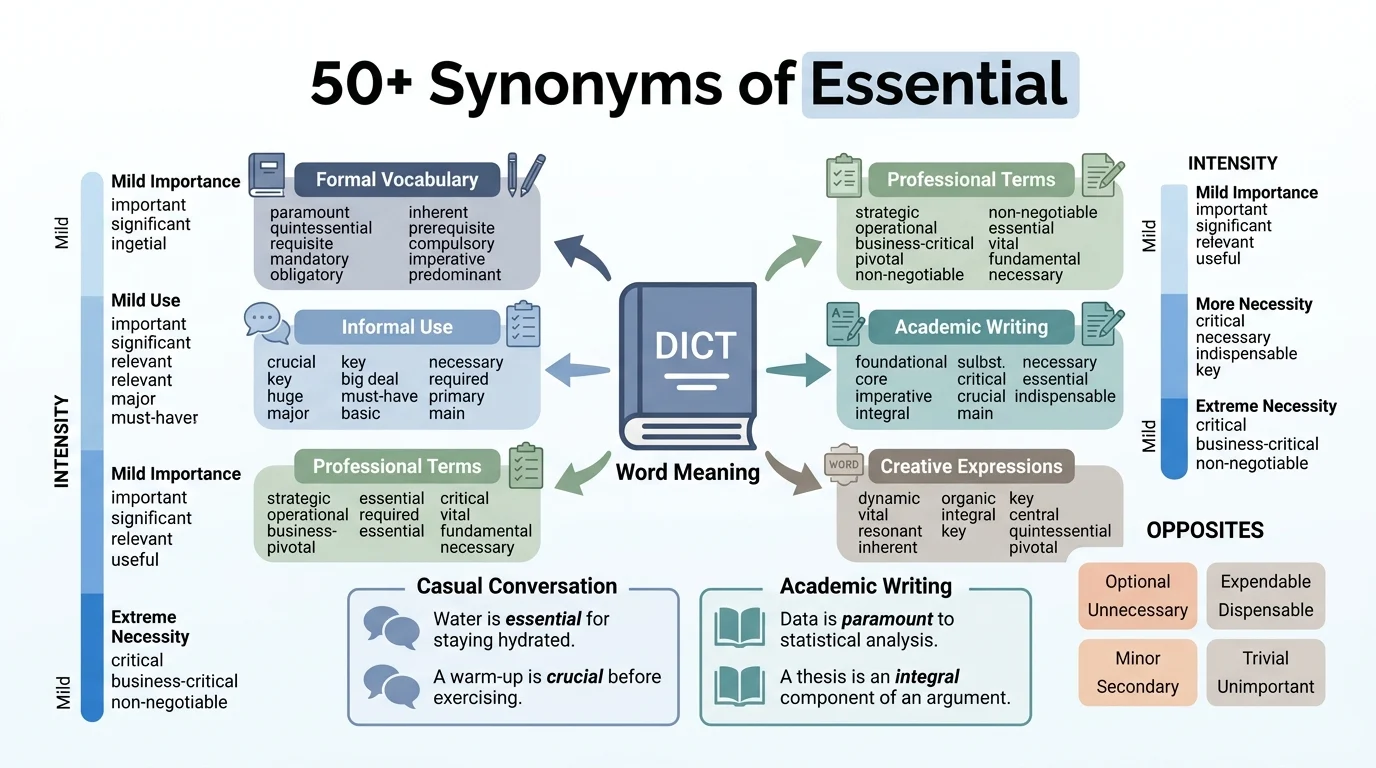
“Essential” means absolutely necessary or extremely important. It describes something that cannot be missed or ignored. The best synonyms depend on your context.Professional writing, choose “vital” or “paramount.” For academic work, use “indispensable” or “fundamental.” Casual conversation, “must-have” or “key” work well. For creative writing, try “integral” or “critical.”
Meaning, Tone, and Context
Simple Definition
Essential describes something that is absolutely necessary. It refers to the core parts of something that cannot be removed or ignored without causing failure or serious problems.
Part of Speech
Essential is primarily an adjective. It is also used as a noun, meaning a basic or necessary item, such as “travel essentials.”
Overall Tone
Essential is neutral but carries a sense of urgency and importance. It communicates that something is not optional.
Formality Level
Essential is semi-formal. It works well in professional, academic, and everyday situations. It is formal enough for business reports but natural enough for casual conversations.
Common Uses
Native English speakers use “essential” in many contexts. You will hear it in workplace meetings, academic lectures, news reports, and everyday conversations. It frequently appears in instructions, requirements, and recommendations.
Word Forms
- Adjective: essential
- Noun: essential (as in “the essentials”)
- Adverb: essentially (meaning fundamentally)
- Related noun: essentiality (meaning the quality of being essential)
When and How to Use “Essential”
Choose “essential” when you want to emphasize that something is not optional. It works best when you need to stress the importance of an item, skill, quality, or action. Use it when the stakes are clear and the consequences of omission are serious.
Here are realistic examples showing “essential” in different contexts.
Professional Context
“Regular communication is essential for maintaining strong client relationships.”
Academic Context
“Critical thinking skills are essential for conducting valid research.”
Workplace Context
“Safety training is essential for all new employees before they begin working.”
Personal Context
“Getting enough sleep is essential for maintaining good health.”
Email Context
“Please review the attached documents. Your approval is essential before we can proceed.”
Resume Context
“Managed essential supply chain operations that reduced costs by 15 percent.”
Social Media Context
“Good lighting is essential for taking high quality photos.”
Best Synonyms of “Essential”
No two synonyms are exactly the same. Each alternative carries its own shade of meaning, emotional weight, and level of formality. Here are the best synonyms for essential based on specific contexts.
Professional Writing
Vital is the best professional synonym. It suggests something is not just important but absolutely necessary for success or survival. Business professionals respond well to this word because it conveys urgency without sounding dramatic.
Academic Writing
Indispensable works best in academic contexts. It shows that something is so essential that it cannot be done without. Academics and researchers use this word to describe foundational theories, methods, or resources.
Business Communication
Imperative is ideal for business communication. It signals that something is not optional and requires immediate attention. Use this when you need to motivate action or emphasize compliance.
Casual Conversation
Must-have is the most natural choice for everyday talk. It is informal, direct, and easy to understand. Friends and family will immediately grasp what you mean.
Emotional Writing
Crucial adds emotional weight to your statement. It suggests that something is essential at a critical moment. This word works well when you want to create a sense of urgency or importance.
Creative Writing
Integral is a beautiful choice for creative writing. It suggests that something is an essential part of a whole. Use this when describing characters, plot elements, or themes that cannot be separated from the story.
Resume Writing
Core is an excellent synonym for resumes. It describes fundamental skills, responsibilities, or achievements that define your professional identity. Employers appreciate this clear, confident language.
Workplace Communication
Key is straightforward and effective in workplace settings. It highlights essential points without overstating their importance. Colleagues will understand your message immediately.
Stronger Meaning
Paramount conveys the strongest level of importance. It suggests that something is more important than everything else. Use this when you need to show absolute priority.
Softer Meaning
Basic offers a milder alternative. It describes fundamental elements without emphasizing urgency. Use this when discussing simple, foundational ideas.
When Not to Use “Essential”
There are situations where “essential” is not the best choice. Understanding these moments will help you communicate more effectively.
When the Word Sounds Too General
“Good communication is essential for teamwork.”
This sentence is true but vague. It does not explain what kind of communication or why it matters.
Better: “Clear and honest communication is vital for building team trust and preventing misunderstandings.”
When the Word Sounds Too Formal
“Your presence at the party is essential.”
This sounds overly formal for a casual invitation. It might make your friends feel pressured.
Better: “We really hope you can make it to the party.”
When the Word Sounds Too Strong
“Buying this product is essential.”
This sounds like a sales pitch. It may come across as pushy or exaggerated.
Better: “This product can significantly improve your daily routine.”
When the Word Sounds Too Weak
“The training session is essential but not mandatory.”
This is confusing. If something is essential, it should be mandatory. The contradiction weakens your message.
Better: “The training session is required for all team members.”
When the Word Sounds Outdated
In very informal contexts, “essential” can feel too serious. Texting with friends or writing social media captions often calls for more casual language.
Words Commonly Confused With “Essential”
Many English learners and even native speakers confuse “essential” with similar words. Here are the most common confusions.
Essential vs. Necessary
Difference: All essential things are necessary, but not all necessary things are essential. Essential suggests a higher level of importance. Necessary simply means required.
When to Use It: Use “necessary” when something is required but not critical. Use “essential” when something is absolutely critical.
Example: “Bringing a passport is necessary for international travel. A sense of adventure is essential for truly enjoying the experience.”
Essential vs. Important
Difference: Important describes something with significant value or consequence. Essential describes something that cannot be done without. Essential is stronger than important.
When to Use It: Use “important” for things that matter. Use “essential” for things that are non-negotiable.
Example: “Regular exercise is important for health. Proper hydration is essential for survival.”
Essential vs. Vital
Difference: Vital and essential are very close in meaning. Vital often relates to life, health, or survival. Essential is broader and can apply to any critical element.
When to Use It: Use “vital” when discussing life or death situations or critical success factors. Use “essential” for general necessity.
Example: “Oxygen is vital for human life. Good planning is essential for project success.”
Essential vs. Fundamental
Difference: Fundamental describes the basic structure or foundation of something. Essential describes what is absolutely necessary. Fundamental focuses on building blocks. Essential focuses on requirements.
When to Use It: Use “fundamental” when discussing core principles or foundations. Use “essential” when emphasizing necessity.
Example: “Honesty is a fundamental value in our organization. Training is essential for new employees to succeed.”
Essential vs. Critical
Difference: Critical suggests urgency and potentially serious consequences. Essential simply states necessity without implying emergency.
When to Use It: Use “critical” when timing matters or when failure would cause major problems. Use “essential” for general necessity.
Example: “The patient needs critical care immediately. Regular checkups are essential for maintaining health.”
Essential vs. Indispensable
Difference: Indispensable is a stronger version of essential. It means absolutely impossible to do without. Essential simply means extremely necessary.
When to Use It: Use “indispensable” when you want to emphasize that something is irreplaceable. Use “essential” for strong necessity.
Example: “Her leadership was indispensable during the crisis. Good communication is essential for team success.”
Best Synonyms of “Essential” by Context
| Context | Best Synonym | Why It Works | Example |
|---|---|---|---|
| Formal writing | Vital | Conveys urgency and high importance | “Accurate data is vital for making informed decisions.” |
| Academic writing | Indispensable | Suggests irreplaceable value | “This theory is indispensable to understanding economic behavior.” |
| Professional communication | Imperative | Signals non-optional action | “It is imperative that we meet the deadline.” |
| Business emails | Key | Clear, concise, and professional | “The key point is that we need more resources.” |
| Resume writing | Core | Highlights fundamental skills | “Core competencies include project management and strategic planning.” |
| Workplace communication | Fundamental | Describes basic principles | “Respect is fundamental to our company culture.” |
| Casual conversation | Must-have | Informal and natural | “A good coffee maker is a must-have in this kitchen.” |
| Everyday speaking | Important | Simple and clear | “It’s important to stay hydrated during summer.” |
| Creative writing | Integral | Suggests something is part of a whole | “Her courage is integral to the story’s resolution.” |
| Storytelling | Critical | Adds dramatic tension | “The detective’s discovery was critical to solving the case.” |
| Emotional writing | Crucial | Adds emotional weight | “Your support is crucial during this difficult time.” |
| Strong emphasis | Paramount | Indicates highest priority | “Safety is paramount in all our operations.” |
| Mild tone | Basic | Softens the message | “Basic knowledge of computers is expected.” |
| Social media captions | Essential | Direct and impactful | “Great lighting is essential for amazing photos.” |
| American English | Essential | Widely used and understood | “Experience is essential for this position.” |
How to Choose the Best Synonym of “Essential”
Choosing the right synonym is about understanding your audience, your purpose, and your message. Follow this practical decision guide.
Consider your audience first. If you are writing to business executives, choose professional synonyms like “vital” or “imperative.” If you are writing to friends, choose casual options like “must-have” or “key.”
Think about your tone. If you want to sound formal, select “indispensable” or “fundamental.” If you want to sound conversational, choose “important” or “necessary.”
Evaluate the emotional weight. Some synonyms carry stronger emotions. “Crucial” and “critical” suggest urgency. “Basic” and “necessary” are more neutral. Match the emotional level to your message.
Consider the stakes. If failure would cause serious problems, use strong synonyms like “vital” or “paramount.” If the consequences are minor, use milder alternatives.
Read your sentence aloud. Natural sounding language is always better. If a synonym feels awkward or forced, choose a different one.
Avoid overcomplicating. Sometimes the simplest choice is the best. Using “essential” itself is perfectly acceptable. Save the synonyms for when you need variety or specific emphasis.
Real Life Examples of “Essential”
Seeing “essential” and its synonyms in real situations helps you understand how to use them naturally.
School
“The teacher explained that punctuation is essential for clear writing.”
College
“Time management is essential for balancing coursework and part time jobs.”
Workplace
“Regular feedback is essential for helping employees grow and develop.”
Business
“Customer trust is essential for building a strong brand reputation.”
“Your response by Friday is essential for us to complete the project on time.”
Resume
“Developed essential leadership skills while managing a team of 12 employees.”
Conversation
“I think good communication is essential in any relationship.”
Storytelling
“The wise mentor was essential to the hero’s journey of self discovery.”
Blogging
“Using high quality images is essential for keeping readers engaged.”
Social Media
“Captions are essential for connecting with your audience on a personal level.”
Improved Example with Stronger Synonym
Original: “Teamwork is essential for success.”
Improved: “Collaboration is vital for achieving our team goals.”
Original: “This step is essential in the process.”
Improved: “This step is indispensable to the entire process.”
Original: “A good leader is essential.”
Improved: “A good leader is integral to the team’s performance.”
18 Best Synonyms of “Essential”
| Synonym | Simple Meaning | Best Used For | Example Sentence |
|---|---|---|---|
| Vital | Absolutely necessary for success or life | Professional writing, health contexts | “Regular exercise is vital for maintaining heart health.” |
| Indispensable | Impossible to do without | Academic writing, formal contexts | “Her research is indispensable to the scientific community.” |
| Crucial | Extremely important, especially at a critical moment | Emotional writing, urgent situations | “Your support during this transition is crucial.” |
| Imperative | Essential and requiring immediate action | Business communication, instructions | “It is imperative that all employees attend the safety briefing.” |
| Key | Extremely important or central | Workplace communication, casual contexts | “Time management is a key skill for remote workers.” |
| Fundamental | Basic and forming the core of something | Academic writing, describing principles | “Trust is fundamental to any successful partnership.” |
| Paramount | More important than anything else | Strong emphasis, formal contexts | “Customer satisfaction is paramount in our industry.” |
| Critical | Essential at a decisive point | Storytelling, urgent situations | “The pilot’s experience was critical during the emergency.” |
| Integral | Essential as part of a whole | Creative writing, describing connections | “Music is integral to the film’s emotional impact.” |
| Necessary | Required but not necessarily critical | Everyday conversation, basic requirements | “A valid ID is necessary for entering the building.” |
| Basic | Fundamental and simple | Mild tone, describing foundations | “Basic knowledge of Excel is required for this job.” |
| Compulsory | Required by rules or laws | Formal rules, legal contexts | “Safety training is compulsory for all construction workers.” |
| Mandatory | Required by authority | Formal instructions, workplace rules | “Attendance at the weekly meeting is mandatory.” |
| Principal | Primary or most important | Formal writing, describing main elements | “The principal reason for the delay was budget constraints.” |
| Central | Main or most important | Descriptive writing, emphasizing importance | “Family values are central to their decision making.” |
| Necessary | Absolutely needed but less urgent | General use, everyday situations | “Warm clothing is necessary for cold weather.” |
| Required | Demanded by rules or expectations | Formal instructions, job descriptions | “A degree is required for this position.” |
| Significant | Meaningful and noteworthy | Descriptive writing, moderate emphasis | “Her contribution was significant to the project’s success.” |
Synonyms of “Essential” by Usage
Professional vs Personal Synonyms
Professional contexts demand precise, confident language. “Vital,” “imperative,” and “fundamental” convey authority and seriousness. These words signal that you take the matter seriously.
Personal contexts allow more relaxed language. “Must-have,” “big deal,” and “key” feel natural and friendly. They help you connect with friends, family, and casual audiences.
Choose “vital” for performance reviews and business proposals. Choose “must-have” for recommendations to friends.
Formal vs Conversational Synonyms
Formal writing includes academic papers, official reports, and legal documents. For these contexts, use “indispensable,” “paramount,” or “compulsory.” These words sound authoritative and precise.
Conversational writing includes emails to colleagues, social media posts, and casual blog writing. For these contexts, use “key,” “important,” or “necessary.” These words are clear and accessible.
Academic Synonyms
Academic writing requires precision and authority. Use these synonyms for research papers, essays, and scholarly discussions:
- Indispensable suggests something is absolutely necessary for the research
- Fundamental describes core theories and principles
- Integral shows how concepts are connected
- Central highlights the main focus of the research
- Paramount emphasizes the highest priority
These words sound authoritative and demonstrate sophisticated vocabulary.
Professional and Business Synonyms
Professional environments value clarity and confidence. Use these synonyms for resumes, interviews, and business communication:
- Vital shows you understand what truly matters
- Imperative signals non-negotiable requirements
- Core describes fundamental skills and responsibilities
- Key highlights important qualifications
- Critical shows you understand high stakes situations
Employers and business partners respond well to confident, specific language.
Creative and Literary Synonyms
Creative writing benefits from vivid, expressive language. Use these synonyms for storytelling, poetry, and descriptive writing:
- Integral suggests beautiful connections between elements
- Fundamental describes deep, foundational ideas
- Central emphasizes what truly matters in the story
- Indispensable shows irreplaceable value
- Vital adds energy and urgency
These words help you create emotional resonance and vivid imagery.
Slang or Modern Synonyms
English has a few informal ways to express “essential.” These are best for casual situations.
Must-have is the most common slang synonym. It means something is highly desirable and almost necessary. Use this in everyday conversation, product reviews, and casual recommendations.
Game-changer describes something that completely changes a situation. It suggests the thing is essential for transformation.
Non-negotiable is a modern term meaning absolutely essential and not open to discussion. Use this in both casual and professional contexts.
Avoid slang in formal writing, academic papers, and official business documents.
Strongest to Mildest Synonyms
Understanding the intensity of each synonym helps you choose the right emotional weight.
| Intensity Level | Synonyms |
|---|---|
| Mild | Necessary, Basic, Required |
| Moderate | Important, Key, Central |
| Strong | Vital, Critical, Integral |
| Very Strong | Indispensable, Paramount, Imperative |
Mild synonyms are neutral and factual. Use them for simple requirements and everyday situations.
Moderate synonyms express genuine importance without overstatement. Use them for most professional and academic writing.
Strong synonyms convey urgency and high stakes. Use them when failure is not an option.
Very strong synonyms emphasize absolute priority. Use them sparingly for maximum impact.
Emotional vs Neutral Synonyms
Emotional Synonyms
Some synonyms carry strong emotional weight. They express feelings of urgency, care, or concern.
- Crucial feels urgent and pressing
- Critical suggests danger or serious consequences
- Vital connects to life and survival
- Indispensable shows deep appreciation
- Paramount suggests passionate commitment
Use emotional synonyms when you want to motivate, inspire, or create urgency. They work well in persuasive writing, speeches, and personal messages.
Neutral Synonyms
Other synonyms simply communicate information without emotional coloring.
- Necessary states a fact without emotion
- Required describes rules without enthusiasm
- Key identifies importance without urgency
- Fundamental explains structure without drama
- Basic describes simplicity without judgment
Use neutral synonyms when you need to state facts clearly. They work well in reports, instructions, and technical writing.
Antonyms of “Essential”
| Antonym | Meaning | Example Sentence |
|---|---|---|
| Optional | Available but not required | “The workshop is optional, but I recommend attending.” |
| Unnecessary | Not needed or required | “These extra steps are unnecessary for the basic process.” |
| Nonessential | Not absolutely necessary | “We should reduce nonessential spending this quarter.” |
| Secondary | Less important than primary things | “The decoration is secondary to the main event.” |
| Minor | Small or unimportant in comparison | “This is a minor issue that can be fixed later.” |
| Peripheral | Not directly involved or important | “That concern is peripheral to our main goal.” |
| Dispensable | Able to be omitted or replaced | “This feature is dispensable for the initial launch.” |
| Expendable | Not essential and can be sacrificed | “These items are expendable in the budget.” |
| Unimportant | Lacking significance or value | “The color of the logo is unimportant for now.” |
| Inessential | Not essential; not strictly necessary | “The extra features are inessential to the product.” |
| Extraneous | Irrelevant or not pertinent | “We need to remove extraneous information from the report.” |
| Redundant | Unnecessary because already present | “The duplicate section is redundant and confusing.” |
| Superfluous | More than what is needed | “The lengthy introduction is superfluous and can be cut.” |
| Surplus | More than is required | “We have surplus materials after the project ended.” |
| Trivial | Of little value or importance | “The grammatical error is trivial and easily corrected.” |
Content Quality Rules for Part 2
Comparison: “Essential” vs Similar Words
Essential vs Vital
Main Difference: Vital often relates to life, health, or survival. Essential applies to any situation where something is absolutely necessary. Vital feels more urgent and biologically significant.
Which Is Stronger? Vital is slightly stronger because it suggests life or death consequences.
Which Is More Formal? Both are formal, but vital is more common in medical and scientific contexts.
When to Use Each: Use vital when discussing health, survival, or critical success. Use essential for general necessity in all contexts.
Examples:
Essential: “A good education is essential for career success.”
Vital: “The first few hours after an accident are vital for treatment.”
Essential vs Imperative
Main Difference: Imperative suggests an immediate need for action. Essential states necessity without emphasizing timing. Imperative often appears in instructions and commands.
Which Is Stronger? Imperative is stronger because it demands immediate action.
Which Is More Formal? Both are formal, but imperative is more authoritative.
When to Use Each: Use imperative when you need to motivate action. Use essential for general statements of necessity.
Examples:
Essential: “Good nutrition is essential for growth.”
Imperative: “It is imperative that you submit the report today.”
Essential vs Crucial
Main Difference: Crucial emphasizes a decisive or critical moment. Essential emphasizes overall necessity. Crucial often involves turning points or high stakes decisions.
Which Is Stronger? Crucial carries more emotional weight and urgency.
Which Is More Formal? Both are formal, but crucial is more common in storytelling and emotional writing.
When to Use Each: Use crucial when timing matters or when consequences are severe. Use essential for general requirements.
Examples:
Essential: “Patience is essential for learning a new language.”
Crucial: “The final exam is crucial for passing the course.”
Essential vs Indispensable
Main Difference: Indispensable means something cannot be replaced. Essential means something cannot be removed. Indispensable is the stronger word.
Which Is Stronger? Indispensable is significantly stronger.
Which Is More Formal? Indispensable is more formal and less commonly used in everyday speech.
When to Use Each: Use indispensable when you want to emphasize irreplaceable value. Use essential for strong necessity.
Examples:
Essential: “A good team is essential for project success.”
Indispensable: “Her expertise is indispensable to our research.”
Essential vs Fundamental
Main Difference: Fundamental describes the basic structure or foundation of something. Essential describes what is absolutely necessary. Fundamental is about building blocks. Essential is about requirements.
Which Is Stronger? Both are strong, but essential emphasizes necessity while fundamental emphasizes structure.
Which Is More Formal? Both are formal and academic.
When to Use Each: Use fundamental when describing core principles or foundations. Use essential when emphasizing requirements.
Examples:
Essential: “Good sleep is essential for health.”
Fundamental: “Honesty is a fundamental value in our organization.”
Essential vs Critical
Main Difference: Critical suggests urgency and potentially serious consequences. Essential suggests necessity without implying immediate danger.
Which Is Stronger? Critical is stronger because it implies high stakes and urgency.
Which Is More Formal? Both are formal, but critical is more common in medical and technical contexts.
When to Use Each: Use critical when timing matters or when failure would cause major problems. Use essential for general necessity.
Examples:
Essential: “Regular maintenance is essential for car reliability.”
Critical: “The patient’s condition is critical and requires immediate attention.”
Common Phrases and Expressions with “Essential”
Phrase: Essential oil
Meaning: Natural oils extracted from plants for fragrance or therapeutic use.
Example Sentence: “Lavender essential oil is known for its calming properties.”
Phrase: Essential worker
Meaning: An employee whose job is considered vital to society, especially during emergencies.
Example Sentence: “Essential workers kept the country running during the pandemic.”
Phrase: Essential services
Meaning: Public services such as water, electricity, and healthcare that are necessary for daily life.
Example Sentence: “The government prioritized funding for essential services.”
Phrase: Essential reading
Meaning: Books or articles that are highly recommended or necessary to read.
Example Sentence: “This book is essential reading for anyone interested in history.”
Phrase: Essential equipment
Meaning: Tools or gear that are absolutely necessary for a particular activity.
Example Sentence: “A good computer is essential equipment for graphic designers.”
Phrase: Essential nutrients
Meaning: Vitamins and minerals that the body needs to function properly.
Example Sentence: “Fruits and vegetables provide essential nutrients for good health.”
Phrase: Essential difference
Meaning: The most important or fundamental difference between two things.
Example Sentence: “The essential difference between the two proposals is cost.”
Phrase: Essential character
Meaning: The most basic or defining nature of something.
Example Sentence: “The essential character of the city is its diversity.”
Common Mistakes to Avoid
1: Using “Essential” Too Often
Incorrect: “Essential equipment, essential training, essential skills, and essential experience are all essential for the job.”
Better: “The job requires essential equipment, vital training, core skills, and relevant experience.”
Why: Repetition makes your writing dull. Varying synonyms keeps your writing engaging.
2: Confusing “Essential” with “Important”
Incorrect: “Bringing a phone is essential to the trip.” (When the phone is just helpful)
Better: “Bringing a phone is important but not essential. You can manage without it.”
Why: Essential means cannot be done without. Important means significant but optional.
3: Using “Essential” for Minor Things
Incorrect: “The extra frosting is essential for the cake.”
Better: “The extra frosting adds a nice touch to the cake.”
Why: Essential should be reserved for truly necessary elements, not minor preferences.
4: Overusing Formal Synonyms in Casual Situations
Incorrect: “It is imperative that you attend my birthday party.”
Better: “It would be great if you could come to my birthday party.”
Why: Formal synonyms sound awkward in casual conversations.
5: Using Slang in Professional Writing
Incorrect: “A good work ethic is a must-have for this position.” (In a formal job description)
Better: “A strong work ethic is essential for this position.”
Why: Slang undermines your professional credibility.
6: Choosing the Wrong Emotional Tone
Incorrect: “The team meeting is critical.” (When it is just a routine meeting)
Better: “The team meeting is important for staying updated.”
Why: Critical suggests high stakes and urgency. Overusing it reduces its impact.
7: Using “Essential” Without Context
Incorrect: “This is essential.”
Better: “This is essential for meeting our deadline.”
Why: Readers need to understand why something is essential. Always explain the reason.
Frequently Asked Questions
1. What are the best synonyms of “essential”?
The best synonyms depend on your context. Professional writing, use vital or imperative. For academic writing, use indispensable or fundamental. For casual conversation, use key or must-have. Choose the word that matches your tone and audience.
2. What are the best formal synonyms of “essential”?
The best formal synonyms include indispensable, imperative, paramount, fundamental, and vital. These words convey authority and precision. Use them in academic papers, business reports, and professional correspondence.
3. What are common informal synonyms of “essential”?
Common informal synonyms include must-have, key, necessary, and important. These words are natural in everyday conversation, social media, and casual emails. They help you sound friendly and approachable.
4. What is another word for “essential” in professional writing?
In professional writing, choose vital, imperative, or core. Vital emphasizes critical importance. Imperative signals non-negotiable action. Core describes fundamental responsibilities. Each word adds authority to your professional communication.
5. What is the difference between “essential” and “vital”?
Essential means absolutely necessary. Vital often relates to life, health, or critical success. Vital is generally stronger and more urgent. Use essential for general necessity. Use vital for high stakes or survival situations.
6. What is the opposite of “essential”?
The opposite of essential includes optional, unnecessary, nonessential, secondary, and dispensable. These words describe things that are not required or can be omitted without negative consequences. Use them when you want to emphasize choice or flexibility.
Conclusion
“Essential” is a powerful word that describes things we simply cannot do without. It signals importance, necessity, and urgency. But no single word works perfectly in every situation.
The best synonyms of essential include vital for professional contexts, indispensable for academic writing, must-have for casual conversation, and integral for creative expression. Each synonym carries its own tone, emotional weight, and level of formality.
The key to choosing the right synonym is understanding your audience, your purpose, and your message. Think about whether you need to sound formal or friendly, urgent or relaxed, emotional or neutral. Then choose the word that communicates your intention most clearly.
Remember that variety strengthens your writing. Using the same word repeatedly makes your writing feel tired and unoriginal. Expanding your vocabulary helps you express yourself with precision and confidence.
So the next time you reach for “essential,” pause and consider whether a stronger, milder, or more specific synonym would serve you better. Your readers will thank you.