Have you ever found yourself writing an email, an essay, or a social media caption and realized you have used the word “analyze” three times in two paragraphs? It happens to everyone. You know what you want to say, but repeating the same word makes your writing feel flat and unpolished. Whether you are a student working on a research paper, a professional drafting a report, or a blogger trying to keep readers engaged, finding the right synonyms of analyze can transform your communication. The word itself is useful, but overusing it weakens your message. Choosing a more precise alternative helps you sound clearer, more confident, and more professional. This guide will help you understand what “analyze” really means, explore the best synonyms for every situation, and avoid common mistakes that even experienced writers make.
What Are the Best Synonyms of “Analyze”?
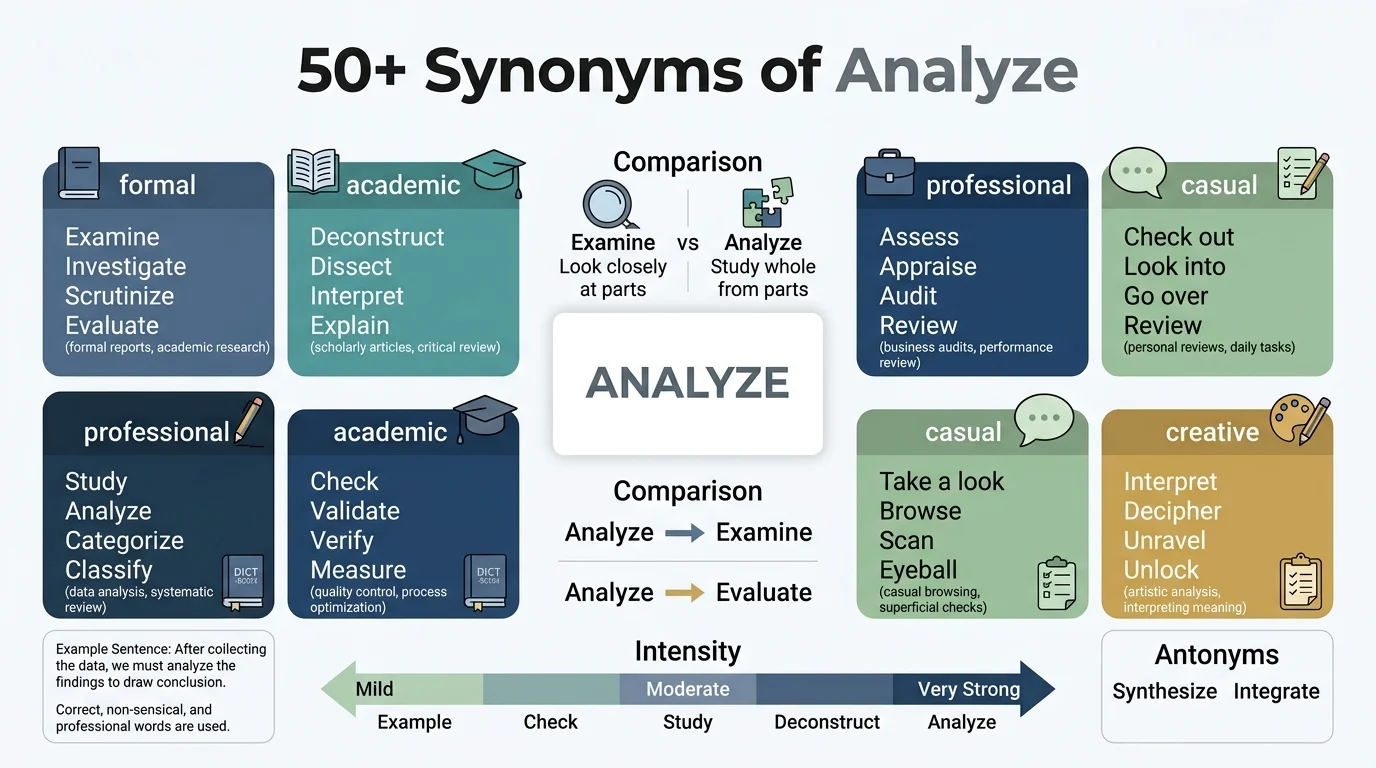
“Analyze” means to study something closely and carefully by breaking it down into smaller parts to understand how it works or what it means. For formal writing, choose examine or scrutinize. Academic work, use investigate or evaluate. Casual conversation, try check out or look into. For professional communication, assess and review work well. For emotional or creative writing, consider probe or dissect.
Meaning, Tone, and Context
Simple Definition
To analyze something means to study it in a detailed and methodical way, often by separating it into its individual parts to understand the whole. When you analyze, you are not just looking at something. You are actively trying to figure out why it works the way it does, what its components are, and how those components relate to each other.
Part of Speech
Analyze is a verb. The noun form is analysis, the adjective forms are analytic and analytical, and the adverb form is analytically.
Overall Tone
Analyze is a neutral word. It does not carry a positive or negative emotional charge on its own. The tone depends entirely on what you are analyzing and why.
Formality Level
Analyze is semi-formal to formal. It is perfectly acceptable in academic writing, professional reports, and everyday conversation. It is not overly stuffy, but it is also not casual slang.
Common Uses
Native English speakers use “analyze” in a wide range of situations:
- Science and research: analyzing data, samples, or results
- Business: analyzing sales figures, market trends, or performance metrics
- Education: analyzing literature, historical events, or arguments
- Everyday life: analyzing a problem, a situation, or someone’s behavior
Word Forms
- Verb: analyze (American spelling) or analyse (British spelling)
- Noun: analysis (singular), analyses (plural)
- Adjective: analytic, analytical
- Adverb: analytically
- Related noun (person): analyst
When and How to Use “Analyze”
Choose “analyze” when you need to describe a careful, systematic examination of something. It works best when you are breaking down a complex topic into manageable pieces to understand it better. Here are seven realistic examples showing how to use it in different contexts.
Professional: “Our team needs to analyze the quarterly sales data before we present our findings to the board.”
Academic: “The professor asked us to analyze the author’s use of symbolism throughout the novel.”
Workplace: “Before we launch the new product, we should analyze customer feedback from the beta test.”
Personal: “I need to analyze my spending habits if I want to save money for a vacation.”
Email: “Could you please analyze the attached report and share your recommendations by Friday?”
Resume: “Analyzed customer behavior patterns to identify opportunities for increasing retention rates.”
Social Media: “Let’s analyze the engagement metrics from last week’s posts to see what content performed best.”
Best Synonyms of “Analyze”
No synonym is identical to “analyze” in every situation. Each alternative carries a slightly different shade of meaning, emotional weight, and level of formality. Here are the best synonyms for specific contexts.
Professional writing: Assess is the best choice because it implies forming a judgment after careful consideration. It sounds authoritative without being overly technical.
Academic writing: Investigate works well because it suggests a thorough, systematic inquiry. It carries the weight of research and discovery.
Business communication: Review is a safe, professional choice that implies careful examination without sounding overly dramatic.
Casual conversation: Check out or look into are natural, relaxed alternatives that native speakers use all the time.
Emotional writing: Probe suggests a deeper, more personal exploration. It carries a sense of curiosity and sometimes vulnerability.
Creative writing: Dissect is vivid and memorable. It creates a strong image of taking something apart piece by piece.
Resume writing: Evaluate is a powerful choice because it suggests you made judgments and reached conclusions, not just looked at data.
Workplace communication: Scrutinize shows attention to detail, but use it carefully. It can sound like you are being overly critical.
Stronger meaning: Anatomize suggests breaking something down to the smallest possible detail.
Softer meaning: Consider is gentler. It implies thoughtful reflection rather than intense examination.
When Not to Use “Analyze”
Using “analyze” in every situation can make your writing feel repetitive and imprecise. Here are situations where you should choose a different word.
When the word sounds too general: If you are describing a quick look at something, “analyze” is too heavy. It implies careful, methodical study, not a casual glance.
- Incorrect: “I analyzed the menu before ordering.”
- Better: “I glanced at the menu before ordering.”
The word sounds too vague: If you need to be specific about what you are doing, “analyze” might not provide enough detail.
- Incorrect: “We analyzed the machine.”
- Better: “We inspected the machine for signs of wear and tear.”
When the word sounds too formal: In casual conversation with friends, “analyze” can sound stiff and unnatural.
- Incorrect: “Let me analyze your outfit.”
- Better: “Let me check out your outfit.”
When the word sounds too weak: If you need to convey intense, detailed examination, “analyze” might not be strong enough.
- Incorrect: “The detective analyzed the crime scene.”
- Better: “The detective scrutinized every inch of the crime scene.”
The word sounds outdated: “Analyze” is not outdated, but in some creative contexts, more vivid alternatives can bring your writing to life.
- Incorrect: “The critic analyzed the painting.”
- Better: “The critic deconstructed the painting layer by layer.”
Words Commonly Confused With “Analyze”
Analyze vs Examine
Difference: “Examine” means to look at something closely, while “analyze” means to break it down into parts to understand how it works. Examination is about observation. Analysis is about understanding structure and relationships.
When to Use It: Use “examine” when you are observing or inspecting. Use “analyze” when you are studying components and their relationships.
Example: “The doctor examined the X-ray.” vs. “The researcher analyzed the data to find patterns.”
Analyze vs Evaluate
Difference: “Evaluate” means to judge the value, quality, or importance of something. “Analyze” means to study the structure and components without necessarily making a judgment. Evaluation involves forming an opinion. Analysis involves understanding how things work.
When to Use It: Use “evaluate” when you need to make a judgment or assessment. Use “analyze” when you are focused on understanding.
Example: “The teacher evaluated the students’ performance.” vs. “The students analyzed the poem’s structure.”
Analyze vs Investigate
Difference: “Investigate” implies a formal inquiry or search for facts, often with a specific question in mind. “Analyze” is broader and can be applied to any careful study. Investigation often suggests uncovering something hidden or unknown.
When to Use It: Use “investigate” when you are looking for answers to specific questions. Use “analyze” when you are studying something to understand it better.
Example: “Police are investigating the cause of the fire.” vs. “We need to analyze the survey responses.”
Analyze vs Assess
Difference: “Assess” means to determine the value, significance, or extent of something. It is closely related to “evaluate.” “Analyze” focuses on understanding components and relationships. Assessment often leads to a conclusion about worth or importance.
When to Use It: Use “assess” when you are measuring or appraising. Use “analyze” when you are studying structure.
Example: “We need to assess the damage after the storm.” vs. “We need to analyze the storm’s path to predict future events.”
Analyze vs Scrutinize
Difference: “Scrutinize” means to examine something very carefully and critically, often with suspicion or intense attention to detail. “Analyze” is more neutral and systematic. Scrutiny implies a higher level of intensity and sometimes distrust.
When to Use It: Use “scrutinize” when you are examining something with great care and possibly skepticism. Use “analyze” for a more neutral, methodical study.
Example: “The auditor scrutinized every receipt.” vs. “The analyst reviewed the financial records.”
Analyze vs Study
Difference: “Study” means to learn about something through reading, observation, or practice. “Analyze” means to break it down into parts to understand its structure. Studying is about acquiring knowledge. Analyzing is about understanding how something is put together.
When to Use It: Use “study” when you are learning or memorizing. Use “analyze” when you are examining components and relationships.
Example: “I need to study for my history exam.” vs. “I need to analyze the causes of the war.”
Best Synonyms of “Analyze” by Context
| Context | Best Synonym | Why It Works | Example |
|---|---|---|---|
| Formal writing | Scrutinize | Conveys intense, careful attention to detail | “The committee will scrutinize every aspect of the proposal.” |
| Academic writing | Investigate | Suggests systematic, scholarly inquiry | “Researchers investigated the effects of the new drug.” |
| Professional communication | Assess | Implies forming a judgment after careful thought | “We need to assess the risks before proceeding.” |
| Business emails | Review | Safe, professional, and widely understood | “Please review the attached document and share your feedback.” |
| Resume writing | Evaluate | Shows you made judgments and reached conclusions | “Evaluated marketing campaigns to determine ROI.” |
| Workplace communication | Examine | Clear, straightforward, and appropriate for most situations | “Let’s examine the data from last quarter.” |
| Casual conversation | Check out | Natural, relaxed, and easy to understand | “I’ll check out the new restaurant and let you know.” |
| Everyday speaking | Look into | Conversational and widely used by native speakers | “I’ll look into that issue and get back to you.” |
| Creative writing | Dissect | Vivid and creates a strong visual image | “She dissected his argument with surgical precision.” |
| Storytelling | Probe | Suggests deeper exploration and curiosity | “He probed her memories, searching for the truth.” |
| Emotional writing | Delve into | Suggests deep, personal exploration | “She delved into her feelings about the breakup.” |
| Strong emphasis | Anatomize | Means to analyze down to the smallest detail | “The critic anatomized the film frame by frame.” |
| Mild tone | Consider | Gentle and thoughtful, less intense | “Please consider all the options before deciding.” |
| Social media captions | Break down | Casual and easy to understand | “Let me break down this recipe for you.” |
| American English | Analyze | Standard American spelling | “We need to analyze the results.” |
| British English | Analyse | Standard British spelling | “We need to analyse the results.” |
How to Choose the Best Synonym of “Analyze”
Choosing the right synonym depends on several factors. Start by asking yourself what you really mean. You looking closely at something? Are you judging its value? Are you searching for hidden information? Each synonym points in a slightly different direction.
Consider your audience. If you are writing for a professor or a client, formal synonyms like scrutinize or investigate show professionalism. If you are texting a friend, check out or look into sound natural and relaxed.
Think about emotional strength. Do you want to sound intense and thorough? Choose scrutinize or anatomize. Do you want to sound thoughtful and measured? Choose consider or review. The emotional weight of your word choice changes how your message lands.
Finally, consider your writing purpose. Academic papers benefit from precise vocabulary like examine or evaluate. Business reports need clear, professional language like assess or review. Creative writing thrives on vivid choices like dissect or probe. The best synonym is the one that communicates your intended message most clearly to your specific reader.
Real Life Examples of “Analyze”
School: “The teacher asked us to analyze the causes of the Civil War for our history project.”
College: “For my psychology paper, I need to analyze the results of the experiment and draw conclusions.”
Workplace: “The manager asked the team to analyze the production data and identify areas for improvement.”
Business: “Our consultants will analyze your current operations and recommend efficiency improvements.”
Email: “Could you please analyze the attached proposal and let me know if you have any concerns?”
Resume: “Analyzed customer feedback to identify trends and improve product satisfaction scores.”
Conversation: “I need to analyze why I keep making the same mistake at work.”
Storytelling: “He analyzed her expression, searching for any sign of deception.”
Blogging: “In this post, I’ll analyze the top five marketing strategies for small businesses.”
Social Media: “Let’s analyze the comments on our last post to see what our audience really thinks.”
18 Best Synonyms of “Analyze”
Synonyms of “Analyze” by Usage
Professional vs Personal Synonyms
In professional settings, choose words that sound competent and measured. Assess, evaluate, and review are excellent choices because they suggest careful judgment without being overly emotional. In personal conversations, check out, look into, and figure out sound natural and friendly. The difference is about tone. Professional synonyms build credibility. Personal synonyms build connection.
Formal vs Conversational Synonyms
Formal writing like reports, essays, and presentations benefits from scrutinize, investigate, and examine. These words sound serious and authoritative. For casual conversations and texting, check out, look at, and go over are more appropriate. They feel relaxed and approachable. Matching formality to your context shows social awareness and communication skill.
Academic Synonyms
Academic writing demands precision and authority. Investigate suggests systematic inquiry. Evaluate implies critical judgment. Examine is straightforward and widely accepted. Scrutinize shows thoroughness. These words signal to your reader that you are engaging with material seriously and thoughtfully.
Professional and Business Synonyms
In resumes, interviews, and business communication, choose words that demonstrate competence and results. Assessed shows you made judgments. Evaluated suggests you reached conclusions. Reviewed implies careful consideration. Audited suggests thoroughness and compliance. These words help you sound like a professional who gets things done.
Creative and Literary Synonyms
Creative writing benefits from vivid, memorable language. Dissect creates a strong image. Probe suggests curiosity and depth. Deconstruct implies intellectual rigor. Anatomize is dramatic and precise. These words add color and emotion to your writing, making it more engaging for readers.
Slang or Modern Synonyms
There are no widely used slang synonyms for “analyze.” In informal contexts, native speakers use phrases like check out, look into, or figure out. These are not slang but casual alternatives. Avoid trying to force slang where it does not naturally exist.
Strongest to Mildest Synonyms
Mild: Consider, look at, review
Moderate: Examine, study, assess
Strong: Scrutinize, investigate, evaluate
Very Strong: Anatomize, dissect, probe
Emotional vs Neutral Synonyms
Emotional Synonyms: Probe suggests curiosity and vulnerability. Dissect can imply cold, clinical examination. Scrutinize often carries suspicion. These words add emotional color to your writing.
Neutral Synonyms: Examine, study, review, and assess simply communicate information without adding emotional weight. Use these when you want to sound objective and professional.
Antonyms of “Analyze”
Comparison: “Analyze” vs Similar Words
Analyze vs Examine
Main Difference: “Examine” is about looking closely. “Analyze” is about breaking down to understand structure. Examination is observation. Analysis is understanding how parts relate.
Which Is Stronger? “Analyze” is stronger because it implies more than just looking. It suggests active intellectual work.
Which Is More Formal? Both are formal, but “analyze” is more technical and specific.
When to Use Each: Use “examine” for observation and inspection. Use “analyze” for studying components and relationships.
Examples:
- Analyze: “We need to analyze the data to find patterns.”
- Examine: “Please examine the document for errors.”
Analyze vs Evaluate
Main Difference: “Evaluate” means to judge value or quality. “Analyze” means to study structure without necessarily making a judgment.
Which Is Stronger? “Evaluate” is stronger in terms of forming conclusions. It implies reaching a judgment.
Which Is More Formal? Both are formal, but “evaluate” is especially common in academic and professional contexts.
When to Use Each: Use “evaluate” when you need to make a judgment. Use “analyze” when you are focused on understanding.
Examples:
- Analyze: “The student analyzed the poem’s structure.”
- Evaluate: “The critic evaluated the film’s artistic merit.”
Analyze vs Investigate
Main Difference: “Investigate” implies a formal inquiry to uncover facts. “Analyze” is a broader term for any careful study.
Which Is Stronger? “Investigate” is stronger in terms of scope and formality. It suggests a systematic search for truth.
Which Is More Formal? “Investigate” is more formal and often used in legal, scientific, and journalistic contexts.
When to Use Each: Use “investigate” when you are looking for answers to specific questions. Use “analyze” for general study.
Examples:
- Analyze: “We analyzed the survey results.”
- Investigate: “Police are investigating the robbery.”
Analyze vs Assess
Main Difference: “Assess” means to determine value, significance, or extent. “Analyze” focuses on understanding components.
Which Is Stronger? “Assess” is stronger in terms of reaching conclusions about worth or importance.
Which Is More Formal? Both are formal, but “assess” is very common in business and education.
When to Use Each: Use “assess” when you are measuring or appraising. Use “analyze” when you are studying structure.
Examples:
- Analyze: “We need to analyze the market trends.”
- Assess: “We need to assess the financial impact.”
Analyze vs Scrutinize
Main Difference: “Scrutinize” means to examine very critically and in detail. “Analyze” is more neutral and systematic.
Which Is Stronger? “Scrutinize” is stronger. It implies intense, often suspicious attention.
Which Is More Formal? Both are formal, but “scrutinize” can sound overly critical.
When to Use Each: Use “scrutinize” when you need to convey intense, critical examination. Use “analyze” for neutral study.
Examples:
- Analyze: “The researcher analyzed the data.”
- Scrutinize: “The auditor scrutinized every expense report.”
Analyze vs Study
Main Difference: “Study” means to learn about something. “Analyze” means to break it down to understand its structure.
Which Is Stronger? “Analyze” is more specific and often implies deeper intellectual work.
Which Is More Formal? Both are neutral, but “analyze” is more technical.
When to Use Each: Use “study” when you are acquiring knowledge. Use “analyze” when you are examining components.
Examples:
- Analyze: “We need to analyze the argument.”
- Study: “I need to study for the exam.”
Common Phrases and Expressions with “Analyze”
Analyze the data
Meaning: To examine data carefully to find patterns or draw conclusions.
Example: “The team spent weeks analyzing the data before publishing their findings.”
Analyze the results
Meaning: To study the outcomes of an experiment, test, or process.
Example: “We will analyze the results of the survey and share them next week.”
Analyze a problem
Meaning: To break down a problem into parts to understand and solve it.
Example: “The consultant was brought in to analyze the company’s productivity problem.”
Analyze someone’s behavior
Meaning: To study why someone acts in a certain way.
Example: “The psychologist analyzed the patient’s behavior over several sessions.”
Analyze the situation
Meaning: To carefully consider all aspects of a situation before acting.
Example: “Before making a decision, we need to analyze the situation thoroughly.”
Analyze the evidence
Meaning: To examine proof or information carefully.
Example: “The detective analyzed the evidence to build a case.”
Critically analyze
Meaning: To examine something with careful judgment and evaluation.
Example: “Students are expected to critically analyze the arguments presented in the readings.”
Common Mistakes to Avoid
1: Choosing a vague synonym instead of a precise one
- Incorrect: “I looked at the problem.” (too vague)
- Better: “I analyzed the problem.” (more precise)
- Why: “Looked at” is too general. “Analyzed” shows you engaged with the problem seriously.
2: Confusing “analyze” with “summarize”
- Incorrect: “Please analyze the report’s main points.” (wrong word)
- Better: “Please summarize the report’s main points.” (correct word)
- Why: Summarizing is condensing. Analyzing is examining structure and relationships.
3: Using an informal synonym in formal writing
- Incorrect: “We need to check out the data.” (too casual)
- Better: “We need to examine the data.” (more formal)
- Why: “Check out” is conversational. “Examine” is appropriate for professional contexts.
4: Selecting an overly dramatic synonym
- Incorrect: “I anatomized the menu.” (too strong)
- Better: “I reviewed the menu.” (appropriate)
- Why: “Anatomize” is too intense for casual situations. It sounds unnatural.
5: Repeating the same word too often
- Incorrect: “We analyzed the data. Then we analyzed the results. Finally, we analyzed the trends.”
- Better: “We analyzed the data. Then we evaluated the results. Finally, we examined the trends.”
- Why: Varying your word choice keeps writing fresh and engaging.
6: Choosing a synonym with the wrong emotional tone
- Incorrect: “The teacher scrutinized my homework.” (sounds suspicious)
- Better: “The teacher reviewed my homework.” (neutral and professional)
- Why: “Scrutinize” implies suspicion or excessive criticism.
7: Using “analysis” as a verb
- Incorrect: “Can you analysis this document?”
- Better: “Can you analyze this document?”
- Why: “Analysis” is a noun. “Analyze” is the verb. This is a common grammar error.
Frequently Asked Questions
1. What are the best synonyms of “analyze”?
The best synonyms depend on your context. Formal writing, use scrutinize or investigate. For casual conversation, use check out or look into. For professional communication, assess and review are excellent choices.
2. What are the best formal synonyms of “analyze”?
The best formal synonyms include scrutinize, investigate, examine, and evaluate. These words convey careful, systematic study and are appropriate for academic papers, business reports, and professional presentations.
3. What are common informal synonyms of “analyze”?
Common informal synonyms include check out, look into, figure out, and go over. These are conversational alternatives that native speakers use in everyday situations like texting, chatting, and casual emails.
4. What is another word for “analyze” in professional writing?
In professional writing, assess, evaluate, and review are strong alternatives. They sound competent and measured, making them ideal for resumes, business emails, and workplace communication.
5. What is the difference between “analyze” and “examine”?
“Examine” means to look at something closely, while “analyze” means to break it down into parts to understand how it works. Examination is about observation. Analysis is about understanding structure and relationships.
6. What is the opposite of “analyze”?
The primary opposite of “analyze” is synthesize, which means to combine separate parts into a whole. Other opposites include combine, merge, integrate, and assemble.
Conclusion
“Analyze” is a valuable word that means to study something closely by breaking it down into its parts. Its synonyms range from formal choices like scrutinize and investigate to casual options like check out and look into. No single synonym works perfectly in every situation. The right word depends on your audience, your purpose, and the tone you want to convey.Professional writing, choose assess or evaluate. For academic work, choose examine or investigate. For creative writing, choose dissect or probe. The key to strong writing is not just knowing synonyms of analyze but knowing when and how to use them. Pay attention to context, and always choose the word that communicates your meaning most clearly. One practical tip: before you write, ask yourself what you really mean. Are you observing, judging, searching, or understanding? Let your answer guide your word choice.