Have you ever noticed how often you use the word “how” in your writing? You might find yourself starting sentence after sentence with this small but essential question word. It happens in emails, essays, social media captions, and even professional reports. While “how” is perfectly correct, overusing it can make your language feel repetitive and dull.
Many English learners and native speakers alike struggle with this common issue. They know they need variety but are unsure which alternatives fit best in different situations. This guide will help you break free from the repetition trap. You will discover a wide range of synonyms for “how” that add precision, clarity, and style to your communication.
What Does “How” Mean?
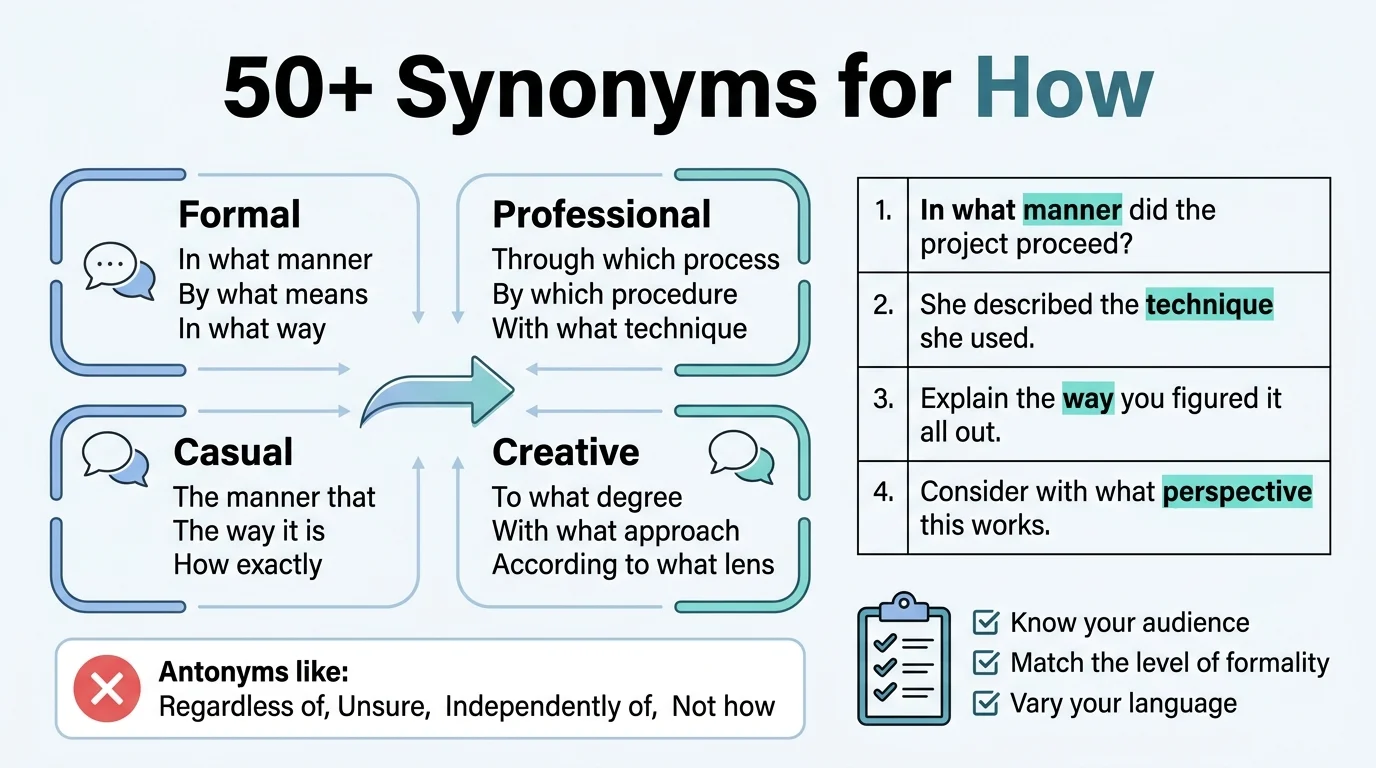
“How” is an adverb and question word used to ask about manner, condition, degree, or extent. The best synonyms depend on context: “in what way” for formal writing, “by what means” for professional use, “to what extent” for academic work, “in which manner” for creative writing, and “what way” for casual conversation.
Meaning, Tone and Context
1. Simple Definition
“How” asks questions about the method, manner, condition, or degree of something.
2. Part of Speech
Adverb, conjunction, and sometimes a noun in informal usage.
3. Positive, Negative, or Neutral Tone
Neutral. The tone depends entirely on the words around it.
4. Formality Level
Neutral to informal. More formal alternatives exist for professional writing.
5. Common Use Cases
Questions, explanations, instructions, storytelling, expressing surprise, and clarifying details.
6. Important Word Forms
“How” does not have many derived forms, but it appears in phrases like “how about,” “how come,” and “how so.”
When and How to Use “How”
You should use “how” when you need to ask about process, condition, method, or extent. It works well in everyday conversation and informal writing. However, you should replace it with more precise language in academic papers, professional reports, and formal speeches.
Professional Example:
How does this software integrate with our existing system? Used in a team meeting to ask about technical compatibility.
Academic Example:
The study examined how stress affects cognitive performance. Used in a research paper to introduce a key research question.
Personal Example:
How was your trip to the mountains? Used in casual conversation to ask about someone’s experience.
Creative Example:
She wondered how the stars could burn so brightly without fading. Used in literary writing to express wonder and curiosity.
Social Media Caption:
How it started versus how it’s going. Used to show a comparison in an engaging post.
Email Example:
Could you explain how we should proceed with this project? Used to request clarification in a professional email.
Casual Conversation:
How do you make that delicious pasta sauce? Used to ask for a recipe or instruction.
Another Word for “How”
The best single replacement for “how” depends entirely on your context and what you are actually asking.
Professional Writing:
Use “in what way” or “by what means.” These phrases sound more formal and precise in business communication.
Academic Writing:
Use “to what extent” or “in which manner.” These phrases add scholarly precision to research questions.
Casual Conversation:
Use “what way” or simply rephrase the question. Native speakers often drop “how” in casual speech.
Emotional Writing:
Use “in what manner” for a thoughtful tone. This adds depth and reflection to personal narratives.
Creative Writing:
Use “in which fashion” or “after what manner.” These phrases add elegance and literary flair.
Resume or Workplace Use:
Use “through which” or “via which.” These phrases sound action oriented and professional.
Social Media Captions:
Use “the way” or drop the word altogether. Short captions often work better without question words.
Stronger Meaning:
Use “by what process” or “through what mechanism.” These phrases emphasize systematic thinking.
Softer Meaning:
Use “to what degree” or “in what sense.” These phrases soften direct questions into more gentle inquiries.
When Not to Use “How”
“How” becomes problematic when you use it too often in a single piece of writing. It also fails when you need a more specific question word.
Too Vague Example:
“How did the team succeed?”
This question is unclear. It could mean process, effort, resources, or timing.
More Precise Version:
“Through what strategies did the team succeed?”
This version asks specifically about methods and approaches.
Too Casual Example:
“How will you complete this task?”
This sounds informal for a performance review.
More Professional Version:
“By what means will you complete this task?”
This version sounds more serious and business appropriate.
Too General Example:
“How do we improve sales?”
This question lacks focus and direction.
More Specific Version:
“Through which channels can we improve sales?”
This version directs attention to distribution and marketing channels.
Words Commonly Confused With “How”
How vs. Why
“How” asks about method or process. “Why” asks about reason or purpose.
How: How did you solve the problem? Asking about the steps you took.
Why: Why did you choose that solution? Asking about your reasoning.
How vs. What
“How” focuses on manner or condition. “What” focuses on identity or content.
How: How does the machine operate? Asking about the operation process.
What: What does the machine do? Asking about the function or purpose.
How vs. When
“How” asks about method. “When” asks about time.
How: How should we schedule the meeting? Asking about the process.
When: When should we schedule the meeting? Asking about the specific time.
How vs. Where
“How” asks about manner. “Where” asks about location.
How: How do we access the files? Asking about the method.
Where: Where are the files stored? Asking about the location.
How vs. Which
“How” asks about condition. “Which” asks about choice among options.
How: How will this affect the team? Asking about the impact.
Which: Which option benefits the team most? Asking for a specific choice.
How vs. Whether
“How” asks about manner. “Whether” asks about alternatives.
How: How should we respond? Asking about the response method.
Whether: Whether we should respond at all. Asking about the decision itself.
Best Synonym by Context for “How”
| Context | Best Synonym | Why It Works | Example |
|---|---|---|---|
| Formal Writing | In what manner | Adds elegance and precision to legal or official documents | The court will determine in what manner the funds should be distributed |
| Academic Writing | To what extent | Works perfectly for research questions and hypotheses | This study examines to what extent social media influences purchasing decisions |
| Professional Business | By what means | Sounds strategic and analytical in corporate communication | By what means can we reduce operational costs this quarter |
| Resume Use | Through which | Shows action and process orientation on professional documents | Developed a system through which client data could be accessed more efficiently |
| Casual Conversation | What way | Feels natural and friendly in everyday dialogue | What way did you fix the sink? |
| Creative Writing | In which fashion | Adds literary depth and descriptive beauty | She wondered in which fashion the seasons would change the landscape |
| Emotional Tone | In what sense | Shows sensitivity and thoughtful questioning | In what sense does this decision affect our future together |
| Strong Intensity | By what process | Emphasizes systematic thinking and detailed analysis | By what process do cells regenerate after injury |
| Soft Moderate Tone | To what degree | Gentle way to ask about intensity or amount | To what degree does exercise improve mental health |
| Social Media Captions | The way | Short, trendy, and engaging for platforms like Instagram | The way this recipe changed my life is incredible |
| US Usage | How come | Common American expression for asking reasons casually | How come you decided to move to Texas |
| UK Usage | How’s that | British English phrase for asking clarification or confirmation | How’s that going to work with our schedule |
| Technical Writing | Through which mechanism | Precise and scientific for technical documentation | Through which mechanism does the engine transfer power |
| Journalistic Writing | In what respect | Useful for interviews and investigative reporting | In what respect does this policy affect ordinary citizens |
| Legal Writing | By which means | Formal and authoritative for legal documents | The contract specifies by which means disputes shall be resolved |
Which Synonym Should You Choose?
Choosing the right synonym depends on three factors: your audience, your purpose, and your setting.
Start with your audience. Are you writing for experts or general readers? Academic audiences expect formal phrases like “to what extent.” General readers prefer simpler options like “what way” or “the way.”
Consider your purpose. Are you asking a specific question or expressing wonder? Research questions need precision, while creative writing benefits from variety and imagery.
Think about formality. Professional emails require formal language. Social media posts can be casual and creative. Match your synonym to the situation.
Check emotional intensity. Some synonyms add emotional weight. Others stay neutral. Choose based on whether you want to sound sensitive, analytical, or somewhere in between.
Vary your language. Even with synonyms, avoid using the same word repeatedly. Mix formal and informal options based on the flow of your writing.
Real Life Examples of “How” in Sentences
School Example:
The teacher explained how to solve complex equations using step by step methods.
Workplace Example:
The manager demonstrated through which methods the team could achieve its quarterly targets.
Writing Example:
The author explored in what manner grief transforms a person’s perspective on life.
Conversation Example:
What way did you manage to finish the project ahead of schedule?
Social Media Example:
The way this outfit looks on you is absolutely stunning.
Resume Example:
Developed a system through which customer feedback was collected and analyzed.
Email Example:
Please explain by what means we should proceed with the client proposal.
Storytelling Example:
She could not understand in which fashion the world had changed so completely.
15 Synonyms for “How”
| Synonym | Simple Meaning | Best Used For | Example Sentence |
|---|---|---|---|
| In what way | Asking about method or manner | Formal and academic writing | In what way does this theory apply to modern society |
| By what means | Asking about resources or tools | Professional and business settings | By what means will we achieve our sustainability goals |
| To what extent | Asking about degree or limit | Research and analytical writing | To what extent does exercise improve mental well being |
| In which manner | Asking about style or approach | Creative and literary writing | She described in which manner the sunset painted the sky |
| In what respect | Asking about specific aspects | Journalistic and interview contexts | In what respect does this policy differ from the previous one |
| Through what | Asking about process or mechanism | Technical and scientific writing | Through what process do plants convert sunlight to energy |
| What way | Asking about method casually | Everyday conversation | What way did you learn to cook so well |
| The way | Describing a method or manner | Social media and casual content | The way she handles pressure is admirable |
| How come | Asking about reason casually | American casual conversation | How come you decided to change careers |
| In what sense | Asking about interpretation | Emotional and philosophical writing | In what sense can we call this a success |
| By which process | Asking about systematic steps | Academic and technical writing | By which process does the body absorb nutrients |
| In which fashion | Asking about style creatively | Literary and descriptive writing | In which fashion did the artist choose to express sorrow |
| Via which | Asking about means or medium | Professional and modern writing | Via which channel should we send the proposal |
| According to what method | Very formal question about procedure | Legal and official documents | According to what method should the data be verified |
| In what form | Asking about presentation or structure | Analytical and descriptive contexts | In what form does the report need to be submitted |
Synonym Groups and Usage Differences
Professional vs. Personal Synonyms
Professional contexts demand precision and formality. Use “by what means” and “through which” in business settings. These phrases signal competence and strategic thinking. Personal contexts allow casual alternatives like “what way” and “the way.” These options feel warm and approachable in conversations with friends and family.
Formal vs. Conversational Synonyms
Formal writing needs authoritative language. “In what manner” and “to what extent” work well in reports, essays, and official correspondence. These phrases add weight and seriousness to your message. Conversational settings reward simplicity. “What way” and “how come” feel natural in texts, emails to friends, and everyday dialogue. Match your tone to the situation.
Academic Synonyms
Academic writing values precision and clarity. “To what extent” helps frame research questions. “In what respect” clarifies specific dimensions of analysis. “By which process” describes systematic procedures. These phrases demonstrate scholarly rigor. They help readers understand exactly what you are investigating and why.
Professional and Business Synonyms
Business communication needs directness and professionalism. “By what means” works well for strategic questions. “Through which” describes systems and processes. “Via which” sounds modern and efficient. These synonyms help you sound competent and action oriented. They avoid the casual tone of “how” in serious business contexts.
Creative or Literary Synonyms
Creative writing rewards variety and imagery. “In which fashion” adds elegance. “what manner” creates a thoughtful tone. “In what sense” suggests deeper meaning. These phrases help you paint vivid pictures and explore complex emotions. They enrich descriptive passages and character reflections.
Slang or Modern Synonyms
Modern language evolves constantly. “How come” has become standard in American casual speech. “The way” appears frequently in social media content. “What way” works in informal settings. These options are acceptable in casual writing and conversation. They are too casual for professional or academic work.
Strongest vs. Weaker Synonyms
The strength of a synonym depends on its precision and authority. “By what mechanism” is the strongest option for technical writing. “In what respect” carries significant analytical power. “What way” is weaker because it lacks specificity. Choose stronger synonyms when you need clarity and weaker ones when simplicity matters.
Emotional vs. Neutral Synonyms
Emotional contexts benefit from thoughtful language. “In what sense” adds sensitivity. “In what manner” suggests careful consideration. These synonyms acknowledge complexity and nuance. Neutral contexts work with “in what way” and “by what means.” These options focus on facts without emotional weight.
Antonyms of “How”
| Antonym | Meaning | Example Sentence |
|---|---|---|
| Because | States a reason | We succeeded because we worked together |
| Since | Indicates a cause or time | Since we planned carefully, everything went smoothly |
| Whereas | Shows contrast | She wanted to stay, whereas he preferred to leave |
| Though | Expresses a concession | Though it was difficult, we managed to finish |
| Although | Introduces a contrasting idea | Although we faced challenges, we remained optimistic |
| Insofar as | Indicates extent or condition | We will help insofar as our resources allow |
| Notwithstanding | Shows contrast despite circumstances | We proceeded notwithstanding the warnings |
| Hence | Shows a logical result | The data was incomplete; hence, we could not conclude |
| Thus | Indicates a conclusion | She studied hard; thus, she passed the exam |
| Consequently | Shows a result | We missed the deadline; consequently, we lost the contract |
| Accordingly | Shows a fitting action | The situation changed; accordingly, we adjusted our plan |
| Therefore | States a logical conclusion | The evidence was clear; therefore, we acted decisively |
| As a result | Shows a consequence | We invested in training; as a result, productivity improved |
| For | States a reason or purpose | We chose that option for its cost effectiveness |
| Seeing that | Indicates a reason or condition | Seeing that everyone agreed, we proceeded with the plan |
Comparison: How vs. Similar Words
How vs. Why
The main difference lies in purpose. “How” asks about method or condition. “Why” asks about reason or motivation.
How: How did the team achieve its goal? This question asks about the steps and processes involved.
Why: Why did the team choose this strategy? This question asks about the reasoning behind the decision.
“How” is neutral and process oriented. “Why” is more personal and reason focused. Use “how” for operational questions. Use “why” for motivational or strategic questions.
How vs. What
“How” and “what” differ in focus. asks about manner, process, or condition. “What” asks about identity, content, or nature.
How: How does this tool function? This asks about the operation or usage method.
What: What does this tool do? This asks about the purpose or output.
“How” is procedural. “What” is descriptive. Use “how” when you need steps or instructions. Use “what” when you need definitions or explanations.
How vs. When
The distinction is temporal. “How” focuses on method. “When” focuses on timing.
How: How should we deliver the presentation? This asks about style and approach.
When: When should we deliver the presentation? This asks about schedule and deadlines.
“How” is about manner. “When” is about time. Use “how” for process questions. Use “when” for scheduling questions.
How vs. Where
The distinction is spatial. “How” focuses on process. “Where” focuses on place.
How: How do we access the database? This asks about method or permission.
Where: Where is the database stored? This asks about physical or digital location.
“How” is procedural. “Where” is locational. Use “how” for access questions. Use “where” for location questions.
How vs. Which
The distinction involves choice. “How” asks about condition or manner. “Which” asks about selection among options.
How: How does this option compare? This asks about performance or features.
Which: Which option works best? This asks for a specific selection.
“How” is comparative. “Which” is selective. Use “how” when asking about quality or performance. Use “which” when asking for a decision.
How vs. Whether
The distinction involves alternatives. “How” asks about method or condition. “Whether” asks about possibilities or alternatives.
How: How should we respond? This asks about the appropriate response method.
Whether: Whether we should respond at all. This asks about the decision to respond.
“How” assumes action. “Whether” questions the action itself. Use “how” when you assume something will happen. Use “whether” when the action itself is uncertain.
Common Phrases and Expressions with “How”
1. How about
Meaning: Used to make a suggestion or ask about someone’s opinion.
Example sentence: How about we meet for coffee tomorrow morning and discuss the project?
2. How come
Meaning: Used to ask for a reason, more casual than “why.”
Example sentence: How come you decided to move to a new city without telling anyone?
3. How so
Meaning: Used to ask someone to explain their statement or opinion.
Example sentence: You think the plan is flawed? How so exactly?
4. How are things
Meaning: A casual greeting asking about someone’s general well being.
Example sentence: How are things at the new office? Are you settling in well?
5. How do you do
Meaning: A formal greeting used when meeting someone for the first time.
Example sentence: How do you do? I have heard so much about your work.
6. How’s that
Meaning: Used to ask for confirmation or clarification.
Example sentence: You want me to finish the report by Friday? How’s that going to work?
7. How far
Meaning: Used to ask about distance or progress.
Example sentence: How far have you progressed on the research project this semester?
8. How much
Meaning: Used to ask about quantity or cost.
Example sentence: How much time do we need to complete this phase of the construction?
Common Mistakes to Avoid
Using “how” when a more precise synonym fits better
Many writers default to “how” in every situation. This creates vague and repetitive text. Replace “how” with specific alternatives that clarify your meaning.
Confusing “how” with “why”
“How” asks about process. “Why” asks about reason. Using “how” when you mean “why” confuses your reader and weakens your message.
Using casual synonyms in formal writing
“What way” and “how come” are fine in conversation. They sound unprofessional in reports, academic papers, and official correspondence. Choose formal alternatives for serious contexts.
Using overly dramatic synonyms for simple situations
“In which fashion” adds literary beauty but seems out of place in a simple email. Match your synonym to the occasion. Save elegant language for creative or thoughtful contexts.
Repeating the same synonym too often
Even excellent synonyms become dull with repetition. Vary your language throughout your writing. Mix formal, neutral, and casual alternatives to maintain reader interest.
Choosing a synonym with the wrong emotional tone
“In what sense” suggests sensitivity and depth. “By what means” feels neutral and analytical. Using emotional language in a technical report sounds strange. neutral language in personal writing seems cold.
slang in academic or professional writing
“How come” has no place in research papers. “The way” works for Instagram captions but fails in job applications. Know your audience and choose accordingly.
FAQs
What is the best synonym for how?
The best synonym depends on context. “In what way” works for formal writing, “what way” for casual conversation, and “to what extent” for academic research.
What is a formal synonym for how?
In what manner” and “by what means” are excellent formal synonyms. They sound professional and precise in official documents and business communication.
What is an informal synonym for how?
“What way” and “how come” are informal synonyms. They work well in casual conversations, texts, and friendly emails.
What is another word for how in professional writing?
Through which” and “by what means” are professional alternatives. They signal competence and strategic thinking in workplace communication.
What is the difference between how and why?
“How” asks about method or process. “Why” asks about reason or purpose. “How” focuses on the way something happens, while “why” focuses on the cause.
What is the opposite of how?
There is no exact opposite. Depending on context, “because,” “since,” and “therefore” can function as opposites by stating a result rather than asking about method.
Conclusion
“How” is a versatile and essential word in English, but it should not dominate your vocabulary. The best way to improve your writing is to understand the subtle differences between synonyms and choose the right one for each situation. Formal contexts demand precision. Casual settings reward simplicity. Creative writing benefits from variety and beauty.
Your word choice shapes how others perceive your communication. Using the right synonym demonstrates thoughtfulness and skill. It helps you express exactly what you mean without confusion or repetition. Practice using these alternatives in your writing and speaking. You will notice a significant improvement in clarity and style.
Remember to verify any uncertain definitions using trusted dictionaries such as Cambridge, Oxford, Merriam Webster, Collins, or Britannica. These resources will help you confirm usage, formality, and correct context before you publish or submit your work.