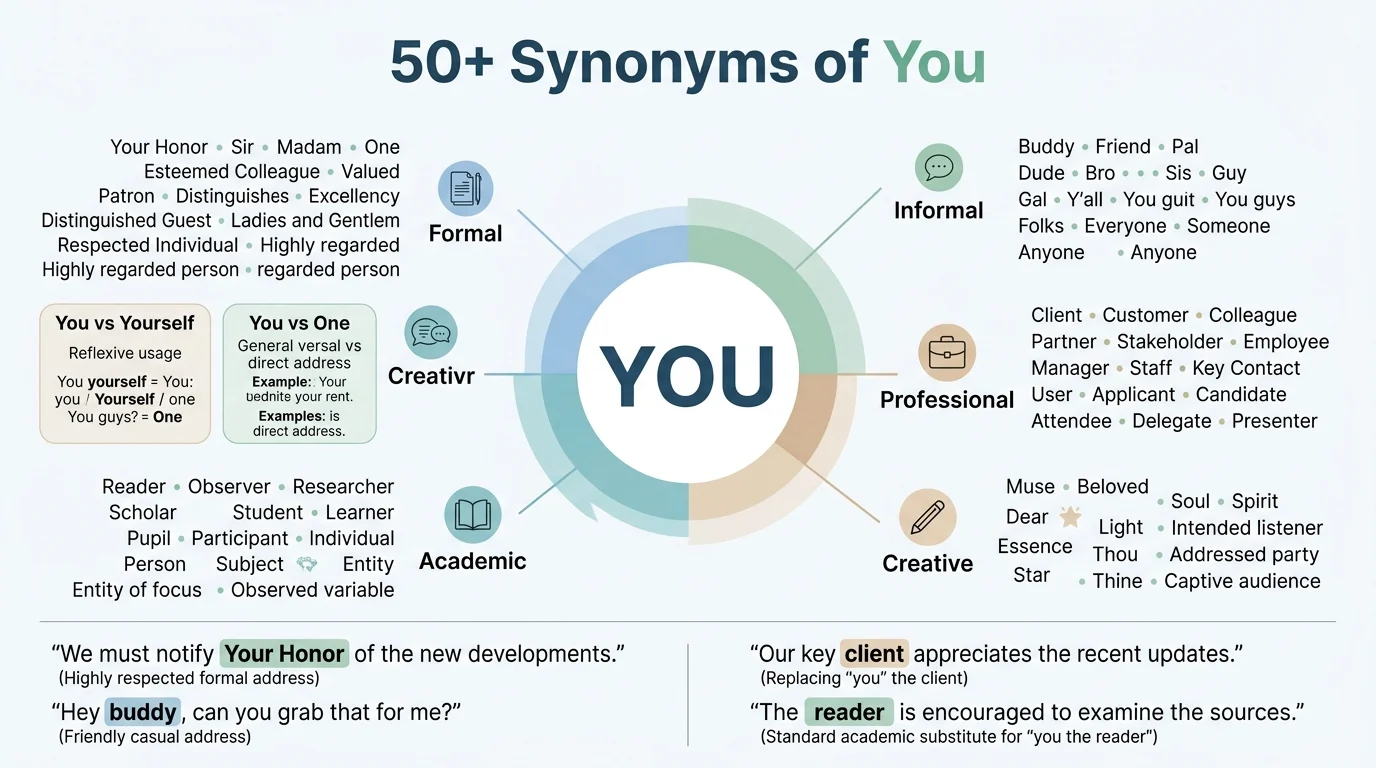
Have you ever written an email, an essay, or a social media caption and realized you keep using the word “you” over and over again? It happens to everyone. You want to sound natural, but repeating the same pronoun makes your writing feel dull and unpolished. Whether you are drafting a professional email, working on a school assignment, or creating content for your blog, finding the right synonyms of you can transform your communication. Choosing the right word improves clarity, adjusts your tone, and helps you connect with your audience more effectively.
What Are the Best Synonyms of “You”?
“You” is a second-person pronoun used to address the person or people you are speaking or writing to. For formal writing, consider “one” or use titles like “sir” or “ma’am.” For casual conversation, “y’all,” “you guys,” or “folks” work well. In professional contexts, “yourself” or “the recipient” are often better choices.
Meaning, Tone, and Context
Simple Definition
“You” is a pronoun that refers to the person or people being addressed. It works for both singular and plural references.
Part of Speech
Pronoun (second person, singular and plural)
Overall Tone
Neutral. The word itself carries no emotional weight, but the context around it determines the tone.
Formality Level
Neutral. “You” works in formal, semi-formal, and informal settings. It is the standard way to address someone in modern English.
Common Uses
Native English speakers use “you” constantly in everyday conversation. It appears in questions, commands, and statements. It is the primary way to address someone directly. In writing, it can feel too direct or repetitive, which is why alternatives are helpful.
Word Forms
- You (pronoun)
- Your (possessive adjective)
- Yours (possessive pronoun)
- Yourself (reflexive pronoun)
- Yourselves (reflexive pronoun, plural)
When and How to Use “You”
“You” is the default choice for addressing someone directly. Use it when you want clear, straightforward communication. However, overusing it can make your writing sound repetitive or too casual. Here are seven realistic examples showing how “you” works in different contexts.
Professional
We appreciate the effort you put into this project.
Academic
You must cite your sources properly to avoid plagiarism.
Workplace
Could you send me the updated report by noon?
Personal
I am so glad you came to the party.
Thank you for your time, and I look forward to hearing from you.
Resume
Managed a team of five and ensured you met all project deadlines.
Tag someone you think needs to see this.
Best Synonyms of “You”
No synonym is identical in every situation. The best choice depends on your audience, purpose, and tone. Here are the top recommendations for specific contexts.
Professional Writing
Yourself is a strong choice. It adds a reflexive emphasis that sounds polished in professional documents. For example, “Please complete the form yourself” sounds more formal than “Please complete the form.”
Academic Writing
One is the classic academic alternative. It removes the directness of “you” and creates a more formal, general tone. For instance, “One must consider the evidence” sounds more academic than “You must consider the evidence”.
Business Communication
The recipient or the client works well. These terms are specific and professional. “The recipient will receive a confirmation email” is clearer and more formal than “You will receive a confirmation email.”
Casual Conversation
Y’all or you guys are excellent for plural “you” in casual settings. “Y’all” is common in the Southern United States, while “you guys” is used nationwide.
Emotional Writing
Thou and thee can add a poetic or emotional weight, but they are archaic. Use them only in creative or historical contexts.
Creative Writing
The reader or the listener can create a direct connection with the audience. “The reader will find this story compelling” feels more literary than “You will find this story compelling.”
Resume Writing
Yourself or the implied “you” in bullet points often works best. Most resume bullet points do not use “you” directly but imply it. For example, “Managed a team of ten” implies “you managed.”
Workplace Communication
Everyone or the team can replace “you” when addressing a group. “Everyone should submit their timesheets by Friday” sounds more inclusive than “You should submit your timesheets by Friday.”
Stronger Meaning
Thyself (archaic) or yourself can add emphasis. “Believe in yourself” is stronger than “Believe in you.”
Softer Meaning
One or someone softens the directness. “One might feel overwhelmed” is gentler than “You might feel overwhelmed.”
When Not to Use “You”
Using “you” is not always the best choice. Here are situations where it can be less effective.
Too General
When you need to address a specific person, “you” can feel vague. In legal or formal documents, “the party” or “the undersigned” is more precise.
Weak: You are responsible for the payment.
Stronger: The party is responsible for the payment.
Too Vague
In instructions, “you” can be unclear if the reader is not the one acting. Use “the user” or “the customer” instead.
Weak: You should press the button.
Stronger: The user should press the button.
Too Formal
In casual conversation, “you” is neutral, but using overly formal alternatives like “one” can sound strange. Stick with “you” or casual forms like “y’all.”
Awkward: One should come to the party.
Natural: You should come to the party.
Too Informal
In academic or professional writing, overusing “you” can feel too casual. Replace it with “one” or restructure the sentence.
Weak: You can see the results in the table.
Stronger: The results are shown in the table.
Too Weak
When you need to emphasize the individual, “you” can feel weak. Use “yourself” or “you yourself” for emphasis.
Weak: You should believe in you.
Stronger: You should believe in yourself.
Too Strong
In some contexts, “you” can feel accusatory. Use “one” or “people” to soften the tone.
Harsh: You are making a mistake.
Softer: One might be making a mistake.
Outdated
Forms like “thou,” “thee,” and “ye” are archaic and sound outdated in modern conversation. Use them only for literary or historical effect.
Words Commonly Confused With “You”
You vs. Your
Difference: “You” is a pronoun, while “your” is a possessive adjective. “You” refers to the person, and “your” shows ownership.
When to Use It: Use “you” when addressing someone. Use “your” when indicating something belongs to them.
Example (You): You are the best.
Example (Your): Your work is impressive.
You vs. Yourself
Difference: “Yourself” is a reflexive pronoun. It refers back to the subject. “You” is the standard pronoun.
When to Use It: Use “yourself” when the subject and object are the same person.
Example (You): I see you.
Example (Yourself): You see yourself.
You vs. Thou
Difference: “Thou” is an archaic, poetic form of “you” used as a subject. It is rarely used in modern English.
When to Use It: Use “thou” in historical fiction, poetry, or religious texts.
Example (You): You are kind.
Example (Thou): Thou art kind.
You vs. Thee
Difference: “Thee” is the archaic objective form of “thou.” It is used as an object.
When to Use It: Use “thee” in the same contexts as “thou” but as an object.
Example (You): I love you.
Example (Thee): I love thee.
You vs. Ye
Difference: “Ye” is an archaic plural form of “you” used as a subject.
When to Use It: Use “ye” in historical or ceremonial contexts.
Example (You): You are all invited.
Example (Ye): Hear ye, hear ye!
You vs. One
Difference: “One” is a formal, generic pronoun that refers to people in general, not a specific person.
When to Use It: Use “one” in formal writing to avoid direct address.
Example (You): You must be careful.
Example (One): One must be careful.
Best Synonyms of “You” by Context
| Context | Best Synonym | Why It Works | Example |
|---|---|---|---|
| Formal writing | One | Removes direct address and sounds more academic | One must consider the evidence. |
| Academic writing | One | Creates a formal, impersonal tone | One can observe this trend clearly. |
| Professional communication | Yourself | Adds a reflexive, polished touch | Please review the document yourself. |
| Business emails | The recipient | Clear and professional | The recipient will receive a confirmation. |
| Resume writing | (Implied) | Bullet points imply “you” without stating it | Managed a team of five. |
| Workplace communication | Everyone | Inclusive and clear | Everyone should submit their reports. |
| Casual conversation | Y’all / You guys | Friendly and natural | How are y’all doing? |
| Everyday speaking | You | Standard and neutral | You are right. |
| Creative writing | The reader | Engages the audience directly | The reader will feel the emotion. |
| Storytelling | Thou / Thee | Adds a poetic or historical flavor | Thou art my hero. |
| Emotional writing | Yourself | Adds emphasis and personal connection | Believe in yourself. |
| Strong emphasis | Yourself / Thyself | Adds reflexive emphasis | Do it yourself. |
| Mild tone | One | Softens directness | One might feel that way. |
| Social media captions | You / Y’all | Direct and engaging | Tag someone you love. |
| American English | Y’all | Common in the Southern US | Y’all are the best. |
| British English | You lot | Common in the UK | You lot are in trouble. |
How to Choose the Best Synonym of “You”
Choosing the right synonym depends on several factors.
Meaning
Decide if you are addressing a specific person, a group, or people in general. “You” works for all three, but alternatives like “one” (general) or “y’all” (group) can be more precise.
Tone
Consider the tone you want to convey. Formal synonyms like “one” or “the recipient” sound professional. Informal synonyms like “y’all” or “guys” sound friendly and casual.
Audience
Think about who you are addressing. A professor will appreciate “one,” while a friend will prefer “you” or “y’all.”
Emotional Strength
If you want to emphasize the individual, use “yourself” or “you yourself.” If you want to soften the message, use “one” or “someone.”
Writing Purpose
Academic papers benefit from “one.” Business emails benefit from “yourself” or “the recipient.” Social media posts benefit from “you” or “y’all.”
Level of Formality
Match the formality of your writing. Formal writing avoids “you” altogether in many cases. Informal writing embraces it.
Natural Sounding Usage
Read your sentence aloud. If it sounds awkward, try a different synonym. The best word is the one that sounds most natural in context.
Real Life Examples of “You”
School
You should study for the exam. → Students should study for the exam.
College
You must submit your thesis by Friday. → All candidates must submit their theses by Friday.
Workplace
You need to finish this project. → The team needs to finish this project.
Business
You will receive a response within 24 hours. → Clients will receive a response within 24 hours.
Thank you for your time. → Thank you for your valuable time.
Resume
You managed a team of ten. → Managed a team of ten. (Implied “you”)
Conversation
You are amazing! → You are amazing! (No replacement needed)
Storytelling
You walk into the room. → The reader walks into the room.
Blogging
You will love this recipe. → Readers will love this recipe.
Tag someone you love. → Tag someone you love. (No replacement needed)
18 Best Synonyms of “You”
| Synonym | Simple Meaning | Best Used For | Example Sentence |
|---|---|---|---|
| Yourself | The reflexive form of “you” | Adding emphasis or when the subject and object are the same | Believe in yourself. |
| One | People in general | Formal and academic writing | One must be cautious. |
| Someone | An unspecified person | General statements | Someone should help. |
| Anyone | Any person at all | Broad, inclusive statements | Anyone can do this. |
| Everybody | All people in a group | Addressing a group informally | Everybody is invited. |
| People | Multiple individuals | General or neutral references | People often make that mistake. |
| Folks | A friendly term for people | Casual conversation | How are folks doing? |
| Sir | A polite way to address a man | Formal or respectful address | Thank you, sir. |
| Ma’am | A polite way to address a woman | Formal or respectful address | Yes, ma’am. |
| Friend | A warm, friendly address | Casual, personal conversation | Hey, friend, how are you? |
| Buddy | A casual, friendly address | Very informal conversation | Thanks, buddy. |
| Guys | A casual term for a group | Informal group address | What are you guys doing? |
| You All | A clear plural form of “you” | Emphasizing a group | You all need to listen. |
| Y’all | A short, casual form of “you all” | Informal, especially in the Southern US | Y’all come back now. |
| You Guys | Another casual plural form | Informal group address | You guys are funny. |
| The Reader | The person reading | Creative and instructional writing | The reader will understand. |
| The Listener | The person hearing | Speeches and presentations | The listener will appreciate that. |
| The Recipient | The person receiving something | Formal and business writing | The recipient should sign here. |
Synonyms of “You” by Usage
Professional vs Personal Synonyms
In professional settings, use “yourself,” “the recipient,” or “the client.” These sound polished and specific. In personal settings, use “you,” “y’all,” or “friend.” These sound warm and natural.
Formal vs Conversational Synonyms
For reports, essays, and business writing, use “one” or “the reader.” For presentations, emails, and casual conversations, use “you” or “you guys.” In texting, “u” or “ya” are common but are not recommended for formal writing.
Academic Synonyms
“One” is the gold standard for academic writing. It sounds authoritative and removes the directness of “you.” “The researcher” or “the participant” are also useful in research papers. Use these to maintain a formal, objective tone.
Professional and Business Synonyms
Resumes, use implied “you.” For interviews and meetings, use “you” directly. Presentations, use “the audience” or “the team.” Performance reviews, use “yourself” to emphasize personal responsibility. For client communication, use “the client” or “yourself” to sound professional.
Creative and Literary Synonyms
“The reader,” “the listener,” and “the audience” are excellent for creative writing. They create a direct connection with the reader. “Thou” and “thee” add a poetic or historical flavor. Use these to add emotion and imagery to your writing.
Slang or Modern Synonyms
“Ya” is a casual, informal form of “you” used in spoken English. “Y’all” is a common slang term in the Southern US. “Yous” or “youse” are used in some regions, including parts of Australia and the Northeastern US. Use slang only in casual settings and avoid it in professional or academic writing.
Strongest to Mildest Synonyms
Mild: One, someone, anyone
Moderate: You, people, folks
Strong: Yourself, you yourself
Very Strong: Thyself, thou (when used emphatically)
The emotional intensity increases as you move from mild to very strong. “One” is detached and neutral. “Yourself” adds personal emphasis. “Thyself” adds poetic and emotional weight.
Emotional vs Neutral Synonyms
Emotional Synonyms: Yourself, thou, thee, friend. These words carry feelings of connection, emphasis, or historical reverence.
Neutral Synonyms: One, someone, anyone, people. These words simply communicate information without adding emotion. Use neutral synonyms in academic, professional, or technical writing. Use emotional synonyms in creative, personal, or persuasive writing.
Antonyms of “You”
“You” does not have direct antonyms in the same way that adjectives do. However, pronouns that refer to the speaker or others can be considered opposites in terms of perspective.
| Antonym | Meaning | Example Sentence |
|---|---|---|
| I | The speaker | I am going to the store. |
| Me | The speaker as an object | She saw me. |
| Myself | The reflexive form of “I” | I hurt myself. |
| We | The speaker and others | We are leaving. |
| Us | The speaker and others as an object | They told us. |
| Ourselves | The reflexive form of “we” | We did it ourselves. |
| He | A male person | He is my brother. |
| Him | A male person as an object | I gave it to him. |
| She | A female person | She is my sister. |
| Her | A female person as an object | I saw her. |
| They | Multiple people | They are coming. |
| Them | Multiple people as an object | I told them. |
| Their | Possessive of “they” | That is their car. |
| Theirs | Possessive pronoun of “they” | The car is theirs. |
| Themselves | Reflexive form of “they” | They did it themselves. |
Comparison: “You” vs Similar Words
You vs Yourself
Main Difference: “You” is the standard pronoun. “Yourself” is the reflexive form used when the subject and object are the same.
Which Is Stronger? “Yourself” is stronger because it adds emphasis.
Which Is More Formal? “Yourself” is slightly more formal.
When to Use Each: Use “you” for general address. Use “yourself” for emphasis or when the action reflects back on the subject.
Examples:
- You: I see you.
- Yourself: You see yourself.
You vs One
Main Difference: “You” addresses a specific person or people. “One” refers to people in general.
Which Is Stronger? “You” is stronger because it is direct.
Which Is More Formal? “One” is more formal.
When to Use Each: Use “you” in conversation and informal writing. Use “one” in academic and formal writing.
Examples:
- You: You should eat healthy.
- One: One should eat healthy.
You vs Thou
Main Difference: “You” is modern and standard. “Thou” is archaic and poetic.
Which Is Stronger? “Thou” can be stronger in poetic contexts.
Which Is More Formal? Neither is formal in modern English. “Thou” is used for historical or religious effect.
When to Use Each: Use “you” in all modern contexts. Use “thou” only in creative writing or historical contexts.
Examples:
- You: You are brave.
- Thou: Thou art brave.
You vs Thee
Main Difference: “You” is the standard pronoun. “Thee” is the archaic objective form of “thou”.
Which Is Stronger? “Thee” can sound more poetic.
Which Is More Formal? Neither is formal in modern English.
When to Use Each: Use “you” in all modern contexts. Use “thee” in poetry or historical fiction.
Examples:
- You: I love you.
- Thee: I love thee.
You vs Ye
Main Difference: “You” is the standard pronoun. “Ye” is an archaic plural form used as a subject.
Which Is Stronger? “Ye” sounds more ceremonial.
Which Is More Formal? Neither is formal in modern English.
When to Use Each: Use “you” in all modern contexts. Use “ye” in historical or ceremonial contexts.
Examples:
- You: You are all welcome.
- Ye: Hear ye, hear ye!
You vs Y’all
Main Difference: “You” can be singular or plural. “Y’all” is explicitly plural.
Which Is Stronger? “Y’all” is more emphatic about the group.
Which Is More Formal? “You” is more formal. “Y’all” is informal.
When to Use Each: Use “you” for singular or general plural. Use “y’all” for plural in casual conversation, especially in the Southern US.
Examples:
- You: You are all invited.
- Y’all: Y’all are invited.
Common Phrases and Expressions with “You”
| Phrase | Meaning | Example Sentence |
|---|---|---|
| You know | Used to emphasize a point or seek agreement | You know, I think you are right. |
| You bet | An enthusiastic agreement | “Can you help me?” “You bet!” |
| You’re welcome | A polite response to “thank you” | Thank you for your help. You’re welcome. |
| You guys | An informal plural form of “you” | What are you guys doing tonight? |
| You all | A clear plural form of “you” | You all need to listen carefully. |
| You see | Used to draw attention to an explanation | You see, the problem is more complex. |
| You too | Used to return a sentiment | Have a great day! You too! |
Common Mistakes to Avoid
Choosing a Vague Synonym Instead of a Precise One
Using “someone” when you mean a specific person can be confusing.
Incorrect: Someone should submit the report.
Better: You should submit the report.
Confusing “You” with “Your”
“You” is a pronoun; “your” is possessive.
Incorrect: Your are the best.
Better: You are the best.
Using an Informal Synonym in Formal Writing
Using “y’all” in a business email is too casual.
Incorrect: Y’all need to approve this.
Better: You all need to approve this. (Or use “the team”)
Selecting an Overly Dramatic Synonym
Using “thou” in a modern email sounds strange.
Incorrect: Thou art invited to the meeting.
Better: You are invited to the meeting.
Repeating the Same Word Too Often
Overusing “you” makes writing dull.
Incorrect: You should do this. You should do that. You should try this.
Better: You should do this and that. Try this.
Choosing a Synonym with the Wrong Emotional Tone
Using “one” in a personal conversation can sound cold.
Incorrect: One is my best friend.
Better: You are my best friend.
Using Slang in Academic or Professional Writing
Using “ya” in an academic paper is inappropriate.
Incorrect: Ya can see the results.
Better: You can see the results.
Frequently Asked Questions
What are the best synonyms of “you”?
The best synonyms depend on context. “One” works for formal writing. “Y’all” works for casual conversation. “Yourself” works for professional communication. “Thou” and “thee” are poetic but archaic.
What are the best formal synonyms of “you”?
Formal synonyms include “one,” “the reader,” “the recipient,” “the client,” and titles like “sir” or “ma’am.” These are suitable for academic, legal, and professional writing.
What are common informal synonyms of “you”?
Common informal synonyms include “y’all,” “you guys,” “you all,” “folks,” “guys,” “buddy,” and “friend.” “Ya” is also used in very casual speech.
What is another word for “you” in professional writing?
In professional writing, use “yourself,” “the recipient,” “the client,” or “the employee.” These terms are clear and professional. Avoid using “one” in business writing as it can sound too academic.
What is the difference between “you” and “thou”?
“You” is the modern, standard second-person pronoun. “Thou” is an archaic, poetic form used as a subject. “Thou” is rarely used in modern English outside of historical, religious, or literary contexts.
What is the opposite of “you”?
“You” does not have a direct opposite. However, pronouns like “I,” “me,” “we,” and “us” refer to the speaker or the speaker’s group, making them opposites in terms of perspective.
Conclusion
“You” is a simple, versatile pronoun that addresses the person or people you are speaking to. But using the same word repeatedly can make your writing feel flat. The synonyms of you offer a range of alternatives for every situation. “One” works best in formal and academic writing. “Y’all” and “you guys” are perfect for casual conversation. “Yourself” adds a professional touch. No single synonym works perfectly in every context. The best choice depends on your audience, tone, and purpose. The next time you write, pay attention to how often you use “you.” Try replacing it with a more precise alternative. Your writing will become clearer, more engaging, and more effective.