Have you ever read back an email or essay and realized you used the word “some” five times in two paragraphs? You are not alone. This small word sneaks into our writing constantly. It feels safe and easy. But overusing “some” makes your writing sound vague and uncertain.
Stronger writers know that word choice shapes how others perceive your message. Choosing the right synonym can make your sentences clearer, more confident, and more professional.
What Does “Some” Mean?
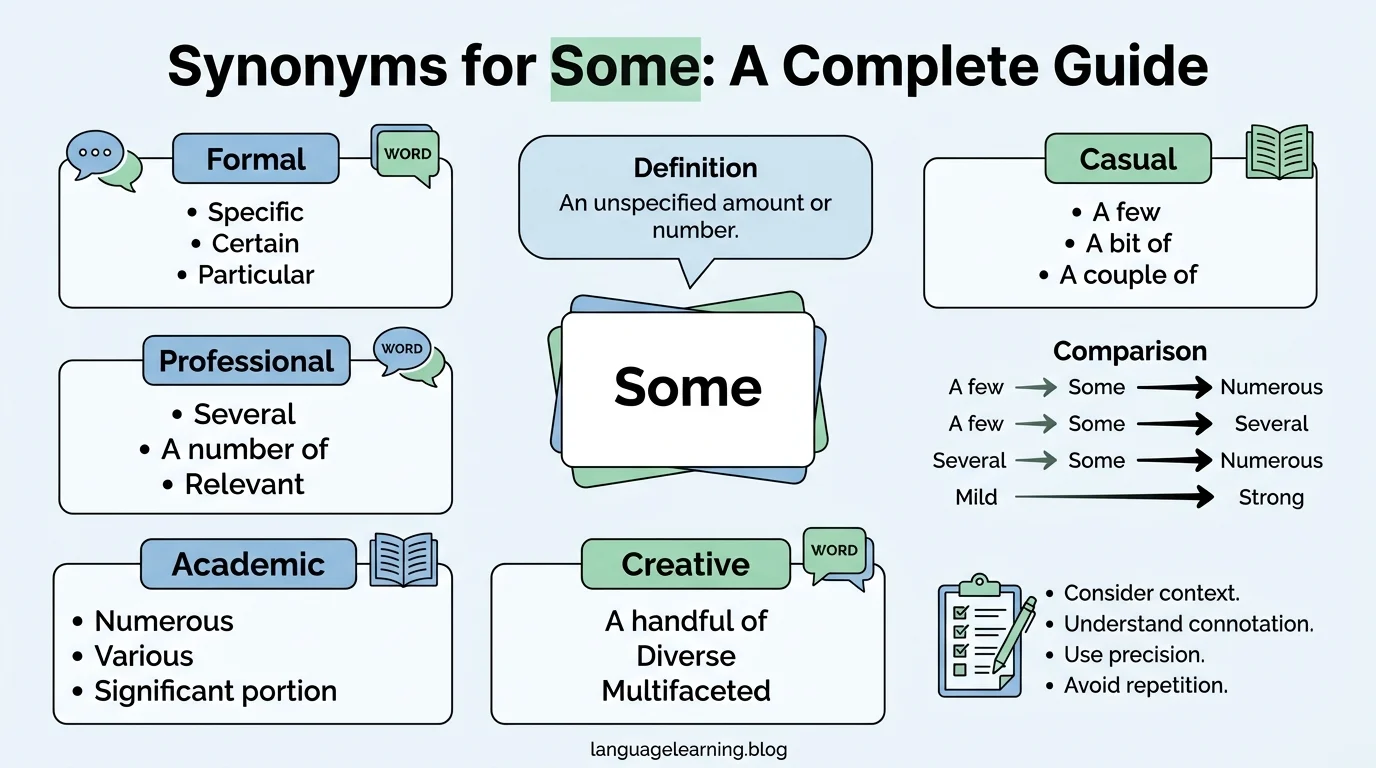
“Some” is a determiner and pronoun that refers to an unspecified amount, number, or person. The best synonyms depend on your context. Use “several” or “a few” for countable items. Use “a little” or “a portion” for uncountable nouns. For formality, choose “certain” in professional writing. For casual conversation, try “a couple” or “a handful.”
Meaning, Tone and Context
- Simple definition: Some refers to an indefinite quantity, part of a whole, or an unspecified person or thing.
- Part of speech: Some functions as a determiner, pronoun, and adverb.
- Tone: Neutral. The word itself carries no strong emotional weight.
- Formality level: Informal to neutral. It works in most settings but lacks precision.
- Common use cases: Describing vague amounts, referring to unknown people, suggesting partial quantities, and softening statements.
- Important word forms: The adjective form is “some” (some people). The pronoun form is also “some” (some are here). The adverb form means approximately (some 50 people attended).
When and How to Use “Some”
Use “some” when you genuinely do not know the exact number or when precision is unnecessary. It works well for casual statements and general observations. But avoid it when you need clarity or authority.
Here are realistic examples labeled by context:
Professional context: “We have some concerns about the proposed timeline.”
Personal context: “I would like some time to think about your suggestion.”
Academic context: “Some researchers argue that this theory is outdated.”
Emotional context: “She felt some relief after hearing the good news.”
Creative context: “Some days feel longer than others.”
Social media context: “Here are some photos from our weekend trip.”
Email context: “Could you please send me some additional details?”
Another Word for “Some”
The best replacement depends entirely on what you are describing. For countable items, “several” works well. For uncountable things, “a portion” or “a bit” may be better. If you mean specific but unnamed people or things, “certain” is your strongest choice.
Direct suggestions by situation:
- Professional writing: “certain” or “various”
- Academic writing: “several” or “a number of”
- Casual conversation: “a couple” or “a few”
- Emotional writing: “a measure of” or “a degree of”
- Creative writing: “a handful” or “several”
- Resume or workplace use: “various” or “numerous”
- Social media captions: “a few” or “some” (it is acceptable here)
- Stronger meaning: “multiple” or “various”
- Softer meaning: “a little” or “a bit”
When Not to Use “Some”
Do not use “some” in professional documents when you need to demonstrate authority or precision. It sounds weak and uncertain. Avoid it in resumes when you can state exact numbers or achievements.
Example of weak writing: “I managed some projects with some teams.”
Improved: “I managed five projects with twelve cross functional teams.”
Example of vague writing: “We need some improvements in our process.”
Improved: “We need specific improvements in our approval process.”
Words Commonly Confused With “Some”
Many writers confuse “some” with similar words. Here is how they differ.
Some vs. Any
Use “some” in positive statements. Use “any” in questions and negative statements. “I have some money” is correct. “I do not have any money” is correct.
Some vs. Several
“Several” means more than two but not a large number. It is more specific than “some.” Use “several” when you know the approximate count.
Some vs. A Few
“A few” specifically refers to a small number, usually three to five. It is more precise than “some” for countable items.
Some vs. A Little
“A little” refers to a small amount of uncountable things. Use it for things like time, space, or effort.
Some vs. Certain
“Certain” implies specific but unnamed items or people. It sounds more formal and intentional than “some.”
Some vs. Various
“Various” emphasizes variety and difference among items. “Some” does not carry this meaning.
Best Synonym by Context for “Some”
| Context | Best Synonym | Why It Works | Example |
|---|---|---|---|
| Formal writing | Certain | Adds precision and authority | Certain factors influenced our decision |
| Academic writing | Several | Shows countable precision | Several studies support this finding |
| Professional business | Various | Emphasizes range and variety | We examined various solutions |
| Resume usage | Numerous | Demonstrates quantity and achievement | Managed numerous client accounts |
| Casual conversation | A couple | Sounds natural and friendly | I need a couple of minutes |
| Creative writing | A handful | Adds imagery and character | A handful of stars appeared |
| Emotional tone | A measure of | Adds depth and feeling | She found a measure of peace |
| Strong intensity | Multiple | Emphasizes significant quantity | We faced multiple challenges |
| Soft moderate tone | A little | Softens the statement | I need a little more time |
| Social media captions | A few | Conversational and engaging | A few highlights from today |
| US English | Several | Widely understood and natural | Several people attended |
| UK English | A few | Equally natural in British usage | A few people attended |
Which Synonym Should You Choose?
Ask yourself three questions before choosing a replacement for “some.”
First, what are you describing? Countable nouns need words like “several” or “a few.” Uncountable nouns need words like “a little” or “a portion.”
Second, how formal is your context? Professional reports need “certain” or “various.” Text messages can use “a couple” or “some.”
Third, what tone do you want? If you want to sound confident, choose “multiple” or “numerous.” If you want to soften your message, choose “a little” or “a bit.”
The best synonym matches your meaning, your audience, and your purpose.
Real Life Examples of “Some” in Sentences
These examples show how “some” appears across different situations. Stronger synonyms appear in parentheses where appropriate.
School context: “The teacher assigned some (several) chapters for homework this weekend.”
Workplace context: “We encountered some (various) technical issues during the launch.”
Writing context: “The author included some (certain) details that seemed unnecessary.”
Conversation context: “I have some (a couple of) ideas for dinner tonight.”
Social media context: “Here are some (a few) snapshots from our vacation.”
Resume context: “I led some (numerous) successful marketing campaigns.”
Email context: “Please send some (the relevant) documents before Friday.”
Storytelling context: “Some (a handful of) moments stay with you forever.”
15 Synonyms for “Some”
| Synonym | Simple Meaning | Best Used For | Example Sentence |
|---|---|---|---|
| Several | More than two but not many | Countable items in moderate quantities | Several employees volunteered for the project |
| A few | A small number, usually three to five | Casual countable references | I need a few more days to finish |
| Various | Different types or kinds | Emphasizing variety | We discussed various options |
| Certain | Specific but unnamed | Formal unspecified references | Certain conditions must be met |
| A couple | Two or a small number | Very casual conversation | I will be there in a couple of minutes |
| A handful | A small number that can be counted | Creative or casual use | A handful of guests arrived early |
| A number of | An unspecified quantity | Professional and academic writing | A number of factors contributed |
| Multiple | More than one, often many | Emphasizing quantity | We received multiple applications |
| Numerous | Very many | Showing large quantity | Numerous studies confirm this |
| A portion | A part of a whole | Uncountable or partial amounts | A portion of the budget is allocated |
| A bit | A small amount | Informal uncountable references | I need a bit of help |
| A little | A small amount of uncountable things | Softening statements | We have a little time left |
| An amount of | A quantity of something | Formal uncountable references | An amount of effort is required |
| A measure of | A moderate quantity | Emotional or formal contexts | She has a measure of talent |
| Quite a few | A surprisingly large number | Emphasizing quantity in casual speech | Quite a few people attended |
Synonym Groups and Usage Differences
Professional vs. Personal Synonyms
Professional writing demands precision. Use “various” when you mean different types. Use “numerous” when you want to emphasize quantity. Personal writing allows for softer words like “a couple” and “a bit.” These feel more natural in conversation and personal messages.
Formal vs. Conversational Synonyms
Formal writing works best with “certain,” “numerous,” and “various.” These words appear in reports, essays, and official documents. Conversational writing uses “a couple,” “a few,” and “a bit.” These words feel natural in texts, emails to friends, and social media posts.
Academic Synonyms
Academic writing values precision. “Several” works well for countable items from studies. “Various” emphasizes the range of sources or factors. “A number of” appears frequently in research papers. Avoid vague words like “some” in academic contexts.
Professional and Business Synonyms
Business communication needs confidence. “Various” shows you considered multiple options. “Numerous” demonstrates scale and achievement. “Certain” adds authority to recommendations. Use these words in emails, presentations, and reports.
Creative or Literary Synonyms
Creative writing benefits from imagery. “A handful” creates a visual image. “A measure of” adds depth and emotion. “A scattering of” works for creative descriptions. These words paint pictures that “some” cannot.
Slang or Modern Synonyms
Modern casual speech uses phrases like “a couple” and “a few” most commonly. “Some” itself remains acceptable in casual contexts. Slang like “a hot minute” or “a bunch” works only in very informal settings. Avoid these in professional communication.
Strongest vs. Weaker Synonyms
Intensity scale from mildest to strongest:
A little (mildest) → A bit → A few → Several → A number of → Various → Multiple → Numerous (strongest)
Choose based on how much emphasis you need.
Emotional vs. Neutral Synonyms
Emotional synonyms add feeling to your writing. “A measure of” suggests significance. “A portion of” can imply sharing or fairness. Neutral synonyms like “several” and “various” simply state facts without emotional weight.
Antonyms of “Some”
| Antonym | Meaning | Example Sentence |
|---|---|---|
| None | Not any | None of the applications were approved |
| All | Every single one | All employees attended the meeting |
| Every | Each individual | Every student received a certificate |
| Each | Every one individually | Each person has a unique role |
| Whole | The complete amount | The whole team contributed to the success |
| Entire | The full extent | The entire budget was allocated |
| Every single | Emphasizing all without exception | Every single detail was reviewed |
| Not any | Zero quantity | Not any evidence was found |
| The whole | Complete entirety | The whole project was completed early |
| Every one | All individuals | Every one of the participants agreed |
| Total | Complete sum | Total attendance exceeded expectations |
| Complete | Full and whole | Complete cooperation was achieved |
| Every last | Emphasizing totality | Every last item was accounted for |
| The entirety | The whole of something | The entirety of the report was accurate |
| All of | The complete group or amount | All of the data supports this conclusion |
Comparison: Some vs. Similar Words
Some vs. Several
Main difference: “Several” implies more than two and indicates a specific countable number. “Some” remains vague and works for both countable and uncountable things.
Which one is stronger: Several is stronger because it shows you know approximately how many.
Which one is more formal: Several works better in formal writing.
Example for some: “Some people arrived late.”
Example for several: “Several people arrived late.”
Some vs. Any
Main difference: Use “some” in positive statements. Use “any” in questions and negative statements.
Which one is stronger: Neither is particularly strong, but “some” is more affirmative.
Which one is more formal: Both are neutral, but “any” is more common in formal questions.
Example for some: “We have some information.”
Example for any: “Do we have any information?”
Some vs. A Few
Main difference: “A few” specifically means a small number, usually three to five. “Some” is less precise.
Which one is stronger: A few is stronger because it gives the reader a better estimate.
Which one is more formal: A few is slightly more precise and works in most contexts.
Example for some: “I need some days to decide.”
Example for a few: “I need a few days to decide.”
Some vs. A Little
Main difference: “A little” refers to uncountable nouns only. “Some” works for both countable and uncountable.
Which one is stronger: A little is more specific for uncountable things.
Which one is more formal: Both are acceptable, but “a little” is slightly more precise.
Example for some: “I need some time.”
Example for a little: “I need a little time.”
Some vs. Certain
Main difference: “Certain” implies specific but unnamed items. “Some” is completely vague.
Which one is stronger: Certain is much stronger and more intentional.
Which one is more formal: Certain is significantly more formal.
Example for some: “Some people disagree.”
Example for certain: “Certain people disagree.”
Some vs. Various
Main difference: “Various” emphasizes different types or kinds. “Some” does not suggest variety.
Which one is stronger: Various is stronger and more descriptive.
Which one is more formal: Various is more formal and professional.
Example for some: “We have some options.”
Example for various: “We have various options.”
Common Phrases and Expressions with “Some”
1. Some time
Meaning: An unspecified amount of time.
Example sentence: “We need some time to review the proposal.”
2. Some people
Meaning: An unspecified group of individuals.
Example sentence: “Some people prefer to work in the morning.”
3. Some days
Meaning: Certain unspecified days.
Example sentence: “Some days are more productive than others.”
4. Some of
Meaning: A portion of a group or thing.
Example sentence: “Some of the students arrived early.”
5. Some kind of
Meaning: An unspecified type or category.
Example sentence: “She experienced some kind of technical issue.”
6. Some more
Meaning: An additional unspecified amount.
Example sentence: “Would you like some more coffee?”
7. Somewhat
Meaning: To a moderate degree.
Example sentence: “The results were somewhat surprising.”
8. Somewhere
Meaning: In an unspecified place.
Example sentence: “We will meet somewhere downtown.”
Common Mistakes to Avoid
- Using “some” when a more precise synonym is better. Replace vague “some” with “several,” “various,” or “numerous” to add clarity and authority to your writing.
- Confusing “some” with “any.” Remember to use “some” in positive statements and “any” in questions and negative sentences.
- Using a casual synonym in formal writing. Save “a couple” and “a bit” for casual conversations. Use “several” and “various” in professional documents.
- Using an overly dramatic synonym for a simple situation. Do not say “numerous” when you mean “a few.” Match the intensity to the reality.
- Repeating “some” too often. Vary your word choice to keep your writing fresh and engaging.
- Choosing a synonym with the wrong emotional tone. “A measure of” sounds emotional and significant. “Several” sounds neutral and factual. Choose based on your intended tone.
- Using “some” in resumes when you can state exact numbers. Replace “managed some projects” with “managed fifteen projects” to demonstrate real achievement.
FAQs
What is the best synonym for some?
The best synonym depends on your context. Use “several” for countable items and “a little” for uncountable items.
What is a formal synonym for some?
“Certain” and “various” are excellent formal synonyms for some in professional and academic writing.
What is an informal synonym for some?
“A couple” and “a few” work well as informal synonyms for some in casual conversation.
What is another word for some in professional writing?
“Numerous,” “various,” and “certain” are strong professional alternatives to some.
What is the difference between some and several?
Some is vague and works for both countable and uncountable things. Several specifically means more than two countable items.
What is the opposite of some?
The direct opposites are “none,” “all,” and “every.” Choose based on whether you mean zero or all.
Conclusion
“Some” is a useful word, but relying on it too often weakens your writing. The best writers choose precise words that match their meaning, audience, and tone. Use “several” when you know approximately how many. Use “certain” when you mean specific but unnamed items. “a little” when you want to soften a statement. Pay attention to context and formality. Strong word choice makes your message clearer and more professional. Your readers will notice the difference.