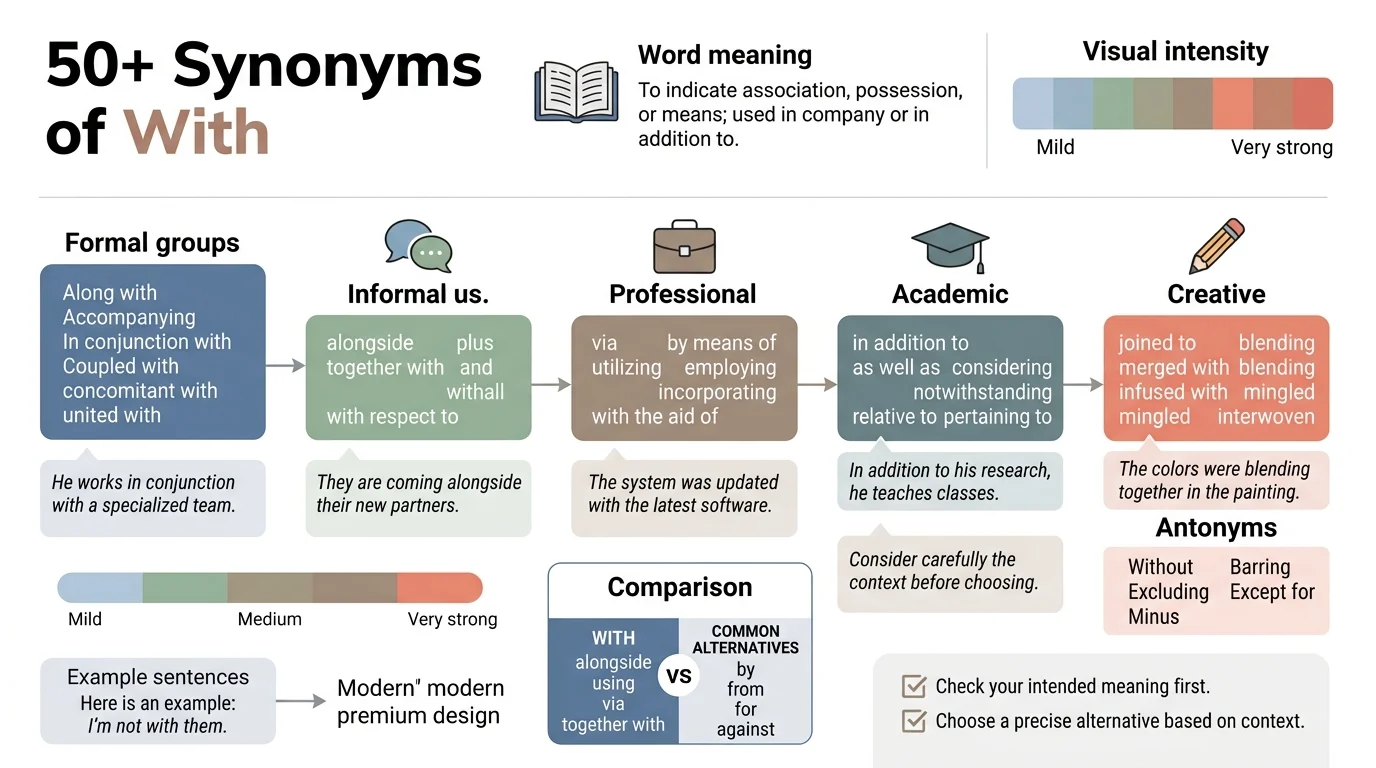
Have you ever reread an email or an essay and noticed the word “with” appearing in nearly every sentence? You are not alone. Many writers, students, and professionals fall into the habit of overusing this small but powerful preposition. The good news is that learning synonyms of with can instantly elevate your writing, making it clearer, more precise, and more engaging.
Whether you are drafting a business proposal, writing a college essay, crafting a social media caption, or simply trying to sound more natural in everyday conversation, choosing the right synonym matters. The word “with” connects ideas, people, and actions, but it does not always carry the exact nuance you need. Sometimes you need to show accompaniment. Other times you need to indicate a tool, a method, or even opposition.
This guide will help you understand what “with” really means, explore the best synonyms for every context, and avoid common mistakes that weaken your communication. By the end, you will confidently choose the most accurate word instead of guessing.
What Are the Best Synonyms of “With”?
“With” is a preposition that indicates accompaniment, association, possession, or means. The best synonym depends entirely on your context. Formal writing, use “alongside,” “in conjunction with,” or “by means of.” For casual conversation, try “together with” or “along with.” Academic work, choose “in relation to” or “in accordance with.” For professional communication, “in collaboration with” and “via” work well.
Meaning, Tone, and Context
Simple Definition
“With” is a preposition that shows a relationship between two or more things. It can mean:
- Accompaniment: being together with someone or something
- Possession: having or carrying something
- Means: using a tool or method to do something
- Opposition: against someone or something
- Relation: concerning or regarding a topic
Part of Speech
Preposition (primarily). It can also appear as a prefix in words like “withdraw” or “withstand,” but in everyday usage, it functions almost exclusively as a preposition.
Overall Tone
Neutral. “With” does not carry strong positive or negative emotional weight on its own. Its tone shifts based on the words around it.
Formality Level
Neutral to informal. “With” works in almost any setting, from casual texting to formal reports. However, in very formal or academic writing, more precise synonyms often communicate your meaning more effectively.
Common Uses
Native English speakers use “with” constantly in both spoken and written English. You will hear it in:
- Describing who you are with (I am with my family)
- Explaining how something was done (She wrote with a pen)
- Showing what something has (a house with a pool)
- Expressing opposition (I fought with my brother)
- Introducing a topic (With regard to your question)
Word Forms
- Preposition: with
- Prefix: with- (as in withdraw, withhold, withstand)
- Opposite: without
When and How to Use “With”
Use “with” when you need a simple, neutral way to connect people, objects, or ideas. It is the default choice for showing that two things belong together or that one thing is used to accomplish another. However, when you want to add precision, formality, or emotional weight, consider a synonym instead.
Here are seven realistic examples showing how “with” works in different contexts.
Professional:
“The marketing team worked with the design department to launch the new campaign.”
Academic:
“The study examined the relationship between sleep patterns and academic performance with a sample of 500 students.”
Workplace:
“Please review the attached document with your manager before the meeting.”
Personal:
“I spent the weekend with my family at the lake house.”
Email:
“I have attached the report with the updated financial figures.”
Resume:
“Managed a team of 12 with a focus on increasing quarterly revenue.”
“Coffee with a view. Best way to start the morning.”
Best Synonyms of “With”
No synonym is identical to “with” in every situation. The best choice depends on what you are trying to say: are you showing accompaniment, indicating a tool, expressing opposition, or referring to a topic? Here are the best synonyms for specific contexts.
Professional writing: in collaboration with — This sounds polished and implies active cooperation, which is ideal for workplace and business contexts.
Academic writing: in relation to — This adds precision and formality, making it perfect for research papers and scholarly work.
Business communication: in conjunction with — This conveys partnership and coordinated effort, which fits corporate language well.
Casual conversation: along with — This sounds natural and conversational without being overly formal or stiff.
Emotional writing: alongside — This suggests closeness and support, adding a warm, human touch.
Creative writing: amid or amidst — These add a literary, atmospheric quality that works beautifully in descriptive prose.
Resume writing: utilizing — This sounds active and competent, showing that you know how to use resources effectively.
Workplace communication: together with — This emphasizes unity and shared effort, which builds team spirit.
Stronger meaning: by means of — This makes the method or tool you used sound more deliberate and significant.
Softer meaning: plus — This is gentler and more casual, suitable for informal lists or additions.
When Not to Use “With”
Sometimes “with” is not the best choice. Here are situations where you should consider a stronger alternative.
When It Sounds Too General
Incorrect: “I fixed the issue with my skills.”
Better: “I fixed the issue using my troubleshooting expertise.”
The word “with” does not explain how you used your skills. Replacing it with “using” adds clarity and shows action.
When It Sounds Too Vague
Incorrect: “The policy was created with employee feedback.”
Better: “The policy was created based on employee feedback.”
“Based on” clarifies that the feedback directly shaped the policy, not just that feedback existed somewhere nearby.
When It Sounds Too Informal
Incorrect: “The research was conducted with a new methodology.”
Better: “The research was conducted by means of a new methodology.”
In academic or formal contexts, “by means of” sounds more precise and authoritative.
When It Sounds Too Weak
Incorrect: “She succeeded with her team.”
Better: “She succeeded alongside her team.”
“Alongside” suggests equal partnership and shared effort, which is more powerful than simple accompaniment.
When It Sounds Too Formal
Incorrect: “I need to speak with you regarding the project.”
Better: “I need to talk to you about the project.”
In casual conversation, “about” sounds more natural and less stiff.
When It Is Outdated in Certain Uses
Using “with” to mean “despite” (With all his experience, he still made mistakes) is still acceptable but can sound slightly old-fashioned. Consider “despite” or “in spite of” for clearer modern usage.
Words Commonly Confused With “With”
With vs Alongside
Difference: “Alongside” emphasizes physical or metaphorical closeness and equal positioning. “With” is broader and can mean mere accompaniment.
When to Use Each: Use “alongside” when you want to stress proximity or partnership. Use “with” for general connection.
Example (with): “I sat with my friend.”
Example (alongside): “I sat alongside my friend, both of us watching the sunset.”
With vs By
Difference: “By” focuses on the agent or doer of an action. “With” focuses on the tool or companion.
When to Use Each: Use “by” when the subject performs the action. Use “with” when something is used to perform the action.
Example (with): “I cut the paper with scissors.”
Example (by): “The paper was cut by me.”
With vs Through
Difference: “Through” emphasizes the process or passage from start to finish. “With” emphasizes the tool or companion.
When to Use Each: Use “through” when describing a journey, process, or intermediary. Use “with” for tools or companions.
Example (with): “I learned Spanish with a tutor.”
Example (through): “I learned Spanish through daily practice.”
With vs Using
Difference: “Using” is more direct and action-oriented. “With” can be more passive.
When to Use Each: Use “using” when you want to emphasize the active application of a tool or method. Use “with” for a more neutral statement.
Example (with): “She painted the picture with watercolors.”
Example (using): “She painted the picture using watercolors and a fine brush.”
With vs Against
Difference: “Against” indicates opposition or conflict. “With” can mean either accompaniment or opposition depending on context.
When to Use Each: Use “against” when you want to make opposition clear. Use “with” when the meaning could be ambiguous.
Example (with): “The team played with the visitors.” (ambiguous)
Example (against): “The team played against the visitors.” (clear)
With vs Among
Difference: “Among” means surrounded by or part of a group. “With” means in the company of, which can be one person or many.
When to Use Each: Use “among” when you are part of a larger group. Use “with” for more specific company.
Example (with): “I went with my colleagues.”
Example (among): “I felt comfortable among my colleagues.”
Best Synonyms of “With” by Context
| Context | Best Synonym | Why It Works | Example |
|---|---|---|---|
| Formal writing | In conjunction with | Sounds professional and coordinated | “The new policy was developed in conjunction with industry experts.” |
| Academic writing | In relation to | Adds precision and scholarly tone | “The findings were analyzed in relation to previous research.” |
| Professional communication | In collaboration with | Emphasizes teamwork and partnership | “The project was completed in collaboration with three departments.” |
| Business emails | Via | Concise and modern for digital communication | “Please send the document via email attachment.” |
| Resume writing | Utilizing | Sounds active and competent | “Increased sales utilizing data-driven marketing strategies.” |
| Workplace communication | Together with | Emphasizes unity and shared effort | “Together with the engineering team, we solved the production issue.” |
| Casual conversation | Along with | Natural and conversational | “I’m bringing snacks along with drinks to the party.” |
| Everyday speaking | Plus | Casual and simple for additions | “I’ll take the burger plus fries.” |
| Creative writing | Amidst | Literary and atmospheric | “She walked amidst the falling autumn leaves.” |
| Storytelling | Alongside | Suggests closeness and shared experience | “The hero fought alongside his loyal companion.” |
| Emotional writing | Side by side with | Warm and supportive | “We stood side by side with our neighbors during the crisis.” |
| Strong emphasis | By means of | Formal and deliberate | “The results were achieved by means of rigorous testing.” |
| Mild tone | As well as | Gentle addition without emphasis | “He brought his sister as well as his cousin.” |
| Social media captions | Featuring | Showcases highlights attractively | “New collection featuring sustainable fabrics.” |
How to Choose the Best Synonym of “With”
Choosing the right synonym comes down to asking yourself a few simple questions.
What are you trying to say?
you are showing that people are together, choose “alongside,” “together with,” or “in company with.” If you are showing how something was done, choose “using,” “via,” or “by means of.” You are showing opposition, choose “against” or “versus.”
Who is your audience?
For professional or academic readers, choose formal synonyms like “in conjunction with” or “in relation to.” For friends or casual readers, choose “along with” or “plus.”
How much emotion do you want to convey?
Neutral words like “with” and “plus” simply inform. Emotional words like “alongside” and “side by side with” add warmth and connection.
What is your writing purpose?
Resumes need active, competent words like “utilizing.” Essays need precise words like “in accordance with.” Stories need vivid words like “amidst.”
Does it sound natural?
Read your sentence aloud. If the synonym feels forced or awkward, try a different one. The best word is the one that communicates your message most clearly.
Real Life Examples of “With”
Here are realistic examples showing how replacing “with” with a stronger synonym can improve your writing.
School:
“I worked with my lab partner on the science project.”
Improved: “I collaborated alongside my lab partner on the science project.”
College:
“The professor shared the lecture notes with the students.”
Improved: “The professor shared the lecture notes among the students.”
Workplace:
“We handled the client complaint with patience.”
Improved: “We handled the client complaint using a calm and professional approach.”
Business:
“The company grew with the new marketing strategy.”
Improved: “The company grew through the new marketing strategy.”
Email:
“I am writing with the updated schedule.”
Improved: “I am writing regarding the updated schedule.”
Resume:
“Managed projects with a team of developers.”
Improved: “Managed projects in collaboration with a team of developers.”
Conversation:
“I went to the store with my sister.”
Improved: “I went to the store along with my sister.”
Storytelling:
“The knight fought with the dragon.”
Improved: “The knight fought against the dragon.” (if opposing) or “The knight fought alongside the dragon.” (if allied)
Blogging:
“This recipe works well with fresh ingredients.”
Improved: “This recipe works well using fresh ingredients.”
“Morning coffee with a view.”
Improved: “Morning coffee featuring a stunning view.”
18 Best Synonyms of “With”
Synonyms of “With” by Usage
Professional vs Personal Synonyms
In professional settings, choose words that sound competent and collaborative: in collaboration with, in conjunction with, via, utilizing. These words signal that you understand workplace norms and communicate effectively.
In personal settings, choose words that sound warm and natural: along with, together with, plus. These words create a friendly, approachable tone.
Formal vs Conversational Synonyms
Formal (reports, essays, business writing, presentations):
- in relation to
- by means of
- in conjunction with
- with regard to
- in accordance with
Conversational (emails to friends, texting, casual conversations):
- along with
- together with
- plus
- beside
Academic Synonyms
For research papers, essays, and academic discussions, these synonyms add authority and precision:
- In relation to: shows connections between variables or concepts
- With regard to: introduces a specific topic formally
- In accordance with: shows compliance with rules or standards
- By means of: describes methodology formally
Professional and Business Synonyms
For resumes, interviews, meetings, and client communication, these synonyms make you sound competent and professional:
- In collaboration with: shows teamwork and partnership
- In conjunction with: indicates coordinated effort
- Utilizing: shows active use of skills or resources
- Via: concise for digital or route-based communication
Creative and Literary Synonyms
For storytelling, fiction, poetry, and descriptive writing, these synonyms add atmosphere and emotion:
- Amidst: creates a literary, immersive feeling
- Alongside: suggests emotional closeness and shared experience
- Side by side with: warm and supportive imagery
- In the company of: elegant and slightly formal
Slang or Modern Synonyms
“With” does not have widely used slang equivalents. However, in modern digital communication, via has become common for indicating digital methods. In casual speech, plus works as a simple alternative for addition.
Strongest to Mildest Synonyms
Mild: plus, as well as, along with
Moderate: with, together with, beside
Strong: alongside, in company with, accompanied by
Very Strong: by means of, in conjunction with, in collaboration with
The emotional intensity increases as you move from simple addition to active partnership and deliberate method.
Emotional vs Neutral Synonyms
Emotional Synonyms (express stronger feelings):
- alongside — suggests loyalty and support
- side by side with — implies solidarity
- in company with — suggests belonging
Neutral Synonyms (simply communicate information):
- with — neutral connection
- plus — neutral addition
- via — neutral method
Use emotional synonyms when you want to connect with your reader on a personal level. Use neutral synonyms when you simply need to convey information clearly.
Antonyms of “With”
Comparison: “With” vs Similar Words
With vs Without
Main Difference: “With” indicates presence or accompaniment. “Without” indicates absence or lack.
Which Is Stronger? Neither is stronger; they are exact opposites.
Which Is More Formal? Both are neutral in formality.
When to Use Each: Use “with” when something is present. Use “without” when something is absent.
Examples:
- With: “She came with her friends.”
- Without: “She came without her friends.”
With vs For
Main Difference: “With” shows accompaniment or means. “For” shows purpose or benefit.
Which Is Stronger? “For” often implies intention, which can sound more purposeful.
Which Is More Formal? Both are neutral.
When to Use Each: Use “with” for companionship or tools. Use “for” when explaining why something is done.
Examples:
- With: “I bought flowers with my sister.”
- For: “I bought flowers for my sister.”
With vs By
Main Difference: “By” identifies the doer or agent. “With” identifies the tool or companion.
Which Is Stronger? “By” often sounds more active in passive constructions.
Which Is More Formal? Both are neutral.
When to Use Each: Use “by” for the person or thing performing an action. Use “with” for what was used.
Examples:
- With: “The cake was made with chocolate.”
- By: “The cake was made by my grandmother.”
With vs Through
Main Difference: “Through” emphasizes a process or intermediary. “With” emphasizes a tool or companion.
Which Is Stronger? “Through” can sound more dynamic because it implies a journey.
Which Is More Formal? Both are neutral.
When to Use Each: Use “through” for processes and intermediaries. Use “with” for tools and companions.
Examples:
- With: “I learned English with an app.”
- Through: “I learned English through daily practice.”
With vs Among
Main Difference: “Among” means surrounded by or part of a group. “With” means in the company of, which can be one or many.
Which Is Stronger? “Among” can sound more inclusive.
Which Is More Formal? “Among” is slightly more formal.
When to Use Each: Use “among” when you are part of a larger group. Use “with” for specific company.
Examples:
- With: “I sat with my friends.”
- Among: “I sat among my friends.”
With vs Against
Main Difference: “Against” clearly indicates opposition. “With” can mean either accompaniment or opposition, creating ambiguity.
Which Is Stronger? “Against” is stronger because it leaves no doubt about conflict.
Which Is More Formal? Both are neutral.
When to Use Each: Use “against” when you want to make opposition unmistakable. Use “with” only when the context makes the meaning clear.
Examples:
- With: “The team played with the visitors.” (ambiguous)
- Against: “The team played against the visitors.” (clear)
Common Phrases and Expressions with “With”
Phrase: Along with
Meaning: Together with or in addition to
Example Sentence: “She brought her resume along with a cover letter.”
Phrase: In line with
Meaning: In agreement with or conforming to
Example Sentence: “The new policy is in line with company values.”
Phrase: With regard to
Meaning: Concerning or regarding a specific topic
Example Sentence: “With regard to your application, we will contact you soon.”
Phrase: In connection with
Meaning: Related to or concerning
Example Sentence: “The police arrested two men in connection with the robbery.”
Phrase: Deal with
Meaning: Handle or manage
Example Sentence: “She knows how to deal with difficult customers.”
Phrase: Come up with
Meaning: Think of or produce
Example Sentence: “We need to come up with a new marketing strategy.”
Phrase: Go with
Meaning: Accompany or match
Example Sentence: “The red tie goes well with the blue suit.”
Phrase: Side by side with
Meaning: Together and equally
Example Sentence: “The two companies worked side by side with each other.”
Common Mistakes to Avoid
1: Choosing a Vague Synonym Instead of a Precise One
Incorrect: “I solved the problem with my computer.”
Better: “I solved the problem using my computer.”
The word “using” makes it clear that the computer was the tool, not just present in the room.
2: Confusing “With” and “By”
Incorrect: “The book was written with Mark Twain.”
Better: “The book was written by Mark Twain.”
“By” identifies the author. “With” would suggest Mark Twain was a tool or companion, not the writer.
3: Using an Informal Synonym in Formal Writing
Incorrect: “The research was done plus a new method.”
Better: “The research was conducted by means of a new method.”
“Plus” is too casual for academic or professional writing. “By means of” adds the formality such contexts require.
4: Selecting an Overly Dramatic Synonym
Incorrect: “I went to the store alongside my mother.”
Better: “I went to the store with my mother.”
“Alongside” suggests equality and shared purpose, which is overly dramatic for a simple trip to the store.
5: Repeating the Same Word Too Often
Incorrect: “I went with my friend. We talked with the manager. She agreed with us.”
Better: “I went with my friend. We spoke to the manager. She agreed with us.”
In the second sentence, “to” replaces “with” because the manager was the recipient of the conversation, not a companion.
6: Choosing a Synonym with the Wrong Emotional Tone
Incorrect: “The team worked amidst each other.”
Better: “The team worked alongside each other.”
“Amidst” suggests being surrounded by something, which does not fit teamwork. “Alongside” suggests partnership.
7: Using Slang in Academic or Professional Writing
Incorrect: “The findings were shared sans commentary.”
Better: “The findings were shared without commentary.”
“Sans” is stylistic and sometimes humorous. It does not belong in formal writing.
Frequently Asked Questions
1. What are the best synonyms of “with”?
The best synonyms of with depend on your context. Accompaniment, use “alongside” or “together with.” For method, use “using” or “by means of.” For formal writing, use “in relation to” or “in conjunction with.”
2. What are the best formal synonyms of “with”?
The best formal synonyms of with include “in conjunction with,” “by means of,” “in relation to,” “with regard to,” and “in accordance with.” These words add precision and authority to academic and professional writing.
3. What are common informal synonyms of “with”?
Common informal synonyms of with include “along with,” “together with,” “plus,” and “beside.” These words sound natural in everyday conversation, casual emails, and social media posts.
4. What is another word for “with” in professional writing?
In professional writing, another word for with is “in collaboration with,” “in conjunction with,” or “via.” These synonyms sound competent and polished in resumes, business emails, and workplace communication.
5. What is the difference between “with” and “by”?
The main difference between with and by is that “with” indicates a tool or companion, while “by” indicates the doer or agent of an action. Use “with” for what was used and “by” for who performed the action.
6. What is the opposite of “with”?
The opposite of with is “without.” Other antonyms include “apart from,” “excluding,” “minus,” “except for,” and “aside from.” These words indicate absence, exclusion, or separation.
Conclusion
The word “with” is one of the most common prepositions in English, and for good reason. It connects people, ideas, tools, and actions in countless ways. But using the same word repeatedly can make your writing feel flat and repetitive. Learning synonyms of with gives you the power to communicate with greater clarity, precision, and emotional impact.
Remember that no synonym works perfectly in every situation. The best choice depends on your audience, your purpose, and the specific meaning you want to convey. Formal writing, choose words like “in conjunction with” or “by means of.” For casual conversation, choose “along with” or “plus.” For emotional connection, choose “alongside” or “side by side with.”
The next time you write an email, an essay, or a social media post, pause before you type “with.” Ask yourself what you really mean to say. Then choose the synonym that communicates your message most clearly. Your readers will notice the difference.
Definitions, meanings, and usage recommendations should be verified with trusted language references before publication. Recommended sources include Cambridge Dictionary, Oxford English Dictionary, Merriam Webster, Collins Dictionary, and Britannica.