Have you ever felt that you are repeating the same word over and over in your writing? Perhaps you are drafting an email, writing a story, or preparing a presentation. You might find yourself stuck on the word “specter” and need a better alternative.
This guide will help you replace “specter” with confidence. You will learn the exact meaning, tone, and context for dozens of powerful synonyms.
What Does “Specter” Mean?
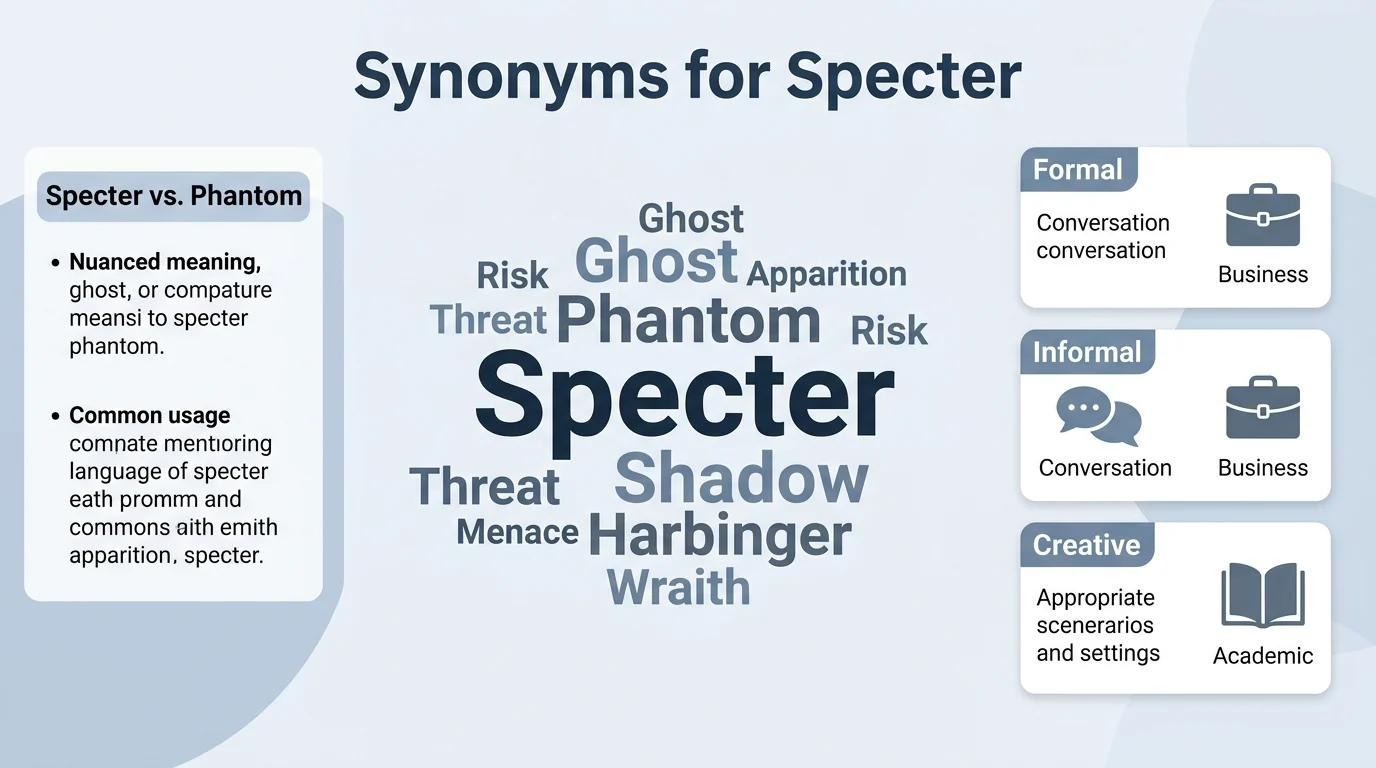
The word “specter” primarily means a ghost or a visible spirit. It also describes a haunting or unsettling idea that causes fear. The best synonyms depend on your context. Use “ghost” for casual conversations, “apparition” for descriptive writing, “phantom” for literary work, and “threat” for professional reports about potential dangers.
Meaning, Tone and Context
Simple Definition
A specter is a ghostly image or a source of fear and dread. It can be a literal ghost or a figurative worry that haunts your thoughts.
Part of Speech
Specter is a noun. The plural form is “specters.”
Tone
The tone of “specter” is almost always negative, serious, and dramatic. It creates a feeling of unease or foreboding.
Formality Level
This word is moderately formal. It appears more often in literature, journalism, and serious discussions than in everyday conversation.
Common Use Cases
You will see “specter” used to discuss ghosts in stories. More frequently, it describes intangible fears like the specter of unemployment or the specter of war.
Important Word Forms
The word “spectral” is the adjectival form, meaning ghostly or relating to a specter. For example, a “spectral figure” or “spectral light.”
When and How to Use “Specter”
You should use “specter” when you want to emphasize a pervasive and unsettling presence. It works best in formal writing, creative storytelling, and serious professional discussions about risks.
Here are several realistic examples to show you how it is used.
Professional Example
The constant specter of budget cuts made the team anxious about their projects.
Personal Example
The specter of past mistakes haunted him during his college application process.
Academic Example
Historians still debate the specter of economic collapse that loomed over the 1930s.
Creative Example
A pale specter drifted through the abandoned manor’s grand hall.
Emotional Example
She could not escape the specter of loneliness, even in a crowded room.
Social Media Caption
The specter of a rainy day ruined our plans for a beach party.
Another Word for “Specter”
Choosing the right replacement is crucial for clear communication. Here is the best single replacement based on your specific need.
Professional Writing
Use “threat.” This word is direct and practical. It focuses on the real danger without a supernatural tone.
Academic Writing
Use “phenomenon” if discussing a scientific or historical concept. Use “apparition” if describing a visual event in a narrative.
Casual Conversation
Use “ghost” or “scare.” These words are simple and easily understood by everyone.
Emotional Writing
Use “shadow” or “gloom.” These words suggest a dark, persistent emotional weight.
Creative Writing
Use “phantom” or “wraith.” These words add a poetic and vivid sense of mystery.
Resume or Workplace Use
Avoid “specter” on a resume. Focus on positive actions. Instead, discuss a “concern” or “risk” that you mitigated.
Social Media Captions
Use “vibe” or “presence” for a modern, casual feel.
Stronger Meaning
Use “menace” or “harbinger.” These synonyms suggest an active and threatening force.
Softer Meaning
Use “suggestion” or “hint.” These words reduce the dramatic intensity and imply something less definitive.
When Not to Use “Specter”
Do not use “specter” when the situation feels too light or positive. The word carries a heavy, gloomy weight.
For example, avoid it when describing a minor inconvenience. Saying “the specter of a flat tire” is overly dramatic. “The risk of a flat tire” is much more appropriate.
Also, do not use it for casual daily tasks. For example, “the specter of laundry” sounds silly and forced. A more precise synonym, like “chore,” would improve the sentence significantly.
Words Commonly Confused With “Specter”
Several similar words are often confused with “specter.” Understanding their subtle differences will make you a more precise writer.
Specter vs. Ghost
A ghost is the most common term for a dead person’s spirit. A specter is a more formal and often more unsettling vision. “Ghost” is for everyday use, while “specter” is for literary or dramatic contexts.
Specter vs. Phantom
A phantom is an illusion or a trick of the eye. A specter feels more real and often has a personality. “Phantom” implies something insubstantial, while “specter” suggests a true presence.
Specter vs. Apparition
An apparition is a sudden, unexplained sighting. A specter is a persistent and haunting presence. “Apparition” is a neutral observation, while “specter” is a fearful experience.
Specter vs. Spirit
A spirit is a broader term that can be good, evil, or neutral. A specter is almost always negative and frightening. “Spirit” is general, and “specter” is specifically negative.
Specter vs. Omen
An omen is a sign of a future event. A specter is the event itself or a manifestation of the threat. “Omen” predicts trouble, and “specter” is the trouble itself.
Best Synonym by Context for “Specter”
The following table gives you the best choices for a variety of writing situations.
| Context | Best Synonym | Why It Works | Example |
|---|---|---|---|
| Formal Writing | Threat | It is direct and specific. It removes ambiguity and supernatural elements. | The policy addresses the threat of inflation. |
| Academic Writing | Phenomenon | It suggests an observable event or concept suitable for analysis. | Researchers studied the phenomenon of sleep paralysis. |
| Professional Use | Risk | This is the standard business term. It is clear and actionable. | We need to assess the risk of supply chain disruption. |
| Creative Writing | Phantom | It adds a poetic and mysterious flavor. It is perfect for descriptive prose. | The phantom ship sailed on the horizon. |
| Emotional Tone | Shadow | It implies a dark, looming presence that follows you. | The shadow of grief stayed with her for years. |
| Strong Intensity | Menace | It suggests an active, dangerous, and aggressive force. | The menacing specter of war hung over the nation. |
| Soft or Moderate | Hint | This reduces the fear factor and suggests something vague. | There was a hint of danger in the air. |
| Casual Conversation | Scare | This is an everyday word. It is relatable and not overly formal. | The old movie gave me a good scare. |
| Social Media Captions | Vibe | This is a trendy word. It describes the general feeling of a situation. | The abandoned building gave off a spooky vibe. |
Which Synonym Should You Choose?
Choosing the right synonym requires careful thought. You need to consider your audience, your purpose, and the exact feeling you want to convey.
First, always consider the formality of your situation. Are you writing a business email or a text to a friend? The answer changes your choice completely.
Second, think about the emotional intensity. Are you describing a deadly threat or a mild fear? Match your word to the strength of your feeling.
Third, evaluate your audience. A professional report requires precise language like “risk.” A novel allows for creative words like “wraith.”
Real Life Examples of “Specter” in Sentences
Here are examples that show how “specter” and its synonyms are used in everyday situations.
School
The upcoming exam was a specter that loomed over every student in the class.
Workplace
The manager addressed the specter of layoffs directly to calm the anxious staff.
Writing
In her novel, the hero was haunted by the phantom of his lost love.
Conversation
“I don’t want to be a Debbie Downer, but the specter of debt is always there,” he admitted.
Social Media
The specter of a boring weekend forced us to make plans.
The project manager highlighted the risk of missing the deadline in her weekly update.
Storytelling
The ghostly figure was a wraith, a lost soul with unfinished business in the mortal world.
Resume
Instead of focusing on the threat of failure, I emphasized my ability to manage complex risks.
15 Synonyms for “Specter”
This table provides a curated list of the most accurate and useful synonyms for “specter.” Each word is designed to improve your vocabulary in a specific way.
| Synonym | Simple Meaning | Best Used For | Example Sentence |
|---|---|---|---|
| Ghost | A dead person’s spirit. | General, casual conversations. | The ghost in the attic was very friendly. |
| Phantom | An illusion or a ghostly image. | Creative and literary writing. | The phantom ship vanished into the fog. |
| Apparition | A sudden, strange sight. | Descriptive or narrative writing. | The apparition appeared only for a split second. |
| Spirit | A supernatural being. | General discussions, often neutral. | The spirit of the forest protected the animals. |
| Wraith | A ghost or a pale apparition. | Dark, gothic, or dramatic stories. | The wraith was a cold and terrifying creature. |
| Haunting | A persistent, disturbing memory. | Emotional and psychological contexts. | The haunting of her childhood affected her choices. |
| Shadow | A dark, looming presence. | Emotional and descriptive contexts. | The shadow of failure followed him everywhere. |
| Menace | A threatening presence. | Strong, intense situations. | The economic menace worried the entire world. |
| Threat | A potential danger. | Professional and formal writing. | The threat of a cyberattack is very real. |
| Risk | A chance of loss or injury. | Business, resume, and academic use. | Every investment carries a certain level of risk. |
| Omen | A sign of a future event. | Predictive or ominous storytelling. | The raven was an omen of death. |
| Harbinger | A forerunner of something bad. | Formal and literary writing. | The dark clouds were a harbinger of the storm. |
| Fear | An unpleasant emotion. | Psychological and casual contexts. | The fear of failure kept him from trying. |
| Dread | Great fear and anxiety. | Emotional and psychological contexts. | A sense of dread filled the empty room. |
| Gloom | A state of depression or darkness. | Emotional and descriptive contexts. | The economic gloom affected the entire market. |
Synonym Groups and Usage Differences
Professional vs. Personal Synonyms
Professional language requires direct and neutral words. Use “risk” or “threat” to discuss business challenges. In personal writing, you can use more emotional words like “shadow” or “dread” to describe your feelings.
Formal vs. Conversational Synonyms
Formal writing, such as essays or reports, benefits from precise words like “apparition” or “phenomenon.” These sound intelligent and measured. For a text message or a casual chat, “ghost” or “scare” is perfectly acceptable.
Academic Synonyms
In academic writing, precision is paramount. Use “phenomenon” to describe a studied event. Use “concept” if the specter is an idea. Avoid overly dramatic words like “wraith” or “menace.”
Professional and Business Synonyms
Business communication is best served by “risk,” “threat,” or “concern.” These words are clear and action-oriented. They help teams understand problems without the emotional baggage of words like “dread.”
Creative or Literary Synonyms
This is where you can be imaginative. Use “phantom,” “wraith,” “apparition,” or “harbinger” to build atmosphere and add depth to your narrative. These words create vivid pictures in the reader’s mind.
Slang or Modern Synonyms
Strictly speaking, there is no slang equivalent for “specter.” However, in modern usage, people often use “vibe” to describe a general feeling of a place or situation. For example, “This old house has a creepy vibe.” It is acceptable in casual speech but never in professional writing.
Strongest vs. Weaker Synonyms
The intensity of the word can change the entire meaning of your sentence. Here is a scale from mild to strong.
- Mild: Hint, suggestion, presence.
- Moderate: Risk, concern, shadow.
- Strong: Threat, menace, omen.
- Strongest: Harbinger, wraith, dread.
Emotional vs. Neutral Synonyms
Emotional synonyms like “dread,” “gloom,” and “haunting” carry a heavy psychological weight. They are perfect for storytelling and personal reflection. Neutral synonyms like “risk,” “phenomenon,” and “concept” are factual and objective. They are best for reporting and analysis.
Antonyms of “Specter”
Understanding what a specter is not can be just as helpful as understanding what it is. The following are the opposites, or antonyms, of a specter.
| Antonym | Meaning | Example Sentence |
|---|---|---|
| Reality | The state of things as they actually exist. | The reality of the situation was much less scary. |
| Certainty | A fact that is sure to happen. | The certainty of the outcome gave us peace. |
| Fact | A true piece of information. | The facts proved the rumors were just a hoax. |
| Being | A real living creature. | He was a warm, human being, not a cold specter. |
| Presence | Being present in a positive way. | Her calming presence eliminated the fear in the room. |
| Comfort | A state of physical ease and freedom from pain. | The comfort of his words reassured everyone. |
| Hope | A feeling of expectation for a positive result. | Hope replaced the specter of despair. |
| Guardian | A person who protects something. | The guardian angel protected him from harm. |
| Angel | A spiritual being of divine power. | The angel brought a message of peace. |
| Protection | The action of protecting someone or something. | The new law offers protection against financial risk. |
| Safety | The condition of being protected from danger. | The safety of the workers is our top priority. |
| Strength | The quality of being strong. | Her strength overcame the specter of doubt. |
| Security | The state of being free from danger. | The security of the vault was absolute. |
| Truth | The quality of being in accordance with fact. | The truth dispelled the specter of lies. |
| Assurance | A positive declaration intended to give confidence. | The manager’s assurance calmed the employees. |
Comparison: Specter vs. Similar Words
Comparing “specter” with its closest synonyms will help you understand the precise nuance of each word.
Specter vs. Ghost
The main difference is formality. A “ghost” is the everyday word for the spirit of a dead person. A “specter” is a more formal and literary term. “Ghost” is neutral, while “specter” is often frightening. For example, “The ghost was friendly” versus “The specter filled him with dread.”
Specter vs. Phantom
A “phantom” is often a deceptive or illusory image. It can be a trick of the mind or a mirage. A “specter” feels more substantial and terrifying. The “phantom” disappears, but the “specter” haunts you.
Specter vs. Apparition
An “apparition” is a sudden, short-lived appearance. A “specter” is a persistent, ongoing presence. “Apparition” is a neutral term for a sighting. “Specter” implies that the sighting is a source of fear.
Specter vs. Spirit
“Spirit” is a broad, general term that can apply to supernatural beings, emotions, or even alcohol. “Specter” is specific and negative. You can have a good “spirit,” but you can never have a good “specter.”
Specter vs. Omen
An “omen” is a sign or warning of a future event. A “specter” is the event itself, or a manifestation of the event. The “omen” predicts the trouble, and the “specter” is the trouble.
Specter vs. Threat
“Threat” is more concrete and often human or measurable. A “specter” is often abstract and frightening. “Threat” is what you manage in a report; “specter” is what you fear in a story.
Common Phrases and Expressions with “Specter”
These phrases show how “specter” is used in common language.
1. The Specter of Something
This phrase is used to describe an unwanted possibility that is always in the background.
Meaning: A constant fear or worry about a negative future event.
Example: The specter of unemployment hung over the manufacturing town.
2. Raise the Specter
This phrase means to bring up a frightening or unwelcome memory or idea.
Meaning: To make people remember or think about a past problem.
Example: The politician raised the specter of war to gain support for his policies.
3. A Haunting Specter
This phrase emphasizes a ghost or memory that refuses to go away.
Meaning: A memory or image that remains in the mind and causes distress.
Example: The image of the accident was a haunting specter for the driver.
4. The Grim Specter
This phrase highlights a particularly somber or forbidding threat.
Meaning: A dark and serious threat.
Example: The grim specter of famine was a reality for many nations.
5. To Lay a Specter to Rest
This phrase is less common but used metaphorically to stop a persistent fear.
Meaning: To defeat a fear or solve a problem that has been haunting you.
Example: The new research helped lay the specter of disease to rest.
Common Mistakes to Avoid
Even expert writers sometimes misuse this word. Here are common errors to avoid.
1. Using a Casual Synonym in Formal Writing
Using “scare” in a formal business report is incorrect. It sounds unprofessional and childish. Use “threat” or “risk” instead.
2. Using a Formal Synonym in Casual Writing
Using “harbinger” in a text message to a friend seems pretentious and out of place. Stick to “ghost” or “vibe” in casual contexts.
3. Confusing “Specter” with “Spirit”
Remember, “specter” is always negative. “Spirit” can be positive, negative, or neutral. Using “specter” to describe a happy memory would be a serious error.
4. Choosing a Synonym with the Wrong Emotional Tone
If you want to express a mild worry, do not use “menace.” “Menace” suggests an active and dangerous threat. “Concern” or “shadow” would be more appropriate.
5. Using a Synonym That Does Not Fit the Context
Do not use “apparition” to describe an economic crisis. “Apparition” is a visual term. “Threat” or “risk” is a conceptual term. Match the word to the subject.
6. Overusing the Word “Ghost”
“Ghost” is a great word, but using it too often makes your writing repetitive. Use this guide to find a variety of more expressive synonyms.
FAQs
1. What is the best synonym for specter?
The best synonym depends on context. “Ghost” works for general use, “apparition” for descriptive writing, and “threat” for professional contexts.
2. What is a formal synonym for specter?
Formal synonyms include “apparition,” “phenomenon,” and “threat.” These words are suitable for academic and business writing.
3. What is an informal synonym for specter?
Informal synonyms include “ghost” and “scare.” These words are perfect for everyday conversation and casual texts.
4. What is another word for specter in professional writing?
In professional writing, “risk” and “threat” are the best and most accurate synonyms to use.
5. What is the difference between specter and phantom?
A “specter” is a real, haunting presence, while a “phantom” is often an illusion or a deceptive image.
6. What is the opposite of specter?
The opposite of a specter is “reality,” “certainty,” or “fact.” A specter is a fear or an illusion; its opposite is something true and solid.
Conclusion
The word “specter” is a powerful term for describing both literal ghosts and metaphorical fears. Its synonyms offer a wide range of emotional tones and formality levels. Whether you are writing a novel, a business report, or an email, you now have the tools to choose the perfect word.
Remember to always consider your context and audience. A practical tip is to keep a list of your favorite synonyms from this guide nearby. With practice, you will stop repeating “specter” and start using language that is precise, vivid, and effective.