Have you ever read back through an email or an essay and realized you used the word “full” five times in two paragraphs? It happens to everyone. You describe a “full schedule,” a “full glass,” and a “full heart,” and the repetition starts to feel dull. English has a rich vocabulary, yet many writers default to the same familiar words. That is exactly why exploring the synonyms of full can transform your writing from repetitive to precise. The right synonym does more than avoid repetition. It sharpens your meaning, sets the right tone, and helps your reader understand exactly what you intend to communicate. Whether you are writing a resume, drafting a business email, or crafting a story, choosing the best word makes a real difference.
What Are the Best Synonyms of “Full”?
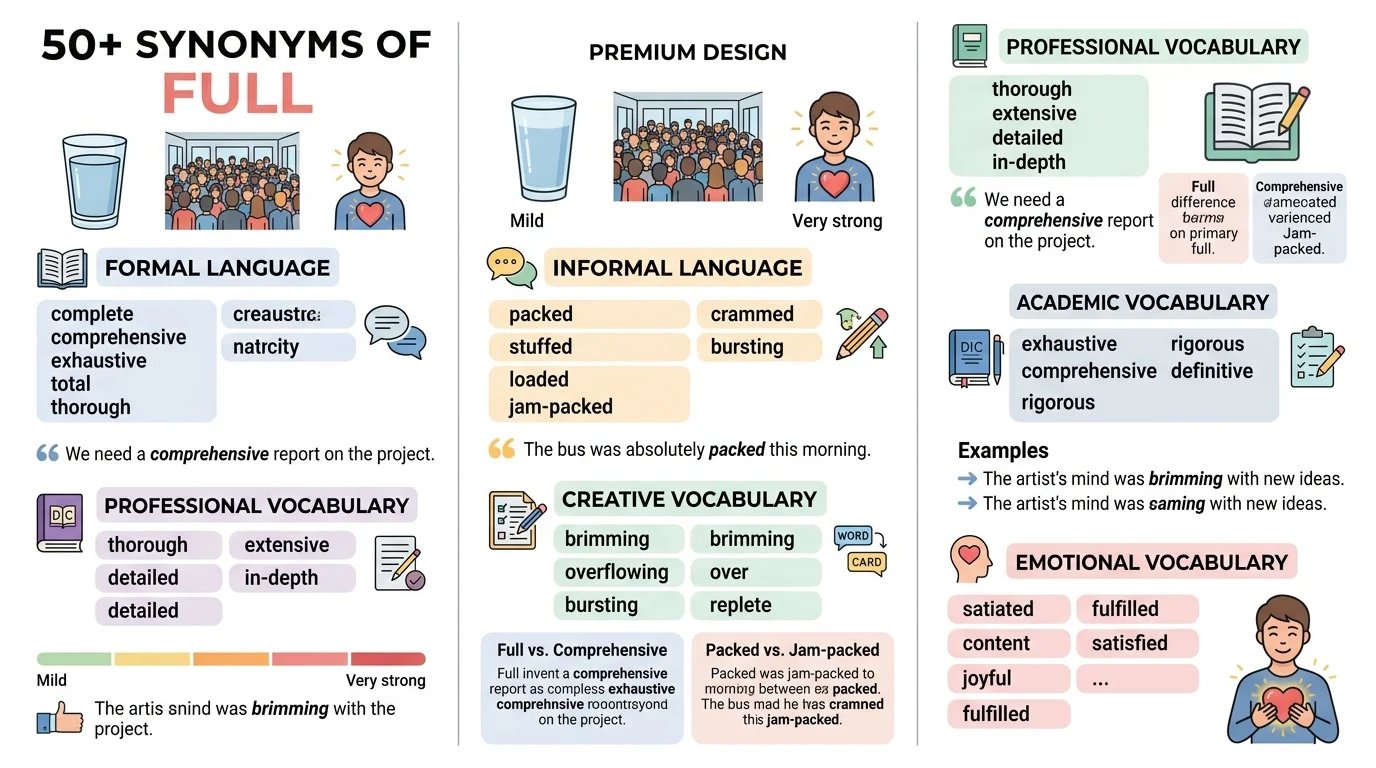
“Full” means containing as much as possible, complete, or satisfied. The best synonym depends on your context. For formal writing, choose “complete” or “comprehensive.” Casual conversation, use “packed” or “stuffed.” For professional settings, “thorough” or “exhaustive” work well. Emotional writing, “brimming” or “overflowing” add warmth.
Meaning, Tone, and Context
Simple Definition
“Full” describes something that holds as much as it can, has no missing parts, or has reached a maximum state. A cup can be full of water. A report can be full of details. A person can be full after a meal.
Part of Speech
“Full” functions primarily as an adjective. It can also appear as an adverb, as in “full well,” or as a noun when referring to the moon, as in “the full of the moon.”
Overall Tone
“Full” is neutral. It simply states a fact without adding emotion or judgment.
Formality Level
“Full” is neutral in formality. It works in almost any setting, from casual texting to formal reports.
Common Uses
Native English speakers use “full” constantly. They talk about full schedules, full parking lots, full names, full attention, and full stops. It appears in everyday conversation, professional writing, and academic work alike.
Word Forms
- Noun: fullness (the state of being full)
- Adjective: full, fuller, fullest
- Adverb: fully (completely)
When and How to Use “Full”
“Full” is your go-to word when you need a straightforward description of capacity, completeness, or satisfaction. It is safe, clear, and widely understood. However, it is also generic. If you want to add precision or flair, consider a more specific synonym. Here are seven examples showing “full” in different contexts.
- Professional: “We have a full schedule of meetings this week.”
- Academic: “The researcher conducted a full review of the existing literature.”
- Workplace: “The conference room is full, so we will meet in the lobby.”
- Personal: “I feel full after that large dinner.”
- Email: “Please provide a full explanation of the delay.”
- Resume: “Managed a full range of marketing campaigns.”
- Social Media: “My heart is full after spending time with family today.”
Best Synonyms of “Full”
No two synonyms are exactly alike. Each carries a slightly different shade of meaning, tone, and intensity. Here are the best choices for specific situations.
- Professional writing: “Comprehensive.” It suggests thoroughness and attention to detail.
- Academic writing: “Exhaustive.” It implies that every possible angle has been covered.
- Business communication: “Complete.” It is clear, direct, and leaves no room for misunderstanding.
- Casual conversation: “Packed.” It feels natural and conversational.
- Emotional writing: “Brimming.” It conveys a sense of being filled with emotion.
- Creative writing: “Overflowing.” It adds vivid imagery.
- Resume writing: “Extensive.” It suggests broad experience and capability.
- Workplace communication: “Thorough.” It signals careful and detailed work.
- Stronger meaning: “Jam-packed” or “bursting.”
- Softer meaning: “Plentiful” or “ample.”
When Not to Use “Full”
“Full” is not always the best choice. Sometimes it sounds too vague, too weak, or too informal. Here are situations where you should consider an alternative.
When It Sounds Too General
If you are describing a detailed report, saying it is “full” does not tell the reader much. Better: “comprehensive” or “exhaustive.”
- Weak: “The report is full of information.”
- Stronger: “The report provides a comprehensive analysis of the market.”
When It Sounds Too Vague
Describing a busy day as “full” is bland. Better: “hectic” or “packed.”
- Weak: “I had a full day at work.”
- Stronger: “I had a packed day with back-to-back meetings.”
When It Sounds Too Informal
In formal academic writing, “full” can seem imprecise. Better: “complete” or “thorough.”
- Weak: “The study gives a full picture of the problem.”
- Stronger: “The study offers a thorough examination of the problem.”
When It Sounds Too Weak
If you want to emphasize that a place was extremely crowded, “full” is too mild. Better: “jam-packed” or “overflowing.”
- Weak: “The stadium was full.”
- Stronger: “The stadium was overflowing with fans.”
When It Sounds Too Strong
If you simply want to say there are enough supplies, “full” might imply more than you mean. Better: “adequate” or “sufficient.”
- Too strong: “We have a full supply of materials.”
- Better: “We have an adequate supply of materials for the project.”
Words Commonly Confused With “Full”
Full vs. Complete
Difference: “Complete” emphasizes that nothing is missing. “Full” emphasizes capacity.
When to Use It: Use “complete” when you mean whole or finished. Use “full” when you mean filled to capacity.
Example: “The complete set of documents is on the table.” vs. “The folder is full of documents.”
Full vs. Total
Difference: “Total” refers to the entire sum or amount. “Full” refers to capacity or completeness.
When to Use It: Use “total” for numbers and sums. Use “full” for physical space or satisfaction.
Example: “The total cost is $500.” vs. “The car is full of passengers.”
Full vs. Entire
Difference: “Entire” means the whole thing, with no parts excluded. “Full” often relates to capacity.
When to Use It: Use “entire” when you mean all of something. Use “full” when you mean filled.
Example: “She read the entire book.” vs. “The bookshelf is full of books.”
Full vs. Ample
Difference: “Ample” means enough or more than enough. “Full” means completely filled.
When to Use It: Use “ample” when there is plenty of space or time. Use “full” when there is no space left.
Example: “We have ample time to finish.” vs. “The parking lot is full.”
Full vs. Replete
Difference: “Replete” is a more formal word meaning well supplied or filled. “Full” is more common and neutral.
When to Use It: Use “replete” in formal or literary writing. Use “full” in everyday speech.
Example: “The library is replete with rare manuscripts.” vs. “The library is full of students.”
Full vs. Sated
Difference: “Sated” specifically means satisfied, especially with food or desire. “Full” has a broader meaning.
When to Use It: Use “sated” when describing appetite or desire. Use “full” for general capacity.
Example: “After the feast, I felt sated.” vs. “The fridge is full of food.”
Best Synonyms of “Full” by Context
| Context | Best Synonym | Why It Works | Example |
|---|---|---|---|
| Formal writing | Comprehensive | Sounds thorough and authoritative | “The committee issued a comprehensive report.” |
| Academic writing | Exhaustive | Implies complete coverage of a topic | “The researcher conducted an exhaustive literature review.” |
| Professional communication | Thorough | Signals careful attention to detail | “We need a thorough analysis of the budget.” |
| Business emails | Complete | Clear and professional | “Please send the complete file by Friday.” |
| Resume writing | Extensive | Suggests broad experience | “Developed extensive expertise in digital marketing.” |
| Workplace communication | Packed | Casual but professional | “My calendar is packed with meetings today.” |
| Casual conversation | Stuffed | Informal and friendly | “I’m stuffed after that big lunch.” |
| Everyday speaking | Filled | Simple and natural | “The room is filled with people.” |
| Creative writing | Overflowing | Adds vivid imagery | “Her heart was overflowing with joy.” |
| Storytelling | Brimming | Suggests emotion barely contained | “His eyes were brimming with tears.” |
| Emotional writing | Bursting | Conveys intense emotion | “She was bursting with pride.” |
| Strong emphasis | Jam-packed | Emphasizes maximum capacity | “The store was jam-packed with shoppers.” |
| Mild tone | Ample | Suggests sufficiency without excess | “There is ample space in the garage.” |
| Social media captions | Loaded | Trendy and engaging | “Loaded with fun times and good vibes.” |
| American English | Full | Standard and widely used | “The gas tank is full.” |
How to Choose the Best Synonym of “Full”
Choosing the right synonym starts with understanding your purpose. Ask yourself these questions.
What exactly am I trying to say?
Are you describing physical capacity, completeness, satisfaction, or intensity? Each meaning has its own best synonyms.
Who is my audience?
A formal report calls for “comprehensive” or “exhaustive.” A text to a friend might use “stuffed” or “packed.”
What tone do I want?
Neutral? Use “complete” or “filled.” Emotional? Use “brimming” or “overflowing.” Playful? Use “jam-packed” or “loaded.”
How strong should the word be?
For mild descriptions, choose “ample” or “plentiful.” For strong emphasis, choose “bursting” or “crammed.”
Does it sound natural?
Read your sentence aloud. If the synonym feels forced or out of place, choose a different one. The best word is the one that communicates your message clearly and naturally.
Real Life Examples of “Full”
School
- Original: “The classroom was full of students.”
- Improved: “The classroom was packed with eager students.”
College
- Original: “My schedule is full this semester.”
- Improved: “My schedule is loaded with challenging courses this semester.”
Workplace
- Original: “The project plan is full of details.”
- Improved: “The project plan is comprehensive and covers every phase.”
Business
- Original: “We have a full inventory of products.”
- Improved: “We maintain a complete inventory of all products.”
- Original: “I have a full day of calls tomorrow.”
- Improved: “I have a packed day of back-to-back calls tomorrow.”
Resume
- Original: “Full responsibility for the sales team.”
- Improved: “Complete responsibility for the sales team’s performance.”
Conversation
- Original: “I’m full after that meal.”
- Improved: “I’m stuffed after that meal.”
Storytelling
- Original: “The room was full of memories.”
- Improved: “The room was brimming with memories of childhood.”
Blogging
- Original: “This guide is full of useful tips.”
- Improved: “This guide is packed with actionable tips.”
Social Media
- Original: “My heart is full.”
- Improved: “My heart is overflowing with gratitude.”
18 Best Synonyms of “Full”
| Synonym | Simple Meaning | Best Used For | Example Sentence |
|---|---|---|---|
| Complete | Having all parts; whole | Formal and professional writing | “The complete report is ready for review.” |
| Comprehensive | Covering everything | Academic and business reports | “The study provides a comprehensive overview.” |
| Exhaustive | Extremely thorough | Research and detailed analysis | “The team conducted an exhaustive search.” |
| Thorough | Careful and complete | Workplace and professional contexts | “She gave a thorough explanation of the process.” |
| Extensive | Large in amount or scale | Resumes and professional descriptions | “He has extensive experience in finance.” |
| Packed | Very crowded or full | Casual conversation and social media | “The concert was packed with fans.” |
| Stuffed | Filled with food or objects | Informal and conversational settings | “I’m stuffed after that huge dinner.” |
| Brimming | Full to the point of overflowing | Emotional and creative writing | “Her eyes were brimming with happy tears.” |
| Overflowing | So full that it spills over | Descriptive and emotional writing | “The donation box was overflowing.” |
| Bursting | Extremely full or eager | Strong emphasis and emotional contexts | “The kids were bursting with excitement.” |
| Jam-packed | Completely filled | Informal and emphatic descriptions | “The stadium was jam-packed with spectators.” |
| Loaded | Filled with a large amount | Informal and modern English | “The website is loaded with helpful resources.” |
| Ample | Enough or more than enough | Describing sufficient space or time | “There is ample parking near the entrance.” |
| Plentiful | Existing in large amounts | Describing abundant resources | “Fresh produce is plentiful at the market.” |
| Replete | Well supplied or filled | Formal and literary contexts | “The book is replete with historical details.” |
| Sated | Satisfied, especially with food | Describing fullness after eating | “After the feast, I felt completely sated.” |
| Crammed | Packed tightly | Describing crowded spaces | “The subway car was crammed with commuters.” |
| Teeming | Full of living things or activity | Vivid and descriptive writing | “The market was teeming with shoppers.” |
Synonyms of “Full” by Usage
Professional vs Personal Synonyms
In professional settings, choose words like “comprehensive,” “thorough,” or “extensive.” These sound competent and serious. In personal conversations, “packed,” “stuffed,” or “loaded” feel more natural and friendly.
Formal vs Conversational Synonyms
For formal writing such as reports, essays, and business presentations, use “complete,” “exhaustive,” or “comprehensive.” For casual conversations, texting, and social media, use “packed,” “crammed,” or “loaded.”
Academic Synonyms
Academic writing demands precision. “Exhaustive” suggests that every possible source has been consulted. “Comprehensive” indicates broad coverage. “Thorough” signals careful methodology. These words lend authority to research papers and scholarly essays.
Professional and Business Synonyms
In resumes, interviews, and client communications, “extensive” shows depth of experience. “Complete” suggests nothing is missing. “Thorough” implies careful attention to detail. These words build confidence and professionalism.
Creative and Literary Synonyms
For storytelling and descriptive writing, “brimming,” “overflowing,” and “bursting” add emotion and imagery. “Teeming” suggests life and activity. These words paint vivid pictures and engage the reader’s imagination.
Slang or Modern Synonyms
“Loaded” is common in informal American English. It means filled with a large amount of something. Use it in casual conversation, social media, and blogging. Avoid it in formal or academic writing.
Strongest to Mildest Synonyms
| Intensity | Synonyms |
|---|---|
| Mild | Ample, plentiful, sufficient |
| Moderate | Filled, complete, thorough |
| Strong | Packed, crammed, loaded |
| Very Strong | Jam-packed, bursting, overflowing |
Emotional vs Neutral Synonyms
Emotional Synonyms: Brimming, overflowing, bursting, teeming. These words express strong feelings or vivid imagery. Use them in creative writing, storytelling, and personal reflections.
Neutral Synonyms: Complete, thorough, extensive, ample. These words simply communicate facts without adding emotion. Use them in professional, academic, and business writing.
Antonyms of “Full”
| Antonym | Meaning | Example Sentence |
|---|---|---|
| Empty | Containing nothing | “The glass is completely empty.” |
| Hollow | Having an empty space inside | “The tree trunk was hollow.” |
| Void | Completely empty | “The room was void of furniture.” |
| Bare | Without contents or covering | “The shelves were bare.” |
| Blank | Empty or without marks | “He stared at the blank page.” |
| Vacant | Unoccupied or empty | “The hotel had no vacant rooms.” |
| Devoid | Lacking or empty of | “The report was devoid of useful information.” |
| Depleted | Reduced in quantity | “The funds were depleted after the project.” |
| Insufficient | Not enough | “The supply was insufficient for the demand.” |
| Meager | Lacking in quantity | “The meal was meager and unsatisfying.” |
| Scant | Barely sufficient | “There was scant evidence to support the claim.” |
| Deficient | Lacking something essential | “The diet was deficient in vitamins.” |
| Barren | Unable to produce or empty | “The land was barren and dry.” |
| Unfilled | Not filled | “The position remains unfilled.” |
| Partial | Not complete | “The report gave only a partial picture.” |
Comparison: “Full” vs Similar Words
Full vs Complete
Main Difference: “Full” emphasizes capacity. “Complete” emphasizes that nothing is missing.
Which Is Stronger? “Complete” is more definitive. It suggests finality.
Which Is More Formal? Both are formal, but “complete” is slightly more formal in academic contexts.
When to Use Each: Use “full” for physical capacity. Use “complete” for wholeness or finished work.
Examples:
- Full: “The glass is full of water.”
- Complete: “The project is now complete.”
Full vs Total
Main Difference: “Total” refers to the entire sum. “Full” refers to capacity or extent.
Which Is Stronger? “Total” is absolute. “Full” can be more flexible.
Which Is More Formal? “Total” is common in formal and technical writing.
When to Use Each: Use “total” for numbers and sums. Use “full” for physical space or satisfaction.
Examples:
- Full: “The car is full of passengers.”
- Total: “The total cost is $500.”
Full vs Entire
Main Difference: “Entire” means the whole thing. “Full” often relates to capacity.
Which Is Stronger? “Entire” is more absolute. “Full” can imply a maximum but not necessarily everything.
Which Is More Formal? Both are neutral.
When to Use Each: Use “entire” when you mean all of something. Use “full” when you mean filled.
Examples:
- Full: “The bookshelf is full of books.”
- Entire: “She read the entire book.”
Full vs Ample
Main Difference: “Ample” means enough or more than enough. “Full” means completely filled.
Which Is Stronger? “Full” suggests maximum capacity. “Ample” suggests sufficiency.
Which Is More Formal? “Ample” is slightly more formal.
When to Use Each: Use “ample” when there is plenty. Use “full” when there is no space left.
Examples:
- Full: “The parking lot is full.”
- Ample: “We have ample time to finish.”
Full vs Packed
Main Difference: “Packed” emphasizes being tightly filled, often with people. “Full” is more general.
Which Is Stronger? “Packed” is stronger and more vivid.
Which Is More Formal? “Full” is more formal. “Packed” is informal.
When to Use Each: Use “packed” for crowds and busy places. Use “full” for general capacity.
Examples:
- Full: “The stadium was full.”
- Packed: “The stadium was packed with fans.”
Full vs Replete
Main Difference: “Replete” is a formal word meaning well supplied. “Full” is common and neutral.
Which Is Stronger? “Replete” suggests abundance. “Full” suggests maximum capacity.
Which Is More Formal? “Replete” is much more formal and literary.
When to Use Each: Use “replete” in formal or literary writing. Use “full” in everyday speech.
Examples:
- Full: “The library is full of students.”
- Replete: “The library is replete with rare manuscripts.”
Common Phrases and Expressions with “Full”
Full speed ahead
Meaning: Proceed at maximum speed or with full effort.
Example: “The team gave the project full speed ahead and completed it early.”
Full of beans
Meaning: Energetic and lively.
Example: “The kids are full of beans this morning.”
Full circle
Meaning: Returning to the original position or situation.
Example: “After years of travel, my career has come full circle.”
Full swing
Meaning: At the peak of activity or operation.
Example: “The party was in full swing by midnight.”
Full stop
Meaning: A complete stop or period (British English).
Example: “You need to come to a full stop at the intersection.”
Full house
Meaning: A completely filled venue or a poker hand.
Example: “The theater had a full house for the opening night.”
Full of oneself
Meaning: Conceited or self-important.
Example: “He is so full of himself that he never listens to anyone else.”
Common Mistakes to Avoid
Choosing a Vague Synonym
Incorrect: “The report is full of important data.”
Better: “The report contains comprehensive data on market trends.”
Why: “Comprehensive” is more precise and professional than “full of.”
Confusing “Full” with “Complete”
Incorrect: “The full project is due Friday.” (implies capacity)
Better: “The complete project is due Friday.” (implies finished)
Why: “Complete” means finished. “Full” means filled.
Using an Informal Synonym in Formal Writing
Incorrect: “The study gives a packed analysis of the results.”
Better: “The study provides a thorough analysis of the results.”
Why: “Packed” is too casual for academic or professional writing.
Selecting an Overly Dramatic Synonym
Incorrect: “The room was bursting with chairs.”
Better: “The room was filled with chairs.”
Why: “Bursting” implies extreme emotion or pressure, not suitable for describing furniture.
Repeating the Same Word Too Often
Incorrect: “The full report is full of full details.”
Better: “The comprehensive report contains complete details.”
Why: Varying your word choice improves readability and style.
Choosing a Synonym with the Wrong Emotional Tone
Incorrect: “The memorial was full of flowers.” (neutral)
Better: “The memorial was overflowing with flowers.” (more emotional and respectful)
Why: “Overflowing” adds a sense of tribute and abundance.
Using Slang in Professional Writing
Incorrect: “My resume is loaded with experience.”
Better: “My resume demonstrates extensive experience.”
Why: “Loaded” is too informal for a resume. “Extensive” sounds more professional.
Frequently Asked Questions
What are the best synonyms of “full”?
The best synonyms depend on context. Formal writing, use “complete” or “comprehensive.” For casual conversation, use “packed” or “stuffed.” For emotional writing, use “brimming” or “overflowing.”
What are the best formal synonyms of “full”?
The best formal synonyms include “comprehensive,” “exhaustive,” “thorough,” and “complete.” These words sound authoritative and precise in academic, business, and professional contexts.
What are common informal synonyms of “full”?
Common informal synonyms include “packed,” “stuffed,” “loaded,” “crammed,” and “jam-packed.” These words are natural in casual conversation, texting, and social media.
What is another word for “full” in professional writing?
In professional writing, use “comprehensive,” “thorough,” “extensive,” or “complete.” These words convey competence and attention to detail.
What is the difference between “full” and “complete”?
“Full” emphasizes capacity or being filled to the maximum. “Complete” emphasizes that nothing is missing or that something is finished. Use “full” for physical space and “complete” for wholeness.
What is the opposite of “full”?
The most direct opposite is “empty.” Other antonyms include “hollow,” “void,” “bare,” “vacant,” “devoid,” and “depleted.”
Conclusion
“Full” is a versatile and useful word that describes capacity, completeness, and satisfaction. But its very versatility makes it generic. By exploring the synonyms of full, you gain the ability to choose words that fit your exact meaning, tone, and audience. “complete” and “comprehensive” for formal writing. Use “packed” and “stuffed” for casual conversation. Use “brimming” and “overflowing” for emotional impact. No single synonym works perfectly in every situation. The best writers choose their words with care, considering who they are writing for and what they want to communicate. The next time you reach for “full,” pause and ask yourself if a more precise word would serve you better. Your readers will notice the difference.