You are writing an important email to your boss. Want to connect two strong points. You type “furthermore.” Then you pause. You have used that word three times already in the same paragraph. You need another word for furthermore, but nothing comes to mind.
This happens to everyone. Writers, students, and professionals all face this moment. Repeating the same transition word makes your writing feel robotic and dull. Your reader loses interest. Your message loses impact.
The good news is simple. English has many excellent alternatives. You just need to know which one fits your situation. This guide shows you exactly how to choose the best synonym for furthermore in any context.
What Does “Furthermore” Mean?
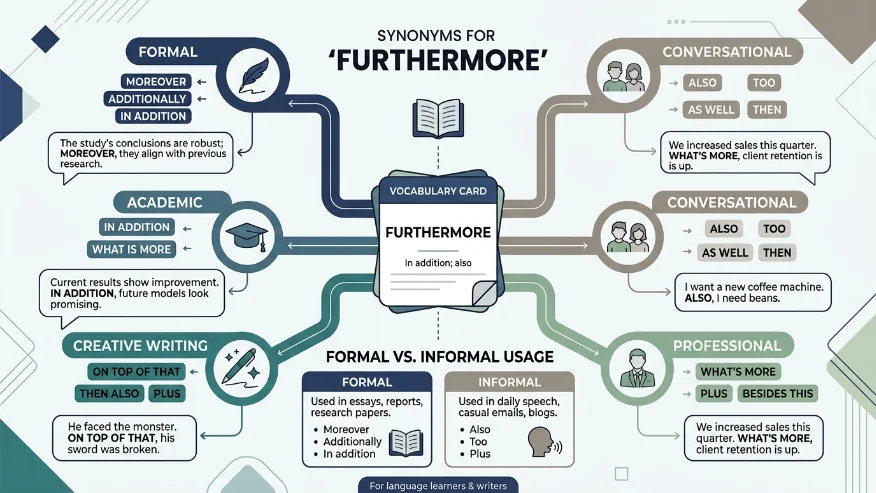
Furthermore is a transition word that adds extra information to support your main point. It means “in addition to what was just stated.” The best synonyms for furthermore include moreover, additionally, and in addition. For formal writing, use moreover. For everyday writing, use additionally. Also for professional documents, use in addition.
Meaning, Tone and Context
Furthermore connects ideas and builds arguments. It signals that you are adding another supporting point.
- Simple definition: Furthermore means “in addition to what came before” or “as an extra point.
- Part of speech: Furthermore is an adverb.
- Tone: Neutral. It does not carry strong positive or negative feelings.
- Formality level: Formal. Furthermore works best in academic papers, professional reports, and serious writing.
- Common use cases: Essays, research papers, business proposals, formal emails, speeches, and argumentative writing.
- Important word forms: The word itself stays the same. It does not change form. You cannot make it an adjective or a verb. It only functions as a conjunctive adverb.
When and How to Use “Furthermore”
Use furthermore when you want to add a new point that strengthens your previous statement. It shows logical progression. It tells your reader that this new information is important and supports your main argument.
Do not use furthermore for small or casual additions. Save it for meaningful supporting points.
Professional context example:
“The new software will reduce processing time by 30%. Furthermore, it will cut operational costs by nearly 15%.”
Academic context example:
“The study found a clear correlation between exercise and cognitive function. Furthermore, participants who exercised regularly reported better sleep quality.”
Personal context example:
“The apartment has a great location near the subway. Furthermore, it includes parking and utilities in the rent.”
Emotional context example:
“She has always supported my career choices. Furthermore, she encourages me to take risks and grow professionally.”
Creative context example:
“The forest held secrets in every shadow. Furthermore, the ancient trees seemed to whisper warnings to those who passed.”
Social media caption example:
“This recipe is quick and affordable. Furthermore, it uses ingredients you already have in your pantry.”
Email context example:
“We have reviewed your proposal thoroughly. Furthermore, we have already identified potential team members for the project.”
Resume context example:
“Managed a team of 12 sales representatives. Furthermore, implemented a new training program that increased quarterly revenue by 22%.”
Another Word for “Furthermore”
The best single replacement depends entirely on your context. Here are direct suggestions for specific situations.
- Professional writing: Additionally. This word sounds capable and straightforward in business settings.
- Academic writing: Moreover. This carries the same formal weight as furthermore and is widely accepted in scholarly work.
- Casual conversation: Also. Simple, natural, and common in everyday speech.
- Emotional writing: Besides. This adds a gentle, personal tone while still connecting ideas.
- Creative writing: Then. This maintains narrative flow without sounding stiff or overly formal.
- Resume or workplace use: In addition. This phrase fits naturally in bullet points and professional summaries.
- Social media captions: Plus. Short, punchy, and perfect for quick online posts.
- Stronger meaning: Moreover. This adds emphasis and makes your argument feel more complete.
- Softer meaning: Also. This reduces intensity and sounds more conversational.
When Not to Use “Furthermore”
Furthermore sounds too formal in casual settings. You should avoid it in text messages, quick emails, and everyday conversations with friends. It creates unnecessary distance between you and your reader.
Furthermore feels redundant when you are not building an argument. If you are simply listing items, use a simpler word like “also” or “and.”
Furthermore weakens your writing when used too often. Overuse makes your paragraphs feel formulaic and tired.
Consider this weak example:
“The team met its quarterly targets. Furthermore, customer satisfaction scores improved. Furthermore, employee engagement increased.”
Now see how a more precise synonym improves the sentence:
“The team met its quarterly targets. Additionally, customer satisfaction scores improved. More importantly, employee engagement increased.”
The second version shows you understand the relative importance of each point.
Words Commonly Confused With “Furthermore”
Several words seem similar to furthermore but have different meanings or uses. Understanding these differences helps you choose the right word.
Furthermore vs. Moreover: Both mean “in addition,” but moreover often adds information that is more important or surprising. Use moreover when your new point strengthens the previous one significantly.
Furthermore vs. Additionally: Additionally is more neutral and slightly less formal. Use additionally for straightforward additions without extra emphasis.
Furthermore vs. Besides: Besides often introduces a weaker or less important point. It can also mean “apart from” or “except for.
Furthermore vs. Also: Also is more casual and general. It does not carry the formal weight of furthermore.
Furthermore vs. In addition: In addition works well in both formal and professional settings. It sounds natural in writing and speech.
Furthermore vs. What’s more: This phrase is more conversational and adds a sense of enthusiasm or surprise.
Best Synonym by Context for “Furthermore”
| Context | Best Synonym | Why It Works | Example |
|---|---|---|---|
| Formal writing | Moreover | Maintains formal tone and adds weight to arguments | The proposal is cost effective. Moreover, it is environmentally sustainable. |
| Academic writing | Moreover | Widely accepted in scholarly publications | The data supports the hypothesis. Moreover, the results are statistically significant. |
| Professional or business use | Additionally | Clear, capable, and professional | The new system improves efficiency. Additionally, it reduces human error. |
| Casual conversation | Also | Natural and conversational | I love that restaurant. Also, the prices are reasonable. |
| Creative writing | Then | Maintains narrative flow without formality | She opened the letter. Then, she read the shocking news. |
| Emotional tone | Besides | Adds a gentle, personal quality | I trust him completely. Besides, he has never let me down. |
| Strong intensity | Moreover | Emphasizes the importance of the new point | The company is growing rapidly. Moreover, it is expanding into new markets. |
| Soft or moderate tone | Also | Reduces formality and intensity | The movie was entertaining. Also, the acting was impressive. |
| Social media captions | Plus | Short and casual | This dress is beautiful. Plus, it was on sale. |
| Resume or workplace | In addition | Professional and easy to read | Led product development. In addition, managed cross functional teams. |
Which Synonym Should You Choose?
Choose your synonym based on three factors: formality, emphasis, and audience.
First, consider your writing context. If you are writing an academic paper, choose moreover. If you are sending a business email, choose additionally.
Second, think about emphasis. Do you want to highlight that this new point is especially important? Choose moreover. Do you want to simply add information without extra stress? Choose additionally or in addition.
Third, consider your audience. Professional audiences expect clear, direct language. Academic audiences appreciate precise, formal transitions. General audiences respond better to natural, conversational words.
Match your word to your reader. This simple rule improves every piece of writing.
Real Life Examples of “Furthermore” in Sentences
School context:
“The experiment clearly demonstrated the principle. Furthermore, it allowed students to practice proper lab techniques.”
Workplace context:
“Our quarterly profits have increased. Furthermore, we have expanded our client base by 15%.”
Writing context:
“The novel explores themes of identity and belonging. Furthermore, it challenges readers to question their assumptions.”
Conversation context:
“I really enjoy hiking. Furthermore, it helps me stay in shape and clear my mind.”
Social media context:
“This app saves you time. Furthermore, it is completely free to use.”
Email context:
“We appreciate your prompt response. Furthermore, we would like to schedule a follow up meeting.”
Storytelling context:
“The hero faced impossible odds. Furthermore, he had lost his most trusted ally the night before.”
25 Synonyms for “Furthermore”
| Synonym | Simple Meaning | Best Used For | Example Sentence |
|---|---|---|---|
| Moreover | Adds a stronger supporting point | Formal and academic writing | The theory is widely accepted. Moreover, it has been tested repeatedly. |
| Additionally | Adds information in a neutral way | Professional and general writing | The course covers grammar. Additionally, it includes vocabulary building. |
| In addition | Adds information formally | Professional documents and speeches | The project is on schedule. In addition, we have secured extra funding. |
| Also | Adds information simply | Everyday conversation and casual writing | I visited the museum. Also, I saw the new exhibit. |
| Besides | Adds a point of lesser importance | Casual conversation | The hotel was nice. Besides, we only stayed one night. |
| Plus | Adds information casually | Social media and informal writing | The phone has great features. Plus, it is affordable. |
| Then | Adds a point in sequence | Creative writing and storytelling | He packed his bag. Then, he called a taxi. |
| What’s more | Adds surprising or important information | Enthusiastic or persuasive writing | The restaurant has great food. What’s more, it offers live music. |
| Further | Adds information in a formal way | Legal and formal documents | The investigation continues. Further, new evidence has emerged. |
| Into the bargain | Adds an unexpected benefit | Informal British English | The car is reliable. Into the bargain, it is fuel efficient. |
| To boot | Adds something extra | Informal and conversational | The meal was delicious. To boot, the service was excellent. |
| As well | Adds information neutrally | Both formal and informal writing | She speaks French. As well, she knows some Spanish. |
| On top of that | Adds information emphatically | Conversational and persuasive | The hotel was cheap. On top of that, it had a pool. |
| Likewise | Adds similar information | Comparison and contrast writing | The first team performed well. Likewise, the second team exceeded expectations. |
| By the same token | Adds information that follows logically | Logical and argumentative writing | Exercise improves health. By the same token, it boosts mental clarity. |
| Not only that | Adds information with emphasis | Persuasive and conversational | The job pays well. Not only that, it offers great benefits. |
| In like manner | Adds similar information formally | Academic and formal writing | The first experiment succeeded. In like manner, the second confirmed the results. |
| Correspondingly | Adds information that matches | Academic and analytical writing | Sales increased. Correspondingly, profits rose significantly. |
| For good measure | Adds extra information | Informal and creative writing | She added spices to the dish. For good measure, she squeezed fresh lemon. |
| Again | Adds a repeated or additional point | Argumentative writing | The evidence is clear. Again, we must consider the ethical implications. |
| Then again | Adds a contrasting point | Conversational and reflective | I love city life. Then again, the countryside has its charm. |
| And | Adds information simply | All writing contexts | He woke early and he prepared breakfast. |
| Too | Adds information informally | Everyday conversation | I would like to go too. |
| Along with that | Adds connected information | Professional and persuasive | The product is durable. Along with that, it is easy to use. |
| In the same vein | Adds related information | Academic and creative writing | The poem explores grief. In the same vein, it celebrates resilience. |
Synonym Groups and Usage Differences
Professional vs. Personal Synonyms
Professional contexts demand clarity and precision. Additionally, in addition, and moreover work well in business writing. Personal contexts allow more variety. Also, plus, and besides sound natural in everyday conversation.
Use formal synonyms for reports, presentations, and official correspondence. Use informal synonyms for emails to colleagues, personal notes, and casual conversations.
Formal vs. Conversational Synonyms
Formal synonyms include moreover, in addition, further, and correspondingly. These words belong in academic papers, legal documents, and formal speeches.
Conversational synonyms include also, plus, besides, and on top of that. These words keep your writing natural and approachable.
Match your word to your tone. Formal words in casual writing sound stiff. Casual words in formal writing sound unprofessional.
Academic Synonyms
Academic writing requires precision and formality. Moreover, furthermore, and additionally are standard choices. In like manner and correspondingly work well for comparative arguments.
These words help you build logical arguments. They show your reader exactly how your points connect. They also demonstrate your command of academic language.
Professional and Business Synonyms
Business writing values clarity and professionalism. Additionally, in addition, and moreover are reliable choices. Further works well in legal and technical documents.
Avoid casual synonyms in business writing. Also and plus can sound too informal in professional settings. Save these for internal team communications.
Creative or Literary Synonyms
Creative writing benefits from variety and rhythm. Then, likewise, and in the same vein add flow to your narrative. Again and for good measure create interesting rhetorical effects.
Choose synonyms that match your story’s tone. A formal historical novel might use moreover. A contemporary short story might use besides or plus.
Slang or Modern Synonyms
Modern writing sometimes uses short, punchy transitions. Plus and also work well in social media posts and blog articles. Not only that adds enthusiasm to persuasive writing.
These words are acceptable in casual online content. Avoid them in academic papers, professional reports, and formal correspondence.
Strongest vs. Weaker Synonyms
This scale shows intensity from mild to strongest:
Mild: Also, plus, and
Moderate: Additionally, in addition, besides
Strong: Moreover, furthermore, what’s more
Very strong: Not only that, on top of that
Choose stronger synonyms for important supporting points. Choose milder ones for simple additions.
Emotional vs. Neutral Synonyms
Neutral synonyms add information without emotional weight. These include additionally, in addition, and correspondingly.
Emotional synonyms add enthusiasm, urgency, or personal feeling. These include what’s more, on top of that, and besides.
Match your emotional tone to your purpose. Neutral words work for factual reports. Emotional words work for persuasive or personal writing.
Antonyms of “Furthermore”
| Antonym | Meaning | Example Sentence |
|---|---|---|
| However | Introduces a contrast | The plan is ambitious. However, it lacks detail. |
| Nevertheless | Introduces a contrasting point despite what came before | The road was long. Nevertheless, we continued. |
| Conversely | Introduces an opposite idea | The first group improved. Conversely, the second group showed no change. |
| On the other hand | Introduces a different perspective | I love the city. On the other hand, I miss the quiet countryside. |
| Although | Introduces a limitation | The proposal is strong. Although, it needs more research. |
| Despite | Introduces an unexpected outcome | The weather was terrible. Despite that, we finished the race. |
| In contrast | Shows a clear difference | The north side is sunny. In contrast, the south side is shaded. |
| Yet | Introduces an unexpected contrast | He studied hard. Yet, he failed the exam. |
| Still | Introduces a limitation or exception | The evidence is convincing. Still, we need more data. |
| But | Introduces a simple contrast | I wanted to go. But, I was too tired. |
| Though | Introduces a mild contrast | The movie was long. Though, it was entertaining. |
| Whereas | Shows a direct comparison | The first chapter is simple. Whereas, the second is complex. |
| While | Shows a contrast during an ongoing action | While the plan is good, it is also expensive. |
| Alternatively | Introduces a different choice | We could drive. Alternatively, we could take the train. |
| Instead | Introduces a substitute action | We did not hike. Instead, we visited the museum. |
Comparison: Furthermore vs. Similar Words
Furthermore vs. Moreover
Main difference: Moreover adds information that is more important or surprising than the previous point. Furthermore simply adds another point of similar importance.
Which one is stronger: Moreover is stronger because it signals that this new point is especially significant.
Which one is more formal: Both are formal, but moreover carries slightly more weight.
Example for furthermore: The company reported record profits. Furthermore, it opened three new locations.
Example for moreover: The company reported record profits. Moreover, it achieved this during a global economic downturn.
Furthermore vs. Additionally
Main difference: Additionally is more neutral and flexible. Furthermore is more formal and often used in structured arguments.
Which one is stronger: Furthermore is stronger because it signals a structured argument.
Which one is more formal: Furthermore is more formal.
Example for additionally: The project requires funding. Additionally, it needs skilled staff.
Example for furthermore: The project requires funding. Furthermore, it needs skilled staff to succeed.
Furthermore vs. Also
Main difference: Also is casual and can appear anywhere in a sentence. Furthermore is formal and always appears at the start of a clause.
Which one is stronger: Furthermore is stronger and more emphatic.
Which one is more formal: Furthermore is clearly more formal.
Example for also: The product is affordable. It is also durable.
Example for furthermore: The product is affordable. Furthermore, it is exceptionally durable.
Furthermore vs. In addition
Main difference: In addition is slightly more neutral and works well in both speaking and writing. Furthermore is more formal.
Which one is stronger: They are similar in strength.
Which one is more formal: Furthermore is slightly more formal.
Example for in addition: The course covers grammar. In addition, it teaches writing skills.
Example for furthermore: The course covers grammar. Furthermore, it develops critical thinking.
Furthermore vs. Besides
Main difference: Besides often introduces a point of lesser importance. Furthermore introduces a point of equal importance.
Which one is stronger: Furthermore is stronger.
Which one is more formal: Furthermore is more formal.
Example for besides: The hotel was fine. Besides, we were only there for one night.
Example for furthermore: The hotel was excellent. Furthermore, the staff were incredibly helpful.
Furthermore vs. What’s more
Main difference: What’s more is conversational and enthusiastic. Furthermore is formal and neutral.
Which one is stronger: What’s more is more emphatic in casual writing.
Which one is more formal: Furthermore is more formal.
Example for what’s more: The restaurant serves great food. What’s more, it offers free delivery.
Example for furthermore: The restaurant serves great food. Furthermore, it maintains high safety standards.
Common Phrases and Expressions with “Furthermore”
1. Furthermore and moreover
Meaning: Using both words together for strong emphasis in formal writing.
Example sentence: The evidence supports our conclusion. Furthermore and moreover, it has been independently verified.
2. Furthermore, it is worth noting
Meaning: Introducing an important additional point.
Example sentence: The policy has clear benefits. Furthermore, it is worth noting that it has broad public support.
3. Furthermore, this suggests
Meaning: Connecting a new point to a logical conclusion.
Example sentence: The data shows a clear trend. Furthermore, this suggests a need for policy changes.
4. And furthermore
Meaning: Connecting an additional point in conversation or less formal writing.
Example sentence: I trust her judgment. And furthermore, she has years of experience.
5. Furthermore, in practice
Meaning: Adding a practical point to a theoretical discussion.
Example sentence: The theory is sound. Furthermore, in practice, it has proven effective.
6. Furthermore, it should be noted
Meaning: Drawing attention to an important additional point.
Example sentence: The results are impressive. Furthermore, it should be noted that they were achieved on a limited budget.
7. Furthermore, we must consider
Meaning: Introducing an important factor for consideration.
Example sentence: The proposal has many advantages. Furthermore, we must consider its long term impact.
Common Mistakes to Avoid
- Using furthermore when a more precise synonym is better. Furthermore is formal. If you are writing casually, choose also or plus instead.
- Confusing furthermore with however. Furthermore adds information. However introduces contrast. These words have opposite functions.
- Using a casual synonym in formal writing. Do not use plus or besides in academic papers. These words undermine your professionalism.
- Using an overly dramatic synonym for a simple situation. What’s more is enthusiastic. Save it for surprising or important points.
- Repeating the same word too often. Vary your transitions. Use moreover, additionally, and in addition to keep your writing fresh.
- Choosing a synonym with the wrong emotional tone. Neutral topics need neutral words. Emotional topics can use more expressive synonyms.
- Using slang in academic or professional writing. Plus and to boot do not belong in formal documents. Save these for casual contexts.
- Placing furthermore incorrectly in a sentence. Furthermore always comes at the start of a clause or sentence. It should be followed by a comma.
- Using furthermore when you really mean “in contrast.” Double check your meaning. If you are showing difference, choose however or on the other hand.
- Overusing furthermore at the start of every paragraph. This creates boring, repetitive writing. Mix in different transition words.
FAQs
What is the best synonym for furthermore?
The best synonym depends on your context. Use moreover for formal academic writing, additionally for professional documents, and also for casual conversation.
What is a formal synonym for furthermore?
Moreover and in addition are excellent formal synonyms. They maintain the same level of formality and work well in academic and professional writing.
What is an informal synonym for furthermore?
Also and plus are good informal synonyms. Use them in casual writing, social media posts, and everyday conversation.
What is another word for furthermore in professional writing?
Additionally is the best professional synonym. It sounds capable and straightforward in business emails, reports, and presentations.
What is the difference between furthermore and moreover?
Moreover adds a point that is more important or surprising. Furthermore adds a point of similar importance. Both are formal.
What is the opposite of furthermore?
The opposite of furthermore includes however, nevertheless, conversely, and on the other hand. These words introduce contrast instead of addition.
Conclusion
Furthermore is a valuable transition word for formal writing. It helps you build logical arguments and connect important points. However, using it too often makes your writing feel robotic and repetitive.
The best synonym for furthermore depends on your context. Use moreover for academic writing and strong emphasis. Use additionally for professional documents and neutral additions. Also for casual conversation and everyday writing.
Remember to match your word to your audience and purpose. Formal contexts demand formal synonyms. Casual contexts welcome casual alternatives. This simple rule will improve every piece of writing you create.
Keep this guide handy. When you reach for furthermore, pause and consider your options. The right synonym will make your writing clearer, more engaging, and more effective.