Have you ever caught yourself writing “this” over and over again in an email, essay, or social media post? You are not alone. Many writers, students, and professionals struggle with repetitive language.
Reusing the same word makes your writing sound dull and unclear. Finding better synonyms for this common word can transform your communication instantly. Your readers will appreciate the variety and precision.
What Does “This” Mean?
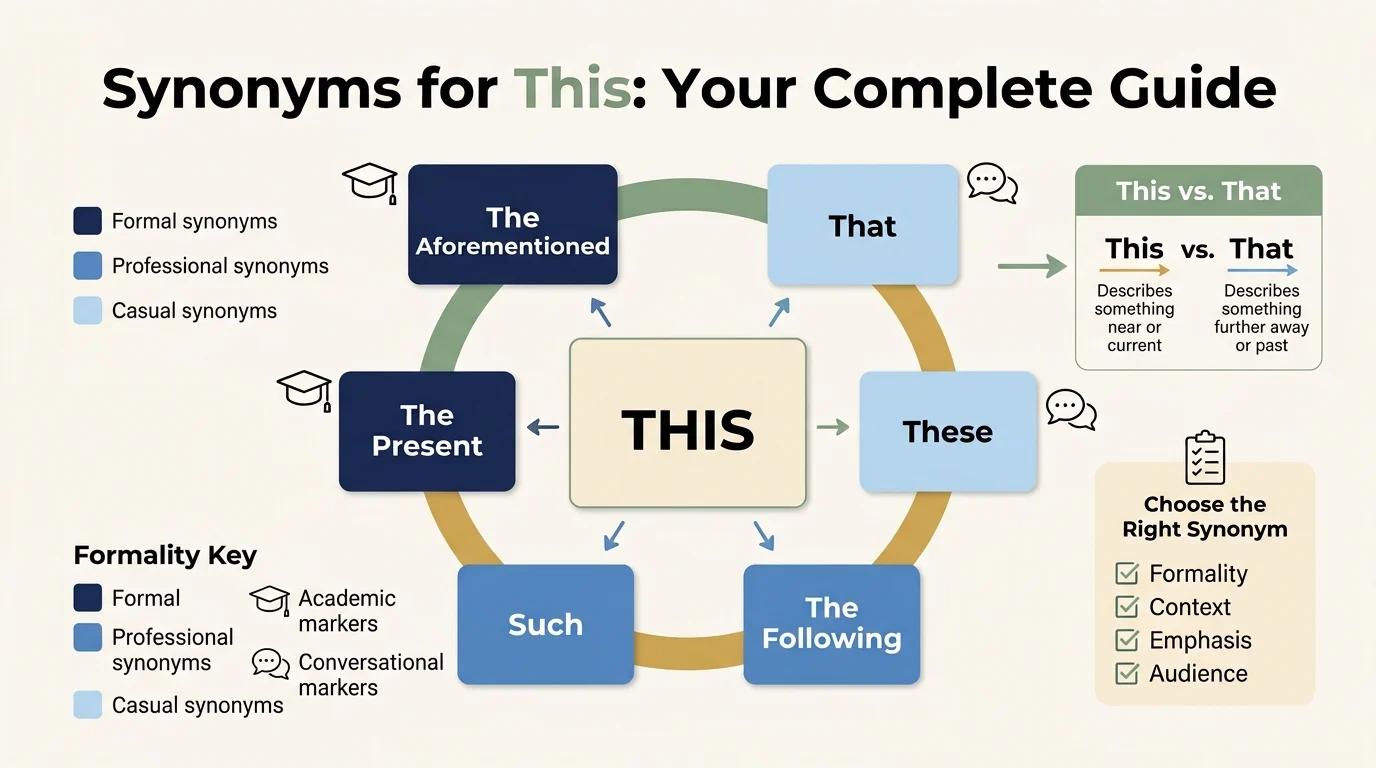
“This” is a demonstrative pronoun and determiner used to point to a specific person, thing, idea, or situation that is nearby in time, space, or context. The best synonyms depend on your situation. For formal writing, try “the aforementioned” or “the latter.” For casual conversation, use “that” or “this one.” academic work, consider “this particular” or “the present.”
Meaning, Tone and Context
- Simple definition: “This” refers to a specific person, object, idea, or situation that is close to the speaker in time, space, or conversation. It helps readers understand exactly what you mean.
- Part of speech: “This” functions as a determiner, pronoun, or adverb depending on how you use it in a sentence. As a determiner, it comes before a noun. As a pronoun, it stands alone.
- Tone: “This” has a neutral tone. It does not carry emotional weight on its own. The tone comes from the words around it and the context of your message.
- Formality level: “This” works in every level of formality. You can use it in academic papers, business emails, text messages, and casual conversations without sounding out of place.
- Common use cases: You use “this” to introduce new topics, refer to previous points, describe physical objects nearby, explain current situations, and connect ideas in writing. It appears constantly in everyday communication.
- Important word forms: Related forms include “these” for plural references, “that” for distant references, and “those” for plural distant references. The word “thus” connects as a formal adverb meaning “in this way.”
When and How to Use “This”
Use “this” when you need to point clearly to something specific. It works best when your reader can easily identify what you mean. Avoid using it when your reference is unclear or when you have already used it too many times.
Here are examples showing “this” in different contexts.
Professional email context:
“This proposal outlines our strategy for the upcoming quarter. Please review it before our meeting.”
Academic writing context:
“This study examines the effects of sleep on cognitive performance in young adults.”
Personal conversation context:
“This is my favorite coffee shop in the whole city. They make the best lattes.”
Creative writing context:
“This moment changed everything. She would never forget the feeling of pure joy.”
Social media caption context:
“This view never gets old. Sunset colors fill the entire sky.”
Resume context:
“This achievement resulted in a 20 percent increase in team productivity.”
Another Word for “This”
The best single replacement depends entirely on your context and what you want to emphasize. Here are the best options for different situations.
Professional writing:
Use “the aforementioned” when referring back to something you already mentioned. Use “this particular” when emphasizing a specific item.
Academic writing:
Use “the present” for current studies or research. Use “the latter” when referring to the second of two items previously mentioned.
Casual conversation:
Use “that” for things slightly further away. Use “this one” when pointing to a specific object physically near you.
Emotional writing:
Use “this very” to add emphasis and emotional weight. Use “such” to express strong feeling about the situation.
Creative writing:
Use “this very” for dramatic effect. Use “the following” to introduce new narrative elements. Use “the latter” for stylistic variety.
Resume or workplace use:
Use “this specific” to highlight particular achievements. Use “the following” to introduce bullet points or lists.
Social media captions:
Use “this one” for a casual, friendly tone. Use “this exact” to emphasize something special or unique.
Stronger meaning:
Use “this very” to add intensity and emphasis. Use “precisely this” to express exactness.
Softer meaning:
Use “this kind of” to soften the directness. Use “this sort of” for a more casual, less precise reference.
When Not to Use “This”
Avoid using “this” when your reader cannot easily identify what you mean. Vague references confuse people and weaken your message.
Too vague:
“This is important.” What is important? The reader has no idea what you mean without more context.
Better alternative:
“This strategy is important for our growth.” Now the reader knows exactly what you mean.
Too repetitive:
“This project needs funding. This funding will help us grow. This growth will create jobs.”
Better alternative:
“This project needs funding. The investment will help us grow. That growth will create jobs.”
Too casual for formal writing:
“This shows the problem.” This sounds too simple for academic or professional reports.
Better alternative:
“This data demonstrates the core problem.” Adding a specific noun makes the sentence more precise.
Words Commonly Confused With “This”
Many writers confuse “this” with similar words. Understanding the differences helps you choose the right word every time.
This vs. That:
“This” refers to something close to you. “That” refers to something further away. Use “this” for current topics and “that” for topics you already discussed.
This vs. These:
“This” is singular. “These” is plural. Use “this” for one item and “these” for multiple items.
This vs. Such:
“This” points to a specific thing. “Such” describes a type or kind. Use “such” when emphasizing quality or degree.
This vs. The:
“This” points specifically. “The” is more general. Use “this” when you need to distinguish one item from others.
This vs. It:
“This” introduces new information. “It” refers back to something already mentioned. Use “this” for new topics and “it” for continuing topics.
This vs. Which:
“This” introduces a new idea. “Which” introduces additional information about something already mentioned.
Best Synonym by Context for “This”
| Context | Best Synonym | Why It Works | Example |
|---|---|---|---|
| Formal writing | The aforementioned | Creates professional distance and clarity | The aforementioned points support our conclusion. |
| Academic writing | The present | Indicates current research or study | The present study builds on previous findings. |
| Professional business | This particular | Adds precision to workplace communication | This particular approach will save us time. |
| Resume writing | The following | Introduces achievements clearly | The following accomplishments demonstrate my skills. |
| Casual conversation | That | Fits natural speech patterns | That is exactly what I meant to say. |
| Creative writing | This very | Adds dramatic emphasis | This very moment changed her life forever. |
| Emotional tone | Such | Expresses strong feeling | Such kindness is rare in this world. |
| Strong intensity | This exact | Emphasizes precision | This exact location holds the key to the mystery. |
| Soft moderate tone | This kind of | Reduces directness | This kind of approach might work better. |
| Social media captions | This one | Sounds friendly and relatable | This one is my favorite photo from the trip. |
| US usage | This | Standard American English usage | This is how we do things in our office. |
| UK usage | This | Standard British English usage | This is how we approach the situation. |
Which Synonym Should You Choose?
Choosing the right synonym depends on several factors. Consider your audience first. A formal report needs different language than a text message.
Think about what you want to emphasize. Are you pointing to something specific? Use “this particular.” Are you introducing a new topic? Use “the following.” Are you referring back to something? Use “the aforementioned.”
Consider the emotional intensity you want. Use “this very” for strong emphasis. Use “such” for emotional weight. “this kind of” for a softer approach.
Think about your sentence structure. Sometimes a simple “this” works perfectly. Other times, replacing it with a more specific word improves clarity. The best choice depends on your unique situation.
Real Life Examples of “This” in Sentences
Here are examples showing how “this” and its synonyms work in different real world situations.
School assignment:
“This research paper explores climate change solutions. The following pages contain our findings.” Using “the following” introduces the paper clearly.
Workplace meeting:
“This strategy will guide our decisions. The approach focuses on customer satisfaction.” Replacing “this” with “the” in the second sentence adds variety.
Writing a novel:
“This particular scene requires careful description. The moment must feel real to readers.” Using “this particular” adds emphasis to the important scene.
Casual conversation:
“This is the best pizza place in town. That one across the street is not as good.” Using both “this” and “that” creates clear contrast.
Social media post:
“This view takes my breath away. Such beauty exists in simple moments.” Replacing “this” with “such” in the second sentence adds emotional depth.
Resume bullet point:
“This achievement earned me the Employee of the Month award. The recognition motivated me to continue growing.” Using “the” in the second sentence provides variety.
Professional email:
“This proposal outlines our recommendations. The aforementioned points summarize our key findings.” Using “the aforementioned” sounds professional and polished.
Storytelling:
“This was the day everything changed. That morning started like any other. Such moments rarely announce themselves.” Using multiple variations creates engaging narrative flow.
25 Synonyms for “This”
| Synonym | Simple Meaning | Best Used For | Example Sentence |
|---|---|---|---|
| That | Refers to something further away | Casual conversation | That is exactly what I needed to hear. |
| These | Plural form of this | Referring to multiple items | These results confirm our hypothesis. |
| The aforementioned | Previously mentioned | Formal writing | The aforementioned points require attention. |
| The following | Coming next | Introductions and lists | The following steps will guide you. |
| This particular | Emphasizes a specific one | Professional writing | This particular method works best. |
| The present | Current or existing | Academic writing | The present study examines new data. |
| The latter | The second of two | Formal and academic writing | The latter option seems more practical. |
| Such | Of that kind | Emotional or descriptive writing | Such courage deserves recognition. |
| This very | Emphasizes exactness | Creative and emotional writing | This very moment changed my life. |
| This exact | Precise and specific | Strong emphasis | This exact location holds the answer. |
| The current | Now happening | Professional and academic | The current situation requires action. |
| The specified | Clearly identified | Technical writing | The specified requirements must be met. |
| The given | Provided or stated | Academic and formal | The given information supports our case. |
| This one | Casual reference | Social media and conversation | This one is my favorite. |
| This kind of | Similar type | Softening directness | This kind of issue arises often. |
| The aforesaid | Previously stated | Legal and formal documents | The aforesaid terms apply to all parties. |
| This sort of | Similar type | Casual conversation | This sort of problem is common. |
| The selfsame | Exactly the same | Literary or formal writing | The selfsame argument appeared yesterday. |
| This self | Emphasizes the thing itself | Philosophical or literary | This self awareness is crucial. |
| The actual | Real or genuine | Clarification | The actual data shows different results. |
| The real | Authentic or true | Emphasis on truth | The real issue remains unsolved. |
| That very | Emphasizes a distant thing | Emotional writing | That very thought keeps me going. |
| This here | Casual emphasis | Informal speech | This here is what we need. |
| The above | Previously written | Formal documents | The above statement is correct. |
| The below | Following text | Formal writing | The below information explains the process. |
Synonym Groups and Usage Differences
Professional vs. Personal Synonyms
Professional writing demands precision and clarity. Use “the aforementioned,” “the following,” or “this particular” in work contexts. These words sound polished and demonstrate your communication skills.
Personal writing allows more freedom. Use “this one,” “that,” or “this kind of” in casual conversations and personal messages. These synonyms feel natural and friendly.
Formal vs. Conversational Synonyms
Formal writing includes reports, academic papers, and business documents. Use “the aforementioned,” “the present,” “the latter,” and “the aforesaid” in these contexts. These words create a professional tone.
Conversational writing includes text messages, social media, and personal emails. Use “that,” “this one,” and “this sort of” in casual communication. These synonyms sound natural and approachable.
Academic Synonyms
Academic writing requires precision and formality. Use “the present” for current research. Use “the aforementioned” for previous points. “the latter” when comparing two items. Use “the given” for provided information. These words appear frequently in scholarly work.
Professional and Business Synonyms
Workplace communication benefits from clear, professional language. Use “this particular” to emphasize specific items. Use “the following” to introduce lists. “the current” to describe present situations. “the specified” for requirements and guidelines.
Creative or Literary Synonyms
Creative writing thrives on variety and emotional depth. Use “this very” for dramatic moments. Use “the selfsame” for literary flair.”such” for emotional descriptions. “the actual” for revealing truth. These words add color and interest to your writing.
Slang or Modern Synonyms
Modern casual language includes “this one,” “this here,” and “this kind of.” These phrases work well in social media and friendly conversations. Avoid them in formal writing or professional documents. They sound too casual for serious contexts.
Strongest vs. Weaker Synonyms
Intensity scale from mild to strongest:
Mild: “this kind of” and “this sort of” soften your statement.
Moderate: “that” and “these” provide neutral reference.
Strong: “this particular” and “the specified” add emphasis.
Strongest: “this very,” “this exact,” and “the selfsame” create powerful emphasis.
Emotional vs. Neutral Synonyms
Emotional synonyms include “such,” “this very,” and “that very.” These words add feeling and passion to your writing. They work well in creative writing, personal messages, and emotional speeches.
Neutral synonyms include “the aforementioned,” “the following,” and “the present.” These words stay factual and objective. They work best in academic papers, business reports, and technical documents.
Antonyms of “This”
| Antonym | Meaning | Example Sentence |
|---|---|---|
| That | Further away | That other option seems better. |
| Those | Plural further away | Those ideas are not relevant here. |
| Other | Different one | Other approaches might work better. |
| Another | One more different | Another solution exists for this problem. |
| Different | Not the same | Different methods produce different results. |
| Opposite | Completely different | The opposite approach yielded success. |
| Alternative | Other choice | An alternative plan is ready. |
| Else | Other than this | Something else caught my attention. |
| Otherwise | In other respects | Otherwise, the plan seems solid. |
| Former | First of two | The former option costs less money. |
| Previous | Before this | Previous studies reached similar conclusions. |
| Prior | Before this time | Prior research supports our theory. |
| Preceding | Coming before | The preceding chapter explains the background. |
| Subsequent | Coming after | Subsequent events proved us correct. |
| Following | Coming next | Following pages contain more details. |
Comparison: This vs. Similar Words
This vs. That
The main difference is proximity. “This” refers to things close to you in time, space, or conversation. “That” refers to things further away.
Which one is stronger? “This” feels more immediate and urgent. “That” feels more distant and detached.
Which one is more formal? Both work in formal writing, but “this” appears more often in current discussions.
Example for “this”: This problem requires immediate attention.
Example for “that”: That issue we discussed last week is resolved.
This vs. These
The main difference is number. “This” is singular. “These” is plural.
Which one is stronger? They have equal strength. The difference is purely grammatical.
Which one is more formal? Both work in all formality levels.
Example for “this”: This study provides new insights.
Example for “these”: These studies provide new insights.
This vs. Such
The main difference is function. “This” points to a specific thing. “Such” describes a type or quality.
Which one is stronger? “Such” often carries more emotional weight. “This” is more neutral.
Which one is more formal? Both work in formal writing, but “such” appears more in descriptive writing.
Example for “this”: This kindness touched my heart.
Example for “such”: Such kindness is rare in this world.
This vs. The
The main difference is specificity. “This” points to one specific item. “The” refers to something generally known.
Which one is stronger? “This” creates more emphasis and distinction.
Which one is more formal? “The” appears more often in formal writing due to its general nature.
Example for “this”: This solution solves our problem.
Example for “the”: The solution solves our problem.
This vs. It
The main difference is introduction versus reference. “This” introduces new information. “It” refers to something already mentioned.
Which one is stronger? “This” has more emphasis as an introducer. “It” is softer as a reference.
Which one is more formal? Both are neutral and work everywhere.
Example for “this”: This idea could change everything.
Example for “it”: It could change everything.
This vs. Which
The main difference is function in sentences. “This” introduces a new idea. “Which” adds information about something already mentioned.
Which one is stronger? “This” has more independent power. “Which” depends on the previous reference.
Which one is more formal? appears more in formal, complex sentences.
Example for “this”: This shows our commitment to quality.
Example for “which”: Our commitment to quality, which we value highly, shows in our work.
Common Phrases and Expressions with “This”
1. This and that
Meaning: Various things or activities, often unimportant ones.
Example sentence: We talked about this and that during our coffee break.
2. This is it
Meaning: The moment has arrived or this is the important point.
Example sentence: This is it. The final decision will be made today.
3. This much
Meaning: To a certain degree or extent.
Example sentence: This much I know for certain: honesty is always the best policy.
4. This or that
Meaning: One thing or another.
Example sentence: You must choose this or that approach for the project.
5. This very moment
Meaning: Right now, emphasizing immediacy.
Example sentence: This very moment could change your entire future.
6. This is the way
Meaning: This is the correct method or approach.
Example sentence: This is the way we have always done things in our department.
7. All this
Meaning: Everything mentioned or everything in the situation.
Example sentence: All this work will pay off in the end.
8. This one time
Meaning: Referring to a specific past occasion.
Example sentence: This one time, we decided to take a different route.
Common Mistakes to Avoid
- Using “this” without a clear reference
Vague “this” confuses readers. Always make sure your reader knows exactly what “this” refers to. If there is any doubt, add a noun after it.
- Confusing “this” with “these” in number agreement
Use “this” for singular nouns. Use “these” for plural nouns. Saying “this results” is incorrect. Say “these results” or “this result.”
- Using a casual synonym in formal writing
Avoid “this one,” “this here,” or “this kind of” in academic papers and professional reports. These phrases sound too casual for serious contexts.
- Using an overly dramatic synonym for simple situations
Saying “this very moment” for something ordinary sounds exaggerated. Save strong synonyms for genuinely important moments.
- Repeating “this” too often in writing
Overusing “this” makes your writing sound repetitive and unpolished. Use synonyms to add variety and keep readers engaged.
- Choosing a synonym with the wrong emotional tone
Match your emotional intensity to the situation. Do not use “such” for neutral facts. Do not use “the aforementioned” for emotional stories.
- Using slang in academic or professional writing
Avoid “this here” and “this one” in formal documents. These phrases belong in casual conversation and social media, not in reports or research papers.
FAQs
What is the best synonym for this?
The best synonym depends on your context. Use “the aforementioned” for formal writing and “that” for casual conversation.
What is a formal synonym for this?
Use “the aforementioned,” “the present,” or “the latter” in formal writing and academic papers.
What is an informal synonym for this?
Use “that,” “this one,” or “this kind of” in casual conversations and personal messages.
What is another word for this in professional writing?
Use “this particular,” “the following,” or “the current” in workplace communication and business documents.
What is the difference between this and that?
“This” refers to things close to you. “That” refers to things further away in time, space, or conversation.
What is the opposite of this?
The opposite concept is “that,” “those,” or “other,” depending on what you are contrasting with “this.”
Conclusion
“This” is a simple but essential word in English. It helps you point to specific people, things, ideas, and situations. However, overusing it makes your writing dull and unclear. The best writers know when to use “this” and when to choose a more precise synonym.
Remember that context determines your best choice. Formal writing demands formal synonyms like “the aforementioned.” Casual conversation welcomes casual options like “that” and “this one.” Academic work requires precision with words like “the present” and “the latter.”
Your vocabulary grows when you understand the subtle differences between similar words. Pay attention to tone, formality, emotional weight, and clarity. Choose words that match your message and your audience. With practice, you will naturally select the perfect synonym for every situation.
A practical vocabulary tip: When you edit your writing, search for every instance of “this.” Ask yourself if each one is clear and necessary. Replace vague or repetitive uses with more specific synonyms. Your writing will become clearer, more engaging, and more professional.