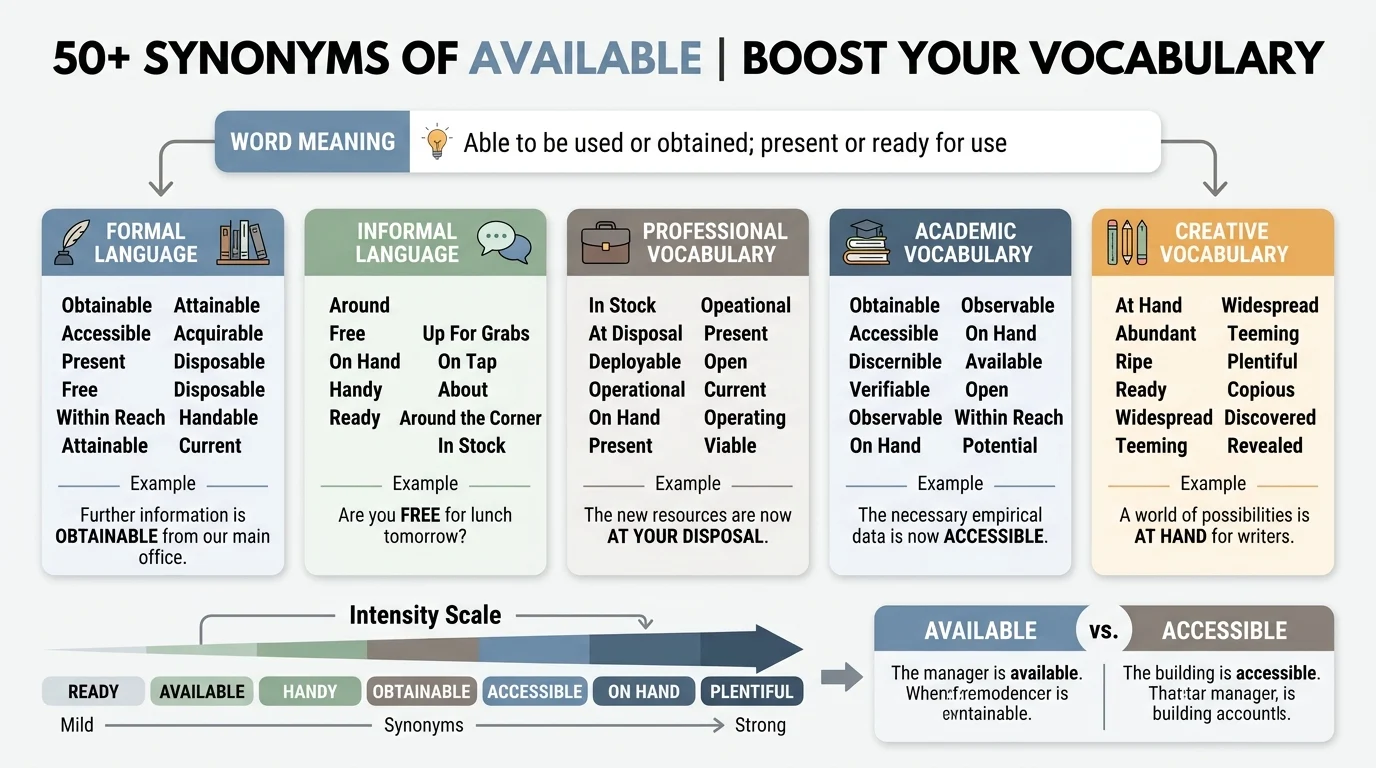
Have you ever written an email, an essay, or a social media caption and realized you used the word “available” three times in two sentences? It happens to everyone. You know what you want to say, but the word feels repetitive, and you cannot think of a better alternative. That is exactly why you need to understand the synonyms of available. This guide will help you replace that overused word with precise alternatives that fit your exact meaning, tone, and audience.
Understanding the synonyms of available does more than expand your vocabulary. It helps you communicate with clarity and confidence. Whether you are writing a business proposal, a college essay, a resume, or a casual text message, choosing the right word makes your message stronger and more professional.
What Are the Best Synonyms of “Available”?
The word available means something is obtainable, accessible, or ready for use. It can also describe a person who is free to do something. The best synonym depends on your context. Formal writing, choose accessible or obtainable. For casual conversation, use handy or free. Professional communication, try on hand or at your disposal. Academic writing, select procurable or attainable. For creative writing, consider within reach or ready to hand.
Meaning, Tone, and Context
Simple Definition
Available means able to be used, obtained, or reached. It describes something that exists and can be accessed when needed. It can also describe a person who is not busy and has time to do something.
Part of Speech
Adjective.
Overall Tone
Neutral. The word itself does not carry strong positive or negative emotion. It simply states a fact about accessibility or readiness.
Formality Level
Neutral to semi-formal. “Available” works in almost any setting, from casual conversation to business writing.
Common Uses
Native English speakers use “available” in many situations:
- Describing products that can be bought: “The shoes are available in three colors.”
- Talking about people who are free: “Is the doctor available this afternoon?”
- Referring to information or resources: “The report is available online.”
- Discussing time or schedules: “I am available for a meeting on Tuesday.”
- Describing opportunities: “Several positions are available at the company.”
Word Forms
- Adjective: available
- Noun: availability
- Adverb: availably (rarely used)
- Verb: avail (different meaning: to be of use or benefit)
When and How to Use “Available”
Choose “available” when you need a straightforward, neutral word that works in almost any context. It is your safe default option. However, using it too often makes your writing feel repetitive and vague. Here are seven realistic examples showing how “available” appears in everyday communication.
Professional
The conference room is available for your team meeting from 2:00 to 4:00 PM.
Academic
Several primary sources are available in the university library’s special collections.
Workplace
Our customer support team is available 24 hours a day, seven days a week.
Personal
I am available to help you move this Saturday if you still need an extra hand.
Email
Please let me know when you are available for a quick phone call about the project.
Resume
References are available upon request.
Social Media
Limited edition merchandise is available now on our website. Grab yours before it sells out!
Best Synonyms of “Available”
No synonym is identical in every situation. Each alternative carries a slightly different shade of meaning, formality level, and emotional weight. Here are the best synonyms for specific contexts.
Professional writing: accessible
This word emphasizes that something is easy to reach or use. It sounds polished and competent. Use it in reports, memos, and professional correspondence.
Academic writing: obtainable
This word suggests that something can be acquired through effort or research. It has a scholarly tone suitable for papers and research articles.
Business communication: at your disposal
This phrase communicates that resources or assistance are ready and waiting for the recipient. It sounds courteous and service-oriented.
Casual conversation: handy
This word suggests convenience and ease of use. It feels relaxed and natural in everyday speech.
Emotional writing: within reach
This phrase adds a sense of closeness and possibility. It works well in personal narratives and reflective writing.
Creative writing: ready to hand
This expression feels literary and descriptive. It paints a picture of something being immediately accessible.
Resume writing: on hand
This phrase suggests preparedness and reliability. It works well in descriptions of skills and qualifications.
Workplace communication: free
This word clearly indicates that someone or something is not occupied. It is direct and easy to understand.
Stronger meaning: readily available
Adding “readily” intensifies the meaning to suggest something is very easy to obtain without delay.
Softer meaning: obtainable
This word is more formal and measured. It suggests something can be gotten but may require some effort.
When Not to Use “Available”
Sometimes “available” is not the best choice. Here are situations where you should choose a stronger, more precise word.
When the word sounds too general
The word “available” is a catch-all term. It does not tell your reader how easy or difficult it is to get something.
Incorrect: The information is available on our website.
Better: The information is easily accessible on our website.
Why: “Easily accessible” tells the reader that finding the information will be simple and quick.
When the word sounds too vague
“Available” does not specify whether something is physically present, ready for use, or simply exists somewhere.
Incorrect: The manager is available.
Better: The manager is free to meet with you now.
Why: “Free to meet” clearly communicates that the manager has time right now, not just that they exist somewhere.
When the word sounds too formal for casual conversation
Sometimes “available” feels stiff in casual settings.
Incorrect: Are you available for coffee this weekend?
Better: Are you free for coffee this weekend?
Why: “Free” sounds more natural and friendly among friends and family.
When the word sounds too informal for academic or professional writing
In formal contexts, “available” can feel too casual.
Incorrect: The data is available in the appendix.
Better: The data is presented in the appendix for reference.
Why: “Presented for reference” sounds more deliberate and scholarly.
When the word sounds too weak
If you want to emphasize that something is very easy to get, “available” is not strong enough.
Incorrect: Customer service is available.
Better: Customer service is readily accessible at all times.
Why: “Readily accessible” emphasizes that help is always close and easy to reach.
When the word sounds outdated (not applicable)
“Available” is not outdated. It remains a common, useful word in modern English.
Words Commonly Confused With “Available”
Available vs Accessible
Difference: “Available” means something exists and can be used or obtained. “Accessible” means something is easy to reach or enter.
When to use it: Use “available” for general availability. Use “accessible” when you want to emphasize ease of access.
Example: The report is available online. (It exists online.) The website is accessible to everyone. (Everyone can easily use it.)
Available vs Obtainable
Difference: “Obtainable” specifically means something can be acquired through effort. “Available” is broader and includes things that are simply present.
When to use it: Use “obtainable” when you want to emphasize that effort or action is required to get something.
Example: Fresh produce is available at the market. Rare books are obtainable through special order.
Available vs Attainable
Difference: “Attainable” usually refers to goals, achievements, or outcomes that can be reached through effort. “Available” refers to things that can be used or obtained.
When to use it: Use “attainable” for goals and aspirations. Use “available” for objects, services, and people.
Example: Career advancement is attainable with hard work. The training materials are available to all employees.
Available vs Handy
Difference: “Handy” suggests something is conveniently close and useful. “Available” simply states that something exists.
When to use it: Use “handy” in casual contexts when you want to emphasize convenience.
Example: Keep a flashlight handy in case of a power outage. Flashlights are available at the hardware store.
Available vs Free
Difference: “Free” can mean either “not busy” (for people) or “at no cost” (for things). “Available” does not imply anything about cost.
When to use it: Use “free” when you mean “not occupied” or “costing nothing.”
Example: I am free this afternoon. (Not busy.) The tickets are free. (No cost.) The tickets are available. (You can get them, possibly for a price.)
Available vs Ready
Difference: “Ready” implies that something has been prepared and is waiting to be used. “Available” simply means something can be used.
When to use it: Use “ready” when preparation has happened. Use “available” for general accessibility.
Example: The presentation is ready for the meeting. The meeting room is available at 3 PM.
Best Synonyms of “Available” by Context
| Context | Best Synonym | Why It Works | Example |
|---|---|---|---|
| Formal writing | Accessible | Sounds polished and professional | The full policy document is accessible through the company portal. |
| Academic writing | Obtainable | Has a scholarly, precise tone | The original manuscripts are obtainable from the archive. |
| Professional communication | At your disposal | Sounds courteous and helpful | Our technical support team is at your disposal during business hours. |
| Business emails | On hand | Suggests readiness and reliability | I have the updated figures on hand for our discussion. |
| Resume writing | Ready | Shows preparedness and initiative | Ready to contribute immediately to your marketing team. |
| Workplace communication | Free | Direct and easy to understand | Is the conference room free at 2 PM? |
| Casual conversation | Handy | Feels natural and relaxed | Keep a pen handy in case you need to take notes. |
| Everyday speaking | Open | Suggests availability without formality | Are you open for lunch on Friday? |
| Creative writing | Within reach | Adds a sense of closeness and imagery | The solution was within reach if only they looked harder. |
| Storytelling | Ready to hand | Creates a descriptive, literary feel | Her notes were ready to hand on the desk beside her. |
| Emotional writing | Available | Neutral, lets the emotion come from context | She made herself available whenever her friend needed support. |
| Strong emphasis | Readily available | Adds intensity and immediacy | Clean water is readily available throughout the facility. |
| Mild tone | Obtainable | Softens the statement with a formal tone | The forms are obtainable at the front desk. |
| Social media captions | Up for grabs | Playful and engaging | Limited spots are up for grabs, so sign up now! |
| American English | Available | Standard and universally understood | The product is available in all 50 states. |
How to Choose the Best Synonym of “Available”
Choosing the right synonym comes down to understanding your audience, your purpose, and the tone you want to convey.
Consider your meaning. Are you describing something that exists, something that is easy to reach, or something that is ready for use? Each meaning points to a different synonym.
Consider your audience. A casual blog post calls for “handy” or “free.” A business report calls for “accessible” or “at your disposal.” An academic paper calls for “obtainable” or “attainable.”
Consider your tone. Do you want to sound friendly, formal, urgent, or neutral? Choose a synonym that matches the emotional weight of your message.
Consider the strength of your message. If you want to emphasize that something is very easy to get, use “readily available” or “easily accessible.” If you want to soften your statement, use “obtainable” or “reachable.”
Consider naturalness. The best synonym is the one that sounds natural in your sentence. Read your sentence aloud. If it sounds awkward or forced, try a different word.
Always choose the word that communicates your intended message most clearly to your reader.
Real Life Examples of “Available”
School
The library has several copies of the textbook available for students who need them.
College
Financial aid advisors are available to help students complete their applications before the deadline.
Workplace
The new software update is available for download. Please install it by the end of the week.
Business
Our client requested a meeting, so I checked my schedule and confirmed that I am available next Tuesday.
Email
I am available to discuss the proposal at your convenience. Just let me know what time works for you.
Resume
Reliable and detail oriented professional available for immediate hire.
Conversation
“Are you available to help me with this project?” “Yes, I have some free time this afternoon.”
Storytelling
The old map showed that fresh water was available just beyond the ridge, giving the travelers renewed hope.
Blogging
If you are looking for affordable travel destinations, plenty of budget friendly options are available across Southeast Asia.
Social media
Our new collection is available now! Shop the link in our bio before everything sells out.
18 Best Synonyms of “Available”
| Synonym | Simple Meaning | Best Used For | Example Sentence |
|---|---|---|---|
| Accessible | Easy to reach or enter | Formal writing, professional contexts | The building is accessible to everyone, including those with disabilities. |
| Obtainable | Can be acquired through effort | Academic writing, formal situations | The rare manuscript is obtainable only through the university archive. |
| Attainable | Can be achieved or reached | Goals, aspirations, academic writing | With consistent effort, your career goals are entirely attainable. |
| Handy | Conveniently close and useful | Casual conversation, everyday speech | Keep a first aid kit handy in your car for emergencies. |
| On hand | Ready and available when needed | Workplace, professional settings | We have extra supplies on hand in case of unexpected demand. |
| At your disposal | Ready for you to use | Professional communication, customer service | Our team is at your disposal to answer any questions you may have. |
| Ready | Prepared and waiting for use | Resumes, professional writing | The new employee is ready to begin training immediately. |
| Free | Not busy or occupied | Casual conversation, scheduling | Are you free to join us for dinner on Saturday? |
| Open | Available for appointments or opportunities | Scheduling, professional settings | I have an open slot at 3 PM if that works for you. |
| Within reach | Close enough to be accessed | Creative writing, emotional contexts | Success was within reach, but they needed one final push. |
| Procurable | Can be obtained, often with effort | Formal, academic, legal contexts | The necessary permits are procurable from the city office. |
| Securable | Can be obtained or made safe | Formal, business, security contexts | Additional funding is securable through the grant program. |
| To be had | Exists and can be obtained | Informal, conversational | There are great deals to be had at the end of the season sale. |
| On tap | Readily available, often for services | Informal, business contexts | We have expert consultants on tap for any project. |
| At hand | Close and ready for use | Formal, descriptive writing | Keep your reference materials at hand while writing the report. |
| Reachable | Can be contacted or accessed | Professional, everyday contexts | The manager is reachable by phone during business hours. |
| Usable | Fit for use | Technical, practical contexts | The old equipment is still usable for basic tasks. |
| Convenient | Easy to use or access | Everyday, professional contexts | Online banking is a convenient way to manage your finances. |
Synonyms of “Available” by Usage
Professional vs Personal Synonyms
In professional settings, choose words that sound competent and reliable: accessible, on hand, at your disposal, and ready. These words convey professionalism and preparedness.
In personal conversations, choose words that sound friendly and natural: handy, free, open, and around. These words feel relaxed and approachable.
Formal vs Conversational Synonyms
Formal synonyms suitable for reports, essays, business writing, presentations, and professional emails:
- Accessible
- Obtainable
- Attainable
- Procurable
- Securable
- At your disposal
Conversational synonyms suitable for casual conversations, texting, and informal writing:
- Handy
- Free
- Open
- Around
- Up for grabs
- To be had
Academic Synonyms
Academic writing demands precision and authority. These synonyms sound scholarly and deliberate:
- Obtainable: Suggests acquisition through research or effort
- Attainable: Suggests achieving a goal or outcome
- Procurable: Suggests formal acquisition, often through official channels
- Accessible: Suggests ease of access to information or resources
Professional and Business Synonyms
For resumes, interviews, meetings, presentations, performance reviews, client communication, and business emails, choose these strong options:
- At your disposal: Shows willingness to serve
- On hand: Shows preparedness
- Ready: Shows initiative
- Accessible: Shows openness and approachability
- Reachable: Shows availability for contact
Creative and Literary Synonyms
For storytelling, fiction, poetry, descriptive writing, and speeches, these expressive alternatives add emotion and imagery:
- Within reach: Suggests closeness and possibility
- Ready to hand: Creates a vivid, descriptive image
- At hand: Suggests immediacy and preparedness
- To be had: Adds a slightly poetic, informal tone
Slang or Modern Synonyms
While “available” does not have many true slang equivalents, these informal expressions work in casual contexts:
- Up for grabs: Means something is available for anyone to take. Acceptable in casual conversation and social media. Avoid in professional or academic writing.
- On tap: Means something is readily available, often used for services or expertise. Acceptable in informal business contexts. Avoid in formal reports.
Strongest to Mildest Synonyms
Mild → Moderate → Strong → Very Strong
| Intensity | Synonym | Explanation |
|---|---|---|
| Mild | Obtainable | Suggests something can be gotten but may require effort |
| Mild | Procurable | Formal, suggests acquisition through official channels |
| Moderate | Accessible | Suggests something is easy to reach or enter |
| Moderate | On hand | Suggests something is ready and present |
| Strong | Readily available | Emphasizes ease and speed of access |
| Strong | At your disposal | Suggests full readiness to serve |
| Very Strong | Immediately accessible | Emphasizes instant access without delay |
Emotional vs Neutral Synonyms
Emotional Synonyms (express stronger feelings or create emotional impact):
- Within reach (hope, possibility)
- At your disposal (willingness, service)
- Ready to hand (preparedness, anticipation)
Neutral Synonyms (simply communicate information without adding emotion):
- Obtainable
- Accessible
- Procurable
- Securable
- Usable
Use emotional synonyms when you want to create a connection with your reader. Use neutral synonyms when you simply need to convey factual information.
Antonyms of “Available”
| Antonym | Meaning | Example Sentence |
|---|---|---|
| Unavailable | Not able to be used or obtained | The manager is unavailable for comment at this time. |
| Inaccessible | Not easy to reach or enter | The remote village is inaccessible during the winter months. |
| Unobtainable | Cannot be acquired | The vintage record is unobtainable anywhere in the world. |
| Occupied | Being used or busy | All the meeting rooms are occupied until 4 PM. |
| Engaged | Busy or occupied with something | The customer service line is currently engaged. |
| Busy | Having a lot to do; not free | The doctor is busy with another patient right now. |
| Taken | Already claimed or occupied | That parking spot is taken, but there is another one around the corner. |
| Reserved | Set aside for someone | The table is reserved for a private party this evening. |
| Out of stock | Not currently available for sale | The popular toy is out of stock until next month. |
| Unreachable | Cannot be contacted or accessed | The website was unreachable due to technical issues. |
| Unattainable | Cannot be achieved or reached | For many people, home ownership feels unattainable. |
| Unprocurable | Cannot be obtained | The specialized part is unprocurable from local suppliers. |
| Not ready | Not yet prepared for use | The report is not ready for distribution. |
| Off limits | Not allowed to be used or entered | The construction zone is off limits to visitors. |
| Spoken for | Already claimed or reserved | All the tickets are spoken for, so we cannot get any more. |
Comparison: “Available” vs Similar Words
Available vs Accessible
Main Difference
“Available” means something exists and can be used or obtained. “Accessible” means something is easy to reach, enter, or understand.
Which Is Stronger?
“Accessible” is stronger when you want to emphasize ease of access. “Available” is broader and less specific.
Which Is More Formal?
Both are formal, but “accessible” is slightly more formal and is often used in discussions of design, technology, and public services.
When to Use Each
Use “available” for general statements about existence or readiness. Use “accessible” when you want to emphasize that something is easy to use or reach.
Examples
Available: The report is available in both print and digital formats.
Accessible: The website has been redesigned to be accessible to users with visual impairments.
Available vs Obtainable
Main Difference
“Obtainable” specifically means something can be acquired, often through effort. “Available” is broader and includes things that are simply present or ready for use.
Which Is Stronger?
Neither is inherently stronger. “Obtainable” suggests effort is required. “Available” suggests something is simply there.
Which Is More Formal?
“Obtainable” is more formal and scholarly. “Available” is neutral.
When to Use Each
Use “obtainable” when you want to emphasize that effort or action is needed. Use “available” for general accessibility.
Examples
Available: Fresh coffee is available in the break room.
Obtainable: The necessary permits are obtainable from the city hall.
Available vs Attainable
Main Difference
“Attainable” usually refers to goals, achievements, or outcomes. “Available” refers to objects, services, and people.
Which Is Stronger?
“Attainable” carries a sense of achievement and possibility. “Available” is neutral.
Which Is More Formal?
“Attainable” is more formal and is often used in academic and professional writing about goals.
When to Use Each
Use “attainable” for goals and aspirations. Use “available” for practical, everyday things.
Examples
Available: The training materials are available to all employees.
Attainable: With the right strategy, our quarterly targets are entirely attainable.
Available vs Handy
Main Difference
“Handy” suggests something is conveniently close and useful. “Available” simply states that something exists.
Which Is Stronger?
“Handy” is more descriptive and suggests practical convenience. “Available” is more general.
Which Is More Formal?
“Available” is neutral. “Handy” is informal and conversational.
When to Use Each
Use “handy” in casual contexts when you want to emphasize convenience. Use “available” in neutral or formal contexts.
Examples
Available: Flashlights are available at the hardware store.
Handy: Keep a flashlight handy in case of a power outage.
Available vs Free
Main Difference
“Free” can mean “not busy” (for people) or “at no cost” (for things). “Available” does not imply anything about cost or busyness.
Which Is Stronger?
“Free” is more direct and specific about cost or availability. “Available” is broader.
Which Is More Formal?
“Available” is more formal. “Free” is neutral to informal.
When to Use Each
Use “free” when you mean “not occupied” or “costing nothing.” Use “available” for general accessibility.
Examples
Available: The tickets are available at the box office.
Free: The tickets are free for students with ID.
Available vs Ready
Main Difference
“Ready” implies that something has been prepared and is waiting to be used. “Available” simply means something can be used.
Which Is Stronger?
“Ready” suggests a state of completion and preparedness. “Available” is more passive.
Which Is More Formal?
Both are neutral, but “ready” is often used in professional contexts to show initiative.
When to Use Each
Use “ready” when preparation has happened. Use “available” for general accessibility.
Examples
Available: The meeting room is available at 3 PM.
Ready: The presentation is ready for the meeting.
Common Phrases and Expressions with “Available”
Phrase: Available for comment
Meaning: Willing and able to speak to the media or answer questions.
Example Sentence: The CEO was not available for comment on the merger rumors.
Phrase: Available upon request
Meaning: Can be provided if someone asks for it.
Example Sentence: Additional information is available upon request from our customer service team.
Phrase: Readily available
Meaning: Very easy to obtain or access quickly.
Example Sentence: Clean drinking water is readily available throughout the city.
Phrase: Make available
Meaning: To provide or supply something so that people can use it.
Example Sentence: The school will make the new textbooks available to all students by next week.
Phrase: Available for (something)
Meaning: Having time or being ready for a particular activity or purpose.
Example Sentence: I am available for a meeting on Thursday afternoon.
Phrase: Freely available
Meaning: Available without restriction or cost.
Example Sentence: The software is freely available for download from the developer’s website.
Phrase: Not available
Meaning: Cannot be used, obtained, or contacted.
Example Sentence: The item you selected is not available in your size.
Common Mistakes to Avoid
1: Choosing a vague synonym instead of a precise one
Using “available” when a more specific word would communicate more clearly.
Incorrect: The data is available in the report.
Better: The data is presented clearly in the report.
Why: “Presented clearly” tells the reader the data is not just there but is organized and easy to understand.
2: Confusing “available” with “accessible”
Using these words interchangeably when they have different meanings.
Incorrect: The building is available to people with disabilities.
Better: The building is accessible to people with disabilities.
Why: “Accessible” specifically means easy to enter or use, which is the right word for disability accommodations.
3: Using an informal synonym in formal writing
Using “handy” or “free” in a formal report or academic paper.
Incorrect: The relevant literature is handy in the library archives.
Better: The relevant literature is obtainable in the library archives.
Why: “Obtainable” sounds more scholarly and appropriate for academic writing.
4: Selecting an overly dramatic synonym
Using a word that is too strong for the situation.
Incorrect: Snacks are at your disposal in the break room.
Better: Snacks are available in the break room.
Why: “At your disposal” is too formal and dramatic for casual snacks. It fits better for services or assistance.
5: Repeating the same word too often
Using “available” multiple times in a short piece of writing.
Incorrect: The report is available online. The data is also available in print. Our team is available to help you access it.
Better: The report is accessible online. The data is also obtainable in print. Our team is ready to help you access it.
Why: Using different synonyms makes the writing more varied and interesting.
6: Choosing a synonym with the wrong emotional tone
Using a word that does not match the emotional weight of your message.
Incorrect: I am open to helping you through this difficult time.
Better: I am available to help you through this difficult time.
Why: “Open” sounds casual. “Available” sounds more committed and supportive in emotional contexts.
7: Using slang in academic or professional writing
Using overly casual expressions in formal contexts.
Incorrect: Several positions are up for grabs at the company.
Better: Several positions are available at the company.
Why: “Up for grabs” is too casual for professional job postings.
Frequently Asked Questions
1. What are the best synonyms of “available”?
The best synonyms depend on your context. Formal writing, use accessible or obtainable. For casual conversation, use handy or free. For professional settings, use on hand or at your disposal.
2. What are the best formal synonyms of “available”?
The best formal synonyms include accessible, obtainable, attainable, procurable, and securable. These words sound polished and appropriate for academic papers, business reports, and professional correspondence.
3. What are common informal synonyms of “available”?
Common informal synonyms include handy, free, open, around, and up for grabs. Use these in casual conversations, text messages, and social media posts.
4. What is another word for “available” in professional writing?
In professional writing, use accessible, on hand, at your disposal, or ready. These words convey competence, preparedness, and professionalism in workplace communication.
5. What is the difference between “available” and “accessible”?
“Available” means something exists and can be used or obtained. “Accessible” means something is easy to reach, enter, or understand. A product can be available but not accessible if it is difficult to use.
6. What is the opposite of “available”?
The most direct opposite is unavailable. Other antonyms include inaccessible, unobtainable, occupied, engaged, busy, and out of stock.
Conclusion
The word “available” is a practical, neutral adjective that describes something that can be used, obtained, or reached. It works in almost any context, from casual conversation to professional writing. However, understanding the synonyms of available helps you communicate with greater precision and style.
The best synonym depends on your audience, your purpose, and the tone you want to convey. Formal writing, choose accessible or obtainable. For casual conversation, choose handy or free. Professional communication, choose on hand or at your disposal. For creative writing, choose within reach or ready to hand.
No synonym works perfectly in every situation. The key is to consider your meaning, your audience, and the emotional weight of your message. Always choose the word that communicates your intended message most clearly.
Here is one practical tip for improving your vocabulary: when you write, read your sentences aloud. If a word feels repetitive or vague, look for a stronger, more precise alternative. With practice, choosing the right word becomes second nature.