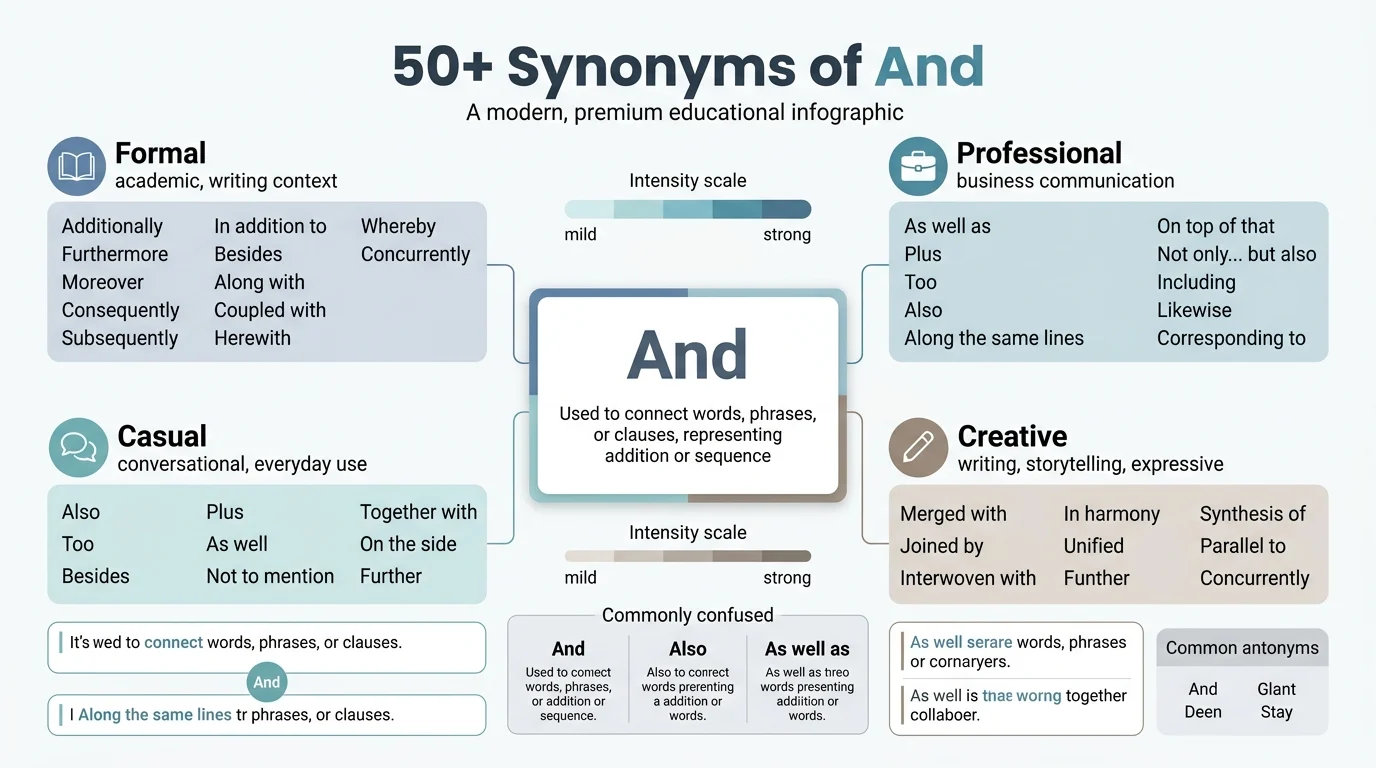
Have you ever read back an email or an essay and noticed you used the word “and” in almost every sentence? You are not alone. This tiny word is the backbone of English, but overusing it can make your writing sound repetitive and simple. Whether you are drafting a resume, writing a school assignment, or composing a social media caption, relying too heavily on “and” can weaken your message. Learning fresh synonyms of and is one of the fastest ways to make your communication clearer and more engaging. Choosing the right alternative helps you connect your ideas more precisely and shows off your vocabulary skills.
What Are the Best Synonyms of “And”?
“And” is a conjunction used to connect words, phrases, or ideas that are related. It is neutral and universally understood. For formal writing, choose “furthermore,” “moreover,” or “in addition.” For casual conversation, try “plus” or “as well as.” For professional emails, “along with” or “together with” sound polished and clear.
Meaning, Tone, and Context
Understanding what “and” actually does is the first step to replacing it effectively.
Simple Definition: “And” is a coordinating conjunction. It joins two or more items, actions, or ideas that are equal in grammatical structure. It simply adds one thing to another.
Part of Speech: Conjunction.
Overall Tone: Neutral. The word “and” carries no emotional weight. It simply connects.
Formality Level: Neutral. It works in every setting, from texting to academic journals. This universality is why it is so overused.
Common Uses: Native speakers use “and” constantly. You use it to list items (bread and butter), show sequence (wake up and eat), or combine ideas (smart and funny). It is the default connector in English.
When and How to Use “And”
You do not need to avoid “and” completely. In fact, trying to remove every instance can make your writing sound forced. Use “and” when you want a simple, neutral connection without any extra meaning.
Here are seven realistic examples showing how “and” works in different contexts.
Professional (Email):
“Thank you for your time and consideration regarding this matter.”
Academic (Essay):
“The study examined the effects of temperature and pressure on the material.”
Workplace (Meeting Notes):
“We need to review the budget and finalize the timeline by Friday.”
Personal (Text Message):
I am going to the store and picking up dinner on the way home.”
Email (Casual):
“I hope you are doing well and enjoying the new office space.”
Resume (Bullet Point):
“Managed a team of five and increased quarterly sales by 15%.”
Social Media (Caption):
“Loving the sunshine and this new coffee spot in town.”
Best Synonyms of “And”
No synonym is identical to “and” in every situation. Some add emphasis, others are more formal, and some are strictly casual. Here is how to choose the best synonym for your specific writing need.
- Professional Writing: “Additionally” or “In addition.” These sound polished and structured, perfect for reports and business documents.
- Academic Writing: “Furthermore” or “Moreover.” These are formal and help build a logical argument by adding supporting evidence.
- Business Communication: “Along with” or “Together with.” These are professional without sounding overly stiff.
- Casual Conversation: “Plus.” It is informal and adds a positive, conversational tone.
- Emotional Writing: “Not to mention.” This adds emphasis and a sense of excitement or importance.
- Creative Writing: “As well as.” It flows smoothly and feels more literary than a simple “and”.
- Resume Writing: “As well as.” It allows you to combine two accomplishments in a sophisticated way.
- Workplace Communication: “Along with.” It clearly shows that two things are happening together or in addition.
- Stronger Meaning: “Moreover.” It suggests the next point is even more important than the previous one.
- Softer Meaning: “Also.” It is gentle and simply adds information without heavy emphasis.
When Not to Use “And”
While “and” is versatile, there are times when it fails you. It can make your writing sound vague or unsophisticated. Here are situations where you should swap it out.
When it sounds too general:
- Explanation: “And” does not show the relationship between ideas. It just sticks them together.
- Better: Use “so” for cause and effect or “but” for contrast.
- Rewrite: Incorrect: “The project was difficult, and we finished it.”
- Better: “The project was difficult, but we finished it.” (Shows contrast)
It sounds too informal:
- Explanation: In an academic paper, overusing “and” can make your argument sound like a child’s list.
- Better: Use “furthermore” or “in addition” to structure your points.
- Rewrite: Incorrect: “The theory is flawed, and it lacks evidence, and it has been criticized.”
- Better: “The theory is flawed. Furthermore, it lacks evidence and has been criticized.”
When it sounds too weak:
- Explanation: Sometimes you need to emphasize that the next point is more important.
- Better: Use “moreover” to signal a stronger point.
- Rewrite: Incorrect: “The candidate is qualified, and she has ten years of experience.”
- Better: “The candidate is qualified. Moreover, she has ten years of experience.”
Words Commonly Confused With “And”
Many words are used similarly to “and,” but they have specific nuances. Here is how to tell them apart.
Best Synonyms of “And” by Context
Choosing the right word depends entirely on where you are writing. This table provides the best choices for specific settings.
| Context | Best Synonym | Why It Works | Example |
|---|---|---|---|
| Formal Writing | Furthermore | It signals a logical progression of ideas. | “The data is compelling. Furthermore, it supports our hypothesis.” |
| Academic Writing | Moreover | It adds weight to an argument. | “The results are significant. Moreover, they are reproducible.” |
| Professional Communication | Additionally | It is clear and structured. | “Additionally, we would like to discuss the quarterly forecast.” |
| Business Emails | In addition | It is polite and standard for professional correspondence. | “In addition to the report, please review the budget.” |
| Resume Writing | As well as | It sounds sophisticated when listing skills. | “Managed social media as well as content creation.” |
| Workplace Communication | Along with | It clearly shows that items are grouped together. | “The software update, along with the new security patch, will be installed tonight.” |
| Casual Conversation | Plus | It is friendly and informal. | “I love this place. Plus, the staff is super nice.” |
| Everyday Speaking | Also | It is simple and natural. | “I am going to the mall. I am also stopping at the bank.” |
| Creative Writing | As well as | It has a rhythmic, pleasant flow. | “The forest was alive with color as well as sound.” |
| Storytelling | Together with | It emphasizes unity or combined action. | “The knight, together with his squire, rode into battle.” |
| Emotional Writing | Not to mention | It adds emphasis and feeling. | “The view was breathtaking, not to mention the incredible food.” |
| Strong Emphasis | Moreover | It highlights the importance of the next point. | “The product is cheap. Moreover, it is reliable.” |
| Mild Tone | Too | It is soft and adds information without force. | “I would like to come too.” |
| Social Media Captions | Plus | It is engaging and conversational. | “Great vibes today, plus amazing coffee.” |
How to Choose the Best Synonym of “And”
Choosing a synonym is not about finding a fancy word. It is about selecting the word that best communicates your intended message.
- Consider Your Audience: Are you writing for a professor, a friend, or a client? Formal audiences require words like furthermore, while friends appreciate plus.
- Think About Emphasis: Do you need to highlight that the next point is more important? Use moreover. Are you just adding a detail? Use also.
- Check the Rhythm: Read your sentence aloud. Does the new word flow naturally? If it sounds clunky, try a different option.
- Avoid Overcorrection: Do not replace every “and.” Sometimes “and” is the best word for the job, especially when listing simple items.
Real Life Examples of “And”
Seeing these synonyms in action helps you understand how to use them. Here are examples across different real-world scenarios.
School (Essay):
“Shakespeare’s plays are timeless; furthermore, they explore universal themes of love and power.”
College (Research Paper):
“The study surveyed 500 participants as well as analyzing historical data from the past decade.”
Workplace (Email):
“We have finalized the design. In addition, we have ordered the initial materials for production.”
Business (Proposal):
“Our solution is affordable. Moreover, it integrates seamlessly with your existing systems.”
Email (Professional):
“Please find the attached contract along with the supplementary terms and conditions.”
Resume:
“Led a team of developers as well as managing client relationships and project timelines.”
Conversation:
“I am going to grab some coffee. Do you want anything? Plus, they have great pastries.”
Storytelling:
“The old house was full of secrets, not to mention the strange noises that came from the attic at night.”
Blogging:
“This recipe is quick and easy. Plus, it only uses five ingredients.”
“Sunshine, good music, and great company. (Sometimes, the original is best!)”
18 Best Synonyms of “And”
Here is a comprehensive list of 18 accurate synonyms for “and,” complete with their meanings and example sentences.
| Synonym | Simple Meaning | Best Used For | Example Sentence |
|---|---|---|---|
| Furthermore | Adding a more important point | Formal writing and speeches | “The proposal is strong. Furthermore, it is on budget.” |
| Moreover | Adding something even more significant | Academic and persuasive writing | “The city is beautiful. Moreover, it is very safe.” |
| Additionally | Adding extra information | Professional and business writing | “Additionally, we offer a one-year warranty.” |
| In addition | On top of what was said | Formal reports and emails | “In addition to the salary, the role includes benefits.” |
| As well as | In addition to, with equal weight | Creative and professional writing | “She is talented as well as hardworking.” |
| Along with | Together with | Professional and workplace communication | “The server, along with the database, crashed.” |
| Together with | Combined with, united | Formal writing, business | “The CEO, together with the board, approved the merger.” |
| Plus | Informal addition | Casual conversation, social media | “The movie was funny, plus the acting was great.” |
| Also | In addition to something already mentioned | General use, conversation | “I like pizza. I also like pasta.” |
| Besides | On top of that, or another reason | Informal, giving reasons | “Besides being qualified, she has great connections.” |
| Too | Means “also,” used at the end | Casual conversation | “I want to go too.” |
| Not to mention | Adds an extra point for emphasis | Emphatic, emotional, or creative writing | “The park is clean, not to mention beautiful.” |
| Coupled with | Combined with something | Formal writing, reports | “High costs, coupled with delays, hurt the project.” |
| Likewise | In the same way | Formal or neutral, showing similarity | “They treated us well, and we acted likewise.” |
| With | Alongside or in the company of | Neutral, describing accompaniment | “I will go with you.” |
| Together | In a group | Neutral, describing unity | “We worked together on the project.” |
| Including | Containing as part of the whole | Lists or descriptions | “Everyone, including the manager, was present.” |
| What is more | An additional point | Formal or emphatic | “The car is fast. What is more, it is efficient.” |
Synonyms of “And” by Usage
Professional vs Personal Synonyms
In the workplace, clarity and structure are key. Use “additionally,” “in addition,” or “along with.” For personal conversations, feel free to use “plus,” “too,” or “also,” which sound more relaxed and friendly.
Formal vs Conversational Synonyms
- Formal (Reports, Essays, Presentations): Moreover, furthermore, in addition, coupled with. These show sophistication and logical thinking.
- Conversational (Texting, Casual Emails): Plus, also, too, besides. These are short, punchy, and sound like natural speech.
Academic Synonyms
For research and essays, precision is vital. “Moreover” and “furthermore” are the gold standard for adding points. “Additionally” is also excellent. They help structure arguments in a way that sounds authoritative and well-researched.
Professional and Business Synonyms
For resumes and client communication, you want to sound competent and polished. “As well as” and “along with” are perfect for combining achievements. “Together with” works well for team efforts.
Creative and Literary Synonyms
Writers often need synonyms that flow beautifully. “As well as” and “together with” have a softer, more literary rhythm. “Not to mention” adds a dramatic flair that works well in storytelling.
Slang or Modern Synonyms
There are no widely accepted slang equivalents for “and” that you should use in writing. In texting, people sometimes use “&” (ampersand) or “+” (plus sign), but these are not appropriate for formal contexts. For spoken slang, “’n’” (as in rock ‘n’ roll) is used but rarely in writing.
Strongest to Mildest Synonyms
The intensity of these synonyms varies significantly.
- Mild: Also, too. These simply add information.
- Moderate: As well as, along with. These are more structured.
- Strong: Moreover, furthermore. These signal that the next point carries weight.
- Very Strong: Not to mention. This is emphatic and draws strong attention to the point.
Emotional vs Neutral Synonyms
- Emotional Synonyms: “Not to mention” adds excitement or emphasis. “Moreover” can show conviction.
- Neutral Synonyms: “Also,” “too,” “as well as.” These simply convey information without adding any emotional layer.
Antonyms of “And”
Since “and” connects and adds, its antonyms are words that separate, contrast, or exclude.
| Antonym | Meaning | Example Sentence |
|---|---|---|
| But | Shows contrast or exception | “I wanted to go, but I was too tired.” |
| Or | Shows an alternative | “Do you want tea or coffee?” |
| Nor | Shows a negative alternative | “He does not like apples, nor does he like pears.” |
| Yet | Shows contrast | “The task was difficult, yet she succeeded.” |
| Although | Shows a concession | “Although it rained, we still went out.” |
| However | Shows contrast | “It was expensive. However, it was worth it.” |
| Unless | Shows an exception | “I will not go unless you come with me.” |
| Except | Shows exclusion | “Everyone was there except John.” |
| Without | Shows the absence of something | “I cannot live without coffee.” |
| Versus | Shows opposition | “The debate was about nature versus nurture.” |
| Against | Shows opposition | “The team played against the champions.” |
| Instead | Shows substitution | “We took the train instead of driving.” |
| Despite | Shows contrast | “Despite the rain, we had fun.” |
| Whereas | Shows contrast | “I like spicy food, whereas she prefers mild.” |
| Lacking | Shows the absence of something | “The plan was good, lacking only in detail.” |
Comparison: “And” vs Similar Words
And vs Also
Main Difference: “And” connects two equal parts in a single unit (bread and butter). “Also” adds information to a separate sentence or clause.
Which Is Stronger? Neutral. “Also” is slightly more conversational.
Which Is More Formal? “And” is neutral. “Also” is acceptable everywhere.
When to Use Each: Use “and” to combine nouns. Use “also” to add a point to a previous statement.
Examples:
- And: “I bought milk and bread.”
- Also: “I bought milk. I also bought bread.”
And vs Plus
Main Difference: “Plus” is informal and often implies a positive addition or benefit.
Which Is Stronger? “Plus” feels more emphatic and positive.
Which Is More Formal? “And” is neutral; “plus” is informal.
When to Use Each: Use “and” in professional contexts. Use “plus” in casual speech or marketing.
Examples:
And vs As Well As
Main Difference: “As well as” puts more emphasis on the first item mentioned.
Which Is Stronger? “And” is neutral; “as well as” is more sophisticated.
Which Is More Formal? “As well as” is more formal.
When to Use Each: Use “as well as” when you want to highlight the main subject.
Examples:
- And: “The manager and the staff attended.”
- As Well As: “The manager, as well as the staff, attended.” (Focuses on the manager)
And vs Moreover
Main Difference: “Moreover” signals that the next point is more important than the last.
Which Is Stronger? “Moreover” is much stronger and more emphatic.
Which Is More Formal? “Moreover” is highly formal.
When to Use Each: Use “and” for simple lists. Use “moreover” to build a persuasive argument.
Examples:
- And: “The plan is cheap and effective.”
- Moreover: “The plan is cheap. Moreover, it is the most effective option available.”
And vs Furthermore
Main Difference: “Furthermore” adds a point that builds on the previous argument.
Which Is Stronger? “Furthermore” is formal and structured.
Which Is More Formal? “Furthermore” is very formal.
When to Use Each: Use “furthermore” in essays or reports to develop a point.
Examples:
- And: “The policy is new and controversial.”
- Furthermore: “The policy is new. Furthermore, it is highly controversial.”
And vs Coupled With
Main Difference: “Coupled with” implies a combination that creates an effect.
Which Is Stronger? “Coupled with” sounds more technical.
Which Is More Formal? “Coupled with” is formal.
When to Use Each: Use “coupled with” to show that two factors are working together.
Examples:
- And: “High demand and low supply caused prices to rise.”
- Coupled With: “High demand, coupled with low supply, caused prices to rise.”
Common Phrases and Expressions with “And”
| Phrase | Meaning | Example Sentence |
|---|---|---|
| And so on | Used to show that a list continues | “We bought pens, paper, notebooks, and so on.” |
| And the like | Similar to “and so on” | “The store sells clothes, shoes, and the like.” |
| Back and forth | Moving in two directions repeatedly | “The debate went back and forth for hours.” |
| Black and white | Clear cut, or the literal colors | “The rules are black and white.” |
| Over and over | Repeatedly | “She played the song over and over.” |
| Now and then | Occasionally | “I go to the cinema now and then.” |
| Pros and cons | Advantages and disadvantages | “We weighed the pros and cons before deciding.” |
| By and large | Generally speaking | “By and large, the project was a success.” |
Common Mistakes to Avoid
1: Using a vague synonym when you need a precise one.
- Incorrect: “We need to review the budget, furthermore finalize the timeline.” (Incorrect use of a formal word)
- Better: “We need to review the budget and finalize the timeline.” (Simple list)
- Why: Overusing formal synonyms in simple lists sounds pretentious.
2: Confusing “and” with “as well as” in subject-verb agreement.
- Incorrect: “The manager, as well as the employees, are worried.”
- Better: “The manager, as well as the employees, is worried.”
- Why: The subject is “manager,” not “employees.” “As well as” is parenthetical.
3: Using informal synonyms in formal writing.
- Incorrect: “The study is groundbreaking, plus it is well-documented.”
- Better: “The study is groundbreaking; moreover, it is well-documented.”
- Why: “Plus” is too casual for academic or professional papers.
4: Selecting an overly dramatic synonym.
- Incorrect: “I bought milk and bread, not to mention eggs.”
- Better: “I bought milk, bread, and eggs.”
- Why: “Not to mention” is too dramatic for a simple shopping list.
5: Repeating the same word too often.
- Incorrect: “The project was long, and it was difficult, and it was expensive.”
- Better: “The project was long, difficult, and expensive.” (Better) or “The project was long and difficult. Furthermore, it was expensive.” (Best)
- Why: Variety makes your writing more engaging.
6: Using slang in academic or professional writing.
- Incorrect: “The results are significant, plus they are conclusive.”
- Better: “The results are significant; furthermore, they are conclusive.”
- Why: Slang undermines your credibility in formal contexts.
Frequently Asked Questions
1. What are the best synonyms of “and”?
The best synonyms depend on context. For formal writing, use “furthermore” or “moreover.” For casual use, try “plus” or “as well as.” For professional settings, “additionally” or “along with” are excellent.
2. What are the best formal synonyms of “and”?
The best formal synonyms are “furthermore,” “moreover,” and “in addition.” These words are commonly used in academic papers, business reports, and professional presentations to build logical arguments.
3. What are common informal synonyms of “and”?
Common informal synonyms include “plus,” “also,” “too,” and “besides.” These are perfect for everyday conversations, text messages, and social media posts.
4. What is another word for “and” in professional writing?
In professional writing, you can use “additionally,” “along with,” or “as well as.” These words sound polished and help you combine ideas clearly without sounding repetitive.
5. What is the difference between “and” and “as well as”?
The main difference is emphasis. “And” gives equal weight to both items. “As well as” places more emphasis on the first item mentioned. For example, “The manager, as well as the staff” focuses on the manager.
6. What is the opposite of “and”?
The opposite of “and” are contrast words like “but,” “or,” “however,” and “yet.” While “and” adds and connects, these words show contrast, alternatives, or exceptions.
Conclusion
“And” is the most common connector in the English language, but relying on it too much can make your writing feel flat and repetitive. By learning the synonyms of and, you gain the power to show relationships between ideas, emphasize important points, and tailor your tone to any audience. No single synonym works in every situation. The key is to consider your context, your audience, and the specific meaning you want to convey. Start by picking just one new synonym, like “furthermore” or “plus,” and use it in your writing this week. You will be amazed at how much clearer and more professional your communication becomes.