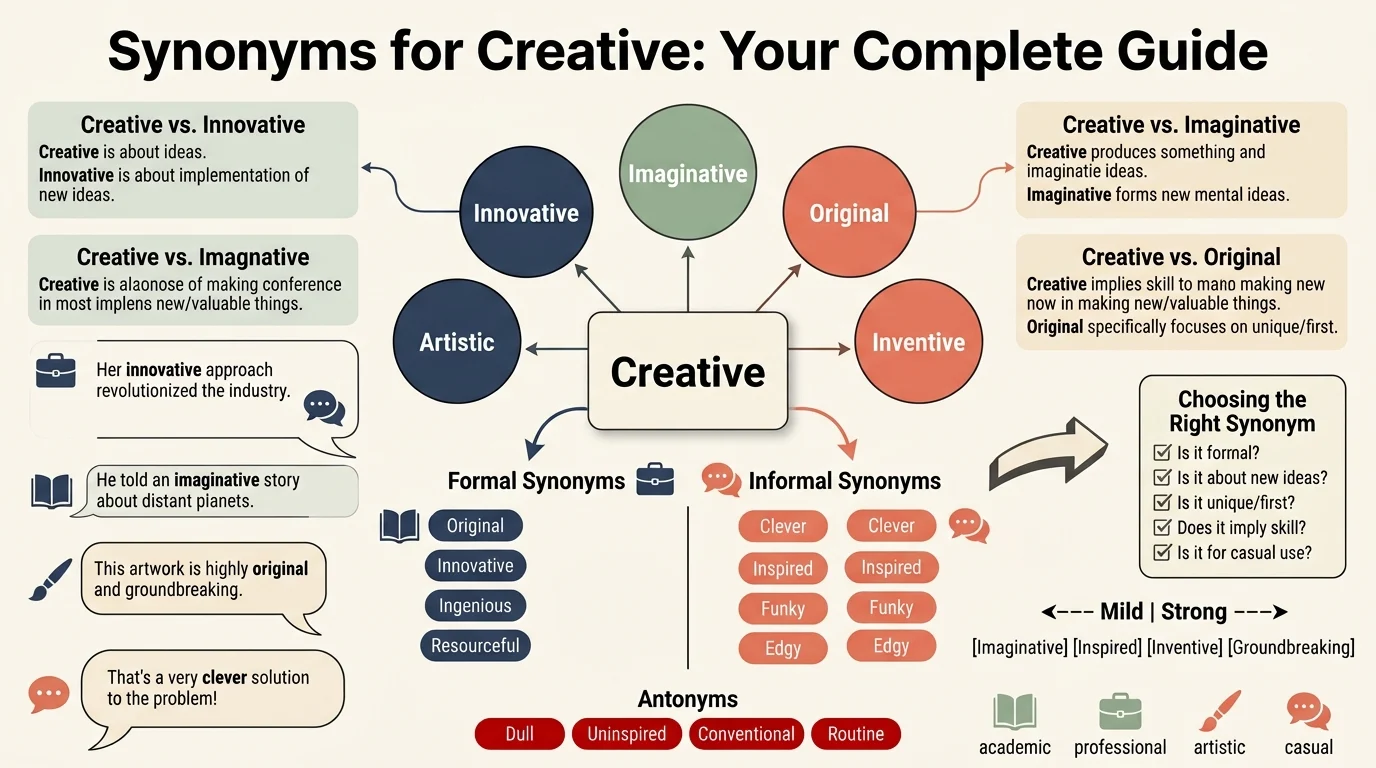
Do you keep using the word “creative” in your writing, emails, or conversations? Many people rely on this single word to describe everything from art projects to problem solving. But overusing “creative” can make your language feel repetitive and vague. This guide will help you find the perfect synonym for any situation.
Whether you are a student writing an essay, a professional crafting a resume, or a blogger looking for fresh vocabulary, the right word can transform your communication. You need precise language that matches your tone and message. Let us explore the best alternatives for “creative” across different contexts.
What Does Creative Mean?
Creative means having the ability to produce original ideas, art, or solutions. The best synonyms depend on your context. Use innovative for professional settings, imaginative for personal expression, original for academic writing, and artistic for emotional or visual work. Choose based on tone and formality.
Meaning, Tone and Context
Simple Definition
Creative describes the ability to use imagination to produce something new or original.
Part of Speech
Creative is primarily an adjective. It can also be used as a noun to refer to a person who works in a creative field, such as a designer or writer.
Tone
Creative has a positive and encouraging tone. It celebrates originality and fresh thinking.
Formality Level
Creative is neutral and works in almost all settings. It appears in casual conversations, professional emails, and academic papers with equal ease.
Common Use Cases
You will use creative to describe art, writing, design, marketing campaigns, problem solving, and innovative business strategies. It applies to personal hobbies and professional projects.
Important Word Forms
Creativity is the noun form. Creatively is the adverb. Create is the verb. The opposite is uncreative.
When and How to Use “Creative”
Use creative when you want to acknowledge original thinking or artistic expression. It works best when describing people, processes, or results that involve imagination. Avoid using it for routine or mechanical tasks.
Here are realistic examples labeled by context.
Professional context: The marketing team developed a creative campaign that increased engagement by forty percent.
Academic context: The researcher proposed a creative methodology that addressed limitations in previous studies.
Personal context: My grandmother has a creative approach to gardening, using recycled containers as planters.
Emotional context: Her creative spirit brought joy and color to every room she decorated.
Social media context: Looking for creative ways to style this vintage jacket for fall.
Resume context: Led a creative team of twelve designers to produce award winning visual content.
Casual context: You always come up with the most creative Halloween costumes.
Another Word for “Creative”
The best single replacement depends on your specific situation. Here are direct suggestions organized by context.
Professional Writing
Innovative works best. It suggests practical originality that produces results. Use inventive when describing problem solving. Use resourceful for solutions that use available materials effectively.
Academic Writing
Original is the strongest choice. It emphasizes new thinking that contributes to knowledge. Use novel for research findings. Use imaginative when discussing theoretical possibilities.
Casual Conversation
Inventive feels natural and friendly. Use clever for quick thinking. Use artsy when describing hobbies or personal style.
Emotional Writing
Artistic connects to emotion and beauty. Use expressive for feelings. Use inspired when creativity comes from strong emotion.
Creative Writing
Imaginative is the classic choice. Use visionary for grand ideas. Poetic for lyrical descriptions. Use whimsical for playful, unexpected ideas.
Resume or Workplace Use
Innovative remains the top choice. Use visionary for leadership roles. Resourceful for operational positions. Use enterprising for business development.
Social Media Captions
Artsy feels modern and visual. Use quirky for unusual choices. Inspired for content influenced by other artists. Use original for unique designs.
Stronger Meaning
Visionary is the strongest. It implies groundbreaking ideas that change how people think. Ingenious suggests brilliant cleverness.
Softer Meaning
Inventive is softer and more accessible. Creative itself is already mild. Imaginative feels gentle and personal.
When Not to Use “Creative”
Creative sounds too vague when you need precision. In technical writing, use innovative to describe new processes. In business reports, use strategic to describe planning.
Using creative for routine tasks diminishes its meaning. Describing a standard data entry process as creative sounds confusing and inaccurate.
Creative feels too casual for formal legal or scientific documents. Use original for scientific discoveries. Use novel for new theories.
Creative can sound weak in resumes. Replace it with specific action words like designed, developed, or pioneered.
Weak example: I used creative thinking to solve the problem.
Improved example: I developed an innovative solution that reduced costs by twenty percent.
Words Commonly Confused With “Creative”
Many words relate to creativity but have different meanings. Understanding these differences helps you choose the right word.
Creative vs. Innovative
Creative focuses on generating new ideas. Innovative focuses on implementing those ideas effectively. Innovation requires action, while creativity can remain conceptual.
Creative vs. Imaginative
Creative implies producing something tangible. Imaginative focuses on the mental process of forming new ideas. You can be imaginative without being productive.
Creative vs. Artistic
Artistic specifically relates to visual arts, music, or performance. Creative applies to all fields including business and science.
Creative vs. Original
Original emphasizes uniqueness and being the first of its kind. Creative includes building on existing ideas in fresh ways.
Creative vs. Inventive
Inventive suggests practical problem solving and mechanical cleverness. Creative has broader artistic and conceptual applications.
Creative vs. Resourceful
Resourceful means finding clever ways to use available resources. Creative includes generating entirely new possibilities.
Best Synonym by Context for “Creative”
| Context | Best Synonym | Why It Works | Example |
|---|---|---|---|
| Formal Writing | Original | Shows uniqueness and scholarly value | The study presents original findings on climate adaptation |
| Academic Writing | Novel | Emphasizes new contributions to knowledge | Her novel approach to data analysis improved accuracy |
| Professional Business | Innovative | Highlights practical results and market value | Our innovative strategy increased market share by fifteen percent |
| Resume Writing | Visionary | Demonstrates leadership and forward thinking | Visionary leader who transformed product development |
| Casual Conversation | Inventive | Sounds natural and approachable | That is such an inventive way to organize your closet |
| Creative Writing | Imaginative | Conveys depth of imagination and storytelling | Her imaginative world building captivated readers |
| Emotional Tone | Artistic | Connects to personal expression and beauty | His artistic vision brought tears to the audience |
| Strong Intensity | Ingenious | Suggests brilliant cleverness | The engineer devised an ingenious solution |
| Soft or Moderate Tone | Resourceful | Shows cleverness without intensity | She found a resourceful way to complete the project |
| Social Media Captions | Artsy | Feels current and visually oriented | Feeling artsy today with this color palette |
Which Synonym Should You Choose?
Consider your audience first. Academic readers prefer original or novel. Business colleagues respond to innovative or visionary. Friends appreciate inventive or clever.
Think about formality. Professional documents demand sophisticated choices like innovative or original. Casual settings welcome artsy, clever, or quirky.
Evaluate emotional intensity. Use artistic for emotional impact. Resourceful for neutral practical situations. Use ingenious for strong admiration.
Match the synonym to the specific action. If someone produces art, use artistic. Someone solves a problem, use resourceful. If someone develops new technology, use innovative.
Check your sentence structure. Some synonyms fit better with specific nouns. Original pairs well with ideas, research, and artwork. Innovative matches solutions, strategies, and products.
Real Life Examples of “Creative” in Sentences
These examples show how stronger synonyms improve clarity and impact across different situations.
School context: The science fair winner used an innovative approach to reduce plastic waste.
Workplace context: Our resourceful team completed the project under budget using repurposed materials.
Writing context: The novelist’s imaginative descriptions transported readers to another world.
Conversation context: Your inventive explanation made the complex concept easy to understand.
Social media context: This quirky arrangement of succulents brightens my entire workspace.
Resume context: Pioneered a visionary marketing campaign that tripled online sales.
Email context: I appreciate your original perspective on the client’s feedback.
Storytelling context: The ingenious plan unfolded perfectly, surprising everyone in the room.
25 Synonyms for “Creative”
| Synonym | Simple Meaning | Best Used For | Example Sentence |
|---|---|---|---|
| Innovative | Produces new and effective ideas | Business and technology | The innovative app changed how people track their fitness |
| Imaginative | Shows strong mental creativity | Writing and personal expression | Her imaginative storytelling captivated children and adults |
| Original | Truly new and not copied | Academic and formal writing | His original research opened new directions in the field |
| Artistic | Relates to visual or performing arts | Creative professions and hobbies | The artistic director chose a bold color scheme for the show |
| Inventive | Good at creating new things | Problem solving and design | The inventor devised an inventive solution to the power shortage |
| Resourceful | Finds clever ways with limited resources | Practical situations and work | Her resourceful use of office supplies saved the presentation |
| Visionary | Sees future possibilities clearly | Leadership and strategy | The visionary entrepreneur predicted the trend before others |
| Ingenious | Brilliantly clever and original | High praise for intelligence | The engineer’s ingenious design won multiple awards |
| Novel | New and unusual in an interesting way | Academic and research contexts | The novel treatment showed promising results in trials |
| Experimental | Tries new and untested methods | Science and art | The experimental film challenged traditional storytelling |
| Inspired | Motivated by strong creative energy | Emotional and artistic contexts | Her inspired performance moved the audience to tears |
| Clever | Quick and smart in a creative way | Casual and practical situations | His clever trick saved us hours of work |
| Expressive | Shows feelings or ideas strongly | Art and emotional communication | The expressive dance conveyed joy and sorrow |
| Original | Fresh and not derivative | General positive description | The restaurant’s original recipes attracted food critics |
| Productive | Produces many creative works | Professional and career contexts | The productive writer published three books this year |
| Fertile | Produces many ideas easily | Brainstorming and planning | Her fertile imagination generated endless story ideas |
| Fresh | New and different in a positive way | Marketing and trends | The fresh design appealed to younger customers |
| Unconventional | Breaks traditional rules | Art and alternative thinking | His unconventional teaching methods engaged every student |
| Daring | Takes risks creatively | Bold creative work | The daring installation challenged museum visitors |
| Pioneering | Leads new developments | Scientific and technological advances | The pioneering research changed medical practice |
| Fertile | Produces many ideas | Brainstorming sessions | The fertile discussion produced ten viable solutions |
| Quick witted | Shows fast creative thinking | Conversation and debate | Her quick witted response defused the tense situation |
| Stylish | Shows creativity in fashion or design | Personal style and aesthetics | The stylish apartment reflected her creative taste |
| Crafty | Shows skill in making things | Hobbies and DIY projects | The crafty grandmother knitted beautiful sweaters |
| Free spirited | Shows creative independence | Personal descriptions | His free spirited attitude attracted other artists |
Synonym Groups and Usage Differences
Professional vs. Personal Synonyms
Professional synonyms focus on results and effectiveness. Innovative, visionary, and resourceful demonstrate practical value.
Personal synonyms emphasize individual expression. Artistic, imaginative, and free spirited describe character and hobby activities.
Use professional words in business communications and resumes. Use personal words in social media, conversations, and creative writing.
Formal vs. Conversational Synonyms
Formal synonyms include original, novel, and pioneering. These appear in academic papers, legal documents, and official reports.
Conversational synonyms include clever, artsy, and quirky. These work well in emails, texts, and casual discussions.
Choose formal language for serious subjects. Choose conversational language for friendly interactions.
Academic Synonyms
Original remains the gold standard for academic writing. It signals genuine contribution to knowledge.
Novel describes research that breaks new ground. Experimental shows methodological innovation.
Use these words in research papers, dissertations, and scholarly articles. They demonstrate intellectual rigor and careful thinking.
Professional and Business Synonyms
Innovative leads business vocabulary. It suggests competitive advantage and forward thinking.
Visionary describes strategic leadership. Resourceful shows practical problem solving skills.
Use these words in resumes, cover letters, presentations, and marketing materials. They communicate value to employers and clients.
Creative or Literary Synonyms
Imaginative adds descriptive depth to writing. It helps readers visualize scenes and characters.
Poetic suggests lyrical beauty. Whimsical adds playful, unexpected elements.
Use these synonyms in fiction, poetry, and descriptive essays. They enrich your prose and engage readers emotionally.
Slang or Modern Synonyms
Artsy has become popular in social media contexts. It describes visual creativity and personal style.
Quirky suggests unusual, endearing creativity. These words work well in casual digital communication.
Avoid slang in professional or academic writing. Use them only in appropriate informal settings.
Strongest vs. Weaker Synonyms
Intensity scale from mild to strongest:
Mild: Creative, inventive, resourceful
Moderate: Imaginative, original, artistic
Strong: Visionary, ingenious, pioneering
Very Strong: Genius, revolutionary, transformative
Choose stronger words for emphasis and high praise. Choose milder words for everyday description.
Emotional vs. Neutral Synonyms
Emotional synonyms include expressive, inspired, and artistic. They connect to feelings and personal experience.
Neutral synonyms include original, novel, and productive. They focus on facts and practical outcomes.
Use emotional words in personal writing and art criticism. Use neutral words in scientific and business contexts.
Antonyms of “Creative”
| Antonym | Meaning | Example Sentence |
|---|---|---|
| Uncreative | Lacks imagination | The uncreative design failed to attract customers |
| Unimaginative | Shows no new ideas | His unimaginative presentation bored the audience |
| Conventional | Follows traditional patterns | The conventional approach produced predictable results |
| Ordinary | Common and not special | The ordinary product had no unique features |
| Routine | Based on standard procedures | The routine process offered no room for innovation |
| Predictable | Easily foreseen | The predictable ending disappointed readers |
| Dull | Lacks interest or originality | The dull lecture put everyone to sleep |
| Stale | Old and uninteresting | The stale marketing campaign needed fresh ideas |
| Uninspired | Without creative energy | The uninspired speech failed to motivate the team |
| Copycat | Copies others without originality | The copycat product received no praise |
| Traditional | Follows established customs | The traditional method worked but offered no advances |
| Unoriginal | Not new or different | The unoriginal plot felt like many other movies |
| Sterile | Lacks creative vitality | The sterile office environment stifled innovation |
| Derivative | Based on other works without improvement | The derivative art showed no personal vision |
| Commonplace | Ordinary and unremarkable | The commonplace design satisfied but did not excite |
Comparison: Creative vs. Similar Words
Creative vs. Innovative
Creative focuses on generating ideas. Innovative focuses on implementing them effectively.
Creative is softer and more personal. Innovative is stronger and more business oriented.
Creative example: The artist created a beautiful mural.
Innovative example: The company developed an innovative recycling system.
Creative vs. Imaginative
Creative implies producing something tangible. Imaginative describes the mental process.
Creative is more active and result oriented. Imaginative focuses on inner vision.
Creative example: She created a new recipe from scratch.
Imaginative example: He imagined a world where animals could talk.
Creative vs. Original
Original means truly new and unprecedented. Creative includes recombining existing elements.
Original is more exclusive and prestigious. Creative is more accessible and common.
Original example: The researcher proposed an original theory.
Creative example: The designer created a creative arrangement of existing furniture.
Creative vs. Artistic
Artistic relates specifically to fine arts. Creative applies to all fields.
Artistic is more specialized. Creative is broader and more general.
Artistic example: Her artistic paintings won gallery exhibitions.
Creative example: His creative accounting saved the company money.
Creative vs. Inventive
Inventive emphasizes practical problem solving. Creative includes artistic and conceptual work.
Inventive suggests mechanical or technical cleverness. Creative suggests artistic or conceptual originality.
Inventive example: The inventor devised an inventive machine.
Creative example: The writer produced creative poetry.
Creative vs. Resourceful
Resourceful means using available resources cleverly. Creative means generating new possibilities.
Resourceful is practical and survival oriented. Creative is expansive and generative.
Resourceful example: The resourceful traveler fixed the broken suitcase.
Creative example: The creative chef invented a new sauce.
Common Phrases and Expressions with “Creative”
1. Creative thinking
Meaning: Using imagination to solve problems or develop new ideas.
Example sentence: Creative thinking helped the team overcome the budget constraint.
2. Creative process
Meaning: The series of steps involved in producing creative work.
Example sentence: Every artist has a unique creative process that produces their best work.
3. Creative writing
Meaning: Writing that expresses ideas and feelings in an imaginative way.
Example sentence: She enrolled in a creative writing course to develop her storytelling skills.
4. Creative outlet
Meaning: An activity that allows someone to express their creativity.
Example sentence: Painting became his creative outlet after a stressful day at work.
5. Creative license
Meaning: The freedom to change facts or rules for artistic effect.
Example sentence: The filmmaker used creative license to make the historical drama more engaging.
6. Creative solution
Meaning: An original answer to a problem.
Example sentence: The team found a creative solution that satisfied both departments.
7. Creative energy
Meaning: The enthusiasm and drive to create.
Example sentence: The workshop channeled their creative energy into productive projects.
8. Creative director
Meaning: A person who leads creative work in an organization.
Example sentence: The creative director approved the final design for the advertising campaign.
Common Mistakes to Avoid
1. Using creative when a more precise synonym is better
Creative becomes meaningless when overused. Replace it with specific words that match your meaning. Use innovative for business, imaginative for writing, and resourceful for problem solving.
2. Confusing creative with artistic
Creative applies to all fields. Artistic only applies to visual arts, music, and performance. Do not describe a scientist’s work as artistic unless they create art.
3. Using a casual synonym in formal writing
Words like artsy or quirky have no place in academic papers. Choose original or novel for scholarly work. Save casual language for personal writing.
4. Using an overly dramatic synonym for a simple situation
Calling a basic craft project visionary sounds exaggerated. Use inventive or clever for ordinary creativity. Save visionary for genuinely groundbreaking work.
5. Repeating the same word too often
Variety strengthens your writing. Replace repeated uses of creative with synonyms. Use imaginative, original, and resourceful to keep your language fresh.
6. Choosing a synonym with the wrong emotional tone
Expressive works for emotional contexts. Productive works for professional contexts. Match the tone to your message. Do not use emotional language in technical reports.
7. Using slang in academic or professional writing
Avoid artsy, quirky, and cool in formal documents. These words undermine your credibility. Use established synonyms like innovative or original instead.
FAQs
What is the best synonym for creative?
The best synonym depends on context. Innovative works well for professional settings. Imaginative suits personal and creative writing. Original fits academic work perfectly.
What is a formal synonym for creative?
Original and novel are the most formal synonyms. They appear in academic papers and official documents. These words signal genuine new thinking.
What is an informal synonym for creative?
Artsy and clever work well in casual conversation. They appear in social media and friendly emails. Save informal words for appropriate situations.
What is another word for creative in professional writing?
Innovative is the top professional synonym. It suggests practical originality that produces results. Use visionary for leadership contexts and resourceful for operational roles.
What is the difference between creative and innovative?
Creative focuses on generating new ideas. Innovative focuses on implementing ideas effectively. Innovation requires action, while creativity can remain conceptual.
What is the opposite of creative?
Uncreative and unimaginative are direct opposites. Conventional and ordinary describe lack of originality. Stale and derivative suggest outdated or copied work.
Conclusion
Creative describes the wonderful ability to generate original ideas and works. But this single word cannot capture every shade of imagination and innovation. The right synonym depends on your context, audience, and purpose.
Professional writing calls for innovative and visionary. Academic work demands original and novel. Personal expression thrives with imaginative and artistic. Casual conversation welcomes clever and inventive.
Paying attention to tone and formality transforms your communication. Stronger synonyms like ingenious and pioneering add impact. Softer options like resourceful and inventive offer versatility.
One practical tip: Keep a list of your favorite creative synonyms handy. Review them before writing. Choose the word that fits your specific meaning. Your readers will notice the precision and variety in your language.