You are writing an email to a client about a carefully selected collection of products. You use the word “curated” three times in two sentences. It feels repetitive, but you are not sure what else to say. This happens to writers, students, and professionals every day. Finding the right synonyms of curated can transform your writing from repetitive to refined. The word “curated” has become popular across industries, from museum exhibits to Spotify playlists to Instagram feeds. But using it too often or in the wrong context can weaken your message. This guide will help you understand what curated really means, discover the best synonyms of curated for every situation, and avoid common mistakes that make your writing sound awkward or unclear.
What Are the Best Synonyms of “Curated”?
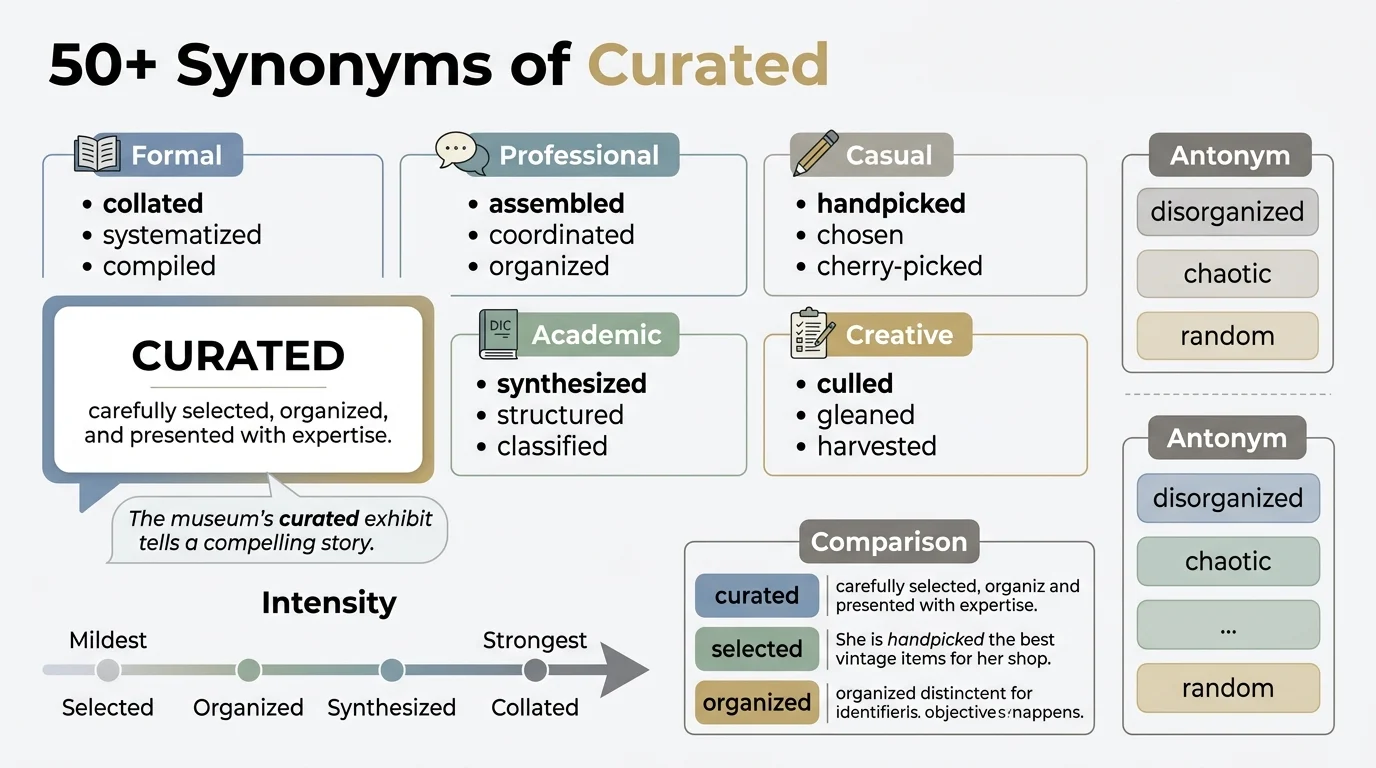
“Curated” means carefully selected, organized, and presented with expert knowledge or thoughtful intention. For formal writing, use “compiled” or “collated.” Casual conversation, use “handpicked” or “chosen.” For professional communication, use “assembled” or “organized.” Academic writing, use “selected” or “systematized.” Creative writing, use “cherry-picked” or “curated” sparingly.
Meaning, Tone, and Context
Simple Definition
Curated means something that has been carefully chosen, organized, and presented with purpose and expertise. It implies that someone with knowledge or good judgment made thoughtful decisions about what to include and how to arrange it.
Part of Speech
Curated is primarily used as:
- Verb (past tense): She curated the exhibition.
- Adjective: The curated collection was impressive.
Overall Tone
Curated carries a positive tone. It suggests quality, thoughtfulness, and expertise. When you describe something as curated, you are saying it is better than something randomly thrown together.
Formality Level
Curated is semi-formal to neutral. It appears frequently in professional contexts like marketing, journalism, and business. It also appears in casual contexts like social media and everyday conversation, though it can sound slightly trendy or buzzword-heavy in very informal settings.
Common Uses
Native English speakers commonly use curated in these contexts:
- Museums and galleries: describing exhibitions and collections
- Digital content: playlists, news feeds, social media posts
- Retail and e-commerce: product selections and collections
- Events and festivals: programming and lineups
- Education: reading lists and course materials
Word Forms
| Form | Word | Example |
|---|---|---|
| Verb (base) | Curate | I will curate the exhibit. |
| Verb (past) | Curated | She curated the collection. |
| Verb (present participle) | Curating | He is curating the festival. |
| Noun | Curator | The curator selected the artwork. |
| Noun | Curation | The curation process took months. |
| Adjective | Curated | The curated playlist was perfect. |
When and How to Use “Curated”
Choose “curated” when you want to emphasize that something has been thoughtfully selected and organized by someone with expertise or good judgment. It works best when the selection process matters as much as the items themselves.
Examples by Context
Professional:
“Our team curated a selection of vendors who meet our strict quality standards.”
Academic:
“The professor curated a reading list that covered the major theories in the field.”
Workplace:
“She curated the quarterly report data to highlight the most important trends.”
Personal:
“I curated a collection of my favorite family photos for the anniversary party.”
Email:
“We have curated a list of potential candidates for your review.”
Resume:
“Curated content calendars for six social media channels, increasing engagement by 40 percent.”
“Check out our curated gift guide for the holiday season.”
Best Synonyms of “Curated”
No synonym is identical to “curated” in every situation. The right choice depends on your audience, purpose, and the specific nuance you want to convey. Here are the best synonyms of curated for different contexts.
Professional Writing
Assembled – This word suggests you gathered components from various sources and built something complete. It sounds concrete and action-oriented, perfect for resumes and business reports.
Academic Writing
Systematized – This word conveys that you imposed order and structure according to a clear method or framework. It sounds rigorous and scholarly.
Business Communication
Compiled – This word implies you gathered materials from multiple sources into a single, organized whole. It is direct and professional.
Casual Conversation
Handpicked – This word suggests personal attention and careful choice. It feels warm and approachable without sounding overly formal.
Emotional Writing
Cherry-picked – This word carries a slightly more personal, even playful tone. It suggests you chose only the very best items with affection or enthusiasm.
Creative Writing
Culled – This word suggests you sorted through a large quantity to extract the best or most useful items. It has a literary, thoughtful feel.
Resume Writing
Coordinated – This word shows you managed inputs across different people, teams, or systems. It signals leadership and organizational ability.
Workplace Communication
Organized – This word is clear, direct, and universally understood. It avoids buzzwords while still communicating competence.
Stronger Meaning
Synthesized – This word suggests you combined different elements into a new, coherent whole. It implies higher-order thinking and creativity.
Softer Meaning
Selected – This word is neutral and straightforward. It communicates choice without emphasizing the expertise or effort behind it.
When Not to Use “Curated”
When It Sounds Too Trendy
“Curated” has become a buzzword. In some contexts, it can sound like you are trying too hard to sound sophisticated. If you are writing for a traditional or conservative audience, consider a more direct synonym.
Incorrect: “We curated a great team for this project.”
Better: “We assembled a great team for this project.”
Why: “Assembled” sounds more substantive and less fashionable.
When It Sounds Too Vague
“Curated” does not always communicate what you actually did. Did you select, organize, evaluate, or create? If the specific action matters, use a more precise word.
Incorrect: “Curated project documentation.”
Better: “Compiled project documentation from 12 departments into a single reference guide.”
Why: The second version tells the reader exactly what you did and how much work was involved.
When It Sounds Too Formal
In casual conversation or text messages, “curated” can sound stiff and unnatural.
Incorrect: “I curated some snacks for the party.”
Better: “I picked out some snacks for the party.”
Why: “Picked out” sounds natural and friendly in casual contexts.
When It Sounds Too Weak
If you want to emphasize significant effort or expertise, “curated” might not be strong enough.
Incorrect: “Curated the annual report.”
Better: “Developed and structured the annual report from raw financial data.”
Why: “Developed” and “structured” communicate more initiative and skill.
Words Commonly Confused With “Curated”
Curated vs Selected
Difference: “Selected” simply means you chose something from a group. “Curated” means you selected and organized with expertise and intention.
When to Use “Selected”: When the act of choosing is the main point and the organization or presentation is less important.
Example: “She selected three candidates for the final interview.”
When to Use “Curated”: When the thoughtful organization and presentation are as important as the selection itself.
Example: “She curated an exhibition of 20th-century photography.”
Curated vs Organized
Difference: “Organized” means you arranged things in a logical order. “Curated” implies you also made thoughtful choices about what to include based on expertise.
When to Use “Organized”: When the primary action is arranging or structuring existing items.
Example: “He organized the files alphabetically.”
When to Use “Curated”: When you also decided what to include and what to leave out.
Example: “He curated a selection of the most influential design articles.”
Curated vs Handpicked
Difference: “Handpicked” emphasizes personal, careful selection. “Curated” adds the element of expert organization and presentation.
When to Use “Handpicked”: When you want to emphasize personal attention and individual choice.
Example: “The handpicked team included the company’s top performers.”
When to Use “Curated”: When you want to emphasize both selection and thoughtful arrangement.
Example: “The curated collection featured works from emerging artists.”
Curated vs Compiled
Difference: “Compiled” means you gathered items from various sources. “Curated” suggests you also exercised judgment about quality and relevance.
When to Use “Compiled”: When gathering and assembling is the primary action.
Example: “She compiled data from five different studies.”
When to Use “Curated”: When you also evaluated and selected based on quality.
Example: “She curated a list of the best resources for new teachers.”
Curated vs Collected
Difference: “Collected” means you gathered things together. “Curated” implies purposeful selection and expert presentation.
When to Use “Collected”: When the act of gathering is the main idea.
Example: “He collected stamps from around the world.”
When to Use “Curated”: When the collection has been thoughtfully chosen and arranged for a specific purpose.
Example: “She curated a collection of modern art for the museum.”
Curated vs Collated
Difference: “Collated” means you gathered and compared information systematically. “Curated” involves selection based on taste or expertise.
When to Use “Collated”: In academic or professional contexts where systematic comparison is the focus.
Example: “The researcher collated survey responses from 1,000 participants.”
When to Use “Curated”: When selection based on quality or relevance is the focus.
Example: “The editor curated stories for the magazine’s special issue.”
Best Synonyms of “Curated” by Context
| Context | Best Synonym | Why It Works | Example |
|---|---|---|---|
| Formal writing | Collated | Sounds precise and systematic | “The committee collated evidence from multiple sources.” |
| Academic writing | Systematized | Conveys rigorous, methodical work | “The researchers systematized the data into clear categories.” |
| Professional communication | Assembled | Sounds concrete and action-oriented | “We assembled a comprehensive proposal for the client.” |
| Business emails | Compiled | Direct and professional | “I compiled the quarterly sales figures for your review.” |
| Resume writing | Coordinated | Shows leadership and project management | “Coordinated input from five departments for the annual report.” |
| Workplace communication | Organized | Clear and universally understood | “She organized the project files for easy access.” |
| Casual conversation | Handpicked | Warm and personal without being formal | “I handpicked these flowers for the centerpiece.” |
| Everyday speaking | Chosen | Simple and natural | “These are the songs I chose for the road trip.” |
| Creative writing | Culled | Literary and evocative | “The poet culled images from memory and dream.” |
| Storytelling | Gleaned | Suggests careful extraction of meaning | “He gleaned insights from years of travel.” |
| Emotional writing | Cherry-picked | Playful and personal | “She cherry-picked the best moments for her speech.” |
| Strong emphasis | Synthesized | Implies higher-order thinking | “The report synthesized findings from ten different studies.” |
| Mild tone | Selected | Neutral and straightforward | “We selected vendors who met our criteria.” |
| Social media captions | Hand-selected | Sounds authentic and personal | “Hand-selected finds for your weekend wardrobe.” |
| American English | Curated | Widely used and understood | “The museum’s curated exhibit drew large crowds.” |
How to Choose the Best Synonym of “Curated”
Choosing the right synonym of curated comes down to asking yourself a few simple questions.
What do you actually want to communicate?
You want to emphasize selection, choose “selected” or “handpicked.” You want to emphasize organization, choose “organized” or “arranged.” If you want to emphasize gathering from multiple sources, choose “compiled” or “assembled.” If you want to emphasize expert judgment, choose “curated” itself.
Who is your audience?
For executives and clients, choose “assembled” or “compiled.” These sound professional without being trendy. For academics, choose “systematized” or “collated.” These convey rigor. For friends and family, choose “handpicked” or “chosen.” These sound warm and natural.
What is your tone?
For formal writing, choose “collated” or “systematized.”Neutral writing, choose “selected” or “organized.” For casual writing, choose “handpicked” or “picked out.”
How much emotional weight do you need?
For emotional or personal writing, choose “cherry-picked” or “handpicked.” These words carry warmth and personal attention. For neutral or objective writing, choose “selected” or “compiled.” These words communicate information without added emotion.
What sounds most natural?
Read your sentence aloud with each option. The right synonym of curated is the one that sounds most natural in your specific sentence. If it feels forced or awkward, try a different word.
Real Life Examples of “Curated”
School
“The teacher curated a list of websites for the research project.”
Improved: “The teacher compiled a list of reliable websites for the research project.”
College
“Students curated presentations using resources from the library database.”
Improved: “Students assembled presentations using resources from the library database.”
Workplace
“The manager curated a training program for new hires.”
Improved: “The manager developed a training program for new hires.”
Business
“We curated a product line that appeals to young professionals.”
Improved: “We selected a product line that appeals to young professionals.”
“I have curated a list of potential venues for the conference.”
Improved: “I have compiled a list of potential venues for the conference.”
Resume
“Curated social media content for a national brand.”
Improved: “Developed and managed social media content strategy for a national brand.”
Conversation
“I curated some great recipes for the dinner party.”
Natural: “I picked out some great recipes for the dinner party.”
Storytelling
“The archivist curated letters from the Civil War era.”
Improved: “The archivist preserved letters from the Civil War era.”
Blogging
“This curated gift guide features the best products of the year.”
Improved: “This handpicked gift guide features the best products of the year.”
Social Media
“Check out our curated summer reading list.”
Improved: “Check out our hand-selected summer reading list.”
18 Best Synonyms of “Curated”
| Synonym | Simple Meaning | Best Used For | Example Sentence |
|---|---|---|---|
| Selected | Chosen from a group | General use, neutral contexts | “She selected the best candidates for the position.” |
| Handpicked | Chosen with personal care | Casual, personal, and marketing contexts | “The handpicked ingredients made all the difference.” |
| Assembled | Gathered and put together | Professional and business writing | “He assembled a team of experts for the project.” |
| Compiled | Gathered from multiple sources | Reports, research, and data work | “We compiled survey results from 500 participants.” |
| Organized | Arranged in a structured way | Workplace and everyday contexts | “She organized the files for easy reference.” |
| Arranged | Put in a particular order | General use, visual or physical contexts | “He arranged the artwork by date and style.” |
| Coordinated | Managed different elements together | Leadership and project management | “She coordinated input from all department heads.” |
| Collated | Gathered and compared systematically | Academic and formal contexts | “The researcher collated the experimental data.” |
| Systematized | Organized according to a system | Academic and technical writing | “They systematized the classification process.” |
| Structured | Designed with a clear framework | Professional and technical contexts | “He structured the training program into three modules.” |
| Sorted | Separated into categories | Practical, everyday contexts | “She sorted the applications by deadline.” |
| Gathered | Brought together | General use, casual contexts | “We gathered resources from the library.” |
| Harvested | Collected with effort | Metaphorical, creative contexts | “The team harvested insights from customer feedback.” |
| Culled | Selected from a larger group | Literary and creative writing | “The editor culled the best essays for publication.” |
| Cherry-picked | Selected the very best | Informal, personal, and marketing | “She cherry-picked the most impressive examples.” |
| Gleaned | Extracted gradually | Intellectual and reflective contexts | “He gleaned wisdom from years of experience.” |
| Synthesized | Combined into a new whole | Academic and professional writing | “The report synthesized findings from multiple studies.” |
| Curated | Selected and organized with expertise | When the original word fits best | “The museum’s curated exhibit attracted record visitors.” |
Synonyms of “Curated” by Usage
Professional vs Personal Synonyms
Professional synonyms (workplaces, resumes, business communication): compiled, assembled, coordinated, organized, structured, developed. These words sound concrete and action-oriented. They communicate that you got things done.
Personal synonyms (conversations, social media, personal writing): handpicked, chosen, picked out, cherry-picked. These words sound warm and approachable. They suggest personal attention rather than formal process.
Formal vs Conversational Synonyms
Formal synonyms (reports, essays, business writing, presentations, academic emails): collated, systematized, compiled, structured, synthesized. These words carry authority and precision.
Conversational synonyms (casual emails, texting, everyday speech): handpicked, chosen, picked, picked out. These words are simple, direct, and natural.
Academic Synonyms
For research papers, essays, reports, and academic discussions:
- Systematized – implies methodical organization according to clear principles
- Collated – suggests careful comparison and gathering from multiple sources
- Synthesized – conveys combining different elements into a coherent whole
- Structured – suggests deliberate design and framework
- Classified – implies categorization based on established criteria
These synonyms sound more authoritative and precise than “curated” in academic contexts.
Professional and Business Synonyms
For resumes, interviews, meetings, presentations, performance reviews, client communication, and business emails:
- Compiled – shows you gathered from multiple sources
- Assembled – shows you built something complete
- Coordinated – shows you managed multiple inputs or stakeholders
- Organized – shows you imposed structure
- Developed – shows you created something new
- Structured – shows you designed a framework
These synonyms work because they describe specific, measurable actions. They help employers understand exactly what you did.
Creative and Literary Synonyms
For storytelling, fiction, poetry, descriptive writing, and speeches:
- Culled – suggests careful extraction from a larger body, with a slightly literary feel
- Gleaned – suggests gathering bit by bit, often knowledge or insight
- Harvested – suggests collecting the fruits of effort, with metaphorical richness
- Cherry-picked – suggests choosing only the very best, with playful imagery
- Sifted – suggests separating the valuable from the worthless
These synonyms add imagery and emotional depth that “curated” lacks.
Slang or Modern Synonyms
“Curated” itself is the modern, trendy option. There are no widely used slang synonyms for curated. If you want to sound current and stylish, use “curated.” If you want to avoid trendiness, use one of the more traditional synonyms listed above.
Strongest to Mildest Synonyms
| Intensity | Synonym | What It Communicates |
|---|---|---|
| Mildest | Chosen | Simple selection, no implied effort |
| Mild | Selected | Thoughtful choice from options |
| Mild-Moderate | Organized | Structured arrangement |
| Moderate | Compiled | Gathering from multiple sources |
| Moderate | Assembled | Building something from parts |
| Moderate-Strong | Coordinated | Managing complex inputs |
| Strong | Systematized | Methodical, rule-based organization |
| Strong | Synthesized | Creating new understanding from parts |
| Very Strong | Curated | Expert selection with purposeful presentation |
Emotional vs Neutral Synonyms
Emotional Synonyms (express stronger feelings, personal investment, or enthusiasm):
- Handpicked – warmth, personal care
- Cherry-picked – playfulness, affection
- Harvested – effort, reward
- Gleaned – patience, wisdom
Neutral Synonyms (simply communicate information without added emotion):
- Selected – straightforward choice
- Compiled – factual gathering
- Organized – practical arrangement
- Assembled – neutral construction
Use emotional synonyms when you want to connect with your reader personally. Use neutral synonyms when you want to communicate information clearly and objectively.
Antonyms of “Curated”
| Antonym | Meaning | Example Sentence |
|---|---|---|
| Disorganized | Lacking order or structure | “The disorganized files made it impossible to find anything.” |
| Chaotic | In complete disorder | “The chaotic collection had no theme or purpose.” |
| Random | Lacking pattern or purpose | “The random selection of items made no sense together.” |
| Haphazard | Lacking any obvious plan | “The haphazard arrangement confused the visitors.” |
| Unselected | Not chosen or picked | “The unselected applications were returned to the candidates.” |
| Uncurated | Not carefully selected or organized | “The uncurated feed was full of irrelevant posts.” |
| Neglected | Not given proper attention | “The neglected archive fell into disrepair.” |
| Unmanaged | Not overseen or directed | “The unmanaged collection grew without direction.” |
| Unsystematic | Not methodical or organized | “The unsystematic approach wasted time and resources.” |
| Scattered | Spread out without order | “The scattered documents were impossible to review.” |
| Jumbled | Mixed up in a confused way | “The jumbled files contained no logical order.” |
| Messy | Untidy or disorganized | “The messy desk made it hard to find the report.” |
| Arbitrary | Based on random choice | “The arbitrary selection had no underlying logic.” |
| Unstructured | Lacking a clear framework | “The unstructured data was difficult to analyze.” |
| Disorderly | Lacking order or organization | “The disorderly collection reflected no curatorial vision.” |
Comparison: “Curated” vs Similar Words
Curated vs Selected
Main Difference: “Selected” simply means you chose something. “Curated” means you chose and organized with expertise.
Which Is Stronger? “Curated” is stronger because it implies expertise and purposeful arrangement.
Which Is More Formal? Both are neutral, but “selected” is more common in formal writing.
When to Use Each: Use “selected” when the act of choosing is the main point. Use “curated” when the thoughtful organization matters too.
Examples:
- Selected: “The committee selected three finalists.”
- Curated: “The committee curated an exhibition of finalist works.”
Curated vs Organized
Main Difference: “Organized” means you arranged things. “Curated” means you selected and arranged with expertise.
Which Is Stronger? “Curated” is stronger because it includes selection and expert judgment.
Which Is More Formal? “Organized” is neutral. “Curated” can sound more sophisticated.
When to Use Each: Use “organized” when arrangement is the main action. Use “curated” when selection and expertise are also important.
Examples:
- Organized: “She organized the books by author.”
- Curated: “She curated a collection of rare first editions.”
Curated vs Handpicked
Main Difference: “Handpicked” emphasizes personal selection. “Curated” emphasizes expert selection and organization.
Which Is Stronger? Both are strong, but “curated” implies more systematic expertise.
Which Is More Formal? “Curated” is more formal. “Handpicked” is warmer and more personal.
When to Use Each: Use “handpicked” for personal, casual, or marketing contexts. Use “curated” for professional or institutional contexts.
Examples:
- Handpicked: “The handpicked team included my closest colleagues.”
- Curated: “The curated exhibit featured works from the museum’s permanent collection.”
Curated vs Compiled
Main Difference: “Compiled” means you gathered from sources. “Curated” means you gathered and exercised judgment about quality.
Which Is Stronger? “Curated” is stronger because it includes quality judgment.
Which Is More Formal? Both are professional, but “compiled” is more direct and less trendy.
When to Use Each: Use “compiled” when gathering is the main action. Use “curated” when quality selection also matters.
Examples:
- Compiled: “She compiled data from ten different studies.”
- Curated: “She curated a selection of the most relevant studies.”
Curated vs Assembled
Main Difference: “Assembled” means you put parts together. “Curated” means you selected and arranged with purpose.
Which Is Stronger? “Curated” implies more expertise and judgment. “Assembled” implies more hands-on construction.
Which Is More Formal? Both are professional, but “assembled” is more concrete and less trendy.
When to Use Each: Use “assembled” when building or constructing is the main idea. Use “curated” when selection and presentation are the focus.
Examples:
- Assembled: “He assembled the report from department submissions.”
- Curated: “He curated the report’s content for executive readers.”
Curated vs Collated
Main Difference: “Collated” means you gathered and compared systematically. “Curated” means you selected based on taste or expertise.
Which Is Stronger? Both are strong, but “collated” emphasizes systematic comparison while “curated” emphasizes qualitative judgment.
Which Is More Formal? “Collated” is more formal and academic.
When to Use Each: Use “collated” for systematic data work. Use “curated” for selection based on quality or relevance.
Examples:
- Collated: “The analyst collated responses from all survey participants.”
- Curated: “The editor curated stories that reflected the magazine’s voice.”
Common Phrases and Expressions with “Curated”
Curated Collection
Meaning: A group of items that have been carefully selected and organized by someone with expertise.
Example Sentence: “The museum’s curated collection of Impressionist paintings draws visitors from around the world.”
Curated Playlist
Meaning: A list of songs chosen with care, often around a theme or mood.
Example Sentence: “She made a curated playlist of her favorite songs from the 1990s for the road trip.”
Curated Experience
Meaning: An activity or event that has been thoughtfully designed and arranged for participants.
Example Sentence: “The travel company offers curated experiences that highlight local culture and cuisine.”
Curated Content
Meaning: Digital content that has been selected, organized, and often contextualized for a specific audience.
Example Sentence: “The website features curated content from experts in the field.”
Curated Selection
Meaning: A group of items chosen with care and purpose.
Example Sentence: “The store offers a curated selection of handmade goods from local artisans.”
Curated List
Meaning: A list of items that have been chosen based on specific criteria or quality standards.
Example Sentence: “The professor provided a curated list of recommended readings for the course.”
Curated Feed
Meaning: A social media or news feed that has been filtered and organized to show only relevant or high-quality content.
Example Sentence: “Her curated Instagram feed features only the most visually striking images.”
Common Mistakes to Avoid
Mistake 1: Using “Curated” When “Selected” Would Do
“Curated” implies expertise and thoughtful organization. If you simply mean “chosen,” use “selected.”
Incorrect: “I curated a color for the walls.”
Better: “I selected a color for the walls.”
Why: Choosing a paint color does not typically involve the kind of expert organization that “curated” implies.
Mistake 2: Using “Curated” in Casual Conversation
“Curated” can sound stiff and pretentious in everyday speech.
Incorrect: “I curated some snacks for the movie.”
Better: “I picked out some snacks for the movie.”
Why: “Picked out” sounds natural and friendly.
Mistake 3: Using “Curated” When You Mean “Compiled”
If you gathered information from multiple sources without exercising significant quality judgment, use “compiled.”
Incorrect: “I curated data from five departments.”
Better: “I compiled data from five departments.”
Why: “Compiled” accurately describes gathering information. “Curated” suggests you also evaluated quality.
Mistake 4: Using “Curated” Too Often
Repeating “curated” makes your writing sound repetitive and reliant on buzzwords.
Incorrect: “We curated a list of vendors, curated a selection of products, and curated a marketing plan.”
Better: “We compiled a list of vendors, selected a range of products, and developed a marketing plan.”
Why: Varying your vocabulary makes your writing more engaging and precise.
Mistake 5: Using “Curated” When You Mean “Created”
“Curated” means you selected and organized existing things. If you made something new, use “created” or “developed.”
Incorrect: “She curated a new training program.”
Better: “She developed a new training program.”
Why: “Developed” accurately describes creating something new. “Curated” describes selecting from existing options.
Mistake 6: Choosing an Overly Dramatic Synonym
In professional contexts, “cherry-picked” can sound too casual or even manipulative.
Incorrect: “We cherry-picked the best candidates for the job.”
Better: “We selected the most qualified candidates for the job.”
Why: “Selected” sounds more professional and objective.
Mistake 7: Using Slang in Formal Writing
“Curated” itself can sound trendy. In very formal writing, choose more traditional alternatives.
Incorrect: “The committee curated evidence for the report.”
Better: “The committee collated evidence for the report.”
Why: “Collated” sounds more formal and academic.
Frequently Asked Questions
1. What are the best synonyms of “curated”?
The best synonyms of curated depend on your context. Professional writing, use “compiled” or “assembled.” For casual conversation, use “handpicked” or “chosen.” Academic writing, use “systematized” or “collated.” For creative writing, use “culled” or “gleaned.”
2. What are the best formal synonyms of “curated”?
The best formal synonyms of curated include “collated,” “systematized,” “compiled,” “structured,” and “synthesized.” These words sound precise and authoritative in academic, business, and professional contexts.
3. What are common informal synonyms of “curated”?
Common informal synonyms of curated include “handpicked,” “chosen,” “picked out,” and “cherry-picked.” These words sound warm and natural in casual conversation, personal writing, and social media.
4. What is another word for “curated” in professional writing?
In professional writing, use “compiled,” “assembled,” “coordinated,” or “organized” instead of “curated.” These words describe specific actions and help employers understand exactly what you did.
5. What is the difference between “curated” and “selected”?
“Selected” simply means you chose something from a group. “Curated” means you selected and organized with expertise and intention. “Curated” implies more thought, expertise, and purposeful presentation than “selected.”
6. What is the opposite of “curated”?
The opposite of curated includes “disorganized,” “chaotic,” “random,” “haphazard,” “unselected,” and “uncurated.” These words describe collections or selections that lack thoughtful organization, expert judgment, or purposeful arrangement.
Conclusion
“Curated” means carefully selected, organized, and presented with expertise and intention. It is a useful word, but it is not always the right choice. The best synonyms of curated depend on your audience, purpose, and tone. For professional writing, choose “compiled” or “assembled.” Academic writing, choose “systematized” or “collated.” Casual conversation, choose “handpicked” or “chosen.” For creative writing, choose “culled” or “gleaned.” No synonym works perfectly in every situation. The key is to choose the word that communicates your meaning most clearly to your reader. A practical tip: before you write “curated,” ask yourself what you actually did. Did you select, organize, gather, evaluate, or create? Choose the word that best describes your specific action. Your writing will become clearer, stronger, and more natural.