Have you ever caught yourself using the word “crazy” multiple times in a single email, essay, or social media post? It happens to all of us. You write “that was crazy” or “the weather is crazy” and suddenly realize you have repeated the same word three times in one paragraph.
The problem is not that “crazy” is a bad word. It is a perfectly useful adjective. But when you rely on it too often, your writing starts to sound repetitive and vague. Your readers notice. Professors notice. Your boss notices.
This is exactly why you need a strong collection of synonyms of crazy. The right synonym can make your writing more precise, more professional, and more engaging. It can help you sound more intelligent and thoughtful. And it can save you from the embarrassment of using the same tired word over and over.
This guide will give you everything you need to choose the perfect synonym for every situation. Whether you are writing a business email, a college essay, a creative story, or a casual text to a friend, you will find the right word here.
What Are the Best Synonyms of “Crazy”?
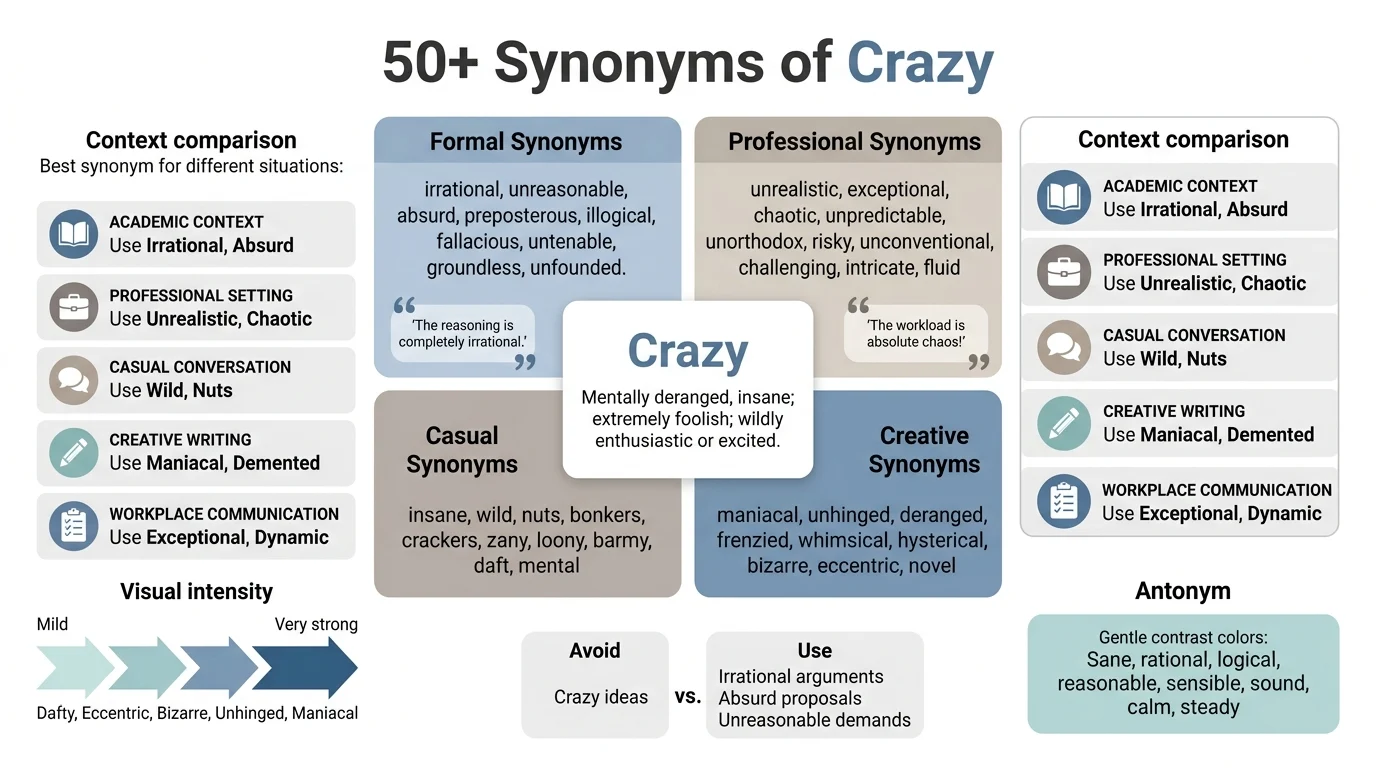
“Crazy” means mentally unstable, extremely enthusiastic, or wildly unusual depending on context. The best synonyms vary by situation. Professional writing, choose “unreasonable” or “absurd.” For casual conversation, try “insane” or “wild.” For academic work, use “irrational” or “unfounded.” Creative writing, consider “lunatic” or “maniacal.”
Meaning, Tone, and Context
Simple Definition
“Crazy” is an informal adjective that describes something or someone as mentally unstable, extremely foolish, wildly enthusiastic, or intensely unusual.
Part of Speech
Adjective. (Can also appear as a noun in informal speech, as in “that crazy over there.”)
Overall Tone
The tone of “crazy” depends entirely on context. It can be negative, positive, or neutral.
- Negative: “He went crazy and started yelling.”
- Positive: “The crowd went crazy when the band started playing.”
- Neutral: “It is crazy how fast technology changes.”
Formality Level
“Crazy” is informal. It belongs in casual conversation, social media, and personal writing. It does not belong in formal reports, academic papers, or professional business documents.
Common Uses
Native English speakers use “crazy” in countless situations. They use it to describe extreme weather, hectic schedules, unbelievable stories, enthusiastic fans, and irrational decisions. It is one of the most versatile informal words in the language, which is exactly why it gets overused.
Word Forms
- Adjective: crazy
- Adverb: crazily
- Noun: craziness
- Verb: (not commonly used as a verb, but “to drive someone crazy” is common)
When and How to Use “Crazy”
Use “crazy” when you want to describe something that is unusual, intense, or surprising in an informal setting. It works well in conversation, text messages, personal emails, and social media posts. Avoid it in formal writing.
7 Realistic Examples
Professional (Casual Workplace):
“The deadline is crazy this week, but we will get it done.”
Academic (Informal Class Discussion):
“It is crazy how much the population has grown in fifty years.”
Workplace (Team Setting):
“The client’s request is crazy, but let us figure out a solution.”
Personal (Talking to a Friend):
“She is crazy talented at painting. I cannot believe she just started.”
Email (Friendly Colleague):
“The conference schedule is crazy, but I will find time to meet you.”
Resume (Avoid in Resumes):
Do not use “crazy” in resumes. Use “exceptional,” “extraordinary,” or “remarkable” instead.
Social Media:
“This view is absolutely crazy. Best trip ever.”
Best Synonyms of “Crazy”
No synonym works perfectly in every situation. Each one carries a slightly different tone, intensity, and level of formality. Here are the best choices for specific contexts.
Professional Writing
Unreasonable. This word describes decisions, demands, or behavior that lack logic or fairness. It sounds mature and measured while still conveying that something is unacceptable.
Academic Writing
Irrational. This word suggests a lack of logical reasoning or sound judgment. It fits well in research papers and scholarly discussions where you need to analyze thinking patterns.
Business Communication
Absurd. This word communicates that an idea or request is completely unreasonable. It maintains professionalism while showing strong disagreement.
Casual Conversation
Insane. This is the closest informal match to “crazy.” It works in almost any casual situation, from describing a wild party to commenting on busy schedules.
Emotional Writing
Desperate. This word captures the feeling of being driven to extreme measures by emotion or circumstance. It adds depth and human feeling.
Creative Writing
Maniacal. This word suggests wild, uncontrolled behavior with a hint of danger or obsession. It creates vivid imagery in storytelling.
Resume Writing
Exceptional. This word describes outstanding performance or achievements without any negative connotations. It belongs on resumes and professional profiles.
Workplace Communication
Unrealistic. This word describes expectations or goals that cannot be met. It sounds professional and constructive rather than accusatory.
Stronger Meaning
Deranged. This word suggests serious mental disturbance or completely disordered thinking. Use it only when you need maximum intensity.
Softer Meaning
Unconventional. This word describes something that is different from normal without suggesting anything negative. It is a gentle, neutral alternative.
When Not to Use “Crazy”
When It Sounds Too Vague
“Crazy” is one of the most overused words in English. When you use it to describe everything, it stops meaning anything specific. Your readers stop paying attention.
Better: Instead of “the traffic was crazy,” try “the traffic was gridlocked” or “the traffic was unbearable.”
When It Sounds Too Informal
“Crazy” has no place in academic papers, formal reports, or professional business documents. It undermines your credibility and makes you sound like you are not taking the subject seriously.
Better: Instead of “the results were crazy,” try “the results were unexpected” or “the results were remarkable.”
When It Sounds Too Weak
Sometimes you need a word with more impact. “Crazy” can sound flippant when you are describing something truly serious or dangerous.
Better: Instead of “the situation was crazy,” try “the situation was volatile” or “the situation was dangerous.”
When It Sounds Too Strong
“Crazy” can sound overly dramatic when you are describing something minor. You risk sounding like you are exaggerating.
Better: Instead of “I am crazy busy,” try “I am very busy” or “I have a packed schedule.”
Words Commonly Confused With “Crazy”
Insane
Difference: “Insane” is the closest synonym and is used almost interchangeably in casual speech. However, “insane” carries a slightly stronger connotation of mental illness.
When to Use It: Use “insane” in casual conversation when you want a synonym that is equally informal.
Example: “That roller coaster was insane.”
Mad
Difference: “Mad” is more common in British English. In American English, it usually means angry rather than crazy. This creates a potential for misunderstanding.
When to Use It: Use “mad” when you mean angry in American English. Use it when you mean crazy only if you are writing for a British audience.
Example: “My boss was mad at me for being late.”
Ridiculous
Difference: “Ridiculous” focuses on foolishness or absurdity rather than mental instability. It is slightly more formal than “crazy.”
When to Use It: Use “ridiculous” when you want to criticize an idea or situation that makes no sense.
Example: “They expect us to finish this project by Friday. That is ridiculous.”
Absurd
Difference: “Absurd” is more formal than “crazy” and suggests something is completely unreasonable or illogical.
When to Use It: Use “absurd” in professional settings when you need to express strong disagreement.
Example: “The proposal to cut our budget by half is simply absurd.”
Unhinged
Difference: “Unhinged” suggests a sudden loss of mental stability. It is more specific than “crazy” and carries a connotation of danger.
When to Use It: Use “unhinged” to describe someone who has lost control in a disturbing way.
Example: “After losing his job, his behavior became increasingly unhinged.”
Deranged
Difference: “Deranged” is the strongest of these terms. It suggests serious mental illness and disturbed behavior. Use it very carefully.
When to Use It: Use “deranged” only when you need the most intense word available.
Example: “The deranged criminal terrified the entire neighborhood.”
Best Synonyms of “Crazy” by Context
| Context | Best Synonym | Why It Works | Example |
|---|---|---|---|
| Formal writing | Unreasonable | It sounds professional and measured | “The proposal was unreasonable from the start.” |
| Academic writing | Irrational | It suggests a lack of logical reasoning | “The decision appeared completely irrational.” |
| Professional communication | Absurd | It maintains professionalism while showing strong disagreement | “That timeline is absurd given our current resources.” |
| Business emails | Unrealistic | It sounds constructive and level headed | “The projected sales numbers are unrealistic.” |
| Resume writing | Exceptional | It highlights achievement without negativity | “Achieved exceptional results in a high pressure environment.” |
| Workplace communication | Unfounded | It suggests a lack of basis or evidence | “His concerns were completely unfounded.” |
| Casual conversation | Insane | It is the most natural informal substitute | “That concert was insane.” |
| Everyday speaking | Wild | It sounds fun and energetic | “The party got wild after midnight.” |
| Creative writing | Maniacal | It adds vivid imagery and intensity | “She let out a maniacal laugh.” |
| Storytelling | Unhinged | It suggests a disturbing loss of control | “His unhinged behavior scared everyone.” |
| Emotional writing | Desperate | It conveys deep emotion and urgency | “The desperate situation called for extreme measures.” |
| Strong emphasis | Deranged | It is the most intense option | “The deranged scheme put everyone at risk.” |
| Mild tone | Unconventional | It is neutral and gentle | “She has an unconventional approach to problem solving.” |
| Social media captions | Bonkers | It sounds fun and playful | “This party is absolutely bonkers.” |
| American English | Nuts | It is a classic American slang synonym | “You are nuts if you think that will work.” |
| British English | Mad | This is the standard British synonym | “The traffic was absolutely mad today.” |
How to Choose the Best Synonym of “Crazy”
Choosing the right synonym requires thinking about four key factors: your audience, your purpose, the emotional intensity you want, and the level of formality you need.
Start With Your Audience
Ask yourself who will read your words. Are you writing for a professor, a boss, a friend, or a stranger on social media? A formal audience demands formal words like “irrational” or “unreasonable.” A casual audience welcomes words like “insane” or “wild.”
Consider Your Purpose
Are you trying to criticize, describe, entertain, or persuade? Criticism calls for words like “absurd” or “ridiculous.” Description works better with “unconventional” or “exceptional.” Entertainment and persuasion both benefit from vivid words like “maniacal” or “unhinged.”
Think About Emotional Strength
How strongly do you want to express yourself? “Unconventional” is mild and neutral. “Unreasonable” is moderate. “Deranged” is extreme. Choose the word that matches your actual feelings.
Match the Level of Formality
Your level of formality should match the situation. Academic papers require “irrational” or “unfounded.” Professional emails work with “unrealistic” or “absurd.” Text messages to friends are perfect for “insane” or “nuts.”
Test for Natural Sound
Read your sentence out loud with the synonym you have chosen. Does it sound natural? Does it feel right? If it sounds forced or awkward, try a different word. The best word is the one that sounds most natural in context.
Real Life Examples of “Crazy”
School
Weak: “The homework load is crazy this week.”
Improved: “The homework load is unreasonable this week.”
College
Weak: “My professor gave us a crazy amount of reading.”
Improved: “My professor assigned an absurd amount of reading.”
Workplace
Weak: “The office is crazy during tax season.”
Improved: “The office is chaotic during tax season.”
Business
Weak: “The client’s expectations are crazy.”
Improved: “The client’s expectations are unrealistic.”
Weak: “Things are crazy on my end right now.”
Improved: “Things are overwhelming on my end right now.”
Resume
Weak: “I led crazy successful product launches.”
Improved: “I led exceptionally successful product launches.”
Conversation
Weak: “That movie was crazy.”
Improved: “That movie was intense.”
Storytelling
Weak: “The villain had a crazy plan.”
Improved: “The villain had a deranged plan.”
Blogging
Weak: “The travel stories from this trip are crazy.”
Improved: “The travel stories from this trip are unbelievable.”
Social Media
Weak: “This sunset is crazy.”
Improved: “This sunset is breathtaking.”
18 Best Synonyms of “Crazy”
| Synonym | Simple Meaning | Best Used For | Example Sentence |
|---|---|---|---|
| Unreasonable | Not based on logic or fairness | Professional criticism | “His demands were completely unreasonable.” |
| Irrational | Lacking logical thought | Academic writing | “The theory was based on irrational assumptions.” |
| Absurd | Wildly unreasonable or illogical | Business communication | “The proposal was absurd from the beginning.” |
| Insane | Extremely foolish or irrational | Casual conversation | “That idea is absolutely insane.” |
| Wild | Uncontrolled or extremely exciting | Social media and speaking | “The party was wild last night.” |
| Maniacal | Behaving in a wildly uncontrolled way | Creative writing | “He laughed with maniacal glee.” |
| Unhinged | Mentally disturbed or unstable | Storytelling | “Her unhinged rant shocked everyone.” |
| Deranged | Completely insane or disturbed | Strong emphasis | “The deranged plan was doomed to fail.” |
| Ridiculous | Deserving of mockery | Everyday criticism | “That is the most ridiculous thing I have ever heard.” |
| Unconventional | Not following normal practices | Neutral descriptions | “She has an unconventional teaching style.” |
| Chaotic | In a state of complete disorder | Describing situations | “The office was chaotic after the announcement.” |
| Unrealistic | Not practical or achievable | Workplace feedback | “The deadline is unrealistic for this team.” |
| Exceptional | Unusually good or outstanding | Resumes and achievements | “She delivered exceptional results.” |
| Unfounded | Having no basis in fact | Academic or professional | “His fears were completely unfounded.” |
| Bonkers | Extremely foolish or crazy | Playful social media | “This weather is absolutely bonkers.” |
| Nuts | Very foolish or crazy | Casual American English | “You would have to be nuts to try that.” |
| Mad | Mentally disturbed or angry | British English contexts | “The traffic is mad today.” |
| Lunatic | Mentally ill or extremely foolish | Strong informal contexts | “That lunatic drove through a red light.” |
Synonyms of “Crazy” by Usage
Professional vs Personal Synonyms
Professional Synonyms (Workplaces, Business, Formal Settings):
- Unreasonable
- Absurd
- Unrealistic
- Unfounded
- Exceptional
- Chaotic
These words sound mature and level headed. They show you can describe difficult situations without resorting to casual language.
Personal Synonyms (Friends, Family, Social Settings):
- Insane
- Wild
- Bonkers
- Nuts
- Ridiculous
These words sound natural in conversation. They express emotion without sounding stiff or formal.
Formal vs Conversational Synonyms
Formal Synonyms (Reports, Essays, Business Writing):
- Irrational
- Unfounded
- Unrealistic
- Exceptional
- Unconventional
These words belong in academic papers, formal reports, and professional presentations. They elevate your writing and demonstrate vocabulary strength.
Conversational Synonyms (Emails, Texting, Casual Talk):
- Insane
- Wild
- Nuts
- Bonkers
- Mad
These words fit everyday situations. They sound natural and friendly. Use them with people you know well.
Academic Synonyms
For research papers, essays, and academic discussions, choose words that sound analytical rather than emotional.
- Irrational – suggests flawed reasoning
- Unfounded – suggests a lack of evidence
- Unconventional – suggests deviation from standard approaches
- Unreasonable – suggests a failure of logic or fairness
These words make your arguments sound more credible and thoughtful.
Professional and Business Synonyms
For resumes, interviews, meetings, and client communication, choose words that convey competence and professionalism.
- Exceptional – describes outstanding performance
- Unrealistic – describes impractical expectations
- Absurd – describes unreasonable proposals
- Chaotic – describes disorganized situations
- Unreasonable – describes unfair demands
These words help you communicate clearly without sounding unprofessional.
Creative and Literary Synonyms
For storytelling, fiction, poetry, and descriptive writing, choose words that add color, emotion, and imagery.
- Maniacal – adds a sense of wild obsession
- Unhinged – suggests a psychological break
- Deranged – adds intensity and danger
- Lunatic – adds dramatic flair
- Berserk – suggests uncontrollable rage
These words paint vivid pictures and keep readers engaged.
Slang or Modern Synonyms
- Bonkers – playful and fun; common in casual conversation
- Nuts – classic American slang; friendly and informal
- Cuckoo – mildly old fashioned but still understood
- Wacky – suggests humor and oddness
Use slang only in casual settings. Avoid it in professional, academic, or formal writing.
Strongest to Mildest Synonyms
Mild:
- Unconventional
- Unusual
- Surprising
- Unexpected
Moderate:
- Unreasonable
- Irrational
- Unrealistic
- Ridiculous
Strong:
- Insane
- Absurd
- Wild
- Maniacal
Very Strong:
- Unhinged
- Deranged
- Lunatic
- Berserk
Emotional vs Neutral Synonyms
Emotional Synonyms (Express Strong Feelings):
- Maniacal
- Unhinged
- Deranged
- Berserk
- Desperate
These words carry intense emotion. Use them in creative writing or when you need strong impact.
Neutral Synonyms (Simply Communicate Facts):
- Unconventional
- Unusual
- Unexpected
- Surprising
- Remarkable
These words describe without adding emotional weight. Use them in professional and academic writing where objectivity matters.
Antonyms of “Crazy”
| Antonym | Meaning | Example Sentence |
|---|---|---|
| Sane | Mentally healthy and rational | “He seemed perfectly sane during the interview.” |
| Rational | Based on logic and reason | “The rational choice was to wait for more data.” |
| Reasonable | Fair and sensible | “Her demands were completely reasonable.” |
| Logical | Based on clear reasoning | “His argument was logical and well structured.” |
| Sensible | Practical and level headed | “That is the most sensible suggestion I have heard.” |
| Calm | Peaceful and controlled | “She remained calm despite the chaos.” |
| Normal | Typical and expected | “The weather has been normal for this time of year.” |
| Ordinary | Common and unremarkable | “It was just an ordinary day at the office.” |
| Predictable | Expected and easily anticipated | “The ending was predictable but satisfying.” |
| Balanced | Showing sound judgment | “The judge was balanced in her decision.” |
| Composed | Self controlled and calm | “He remained composed under pressure.” |
| Levelheaded | Calm and sensible | “We need a levelheaded leader for this project.” |
| Sound | Based on solid reasoning | “Her advice was sound and practical.” |
| Wise | Showing good judgment | “That was a wise decision.” |
| Stable | Mentally and emotionally steady | “He has been stable since starting treatment.” |
Comparison: “Crazy” vs Similar Words
Crazy vs Insane
Main Difference: “Insane” is the closest synonym and is used almost interchangeably in casual speech. However, “insane” carries a slightly stronger connotation of mental illness than “crazy.”
Which Is Stronger: “Insane” is slightly stronger and more formal.
Which Is More Formal: “Insane” is more formal, though both are informal. Neither belongs in academic or professional writing.
When to Use Each: Use “crazy” for everyday situations. Use “insane” when you want a slightly stronger, more dramatic word.
Examples:
- Crazy: “The traffic was crazy this morning.”
- Insane: “The traffic was insane this morning.”
Crazy vs Mad
Main Difference: “Mad” is the preferred British English synonym. In American English, “mad” almost always means “angry.”
Which Is Stronger: They are equal in strength.
Which Is More Formal: “Mad” is slightly more formal in British English, but both are informal.
When to Use Each: Use “mad” for British audiences or when you mean angry in American English. Use “crazy” for American audiences.
Examples:
- Crazy: “The crowd went crazy.”
- Mad: “The crowd went mad.” (UK usage)
Crazy vs Absurd
Main Difference: “Absurd” is more formal and suggests something is completely unreasonable or illogical. “Crazy” is more general and informal.
Which Is Stronger: “Absurd” feels stronger in professional contexts.
Which Is More Formal: “Absurd” is significantly more formal.
When to Use Each: Use “crazy” in casual conversation. Use “absurd” in professional or academic writing.
Examples:
- Crazy: “The deadline is crazy.”
- Absurd: “The deadline is absurd.”
Crazy vs Ridiculous
Main Difference: “Ridiculous” focuses on foolishness or mockery. “Crazy” is more general. “Ridiculous” is slightly more formal.
Which Is Stronger: “Ridiculous” is stronger in terms of mockery.
Which Is More Formal: “Ridiculous” is more formal than “crazy.”
When to Use Each: Use “crazy” for general intensity. Use “ridiculous” when you want to emphasize foolishness.
Examples:
- Crazy: “His excuses were crazy.”
- Ridiculous: “His excuses were ridiculous.”
Crazy vs Unreasonable
Main Difference: “Unreasonable” suggests a lack of logic or fairness. “Crazy” is more general. “Unreasonable” is much more formal and professional.
Which Is Stronger: They are similar in intensity.
Which Is More Formal: “Unreasonable” is significantly more formal. It belongs in professional and academic writing.
When to Use Each: Use “crazy” casually. Use “unreasonable” in professional settings.
Examples:
- Crazy: “Her demands were crazy.”
- Unreasonable: “Her demands were unreasonable.”
Crazy vs Unconventional
Main Difference: “Unconventional” is neutral and non judgmental. “Crazy” is often negative or dramatic. “Unconventional” is much more formal.
Which Is Stronger: “Crazy” is much stronger.
Which Is More Formal: “Unconventional” is much more formal.
When to Use Each: Use “crazy” when you want intensity. Use “unconventional” when you want to describe something different without negative judgment.
Examples:
- Crazy: “She has crazy ideas.”
- Unconventional: “She has unconventional ideas.”
Common Phrases and Expressions with “Crazy”
Crazy About
Meaning: Very enthusiastic or passionate about something or someone.
Example Sentence: “She is crazy about the new coffee shop downtown.”
Drive Someone Crazy
Meaning: To annoy someone intensely or to cause them to become mentally unsettled.
Example Sentence: “The constant noise from the construction site is driving me crazy.”
Like Crazy
Meaning: With great intensity or speed.
Example Sentence: “We worked like crazy to meet the deadline.”
Crazy Good
Meaning: Extremely good or impressive.
Example Sentence: “The pizza at that restaurant is crazy good.”
Go Crazy
Meaning: To become very excited or to lose control.
Example Sentence: “The fans went crazy when the band took the stage.”
Crazy Rich
Meaning: Extremely wealthy.
Example Sentence: “He comes from a crazy rich family.”
Crazy Talk
Meaning: Nonsense or foolish speech.
Example Sentence: “You want to quit your job and travel the world? That is crazy talk.”
Common Mistakes to Avoid
Choosing a Vague Synonym Instead of a Precise One
Incorrect: “The meeting was crazy.”
Better: “The meeting was chaotic.”
Why: “Crazy” could mean anything. “Chaotic” describes exactly what happened.
Confusing “Crazy” With “Mad” in American English
Incorrect: “My boss was crazy at me.”
Better: “My boss was mad at me.”
Why: In American English, “mad” means angry. Using “crazy” makes no sense here.
Using an Informal Synonym in Formal Writing
Incorrect: “The study found crazy differences between the groups.”
Better: “The study found significant differences between the groups.”
Why: “Significant” is formal and academic. “Crazy” is not.
Selecting an Overly Dramatic Synonym
Incorrect: “My coffee order was deranged.”
Better: “My coffee order was wrong.”
Why: “Deranged” is far too strong for a minor mistake.
Repeating the Same Word Too Often
Incorrect: “That movie was crazy. The special effects were crazy. The ending was crazy.”
Better: “That movie was wild. The special effects were incredible. The ending was shocking.”
Why: Variety keeps writing interesting and engaging.
Choosing a Synonym With the Wrong Emotional Tone
Incorrect: “She has a crazy sense of style.” (sounds negative)
Better: “She has an unconventional sense of style.” (sounds positive)
Why: “Unconventional” sounds interesting and creative. “Crazy” sounds judgmental.
Using Slang in Academic or Professional Writing
Incorrect: “The professor gave us bonkers amounts of reading.”
Better: “The professor assigned an unreasonable amount of reading.”
Why: “Bonkers” is playful slang. “Unreasonable” is appropriate for academic contexts.
Frequently Asked Questions
1. What are the best synonyms of “crazy”?
The best synonyms of crazy depend on context. For professional settings, choose “unreasonable” or “absurd.” For casual conversation, choose “insane” or “wild.” Academic writing, choose “irrational” or “unfounded.”
2. What are the best formal synonyms of “crazy”?
The best formal synonyms of crazy include “irrational,” “unfounded,” “unreasonable,” and “absurd.” These words sound professional and measured. They belong in academic papers, business reports, and formal presentations.
3. What are common informal synonyms of “crazy”?
Common informal synonyms of crazy include “insane,” “wild,” “nuts,” and “bonkers.” These words work well in casual conversation, text messages, and social media. Avoid them in professional or academic writing.
4. What is another word for “crazy” in professional writing?
Another word for crazy in professional writing is “unrealistic” for expectations or “unreasonable” for demands. “Absurd” works for proposals, and “chaotic” works for situations. All sound professional and clear.
5. What is the difference between “crazy” and “insane”?
“Crazy” and “insane” are nearly identical in meaning in casual conversation. The main difference is that “insane” is slightly stronger and can sound more dramatic. Both are informal and should not be used in professional writing.
6. What is the opposite of “crazy”?
The opposite of crazy is “sane” for mental stability, “rational” for logical thinking, “reasonable” for fair decisions, or “calm” for emotional control. The best opposite depends on how you are using “crazy.”
Conclusion
“Crazy” is a useful word, but it is overused and often imprecise. Understanding its meaning, tone, and appropriate contexts helps you communicate more effectively. The right synonym can make your writing clearer, more professional, and more engaging.
The best synonyms of crazy vary by situation. Professional writing, choose “unreasonable” or “absurd.” For academic work, choose “irrational” or “unfounded.” Casual conversation, choose “insane” or “wild.” For creative writing, choose “maniacal” or “unhinged.”
No synonym works perfectly in every situation. Always consider your audience, your purpose, and the emotional intensity you want to convey. Choose the word that communicates your message most clearly and naturally.
One practical tip: read your writing out loud before you publish. If “crazy” appears more than once in a short passage, replace at least one instance with a more precise synonym. Your readers will thank you.