You are writing an important email to your boss. You start three sentences with “although.” Your essay repeats “although” five times in one paragraph. Your social media caption sounds repetitive. You feel stuck.
This happens to most writers, students, and professionals. The word “although” is useful but overused. Repeating it makes your writing sound dull and robotic.
Understanding synonyms for although will transform your communication. This guide provides clear alternatives for every situation. You will learn which word fits your context perfectly. Your writing will become more varied and engaging.
What Does Although Mean?
“Although” is a conjunction that introduces a contrast or exception. It means “in spite of the fact that” or “even though.” The best synonyms depend on context. For formal writing, try “whereas” or “notwithstanding.” For casual use, “though” works well. Academic papers often prefer “while” or “whereas.”
Meaning, Tone and Context
Simple Definition
“Although” connects two opposing ideas in one sentence. It shows that something happens despite another situation.
Part of Speech
Conjunction. It joins two clauses together.
Tone
Neutral. The word itself carries no strong emotion.
Formality Level
Standard. “Although” works in most writing situations. It is neither too formal nor too casual.
Common Use Cases
- Academic essays
- Professional emails
- Business reports
- Personal writing
- Speeches and presentations
Important Word Forms
“Although” has no other forms. Related words include “though,” “even though,” and “while.”
When and How to Use “Although”
Use “although” when you need to show contrast between two ideas. Place it at the beginning of a clause or between two clauses.
Here are 7 realistic examples labeled by context:
Professional
Although the project faced delays, the team delivered quality results on time.
Personal
I decided to attend the party although I felt very tired that evening.
Academic
Although the research data was limited, the findings offered valuable insights.
Emotional
She smiled warmly although her heart was breaking inside.
Creative
The old house stood proudly although the roof had nearly collapsed.
Social Media
Although the hike was challenging, the view from the top made it worthwhile.
Email
Although I understand your concerns, I believe we should proceed with the plan.
Another Word for “Although”
Professional Writing
“Whereas” works best for professional documents. It introduces clear contrasts in business reports.
Academic Writing
“While” is preferred in academic papers. It maintains precision and scholarly tone.
Casual Conversation
“Though” sounds natural and relaxed in everyday speech.
Emotional Writing
“Even though” adds emotional weight and emphasis to your contrast.
Creative Writing
“Yet” creates literary flow and poetic rhythm in creative pieces.
Social Media Captions
“But” is short and effective for quick, engaging posts.
Stronger Meaning
“Notwithstanding” conveys stronger contrast in formal contexts.
Softer Meaning
“Although” itself is neutral. “Though” sounds slightly softer in tone.
When Not to Use “Although”
Avoid “although” when you need precision. It is too vague for legal or technical writing.
Do not use it when expressing direct opposition. “But” is stronger for clear disagreement.
Skip “although” in short sentences. It adds unnecessary length to simple statements.
Avoid overusing it. Repetition makes your writing monotonous.
Weak Example
Although the weather was bad, we went outside.
Stronger Alternative
Despite the bad weather, we went outside.
Words Commonly Confused With “Although”
Although vs. Though
“Though” is less formal and often used at the end of sentences. “Although” works better at the start.
Although vs. Even Though
“Even though” emphasizes stronger contrast. Use it when the difference is more surprising.
Although vs. While
“While” can mean time or contrast. Use “although” when meaning is strictly contrast.
Although vs. Whereas
“Whereas” highlights direct comparisons. Use it for clear, parallel differences.
Although vs. But
“But” is a coordinating conjunction. Use it to join two independent clauses.
Although vs. Despite
“Despite” is a preposition followed by a noun. “Although” is a conjunction followed by a clause.
Best Synonym by Context for “Although”
| Context | Best Synonym | Why It Works | Example |
|---|---|---|---|
| Formal writing | Whereas | Indicates clear parallel contrast | The first proposal was rejected, whereas the second was approved. |
| Academic writing | While | Maintains scholarly precision | While the study had limitations, the results were significant. |
| Professional business | Notwithstanding | Demonstrates legal or formal precision | Notwithstanding the challenges, the merger succeeded. |
| Casual conversation | Though | Sounds natural and conversational | I enjoyed the movie, though it was a bit long. |
| Creative writing | Yet | Adds literary rhythm and style | The night was dark, yet the stars shone brightly. |
| Emotional tone | Even though | Emphasizes surprising contrast | Even though she was afraid, she spoke her truth. |
| Strong intensity | Albeit | Suggests concession with formality | The plan was successful, albeit slightly risky. |
| Soft or moderate | Though | Reduces intensity of contrast | The food was good, though not exceptional. |
| Social media captions | But | Keeps content short and engaging | The beach was crowded, but the sunset was gorgeous. |
| US usage | Although | Standard American English usage | Although it rained, the picnic continued. |
| UK usage | Though | More common in British English | The weather was bad, though we still went out. |
Which Synonym Should You Choose?
Consider your audience first. Professional emails need formal synonyms like “whereas.” Social media posts work better with casual alternatives like “but.
Think about the strength of your contrast. Use “even though” for surprising differences. Choose “although” for ordinary contrasts.
Evaluate the formality level. Academic papers prefer “while” and “whereas.” Personal writing accepts “though” and “yet.”
Match the emotional tone. Neutral situations work with “although.” Emotional contexts benefit from “even though.”
Consider sentence length. Short sentences use “but” or “though.” Longer sentences handle “notwithstanding” well.
Real Life Examples of “Although” in Sentences
School
The exam was difficult, yet many students earned high scores.
Workplace
We received critical feedback. The team used it to improve our process.
Writing
The novel had a slow beginning. The story became gripping by the second half.
Conversation
I know you disagree. I still believe we should consider this option.
Social Media
The concert tickets were expensive. The experience was absolutely unforgettable.
Email
I appreciate your suggestion. I think we should explore other solutions first.
Storytelling
The hero had no special powers. He saved the kingdom through courage and wit.
25 Synonyms for “Although”
| Synonym | Simple Meaning | Best Used For | Example Sentence |
|---|---|---|---|
| Whereas | Indicates contrast between two facts | Formal comparisons | The east wing was renovated, whereas the west wing remained original. |
| While | Shows contrast during a period | Academic writing | While the theory is compelling, more evidence is needed. |
| Though | Less formal contrast | Casual speech | The restaurant was busy, though we found a table quickly. |
| Even though | Stronger contrast | Emotional emphasis | Even though he apologized, she still felt hurt. |
| Notwithstanding | Formal concession | Legal documents | Notwithstanding the objections, the policy was approved. |
| Albeit | Formal concession | Formal writing | The solution was effective, albeit expensive. |
| Yet | Contrast with literary tone | Creative writing | The forest was silent, yet full of hidden life. |
| But | Direct contrast | Everyday conversation | I wanted to stay, but I had to leave. |
| Still | Contrast despite circumstances | Emotional writing | The evidence was weak. Still, the jury believed him. |
| However | Contrast between sentences | Professional writing | The sales increased. However, profits remained low. |
| Nevertheless | Formal contrast | Business reports | The budget was reduced. Nevertheless, the project continued. |
| Nonetheless | Formal contrast | Academic papers | The results were unexpected. Nonetheless, they were valid. |
| Despite | Contrast with a noun | Concise writing | Despite the rain, the game continued. |
| In spite of | Contrast with a noun | Formal writing | In spite of the difficulties, they succeeded. |
| Even so | Contrast with previous statement | Conversational contrast | The plan had flaws. Even so, we implemented it. |
| For all | Contrast emphasizing effort | Literary style | For all his training, he lost the match. |
| Granted | Acknowledging a point | Balanced arguments | Granted, the idea is unusual. It might still work. |
| Admittedly | Conceding a point | Honest discussion | Admittedly, I made a mistake. I am fixing it now. |
| Though | Informal contrast | Daily conversations | It was cold, though we enjoyed the walk. |
| With the exception that | Limited contrast | Detailed explanations | The proposal was accepted, with the exception that funding was reduced. |
| Except that | Limited exception | Specific writing | The plan was good, except that it was too expensive. |
| If | Conditional contrast | Hypothetical statements | If the plan is risky, it still offers rewards. |
| Where | Contrast in specific cases | Legal or formal writing | Where the law is unclear, judges interpret it. |
| When | Contrast in time contexts | General writing | When we expected failure, we actually succeeded. |
| Whereas | Clear parallel contrast | Comparison writing | Cats are independent, whereas dogs are loyal. |
Synonym Groups and Usage Differences
Professional vs. Personal Synonyms
Professional contexts prefer formal words. “Whereas” and “notwithstanding” appear in reports and legal documents. Personal writing uses casual options. “Though” and “but” sound friendly and approachable.
Formal vs. Conversational Synonyms
Formal synonyms include “whereas,” “notwithstanding,” and “nevertheless.” These words appear in essays and official documents. Conversational synonyms include “though,” “but,” and “still.” These work well in texts and emails.
Academic Synonyms
Academic writing values “while” and “whereas” for precision. These words create clear, logical contrasts. “Nevertheless” and “nonetheless” connect complex ideas. Professors and researchers prefer these formal options.
Professional and Business Synonyms
Business communication needs clear contrast. “However” starts new paragraphs effectively. “Notwithstanding” appears in contracts and legal documents. “Whereas” compares options in business reports.
Creative or Literary Synonyms
Creative writing benefits from “yet” and “still.” These words add rhythm to poetry and prose. “Even so” creates dramatic tension. “Granted” adds depth to character dialogue.
Strongest vs. Weaker Synonyms
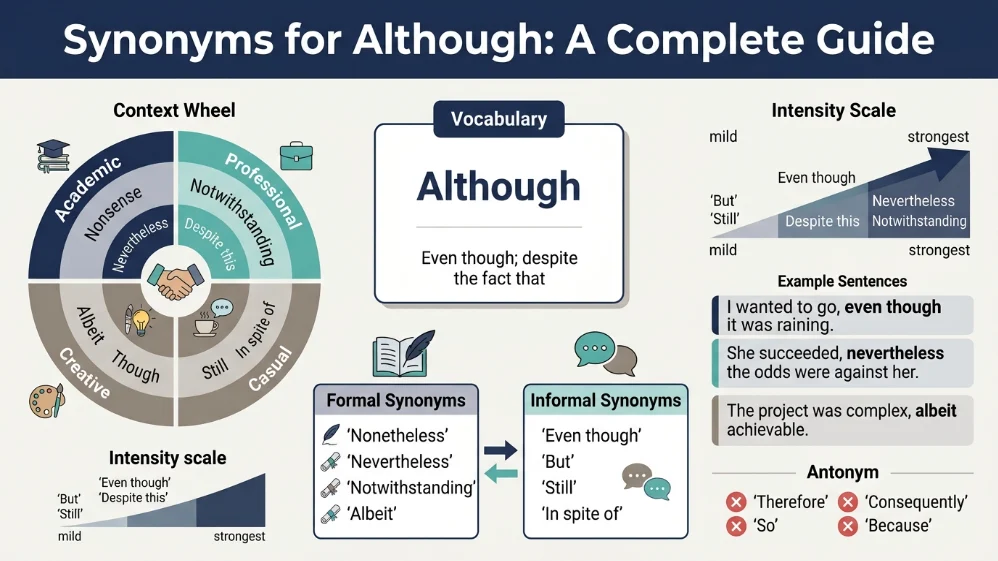
The intensity scale from mild to strongest:
- Mild: “though,” “but”
- Moderate: “although,” “while”
- Strong: “nevertheless,” “even though”
- Strongest: “notwithstanding”
Emotional vs. Neutral Synonyms
Emotional synonyms add feeling to writing. “Even though” emphasizes surprising contrast. “Still” shows persistence despite obstacles. Neutral synonyms stay factual. “Whereas” and “while” simply compare information.
Antonyms of “Although”
| Antonym | Meaning | Example Sentence |
|---|---|---|
| Because | Shows cause | We stayed inside because it was raining. |
| Since | Shows reason | Since he studied hard, he passed the exam. |
| As | Shows cause or reason | As the sun set, we went inside. |
| For | Shows explanation | She was happy, for she had achieved her goal. |
| Therefore | Shows logical conclusion | The evidence was clear. Therefore, we proceeded. |
| Thus | Shows result | The project succeeded. Thus, we celebrated. |
| Hence | Shows consequence | Budget cuts were made. Hence, we delayed hiring. |
| Consequently | Shows result | The weather improved. Consequently, we went out. |
| Accordingly | Shows appropriate response | The rules changed. Accordingly, we updated our policy. |
| So | Shows result | The game was exciting, so we stayed to watch. |
| Then | Shows sequence | We finished the work. Then we left the office. |
| After | Shows time sequence | After the meeting, we had lunch. |
| Before | Shows time sequence | Before we left, we checked everything. |
| Meanwhile | Shows simultaneous action | We worked on the project. Meanwhile, the team prepared the presentation. |
| During | Shows simultaneous time | During the presentation, everyone listened carefully. |
Comparison: Although vs. Similar Words
Although vs. Though
The main difference is formality. “Although” is more formal and proper. “Though” is casual and often appears at the end of sentences.
Which one is stronger? “Although” sounds stronger in formal writing. “Though” is softer and more conversational.
Which one is more formal? “Although” is definitely more formal.
Example with “Although”: Although I was tired, I finished the work.
Example with “Though”: I was tired. I finished the work, though.
Although vs. Even Though
“Even though” emphasizes stronger contrast. It suggests the difference is more surprising or significant.
Which one is stronger? “Even though” is much stronger.
Which one is more formal? “Although” is more formal.
Example with “Although”: Although it was cold, we went swimming.
Example with “Even Though”: Even though it was freezing, we went swimming.
Although vs. While
“While” has two meanings. It can mean “during the time that” or “whereas.” “Although” only means contrast.
Which one is clearer? “Although” is clearer for contrast.
Which one is more formal? Both are formal and acceptable.
Example with “Although”: Although I like coffee, I prefer tea.
Example with “While”: While I like coffee, I prefer tea.
Although vs. Whereas
“Whereas” highlights parallel differences. It compares two things directly. “Although” shows a contrast with an exception.
Which one is more precise? “Whereas” is more precise for comparisons.
Which one is more formal? Both are formal. “Whereas” is more legal and technical.
Example with “Although”: Although she is tall, her brother is short.
Example with “Whereas”: She is tall, whereas her brother is short.
Although vs. But
“But” is a coordinating conjunction. It joins two equal parts. “Although” is a subordinating conjunction. It makes one clause less important.
Which one is more direct? “But” is more direct and forceful.
Which one is more formal? “Although” is more formal.
Example with “Although”: Although the food was expensive, we enjoyed it.
Example with “But”: The food was expensive, but we enjoyed it.
Although vs. Despite
“Despite” is a preposition. It takes a noun or noun phrase. “Although” takes a full clause with a subject and verb.
Which one is more concise? “Despite” is often shorter.
Which one is more formal? “Despite” is formal and professional.
Example with “Although”: Although he was sick, he went to work.
Example with “Despite”: Despite his illness, he went to work.
Common Phrases and Expressions with “Although”
1. Although it may seem
Meaning: Introduces a contrasting idea that appears true but is not completely accurate.
Example sentence: Although it may seem difficult, this task is actually quite simple.
2. Although I must say
Meaning: Adds a personal opinion that contrasts with previous statements.
Example sentence: The presentation was good, although I must say the first speaker was better.
3. Although not ideal
Meaning: Acknowledges a solution is imperfect but acceptable.
Example sentence: Although not ideal, this plan will solve our immediate problem.
4. Although it is true that
Meaning: Admits a fact before presenting a contrasting viewpoint.
Example sentence: Although it is true that sales are down, our profits have increased.
5. Although on the surface
Meaning: Points out a surface level appearance that differs from reality.
Example sentence: Although on the surface the job seems boring, it offers great opportunities.
6. Although I understand
Meaning: Shows empathy while presenting a different perspective.
Example sentence: Although I understand your concerns, I think we should proceed.
7. Although to be honest
Meaning: Introduces a personal truth that contrasts with expectations.
Example sentence: Although to be honest, I never really enjoyed that class.
8. Although the fact remains
Meaning: Stresses an unchangeable truth despite other circumstances.
Example sentence: Although we made mistakes, the fact remains that we completed the project.
Common Mistakes to Avoid
1. Using “Although” with “But”
Avoid combining “although” and “but” in the same sentence. This creates redundancy. Choose one or the other.
Incorrect: Although I was tired, but I finished the work.
Correct: Although I was tired, I finished the work.
2. Confusing “Although” with “Because”
“Although” shows contrast. “Because” shows cause. Mixing them creates confusion.
Incorrect: Although it was raining, we stayed inside.
Correct: Because it was raining, we stayed inside.
3. Using Casual Synonyms in Formal Writing
“Though” and “but” are too casual for academic papers. Use “whereas” and “while” instead.
4. Using Overly Dramatic Synonyms for Simple Situations
“Notwithstanding” sounds excessive for casual conversations. Save formal synonyms for formal contexts.
5. Repeating “Although” Too Often
Repeating any word makes writing dull. Vary your synonyms to keep readers engaged.
6. Choosing a Synonym with the Wrong Emotional Tone
“Even though” adds emotional weight. “Although” is neutral. Match the tone to your message.
7. Using Slang in Academic or Professional Writing
Stick to proper vocabulary in formal settings. Save casual alternatives for personal communication.
FAQs
What is the best synonym for “although”?
The best synonym depends on your context. “Though” works for casual writing. “Whereas” suits formal documents. “While” fits academic papers.
What is a formal synonym for “although”?
“Notwithstanding” and “whereas” are formal alternatives. They appear in legal and professional documents.
What is an informal synonym for “although”?
But” and “though” are informal alternatives. They work well in everyday conversations and text messages.
What is another word for “although” in professional writing?
“However” and “nevertheless” are professional alternatives. They introduce contrast in business reports and emails.
What is the difference between “although” and “though”?
“Although” is more formal. “Though” is more casual and can appear at the end of sentences.
What is the opposite of “although”?
“Because,” “since,” and “therefore” are opposites. They show cause and effect rather than contrast.
Conclusion
“Although” is a valuable word for showing contrast in your writing. It works well in many contexts and carries a neutral tone. However, relying on it too heavily makes your writing predictable and dull.
The best synonyms depend entirely on your situation. Use “whereas” for formal comparisons. Choose “though” for casual conversations. Select “even though” for emotional emphasis. Pick “while” for academic precision.
Remember that tone and context matter more than the word itself. A perfectly chosen synonym will elevate your communication. A poorly chosen one will confuse your audience. Practice using these alternatives in your daily writing. Your vocabulary will grow stronger and more versatile.
Final vocabulary tip: Before replacing “although,” read your sentence aloud. Listen to how the new word sounds. The right choice will feel natural and seamless.