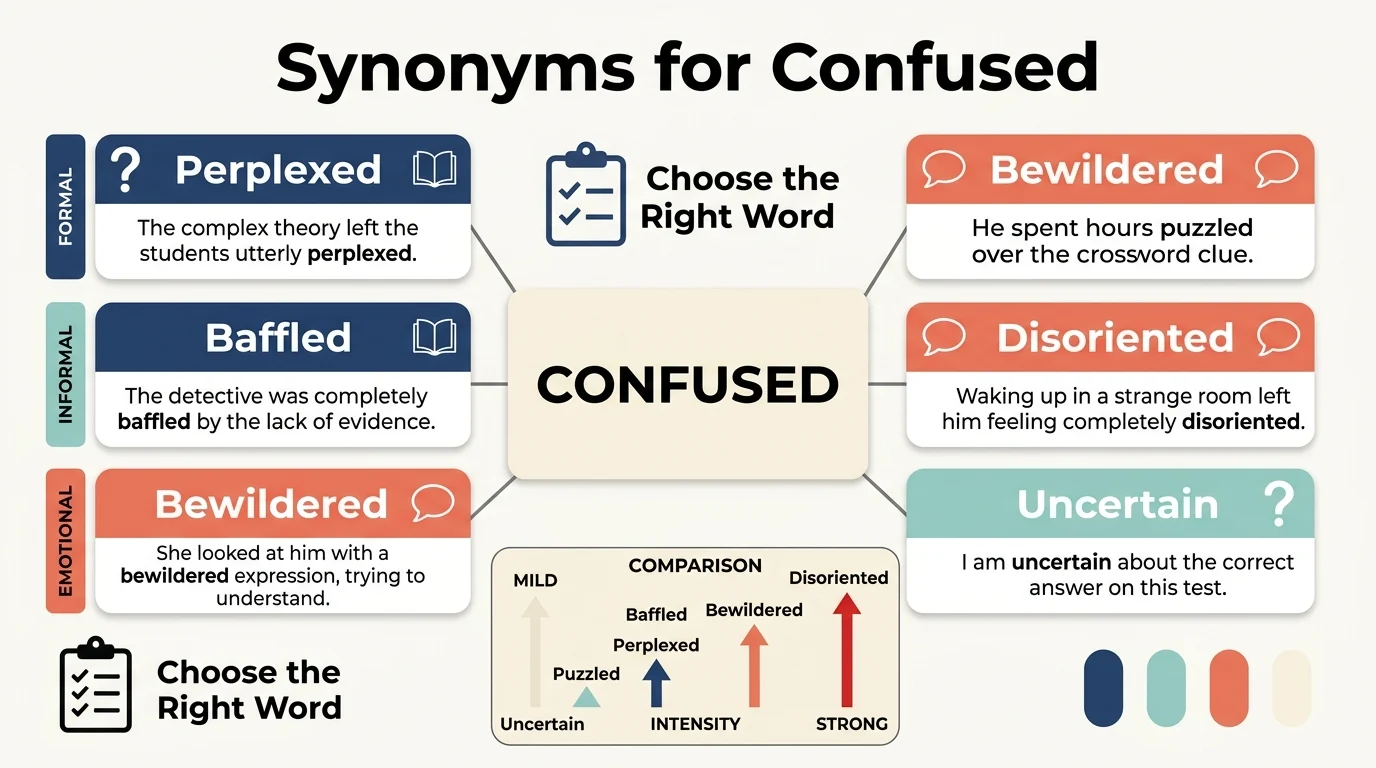
Feeling confused is something everyone experiences. You may feel unsure, puzzled, uncertain, or unable to understand what is happening. That is why finding the right confused synonym can make your writing clearer and more precise.
If you need another word for confused, the best choice depends on the situation and the level of uncertainty you want to express. In this guide, you will find useful synonyms for confused, common confused synonyms, and alternatives that work in everyday speech, academic writing, and professional contexts.
We also explain each word with simple examples so you can choose naturally. Whether you are looking for a synonym for confused, a confusion synonym, or another word for a confused person, this guide will help you find the right term without making your writing sound forced.
What Does “Confused” Mean?
Confused describes a state of being unable to think clearly or understand something. It can range from mild puzzlement to complete disorientation. The best synonym depends on context: use “perplexed” for formal writing, “baffled” for emotional emphasis, “puzzled” for casual conversation, and “bewildered” for creative storytelling. For professional settings, “uncertain” or “disoriented” often work better.
Meaning, Tone and Context
Simple Definition
Confused means lacking clarity of thought or understanding. It indicates that someone cannot make sense of a situation, instruction, or piece of information.
Part of Speech
Confused is an adjective. The related verb form is “confuse.” The noun form is “confusion.” The adverb form is “confusedly.”
Tone
The word has a neutral to slightly negative tone. It points to a mental state that most people want to resolve. It is not offensive, but it can sound weak or vague in formal writing.
Formality Level
Confused is informal to neutral. It works in everyday speech and casual writing. However, it often lacks the precision needed in academic or professional documents.
Common Use Cases
You might use confused when describing a student struggling with a math problem, a traveler reading a foreign map, or an employee processing new instructions. It also appears in emotional contexts, such as someone feeling confused about a relationship.
Important Word Forms
The adjective form is most common. You can also use the verb “to confuse” when describing an action that causes confusion. The noun “confusion” describes the state itself. The adverb “confusedly” describes an action done with confusion.
When and How to Use “Confused”
Understanding when to use confused helps you choose more precise alternatives when needed. Here are realistic examples across different situations.
Professional Example
The team felt confused after the manager changed the project timeline without any explanation.
Academic Example
Students were confused by the complex instructions for the final research paper.
Personal Example
I was completely confused by my friend’s sudden change in attitude.
Emotional Example
She felt confused and hurt when she discovered the truth about the situation.
Creative Writing Example
The detective stood in the rain, confused by the lack of physical evidence at the scene.
Social Media Caption Example
Currently confused about how to assemble this bookshelf. Send help.
Email Example
I am a bit confused about the payment deadline. Could you please clarify the due date?
Another Word for “Confused”
Finding the right replacement depends entirely on your context. Here are the best alternatives for specific situations.
Professional Writing
Use “uncertain” or “disoriented” when you need to sound polished and clear in workplace communication.
Academic Writing
Choose “perplexed” or “puzzled” for essays and research papers where precision matters.
Casual Conversation
Say “lost” or “mixed up” when speaking with friends or family in informal settings.
Emotional Writing
Select “baffled” or “bewildered” to convey stronger emotional depth and personal impact.
Creative Writing
Use “disoriented” or “dazed” to create vivid imagery and descriptive power in stories.
Resume or Workplace Use
Avoid confused entirely. Use “adaptable” or “quick to learn” instead of describing confusion directly.
Social Media Captions
Say “puzzled” or “lost” for relatable, engaging captions that connect with your audience.
Stronger Meaning
Choose “flummoxed” or “dumbfounded” when you want to emphasize complete shock or bewilderment.
Softer Meaning
Use “uncertain” or “unsure” when the confusion is mild and temporary.
When Not to Use “Confused”
Sometimes confused is simply the wrong word. It can sound too vague, too casual, or too weak for your intended message.
Too Vague for Professional Contexts
In a business report, saying “the team was confused” provides no useful information. Instead, be specific: “the team lacked clarity about the new software implementation.”
Too Casual for Academic Writing
Academic readers expect precise language. Instead of “students were confused,” write “students struggled to interpret the ambiguous research findings.”
Too Weak for Emotional Moments
If you are describing a life changing event, confused is not strong enough. Use “devastated” or “shattered” to convey appropriate emotional weight.
Too General for Creative Description
Creative writing demands vivid imagery. Instead of “she looked confused,” describe her expression: “she stared blankly at the empty room.”
How a More Precise Synonym Improves the Sentence
Original sentence: “I felt confused during the presentation.”
Improved sentence: “I felt completely lost during the technical presentation.”
The improved sentence uses “lost” to convey a stronger, more relatable feeling of disconnection from the material.
Words Commonly Confused With “Confused”
Many words relate to confusion, but they have distinct meanings. Here is how they differ.
Confused vs. Perplexed
Perplexed implies a deeper intellectual challenge. It suggests that the person is actively trying to solve a puzzle. Confused is broader and can describe any lack of understanding.
Use perplexed when discussing difficult concepts. Use confused for everyday misunderstandings.
Confused vs. Baffled
Baffled carries a stronger emotional weight. It suggests complete surprise and inability to comprehend. Confused is milder and more neutral.
Use baffled when something seems impossible to understand. Use confused for simple uncertainty.
Confused vs. Bewildered
Bewildered has a more dramatic tone. It often appears in creative writing to describe emotional disorientation. Confused is more straightforward.
Use bewildered in storytelling. Use confused in practical situations.
Confused vs. Disoriented
Disoriented adds a physical or spatial element. It suggests losing a sense of direction or place. Confused focuses on mental understanding.
Use disoriented when describing physical or environmental confusion. Use confused for mental or logical confusion.
Confused vs. Puzzled
Puzzled suggests mild curiosity. It implies that the person is interested in solving the mystery. Confused can include frustration.
Use puzzled when someone is intrigued. Use confused when someone is frustrated.
Confused vs. Uncertain
Uncertain is more formal and neutral. It suggests a lack of confidence rather than a complete lack of understanding. Confused suggests a more active state of not knowing.
Use uncertain in professional writing. Use confused in casual writing.
Confused vs. Dazed
Dazed implies a stunned or shocked state. It often follows a physical or emotional blow. Confused is more cognitive.
Use dazed for shock or trauma. Use confused for ordinary misunderstandings.
Best Synonym by Context for “Confused”
| Context | Best Synonym | Why It Works | Example |
|---|---|---|---|
| Formal Writing | Perplexed | Adds intellectual weight and precision | The committee remained perplexed by the contradictory data. |
| Academic Writing | Puzzled | Suggests active engagement with complex ideas | Researchers were puzzled by the unexpected experimental results. |
| Professional Business | Uncertain | Sounds polished and diplomatic | We are uncertain about the quarterly projections. |
| Resume Writing | Adaptable | Avoids negative connotations | Quickly adapted to new software systems. |
| Casual Conversation | Lost | Relatable and easy to understand | I am totally lost in this conversation. |
| Creative Writing | Bewildered | Creates vivid emotional imagery | She stood bewildered among the crowded marketplace. |
| Emotional Tone | Baffled | Conveys deep personal impact | He was baffled by her sudden departure. |
| Strong Intensity | Flummoxed | Emphasizes complete confusion | The magician’s trick flummoxed the entire audience. |
| Soft or Moderate | Unsure | Downplays the intensity | I am unsure about the correct answer. |
| Social Media Captions | Puzzled | Engaging and relatable | Puzzled by this new app update. |
| US English | Confused | Standard American usage | The student was confused by the assignment. |
| UK English | Confused | Standard British usage | The student was confused by the assignment. |
Which Synonym Should You Choose?
Choosing the right synonym requires thinking about your audience, your purpose, and your emotional tone. Here is a practical decision guide.
Consider Your Meaning
If you simply lack understanding, use “confused” or “puzzled.” If you are completely unable to comprehend, choose “baffled” or “flummoxed.”
Consider Your Formality
For formal writing, choose “perplexed” or “uncertain.” For casual writing, choose “lost” or “mixed up.”
Consider Your Emotional Intensity
For mild confusion, use “unsure” or “puzzled.” For strong emotional confusion, use “bewildered” or “dazed.”
Consider Your Professional Value
In professional contexts, avoid “confused” entirely. Use “seeking clarification” or “reviewing the details” instead.
Consider Your Sentence Context
Look at the entire sentence. Does it describe a mental state, a physical reaction, or an emotional response? Match your synonym to the specific situation.
Real Life Examples of “Confused” in Sentences
These examples show how confused appears across different real world situations. Each example uses the word or a stronger alternative to improve clarity.
School Example
The student stared at the algebra problem, completely lost and unsure where to begin.
Workplace Example
After the merger announcement, employees felt disoriented about their future roles.
Writing Example
The author revised the confusing chapter three times to make it clearer for readers.
Conversation Example
My friend looked bewildered when I mentioned the unexpected plot twist.
Social Media Example
I am genuinely flummoxed by this new Instagram update.
Email Example
I am seeking clarification on the revised budget figures.
Storytelling Example
The traveler wandered through the maze like streets, dazed and disoriented by the unfamiliar city.
25 Synonyms for “Confused”
This table provides 15 carefully selected synonyms for confused. Each one has a unique meaning and specific use case.
| Synonym | Simple Meaning | Best Used For | Example Sentence |
|---|---|---|---|
| Perplexed | Deeply puzzled by something complex | Academic writing | The scientist was perplexed by the unusual data pattern. |
| Baffled | Completely unable to understand | Emotional situations | She was baffled by her friend’s strange behavior. |
| Bewildered | Confused and overwhelmed | Creative writing | The child looked bewildered in the busy airport. |
| Disoriented | Losing sense of direction or time | Physical or spatial confusion | After the accident, he felt disoriented and dizzy. |
| Puzzled | Mildly confused and curious | Casual conversation | I am puzzled by the missing keys. |
| Flummoxed | Utterly confused or perplexed | Strong emphasis | The complex puzzle flummoxed everyone in the room. |
| Dazed | Stunned or unable to think clearly | Shock or surprise | She was dazed after hearing the unexpected news. |
| Uncertain | Lacking confidence or surety | Professional writing | The team was uncertain about the project timeline. |
| Unsure | Not certain or definite | Personal situations | I am unsure about my career path. |
| Lost | Unable to understand or find way | Casual speech | I am totally lost in this conversation. |
| Mixed up | Confused about facts or details | Everyday language | I got mixed up with the meeting times. |
| Addled | Mentally confused | Descriptive writing | His addled mind could not focus on the task. |
| Befuddled | Confused and unable to think clearly | Humorous or light tone | The new software left me thoroughly befuddled. |
| Muddled | Confused and disordered | Describing thoughts | His muddled thoughts prevented him from making a decision. |
| Stumped | Unable to find an answer | Problem solving | The difficult question stumped the entire class. |
Synonym Groups and Usage Differences
Professional vs. Personal Synonyms
Professional writing demands precision and diplomacy. Use “uncertain” or “seeking clarification” instead of confused. These phrases sound more competent and solution focused.
Personal writing allows more emotional language. Use “baffled” or “bewildered” to express genuine confusion in relationships or personal experiences.
Formal vs. Conversational Synonyms
Formal writing includes reports, essays, and official communications. Use “perplexed” or “disoriented” to maintain a sophisticated tone. These words show intellectual engagement.
Conversational writing includes texts, emails to friends, and social media. Use “lost” or “puzzled” for natural, relatable communication.
Academic Synonyms
Academic writing values precise language. Choose “perplexed” or “puzzled” to describe intellectual challenges. Avoid vague words like “confused” that lack academic rigor.
Use “uncertain” when discussing research findings. Use “ambiguous” to describe unclear data. These choices demonstrate scholarly vocabulary.
Professional and Business Synonyms
Business communication requires clarity and confidence. Never use “confused” in a resume or performance review. Instead, use “adaptable” or “quick to learn.”
In emails, say “seeking clarification” rather than “I am confused.” This approach sounds proactive and professional.
Creative or Literary Synonyms
Creative writing benefits from vivid, emotional language. Use “bewildered” to paint a picture of disorientation. “dazed” to describe shock or trauma.
Use “addled” to show mental exhaustion. “disoriented” to describe physical confusion in a scene. These words add depth to your storytelling.
Slang or Modern Synonyms
Some modern slang includes “mind blown” or “frazzled.” These work in casual contexts but are inappropriate for formal writing.
Use “frazzled” to describe a busy, stressed person. Use “mind blown” for moments of surprising realization. Avoid these in academic or professional settings.
Strongest vs. Weaker Synonyms
Intensity scale from mildest to strongest:
Mild: Unsure, uncertain, puzzled
Moderate: Confused, lost, mixed up
Strong: Perplexed, disoriented, baffled
Very Strong: Flummoxed, dumbfounded, bewildered
Extreme: Addled, dazed, shell shocked
Emotional vs. Neutral Synonyms
Emotional synonyms add personal feeling. Use “baffled” to show frustration. Use “bewildered” to show vulnerability.
Neutral synonyms stay factual. Use “uncertain” to describe a situation. Use “perplexed” to describe a logical puzzle. Choose based on whether you want to express emotion or simply state a fact.
Antonyms of “Confused”
These antonyms describe clarity, understanding, and certainty. Use them to contrast confusion with clear thinking.
| Antonym | Meaning | Example Sentence |
|---|---|---|
| Clear | Easy to understand | The instructions were perfectly clear. |
| Certain | Completely sure | I am certain about my decision. |
| Confident | Feeling sure and self assured | She felt confident about the exam. |
| Informed | Having accurate knowledge | He was well informed about the topic. |
| Aware | Having conscious knowledge | I am fully aware of the situation. |
| Oriented | Familiar with the surroundings | The new employee quickly became oriented. |
| Composed | Calm and in control | She remained composed during the crisis. |
| Focused | Concentrating on a goal | The team was focused on the task. |
| Understanding | Grasping the meaning | I have a complete understanding of the problem. |
| Decisive | Able to make decisions quickly | The decisive leader chose the best option. |
| Enlightened | Having greater knowledge | The lecture left me feeling enlightened. |
| Lucid | Clear and easy to understand | He provided a lucid explanation of the process. |
| Unambiguous | Not open to multiple interpretations | The contract language was unambiguous. |
| Assured | Confident and certain | The assured speaker captivated the audience. |
| Discerning | Having good judgment | She is a discerning reader of complex texts. |
Comparison: Confused vs. Similar Words
Confused vs. Perplexed
Main difference: Confused is general and broad. Perplexed is specific to intellectual challenges.
Perplexed is stronger and more formal. It suggests active mental effort to solve a problem.
Example with confused: I am confused by the new policy.
Example with perplexed: I am perplexed by the contradictory evidence in the case.
Confused vs. Baffled
Main difference: Baffled implies stronger emotional surprise. Confused is more neutral.
Baffled is much stronger and more dramatic. Confused is milder.
Example with confused: The math problem confused me.
Example with baffled: The magician’s trick baffled the entire audience.
Confused vs. Bewildered
Main difference: Bewildered adds emotional overwhelm. Confused is more cognitive.
Bewildered is more intense and vivid. Confused is straightforward.
Example with confused: I am confused by the directions.
Example with bewildered: She was bewildered by the bustling city streets.
Confused vs. Disoriented
Main difference: Disoriented involves physical or spatial confusion. Confused is mental.
Disoriented adds a physical dimension. Confused is purely cognitive.
Example with confused: I am confused about the schedule.
Example with disoriented: After the accident, he was disoriented and could not find his way.
Confused vs. Puzzled
Main difference: Puzzled suggests curiosity. Confused suggests frustration.
Puzzled is milder and more positive. Confused is more negative.
Example with confused: I am confused by the error message.
Example with puzzled: I am puzzled by the unusual design choice.
Confused vs. Dazed
Main difference: Dazed implies shock or trauma. Confused is ordinary.
Dazed is much stronger and physical. Confused is mental and mild.
Example with confused: The announcement left me confused.
Example with dazed: The sudden news left her dazed and speechless.
Common Phrases and Expressions with “Confused”
1. Confused State of Mind
Meaning: A mental condition where thinking is unclear.
Example sentence: After the accident, he remained in a confused state of mind.
2. Leave Someone Confused
Meaning: To cause someone to be unable to understand something.
Example sentence: The complex instructions left the students confused.
3. Confused About Something
Meaning: To lack understanding about a specific topic.
Example sentence: I am still confused about the new payment system.
4. Confused Look on Someone’s Face
Meaning: A facial expression showing lack of understanding.
Example sentence: She gave me a confused look when I mentioned the new policy.
5. Confused and Frustrated
Meaning: Combining confusion with annoyance.
Example sentence: He felt confused and frustrated by the endless paperwork.
6. Confused as to Why
Meaning: Unable to understand the reason for something.
Example sentence: I am confused as to why the meeting was canceled.
7. Completely Confused
Meaning: Emphasizing total lack of understanding.
Example sentence: The complicated legal document left me completely confused.
8. Confused About Life
Meaning: Feeling uncertain about personal direction or purpose.
Example sentence: After graduation, she felt confused about life and her career choices.
Common Mistakes to Avoid
Mistake 1: Using Confused When a More Precise Synonym Works Better
Wrong sentence: I was confused by the novel’s ending.
Better sentence: I was baffled by the novel’s unexpected ending.
The word “baffled” adds emotional depth to your reaction.
Mistake 2: Confusing Confused with Disoriented
Wrong sentence: I felt disoriented by the complex equation.
Better sentence: I felt perplexed by the complex equation.
Use “disoriented” for physical confusion, not mental challenges.
Mistake 3: Using a Casual Synonym in Formal Writing
Wrong sentence: The data set left the researchers lost.
Better sentence: The data set left the researchers perplexed.
“Lost” is too informal for academic writing.
Mistake 4: Using an Overly Dramatic Synonym for a Simple Situation
Wrong sentence: I was flummoxed by the missing coffee mug.
Better sentence: I was puzzled by the missing coffee mug.
“Flummoxed” is too strong for a minor inconvenience.
Mistake 5: Repeating the Same Word Too Often
Wrong paragraph: I am confused by the schedule. My boss seems confused too. The team is confused about the deadline.
Better paragraph: I am confused by the schedule. My boss seems uncertain as well. The team is puzzled about the deadline.
Use synonyms to add variety and clarity.
Mistake 6: Choosing a Synonym with the Wrong Emotional Tone
Wrong sentence: The happy news left me bewildered.
Better sentence: The happy news left me pleasantly surprised.
“Bewildered” has a negative emotional tone that does not match happiness.
Mistake 7: Using Slang in Academic or Professional Writing
Wrong sentence: The experiment results blew my mind.
Better sentence: The experiment results were surprising.
Slang is inappropriate for professional and academic contexts.
FAQs
What is the best synonym for confused?
The best synonym depends on your context. Use “perplexed” for formal writing, “baffled” for emotional emphasis, and “puzzled” for casual conversation.
What is a formal synonym for confused?
“Perplexed” is the most appropriate formal synonym for confused. It suggests intellectual engagement and works well in academic and professional writing.
What is an informal synonym for confused?
“Lost” is a common informal synonym for confused. It works well in casual conversation and social media posts.
What is another word for confused in professional writing?
In professional writing, use “uncertain” instead of confused. This term sounds more competent and diplomatic.
What is the difference between confused and perplexed?
Perplexed suggests a specific intellectual challenge, while confused is broader and more general. Perplexed also carries a more formal tone.
What is the opposite of confused?
The opposite of confused is clear, certain, or composed. These words describe a state of understanding and confidence.
Conclusion
Confused is a useful word, but it often lacks the precision your writing deserves. By expanding your vocabulary with synonyms like perplexed, baffled, and bewildered, you can communicate more effectively in any situation.
Remember that tone and context matter more than the word itself. Choose formal synonyms for professional writing, emotional synonyms for personal stories, and casual synonyms for everyday conversations. The right word makes your message clearer and more impactful.
Your practical vocabulary tip for today is to replace “confused” with “perplexed” in your next email. This small change will instantly elevate your professional communication.
Use the synonyms in this guide to avoid repetition, add emotional depth, and speak with greater clarity. Your readers will notice the difference.