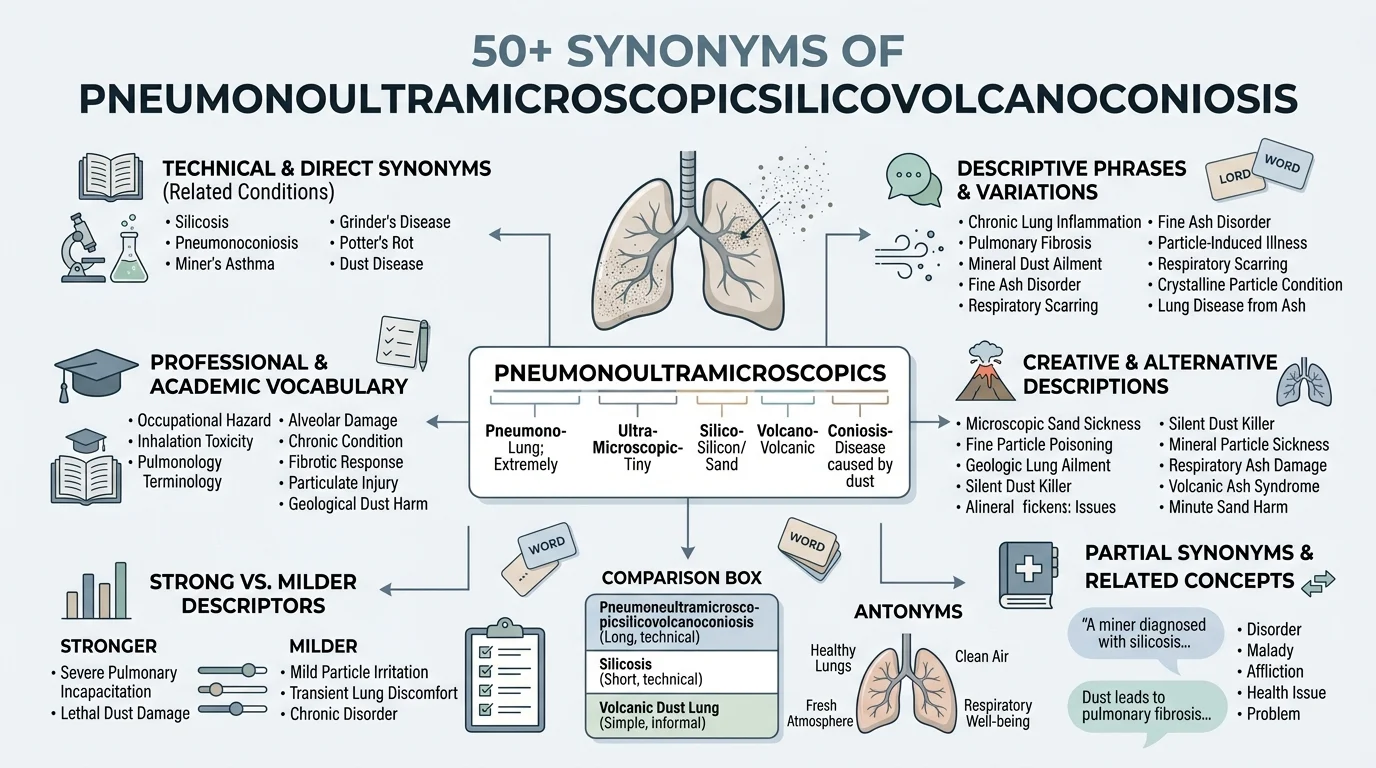
You are writing an essay about occupational lung diseases. You type the same clinical term repeatedly. Your paragraph feels repetitive and flat. You know there must be a better way to express the same idea without sounding like a broken record. This is exactly where understanding the synonyms of pneumonoultramicroscopicsilicovolcanoconiosis becomes essential. Choosing the right alternative can transform your writing from awkward and clunky to clear and professional. Whether you are drafting a research paper, preparing a workplace safety report, or simply trying to impress your English teacher, knowing which synonym fits each situation will elevate your communication skills instantly.
What Are the Best Synonyms of “Pneumonoultramicroscopicsilicovolcanoconiosis”?
Pneumonoultramicroscopicsilicovolcanoconiosis is an invented long word meaning a lung disease caused by inhaling very fine silica or quartz dust.For formal medical writing, use silicosis or pneumoconiosis. For casual conversation, simply say lung disease or dust-related lung condition. For academic papers, silica pneumoconiosis works best.
Meaning, Tone, and Context
Simple Definition
Pneumonoultramicroscopicsilicovolcanoconiosis refers to a lung disease caused by breathing in extremely fine silicate or quartz dust particles.The word was invented in 1935 by Everett M. Smith, president of the National Puzzlers’ League, as a deliberate exercise in creating an extremely long word.Despite its impressive length, it is simply a synonym for the more common medical term silicosis.
Part of Speech
Noun. It is typically used as an uncountable noun referring to the disease itself.
Overall Tone
Neutral to slightly clinical. The word itself is neither positive nor negative, but its length makes it sound overly technical and almost comical.
Formality Level
Highly formal. This word is rarely used in everyday conversation. It appears almost exclusively in discussions about long words, trivia, or as a curiosity rather than in actual medical practice.
Common Uses
Native English speakers mostly encounter this word in:
- Trivia articles about the longest words in English
- Word puzzle discussions
- Educational contexts teaching vocabulary or word formation
- Humorous references to unnecessarily long terminology
Word Forms
Noun: pneumonoultramicroscopicsilicovolcanoconiosis
Related term: pneumoconiosis (the broader category of lung diseases caused by dust inhalation)
When and How to Use “Pneumonoultramicroscopicsilicovolcanoconiosis”
You should only use this word when you want to draw attention to its length or when discussing longest-word trivia. In actual medical or professional writing, it is almost never the right choice. Here are realistic examples across different contexts.
Professional (Medical Report):
“The patient’s chest X-ray revealed changes consistent with pneumonoultramicroscopicsilicovolcanoconiosis, though we prefer the simpler diagnostic term silicosis.”
Academic (Linguistics Paper):
“Pneumonoultramicroscopicsilicovolcanoconiosis exemplifies how English speakers can combine Greek and Latin roots to create new technical vocabulary.”
Workplace (Safety Training):
“Workers in high-risk environments should understand conditions like pneumonoultramicroscopicsilicovolcanoconiosis, commonly known as silicosis.”
Personal (Conversation):
“Did you know pneumonoultramicroscopicsilicovolcanoconiosis is the longest word in most English dictionaries?”
Email (To a Colleague):
I came across pneumonoultramicroscopicsilicovolcanoconiosis in a trivia article, but the actual medical term is just silicosis.
Resume (Not Recommended):
Avoid using this word on a resume entirely. It will confuse recruiters and make you appear out of touch.
Social Media:
“Just learned how to spell pneumonoultramicroscopicsilicovolcanoconiosis. My autocorrect is having a meltdown.”
Best Synonyms of “Pneumonoultramicroscopicsilicovolcanoconiosis”
No synonym is identical in every situation. The right choice depends on your audience, purpose, and the level of formality required. Here are the best synonyms for specific contexts.
Professional Writing:
Use silicosis. It is the standard medical term understood by healthcare professionals worldwide.
Academic Writing:
Use pneumoconiosis or silica pneumoconiosis. These terms sound appropriately scholarly and precise.
Business Communication:
Use occupational lung disease or dust-related respiratory condition. These phrases are clear without being overly technical.
Casual Conversation:
Use lung disease or dust lung. These terms are simple and immediately understandable.
Emotional Writing:
Use debilitating lung condition or respiratory illness. These phrases convey seriousness without clinical coldness.
Creative Writing:
Use miner’s lung or stone dust disease. These terms have a poetic, evocative quality.
Resume Writing:
Do not use any variation of this word on a resume. If relevant, mention occupational health and safety experience instead.
Workplace Communication:
Use dust-related illness or respiratory hazard. These terms are clear and actionable for safety discussions.
Stronger Meaning:
Use progressive pulmonary fibrosis to emphasize the severity and irreversible nature of the condition.
Softer Meaning:
Use minor dust irritation if describing a less severe reaction.
When Not to Use “Pneumonoultramicroscopicsilicovolcanoconiosis”
When It Sounds Too Gimmicky
Using this word in serious medical or professional writing makes you look like you are showing off rather than communicating clearly. Medical professionals do not use this term in practice. It exists primarily as a linguistic curiosity.
Incorrect:
“The factory worker was diagnosed with pneumonoultramicroscopicsilicovolcanoconiosis after twenty years of exposure.”
Better:
“The factory worker was diagnosed with silicosis after twenty years of exposure.”
When It Sounds Too Vague
Despite its length, the word does not specify which type of dust or what severity of disease. It is actually less precise than simpler alternatives.
Incorrect:
“Employees should be aware of pneumonoultramicroscopicsilicovolcanoconiosis risks.”
Better:
“Employees should be aware of silicosis risks from inhaling crystalline silica dust.”
When It Sounds Too Formal for the Audience
In casual conversation or general audience writing, this word will confuse rather than inform.
Incorrect:
“My grandfather has pneumonoultramicroscopicsilicovolcanoconiosis from his mining days.”
Better:
“My grandfather has lung disease from his mining days.”
Words Commonly Confused With “Pneumonoultramicroscopicsilicovolcanoconiosis”
Pneumonoultramicroscopicsilicovolcanoconiosis vs Silicosis
Difference: Silicosis is the actual medical term for the disease. Pneumonoultramicroscopicsilicovolcanoconiosis is an artificially constructed synonym created for wordplay.
When to Use It: Use silicosis in all medical, professional, and academic contexts. Use pneumonoultramicroscopicsilicovolcanoconiosis only when discussing longest words or word trivia.
Example (Silicosis): “Miners are at high risk for developing silicosis.”
Example (Pneumonoultramicroscopicsilicovolcanoconiosis): “The longest word in the dictionary is pneumonoultramicroscopicsilicovolcanoconiosis.”
Pneumonoultramicroscopicsilicovolcanoconiosis vs Pneumoconiosis
Difference: Pneumoconiosis is the broader category of lung diseases caused by dust inhalation. Silicosis is one specific type of pneumoconiosis.
When to Use It: Use pneumoconiosis when referring to dust-related lung diseases in general. Use silicosis when specifically discussing silica dust exposure.
Example (Pneumoconiosis): “Pneumoconiosis encompasses several occupational lung diseases.”
Example (Silicosis): “Silicosis is a type of pneumoconiosis caused by silica dust.”
Pneumonoultramicroscopicsilicovolcanoconiosis vs Black Lung
Difference: Black lung specifically refers to lung disease caused by coal dust, while silicosis is caused by silica dust.
When to Use It: Use black lung when discussing coal mining specifically. Use silicosis for other dust exposures.
Example (Black Lung): “Coal miners face the risk of developing black lung disease.”
Example (Silicosis): “Stone cutters are vulnerable to silicosis.”
Pneumonoultramicroscopicsilicovolcanoconiosis vs Asbestosis
Difference: Asbestosis is caused by asbestos fibers, not silica dust. They are different diseases with different causes.
When to Use It: Use asbestosis when discussing asbestos exposure. Use silicosis for silica dust exposure.
Example (Asbestosis): “Workers who handled asbestos developed asbestosis.”
Example (Silicosis): “Sandblasters are at risk for silicosis.”
Pneumonoultramicroscopicsilicovolcanoconiosis vs Fibrosis
Difference: Fibrosis is the scarring of lung tissue. It is a symptom or result of diseases like silicosis, not the disease itself.
When to Use It: Use fibrosis when describing the tissue damage. Use silicosis when naming the specific disease.
Example (Fibrosis): “The X-ray showed significant pulmonary fibrosis.”
Example (Silicosis): “The fibrosis was caused by years of silica dust exposure.”
Best Synonyms of “Pneumonoultramicroscopicsilicovolcanoconiosis” by Context
| Context | Best Synonym | Why It Works | Example |
|---|---|---|---|
| Formal writing | Silicosis | Standard medical term recognized worldwide | “The patient was diagnosed with silicosis.” |
| Academic writing | Silica pneumoconiosis | Precise and scholarly sounding | “Silica pneumoconiosis remains a significant occupational health concern.” |
| Professional communication | Occupational lung disease | Clear and professional without jargon | “Occupational lung diseases affect thousands of workers annually.” |
| Business emails | Respiratory condition | Neutral and easy to understand | “The report addresses respiratory conditions linked to workplace dust.” |
| Resume writing | Occupational health and safety | Relevant experience framing | “Managed occupational health and safety programs for manufacturing facilities.” |
| Workplace communication | Dust-related illness | Direct and actionable | “Dust-related illnesses can be prevented with proper protective equipment.” |
| Casual conversation | Lung disease | Simple and immediately clear | “He has lung disease from working in the mine.” |
| Everyday speaking | Dust lung | Informal and conversational | “Dust lung is a real risk for construction workers.” |
| Creative writing | Miner’s lung | Evocative and atmospheric | “The old miner’s lungs bore the scars of decades underground.” |
| Storytelling | Stone dust disease | Descriptive and vivid | “Stone dust disease had claimed another victim.” |
| Emotional writing | Debilitating lung condition | Conveys seriousness and suffering | “The debilitating lung condition robbed him of his breath.” |
| Strong emphasis | Progressive pulmonary fibrosis | Highlights severity and irreversibility | “Progressive pulmonary fibrosis left him dependent on oxygen.” |
| Mild tone | Minor respiratory irritation | Minimizes severity appropriately | “He experienced minor respiratory irritation from the dust.” |
| Social media captions | Dust lung | Short and engaging | “Dust lung awareness: protect your lungs at work.” |
How to Choose the Best Synonym of “Pneumonoultramicroscopicsilicovolcanoconiosis”
Choosing the right synonym comes down to four simple questions.
Who is your audience? If you are writing for medical professionals, use silicosis. If you are writing for the general public, use lung disease or dust-related illness.
What is your purpose? Are you trying to inform, persuade, or entertain? Trivia articles can use the full word. Medical reports should not.
How formal is the setting? Academic papers call for pneumoconiosis. Casual blogs can use dust lung.
What emotional tone do you want? To convey seriousness, use progressive lung disease. To stay neutral, use silicosis.
The best synonym is always the one that communicates your message most clearly to your specific reader.
Real Life Examples of “Pneumonoultramicroscopicsilicovolcanoconiosis”
School Assignment:
“The longest word in the English dictionary is pneumonoultramicroscopicsilicovolcanoconiosis, which refers to a lung disease caused by inhaling fine dust.”
College Research Paper:
“While pneumonoultramicroscopicsilicovolcanoconiosis is often cited as the longest English word, the preferred medical term is silicosis, which appears in all major medical texts.”
Workplace Safety Bulletin:
“Workers should understand the risks of silicosis, a preventable lung disease caused by inhaling crystalline silica dust.”
Business Report:
“The company’s dust control measures have significantly reduced the incidence of occupational lung diseases among employees.”
Email to HR:
“I would like to request information about respiratory protection programs for employees exposed to silica dust.”
Conversation:
“Did you know there is a 45-letter word for lung disease? It is called pneumonoultramicroscopicsilicovolcanoconiosis, but everyone just says silicosis.”
Storytelling:
“The stonecutter’s chest heaved with each breath, his lungs ravaged by decades of fine dust.”
Blogging:
“If you work with stone, concrete, or sand, protect your lungs from silicosis. This serious disease is preventable with proper masks and ventilation.”
Social Media:
“Fun fact: pneumonoultramicroscopicsilicovolcanoconiosis is the longest word in English. It means silicosis. Now you know!”
18 Best Synonyms of “Pneumonoultramicroscopicsilicovolcanoconiosis”
| Synonym | Simple Meaning | Best Used For | Example Sentence |
|---|---|---|---|
| Silicosis | Lung disease from silica dust | Medical and professional writing | “Silicosis is a preventable occupational disease.” |
| Pneumoconiosis | Any dust-related lung disease | Academic and medical contexts | “Pneumoconiosis encompasses several occupational lung conditions.” |
| Silica pneumoconiosis | Pneumoconiosis specifically from silica | Precise medical documentation | “The autopsy confirmed silica pneumoconiosis.” |
| Black lung | Lung disease from coal dust | Coal mining contexts | “Black lung disease has affected generations of coal miners.” |
| Miner’s phthisis | Historical term for miner’s lung disease | Historical or literary writing | “Miner’s phthisis was common in the nineteenth century.” |
| Grinders’ asthma | Lung disease from grinding dust | Industrial and manufacturing contexts | “Grinders’ asthma affected many metal workers.” |
| Potter’s rot | Lung disease from pottery dust | Ceramics and pottery industry contexts | “Potter’s rot was a known hazard in the ceramics industry.” |
| Chalicosis | Lung disease from stone dust | Specific medical terminology | “Chalicosis is caused by inhaling stone dust.” |
| Lithosis | Lung disease from stone dust | Technical medical writing | “Lithosis affects workers who cut or grind stone.” |
| Lung fibrosis | Scarring of lung tissue | Describing the physical damage | “Lung fibrosis made it difficult for him to breathe.” |
| Occupational lung disease | Any lung disease from workplace exposure | General professional communication | “Occupational lung diseases are preventable with proper safety measures.” |
| Dust-induced lung disease | Lung disease caused by dust | Public health and education | “Dust-induced lung diseases affect millions worldwide.” |
| Respiratory illness | Any illness affecting breathing | General and accessible writing | “Respiratory illnesses from dust exposure are serious.” |
| Pulmonary condition | Condition affecting the lungs | Medical and professional contexts | “His pulmonary condition was linked to workplace dust.” |
| Progressive lung disease | Worsening lung condition over time | Emphasizing severity | “Progressive lung disease required him to use oxygen.” |
| Respiratory disease | Disease of the respiratory system | Formal and professional writing | “Respiratory diseases are a leading cause of workplace illness.” |
| Dust-related condition | Condition caused by dust exposure | Accessible and clear communication | “Dust-related conditions can be avoided with proper protection.” |
| Silicotic lung disease | Disease specifically from silica | Precise medical terminology | “Silicotic lung disease was confirmed by biopsy.” |
Synonyms of “Pneumonoultramicroscopicsilicovolcanoconiosis” by Usage
Professional vs Personal Synonyms
In professional settings, choose silicosis, occupational lung disease, or pneumoconiosis. These terms sound credible and demonstrate expertise.
In personal conversations, choose lung disease, dust lung, or breathing trouble. These terms are natural and easy to understand.
Formal vs Conversational Synonyms
Formal (reports, essays, business writing, presentations):
- Silicosis
- Pneumoconiosis
- Occupational lung disease
- Silica pneumoconiosis
Conversational (casual talks, texting, social media):
- Lung disease
- Dust lung
- Breathing problems from dust
Academic Synonyms
For research papers and academic discussions, use silica pneumoconiosis or pneumoconiosis. These terms appear in peer-reviewed literature and sound appropriately authoritative. They demonstrate precision and familiarity with medical terminology.
Professional and Business Synonyms
For resumes, interviews, meetings, and client communication, use occupational health, respiratory safety, or workplace dust hazards. These terms frame the issue as a business and safety concern rather than a purely medical one.
Creative and Literary Synonyms
For storytelling and descriptive writing, use miner’s lung, stone dust disease, or the dust sickness. These terms carry emotional weight and create vivid imagery.
Slang or Modern Synonyms
There are no widely used slang terms for this condition. The word is too specialized and obscure to have generated casual alternatives. Stick to the standard synonyms listed above.
Strongest to Mildest Synonyms
Mild:
- Minor dust irritation
- Respiratory sensitivity
Moderate:
- Dust-related lung condition
- Occupational respiratory issue
Strong:
- Silicosis
- Pneumoconiosis
- Lung fibrosis
Very Strong:
- Progressive pulmonary fibrosis
- Debilitating lung disease
- Fatal respiratory illness
Emotional vs Neutral Synonyms
Emotional Synonyms
These words express stronger feelings and convey seriousness:
- Debilitating lung condition
- Progressive pulmonary fibrosis
- Devastating respiratory illness
- Crippling lung disease
Use these when you want to emphasize suffering, severity, or the human cost of the disease.
Neutral Synonyms
These words simply communicate information without added emotion:
- Silicosis
- Pneumoconiosis
- Occupational lung disease
- Dust-related respiratory condition
Use these in medical reports, academic papers, and professional communications where objectivity is important.
Antonyms of “Pneumonoultramicroscopicsilicovolcanoconiosis”
| Antonym | Meaning | Example Sentence |
|---|---|---|
| Healthy lungs | Lungs free from disease | “The miner dreamed of retiring with healthy lungs.” |
| Clear breathing | Unobstructed breathing | “After leaving the mine, he enjoyed clear breathing again.” |
| Respiratory health | Good condition of the respiratory system | “Respiratory health improved after dust controls were installed.” |
| Lung wellness | Optimal lung function | “Lung wellness programs helped workers stay healthy.” |
| Clean air | Air free from harmful particles | “Clean air regulations reduced occupational diseases.” |
| Pulmonary fitness | Strong, healthy lungs | “Pulmonary fitness was a requirement for the job.” |
| Breath ease | Comfortable breathing | “Breath ease returned after he left the dusty environment.” |
| Respiratory strength | Strong respiratory system | “Respiratory strength declined after years of dust exposure.” |
| Lung capacity | Volume of air lungs can hold | “Lung capacity decreased as the disease progressed.” |
| Healthy respiration | Normal breathing function | “Healthy respiration depends on clean air.” |
| Unimpaired breathing | Breathing without obstruction | “Unimpaired breathing is essential for quality of life.” |
| Pulmonary wellness | Overall lung health | “Pulmonary wellness requires avoiding dust exposure.” |
| Clear lungs | Lungs without disease or damage | “Clear lungs are a blessing for any worker.” |
| Respiratory freedom | Ability to breathe without restriction | “Respiratory freedom is something we often take for granted.” |
| Lung integrity | Undamaged lung tissue | “Lung integrity must be protected with proper safety measures.” |
Comparison: “Pneumonoultramicroscopicsilicovolcanoconiosis” vs Similar Words
Pneumonoultramicroscopicsilicovolcanoconiosis vs Silicosis
Main Difference: Pneumonoultramicroscopicsilicovolcanoconiosis is an artificially constructed word created for its length. Silicosis is the genuine medical term used by healthcare professionals.
Which Is Stronger? Neither is stronger in meaning. They refer to the same disease. However, silicosis carries more medical authority.
Which Is More Formal? Both are formal, but silicosis is the appropriate formal term for medical contexts. Pneumonoultramicroscopicsilicovolcanoconiosis is formal only in the sense of being overly technical.
When to Use Each: Use silicosis for all practical purposes. Use pneumonoultramicroscopicsilicovolcanoconiosis only when discussing word length or trivia.
Examples:
- Pneumonoultramicroscopicsilicovolcanoconiosis: “The longest word in the dictionary is pneumonoultramicroscopicsilicovolcanoconiosis.”
- Silicosis: “The doctor diagnosed him with silicosis.”
Pneumonoultramicroscopicsilicovolcanoconiosis vs Pneumoconiosis
Main Difference: Pneumoconiosis is the broader category. Silicosis is one specific type.
Which Is Stronger? Pneumoconiosis is broader. Silicosis is more specific.
Which Is More Formal? Both are formal medical terms. Pneumoconiosis is used in public health and occupational medicine.
When to Use Each: Use pneumoconiosis when discussing dust-related lung diseases generally. Use silicosis when specifically referring to silica dust.
Examples:
- Pneumoconiosis: “Pneumoconiosis includes several occupational lung diseases.”
- Silicosis: “Silicosis is caused specifically by silica dust.”
Pneumonoultramicroscopicsilicovolcanoconiosis vs Black Lung
Main Difference: Black lung specifically refers to coal dust exposure. Silicosis refers to silica dust exposure.
Which Is Stronger? Both are serious. Black lung is more commonly associated with coal mining.
Which Is More Formal? Silicosis is the formal medical term. Black lung is more colloquial.
When to Use Each: Use black lung for coal mining contexts. Use silicosis for other silica dust exposures.
Examples:
- Black Lung: “Black lung has affected coal miners for generations.”
- Silicosis: “Silicosis is a risk for stonecutters and sandblasters.”
Pneumonoultramicroscopicsilicovolcanoconiosis vs Asbestosis
Main Difference: Asbestosis is caused by asbestos fibers. Silicosis is caused by silica dust.
Which Is Stronger? Both are serious and potentially fatal.
Which Is More Formal? Both are formal medical terms.
When to Use Each: Use asbestosis for asbestos exposure. Use silicosis for silica dust exposure.
Examples:
- Asbestosis: “Asbestosis was common among shipyard workers.”
- Silicosis: “Silicosis affects workers who handle stone and sand.”
Pneumonoultramicroscopicsilicovolcanoconiosis vs Fibrosis
Main Difference: Fibrosis is the scarring of lung tissue. It is a symptom, not a specific disease.
Which Is Stronger? Fibrosis describes the damage. Silicosis names the disease.
Which Is More Formal? Both are formal medical terms.
When to Use Each: Use fibrosis when describing tissue damage. Use silicosis when naming the disease.
Examples:
- Fibrosis: “The X-ray showed significant fibrosis in both lungs.”
- Silicosis: “The fibrosis was caused by years of silica dust exposure.”
Pneumonoultramicroscopicsilicovolcanoconiosis vs Occupational Lung Disease
Main Difference: Occupational lung disease is the broad category. Silicosis is one specific type.
Which Is Stronger? Occupational lung disease is broader. Silicosis is more specific.
Which Is More Formal? Both are formal. Occupational lung disease is used in public health and legal contexts.
When to Use Each: Use occupational lung disease for general discussions. Use silicosis for specific silica-related cases.
Examples:
- Occupational Lung Disease: “Occupational lung diseases are a major public health concern.”
- Silicosis: “Silicosis is one of the most common occupational lung diseases.”
Common Phrases and Expressions with “Pneumonoultramicroscopicsilicovolcanoconiosis”
Phrase: “The longest word in the dictionary”
Meaning: This phrase almost always refers to pneumonoultramicroscopicsilicovolcanoconiosis, which holds the record in many English dictionaries.
Example Sentence: “The longest word in the dictionary is pneumonoultramicroscopicsilicovolcanoconiosis, with forty-five letters.”
Phrase: “An artificial long word”
Meaning: The Oxford English Dictionary describes it this way because it was intentionally created rather than arising naturally.
Example Sentence: “According to the OED, pneumonoultramicroscopicsilicovolcanoconiosis is an artificial long word.”
Phrase: “A lung disease caused by inhaling fine dust”
Meaning: This is the straightforward definition that appears in most dictionaries.
Example Sentence: “Pneumonoultramicroscopicsilicovolcanoconiosis refers to a lung disease caused by inhaling fine dust.”
Phrase: “Silica dust exposure”
Meaning: The underlying cause of silicosis, often mentioned alongside the long word.
Example Sentence: “Silica dust exposure can lead to pneumonoultramicroscopicsilicovolcanoconiosis, commonly known as silicosis.”
Common Mistakes to Avoid
1: Using the Full Word in Serious Medical Writing
Incorrect: “The patient was diagnosed with pneumonoultramicroscopicsilicovolcanoconiosis.”
Better: “The patient was diagnosed with silicosis.”
Why: Medical professionals never use this word. It makes you look uninformed.
2: Confusing Silicosis with Black Lung
Incorrect: “Coal miners are at risk for silicosis.”
Better: “Coal miners are at risk for black lung disease.”
Why: Silicosis is from silica dust. Black lung is from coal dust. They are different.
3: Using the Word in Casual Conversation
Incorrect: “My uncle has pneumonoultramicroscopicsilicovolcanoconiosis.”
Better: “My uncle has lung disease from his work.”
Why: The long word will confuse and distract your listener.
4: Assuming the Word Has Medical Authority
Incorrect: “According to medical literature, pneumonoultramicroscopicsilicovolcanoconiosis affects many workers.”
Better: “According to medical literature, silicosis affects many workers.”
Why: The long word does not appear in medical literature. It is a trivia word, not a medical term.
5: Using the Word on a Resume
Incorrect: “Managed risks related to pneumonoultramicroscopicsilicovolcanoconiosis.”
Better: “Managed occupational health and safety programs for dust hazard prevention.”
Why: Recruiters will not know what you are talking about. Use clear, professional language.
6: Spelling It Incorrectly
Incorrect: “Pneumonoultramicroscopicsilicovolcanoconiosis” is often misspelled.
Better: Double-check the spelling if you must use it. The correct spelling has forty-five letters.
Why: With a word this long, even a small error is obvious and embarrassing.
7: Using It to Sound Intelligent
Incorrect: Dropping the word in conversation to impress others.
Better: Use simpler, clearer language that actually communicates.
Why: Using obscure words makes you seem pretentious, not intelligent.
Frequently Asked Questions
1. What are the best synonyms of pneumonoultramicroscopicsilicovolcanoconiosis?
The best synonyms are silicosis for medical contexts, pneumoconiosis for academic writing, and occupational lung disease for professional communication. Each serves a different purpose and audience.
2. What are the best formal synonyms of pneumonoultramicroscopicsilicovolcanoconiosis?
The best formal synonyms are silicosis, pneumoconiosis, and silica pneumoconiosis. These terms are recognized in medical literature and professional settings.
3. What are common informal synonyms of pneumonoultramicroscopicsilicovolcanoconiosis?
Common informal synonyms include lung disease, dust lung, and breathing problems from dust. These terms are clear and accessible for everyday conversation.
4. What is another word for pneumonoultramicroscopicsilicovolcanoconiosis in professional writing?
In professional writing, use silicosis or occupational lung disease. These terms are precise, widely understood, and appropriate for workplace and medical contexts.
5. What is the difference between pneumonoultramicroscopicsilicovolcanoconiosis and silicosis?
Pneumonoultramicroscopicsilicovolcanoconiosis is an invented long word that means the same as silicosis. Silicosis is the actual medical term used by healthcare professionals.
6. What is the opposite of pneumonoultramicroscopicsilicovolcanoconiosis?
The opposite concepts include healthy lungs, clear breathing, respiratory health, and lung wellness. These terms describe the absence of disease and normal lung function.
Conclusion
Pneumonoultramicroscopicsilicovolcanoconiosis is a fascinating linguistic curiosity, but it is rarely the right word for actual communication. The word means a lung disease caused by inhaling fine silica dust, and its best synonyms depend entirely on your context. Medical and professional writing, choose silicosis. For academic papers, use pneumoconiosis. For everyday conversation, simply say lung disease. No synonym works perfectly in every situation, so always consider your audience, tone, and purpose before choosing your words. The most effective communicators prioritize clarity over complexity. Understanding the synonyms of pneumonoultramicroscopicsilicovolcanoconiosis helps you do exactly that. Choose the word that serves your reader best, and your writing will always be stronger for it.