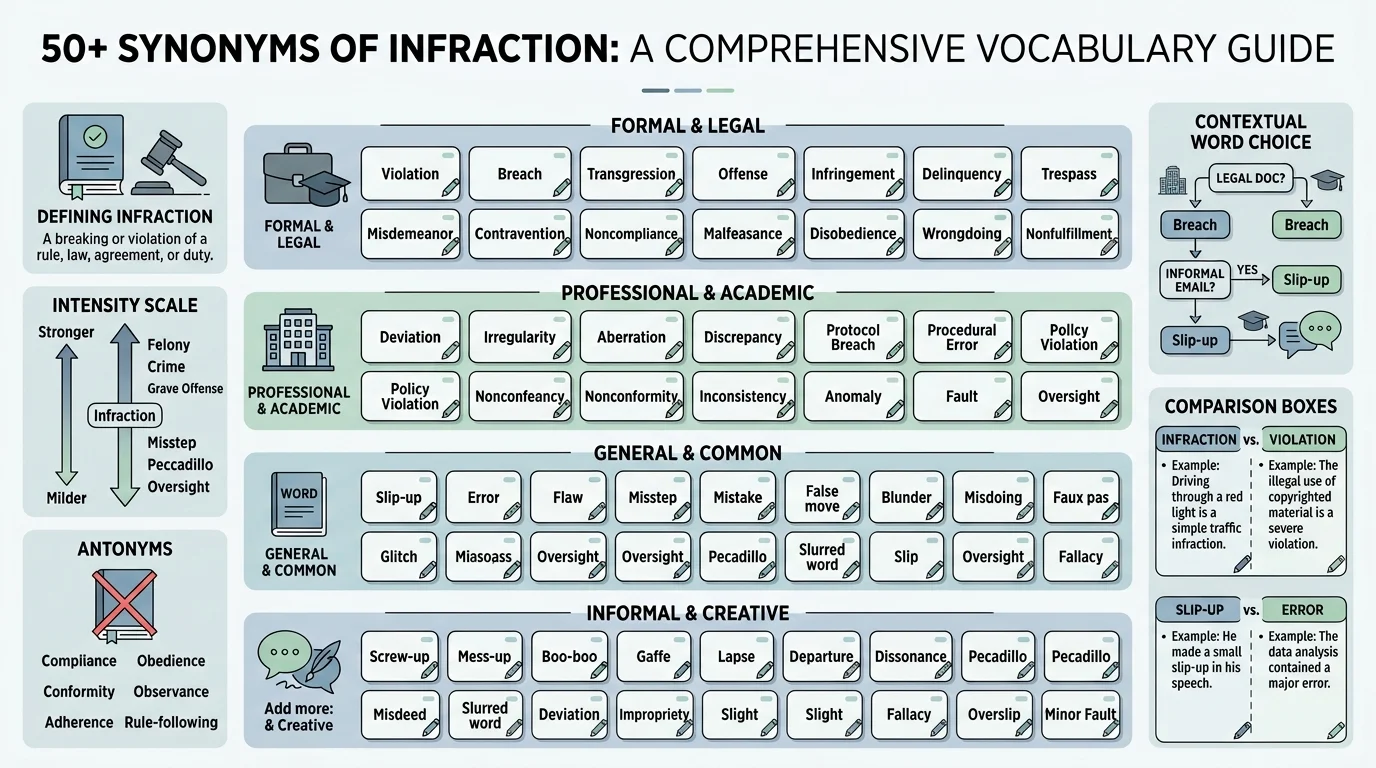
Have you ever found yourself writing an email, a school essay, or a workplace report and realized you have used the word “infraction” three times in two paragraphs? It happens to the best of us. Whether you are drafting a disciplinary memo, describing a traffic ticket, or explaining a policy violation in a business document, repeating the same word makes your writing feel dull and imprecise.
That is exactly why you need a strong command of the synonyms of infraction. Choosing the right alternative does more than just avoid repetition. It helps you communicate the exact severity, tone, and context of the rule-breaking you are describing. A parking ticket and a contract breach are both infractions, but they require very different vocabulary to describe them accurately. This guide will help you master every synonym so you never guess which word fits again.
What Are the Best Synonyms of “Infraction”?
An infraction is a minor violation or breach of a rule, law, or agreement. The best synonyms depend on your context. For formal writing, use “breach” or “contravention.” Casual conversation, try “violation” or “offense.” For academic or legal precision, choose “transgression” or “misdemeanor.” Workplace communication, “noncompliance” or “dereliction” work well.
Meaning, Tone, and Context
Simple Definition
An infraction is the act of breaking a rule, law, or agreement. It is typically a minor offense rather than a serious crime.
Part of Speech
Noun (countable and uncountable). Example: “He received a ticket for a traffic infraction.”
Overall Tone
Neutral to slightly negative. The word carries a formal, clinical tone that describes rule-breaking without strong emotional judgment.
Formality Level
Formal. “Infraction” is most commonly used in legal, academic, and professional settings. It is not a word you would typically use in casual texting or everyday conversation.
Common Uses
Native English speakers use “infraction” in several specific situations:
- Traffic violations (parking tickets, speeding)
- School rule violations (dress code, tardiness)
- Workplace policy breaches (safety rules, attendance)
- Legal contexts (civil infractions, minor offenses)
- Sports (rule violations during a game)
- Medical terminology (an incomplete fracture of a bone)
Word Forms
- Noun: infraction
- Verb: infract (rarely used; “to infract” means to break or violate)
- Adjective: infractional (very uncommon)
- Related noun: infractor (one who commits an infraction)
- Opposite form: compliance, obedience, adherence
When and How to Use “Infraction”
Choose “infraction” when you need a formal, precise word for breaking a rule or law, especially when the violation is minor rather than criminal. It works best in official documents, legal discussions, academic writing, and professional policy communications.
Here are seven realistic examples showing how to use “infraction” in different contexts.
Professional
“The employee received a written warning for a safety infraction on the factory floor.”
Academic
“The university’s honor code defines plagiarism as a serious academic infraction.”
Workplace
“Repeated infractions of the attendance policy may lead to termination.”
Personal
“He was embarrassed about the parking infraction he received downtown.”
Email
“Please review the attached policy regarding infractions of our data security protocols.”
Resume
Avoid using “infraction” on a resume. Instead, describe problem-solving or compliance skills positively.
Social Media
“Got a minor infraction on my record today. Time to be more careful.”
Best Synonyms of “Infraction”
No two synonyms are identical in every situation. The right word depends on the severity of the rule-breaking, the formality of your setting, and the emotional weight you want to convey. Here are the best recommendations for specific contexts.
Professional writing: “Noncompliance” works best because it sounds objective and policy-oriented.
Academic writing: “Transgression” conveys a thoughtful, precise violation of established norms or rules.
Business communication: “Breach” is clear, direct, and widely understood in contracts and agreements.
Casual conversation: “Violation” is the most natural and commonly used alternative in everyday speech.
Emotional writing: “Trespass” adds a personal or moral weight, suggesting an overstepping of boundaries.
Creative writing: “Infringement” works well when describing the violation of rights, privacy, or personal space.
Resume writing: Do not use synonyms of infraction on a resume. Focus on positive accomplishments instead.
Workplace communication: “Dereliction” is strong and formal, suitable for serious failures of duty.
Stronger meaning: “Misdemeanor” implies a legal offense more serious than a simple infraction.
Softer meaning: “Lapse” suggests a minor, temporary, or accidental failure rather than intentional wrongdoing.
When Not to Use “Infraction”
There are situations where “infraction” is not the best choice. Using it incorrectly can make your writing sound awkward, overly formal, or imprecise.
When the word sounds too general
If you are describing a specific type of rule-breaking, a more precise word is better. For example, “infraction” does not distinguish between a broken promise and a broken law.
When the word sounds too vague
In legal or contractual writing, “infraction” may not carry enough weight. Use “breach” or “violation” for clearer legal meaning.
When the word sounds too formal
In casual conversation or social media posts, “infraction” sounds stiff and unnatural. Use “violation” or “offense” instead.
Incorrect: “I committed an infraction by arriving five minutes late.”
Better: “I was late by five minutes. My bad.” (casual) or “I violated the attendance policy.” (professional)
When the word sounds too weak
If the wrongdoing is serious, “infraction” downplays its significance. Use “transgression,” “offense,” or “misdemeanor.”
Incorrect: “The embezzlement was a serious infraction.”
Better: “The embezzlement was a serious criminal offense.”
When the word sounds too strong
For minor, accidental mistakes, “infraction” can sound overly formal or punitive. Use “lapse” or “slip” instead.
Incorrect: “She made a small infraction by forgetting to save the document.”
Better: “She had a momentary lapse and forgot to save the document.”
Words Commonly Confused With “Infraction”
Several words are frequently confused with “infraction.” Understanding the differences will help you choose the right word every time.
Infraction vs. Violation
Difference: “Violation” is broader and can describe moral wrongs, while “infraction” is typically limited to rules and laws.
When to use it: Use “violation” when the act is morally or ethically wrong, not just a technical rule-breaking.
Example: “Running a red light is a traffic infraction. Lying to your friend is a violation of trust.”
Infraction vs. Offense
Difference: “Offense” is a more general term for any act that causes displeasure or breaks a rule. “Infraction” is more formal and often legal.
When to use it: Use “offense” in everyday language or when describing something that offends someone.
Example: “His rude comment was a personal offense, not a workplace infraction.”
Infraction vs. Breach
Difference: “Breach” often refers to breaking a contract, agreement, or promise, while “infraction” is more commonly used for rules and laws.
When to use it: Use “breach” in legal, contractual, or security contexts.
Example: “The company sued for breach of contract, not just a minor infraction.”
Infraction vs. Misdemeanor
Difference: A misdemeanor is a criminal offense more serious than an infraction but less serious than a felony.
When to use it: Use “misdemeanor” in legal contexts when discussing actual criminal charges.
Example: “Theft is a misdemeanor, while a parking ticket is only a civil infraction.”
Infraction vs. Transgression
Difference: “Transgression” often implies a moral or ethical boundary crossed, while “infraction” is more neutral and rule-based.
When to use it: Use “transgression” in moral, religious, or philosophical discussions.
Example: “His transgression against the community’s values was more serious than a simple rule infraction.”
Best Synonyms of “Infraction” by Context
| Context | Best Synonym | Why It Works | Example |
|---|---|---|---|
| Formal writing | Breach | Clear, precise, and legally recognized | “The contract breach was immediately reported.” |
| Academic writing | Transgression | Suggests thoughtful violation of norms | “The study examined moral transgressions in adolescents.” |
| Professional communication | Noncompliance | Objective and policy-focused | “Noncompliance with safety protocols will be reviewed.” |
| Business emails | Violation | Direct and widely understood | “Please address the policy violation in your department.” |
| Resume writing | (Avoid) | Negative words hurt your application | Focus on achievements, not rule-breaking. |
| Workplace communication | Dereliction | Strong and formal for duty failures | “The manager was cited for dereliction of duty.” |
| Casual conversation | Offense | Natural and conversational | “What was the offense? A speeding ticket?” |
| Everyday speaking | Violation | Most common and easily understood | “That’s a violation of the house rules.” |
| Creative writing | Infringement | Suggests overstepping rights or boundaries | “The infringement on her privacy was unforgivable.” |
| Storytelling | Trespass | Adds moral or personal weight | “His trespass against the family honor was unforgivable.” |
| Emotional writing | Sin (figurative) | Adds dramatic, moral weight | “It was a sin against everything she believed in.” |
| Strong emphasis | Misdemeanor | Legal weight without being a felony | “The offense was classified as a misdemeanor.” |
| Mild tone | Lapse | Suggests a minor, temporary failure | “It was just a lapse in judgment, nothing more.” |
| Social media captions | Violation | Short, punchy, and relatable | “No more parking violations for me.” |
| American English | Violation | Most commonly used in US legal contexts | “He received a citation for a traffic violation.” |
How to Choose the Best Synonym of “Infraction”
Choosing the right synonym does not have to be complicated. Ask yourself these five questions every time you need an alternative to “infraction.”
What is the severity of the rule-breaking?
For minor, accidental mistakes, choose “lapse” or “slip.” Moderate violations, use “violation” or “offense.” For serious legal or moral breaches, pick “transgression,” “misdemeanor,” or “breach.”
Who is your audience?
For legal professionals, academics, or executives, use formal words like “breach,” “contravention,” or “noncompliance.” For friends, family, or social media, use “violation” or “offense.”
What is your tone?
For a neutral, factual tone, choose “violation” or “infringement.” A stronger, more judgmental tone, pick “transgression” or “trespass.” For a softer, more forgiving tone, use “lapse.”
Are you describing a legal, moral, or practical violation?
Legal violations call for “breach” or “contravention.” Moral violations suit “transgression” or “trespass.” Practical rule-breaking works well with “violation” or “noncompliance.”
Does the word sound natural in your sentence?
Read your sentence aloud. If the synonym feels forced or overly formal, choose a simpler word. The best synonym is the one that communicates your meaning most clearly.
Real Life Examples of “Infraction”
Seeing “infraction” and its synonyms in real contexts makes the differences clear. Here are examples from various situations.
School
“The student received detention for a dress code infraction.”
College
“Plagiarism is considered a serious academic infraction at this university.”
Workplace
“His third infraction of the safety policy resulted in a mandatory training session.”
Business
“The vendor was fined for infractions of the delivery timeline.”
Email
“Please note that any infraction of our remote work policy will be documented.”
Resume
Do not use “infraction” on a resume. Instead: “Ensured 100% compliance with workplace safety regulations.”
Conversation
“I can’t believe I got an infraction for that. It was such a small mistake.”
Storytelling
“The knight’s infraction against the king’s decree led to his banishment.”
Blogging
“Five common traffic infractions that could cost you hundreds of dollars.”
Social Media
“First parking infraction of the year. Off to a great start.”
18 Best Synonyms of “Infraction”
| Synonym | Simple Meaning | Best Used For | Example Sentence |
|---|---|---|---|
| Breach | Breaking a law, agreement, or promise | Legal and contractual writing | “The contractor’s breach of the agreement led to legal action.” |
| Violation | Act of breaking a rule or law | General use, everyday situations | “Speeding is a common traffic violation.” |
| Transgression | Crossing a moral or ethical boundary | Academic, moral, or religious contexts | “His transgression against community standards was widely condemned.” |
| Offense | An act that breaks a rule or causes displeasure | Casual and general use | “Her only offense was being late to the meeting.” |
| Infringement | Overstepping rights, privacy, or boundaries | Legal, creative, and personal contexts | “The unauthorized use of the image was an infringement of copyright.” |
| Contravention | Acting against a law or regulation | Formal and legal writing | “The policy is in direct contravention of federal guidelines.” |
| Misdemeanor | A minor criminal offense | Legal contexts, more serious than infraction | “The charge was reduced to a misdemeanor.” |
| Noncompliance | Failure to follow rules or standards | Workplace and regulatory contexts | “Noncompliance with safety standards will result in fines.” |
| Dereliction | Neglect of duty or responsibility | Formal workplace and military contexts | “The officer was accused of dereliction of duty.” |
| Trespass | Entering or overstepping boundaries without permission | Legal, moral, and personal contexts | “The trespass onto private property was reported to police.” |
| Lapse | A temporary or accidental failure | Mild, forgiving contexts | “It was a lapse in concentration, not intentional wrongdoing.” |
| Delict | A legal wrong or offense | Legal and academic contexts | “The civil delict resulted in a damages claim.” |
| Disobedience | Refusal to follow rules or authority | General use, often with authority figures | “The student’s disobedience led to detention.” |
| Nonobservance | Failure to follow a rule or custom | Formal and religious contexts | “Nonobservance of the holiday traditions was noted.” |
| Error | A mistake or inaccuracy | Mild, neutral contexts | “The data entry error was quickly corrected.” |
| Sin (figurative) | A serious moral wrong | Emotional, dramatic, or religious writing | “In her eyes, it was a sin against the family.” |
| Breaking | The act of violating a rule | Casual and straightforward contexts | “Breaking the rules has consequences.” |
| Fault | A minor mistake or error | Mild, personal contexts | “It was my fault for not checking the guidelines.” |
Synonyms of “Infraction” by Usage
Professional vs Personal Synonyms
In professional settings, choose words that sound objective and policy-oriented: “noncompliance,” “breach,” “dereliction,” and “contravention.” These words convey seriousness without emotional exaggeration.
In personal or everyday conversations, simpler words work better: “violation,” “offense,” “lapse,” and “error.” These sound natural and relatable without sounding like a legal document.
Formal vs Conversational Synonyms
For reports, essays, business writing, and presentations, use formal synonyms: “breach,” “contravention,” “transgression,” “noncompliance,” and “dereliction.” These words establish authority and precision.
For emails, casual conversations, and texting, use conversational synonyms: “violation,” “offense,” “lapse,” and “breaking.” These words are clear and approachable.
Academic Synonyms
For research papers, essays, reports, and academic discussions, use precise, authoritative vocabulary: “transgression,” “contravention,” “infringement,” and “delict.” These words demonstrate scholarly precision and are commonly found in academic literature.
Professional and Business Synonyms
For resumes, interviews, meetings, presentations, performance reviews, client communication, and business emails, choose words that sound competent and serious: “noncompliance,” “breach,” “dereliction,” and “contravention.” These words fit professional environments because they are specific, formal, and widely understood in business contexts.
Creative and Literary Synonyms
For storytelling, fiction, poetry, descriptive writing, and speeches, choose expressive alternatives: “transgression,” “trespass,” “sin” (figurative), and “infringement.” These words add emotional depth, moral weight, and vivid imagery to your writing.
Slang or Modern Synonyms
There is no widely used slang synonym for “infraction.” The word itself is formal, and slang alternatives like “mess-up,” “slip-up,” or “blunder” are too informal and do not carry the same meaning. Avoid using slang when you mean “infraction.”
Strongest to Mildest Synonyms
Understanding the intensity of each synonym helps you choose the right emotional weight for your message.
Mild → Moderate → Strong → Very Strong
- Mild: error, lapse, fault
- Moderate: violation, offense, noncompliance, breaking
- Strong: breach, infringement, contravention, nonobservance
- Very Strong: transgression, misdemeanor, dereliction, trespass, delict, sin
The mildest synonyms suggest accidental or minor mistakes. The strongest synonyms imply deliberate wrongdoing, legal consequences, or moral failure.
Emotional vs Neutral Synonyms
Emotional Synonyms
These words express stronger feelings and moral judgment: “transgression,” “trespass,” “sin” (figurative), “dereliction.” Use them when you want to convey disapproval, moral outrage, or personal hurt.
Neutral Synonyms
These words simply communicate information without adding emotion: “violation,” “breach,” “noncompliance,” “contravention,” “infringement,” “offense.” Use them in professional, legal, or academic writing where objectivity is important.
Antonyms of “Infraction”
| Antonym | Meaning | Example Sentence |
|---|---|---|
| Compliance | Acting in accordance with rules | “The company ensured full compliance with all regulations.” |
| Obedience | Following rules or authority | “The soldiers showed complete obedience to their commanding officer.” |
| Conformity | Behaving according to accepted standards | “Conformity to safety standards is mandatory.” |
| Adherence | Steady attachment to rules or beliefs | “Adherence to the policy is expected of all employees.” |
| Observance | Following a rule, custom, or law | “Observance of traffic laws prevents accidents.” |
| Upholding | Maintaining or supporting a rule | “The judge was praised for upholding the law.” |
| Respect | Showing consideration for rules | “Respect for the rules keeps the community safe.” |
| Honor | Fulfilling obligations with integrity | “He honored his contract by delivering on time.” |
| Keeping | Fulfilling a promise or rule | “Keeping the agreement was his top priority.” |
| Fulfillment | Carrying out a duty or requirement | “The fulfillment of all requirements was verified.” |
| Maintenance | Preserving a standard or condition | “Maintenance of order is essential in the classroom.” |
| Preservation | Protecting rules or standards | “Preservation of academic integrity is our goal.” |
| Following | Acting in accordance with rules | “Following the guidelines prevents errors.” |
| Agreement | Harmony in action or opinion | “There was full agreement with the terms.” |
| Harmony | Peaceful coexistence without conflict | “The team worked in harmony with all policies.” |
Comparison: “Infraction” vs Similar Words
Infraction vs Violation
Main Difference: “Violation” is broader and can apply to moral wrongs, while “infraction” is limited to rules and laws.
Which Is Stronger? “Violation” can be stronger when describing moral or ethical breaches.
Which Is More Formal? “Infraction” is more formal and legalistic.
When to Use Each: Use “infraction” for minor rule-breaking. Use “violation” for any breach of rules, laws, or moral principles.
Examples:
- Infraction: “The parking infraction cost him fifty dollars.”
- Violation: “The violation of her privacy was unacceptable.”
Infraction vs Breach
Main Difference: “Breach” often refers to breaking a contract, agreement, or security, while “infraction” is more general.
Which Is Stronger? “Breach” is usually stronger in legal contexts.
Which Is More Formal? Both are formal, but “breach” is more common in legal documents.
When to Use Each: Use “breach” for contracts, promises, and security. Use “infraction” for general rule-breaking.
Examples:
- Infraction: “The student committed an infraction of the dress code.”
- Breach: “The data breach exposed millions of records.”
Infraction vs Offense
Main Difference: “Offense” is broader and can mean anything that causes displeasure, while “infraction” is specifically about rule-breaking.
Which Is Stronger? “Offense” can be stronger when it involves personal insult.
Which Is More Formal? “Infraction” is more formal.
When to Use Each: Use “offense” for personal or general situations. Use “infraction” for formal rule violations.
Examples:
- Infraction: “The referee called an infraction on the player.”
- Offense: “Her comment was a personal offense to everyone in the room.”
Infraction vs Misdemeanor
Main Difference: A misdemeanor is a criminal offense, while an infraction is typically a civil or non-criminal violation.
Which Is Stronger? “Misdemeanor” is much stronger and implies criminal liability.
Which Is More Formal? Both are legal terms, but “misdemeanor” is specifically criminal.
When to Use Each: Use “infraction” for minor, non-criminal violations. Use “misdemeanor” for actual criminal charges.
Examples:
- Infraction: “He received a ticket for a traffic infraction.”
- Misdemeanor: “The theft was charged as a misdemeanor.”
Infraction vs Transgression
Main Difference: “Transgression” often implies crossing a moral or ethical line, while “infraction” is neutral and rule-based.
Which Is Stronger? “Transgression” is usually stronger because it carries moral weight.
Which Is More Formal? Both are formal, but “transgression” is more common in academic and religious contexts.
When to Use Each: Use “transgression” for moral, ethical, or spiritual violations. Use “infraction” for formal rule-breaking.
Examples:
- Infraction: “The employee was warned for a safety infraction.”
- Transgression: “His transgression against the community’s values was unforgivable.”
Infraction vs Infringement
Main Difference: “Infringement” specifically refers to overstepping rights, privacy, or intellectual property, while “infraction” is broader.
Which Is Stronger? “Infringement” can be stronger in legal contexts involving rights.
Which Is More Formal? Both are formal legal terms.
When to Use Each: Use “infringement” for rights, privacy, and intellectual property. Use “infraction” for general rules and laws.
Examples:
- Infraction: “The student committed an infraction of the school’s attendance policy.”
- Infringement: “The unauthorized use of the song was an infringement of copyright.”
Common Phrases and Expressions with “Infraction”
| Phrase | Meaning | Example Sentence |
|---|---|---|
| Minor infraction | A small or insignificant rule violation | “The officer let him off with a warning for a minor infraction.” |
| Traffic infraction | A violation of driving rules | “Speeding is the most common traffic infraction.” |
| Civil infraction | A non-criminal violation of law | “Parking overtime is a civil infraction, not a crime.” |
| Serious infraction | A significant or major rule violation | “A serious infraction of safety rules can lead to termination.” |
| Infraction of the rules | Breaking established regulations | “Any infraction of the rules will be reported to the principal.” |
| Commit an infraction | To break a rule or law | “He committed an infraction by leaving the scene.” |
Common Mistakes to Avoid
1: Choosing a vague synonym instead of a precise one
Incorrect: “The error was a major infraction.”
Better: “The error was a serious breach of protocol.”
Why: “Breach” is more specific and formal than “error.”
2: Confusing “infraction” with “infarction”
These two words sound similar but have completely different meanings. “Infarction” is a medical term for tissue death due to lack of blood supply.
Incorrect: “He was hospitalized for a heart infraction.”
Correct: “He was hospitalized for a heart infarction.”
3: Using an informal synonym in formal writing
Incorrect: “The employee’s mess-up was noted in his file.”
Better: “The employee’s infraction was noted in his file.”
Why: “Mess-up” is too casual for official documentation.
4: Selecting an overly dramatic synonym
Incorrect: “She committed a sin by arriving five minutes late.”
Better: “She committed a minor infraction by arriving five minutes late.”
Why: “Sin” is too strong for a minor, non-moral violation.
5: Repeating the same word too often
Incorrect: “The infraction was minor. The infraction was noted. The infraction led to a warning.”
Better: “The infraction was minor. The violation was noted. The breach led to a warning.”
Why: Varying your vocabulary improves readability.
6: Choosing a synonym with the wrong emotional tone
Incorrect: “His transgression against the parking rules was minor.”
Better: “His violation of the parking rules was minor.”
Why: “Transgression” implies moral wrongdoing, which is too strong for a parking violation.
7: Using slang in academic or professional writing
Incorrect: “The study examined students’ slip-ups in the classroom.”
Better: “The study examined students’ infractions in the classroom.”
Why: “Slip-up” is too informal for academic writing.
Frequently Asked Questions
1. What are the best synonyms of “infraction”?
The best synonyms depend on your context. Formal writing, use “breach” or “contravention.” For casual conversation, use “violation” or “offense.” For academic contexts, choose “transgression.”
2. What are the best formal synonyms of “infraction”?
The best formal synonyms are “breach,” “contravention,” “noncompliance,” and “dereliction.” These words are precise, objective, and suitable for legal, academic, and professional writing.
3. What are common informal synonyms of “infraction”?
Common informal synonyms include “violation,” “offense,” “lapse,” and “error.” These words are widely understood and work well in everyday conversation and casual writing.
4. What is another word for “infraction” in professional writing?
In professional writing, use “noncompliance,” “breach,” or “contravention.” These words sound objective and policy-focused, making them ideal for workplace and business communication.
5. What is the difference between “infraction” and “violation”?
“Infraction” is typically limited to rules and laws and is often minor. “Violation” is broader and can describe moral wrongs as well. “Violation” can also carry a stronger sense of wrongdoing.
6. What is the opposite of “infraction”?
The opposites of “infraction” include compliance, obedience, conformity, adherence, observance, and upholding. These words describe following rules rather than breaking them.
Conclusion
An infraction is a minor violation or breach of a rule, law, or agreement. The word is formal and neutral, making it suitable for legal, academic, and professional contexts. However, no single synonym works perfectly in every situation. Formal writing, choose “breach” or “contravention.” Casual conversation, pick “violation” or “offense.” For academic precision, use “transgression.” For workplace communication, select “noncompliance” or “dereliction.”
The best synonym is the one that matches your audience, tone, and purpose. When you are unsure, read your sentence aloud and ask whether the word sounds natural and clear. The synonyms of infraction give you a rich vocabulary to describe rule-breaking with precision and confidence. Choose wisely, and your writing will always hit the mark.