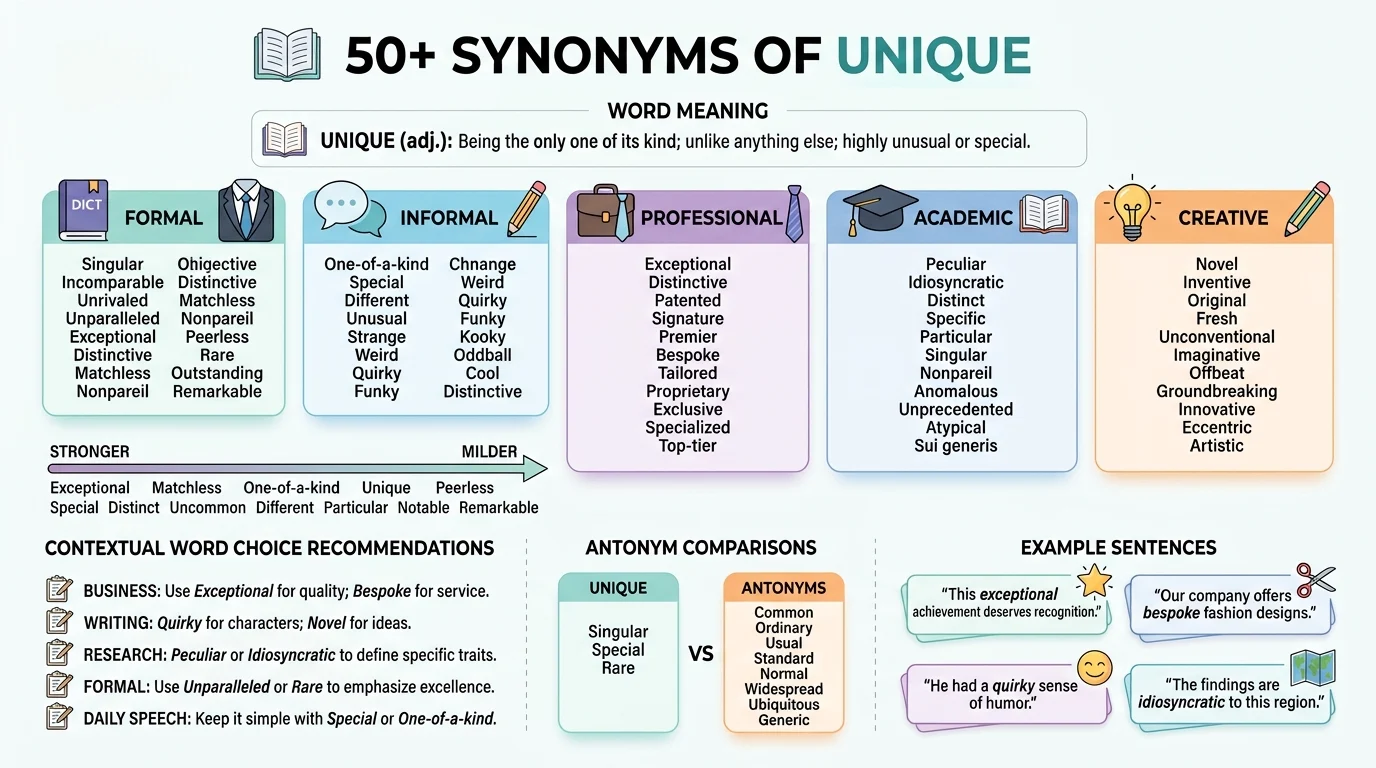
Have you ever found yourself writing an email, an essay, or a social media caption and realized you have used the word “unique” three times in two paragraphs? You are not alone. Many writers, students, and professionals rely on this single word when they want to describe something special, different, or one of a kind. But English offers a rich collection of alternatives that can make your writing more precise and engaging. Understanding the synonyms of unique will help you choose the exact word for every situation, whether you are drafting a business proposal, writing a college essay, or simply trying to sound more natural in conversation. The right word can transform a vague statement into a clear, powerful message.
What Are the Best Synonyms of “Unique”?
“Unique” means being the only one of its kind or having no equal. It describes something unlike anything else. For formal writing, choose “singular” or “unparalleled.” For casual conversation, try “one of a kind” or “special.” Academic writing benefits from “distinctive” or “exceptional,” while professional communication calls for “exclusive” or “inimitable.”
Meaning, Tone, and Context
Simple Definition
Unique means being the only one of its kind. It describes something that has no equal, no match, and nothing else like it anywhere. A snowflake is unique because no two snowflakes are exactly alike. A fingerprint is unique to each person. A historical event is unique because it happens only once with a specific combination of factors.
Part of Speech
Unique is primarily an adjective. It modifies nouns to describe their one of a kind nature. Less commonly, it can function as a noun, as in “the unique among many,” but adjectival use is far more frequent.
Overall Tone
Unique is a neutral word, but its tone shifts depending on context. When describing a person’s talent, it carries a positive, admiring tone. When describing a problem or a situation, it can feel neutral or even slightly negative. The emotional weight comes from what you are describing, not from the word itself.
Formality Level
Unique sits comfortably in the neutral to semi formal range. You can use it in academic writing, professional emails, and everyday conversation. However, the word has a traditional usage rule that makes some style guides cautious: traditionally, “unique” means absolute, so phrases like “very unique” were once considered incorrect. Modern usage accepts these modifiers when “unique” means “unusual” or “rare,” but formal writing often avoids them.
Common Uses
Native English speakers use “unique” in several common situations:
- Describing people: “She has a unique perspective on the problem.”
- Describing objects or products: “This watch has a unique design.”
- Describing opportunities: “This is a unique chance to invest.”
- Describing characteristics: “The region has a unique climate.”
- Describing identifiers: “Each user receives a unique ID number.”
Word Forms
| Form | Word | Example |
|---|---|---|
| Adjective | unique | “Her style is unique.” |
| Adverb | uniquely | “He is uniquely qualified for this role.” |
| Noun | uniqueness | “The uniqueness of the design attracted attention.” |
When and How to Use “Unique”
Choose “unique” when you want to emphasize that something has no equal or when you need to describe something as the only one of its kind. The word works best when you are stating a fact about singularity rather than expressing an opinion about quality.
Professional: “Our company offers a unique solution to supply chain inefficiencies.”
Academic: “The study examines a unique set of environmental factors affecting coral reef recovery.”
Workplace: “She brings a unique combination of technical and interpersonal skills to the team.”
Personal: “My grandmother had a unique way of telling stories that made everyone feel included.”
Email: “I would like to schedule a meeting to discuss the unique challenges this project presents.”
Resume: “Developed a unique inventory tracking system that reduced errors by 40 percent.”
Social Media: “This boutique has the most unique vintage pieces I have ever seen.”
Best Synonyms of “Unique”
No synonym is identical to “unique” in every situation. Each alternative carries its own shade of meaning, tone, and level of formality. The best synonym depends entirely on what you are trying to say and who you are saying it to.
Professional writing: “Distinctive” works best because it emphasizes clear difference without claiming absolute singularity. It sounds polished and precise.
Academic writing: “Singular” is ideal for research and essays because it carries intellectual weight and suggests something worthy of individual attention.
Business communication: “Exclusive” fits well when you want to convey rarity and limited availability, which is often relevant in marketing and sales.
Casual conversation: “One of a kind” sounds natural and friendly without being overly formal.
Emotional writing: “Incomparable” expresses deep admiration and suggests something cannot be compared to anything else.
Creative writing: “Unparalleled” adds dramatic emphasis and works well in descriptive passages.
Resume writing: “Exceptional” highlights outstanding quality while remaining professional and modest.
Workplace communication: “Original” is a safe, neutral choice that suggests fresh thinking without exaggeration.
Stronger meaning: “Peerless” and “matchless” convey the strongest sense of having no equal.
Softer meaning: “Uncommon” or “unusual” suggest difference without claiming absolute uniqueness.
When Not to Use “Unique”
When the Word Sounds Too General
Saying something is “unique” without explaining why can feel vague and unhelpful. Readers may wonder what makes it unique.
Weak: “We offer a unique service.”
Better: “We offer a distinctive service that combines same day delivery with personalized packaging.”
The revised sentence gives the reader specific information about what makes the service different.
When the Word Sounds Too Vague
“Unique” has become so overused that it sometimes loses its impact. In marketing and advertising, “unique” appears so frequently that readers may skim past it without registering its meaning.
Weak: “Our unique product will change your life.”
Better: “Our unparalleled product combines three technologies never before used together.”
Specificity creates credibility. Vague claims create skepticism.
When the Word Is Too Formal or Too Informal
“Unique” works in most settings, but sometimes a more formal or more casual word fits better.
Too informal for an academic paper: “The results were pretty unique.”
Better: “The results were singular in their consistency.”
Too formal for a text message: “This restaurant is unique.”
Better: “This restaurant is one of a kind.”
When the Word Sounds Too Weak
Sometimes you need a stronger word to convey genuine amazement or exceptional quality.
Weak: “She has a unique voice.”
Better: “She has an incomparable voice that no other singer can match.”
When the Word Sounds Too Strong
Using “unique” to describe something that is merely interesting or slightly different can feel like exaggeration.
Too strong: “This is a unique coffee shop.”
Better: “This is an unusual coffee shop with a great atmosphere.”
Save “unique” for things that truly have no equal.
When the Word Feels Outdated
“Unique” is not outdated, but some of its traditional synonyms like “sui generis” can feel overly academic or archaic in everyday writing. Use them only when the context calls for elevated language.
Words Commonly Confused With “Unique”
Unique vs Special
Difference: “Unique” means one of a kind with no equal. “Special” means different or important but not necessarily one of a kind. A person can be special without being unique. Many people are special, but only one person is you.
When to Use It: Use “special” when you want to express value or importance without claiming singularity. Use “unique” when you mean literally the only one.
Example: “This necklace is special to me because my grandmother gave it to me.” “This necklace is unique because no other one like it exists.”
Unique vs Distinct
Difference: “Unique” emphasizes being the only one. “Distinct” emphasizes being clearly different and easily recognizable. Distinct things stand out from a group. Unique things stand alone.
When to Use It: Use “distinct” when something is noticeably different from others. Use “unique” when nothing else is comparable.
Example: “The brand has a distinct visual identity.” “The brand has a unique position in the market.”
Unique vs Different
Difference: “Different” simply means not the same. It does not imply rarity, value, or singularity. “Unique” goes much further and suggests something entirely unlike anything else.
When to Use It: Use “different” for simple comparisons. Use “unique” for extraordinary distinction.
Example: “My opinion is different from yours.” “My perspective is unique because of my background.”
Unique vs Rare
Difference: “Rare” means scarce or infrequent. Something can be rare but not unique. There may be a few of them. “Unique” means only one.
When to Use It: Use “rare” when something is hard to find but not impossible to find another. Use “unique” when only one exists.
Example: “This is a rare coin.” “This is a unique coin, the only one of its kind ever minted.”
Unique vs Original
Difference: “Original” emphasizes being the first of its kind or coming from a creative source. “Unique” emphasizes being the only one. Something can be original but copied later, making it no longer unique.
When to Use It: Use “original” when highlighting creativity or being the source. Use “unique” when highlighting singularity.
Example: “That is an original idea.” “That is a unique approach that no one else has tried.”
Unique vs Uncommon
Difference: “Uncommon” means not frequently encountered. Something uncommon might still have many examples. Unique” means only one example exists.
When to Use It: Use “uncommon” for things that are unusual but not impossible to find. Use “unique” for the only one.
Example: “It is uncommon to see snow in this region.” “This snowflake has a unique crystalline structure.”
Best Synonyms of “Unique” by Context
| Context | Best Synonym | Why It Works | Example |
|---|---|---|---|
| Formal writing | Singular | Conveys intellectual precision and scholarly tone | “The experiment produced singular results.” |
| Academic writing | Distinctive | Emphasizes identifiable difference without overclaiming | “The study identifies distinctive patterns in the data.” |
| Professional communication | Exclusive | Suggests limited access and high value | “We offer exclusive consulting services.” |
| Business emails | Original | Sounds fresh and creative without exaggeration | “I have an original proposal for the client.” |
| Resume writing | Exceptional | Highlights outstanding achievement professionally | “Delivered exceptional results in three consecutive quarters.” |
| Workplace communication | Individual | Focuses on personal or unique contribution | “Each team member brings an individual skill set.” |
| Casual conversation | One of a kind | Friendly and natural, easy to understand | “This pizza place is one of a kind.” |
| Everyday speaking | Unusual | Simple and clear without sounding forced | “That is an unusual way to solve the problem.” |
| Creative writing | Unparalleled | Adds dramatic emphasis and literary quality | “The view from the summit was unparalleled.” |
| Storytelling | Inimitable | Suggests something that cannot be copied or imitated | “He had an inimitable style of storytelling.” |
| Emotional writing | Incomparable | Expresses deep admiration and emotional weight | “Their love was incomparable.” |
| Strong emphasis | Peerless | Conveys the strongest sense of having no equal | “Her skill is peerless in the industry.” |
| Mild tone | Uncommon | Gentle way to suggest difference without drama | “It is uncommon to find such kindness.” |
| Social media captions | Rare | Short, punchy, and visually evocative | “A rare moment captured on film.” |
How to Choose the Best Synonym of “Unique”
Choosing the right synonym starts with understanding what you actually mean. Ask yourself these questions before you write.
What is your core meaning? Are you saying something is the only one of its kind? Or are you saying it is simply different or unusual? If you mean “only one,” choose words like “singular,” “sole,” or “one of a kind.” If you mean “different,” choose “distinctive,” “uncommon,” or “unusual.”
What is your tone? Formal writing calls for “singular” or “distinctive.” Casual conversation welcomes “one of a kind” or “special.” Professional settings benefit from “exceptional” or “exclusive.”
Who is your audience? Academics expect precise, measured language. Business readers appreciate clarity and confidence. Friends and family respond to warmth and simplicity. Match your word to your reader.
How much emotional weight do you need? “Peerless” and “incomparable” carry strong emotion. “Uncommon” and “unusual” carry little emotion. Choose the intensity that fits your message.
What is your writing purpose? Resumes need confident, achievement focused language. Emails need clarity and professionalism. Social media needs engagement and brevity. Let your purpose guide your choice.
Does the word sound natural? Read your sentence aloud. If the synonym feels forced or awkward, try another one. The best word is the one that sounds like you.
Real Life Examples of “Unique”
School: “My science project was unique because it used recycled materials in a new way.” → “My science project was distinctive because it combined recycled materials with solar power.”
College: “The professor has a unique teaching style.” → “The professor has an unconventional teaching style that encourages active participation.”
Workplace: “We need a unique approach to this problem.” → “We need an original approach to this problem, one that no competitor has tried.”
Business: “Our company has a unique value proposition.” → “Our company has an exclusive value proposition that addresses a gap in the market.”
Email: “Thank you for the unique opportunity.” → “Thank you for the exceptional opportunity to present our work.”
Resume: “Managed a unique project.” → “Managed an unparalleled project that became the model for future initiatives.”
Conversation: “That is a unique jacket.” → “That is a one of a kind jacket. Where did you find it?”
Storytelling: “The castle was unique.” → “The castle was incomparable, with towers that seemed to touch the clouds.”
Blogging: “This restaurant offers a unique dining experience.” → “This restaurant offers an inimitable dining experience, from the handmade pasta to the rooftop garden.”
Social Media: “Unique sunset tonight.” → “Rare sunset colors tonight. Nature never repeats itself.”
18 Best Synonyms of “Unique”
| Synonym | Simple Meaning | Best Used For | Example Sentence |
|---|---|---|---|
| Singular | Remarkably unusual or one of a kind | Academic and formal writing | “The researcher made a singular discovery that changed the field.” |
| Distinctive | Clearly different and easy to recognize | Professional and descriptive writing | “Her distinctive voice made her stand out from other singers.” |
| Exceptional | Unusually good or outstanding | Resumes and performance reviews | “He delivered exceptional results under tight deadlines.” |
| Unparalleled | Having no equal or match | Creative and dramatic writing | “The team achieved an unparalleled level of success.” |
| Inimitable | Impossible to imitate or copy | Personal and character descriptions | “She has an inimitable charm that wins everyone over.” |
| Incomparable | So good that nothing can be compared | Emotional and admiring writing | “The beauty of the landscape was incomparable.” |
| Exclusive | Limited to a particular person or group | Business and marketing writing | “Members receive exclusive access to new products.” |
| One of a kind | The only one like it | Casual conversation and everyday writing | “This vintage car is one of a kind.” |
| Rare | Not found frequently; uncommon | Social media and casual descriptions | “It is rare to find such genuine kindness.” |
| Uncommon | Not happening or seen often | Neutral and factual writing | “It is uncommon for this species to appear in urban areas.” |
| Unconventional | Not following traditional ways | Personal and lifestyle writing | “She has an unconventional approach to problem solving.” |
| Original | New and different from what came before | Creative and professional writing | “The designer presented an original collection.” |
| Individual | Belonging to or characteristic of one person | Workplace and personal writing | “Each employee has an individual contribution to make.” |
| Peculiar | Strange or unusual in a noticeable way | Descriptive and narrative writing | “He had a peculiar habit of humming while he worked.” |
| Quirky | Unusual in an interesting or charming way | Creative and casual writing | “The cafe has a quirky atmosphere that customers love.” |
| Matchless | Having no equal | Formal and emphatic writing | “Her dedication to the cause was matchless.” |
| Peerless | Better than all others | Strong and confident writing | “His technical skills are peerless in the industry.” |
| Sole | Being the only one | Legal and formal writing | “She is the sole owner of the company.” |
Synonyms of “Unique” by Usage
Professional vs Personal Synonyms
Professional settings reward precision and restraint. “Distinctive,” “exceptional,” and “exclusive” sound polished and credible. Personal settings reward warmth and relatability. “One of a kind,” “special,” and “unusual” sound friendly and natural.
In a job interview, say “I bring a distinctive combination of skills.” To a friend, say “This restaurant is one of a kind.” The same idea, different words, different impact.
Formal vs Conversational Synonyms
Formal writing favors “singular,” “unparalleled,” and “inimitable.” These words appear in research papers, business reports, and official documents. Conversational writing favors “one of a kind,” “rare,” and “uncommon.” These words appear in text messages, social media, and everyday speech.
A formal report might state: “The study produced singular findings.” A conversation might say: “That is a rare find.”
Academic Synonyms
Academic writing demands precision and authority. “Singular” suggests something worthy of individual scholarly attention. “Distinctive” identifies clear, measurable differences. “Exceptional” notes departure from the norm without overstatement. “Unconventional” describes approaches that challenge established methods. These words signal careful thinking and measured judgment.
Professional and Business Synonyms
Business communication values clarity and confidence. “Exclusive” works well for marketing and sales. “Exceptional” suits performance reviews and resumes. “Original” fits proposals and presentations. “Distinctive” describes brand identity and market position. These words project professionalism without exaggeration.
Creative and Literary Synonyms
Writers and storytellers need words that paint pictures. “Incomparable” suggests beauty beyond measure. “Unparalleled” conveys scale and drama. “Inimitable” captures personality and style. “Matchless” and “peerless” add classic literary weight. These words create emotion and imagery that engage readers.
Slang or Modern Synonyms
English does not have widely recognized slang equivalents for “unique.” However, phrases like “one of a kind,” “next level,” and “in a league of its own” appear in casual speech. Use these in conversation and social media. Avoid them in formal or professional writing.
Strongest to Mildest Synonyms
Mild: Uncommon, unusual, different
These words simply suggest something is not typical. They carry little emotional weight.
Moderate: Distinctive, original, individual
These words emphasize recognizable difference and personal character. They feel confident without being dramatic.
Strong: Exceptional, rare, exclusive
These words suggest high value and limited availability. They carry noticeable emphasis.
Very Strong: Unparalleled, incomparable, inimitable, peerless, matchless, singular
These words declare that nothing else can compare. They carry the fullest emotional and rhetorical force.
Emotional vs Neutral Synonyms
Emotional Synonyms
“Incomparable,” “inimitable,” and “peerless” carry strong positive emotion. They express admiration, wonder, and deep appreciation. Use them when you want your reader to feel something. These words appear in love letters, speeches, and passionate writing.
Neutral Synonyms
“Distinctive,” “uncommon,” and “individual” simply communicate information. They describe difference without adding emotional weight. Use them when you want to state facts clearly. These words appear in reports, instructions, and objective descriptions.
Antonyms of “Unique”
| Antonym | Meaning | Example Sentence |
|---|---|---|
| Common | Found frequently; ordinary | “This design is common in modern architecture.” |
| Ordinary | Not special or different | “The product was ordinary and failed to attract buyers.” |
| Typical | Showing the usual characteristics | “Her response was typical of someone in her position.” |
| Normal | Conforming to a standard | “The results fell within the normal range.” |
| Average | Not outstanding; medium | “His performance was average, neither good nor bad.” |
| Standard | Regularly used or produced | “The company offers standard warranties on all products.” |
| Usual | Happening most often | “The usual procedure takes about three weeks.” |
| Conventional | Following traditional ways | “They chose a conventional marketing strategy.” |
| Routine | Regular and unvarying | “The inspection was a routine part of the process.” |
| Familiar | Well known from previous experience | “The situation felt familiar to everyone on the team.” |
| Regular | Occurring at fixed intervals | “She is a regular customer at the cafe.” |
| Generic | Not specific; general | “The packaging used generic designs.” |
| Unremarkable | Not worthy of attention | “The building was unremarkable and easily forgotten.” |
| Prevalent | Widespread in a particular area | “This type of architecture is prevalent in the region.” |
| Widespread | Found over a large area | “The practice became widespread in the 1990s.” |
Comparison: “Unique” vs Similar Words
Unique vs Special
Main Difference: “Unique” means one of a kind. “Special” means valued or important but not necessarily singular.
Which Is Stronger? “Unique” is stronger because it claims absolute singularity.
Which Is More Formal? Both are neutral, but “unique” appears more frequently in formal writing.
When to Use Each: Use “special” when expressing personal value. Use “unique” when stating factual singularity.
Examples:
- Unique: “Each fingerprint is unique to the individual.”
- Special: “This necklace is special because it belonged to my mother.”
Unique vs Distinct
Main Difference: “Unique” emphasizes being the only one. “Distinct” emphasizes being clearly different and noticeable.
Which Is Stronger? “Unique” is stronger because it goes beyond difference to singularity.
Which Is More Formal? Both are formal. “Distinct” is slightly more common in technical writing.
When to Use Each: Use “distinct” when something stands out from a group. Use “unique” when something stands alone.
Examples:
- Unique: “This species is unique to this island.”
- Distinct: “The species has distinct markings that make it identifiable.”
Unique vs Different
Main Difference: “Different” simply means not the same. “Unique” means unlike anything else.
Which Is Stronger? “Unique” is much stronger.
Which Is More Formal? “Different” is neutral. “Unique” is slightly more formal.
When to Use Each: Use “different” for simple comparisons. Use “unique” for extraordinary distinction.
Examples:
- Unique: “Her approach to teaching is unique.”
- Different: “Her approach is different from what I expected.”
Unique vs Rare
Main Difference: “Rare” means scarce or infrequent. “Unique” means only one exists.
Which Is Stronger? “Unique” is stronger because it rules out any other examples.
Which Is More Formal? Both are neutral.
When to Use Each: Use “rare” when something is hard to find. Use “unique” when only one exists.
Examples:
- Unique: “This coin is unique; no others like it exist.”
- Rare: “This coin is rare; only a few were ever made.”
Unique vs Original
Main Difference: “Original” means first or coming from a creative source. “Unique” means only one.
Which Is Stronger? “Unique” is stronger because originality does not guarantee singularity.
Which Is More Formal? Both are neutral.
When to Use Each: Use “original” when highlighting creativity. Use “unique” when highlighting singularity.
Examples:
- Unique: “This is a unique solution to the problem.”
- Original: “This is an original idea that no one has tried.”
Unique vs Uncommon
Main Difference: “Uncommon” means not frequent. “Unique” means only one.
Which Is Stronger? “Unique” is stronger.
Which Is More Formal? Both are neutral.
When to Use Each: Use “uncommon” for things that are unusual. Use “unique” for the only one.
Examples:
- Unique: “This is a unique species found nowhere else.”
- Uncommon: “This species is uncommon in this region.”
Common Phrases and Expressions with “Unique”
“Unique opportunity”
Meaning: A chance that is rare and unlikely to come again
Example: “This is a unique opportunity to invest in a growing market.”
“Unique selling point” (USP)
Meaning: A feature that makes a product or service different from competitors
Example: “The company’s unique selling point is its same day delivery guarantee.”
Phrase: “Unique identifier”
Meaning: A code or number that distinguishes one person or thing from all others
Example: “Each employee receives a unique identifier for the security system.”
Phrase: “Unique perspective”
Meaning: A viewpoint that is different from most others
Example: “Her unique perspective on the issue came from years of international experience.”
“Unique to”
Meaning: Belonging or restricted to a particular place, group, or thing
Example: “This plant is unique to the Amazon rainforest.”
Phrase: “Truly unique”
Meaning: Genuinely one of a kind (often used for emphasis)
Example: “The artist’s work is truly unique in the contemporary art world.”
Common Mistakes to Avoid
Mistake: Using “very unique” in formal writing
While modern usage accepts “very unique” when “unique” means “unusual,” formal writing often avoids it.
Incorrect: “The candidate has a very unique skill set.”
Better: “The candidate has a distinctive skill set.”
Mistake: Confusing “unique” with “special”
“Special” does not mean one of a kind. Using them interchangeably can create confusion.
Incorrect: “This is a unique necklace” (when you mean it is valuable to you).
Better: “This necklace is special to me because my grandmother gave it to me.”
Mistake: Overusing “unique” in marketing
When every product is “unique,” the word loses its impact.
Incorrect: “Our unique product, unique service, and unique approach set us apart.”
Better: “Our innovative product, personalized service, and fresh approach set us apart.”
Mistake: Using “unique” when “uncommon” fits better
Not everything different is unique. Reserve “unique” for true singularity.
Incorrect: “It is unique to see snow in July.”
Better: “It is uncommon to see snow in July.”
Mistake: Using slang synonyms in professional writing
Phrases like “one of a kind” sound casual and may not suit formal documents.
Incorrect: “We are looking for a one of a kind candidate.”
Better: “We are looking for an exceptional candidate.”
Mistake: Choosing a synonym with the wrong emotional tone
“Peculiar” can sound negative. “Quirky” sounds charming. Choose based on your intended impression.
Incorrect: “She has a peculiar sense of style” (may sound critical).
Better: “She has a quirky sense of style” (sounds charming and interesting).
Frequently Asked Questions
1. What are the best synonyms of “unique”?
The best synonyms depend on your context. Formal writing, use “singular” or “unparalleled.” For casual conversation, use “one of a kind” or “special.” For professional writing, use “exceptional” or “distinctive.” Choose the word that fits your tone and audience.
2. What are the best formal synonyms of “unique”?
Formal synonyms include “singular,” “unparalleled,” “inimitable,” “matchless,” and “peerless.” These words appear in academic papers, business reports, and official documents. They convey precision and authority without sounding casual or exaggerated.
3. What are common informal synonyms of “unique”?
Common informal synonyms include “one of a kind,” “special,” “rare,” and “unusual.” These words work well in conversation, text messages, and social media. They sound natural and friendly without requiring formal language.
4. What is another word for “unique” in professional writing?
In professional writing, try “exceptional,” “distinctive,” “exclusive,” or “original.” These words sound polished and credible. They help you stand out without overclaiming. Choose based on whether you want to emphasize quality, difference, rarity, or creativity.
5. What is the difference between “unique” and “special”?
“Unique” means one of a kind with no equal. “Special” means valued or important but not necessarily singular. Many things can be special, but only one thing can be unique. Use “special” for personal value and “unique” for factual singularity.
6. What is the opposite of “unique”?
The opposites of “unique” include “common,” “ordinary,” “typical,” “normal,” and “average.” These words describe things that are not special or different. They suggest something that conforms to expectations rather than standing out.
Conclusion
“Unique” is a powerful word that means being the only one of its kind. It describes things that have no equal and nothing else like them. But English offers many alternatives that can make your writing more precise and engaging. “Singular” and “unparalleled” work well in formal contexts. “One of a kind” and “special” fit casual conversation. “Exceptional” and “distinctive” suit professional writing. “Incomparable” and “inimitable” add emotional weight to creative work. No single synonym works perfectly in every situation. The best word depends on your meaning, your tone, your audience, and your purpose. The next time you reach for “unique,” pause and ask yourself what you really mean. Then choose the word that says it most clearly. Your writing will become stronger, clearer, and more natural. Understanding the synonyms of unique is one of the simplest ways to improve your vocabulary and communicate with greater confidence.