Have you ever caught yourself writing “another” over and over in an email, essay, or social media caption?
You know the feeling. You reread your sentence and realize you have used the same word three times in two paragraphs. It sounds repetitive, dull, and unpolished.
This happens to students writing essays, professionals drafting reports, and job seekers refining resumes. Even experienced writers struggle with word choice when a simple word like “another” becomes their default crutch.
The good news is that English offers many precise alternatives. Each synonym carries a slightly different shade of meaning, tone, and formality.
This guide will help you understand when to use “another,” when to choose a stronger synonym, and how to match your word choice to your audience and purpose.
By the end, you will have a clear strategy for replacing “another” with more powerful, specific, and appropriate words in any situation.
What Does “Another” Mean?
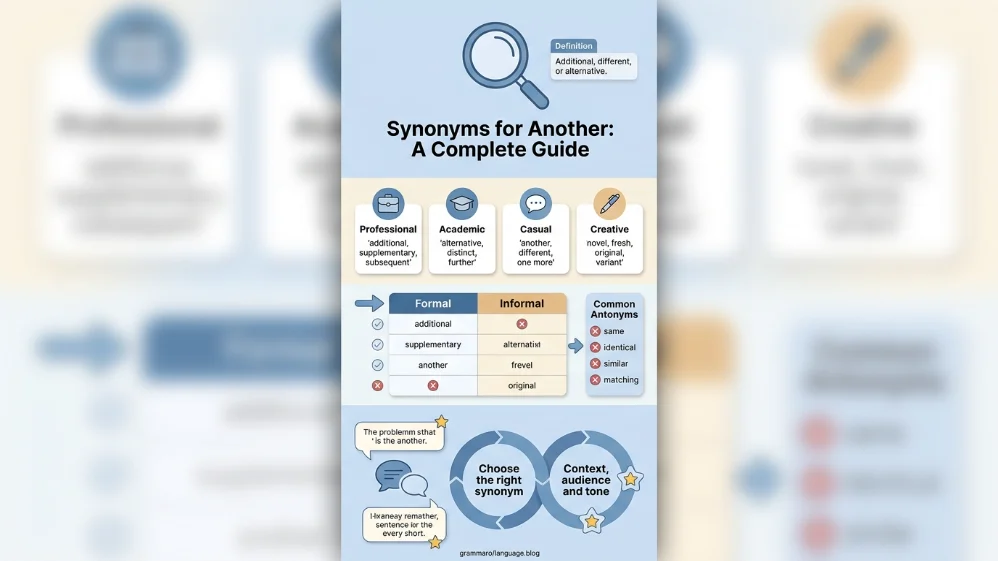
Another” refers to an additional or different person, thing, or example of the same kind. The best synonyms depend on context. Use “additional” for formal writing, “other” for general use, “alternative” for choices, and “extra” for casual conversation. For creative writing, try “further” or “new.”
Meaning, Tone and Context
Simple Definition
“Another” means one more of the same kind or a different one from what has already been mentioned. It indicates addition, distinction, or choice.
Part of Speech
“Another” functions as a determiner and a pronoun. It modifies nouns or stands alone to replace a noun phrase.
Tone
The tone is neutral. It does not carry strong positive or negative emotional weight. This makes it flexible but also somewhat bland.
Formality Level
“Another” fits most formality levels. It works in casual conversation, professional emails, academic papers, and creative writing. Its neutrality is both its strength and its weakness.
Common Use Cases
People use “another” when talking about additional items, different options, second chances, future attempts, and comparing two things. It appears frequently in everyday speech and formal documents alike.
Important Word Forms
The word “another” does not have common variants. Related forms include the prefix “other” and the phrase “one another.” The opposite concepts include “same,” “only,” and “first.”
When and How to Use “Another”
Use “another” when you need to indicate an additional item of the same type or a different item from what has already been mentioned. It works best when the context makes the meaning clear.
Here are realistic examples labeled by context:
Professional Email
“Our team will schedule another meeting to review the revised proposal.”
Academic Writing
“The researcher conducted another experiment to verify the initial findings.”
Personal Conversation
“I would love another cup of coffee before we leave.”
Creative Writing
“She opened another door and found herself in a room full of mirrors.”
Social Media Caption
“Another sunset, another reason to be grateful.”
Resume or Job Application
“I successfully managed another large scale project under a tight deadline.”
Casual Text Message
“Can we try another restaurant tonight? I am not in the mood for pizza.”
Another Word for “Another”
The best single replacement depends entirely on your context and purpose. Here are the top alternatives for specific situations.
Professional Writing
Choose “additional” for reports, business documents, and formal correspondence.
Academic Writing
Use “further” to indicate more evidence, research, or analysis in scholarly work.
Casual Conversation
Use “other” or “extra” in everyday speech with friends and family.
Emotional Writing
Choose “new” to suggest hope, change, or fresh beginnings in personal narratives.
Creative Writing
Use “fresh” or “different” to add descriptive interest in fiction or poetry.
Resume or Workplace Use
Select “subsequent” or “further” to sound polished and competent.
Social Media Captions
Use “extra” or “new” for engaging, short, and relatable content.
Stronger Meaning
Choose “alternative” to emphasize choice or “replacement” to stress substitution.
Softer Meaning
Select “one more” or “an additional” to sound gentle and noncommittal.
When Not to Use “Another”
“Another” becomes problematic when it sounds too vague, too casual, too formal, or too weak for your purpose.
When It Sounds Too Vague
Avoid “another” when you need to specify quantity, type, or purpose. Saying “I need another report” is unclear. Instead say “I need the updated quarterly report” or “I need an additional report on customer feedback.”
When It Sounds Too Casual
In formal legal or medical writing, “another” can seem imprecise. Use “subsequent,” “further,” or “additional” to maintain professionalism.
When It Sounds Too Weak
For persuasive writing or strong recommendations, “another” lacks conviction. Use “alternative,” “superior,” or “better” instead.
When It Sounds Too General
Resumes and cover letters benefit from specificity. Instead of “I managed another project,” say “I managed a second multimillion dollar initiative.”
When More Precision Is Needed
Compare these sentences: “We need another solution” versus “We need a viable alternative solution.” The second sentence provides clearer meaning.
Words Commonly Confused With “Another”
Several words overlap with “another” in meaning but carry distinct nuances. Understanding these differences will improve your word choice.
Another vs. Other
“Another” means one more of the same type or a different one. “Other” refers to a different person or thing from the one already mentioned. Use “another” when adding to an existing group. Use “other” when contrasting two things. Example: “I would like another cookie” means one more. “I would like the other cookie” means the one you already mentioned.
Another vs. Additional
“Additional” simply means extra or added. It emphasizes quantity more than difference. “Another” can mean either an extra one or a different one. “Additional” is slightly more formal. Example: “We need additional resources” sounds more professional than “We need another resource.”
Another vs. Alternative
“Alternative” emphasizes a choice or option between two or more possibilities. “Another” simply indicates an extra item. Use “alternative” when presenting options. Use “another” when adding something to what already exists. Example: “We need an alternative plan” suggests the current plan is not working.
Another vs. Further
“Further” suggests continuation or progression beyond the current point. It is more formal and often used in academic or legal contexts. “Another” is more general. Example: “Further research is required” sounds more scholarly than “Another study is needed.”
Another vs. New
“New” emphasizes freshness, change, or recent creation. “Another” focuses on addition or difference. Use “new” when you want to highlight innovation or novelty. Example: “We need a new approach” suggests a completely different method.
Another vs. Second
“Second” is specific and numerical. It indicates the next in a sequence. “Another” is more general. Use “second” when order matters. Use “another” when order does not matter. Example: “This is my second attempt” versus “This is another attempt.”
Best Synonym by Context for “Another”
| Context | Best Synonym | Why It Works | Example |
|---|---|---|---|
| Formal Writing | Additional | It sounds precise and professional without being overly complex | The committee requested additional documentation before making a decision |
| Academic Writing | Further | It suggests progression and scholarly depth | Further analysis is required to confirm these findings |
| Professional or Business Use | Subsequent | It indicates a clear sequence in business processes | Please review the subsequent steps in the project timeline |
| Resume Writing | Further | It demonstrates initiative and capability | I secured further funding for the department’s expansion |
| Casual Conversation | Extra | It feels natural and unpretentious in everyday speech | Can I have an extra napkin for this messy sandwich? |
| Creative Writing | Different | It adds descriptive variety and imaginative flair | She stepped into a different world entirely |
| Emotional Tone | New | It conveys hope, change, or fresh emotional energy | After the breakup, she needed a new beginning |
| Strong Intensity | Alternative | It suggests active choice and decisive action | We urgently need a viable alternative strategy |
| Soft or Moderate Tone | One More | It sounds gentle and nonpressuring | Would you like one more opportunity to share your thoughts? |
| Social Media Captions | Fresh | It feels current, energetic, and visually appealing | Fresh vibes for a fresh week ahead |
Which Synonym Should You Choose?
Choosing the right synonym for “another” requires considering four key factors.
Consider Your Meaning
First, ask yourself what you really mean. Are you adding something, replacing something, or presenting a choice? If you are adding, use “additional.” If you are replacing, use “alternative” or “different.” You are choosing, use “alternative” or “other.”
Consider Formality
Second, think about your audience and setting. For emails to colleagues, “additional” or “further” work well. For texts to friends, “extra” or “other” feel natural. Academic papers, choose “further” or “subsequent.”
Consider Emotional Intensity
Third, decide how much emotional weight you want. “New” carries hope and optimism. “Different” suggests change. “Alternative” implies problem solving. Neutral words like “additional” and “subsequent” carry no emotional charge.
Consider Sentence Flow
Fourth, read your sentence aloud. Does the synonym sound natural? Does it fit the rhythm of your writing? Sometimes “another” is the simplest and clearest choice. Do not force a synonym if it disrupts clarity.
Real Life Examples of “Another” in Sentences
These examples show how “another” and its synonyms work in different real world situations.
In School
“The professor assigned another chapter for next week’s discussion.” Better: “The professor assigned an additional chapter for next week’s discussion.”
In the Workplace
“We need to schedule another training session for the new software.” Better: “We need to schedule a follow up training session for the new software.”
In Writing
“The author introduced another character in the final chapter.” Better: “The author introduced a new character in the final chapter.”
In Conversation
“I have another idea for our vacation plans.” Better: “I have a different idea for our vacation plans.”
On Social Media
“Another Monday, another coffee.” This works well because it is casual, relatable, and visually simple.
On a Resume
“Led another successful product launch.” Better: “Led a subsequent successful product launch within the same fiscal year.”
In an Email
“Can we set up another call to discuss the budget?” Better: “Can we set up a follow up call to discuss the budget?”
In Storytelling
He found another path through the forest.” Better: “He discovered an alternate path through the dark forest.
25 Synonyms for “Another”
| Synonym | Simple Meaning | Best Used For | Example Sentence |
|---|---|---|---|
| Additional | Extra or added | Professional and academic writing | The team requested additional resources for the new initiative |
| Further | More or continued | Formal and academic contexts | Further investigation revealed the truth behind the incident |
| Alternative | Different option or choice | Decision making and problem solving | We need an alternative plan if the first one fails |
| Extra | More than usual | Casual conversation and everyday use | Can you bring an extra chair to the dinner party? |
| New | Fresh or recent | Creative writing and emotional contexts | The artist found new inspiration in the city streets |
| Different | Not the same | General writing and descriptive language | She wanted a different approach to the problem |
| Subsequent | Following in order | Professional and sequential writing | The subsequent events changed everything |
| Fresh | New or original | Creative and modern contexts | Let us take a fresh look at this old problem |
| Other | Different from the one mentioned | General use in all contexts | I prefer the other option you suggested |
| Supplementary | Added to complete something | Academic and formal contexts | The supplementary materials were helpful for understanding |
| Separate | Distinct or not connected | Clear distinction in writing | We have a separate system for handling complaints |
| Distinct | Clearly different | Emphasizing uniqueness | Each team member brought distinct skills to the project |
| Second | The next in order | Numerical or sequential contexts | This is the second time we have encountered this issue |
| Further | More advanced or additional | Academic and professional | Further training is required for all new employees |
| Replacement | Something that takes the place of another | Substitution and change contexts | We need a replacement part for the broken machine |
| Alternate | Available as another choice | Choice and option contexts | We have an alternate route in case of traffic |
| Substitute | Something used instead of another | Replacement and temporary use | The substitute teacher handled the class well |
| Added | Included as extra | Simple and direct contexts | The added benefit was worth the investment |
| More | Greater in number or amount | Casual and straightforward use | We need more time to complete this project |
| One More | A single additional item | Gentle and conversational use | Would you like one more slice of cake? |
| Novel | New and unusual | Creative and literary contexts | The novel approach surprised everyone |
| Original | First or not copied | Emphasizing uniqueness | She brought an original perspective to the discussion |
| Unusual | Not common or ordinary | Descriptive and creative writing | He had an unusual way of solving problems |
| Fresh | Recently made or new | Modern and creative use | We need fresh ideas for this campaign |
| Supplementary | Extra and additional | Academic and formal use | The supplementary data supported the main argument |
Synonym Groups and Usage Differences
Professional vs. Personal Synonyms
Professional contexts favor precise and formal alternatives. Use “additional,” “subsequent,” “further,” and “supplementary” in business emails, reports, and presentations.
Personal contexts allow more flexible and casual choices. Use “extra,” “other,” “one more,” and “new” in conversations with friends and family.
The difference is subtle but important. “We need additional funding” sounds competent and serious. “We need extra money” sounds casual and less formal.
Formal vs. Conversational Synonyms
Formal writing demands words like “further,” “subsequent,” “supplementary,” and “additional.” These words appear in academic papers, legal documents, and official reports.
Conversational English favors “extra,” “one more,” “other,” and “more.” These words feel natural in texts, social media, and everyday speech.
Do not use “supplementary” in a casual text message. Do not use “extra” in a research paper. Match the formality to the situation.
Academic Synonyms
Academic writing requires precision and clarity. The best alternatives are “further,” “additional,” “subsequent,” “supplementary,” and “distinct.”
These words sound scholarly and demonstrate careful thinking. “Further research” implies ongoing investigation. “Subsequent analysis” suggests a logical sequence. “Distinct variables” shows careful differentiation.
Avoid casual words like “extra” or “one more” in academic contexts. They undermine the seriousness of your work.
Professional and Business Synonyms
Business communication values clarity and professionalism. Use “additional,” “subsequent,” “alternative,” and “further.”
These words work well in emails, reports, and presentations. “Additional resources” sounds professional. “Subsequent steps” shows organization. “Alternative approach” demonstrates problem solving.
Avoid “extra” in formal business writing. It sounds too casual for most professional contexts.
Creative or Literary Synonyms
Creative writing benefits from vivid and descriptive alternatives. Use “new,” “fresh,” “novel,” “unusual,” and “different.”
These words add color and emotional depth. “A fresh perspective” sounds more interesting than “another perspective.” “A novel approach” suggests originality. “An unusual method” creates curiosity.
Match your choice to the tone of your writing. A dark story may need “different” or “unusual.” A hopeful story may need “new” or “fresh.”
Slang or Modern Synonyms
Modern slang offers few direct alternatives to “another.” However, words like “extra” and “fresh” have taken on contemporary meanings.
“Extra” now describes something excessive or over the top in addition to meaning additional. “Fresh” means new and exciting in current slang.
Use these in social media and casual content only. Avoid them in professional, academic, or formal writing.
Strongest vs. Weaker Synonyms
Here is an intensity scale from mild to strongest:
- Mild: “one more” (gentle, noncommittal)
- Mild to Moderate: “more” (simple, direct)
- Moderate: “extra” (casual, additional)
- Moderate to Strong: “additional” (formal, precise)
- Strong: “alternative” (choice oriented, decisive)
- Stronger: “replacement” (substitution, change)
- Strongest: “different” (contrast, distinction)
Choose the intensity that matches your message. A mild suggestion needs “one more.” A strong recommendation needs “alternative” or “different.”
Emotional vs. Neutral Synonyms
Neutral synonyms include “additional,” “subsequent,” “supplementary,” and “extra.” These words simply convey more or different without emotional weight.
Emotional synonyms include “new,” “fresh,” “novel,” and “different.” These words carry feelings of hope, excitement, creativity, or change.
“New” suggests optimism and fresh starts. “Different” can imply dissatisfaction or desire for change. “Alternative” suggests problem solving and decision making.
Antonyms of “Another”
| Antonym | Meaning | Example Sentence |
|---|---|---|
| Same | Identical or not different | We used the same method as last time |
| Only | Sole or single | This is the only opportunity we have |
| One | Singular and alone | She has one goal for this year |
| Original | First or not copied | The original plan worked perfectly |
| Primary | Most important or first | Our primary concern is safety |
| First | Before all others | This is the first time we have tried this |
| Only One | Exclusively one | The only one who knows is the manager |
| Single | Just one | A single mistake could cost us |
| Sole | Alone or only | He is the sole owner of the company |
| Unique | One of a kind | This is a unique situation |
| Same One | Not different | We need the same one we used before |
| Identical | Exactly the same | The results were identical |
| Initial | At the beginning | Our initial assumption was correct |
| One and Only | Unique and singular | She is my one and only choice |
| Original Version | The first form | We should return to the original version |
Comparison: “Another” vs. Similar Words
Another vs. Additional
The main difference is specificity. “Additional” clearly means extra or added. “Another” can mean extra or different.
“Additional” is stronger in formal contexts. It leaves no doubt about meaning. “Another” is more flexible but also more vague.
Example: “We need additional staff” means more people. “We need another staff member” means one more person or a different person.
Another vs. Alternative
“Alternative” emphasizes choice between options. “Another” simply adds or replaces.
“Alternative” is stronger for decision making. It suggests active selection. “Another” is neutral and less committed.
Example: “We need an alternative route” suggests the current route is not working. “We need another route” is less specific.
Another vs. Other
“Other” contrasts two things. “Another” adds to an existing group.
“Other” is stronger when you want to distinguish. “Another” is better when you want to include or add.
Example: “I want the other book” means a specific different book. “I want another book” means one more book or a different one.
Another vs. Further
“Further” suggests progression beyond the current point. “Another” suggests addition without progression.
“Further” is stronger in academic and professional writing. It implies moving forward. “Another” is static and neutral.
Example: “Further research” suggests continuing investigation. “Another study” suggests an additional study without necessarily progressing.
Another vs. New
“New” emphasizes freshness and recentness. “Another” emphasizes addition or difference.
“New” is stronger for creative and emotional contexts. It suggests innovation and change. “Another” is more routine and neutral.
Example: “A new approach” suggests something never tried before. “Another approach” suggests just a different one.
Another vs. Second
“Second” is specific and numerical. “Another” is general and unspecific.
“Second” is stronger when order or sequence matters. “Another” works when exact position is unimportant.
Example: “This is my second attempt” clearly indicates the number. “This is another attempt” does not specify how many.
Common Phrases and Expressions with “Another”
1. One Another
Meaning: Each other, used to describe reciprocal actions between two or more people.
Example: The team members supported one another during the difficult project.
2. Another Day, Another Dollar
Meaning: A casual expression meaning each day brings routine work and income.
Example: He woke up early and said, “Another day, another dollar.”
3. Another Thing
Meaning: Used to introduce an additional point or topic in conversation.
Example: Another thing we need to discuss is the budget for next quarter.
4. Another Time
Meaning: At a different occasion or in the future.
Example: I would love to have dinner with you, but let us do it another time.
5. That Is Another Matter
Meaning: That is a different issue or topic entirely.
Example: Her qualifications are excellent, but her attitude is another matter.
6. Another World
Meaning: A completely different environment, experience, or situation.
Example: Living in a big city is like living in another world compared to our small town.
7. Another Shot
Meaning: Another opportunity or attempt to do something.
Example: After failing the first time, she asked for another shot at the challenge.
8. Another Story
Meaning: A different situation or explanation.
Example: He is friendly at work, but at home he is another story entirely.
Common Mistakes to Avoid
1. Using “Another” When a More Precise Synonym Is Better
Many writers default to “another” because it is easy. This creates vague and weak writing.
Mistake: “We need another person for the team.”
Better: “We need an additional designer for the web project.”
2. Confusing “Another” With “Other”
These words are not interchangeable in all contexts.
Mistake: “I want another shirt you are wearing.”
Better: “I want the other shirt you are wearing.”
3. Using a Casual Synonym in Formal Writing
Words like “extra” and “one more” feel out of place in professional documents.
Mistake: “We require extra funding for the initiative.”
Better: “We require additional funding for the initiative.”
4. Using an Overly Dramatic Synonym for a Simple Situation
Do not say “alternative” when “other” works just fine.
Mistake: “We need an alternative color for the walls.”
Better: “We need a different color for the walls.”
5. Repeating “Another” Too Often
Repetition makes writing sound unpolished and lazy.
Mistake: “We tried another approach. Another team had better results. Another method might work.”
Better: “We tried a different approach. Another team had superior results. An alternative method might work.”
6. Choosing a Synonym With the Wrong Emotional Tone
“Different” can sound negative, while “new” sounds positive.
Mistake: “I want a different job” may sound like dissatisfaction.
Better: “I want a new job” sounds more optimistic and forward looking.
7. Using Slang in Academic or Professional Writing
Words like “extra” or “fresh” do not belong in formal contexts.
Mistake: “We need extra data for our research.”
Better: “We need supplementary data for our research.”
FAQs
1. What is the best synonym for “another” in general writing?
The best general synonym is “additional” for formal writing and “other” for casual use. “Extra” works well in conversation.
2. What is a formal synonym for “another”?
“Subsequent,” “further,” and “supplementary” are excellent formal alternatives for academic and professional contexts.
3. What is an informal synonym for “another”?
“Extra,” “one more,” and “other” are common informal choices for everyday conversation and casual writing.
4. What is another word for “another” in professional writing?
“Additional” is the most professional choice. “Subsequent” and “further” also work well in business and workplace communication.
5. What is the difference between “another” and “other”?
“Another” means one more of the same type or a different one. “Other” refers to a specific different person or thing already mentioned.
6. What is the opposite of “another”?
The opposite concepts include “same,” “only,” “one,” “original,” “primary,” and “first.” These indicate singularity or lack of addition.
Conclusion
“Another” serves an important role in English. It helps us express addition, difference, and choice. However, its neutrality makes it a weak choice when you need precision, professionalism, or emotional impact.
The best synonym for “another” depends entirely on your situation. Use “additional” for professional writing, “further” for academic work, “extra” for casual conversation, and “new” for creative or emotional contexts. Always consider your audience, purpose, and tone before choosing a replacement.
Here is one practical tip. Before you write “another” in any sentence, pause and ask yourself if you really mean additional, different, alternative, or something else. The answer will guide you to a stronger, more precise word.
Improving your word choice takes practice, but the effort pays off in clearer, more engaging, and more professional communication.