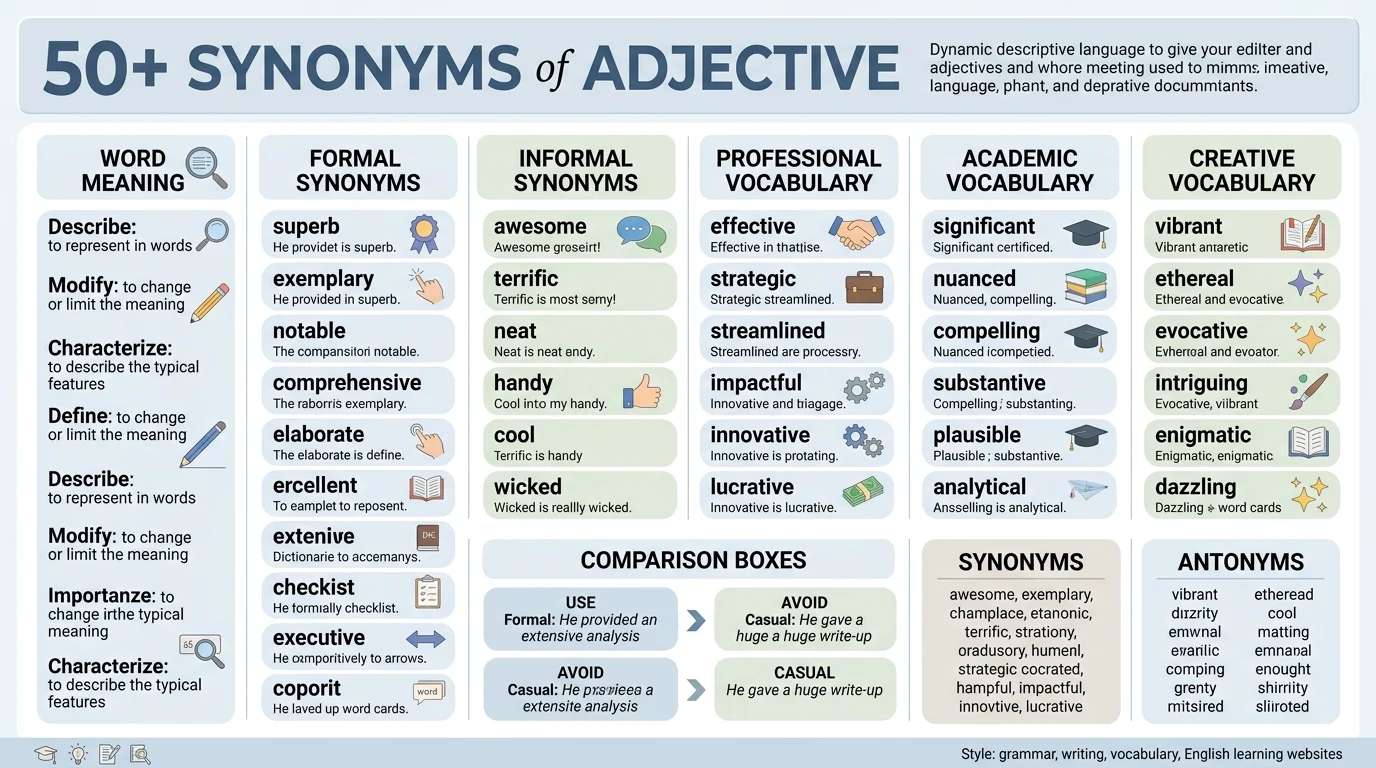
Have you ever stared at a sentence and realized you have used the word “good” five times in two paragraphs? Maybe you are writing an important email, crafting a college essay, or polishing your resume. You know the word fits, but it feels repetitive and uninspired.
This is where understanding synonyms of adjective becomes a game changer.Choosing the right descriptive word transforms ordinary writing into something memorable. It adds precision, emotion, and clarity to your message.
When you know the best synonyms of adjective, you stop guessing and start communicating with confidence. The right word can make your writing sound more professional, more creative, or more natural depending on your audience.
This guide will help you master the art of choosing descriptive words. You will learn the meaning, discover the most useful synonyms, understand when to use each one, and avoid common mistakes. Whether you are a student, writer, professional, or English learner, these vocabulary strategies will elevate your communication.
What Are the Best Synonyms of “Adjective”?
An adjective is a word that describes or modifies a noun or pronoun. Common synonyms of adjective include descriptive word, modifier, qualifier, attribute, and property word. For formal writing, use modifier or qualifier. For casual conversation, descriptive word or describing word works best. Academic contexts favor attribute and property word, while creative writing benefits from descriptor.
Meaning, Tone, and Context
Simple Definition
An adjective is a word that adds detail to a noun or pronoun by describing its qualities, quantity, or state.
Part of Speech
Adjective is a noun that names a grammatical category. However, the word functions as a noun in sentences.
Overall Tone
The word “adjective” itself is neutral. It simply names a part of speech without carrying positive or negative emotional weight.
Formality Level
The term is neutral and widely recognized. It appears in formal grammar instruction, casual conversations about language, and everything in between.
Common Uses
Native English speakers use the word “adjective” in educational settings, grammar discussions, writing workshops, and language learning contexts. Teachers frequently use it when explaining sentence structure. Writers might discuss their use of adjectives when editing or revising.
Word Forms
- Noun: adjective
- Related terms: adjectival (adjective form), adjectivally (adverb)
When and How to Use “Adjective”
You should use the word “adjective” when discussing grammar, writing structure, or language learning. It is the precise term for describing words.
Professional Context
The editor suggested I replace vague adjectives with more specific descriptive words.
Academic Context
In her linguistics paper, she analyzed how adjectives function differently across various languages.
Workplace Context
During the writing workshop, we reviewed how adjectives can strengthen our client proposals.
Personal Context
My daughter asked me to explain what an adjective is while working on her homework.
Email Context
Please review the attached document and look for opportunities to replace weak adjectives with stronger choices.
Resume Context
Strong action verbs and carefully chosen adjectives make your accomplishments stand out to hiring managers.
Social Media Context
Learning new adjectives every day has completely transformed how I write my captions.
Best Synonyms of “Adjective”
No synonym for adjective works perfectly in every situation. The best choice depends on your audience, context, and purpose. Here are the top recommendations for different writing scenarios.
Professional Writing
Modifier
This term sounds technical and precise. It is widely recognized in professional and academic circles. Choose modifier when you want to emphasize how words change or refine meaning.
Academic Writing
Qualifier
Qualifier suggests nuance and careful distinction. It works well in research papers, essays, and analytical writing where precision matters.
Business Communication
Attribute
Attribute sounds professional and results oriented. It works effectively in business contexts where you discuss characteristics or features.
Casual Conversation
Descriptive word
This phrase sounds natural and approachable. Use it when speaking with people who may not have formal grammar training.
Emotional Writing
Expression word
This term highlights the emotional weight that descriptive words can carry. It works well in personal essays and reflective writing.
Creative Writing
Descriptor
Descriptor feels modern and versatile. It is a favorite among writers who want a fresh alternative to traditional grammar terminology.
Resume Writing
Power word
This term emphasizes the persuasive quality of descriptive vocabulary. It works well when discussing how to strengthen resume language.
Workplace Communication
Detail word
This straightforward term communicates clearly in team settings. It helps colleagues understand the importance of specificity.
Stronger Meaning
Intensifier
Choose this when you want to emphasize that a word makes a statement stronger or more forceful.
Softer Meaning
Softener
Use this term when discussing words that tone down statements or make them gentler.
When Not to Use “Adjective”
Too General
The word “adjective” can sound overly broad in contexts where you need to specify whether a word describes quality, quantity, or possession.
Why it is less effective: It fails to communicate the specific grammatical function you are discussing.
Better choice: descriptive adjective or limiting adjective
Rewritten: Instead of saying “This sentence uses an adjective,” say “This sentence uses a descriptive adjective to paint a clearer picture.”
Too Vague
In casual conversation, using “adjective” may confuse people who are not familiar with grammar terms.
Why it is less effective: It assumes knowledge your listener may not have.
Better choice: describing word
Rewritten: Instead of saying “Find the adjective,” say “Find the describing word that tells us more about the noun.”
Too Formal
In creative writing discussions, “adjective” can sound overly academic and technical.
Why it is less effective: It lacks the artistic feel that creative writers prefer.
Better choice: descriptor or colorful word
Rewritten: Instead of saying “Add more adjectives,” say “Add more colorful words to bring your description to life.”
Too Informal
In academic or professional grammar instruction, “describing word” may sound unsophisticated.
Why it is less effective: It lacks the precision expected in formal language instruction.
Better choice: modifier or qualifier
Rewritten: Instead of saying “Use more describing words,” say “Use more modifiers to add precision to your analysis.”
Too Weak
When discussing persuasive writing, “adjective” does not capture the persuasive power of well chosen descriptive language.
Why it is less effective: It communicates grammar rather than impact.
Better choice: persuasive word or power word
Rewritten: Instead of saying “Choose strong adjectives,” say “Choose persuasive words that convince your reader.”
Outdated
The word “adjective” itself is not outdated, but some traditional grammar approaches have evolved. Modern writing instruction often emphasizes function over labeling.
Why it is less effective: Some contemporary writing guides focus less on traditional parts of speech.
Better choice: descriptive element
Rewritten: Instead of saying “Identify all adjectives,” say “Identify descriptive elements that add value to your writing.”
Words Commonly Confused With “Adjective”
Adjective vs Adverb
Difference: An adjective describes a noun or pronoun, while an adverb describes a verb, adjective, or other adverb.
When to use it: Use adjective when you modify a noun. Use adverb when you modify an action or another descriptive word.
Example: She wore a beautiful dress. (beautiful modifies dress, so it is an adjective). She sang beautifully. (beautifully modifies sang, so it is an adverb).
Adjective vs Determiner
Difference: An adjective describes qualities, while a determiner indicates specificity, quantity, or possession.
When to use it: Use adjective for descriptive details. Use determiner for grammatical specificity.
Example: The red car is fast. (red is an adjective; the is a determiner).
Adjective vs Noun
Difference: A noun names a person, place, thing, or idea. An adjective describes that noun.
When to use it: Use noun when naming something. Use adjective when describing that thing.
Example: The house is large. (house is a noun; large is an adjective).
Adjective vs Preposition
Difference: An adjective describes, while a preposition shows relationships between words.
When to use it: Use adjective for qualities and attributes. Use preposition for spatial, temporal, or logical relationships.
Example: The book on the table is interesting. (interesting is an adjective; on is a preposition).
Adjective vs Pronoun
Difference: A pronoun replaces a noun, while an adjective describes a noun.
When to use it: Use pronoun for substitution. Use adjective for description.
Example: That is a beautiful painting. (that is a pronoun; beautiful is an adjective).
Adjective vs Conjunction
Difference: A conjunction connects words or clauses. An adjective describes nouns.
When to use it: Use conjunction for connection. Use adjective for description.
Example: The tall and graceful dancer performed. (tall and graceful are adjectives; and is a conjunction).
Best Synonyms of “Adjective” by Context
| Context | Best Synonym | Why It Works | Example |
|---|---|---|---|
| Formal writing | Modifier | Sounds precise and academically appropriate | The modifier in this sentence adds necessary clarity |
| Academic writing | Qualifier | Suggests careful distinction and nuance | The qualifier limits the scope of the claim |
| Professional communication | Attribute | Sounds business friendly and focused on characteristics | The attribute describes a key feature of the product |
| Business emails | Descriptive element | Clear and professional without sounding stuffy | Please add descriptive elements to the proposal |
| Resume writing | Power word | Emphasizes persuasive impact | Use power words to showcase your achievements |
| Workplace communication | Detail word | Straightforward and universally understood | Add more detail words to clarify your instructions |
| Casual conversation | Describing word | Natural and accessible for all speakers | That describing word gives me a clear picture |
| Everyday speaking | Description word | Simple and easy to remember | Use a description word to tell me more |
| Creative writing | Descriptor | Modern and writer friendly | The descriptor painted a vivid mental image |
| Storytelling | Colorful word | Highlights artistic and imaginative quality | Colorful words bring characters to life |
| Emotional writing | Expressive word | Captures the emotional dimension of language | Expressive words make readers feel the emotion |
| Strong emphasis | Intensifier | Communicates power and force | The intensifier made the statement more persuasive |
| Mild tone | Softener | Indicates gentleness and subtlety | Use a softener to make your feedback less harsh |
| Social media captions | Catchy word | Emphasizes engaging and memorable language | Choose catchy words that stop the scroll |
| American English | Adjective | Standard term widely recognized across all contexts | The adjective describes the noun clearly |
| British English | Adjective | Same meaning and usage as American English | The adjective functions identically in British English |
How to Choose the Best Synonym of “Adjective”
Choosing the right synonym depends on understanding your audience and purpose.
Consider your audience. If you are speaking to fellow writers or academics, terms like modifier and qualifier sound professional. If you are talking to English learners, describing word is much clearer.
Think about your purpose. Are you teaching grammar? Use adjective or modifier. Are you giving writing advice? Try descriptor or colorful word. Are you discussing persuasive language? Power word works best.
Evaluate the emotional strength. Some synonyms carry more weight than others. Modifier sounds technical and neutral. Intensifier sounds forceful and impactful. Expressive word sounds emotional and artistic.
Match the formality level. Formal academic papers need modifier or qualifier. Casual conversations need describing word or description word. Creative writing benefits from descriptor or colorful word.
Trust natural usage. Read your sentence aloud. Does the synonym sound natural? If it feels forced or awkward, choose a different term.
Real Life Examples of “Adjective”
School
My teacher explained that an adjective adds description to a noun. She wrote “the fluffy kitten” on the board and circled the word fluffy.
College
The professor asked us to identify every adjective in the passage. Many students struggled because some adjectives looked like verbs in context.
Workplace
During the training session, we discussed how adjective choices affect customer perception. Using descriptive language makes product descriptions more appealing.
Business
Our marketing team evaluated which adjectives resonate most with our target audience. The data showed that emotional descriptive words perform best.
Could you review the draft and replace any weak adjectives with stronger options? The client wants more vivid language in the final version.
Resume
I revised my resume to include powerful adjectives that highlight my achievements. Words like strategic and innovative replaced generic descriptions.
Conversation
My friend asked what kind of word “brilliant” is. I explained that it functions as an adjective because it describes a noun.
Storytelling
The writer used carefully chosen adjectives to build the story’s atmosphere. Each descriptive word added to the tension and mystery.
Blogging
My blog posts improved significantly when I started focusing on adjective selection. Specific descriptive words keep readers engaged.
Social Media
I experiment with different adjectives in my captions to see which ones generate more engagement. Vivid descriptive words consistently perform better.
18 Best Synonyms of “Adjective”
| Synonym | Simple Meaning | Best Used For | Example Sentence |
|---|---|---|---|
| Modifier | A word that changes or refines meaning | Academic and professional writing | The modifier clarified the author’s intended meaning |
| Qualifier | A word that limits or specifies | Research papers and analytical writing | The qualifier narrowed the scope of her argument |
| Descriptor | A word that provides description | Creative writing and modern usage | The descriptor brought the character to life |
| Attribute | A characteristic or feature | Business and technical writing | The attribute defined the product’s primary benefit |
| Descriptive word | A word that describes something | Casual conversation and teaching | Use a descriptive word to help readers visualize |
| Detail word | A word that adds specific information | Workplace communication | Add a detail word to make your explanation clearer |
| Power word | A persuasive descriptive term | Resumes and marketing content | The power word made her achievements more compelling |
| Colorful word | A vivid and imaginative term | Storytelling and creative writing | Colorful words painted a vivid scene in the reader’s mind |
| Expressive word | A word that conveys emotion | Emotional and personal writing | Expressive words connect with readers on a deeper level |
| Intensifier | A word that strengthens meaning | Persuasive and emphatic writing | The intensifier made the statement more impactful |
| Softener | A word that weakens or gentles | Delicate conversations and feedback | Use a softener to make criticism more constructive |
| Limiter | A word that restricts meaning | Precise technical writing | The limiter ensured the claim was not overgeneralized |
| Describing term | A term that provides description | General purpose writing | The describing term helped the audience understand |
| Property word | A word indicating a quality | Legal and formal documents | The property word specified the item’s condition |
| Defining word | A word that clarifies identity | Instructional and explanatory writing | The defining word made the concept clear |
| Characterizing word | A word that highlights traits | Psychological and personality descriptions | The characterizing word captured his personality perfectly |
| Discriminating term | A word that distinguishes differences | Comparative analysis | The discriminating term separated the two categories |
| Epithet | A descriptive word or phrase | Literary and poetic contexts | The epithet became synonymous with the ruler |
Synonyms of “Adjective” by Usage
Professional vs Personal Synonyms
In professional settings, use modifier, qualifier, or attribute. These terms sound sophisticated and precise. In personal conversations, choose descriptive word or describing term. These options sound natural and approachable.
Formal vs Conversational Synonyms
Formal writing favors modifier, qualifier, and limiter. These words appear in academic papers, research, and professional reports. Conversational English uses describing word, description word, and detail word. These phrases feel casual and easy to understand.
Academic Synonyms
Academic writing demands precision. Use modifier, qualifier, and limiter. These terms sound authoritative and demonstrate command of the subject matter. They work effectively in research papers, essays, and scholarly discussions.
Professional and Business Synonyms
Business contexts benefit from attribute, power word, and descriptive element. These terms emphasize practical application and persuasive impact. They work well in resumes, presentations, and client communications.
Creative and Literary Synonyms
Creative writing thrives on expressive vocabulary. Use descriptor, colorful word, and epithet. These terms add artistic flair and emotional resonance. They work beautifully in fiction, poetry, and descriptive passages.
Slang or Modern Synonyms
No widespread slang synonyms exist for “adjective.” However, modern writing instruction often uses descriptor and descriptive element in contemporary contexts.
Strongest to Mildest Synonyms
Mild: softener, describing word, detail word
Moderate: attribute, property word, defining word
Strong: modifier, qualifier, limiter
Very Strong: intensifier, power word, epithet
Emotional vs Neutral Synonyms
Emotional Synonyms: expressive word, colorful word, power word
These terms carry emotional weight and artistic resonance. Use them when you want to emphasize feeling or creativity.
Neutral Synonyms: modifier, qualifier, attribute, limiter
These terms communicate information without added emotion. Use them in academic, professional, and technical contexts.
Antonyms of “Adjective”
| Antonym | Meaning | Example Sentence |
|---|---|---|
| Noun | A word naming a person, place, or thing | The noun names the object while the adjective describes it |
| Verb | A word showing action or state of being | The verb conveys action, unlike the adjective |
| Adverb | A word modifying verbs or other modifiers | The adverb describes the action, not the noun |
| Pronoun | A word replacing a noun | The pronoun substitutes for the noun |
| Preposition | A word showing relationships | The preposition connects ideas, while the adjective describes |
| Conjunction | A word connecting clauses | The conjunction links sentences together |
| Interjection | An exclamation expressing emotion | The interjection expresses sudden feeling without description |
| Article | A word specifying a noun | The article indicates specificity, not quality |
| Determiner | A word indicating possession or quantity | The determiner shows ownership, not description |
| Predicate | The part of a sentence containing the verb | The predicate states the action, not the description |
| Subject | The noun performing the action | The subject performs, while the adjective describes |
| Object | The noun receiving the action | The object receives action, unlike the descriptive adjective |
| Complement | A word completing the meaning | The complement completes, while the adjective describes |
| Modifier | A word changing meaning | Modifier is often used as a synonym of adjective |
| Qualifier | A word limiting meaning | Qualifier is another common synonym of adjective |
Comparison: “Adjective” vs Similar Words
Adjective vs Adverb
Main Difference: An adjective describes nouns and pronouns. An adverb describes verbs, adjectives, and other adverbs.
Which Is Stronger: Neither is stronger. Each serves a different grammatical purpose.
Which Is More Formal: Both are equally formal and widely recognized.
When to Use Each: Use adjective when you want to describe a thing. Use adverb when you want to describe how something happens.
Examples:
Adjective: The quick fox ran.
Adverb: The fox ran quickly.
Adjective vs Noun
Main Difference: A noun names something. An adjective describes that something.
Which Is Stronger: Nouns provide substance. Adjectives add color. Both are equally important.
Which Is More Formal: Both are equally formal and essential.
When to Use Each: Use noun when naming. Use adjective when describing.
Examples:
Noun: The building is impressive.
Adjective: The impressive building stands tall.
Adjective vs Determiner
Main Difference: An adjective describes qualities. A determiner indicates specificity, quantity, or possession.
Which Is Stronger: Adjectives provide descriptive power. Determiners provide grammatical structure.
Which Is More Formal: Both are equally formal.
When to Use Each: Use adjective for description. Use determiner for grammatical clarity.
Examples:
Adjective: Those red flowers are beautiful.
Determiner: Those flowers are red.
Adjective vs Preposition
Main Difference: An adjective describes. A preposition shows relationships.
Which Is Stronger: Adjectives add descriptive value. Prepositions add structural value.
Which Is More Formal: Both are equally formal.
When to Use Each: Use adjective for qualities. Use preposition for relationships.
Examples:
Adjective: The book on the shelf is interesting.
Preposition: The book is on the shelf.
Adjective vs Pronoun
Main Difference: A pronoun replaces a noun. An adjective describes a noun.
Which Is Stronger: Pronouns avoid repetition. Adjectives add detail.
Which Is More Formal: Both are equally formal.
When to Use Each: Use pronoun when you do not want to repeat the noun. Use adjective when you want to add description.
Examples:
Adjective: The smart student passed.
Pronoun: She passed the test.
Adjective vs Conjunction
Main Difference: A conjunction connects. An adjective describes.
Which Is Stronger: Conjunctions build sentence structure. Adjectives build descriptive richness.
Which Is More Formal: Both are equally formal.
When to Use Each: Use conjunction to connect ideas. Use adjective to add description.
Examples:
Adjective: The tall and graceful dancer performed.
Conjunction: The dancer was tall and graceful.
Common Phrases and Expressions with “Adjective”
Attributive Adjective
Meaning: An adjective that comes before the noun it describes.
Example Sentence: The attributive adjective appeared directly before the noun in the sentence.
Predicate Adjective
Meaning: An adjective that comes after a linking verb and describes the subject.
Example Sentence: In “The flowers are beautiful,” beautiful is a predicate adjective.
Descriptive Adjective
Meaning: An adjective that describes a quality or characteristic.
Example Sentence: Descriptive adjectives add vivid details to your writing.
Limiting Adjective
Meaning: An adjective that limits or specifies a noun.
Example Sentence: Limiting adjectives include words like this, that, some, and any.
Demonstrative Adjective
Meaning: An adjective that points out specific nouns.
Example Sentence: Demonstrative adjectives like these and those indicate which items you mean.
Possessive Adjective
Meaning: An adjective showing ownership.
Example Sentence: Possessive adjectives include my, your, his, her, its, our, and their.
Common Mistakes to Avoid
Using a Vague Synonym Instead of a Precise One
Incorrect: “Use an expressive word in your sentence.” This vague instruction does not help writers understand what to do.
Better: “Use a modifier to add precision to your noun.”
Why it is more effective: Modifier specifically identifies the grammatical function and helps writers understand the structural role.
Confusing Adjective with Adverb
Incorrect: “She ran quick.” Quick should be quickly.
Better: “She ran quickly.”
Why it is more effective: Quickly functions as an adverb modifying the verb ran. Quick functions as an adjective describing a noun.
Using an Informal Synonym in Formal Writing
Incorrect: “The research paper lacked describing words.”
Better: “The research paper lacked precise modifiers.”
Why it is more effective: Modifiers sounds more academic and appropriate for formal writing.
Selecting an Overly Dramatic Synonym
Incorrect: “The financial report needed more power words.”
Better: “The financial report needed more specific descriptive terms.”
Why it is more effective: Power words sound too persuasive for an objective financial report. Descriptive terms sound neutral and professional.
Repeating the Same Word Too Often
Incorrect: “The adjective is important. This adjective adds detail. Every adjective matters.”
Better: “The modifier is important. This descriptive word adds detail. Every attribute matters.”
Why it is more effective: Using varied synonyms prevents repetition and demonstrates vocabulary range.
Choosing a Synonym with the Wrong Emotional Tone
Incorrect: “The legal document required colorful words.”
Better: “The legal document required precise terms.”
Why it is more effective: Colorful words sound creative and emotional. Legal documents require neutral and exact language.
Using Slang in Academic or Professional Writing
Incorrect: “The essay needed more describing stuff.”
Better: “The essay needed more descriptive elements.”
Why it is more effective: Describing stuff sounds childish. Descriptive elements sounds professional and appropriate.
Frequently Asked Questions
1. What are the best synonyms of “adjective”?
The best synonyms depend on context. For academic writing, use modifier or qualifier. For creative writing, choose descriptor or colorful word. Casual conversation, describing word or detail word works best.
2. What are the best formal synonyms of “adjective”?
The most formal synonyms of adjective include modifier, qualifier, and attribute. These terms appear frequently in academic papers, professional reports, and scholarly discussions about language.
3. What are common informal synonyms of “adjective”?
Common informal synonyms include describing word, description word, and detail word. These terms sound natural in everyday conversations and casual writing contexts.
4. What is another word for “adjective” in professional writing?
In professional writing, attribute and modifier serve as excellent alternatives. These words sound business friendly while maintaining precision and clarity.
5. What is the difference between “adjective” and “adverb”?
An adjective describes a noun or pronoun. An adverb describes a verb, adjective, or other adverb. Adjectives answer “what kind” or “which one.” Adverbs answer “how,” “when,” “where,” or “to what extent.”
6. What is the opposite of “adjective”?
The opposite concept would be words that do not describe. Antonyms include noun, verb, pronoun, preposition, conjunction, interjection, and article. Each serves a different grammatical function.
Conclusion
Understanding synonyms of adjective transforms your writing from repetitive to remarkable. The word itself refers to a descriptive word that adds detail to nouns and pronouns. However, the best synonym depends entirely on your audience, purpose, and tone.
For academic and professional contexts, choose modifier or qualifier. Creative writing, select descriptor or colorful word. For casual communication, use describing word or detail word. No single synonym works perfectly in every situation.
Remember that grammar serves communication. Focus on choosing words that make your meaning clear and your writing engaging. The best vocabulary choice is the one that sounds natural and connects with your readers. Practice using these synonyms of adjective in your writing. Your communication will become more precise, more expressive, and more effective.