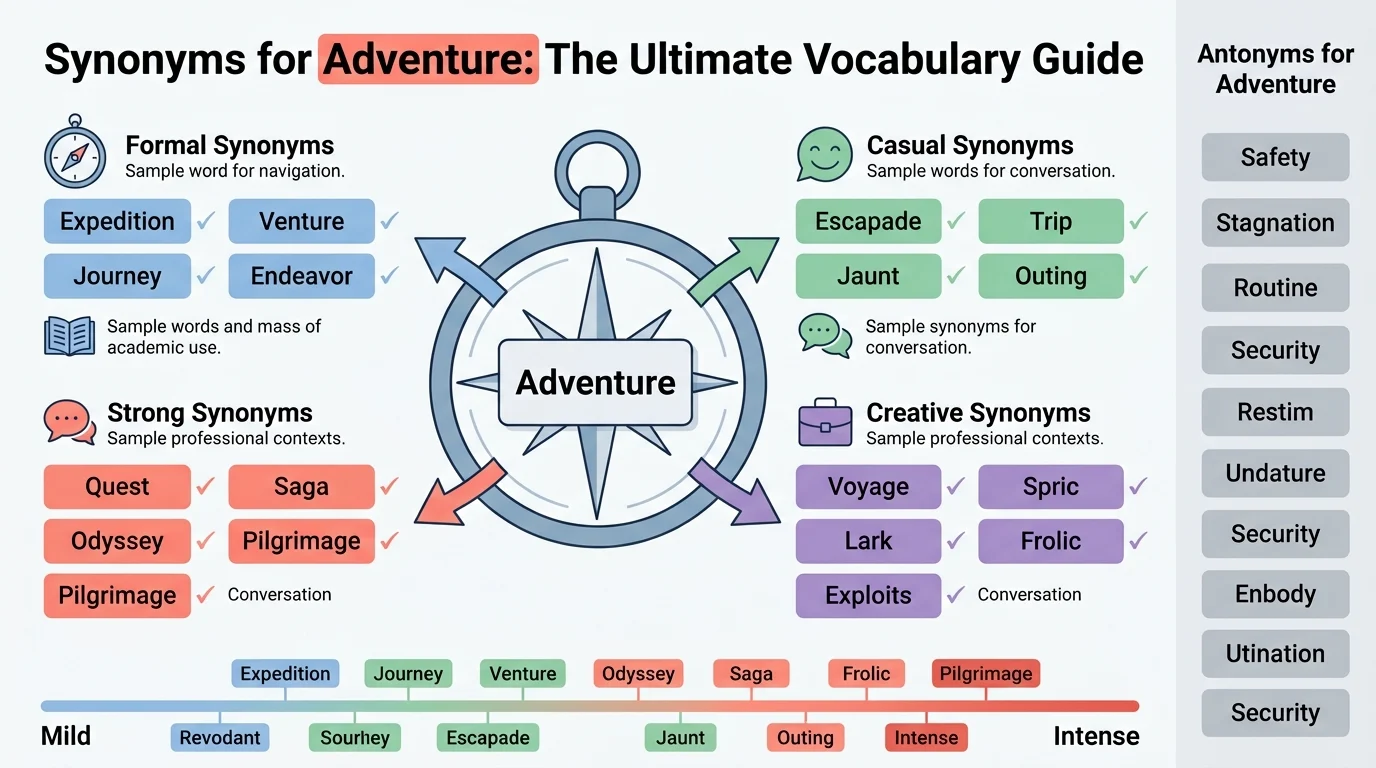
Have you ever noticed how often the word “adventure” shows up in your writing? You might use it in emails, captions, essays, or even casual conversation. The problem is that repeating the same word makes your language feel flat and unoriginal. Many people struggle to find fresh alternatives that capture the exact meaning they want to express.
This guide solves that problem. You will discover over 50 synonyms for adventure that fit different situations. Whether you need a formal word for a professional report or a creative term for storytelling, you will find the perfect replacement here. Each synonym comes with clear explanations, example sentences, and context specific advice. By the end of this guide, you will never overuse the word “adventure” again.
What Does “Adventure” Mean?
Adventure means an exciting or unusual experience that involves risk, uncertainty, or new challenges. For formal settings, use “expedition” or “endeavor.” Casual conversation, try “escapade” or “quest.” For emotional writing, choose “odyssey” or “journey.” Professional contexts, “initiative” or “undertaking” work well.
Meaning, Tone and Context
Simple definition: Adventure refers to an activity or experience that is bold, exciting, and often involves unknown outcomes. It can range from physical travel to intellectual challenges.
Part of speech: Noun. The verb form is “adventure” (to venture or risk), and the adjective form is “adventurous.”
Tone: Generally positive and exciting. The tone becomes neutral in business or academic settings.
Formality level: Moderately formal. The word works in most contexts, though some synonyms fit specific formality levels better.
Common use cases:
Travel writing and personal narratives
Professional project descriptions
Academic essays about exploration or risk
Social media captions for experiences
Resume bullet points highlighting initiative
Important word forms: The noun “adventure” connects to the adjective “adventurous,” the adverb “adventurously,” and the related noun “adventurer.”
When and How to Use “Adventure”
The word “adventure” works best when you describe experiences that feel new, exciting, or slightly risky. It suggests something beyond ordinary daily routines. You can use it for physical activities like hiking or traveling, but also for intellectual pursuits, career moves, or personal growth.
Here are realistic examples in different contexts:
Professional context:
“Taking on this new project felt like a professional adventure that pushed my skills forward.”
Personal context:
“Our weekend road trip turned into an unexpected adventure when we discovered that hidden waterfall.”
Academic context:
“The researcher described her fieldwork as an intellectual adventure into unknown cultural territories.”
Emotional context:
“Starting over in a new city felt like an emotional adventure filled with both fear and hope.”
Creative context:
“The novelist framed her protagonist’s life as a grand adventure across mythical lands.”
Social media context:
“Ready for today’s adventure in the mountains. Who else loves exploring new trails?”
Resume context:
“Led a team through a challenging product launch that became a rewarding adventure in innovation.”
Another Word for “Adventure”
The best single replacement depends on your specific context and what you want to emphasize. Each situation calls for a different nuance.
Professional writing: Use “endeavor” or “initiative.” These words sound serious and goal oriented.
Academic writing: Choose “expedition” or “pursuit.” These terms carry scholarly weight.
Casual conversation: Try “escapade” or “spree.” These feel light and playful.
Emotional writing: Select “odyssey” or “pilgrimage.” These words add depth and meaning.
Creative writing: Use “quest” or “saga.” These terms spark imagination.
Resume or workplace: Pick “undertaking” or “campaign.” These show professional ambition.
Social media captions: Go with “journey” or “exploit.” These are engaging and relatable.
Stronger meaning: Use “exploit” or “feat” for high impact.
Softer meaning: Use “experience” or “outing” for milder situations.
When Not to Use “Adventure”
The word “adventure” sounds vague and overused in many situations. You should avoid it when you need precision. Using “adventure” for every new experience dilutes its impact and makes your writing feel generic.
Consider this weak example: “My internship was an adventure.”
This sentence lacks specificity. What kind of adventure? Was it educational, challenging, or exciting? The reader gains no clear understanding.
A better version: “My internship was an intensive learning experience that challenged my assumptions.”
The improved sentence uses “learning experience” and “challenged” to paint a clearer picture. You can see how a more precise synonym improves the sentence dramatically.
Words Commonly Confused With “Adventure”
Many words relate to adventure but carry distinct meanings. Understanding these differences helps you choose the right word every time.
Adventure vs. Journey:
A journey focuses on the process of traveling from one place to another. An adventure emphasizes excitement and risk during that travel. A journey could be routine, while an adventure never is.
Adventure vs. Expedition:
An expedition implies a planned, organized mission with specific goals. An adventure can be spontaneous and unstructured. Expeditions often involve research or exploration.
Adventure vs. Quest:
A quest suggests a noble or heroic pursuit with a specific goal. Adventures can be aimless or casual. Quests typically have more dramatic stakes.
Adventure vs. Escapade:
An escapade is a playful, mischievous, or reckless adventure. It carries a lighter tone and often involves minor rule breaking. Adventures can be serious or life changing.
Adventure vs. Undertaking:
An undertaking is a serious, often difficult task or project. It emphasizes responsibility and effort. Adventure emphasizes excitement and novelty.
Adventure vs. Experience:
An experience is any event you live through. An adventure is a specific type of experience that includes excitement or risk. All adventures are experiences, but not all experiences are adventures.
Best Synonym by Context for “Adventure”
| Context | Best Synonym | Why It Works | Example |
|---|---|---|---|
| Formal writing | Endeavor | Shows serious effort and purpose | “The scientific endeavor required years of dedication.” |
| Academic writing | Pursuit | Suggests scholarly dedication to discovery | “Her pursuit of knowledge led her across three continents.” |
| Professional business | Initiative | Highlights proactive leadership | “This initiative will transform our market position.” |
| Resume | Undertaking | Demonstrates responsibility and scope | “Managed a complex undertaking that increased revenue by 40 percent.” |
| Casual conversation | Escapade | Sounds fun and slightly mischievous | “Our weekend escapade involved zip lining and midnight swimming.” |
| Creative writing | Quest | Adds mythical and heroic undertones | “The hero embarked on a quest to find the lost city.” |
| Emotional tone | Odyssey | Conveys deep personal transformation | “His journey became an odyssey of self discovery.” |
| Strong intensity | Exploit | Emphasizes daring and remarkable actions | “Her exploit in the mountains became local legend.” |
| Soft moderate tone | Outing | Keeps things simple and pleasant | “We planned a family outing to the botanical gardens.” |
| Social media captions | Journey | Relatable and widely understood | “New city, new journey. Let the exploration begin.” |
| US English preference | Journey | More commonly used in American English | “Their journey across the national parks was unforgettable.” |
| UK English preference | Expedition | More formally used in British contexts | “The expedition to the Arctic was well documented.” |
Which Synonym Should You Choose?
Choosing the right synonym for adventure depends on four key factors. First, consider your meaning. Are you describing physical travel, intellectual growth, or professional risk? Second, evaluate formality. Academic papers demand different words than text messages. Third, assess emotional intensity. Do you want to sound excited, reflective, or neutral? Fourth, think about your audience. What words will resonate with them?
Here is a practical decision guide:
If you need a professional term for a business proposal, choose “initiative” or “undertaking.”
If you write a travel blog, pick “journey,” “expedition,” or “trek.”
you describe a personal growth experience, use “odyssey” or “pilgrimage.”
If you tell a story, select “quest,” “saga,” or “exploit.”
If you speak casually with friends, say “escapade,” “spree,” or “outing.”
Iyou write an academic essay, choose “pursuit,” “investigation,” or “exploration.”
Real Life Examples of “Adventure” in Sentences
School context: “The science fair project became an educational adventure in molecular biology.”
Workplace context: “Our team embraced the software migration as a technical adventure requiring new skills.”
Writing context: “The author described her memoir writing process as an emotional adventure through memory.”
Conversation context: “We decided to turn our boring weekend into an adventure by visiting three state parks.”
Social media context: “Adventure awaits those who step outside their comfort zones.”
Resume context: “Successfully navigated the adventure of launching a new product line in a competitive market.”
Email context: “I hope this email finds you ready for our next adventure in project development.”
Storytelling context: “The old sailor told tales of his adventures on the high seas.”
25 Synonyms for “Adventure”
| Synonym | Simple Meaning | Best Used For | Example Sentence |
|---|---|---|---|
| Journey | Traveling from one place to another | Personal narratives and travel writing | “Their journey through Patagonia changed their perspective on life.” |
| Expedition | Organized trip with specific goals | Scientific or exploratory missions | “The expedition team collected valuable data on climate change.” |
| Quest | Heroic pursuit of a goal | Fantasy writing and storytelling | “The knight continued his quest to find the magical artifact.” |
| Undertaking | Serious task or project | Professional and formal contexts | “The renovation was a costly undertaking that required careful planning.” |
| Escapade | Playful or reckless adventure | Casual storytelling and anecdotes | “Their youthful escapade ended with a broken window and a good story.” |
| Pursuit | Active effort to achieve something | Academic and professional writing | “Her pursuit of excellence earned her international recognition.” |
| Exploit | Bold or daring act | Emphasizing courage and achievement | “His exploit in the rescue mission earned him a medal.” |
| Odyssey | Long journey with significant change | Emotional and literary contexts | “Her odyssey through grief finally led to healing.” |
| Enterprise | Bold or complex project | Business and entrepreneurial contexts | “Starting the company was his greatest enterprise.” |
| Venture | Risky business or activity | Professional and financial contexts | “They launched a joint venture into renewable energy.” |
| Pilgrimage | Sacred or meaningful journey | Spiritual or personal growth writing | “His pilgrimage to the ancient temple brought him peace.” |
| Trek | Long difficult journey on foot | Outdoor and adventure writing | “The trek through the Himalayas tested every muscle.” |
| Saga | Long story of heroic events | Literary and narrative contexts | “The family saga covered three generations of adventures.” |
| Foray | Brief entry into a new activity | Describing new experiences | “Her foray into painting became a lifelong passion.” |
| Campaign | Organized series of activities | Professional and political contexts | “The marketing campaign was an exciting adventure in branding.” |
| Initiative | First step toward a goal | Business and leadership contexts | “The initiative to go global changed our company culture.” |
| Exploration | Discovering new places or ideas | Academic and scientific writing | “The exploration of deep sea life revealed new species.” |
| Crusade | Determined effort for a cause | Passionate or ideological contexts | “His crusade for clean energy inspired thousands.” |
| Mission | Important task with purpose | Professional and military contexts | “The mission to Mars captured worldwide attention.” |
| Feat | Impressive achievement | Highlighting remarkable success | “Climbing that mountain was an incredible feat.” |
| Outing | Short pleasant trip | Casual and social contexts | “Our afternoon outing to the lake was refreshing.” |
| Spree | Unrestrained activity | Fun and energetic contexts | “We went on a shopping spree after our adventure in the city.” |
| Stunt | Daring or unusual act | Entertainment and flashy contexts | “The movie star performed his own stunts for the adventure film.” |
| Passage | Journey across or through | Literary and formal contexts | “His passage through the desert lasted three weeks.” |
| Peril | Exposure to risk or danger | Dramatic and intense contexts | “Their peril in the storm became a survival adventure.” |
Synonym Groups and Usage Differences
Professional vs. Personal Synonyms
Professional synonyms emphasize purpose, planning, and results. Words like “undertaking,” “initiative,” and “enterprise” show responsibility and strategic thinking. These terms belong in business reports, project proposals, and performance reviews.
Personal synonyms highlight emotion, growth, and experience. Words like “journey,” “odyssey,” and “pilgrimage” connect to individual transformation. These terms work best in memoirs, personal essays, and heartfelt conversations.
Formal vs. Conversational Synonyms
Formal synonyms suit academic papers, official reports, and professional speeches. “Expedition,” “pursuit,” and “endeavor” maintain a serious, scholarly tone. These words demonstrate vocabulary sophistication.
Conversational synonyms fit everyday speech, social media, and friendly writing. “Escapade,” “outing,” and “spree” feel natural and approachable. These terms help you connect with readers without sounding stiff.
Academic Synonyms
Academic writing requires precision and authority. Use “investigation,” “exploration,” or “pursuit” when describing research. “Expedition” works for field studies. “Inquiry” suits philosophical or theoretical work. These words demonstrate scholarly rigor.
Professional and Business Synonyms
Business contexts demand words that show competence and strategic value. “Initiative” highlights proactive leadership. “Undertaking” shows responsibility for complex projects. “Enterprise” suggests bold entrepreneurial spirit. “Venture” communicates calculated risk taking.
Creative or Literary Synonyms
Creative writing thrives on vivid imagery and emotional resonance. “Quest” adds heroic undertones. “Odyssey” suggests epic transformation. “Saga” implies generational storytelling. “Pilgrimage” carries spiritual weight. These words paint rich pictures for readers.
Slang or Modern Synonyms
Modern usage includes casual terms that work in specific contexts. “Jam” works for fun experiences. “Hustle” fits urban or entrepreneurial settings. “Ride” describes any exciting experience. Use these sparingly in professional writing. They work best in social media, casual blogs, or dialogue.
Strongest vs. Weaker Synonyms
Intensity scale from mild to strongest:
Mild: Outing, experience, passage
Moderate: Journey, trek, expedition
Strong: Quest, mission, undertaking
Intense: Exploit, peril, crusade
Extreme: Odyssey, saga, feat
Emotional vs. Neutral Synonyms
Emotional synonyms carry deeper meaning and personal connection. “Odyssey” implies transformation and growth. “Pilgrimage” suggests spiritual purpose. “Crusade” shows passionate commitment. These words add feeling to your writing.
Neutral synonyms stay factual and objective. “Expedition” describes organized travel. “Undertaking” defines a task. “Exploration” focuses on discovery. These words work well in academic and professional writing where emotion is inappropriate.
Antonyms of “Adventure”
| Antonym | Meaning | Example Sentence |
|---|---|---|
| Routine | Regular predictable activities | “Her daily routine involved the same commute and tasks.” |
| Stagnation | No change or growth | “The company suffered from stagnation after years of success.” |
| Boredom | Lack of interest or excitement | “The lecture caused boredom among the students.” |
| Monotony | Unchanging repetition | “He grew tired of the monotony of office work.” |
| Inactivity | No movement or action | “The team fell into inactivity after the project ended.” |
| Safety | Freedom from risk | “She preferred safety over the uncertainty of adventure.” |
| Security | Protection from danger | “His job offered security but little excitement.” |
| Comfort | Physical ease and relaxation | “They chose comfort over the challenge of travel.” |
| Predictability | Known outcomes | “The predictability of small town life bored him.” |
| Conformity | Following established rules | “The school demanded conformity from all students.” |
| Mediocrity | Ordinary and unremarkable | “He accepted mediocrity instead of pursuing greatness.” |
| Idleness | Doing nothing productive | “Weekends became periods of idleness.” |
| Quiet | Absence of activity | “The quiet village offered no adventures.” |
| Stability | Unchanging condition | “She craved stability after years of traveling.” |
| Habit | Regular repeated behavior | “His habits prevented him from trying new things.” |
Comparison: Adventure vs. Similar Words
Adventure vs. Journey
The main difference lies in purpose. A journey focuses on movement and transition. An adventure emphasizes excitement and risk during that movement. Journey is generally neutral in tone. Adventure carries positive excitement. Journey is more formal in many contexts. Adventure fits both formal and casual use.
Example for adventure: “Their adventure through the rainforest involved close encounters with wildlife.”
Example for journey: “The journey across the country took three days by train.”
Adventure vs. Expedition
Expedition implies careful planning and specific objectives. Adventure can be spontaneous and unstructured. Expedition sounds more formal and scientific. Adventure feels personal and experiential. Expedition works best in academic or professional writing. Adventure suits broader contexts.
Example for adventure: “Buying a one way ticket to Bangkok was a spontaneous adventure.”
Example for expedition: “The research expedition collected soil samples from the volcano.”
Adventure vs. Quest
Quest suggests a noble, heroic, or legendary pursuit. Adventure can be ordinary or mundane. Quest carries grander emotional stakes. Adventure feels more grounded. Quest suits fantasy, mythology, or high drama. Adventure works in everyday contexts.
Example for adventure: “Learning to cook became a delicious adventure.”
Example for quest: “His quest for the golden fleece took him across dangerous seas.”
Adventure vs. Undertaking
Undertaking emphasizes difficulty and serious effort. Adventure emphasizes excitement and novelty. Undertaking sounds professional and responsible. Adventure sounds fun and thrilling. Undertaking works in business and formal contexts. Adventure fits personal and creative contexts.
Example for adventure: “The weekend hiking trip turned into a muddy adventure.”
Example for undertaking: “The bridge construction was a massive undertaking requiring thousands of workers.”
Adventure vs. Exploit
Exploit highlights a specific daring act with successful results. Adventure describes a broader experience. Exploit sounds more impressive and specific. Adventure feels more general. Exploit often implies bravery or skill. Adventure implies enjoyment and discovery.
Example for adventure: “Summer camp was an adventure filled with new friends and activities.”
Example for exploit: “His exploit of climbing the unclimbed peak made headlines.”
Adventure vs. Escapade
Escapade carries a playful, mischievous, or slightly reckless tone. Adventure can be serious or playful. Escapade is nearly always lighthearted. Adventure varies in emotional weight. Escapade works best for casual stories. Adventure fits all contexts.
Example for adventure: “The white water rafting trip was a thrilling adventure.”
Example for escapade: “The children’s escapade involved sneaking cookies after midnight.”
Common Phrases and Expressions with “Adventure”
1. Adventure of a lifetime
Meaning: An extraordinary, once in a lifetime experience.
Example sentence: “Traveling to Antarctica was the adventure of a lifetime.”
2. Adventure is out there
Meaning: A famous phrase encouraging exploration and taking risks.
Example sentence: “My mother always told me adventure is out there if you look for it.”
3. Taste of adventure
Meaning: A small experience of exciting or risky activities.
Example sentence: “The weekend camping trip gave her a taste of adventure.”
4. Adventure travel
Meaning: Tourism focused on physically challenging or destinations.
Example sentence: “Adventure travel has become increasingly popular among millennials.”
5. Call to adventure
Meaning: A signal or invitation to begin an exciting experience.
Example sentence: “The job offer in Tokyo felt like a call to adventure.”
6. Adventure awaits
Meaning: An encouraging phrase suggesting future excitement.
Example sentence: “Pack your bags because adventure awaits in every new city.”
7. Spirit of adventure
Meaning: A personality trait of seeking excitement and new experiences.
Example sentence: “Her spirit of adventure led her to explore every continent.”
8. Adventure playground
Meaning: A play area designed for children to explore and take risks.
Example sentence: “The adventure playground featured climbing walls and rope bridges.”
Common Mistakes to Avoid
Mistake 1: Using “adventure” when a more precise synonym is better
Many people use “adventure” for any new experience. This weakens their writing. Instead, choose “expedition” for organized travel, “quest” for heroic pursuits, or “undertaking” for professional projects.
Mistake 2: Confusing “adventure” with “journey”
While related, these words are not interchangeable. A journey is about travel. An adventure is about excitement and risk. Use “journey” for physical movement and “adventure” for thrilling experiences.
Mistake 3: Using a casual synonym in formal writing
Saying “escapade” in a business report sounds unprofessional. Use “initiative” or “endeavor” instead. Match your synonym to the formality of your context.
Mistake 4: Using an overly dramatic synonym for a simple situation
Describing a walk to the store as an “odyssey” or “exploit” sounds exaggerated. Save dramatic words for truly significant experiences.
Mistake 5: Repeating the same synonym too often
Even the best synonym becomes boring with overuse. Vary your word choices. Use “expedition,” then “trek,” then “journey” to keep writing fresh.
Mistake 6: Choosing a synonym with the wrong emotional tone
“Pilgrimage” sounds spiritual. “Escapade” sounds playful. “Crusade” sounds passionate. Match the emotional weight of your synonym to the situation.
Mistake 7: Using slang in academic or professional writing
Words like “jam” or “ride” have no place in formal contexts. Stick to professional synonyms like “endeavor” or “pursuit” in serious writing.
FAQs
1. What is the best synonym for adventure?
The best synonym depends on context. Use “journey” for travel, “quest” for heroic pursuits, “undertaking” for professional projects, and “escapade” for casual fun.
2. What is a formal synonym for adventure?
“Endeavor” and “undertaking” are excellent formal synonyms. These words show seriousness and purpose in professional and academic writing.
3. What is an informal synonym for adventure?
“Escapade” and “spree” work well for casual conversation. These terms sound playful and relaxed in social contexts.
4. What is another word for adventure in professional writing?
“Initiative,” “enterprise,” and “venture” are strong professional synonyms. These words demonstrate leadership and strategic thinking.
5. What is the difference between adventure and journey?
Adventure emphasizes excitement and risk. Journey focuses on the act of traveling. A journey can be routine, but an adventure never is.
6. What is the opposite of adventure?
The opposite includes “routine,” “boredom,” “stagnation,” and “monotony.” These words describe predictable, unchanging experiences without excitement.
Conclusion
Adventure describes exciting, risky, or unusual experiences that break from ordinary routines. The best synonyms for adventure depend entirely on your context, audience, and desired tone. “Journey” works for travel narratives. “Quest” adds heroic drama. “Undertaking” suits professional settings. “Escapade” fits casual conversation.
Pay attention to formality, emotional intensity, and precision in your word choices. Avoid overusing any single synonym. Vary your vocabulary to keep writing fresh and engaging. Match your words to your specific situation for maximum impact.
Remember this practical tip: always consider your reader. What word will they understand and appreciate? Choose a synonym that fits your audience, context, and purpose. Your vocabulary will become richer, your writing more compelling, and your communication more effective.